
Periodic Properties and variations of Properties : Physical and Chemical | ICSE Class 10 Chemistry Notes
On this page
This note covers the modern periodic table, atomic number and electronic arrangement, nuclear charge and electron shells, atomic size, metallic and non-metallic character, ionisation potential, electron affinity, electronegativity, and variations in the alkali metal and halogen groups.
What makes the modern periodic table periodic?
Definition: The Modern Periodic Law states that the physical and chemical properties of elements are periodic functions of their atomic numbers.
An element is a substance consisting of atoms with the same number of protons. A proton is a positively charged particle in the nucleus, the central part of an atom. The atomic number, represented by the symbol Z, is the number of protons in an atom's nucleus.
An electron is a negatively charged particle outside the nucleus. A neutral atom has equal numbers of protons and electrons, so its total charge is zero. Its atomic number therefore also tells us its number of electrons.
What does periodicity mean?
Periodicity means the recurrence of similar properties when elements are arranged in increasing atomic number. It arises because similar arrangements of outer electrons recur. The elements do not repeat, but patterns in their properties do.
A period is a horizontal row of the periodic table. A group is a vertical column. The modern table has seven periods and eighteen groups, numbered 1 to 18. Members of a group have similar outer electronic arrangements and therefore similar chemical properties.
Atomic number, rather than atomic mass, determines an element's position in the modern table. Increasing atomic number gives a systematic sequence in which changes in electronic arrangement explain both similarities within groups and differences across periods.
What the figure shows
The long form of the periodic table
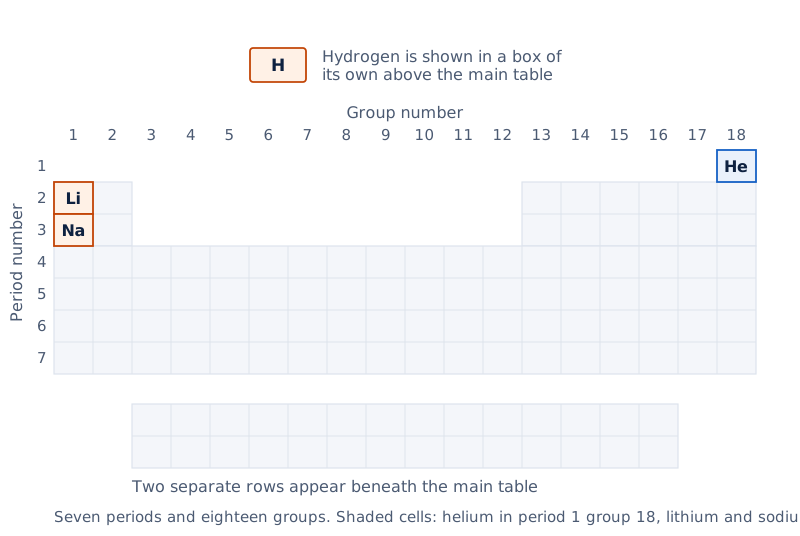
The table has numbered horizontal periods and vertical groups. Two separate rows appear beneath the main table. Hydrogen is shown in a separate box above the main table. Helium occupies period 1 in group 18, while lithium and sodium occupy group 1 in periods 2 and 3 respectively.
Drawn by One Young India.
The complete table provides the overall arrangement. For comparisons among the first twenty elements, focus on the first three periods and the beginning of the fourth. Potassium and calcium begin the fourth period; calcium does not end that period.
How do electron shells explain the positions of the first twenty elements?
An electron shell is a main energy level occupied by electrons around the nucleus. An atom's electronic configuration describes its electron arrangement. Here, configurations give the numbers of electrons in successive shells, starting with the shell nearest the nucleus.
The valence shell is the outermost occupied shell, and its electrons are valence electrons. Thus, 2,8,1 means two electrons in the first shell, eight in the second and one in the third. The commas separate shells, not different atoms.
Which positions follow from these configurations?
For the first twenty elements, the number of occupied shells gives the period. Elements in groups 1 and 2 have one and two valence electrons respectively. For groups 13 to 18, the corresponding numbers are three to eight, with helium as the exception.
Helium has two electrons in its first shell and belongs to group 18. The other group 18 elements listed below have eight electrons in their outermost shell. These are the noble gases, a family with very low chemical reactivity.
| Element and symbol | Atomic number | Electrons by shell | Period | Group |
|---|---|---|---|---|
| Hydrogen, H | 1 | 1 | 1 | 1 |
| Helium, He | 2 | 2 | 1 | 18 |
| Lithium, Li | 3 | 2,1 | 2 | 1 |
| Beryllium, Be | 4 | 2,2 | 2 | 2 |
| Boron, B | 5 | 2,3 | 2 | 13 |
| Carbon, C | 6 | 2,4 | 2 | 14 |
| Nitrogen, N | 7 | 2,5 | 2 | 15 |
| Oxygen, O | 8 | 2,6 | 2 | 16 |
| Fluorine, F | 9 | 2,7 | 2 | 17 |
| Neon, Ne | 10 | 2,8 | 2 | 18 |
| Sodium, Na | 11 | 2,8,1 | 3 | 1 |
| Magnesium, Mg | 12 | 2,8,2 | 3 | 2 |
| Aluminium, Al | 13 | 2,8,3 | 3 | 13 |
| Silicon, Si | 14 | 2,8,4 | 3 | 14 |
| Phosphorus, P | 15 | 2,8,5 | 3 | 15 |
| Sulphur, S | 16 | 2,8,6 | 3 | 16 |
| Chlorine, Cl | 17 | 2,8,7 | 3 | 17 |
| Argon, Ar | 18 | 2,8,8 | 3 | 18 |
| Potassium, K | 19 | 2,8,8,1 | 4 | 1 |
| Calcium, Ca | 20 | 2,8,8,2 | 4 | 2 |
The table separates two useful comparisons. Sodium and magnesium have the same number of occupied shells but different numbers of valence electrons. Lithium, sodium and potassium have different numbers of occupied shells but the same number of valence electrons.
Similarly, fluorine and chlorine have seven valence electrons, although chlorine has an additional shell. Similar outer arrangements account for family resemblance; differences in the number of shells help explain variations within the family.
How do nuclear charge and shielding control periodic trends?
Nuclear charge is the positive charge of the nucleus due to its protons. More protons mean a greater nuclear charge. However, the attraction experienced by an outer electron also depends on its distance from the nucleus and the intervening electrons.
Shielding, also called screening, is the reduction of the nuclear attraction experienced by an outer electron because of inner electrons. The net attraction after this shielding is described using effective nuclear charge, the nuclear charge effectively experienced by the electron.
What changes across a period?
- Atomic number increases from one element to the next, so the number of protons and the nuclear charge increase.
- For the second and third periods, successive outer electrons enter the same main shell.
- Shielding by the inner electrons does not increase very much to compensate for the increasing nuclear attraction.
- The outer electrons are therefore held more tightly, explaining the general decrease in atomic size and increase in the energy needed to remove an electron.
What changes down a group?
Moving down a group adds an occupied shell. The valence electrons are farther from the nucleus, and additional inner electrons increase shielding. Nuclear charge also increases, but distance and shielding outweigh its effect on the removal of an outer electron.
This explains why a larger atomic number does not automatically mean a smaller atom. Across a period, increasing nuclear attraction acts within the same valence shell. Down a group, the added shell changes the balance and atomic size increases.
Use both parts of the explanation: identify what happens to nuclear charge, then state whether the outer electrons occupy the same shell or a more distant shell. A trend without its structural reason is less useful than a connected explanation.
What is atomic size, and how does it vary?
Atomic size describes the extent of an atom and is commonly expressed through its atomic radius. The electron cloud, meaning the region occupied by the electrons around the nucleus, has no sharp boundary. Atomic radius is therefore an estimate, not the radius of a hard sphere.
A covalent bond involves atoms sharing electrons. For two identical atoms joined by a single covalent bond, half the distance between their nuclei gives the covalent radius. For a metal, the metallic radius is half the distance between adjacent atomic nuclei in its crystal, a solid with a regular arrangement of particles.
Atomic radii are often expressed in picometres, abbreviated pm. One picometre is 10⁻¹² metre, meaning one trillionth of a metre. The radius values below use this unit consistently.
What do the period 3 values show?
| Element | Atomic radius in pm |
|---|---|
| Sodium | 186 |
| Magnesium | 160 |
| Aluminium | 143 |
| Silicon | 117 |
| Phosphorus | 110 |
| Sulphur | 104 |
| Chlorine | 99 |
Atomic size generally decreases across a period. In period 3, the outer electrons remain in the third shell while nuclear charge increases. The greater effective attraction draws the electrons closer to the nucleus.
What the figure shows
Atomic radius across period 2
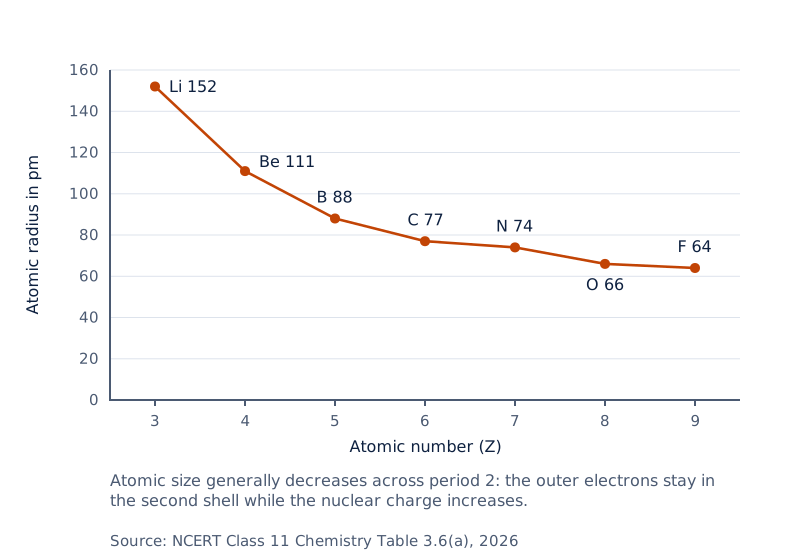
The horizontal axis shows atomic number and the vertical axis shows atomic radius in pm. Labelled points for lithium, beryllium, boron, carbon, nitrogen, oxygen and fluorine form a descending curve.
Drawn by One Young India.
Down a group, atomic radius increases. Lithium, sodium and potassium have radii of 152 pm, 186 pm and 231 pm respectively. Additional shells place the outer electrons farther from the nucleus, while inner electrons shield them from its attraction.
How can a radius be calculated from a bond distance?
Worked example 1. A chlorine molecule contains two identical chlorine atoms joined by a single covalent bond. Their nuclei are 198 pm apart. Calculate the covalent radius, expressing the distance and radius in metres as well as picometres.
Formula: If is the numerical internuclear distance in picometres, . The covalent radius is , because the distance spans two equal radii.
Substitute: . Then .
Answer: The covalent radius is 99 pm, or 0.000000000099 m. Dividing the distance by two is appropriate because the two bonded atoms are identical.
Note: Noble-gas radii are measured as non-bonded radii, using separations between atoms that are not chemically bonded. Do not append them directly to a sequence of covalent radii and treat the resulting comparison as a uniform measure of atomic size.
How do metallic and non-metallic character differ?
Metallic character is the tendency of an atom to lose electrons and form a positive ion. An ion is a charged atom or group of atoms. A positive ion is a cation; a negative ion is an anion.
Non-metallic character is associated with the tendency to gain electrons. The two characters connect chemical behaviour with electron arrangement. Metals lose outer electrons relatively readily, while non-metals have a strong tendency to gain electrons.
How does atomic structure explain the trends?
Across a period, metallic character decreases and non-metallic character increases. Increasing effective nuclear attraction holds the outer electrons more tightly. Losing an electron becomes less favourable, while the tendency to attract electrons increases.
Down a group, metallic character increases and non-metallic character decreases. Additional shells increase atomic size and shielding. The outer electrons are held less tightly, so electron loss becomes easier. This relationship is especially clear in the alkali metals.
| Feature | Metals | Non-metals |
|---|---|---|
| Electron tendency | Lose electrons to form cations | Have a strong tendency to gain electrons |
| Broad position | Left side of the table | Upper right part of the table |
| Across a period | Metallic character decreases | Non-metallic character increases |
| Down a group | Metallic character increases | Non-metallic character decreases |
The change between these characters is not abrupt. Metalloids are elements with properties characteristic of both metals and non-metals. Silicon is an example. A borderline position should not be mistaken for a sudden, complete change in every physical property.
Physical properties also help describe the distinction. Metals are malleable, meaning they can be hammered into sheets, and ductile, meaning they can be drawn into wires. Most non-metallic solids are brittle, meaning they break rather than deform in these ways.
Do not equate non-metallic character with universal high reactivity. Noble gases have very low chemical reactivity because their stable outer electron arrangements are difficult to alter by adding or removing electrons.
What is ionisation potential, and why does it change?
Definition: First ionisation potential, commonly discussed as first ionisation energy, is the minimum energy required to remove the most loosely held electron from an isolated gaseous atom in its ground state.
Isolated means the atom is considered separately from other atoms. Gaseous specifies that it is in the gas state. The ground state is its lowest-energy state. These conditions make comparisons between elements meaningful.
Let X represent an atom of any element. In the equation below, (g) means gaseous state, e⁻ means an electron, X⁺ means the cation with one positive charge, and → means that the process produces the species on the right.
X(g) → X⁺(g) + e⁻
Energy must be supplied to remove the electron. When expressed per mole of atoms as ionisation enthalpy, the unit is kJ mol⁻¹, meaning kilojoules per mole. A kilojoule is a thousand joules, and a mole is the standard unit of amount of substance.
Why does it generally increase across a period?
The outer electrons remain in the same main shell while nuclear charge increases. The stronger effective attraction makes electron removal more difficult. First ionisation energy therefore generally increases across a period; this is not an exception-free rule.
Down a group, the outermost electron is farther from the nucleus and more strongly shielded by inner electrons. Less energy is needed to remove it, so first ionisation energy generally decreases. The increased nuclear charge alone does not determine this trend.
What the figure shows
First ionisation enthalpy across period 2
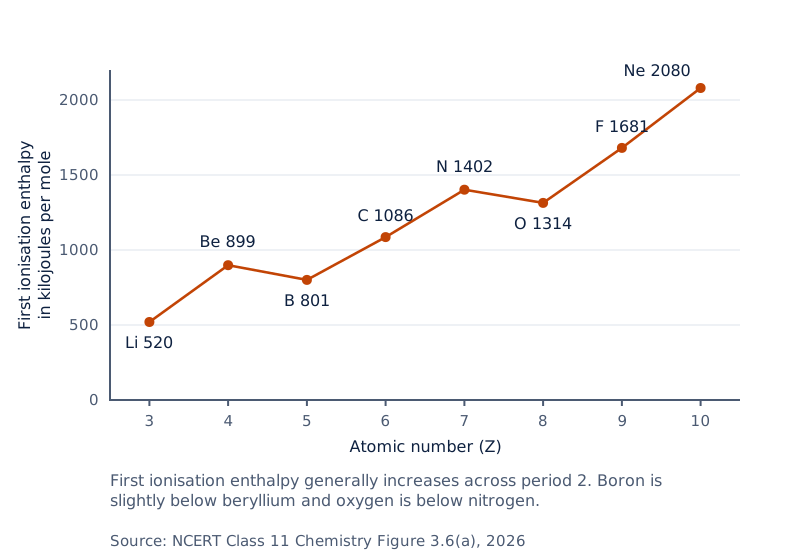
The graph plots atomic number horizontally and first ionisation enthalpy vertically. The labelled points rise overall from lithium to neon, with downward steps from beryllium to boron and from nitrogen to oxygen.
Drawn by One Young India.
Boron's first ionisation enthalpy is slightly less than beryllium's. Oxygen's is smaller than nitrogen's. These comparisons show why the word “generally” belongs in the trend. A simple statement that every successive element needs more energy would be incorrect.
Noble gases have high first ionisation enthalpies because their electron arrangements are very stable. Alkali metals, the group 1 metals such as lithium, sodium and potassium, have low first ionisation enthalpies and readily lose their single valence electron.
How is the energy for one atom converted to a molar value?
Worked example 2. An electron in the ground state of hydrogen has energy . Calculate the ionisation enthalpy in joules per mole. Take the separated electron's energy as zero and use , the number of atoms per mole.
Formula: First find the energy needed for one atom, . Then multiply by the number of atoms per mole: .
Substitute: . Hence .
Answer: The ionisation enthalpy is approximately 1310000 J mol⁻¹, or 1310 kJ mol⁻¹, to three significant figures. The positive sign means energy must be supplied to remove the electron.
What is electron affinity, and which exceptions matter?
Definition: Electron affinity describes the energy released when an isolated neutral gaseous atom accepts an electron to form a singly charged negative ion. In the energy-release convention, a greater positive affinity means more energy is released.
Using the symbols already defined, X⁻ represents the anion with one negative charge. The electron-gain process is:
X(g) + e⁻ → X⁻(g)
Electron addition does not release energy for every element. Exothermic means energy is released, while endothermic means energy is absorbed. If energy must be supplied, electron affinity has a negative sign in the energy-release convention.
How does electron gain enthalpy describe the same kind of process?
Electron gain enthalpy is the enthalpy change accompanying electron addition to a neutral gaseous atom. Here, enthalpy change describes the energy change of the process. Energy release gives a negative electron gain enthalpy, whereas energy absorption gives a positive value.
Keep the sign conventions distinct. A more negative electron gain enthalpy indicates greater energy release. When discussing electron affinity as energy released, greater release is described as higher affinity. Do not copy a negative enthalpy value and silently relabel it positive electron affinity.
What are the general trends?
Electron affinity generally increases across a period as effective nuclear attraction increases and atomic size decreases. Electron gain enthalpy correspondingly tends to become more negative. The added electron is, on average, closer to the positively charged nucleus.
Down a group, electron affinity generally decreases as atomic size increases. The added electron is farther from the nucleus. Electron gain enthalpy generally becomes less negative, but its variation is less systematic than the variation in ionisation enthalpy.
| Element | Electron gain enthalpy in kJ mol⁻¹ | Interpretation |
|---|---|---|
| Oxygen | −141 | Energy released on electron addition |
| Sulphur | −200 | More energy released than for oxygen |
| Fluorine | −328 | Energy released on electron addition |
| Chlorine | −349 | More energy released than for fluorine |
| Neon | +116 | Energy supplied for electron addition |
Chlorine has a higher electron affinity than fluorine. Fluorine's small second shell has significant repulsion between the entering electron and electrons already present. Chlorine's larger third shell provides more space, so this repulsion is smaller and electron addition releases more energy.
The oxygen-sulphur pair shows a similar exception. Sulphur's electron gain enthalpy is more negative than oxygen's. For noble gases, electron addition requires entry into a new, higher shell; their electron gain enthalpies are positive.
How can electron gain enthalpies be compared?
Worked example 3. Which has the more negative electron gain enthalpy, oxygen or fluorine? Use the values −141 kJ mol⁻¹ for oxygen and −328 kJ mol⁻¹ for fluorine.
Answer: Fluorine has the more negative value, −328000 J mol⁻¹, compared with −141000 J mol⁻¹ for oxygen. Both are in period 2. Increasing effective nuclear attraction across the period favours electron addition, so fluorine releases more energy.
Worked example 4. Which has the more negative electron gain enthalpy, fluorine or chlorine? Their values are −328 kJ mol⁻¹ and −349 kJ mol⁻¹ respectively.
Answer: Chlorine has the more negative value, −349000 J mol⁻¹, compared with −328000 J mol⁻¹ for fluorine. The entering electron encounters less repulsion in chlorine's larger third shell than in fluorine's compact second shell. This is an exception to the general down-group trend.
Worked example 5. Among phosphorus, sulphur, chlorine and fluorine, identify the elements with the most negative and least negative electron gain enthalpies. Explain the comparison.
Answer: Chlorine has the most negative electron gain enthalpy, −349000 J mol⁻¹. Phosphorus has the least negative value. Across period 3, electron gain enthalpy generally becomes more negative from phosphorus through sulphur to chlorine.
Fluorine does not replace chlorine as the most negative member of this set: electron addition to its small second shell causes greater electron repulsion than addition to chlorine's larger third shell.
Note: A smaller atom does not necessarily have a higher electron affinity than every larger atom. Nuclear attraction and repulsion between electrons both matter, especially when comparing fluorine with chlorine.
What is electronegativity, and how is it different from electron affinity?
Definition: Electronegativity is the ability of an atom in a chemical compound to attract shared electrons towards itself.
A chemical compound contains two or more elements chemically combined in a fixed proportion. The essential phrase in electronegativity is shared electrons. Electronegativity describes attraction within a chemical bond. Electron affinity concerns the energy associated with adding an electron to a separate gaseous atom. The two properties are related to attraction for electrons but describe different situations.
Electronegativity is a qualitative measure expressed through numerical scales. A widely used one is the Pauling scale, a scale comparing atoms' attraction for shared electrons. Its values have no physical unit. Fluorine is assigned 4.0 and is the most electronegative element.
How do the values vary?
Electronegativity generally increases across a period and decreases down a group. Across a period, decreasing atomic radius and increasing effective nuclear attraction strengthen the pull on shared electrons. Down a group, increasing radius weakens that attraction.
The following are approximate Pauling-scale values. They show the rise across the third period without implying that the electronegativity of an element is identical in every compound.
| Element | Approximate electronegativity |
|---|---|
| Sodium | 0.9 |
| Magnesium | 1.2 |
| Aluminium | 1.5 |
| Silicon | 1.8 |
| Phosphorus | 2.1 |
| Sulphur | 2.5 |
| Chlorine | 3.0 |
High electronegativity is associated with non-metallic character. Low electronegativity is associated with metallic character. The rise in electronegativity across a period accompanies increasing non-metallic character; its fall down a group accompanies increasing metallic character.
| Property | Situation being described | How it is expressed |
|---|---|---|
| Ionisation energy | Removing an electron from an isolated gaseous atom | Energy required |
| Electron affinity | Adding an electron to an isolated gaseous atom | Energy released in the stated convention |
| Electronegativity | Attracting shared electrons in a compound | A relative value on a numerical scale |
Fluorine and chlorine must be distinguished carefully. Fluorine has the higher electronegativity, but chlorine releases more energy on electron addition. “Attracts shared electrons most strongly” and “releases most energy on gaining an electron” are different claims.
Electronegativity is not directly measurable in the same way as an energy change. Its value also varies with the atom to which the element is bonded, so the tabulated values should be treated as approximate comparisons.
Why do alkali metals and halogens show different reactivity trends?
Reactivity describes how readily a substance undergoes chemical change. To understand its periodic variation, identify whether the characteristic process involves losing or gaining an electron. There is no single direction of increasing reactivity that applies to every group.
What happens in the alkali metals?
Lithium, sodium and potassium each have one valence electron. They readily lose this electron and form cations with one positive charge. Down this sequence, the number of occupied shells and atomic size increase, while first ionisation energy decreases.
The increasing ease of electron loss explains the increasing reactivity: lithium is less reactive than sodium, which is less reactive than potassium. The family has similar outer arrangements, but its members do not have identical reactivity.
Worked example 6. Lithium, sodium and potassium have configurations 2,1; 2,8,1; and 2,8,8,1 respectively. Explain why potassium loses its outer electron more readily than lithium.
Answer: Potassium's valence electron occupies a more distant shell and experiences greater shielding by inner electrons. Despite potassium's greater nuclear charge, its first ionisation energy is lower, so removing the outer electron requires less energy.
What happens in the halogens?
The halogens are group 17 elements. Fluorine and chlorine have seven valence electrons. Each can gain one electron to attain a stable noble-gas arrangement and form an anion with one negative charge.
Halogen reactivity decreases down the group. Fluorine is more reactive than chlorine. With increasing shell number, atomic size increases and electronegativity decreases. This differs from alkali metals, whose increasing reactivity is associated with easier electron loss.
Note: Chlorine's higher electron affinity does not make it more reactive than fluorine. Electron affinity describes one electron-addition process; it is not a complete ranking of all chemical reactivity.
Across a period, reactivity tends to be high among group 1 metals, lower towards the middle, and high among group 17 non-metals. Noble gases must be considered separately because of their very low chemical reactivity and stable outer arrangements.
How can periodic comparisons be solved systematically?
Begin with the property being compared. A larger atomic radius, a higher ionisation energy and a higher electronegativity do not all occur in the same direction. Naming the property prevents a remembered arrow from being applied to the wrong question.
- Use the given atomic number or configuration to establish the occupied shells and valence electrons.
- Decide whether the elements belong to the same period or the same group.
- Compare nuclear charge, distance of outer electrons and shielding, using the features that actually change.
- Apply the appropriate trend, then check relevant exceptions such as fluorine and chlorine for electron affinity.
Which trends should be kept together?
| Property | Across a period, left to right | Down a group |
|---|---|---|
| Atomic size | Generally decreases | Increases |
| Metallic character | Decreases | Increases |
| Non-metallic character | Increases | Decreases |
| First ionisation energy | Generally increases | Generally decreases |
| Electron affinity | Generally increases | Generally decreases, with important exceptions |
| Electronegativity | Generally increases | Generally decreases |
Worked example 7. Sodium has atomic number 11 and configuration 2,8,1. Chlorine has atomic number 17 and configuration 2,8,7. Compare their atomic sizes and explain the difference using shells and nuclear charge.
Answer: Sodium is larger. Both atoms have three occupied shells, but chlorine has more protons. The stronger effective attraction in chlorine pulls the outer electrons closer to its nucleus.
The listed atomic radii are 186 pm for sodium and 99 pm for chlorine. In metres, and , or 0.000000000186 m and 0.000000000099 m respectively. Both representations give the same comparison.
When data are provided, use them alongside the explanation. An observed exception should not be replaced by a prediction from a general trend. In particular, retain “generally” for ionisation energy and electron affinity, and distinguish approximate electronegativity values from exact counts of protons or electrons.
Glossary
- Atomic number — The number of protons present in the nucleus of an atom.
- Period — A horizontal row of elements arranged within the modern periodic table.
- Group — A vertical column containing elements with similar outer electronic arrangements.
- Periodicity — Recurrence of similar properties when elements are arranged in increasing atomic number.
- Valence electrons — Electrons occupying the outermost shell of an atom in its electronic arrangement.
- Nuclear charge — The positive charge of an atomic nucleus due to its protons.
- Shielding — Reduction of nuclear attraction experienced by outer electrons because of intervening inner electrons.
- Atomic radius — A measure estimating atomic size from distances between atoms in specified circumstances.
- Metallic character — The tendency of an atom to lose electrons and form a positive ion.
- Non-metallic character — Character associated with the tendency of an element's atoms to gain electrons.
- Ionisation potential — Minimum energy required to remove the most loosely held electron from an isolated gaseous atom in its ground state.
- Electron affinity — Energy released when a neutral gaseous atom accepts an electron, using the energy-release sign convention.
- Electronegativity — Ability of an atom in a chemical compound to attract shared electrons towards itself.
- Alkali metals — Group 1 metals with one valence electron that they readily lose during cation formation.
- Halogens — Group 17 elements with seven valence electrons and a strong tendency to gain an electron.
Common errors and misconceptions
- Misconception: Modern periodic order is based on atomic mass. Correct: Elements are arranged by increasing atomic number, which counts protons in the nucleus.
- Misconception: A larger nuclear charge must mean a smaller atom. Correct: Additional shells and shielding increase atomic size down a group despite its increasing nuclear charge.
- Misconception: First ionisation energy rises at every step across a period. Correct: It generally rises, but boron is slightly below beryllium and oxygen is below nitrogen.
- Misconception: Electron affinity and electronegativity describe the same process. Correct: Electron affinity concerns electron addition to a gaseous atom; electronegativity concerns attraction for shared electrons in a compound.
- Misconception: Fluorine has a higher electron affinity than chlorine because it is smaller. Correct: Strong electron repulsion in fluorine's small outer shell makes electron addition release less energy than in chlorine.
- Misconception: Noble-gas radii can be directly added to a series of covalent radii. Correct: Non-bonded and covalent radii are different measures and should not be compared as one uniform series.
- Misconception: Every group becomes more reactive downwards. Correct: Alkali-metal reactivity increases down the group, whereas halogen reactivity decreases.
- Misconception: Calcium completes period 4. Correct: Potassium and calcium begin period 4; they are its first two elements.
Exam-style questions with model answers
Q1. State the Modern Periodic Law and define atomic number. [2 marks]
- The physical and chemical properties of elements are periodic functions of their atomic numbers.
- Atomic number is the number of protons in the nucleus of an atom.
Q2. Sodium has configuration 2,8,1 and atomic number 11; chlorine has configuration 2,8,7 and atomic number 17. Identify the larger atom and explain your answer using shells and nuclear charge. [3 marks]
- Sodium has the larger atomic radius. Chlorine is smaller, although both elements lie in the same period of the modern periodic table.
- Both configurations show three occupied shells. Their outer electrons therefore occupy the same main shell, so no additional shell explains the difference.
- Chlorine has the greater nuclear charge because it has more protons. Its stronger effective attraction draws the outer electrons closer to the nucleus.
Q3. Define first ionisation potential, explain why energy is required, and state its general trends across a period and down a group. [4 marks]
- First ionisation potential is the minimum energy required to remove the most loosely held electron from an isolated gaseous atom in its ground state.
- The negatively charged electron is attracted by the positively charged nucleus, so energy must be supplied to remove it.
- It generally increases across a period because effective nuclear attraction increases while the outer electrons remain in the same main shell.
- It generally decreases down a group because the outer electron is farther from the nucleus and experiences increased shielding by inner electrons.
Q4. Fluorine has configuration 2,7 and electron gain enthalpy −328 kJ mol⁻¹; chlorine has configuration 2,8,7 and electron gain enthalpy −349 kJ mol⁻¹. Using electron affinity as energy released, identify the element with higher affinity, interpret the negative signs and explain the exception to the general down-group trend. [4 marks]
- Chlorine has the higher electron affinity in the energy-release convention because its electron gain enthalpy is more negative than fluorine's.
- The negative signs show that electron addition releases energy. The chlorine value indicates greater energy release per mole than the fluorine value.
- Fluorine's entering electron joins its small second shell, where repulsion from electrons already present is significant.
- Chlorine's entering electron joins a larger third shell with more space and less electron repulsion. This makes the fluorine-chlorine comparison an exception to the general decrease in affinity down a group.
Q5. Explain six general property changes on moving from sodium to chlorine across period 3: atomic size, metallic character, non-metallic character, first ionisation energy, electron affinity and electronegativity. All these atoms have three occupied shells, and nuclear charge increases across the sequence. [6 marks]
- Atomic size generally decreases. The outer electrons remain in the third shell while increasing effective nuclear attraction pulls them closer to the nucleus.
- Metallic character decreases. More strongly held outer electrons are less readily lost, reducing the tendency to form positive ions.
- Non-metallic character increases. Increasing attraction for electrons favours the electron-gaining tendency associated with non-metallic behaviour.
- First ionisation energy generally increases because more energy is needed to remove an outer electron held by a stronger effective nuclear attraction.
- Electron affinity generally increases in the energy-release convention. Adding an electron to a smaller atom generally releases more energy, although this trend has exceptions.
- Electronegativity generally increases. The smaller atoms with greater effective nuclear attraction pull more strongly on shared electrons when present in compounds.
Q6. Lithium, sodium and potassium have configurations 2,1; 2,8,1; and 2,8,8,1 respectively, and their nuclear charges increase in that order. Explain their group similarity, the changes in size, shielding and first ionisation energy, and their reactivity order. [5 marks]
- All three have one valence electron, which gives them similar chemical properties as alkali metals. They readily lose this electron to form a singly charged cation.
- Atomic size increases from lithium through sodium to potassium because each successive atom has an additional occupied shell, placing the outer electron farther from the nucleus.
- Shielding increases down the sequence because additional inner electrons reduce the nuclear attraction experienced by the outer electron, despite the increasing nuclear charge.
- First ionisation energy decreases down the sequence. The greater distance and shielding make the outer electron easier to remove from the atom.
- Reactivity increases from lithium to sodium to potassium. For these metals, greater ease of losing the single outer electron accounts for increasing reactivity.
Q7. A chlorine molecule consists of two identical chlorine atoms joined by a single covalent bond. The distance between their nuclei is 198 pm. State the rule for finding the covalent radius and calculate it. [2 marks]
- For two identical atoms joined by a single covalent bond, the covalent radius is half the distance between their nuclei.
- Dividing the given distance, 198 pm, by 2 gives a chlorine covalent radius of 99 pm.
Q8. Distinguish electron affinity from electronegativity in terms of the situation involved, the electrons concerned and the way the property is expressed. [3 marks]
- Electron affinity concerns adding an electron to an isolated neutral gaseous atom. Electronegativity concerns an atom already present in a chemical compound.
- Electron affinity describes acceptance of an additional electron to form an anion. Electronegativity describes attraction for electrons shared in a chemical bond.
- Electron affinity is expressed as an energy quantity using a stated sign convention. Electronegativity is expressed as a relative numerical value, such as a Pauling-scale value, without a physical unit.
Key takeaways
- The modern periodic table uses increasing atomic number, and recurring outer electron arrangements explain recurring similarities in elemental properties.
- Across a period, increasing nuclear attraction acts within the same main shell; down a group, additional shells increase distance and shielding.
- Atomic size generally decreases across a period and increases down a group; metallic character changes in the same broad directions.
- First ionisation energy generally increases across a period and decreases down a group, with exceptions to the overall pattern.
- Electron affinity concerns electron addition to a gaseous atom; electronegativity concerns attraction for shared electrons in a compound.
- Chlorine releases more energy than fluorine on electron addition, even though fluorine has the greater electronegativity.
- Alkali-metal reactivity increases down the group through easier electron loss, whereas halogen reactivity decreases down the group.
- Interpret numerical values with their definitions, units and sign conventions, and retain the word “generally” wherever a trend has exceptions.
Test yourself
What does the configuration 2,8,7 tell you about shells and valence electrons?
The atom has three occupied shells and seven valence electrons in its outermost shell.
Why does atomic size increase down a group even though nuclear charge increases?
Additional shells place outer electrons farther from the nucleus, while extra inner electrons increase shielding. These changes produce larger atoms.
Why must “isolated”, “gaseous” and “ground state” appear in the ionisation-energy definition?
They specify the atom's surroundings, physical state and initial energy state, making comparisons between different elements meaningful.
Which has higher electron affinity, fluorine or chlorine, and why?
Chlorine has higher electron affinity in the energy-release convention. Its larger outer shell produces less repulsion for the added electron than fluorine's small second shell.
Does a negative electron gain enthalpy mean energy is absorbed?
No. A negative electron gain enthalpy means energy is released when the gaseous atom accepts the electron.
Why is helium in group 18 despite having two valence electrons?
Its two electrons complete the first shell, giving a stable arrangement associated with very low chemical reactivity.
Why is a direct comparison between a noble-gas radius and a covalent radius unsuitable?
The noble-gas value is a non-bonded radius, while the covalent value comes from bonded atoms. They are different measures of size.
Why should reactivity trends specify whether the elements are alkali metals or halogens?
Alkali metals become more reactive down their group, whereas halogens become less reactive. Their characteristic electron-loss and electron-gain behaviour differs.
Write about it
Turn a question from this chapter into a paper.
The Writing Studio has a structure guide, a rubric and citation tools for 15 formats, from essays to research papers. Drafting is free with an account. Learnacy Essential adds feedback from an AI writing coach and submission to The OYI Review.
Learnacy Essential is ₹1,499 for the year. Publication depends on review and is not guaranteed.