
Solutions | ISC Class 12 Chemistry Notes
On this page

This note covers types of solutions, concentration measures, solubility, Henry’s law, Raoult’s law, ideal and non-ideal solutions, azeotropes, colligative properties, molar-mass determination, osmosis, reverse osmosis, abnormal molar masses and the van’t Hoff factor.
What is a solution, and how are solutions classified?
Definition: A solution is a homogeneous mixture of two or more components. Homogeneous means that its composition and properties are uniform throughout the mixture.
The solvent is generally the component present in the largest quantity and determines the physical state of the solution. The other component or components are called solutes. A binary solution contains two components.
Solutes and solvents may be solid, liquid or gaseous. Classify the solution by its solvent’s state.
Which combinations occur?
| Solution type | Solute state | Solvent state | Example |
|---|---|---|---|
| Gaseous | Gas | Gas | Oxygen and nitrogen mixture |
| Gaseous | Liquid | Gas | Chloroform mixed with nitrogen |
| Gaseous | Solid | Gas | Camphor in nitrogen |
| Liquid | Gas | Liquid | Oxygen dissolved in water |
| Liquid | Liquid | Liquid | Ethanol dissolved in water |
| Liquid | Solid | Liquid | Glucose dissolved in water |
| Solid | Gas | Solid | Hydrogen in palladium |
| Solid | Liquid | Solid | Mercury amalgam with sodium |
| Solid | Solid | Solid | Copper dissolved in gold |
Concentration expresses how much of a component is present relative to a specified amount of solution or solvent. The words dilute and concentrated describe relatively small and relatively large solute quantities, respectively, but do not provide a numerical composition.
How are percentages, parts per million and mole fractions expressed?
What does each percentage measure?
Mass percentage is the mass of a component divided by the total mass of solution, multiplied by 100. The notation w/w means mass by mass. Writing g for gram, a 10% glucose solution by mass contains 10 g glucose in 100 g solution, hence 90 g water.
Volume percentage, written V/V, is the volume of a component divided by the total solution volume, multiplied by 100. Writing mL for millilitre and L for litre, a 10% ethanol solution by volume contains 10 mL ethanol in enough water to make 100 mL solution.
Mass by volume percentage, written w/V, gives grams of solute in 100 mL solution. It is used in medicine and pharmacy.
Parts per million, abbreviated ppm, expresses the number of parts of a component per million parts of the complete solution. The basis may be mass or volume and must be stated. It suits trace quantities.
On a mass basis, ppm = (mass of component / mass of solution) × 10⁶. A litre of sea water weighing 1030 g contains about 6 × 10⁻³ g dissolved oxygen, corresponding to 5.8 ppm by mass.
What is mole fraction?
A mole is the unit of amount of substance, written mol. The mole fraction of a component is its amount in moles divided by the total amount in moles. Let n₁ and n₂ be the amounts of components 1 and 2.
Writing x₁ and x₂ for their mole fractions gives x₁ = n₁ / (n₁ + n₂) and x₂ = n₂ / (n₁ + n₂). Therefore, x₁ + x₂ = 1. Mole fraction has no unit.
For 20% ethylene glycol by mass in water, take 100 g solution: 20 g glycol and 80 g water. Their molar masses, meaning mass per mole, are 62 and 18 g mol⁻¹. The glycol and water mole fractions are approximately 0.068 and 0.932.
Note: Mass percentages and mole fractions are different ratios. Convert each component’s mass into moles before calculating a mole fraction.
How do molarity, molality and normality differ?
Which denominator belongs to each concentration?
Molarity, denoted C here, is the amount of solute in moles per litre of solution. If n is the amount of solute and V is the solution volume in litres, C = n / V. Its usual unit is mol L⁻¹, also written M.
Molality, denoted m, is the amount of solute per kilogram of solvent. If s is the solvent mass in kilograms, m = n / s. Its unit is mol kg⁻¹, where kg denotes kilogram.
Normality, denoted N, is the number of gram-equivalents of solute per litre of solution for a specified reaction. An equivalent measures reacting capacity. The equivalent mass E is the mass corresponding to one equivalent in that reaction.
Let f be the reaction-dependent number of equivalents per mole, Mₛ the solute molar mass, and w its mass in grams. Then E = Mₛ / f, N = w / (E V) and N = f C. Specify the reaction when assigning f.
For sodium hydroxide neutralising an acid, one mole supplies one mole of hydroxide ions (OH⁻), which are negatively charged particles, so f = 1. Normality equals molarity numerically: 0.278 equivalents per litre for Worked example 1.
| Measure | Denominator | Temperature dependence |
|---|---|---|
| Molarity | Litres of solution | Changes with solution volume |
| Molality | Kilograms of solvent | Independent of temperature |
| Mole fraction | Total moles of components | Independent of temperature |
| Normality | Litres of solution | Changes with solution volume for a fixed reaction basis |
How are numerical concentrations calculated?
Worked example 1. Find the molarity of 5 g sodium hydroxide in 450 mL solution. Its molar mass is 40 g mol⁻¹.
Formula: n = w / Mₛ; C = n / V. Substitute: n = 5 / 40 = 0.125 mol; V = 450 / 1000 = 0.450 L. Answer: C = 0.125 / 0.450 = 0.278 mol L⁻¹.
Worked example 2. Find the molality of 2.5 g ethanoic acid in 75 g benzene. The acid’s molar mass is 60 g mol⁻¹; calculate the concentration from the amount of acid added.
Formula: n = w / Mₛ; m = n / s. Substitute: n = 2.5 / 60 ≈ 0.0417 mol; s = 75 / 1000 = 0.075 kg. Answer: m = 0.0417 / 0.075 = 0.556 mol kg⁻¹.
Which units must remain consistent?
The International System of Units is abbreviated SI. The SI unit of amount of substance is mole (mol). The SI unit of mass is kilogram (kg). The SI unit of volume is cubic metre (m³).
The SI unit of temperature is kelvin (K). The SI unit of pressure is pascal (Pa). Solution calculations also use litres and pressure units such as bar; use units consistent with the constants supplied.
How do temperature and pressure affect solubility?
Solubility is the maximum amount of a substance that dissolves in a specified amount of solvent at a specified temperature. It depends on the substances, temperature and pressure.
In general, a solute dissolves when its intermolecular interactions, meaning attractions between particles, resemble those in the solvent: “like dissolves like”. Sodium chloride and sugar dissolve readily in water; naphthalene and anthracene dissolve readily in benzene.
What happens at saturation?
Dissolution transfers solute into solution; crystallisation separates solute from solution. In a saturated solution in contact with undissolved solute, these processes reach equal rates. This is dynamic equilibrium, meaning that opposing processes continue at the same rate.
A saturated solution cannot dissolve more solute at the same temperature and pressure. An unsaturated solution can dissolve more at the same temperature.
In general, for a nearly saturated solution, endothermic dissolution, which absorbs heat, should become more favourable as temperature rises. Exothermic dissolution, which releases heat, should become less favourable. Pressure has no significant effect on solid solubility because solids and liquids are highly incompressible.
What does Henry’s law state?
Henry’s law relates gas solubility to pressure at constant temperature. Let p be the gas’s partial pressure, meaning its contribution to the pressure above the solution; x its dissolved mole fraction; and Kₕ the Henry’s law constant. Then p = Kₕ x.
At a given pressure, a larger Kₕ means a smaller x and lower gas solubility. Kₕ depends on the gas and temperature and has pressure units. Gas solubility decreases as temperature rises. Carbon dioxide is kept dissolved in soft drinks by sealing bottles under high pressure.
Worked example 3. Nitrogen at 293 K has partial pressure 0.987 bar and Kₕ = 76.48 kbar, where kbar means 1000 bar. Find its amount dissolved in 1 L water containing 55.5 mol water. Here n₁ denotes water moles and n₂ nitrogen moles.
Formula: x = p / Kₕ; n₂ ≈ x n₁ for a very dilute solution. Substitute: x = 0.987 / 76480 = 1.29 × 10⁻⁵. Answer: n₂ = 1.29 × 10⁻⁵ × 55.5 = 7.16 × 10⁻⁴ mol, or 0.716 mmol, where mmol means millimole.
How does Raoult’s law describe volatile liquid mixtures?
A volatile component contributes appreciably to vapour above a solution; a non-volatile solute contributes negligibly. Vapour pressure is the equilibrium pressure exerted by vapour above its liquid at a given temperature.
For two volatile components, let p₁ and p₂ be their partial vapour pressures. Let p₁⁰ and p₂⁰ be the pure-liquid vapour pressures at the same temperature. The superscript ⁰ denotes a pure-component value; x₁ and x₂ describe the liquid composition.
Raoult’s law gives p₁ = p₁⁰ x₁ and p₂ = p₂⁰ x₂. Each partial pressure is proportional to that component’s mole fraction. Ideal solutions obey these relations throughout the composition range.
How are total pressure and vapour composition found?
Dalton’s law of partial pressures adds the individual pressures. Denoting total vapour pressure by pₜ, pₜ = p₁ + p₂. Combining the laws gives pₜ = p₁⁰x₁ + p₂⁰x₂ = p₁⁰ + (p₂⁰ − p₁⁰)x₂.
Let y₁ and y₂ denote mole fractions in the vapour. Then y₁ = p₁ / pₜ and y₂ = p₂ / pₜ. The liquid and vapour compositions need not be identical.
What the figure shows
Vapour pressure of an ideal solution
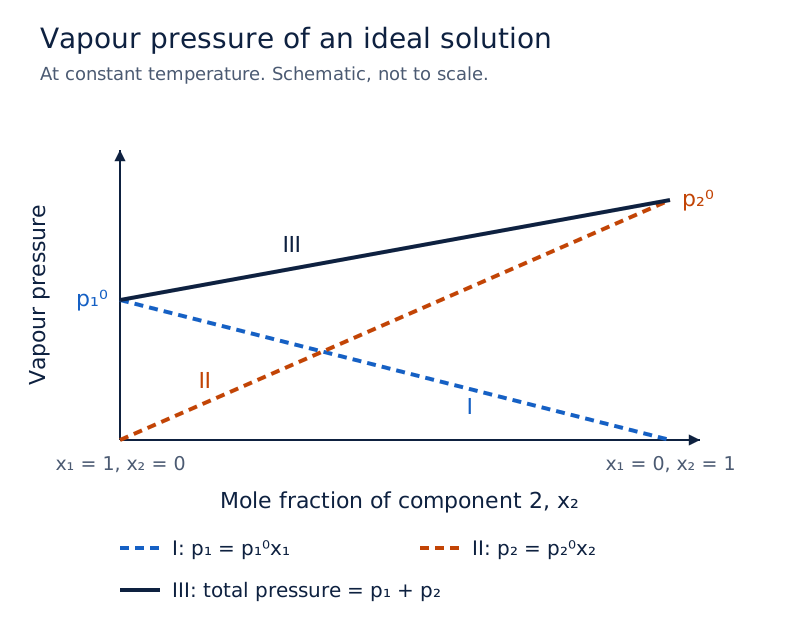
The vertical axis shows vapour pressure and the horizontal axis shows mole fraction. Dashed lines I and II show the component partial pressures. Straight line III shows their sum between the pure-component vapour pressures.
Drawn by One Young India.
At constant temperature, the total pressure changes linearly with composition. In the illustrated case, component 2 has the higher pure vapour pressure and is more volatile. For this ideal mixture, the equilibrium vapour is richer in the more volatile component.
Henry’s law and Raoult’s law both relate partial pressure to liquid mole fraction. Raoult’s relation is the special case in which the Henry’s law constant equals the pure-component vapour pressure.
Why do solutions show ideal behaviour or deviations?
An ideal solution obeys Raoult’s law across the entire concentration range. Let ΔHmix be the enthalpy change on mixing and ΔVmix the volume change on mixing; the symbol Δ indicates a change. Enthalpy change here measures heat absorbed or released at constant pressure.
For ideal mixing, ΔHmix = 0 and ΔVmix = 0. No heat is exchanged, and component volumes add without change.
How do molecular attractions explain the difference?
Let A and B denote the molecular species. Ideal behaviour arises when attractions between unlike A-B molecules are nearly equal to those between A-A and B-B molecules. A perfectly ideal solution is rare; benzene-toluene and n-hexane-n-heptane mixtures are nearly ideal.
A non-ideal solution departs from Raoult’s law because unlike-molecule attractions differ from those between like molecules.
| Feature | Positive deviation | Negative deviation |
|---|---|---|
| Vapour pressure | Higher than Raoult’s prediction | Lower than Raoult’s prediction |
| Unlike-molecule attraction | Weaker than like-molecule attractions | Stronger than like-molecule attractions |
| Escaping tendency | Increases | Decreases |
| Example | Ethanol and acetone | Chloroform and acetone |
Hydrogen bonding is attraction involving hydrogen bonded to a strongly electronegative atom and an electron-rich site on another molecule. Acetone disrupts some hydrogen bonds between ethanol molecules, weakening attractions and producing positive deviation.
Chloroform can form hydrogen bonds with acetone. The stronger unlike-molecule attraction reduces escape into the vapour and produces negative deviation. Phenol and aniline also show negative deviation through stronger hydrogen bonding between unlike molecules.
What the figure shows
Deviations from Raoult’s law
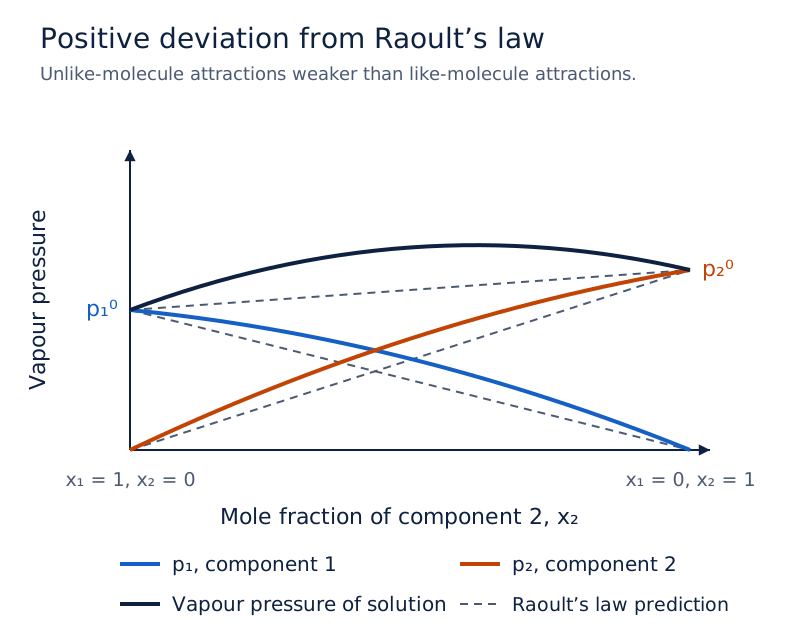
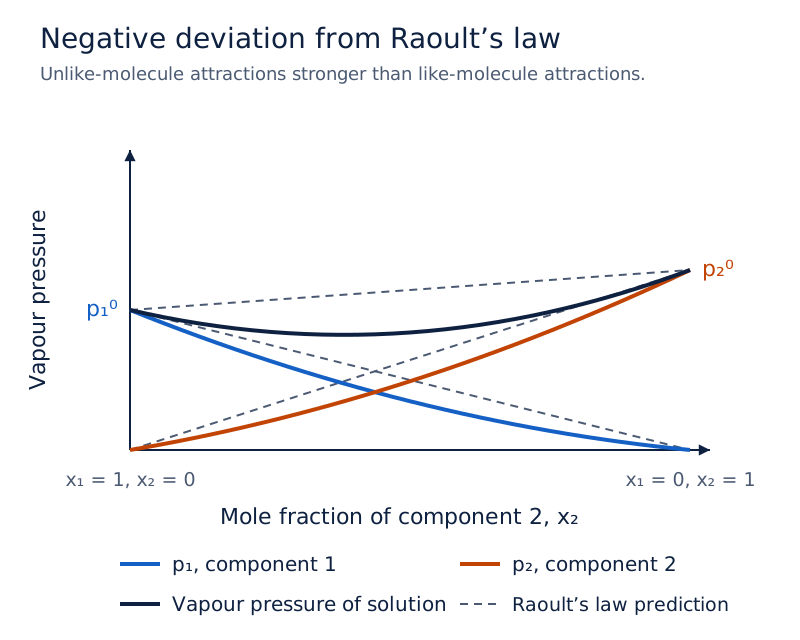
Both panels plot vapour pressure against mole fraction. In panel (a), the curved pressure plots lie above the corresponding straight reference lines. In panel (b), they lie below. Component curves and the total solution-pressure curve are shown.
Drawn by One Young India.
What are azeotropes, and why does fractional distillation stop separating them?
Definition: Azeotropes are binary mixtures with the same composition in the liquid and vapour phases that boil at a constant temperature.
Fractional distillation separates volatile components through repeated vaporisation and condensation, using differences between liquid and vapour composition. At the azeotropic composition, the vapour has the same composition as the liquid, so further fractional distillation cannot separate the components.
How do the two types differ?
A minimum-boiling azeotrope forms at a specific composition in a solution showing a large positive deviation from Raoult’s law. Ethanol-water gives an azeotropic solution containing approximately 95% ethanol by volume on fractional distillation.
A maximum-boiling azeotrope forms at a specific composition in a solution showing a large negative deviation. The nitric acid-water azeotrope contains approximately 68% nitric acid and 32% water by mass, and boils at 393.5 K.
Diagram
Azeotropic boiling behaviour
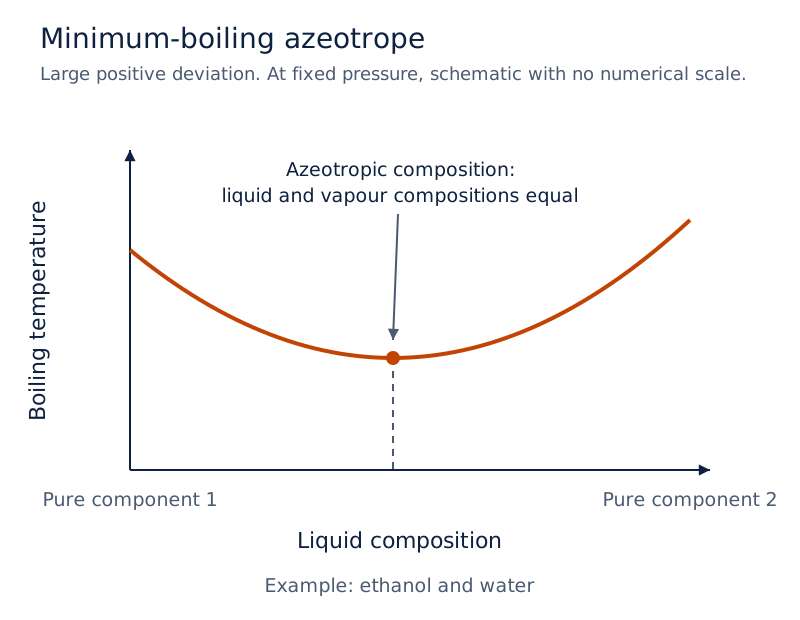
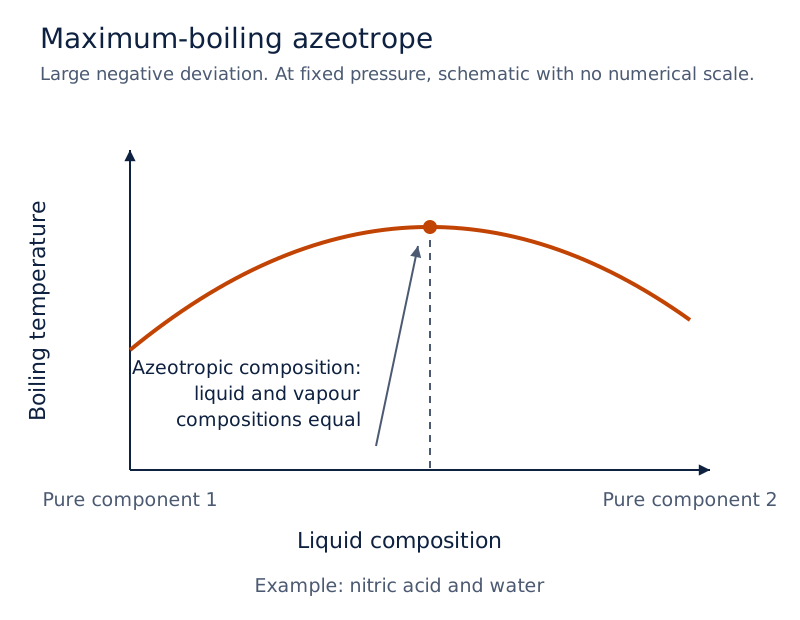
At fixed pressure, draw boiling temperature vertically and liquid composition horizontally. Draw a minimum for the minimum-boiling type and a maximum for the maximum-boiling type. Label each extremum “azeotropic composition: liquid and vapour compositions equal”. These are schematic curves without numerical scales.
Drawn by One Young India.
Large deviations produce the stated azeotropic behaviour at a particular composition. A deviation alone does not justify calling every mixture azeotropic.
How does relative lowering of vapour pressure determine molar mass?
Colligative properties depend on the number of solute particles relative to the amount of solvent or solution, rather than their chemical identity. They comprise relative lowering of vapour pressure, elevation of boiling point, depression of freezing point and osmotic pressure.
For a non-volatile solute, the vapour pressure comes from the solvent. Solute particles reduce the fraction of the surface occupied by solvent molecules and reduce solvent escape. Define Δp = p₁⁰ − p₁ as the lowering of solvent vapour pressure.
Derivation: Relative lowering and molar mass
- For a solution obeying Raoult’s law, p₁ = x₁p₁⁰. Subtracting from the pure-solvent pressure gives Δp = p₁⁰(1 − x₁).
- Since x₁ + x₂ = 1, dividing by p₁⁰ gives Δp / p₁⁰ = x₂ = n₂ / (n₁ + n₂).
- For a dilute solution, n₂ is much smaller than n₁, so Δp / p₁⁰ ≈ n₂ / n₁.
- Let w₁ and w₂ be solvent and solute masses, and M₁ and M₂ their molar masses. Substituting n₁ = w₁/M₁ and n₂ = w₂/M₂ gives Δp / p₁⁰ ≈ w₂M₁ / (M₂w₁).
M₂ = w₂ M₁ p₁⁰ / (w₁ Δp) is the resulting dilute-solution expression, assuming that solute particles neither associate (join into groups) nor dissociate (separate into smaller particles).
The relative lowering Δp/p₁⁰ is dimensionless. The lowering Δp has pressure units. Distinguish the exact mole-fraction expression within the Raoult model from the dilute approximation that neglects solute moles in the denominator.
Worked example 4. A non-volatile, non-electrolyte (non-ion-forming) solid of mass 0.5 g dissolves in 39.0 g benzene. At the same temperature, pure benzene has vapour pressure 0.850 bar and the solution 0.845 bar. Benzene’s molar mass is 78 g mol⁻¹. Use the dilute approximation.
Formula: Δp = p₁⁰ − p₁; M₂ = w₂M₁p₁⁰ / (w₁Δp). Substitute: Δp = 0.005 bar; M₂ = (0.5 × 78 × 0.850) / (39.0 × 0.005). Answer: M₂ = 170 g mol⁻¹.
Why does a non-volatile solute raise the boiling point?
A liquid boils when its vapour pressure equals the external pressure. Dissolving a non-volatile solute lowers solvent vapour pressure at a given temperature. The solution must therefore be heated further to reach the same external pressure.
Let Tᵦ⁰ be the pure-solvent boiling point and Tᵦ the solution boiling point, both at the same pressure. The boiling-point elevation is ΔTᵦ = Tᵦ − Tᵦ⁰. For dilute solutions, ΔTᵦ = Kᵦ m.
The molal elevation constant Kᵦ, also called the ebullioscopic constant, is the elevation per unit molality. Its unit is K kg mol⁻¹. It depends on the solvent; a molality of one mol kg⁻¹ gives an elevation numerically equal to Kᵦ under the dilute-solution relation.
Derivation: Boiling-point elevation and molar mass
- With solute mass w₂ in grams and molar mass M₂ in g mol⁻¹, the solute amount is w₂/M₂ moles.
- For solvent mass w₁ in grams, the solvent mass in kilograms is w₁/1000. Thus m = 1000w₂/(M₂w₁).
- Insert this molality into ΔTᵦ = Kᵦm to obtain ΔTᵦ = 1000Kᵦw₂/(M₂w₁).
- Rearrange to obtain the solute molar mass from known masses and measured elevation.
M₂ = 1000 Kᵦ w₂ / (ΔTᵦ w₁), with both masses entered in grams and no association or dissociation assumed.
What the figure shows
Boiling-point elevation
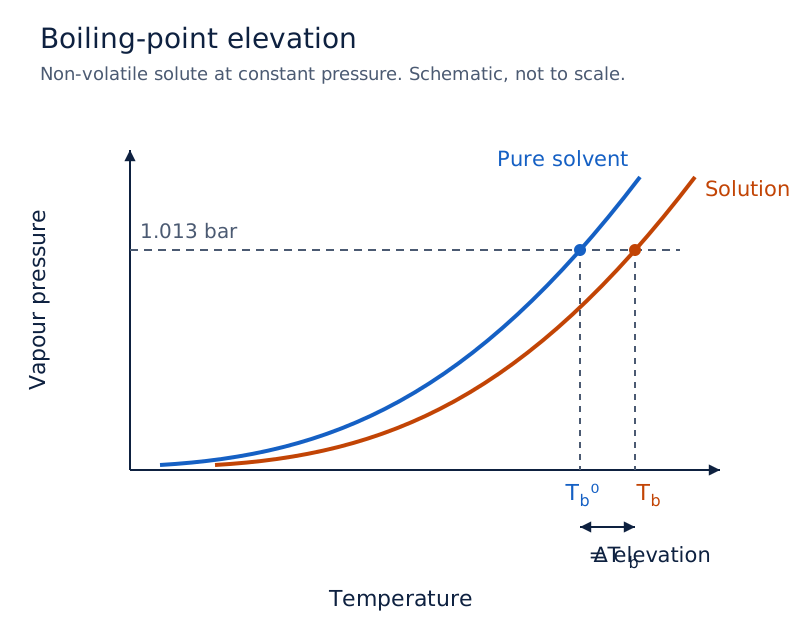
Vapour pressure is plotted against temperature. The solution curve lies below the solvent curve. A horizontal line marked 1.013 bar intersects the solution curve at the higher temperature; ΔTᵦ marks the separation of the boiling temperatures.
Drawn by One Young India.
Worked example 5. Dissolve 18 g glucose, molar mass 180 g mol⁻¹, in 1 kg water. At 1.013 bar, pure water boils at 373.15 K. Given Kᵦ = 0.52 K kg mol⁻¹, find the solution boiling point.
Formula: m = n / s; ΔTᵦ = Kᵦm; Tᵦ = Tᵦ⁰ + ΔTᵦ. Substitute: m = (18/180)/1 = 0.1 mol kg⁻¹; ΔTᵦ = 0.52 × 0.1 = 0.052 K. Answer: Tᵦ = 373.202 K.
Why does a dissolved solute lower the freezing point?
At the freezing point, solid and liquid solvent are in dynamic equilibrium. Their vapour pressures are equal. Adding a non-volatile solute lowers the vapour pressure of the liquid, so equality with the pure solid solvent is reached at a lower temperature.
Let Tf⁰ denote the pure-solvent freezing point and Tf the freezing point of solvent in solution. The freezing-point depression is ΔTf = Tf⁰ − Tf.
For a dilute ideal solution, ΔTf = Kf m. The molal depression constant Kf, or cryoscopic constant, is the depression per unit molality. It depends on the solvent and has unit K kg mol⁻¹.
Derivation: Freezing-point depression and molar mass
- For w₂ grams of solute of molar mass M₂, the amount of solute is w₂/M₂ moles.
- For w₁ grams of solvent, molality is m = (w₂/M₂)/(w₁/1000).
- Substitute into ΔTf = Kfm to obtain ΔTf = 1000Kfw₂/(M₂w₁).
- Rearrange for M₂, using the measured depression and the solvent’s cryoscopic constant.
M₂ = 1000 Kf w₂ / (ΔTf w₁), with masses in grams and solute association or dissociation absent.
What the figure shows
Freezing-point depression
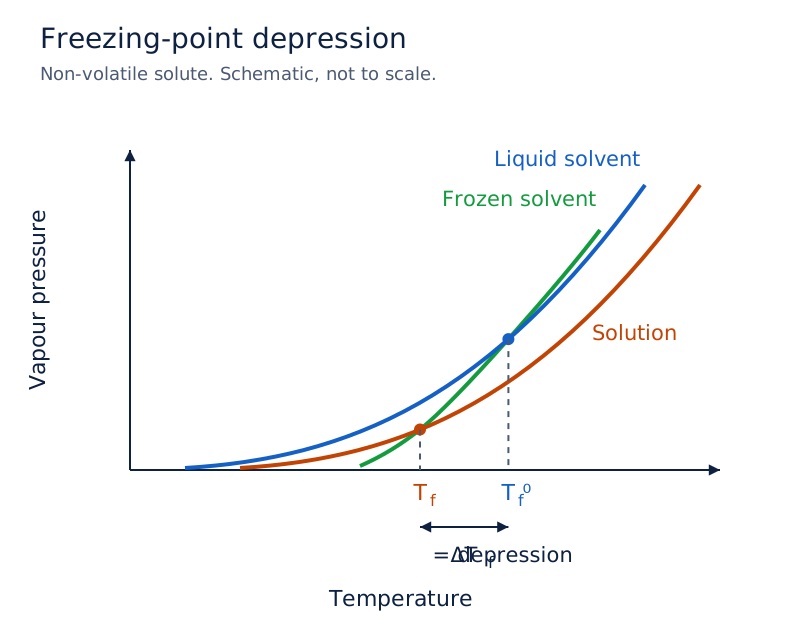
The graph plots vapour pressure against temperature for frozen solvent, liquid solvent and solution. The solution curve meets the frozen-solvent curve at a lower temperature than the liquid-solvent curve does. The marked temperature interval is ΔTf.
Drawn by One Young India.
Which constants belong to the solvent?
| Solvent | Kᵦ / K kg mol⁻¹ | Kf / K kg mol⁻¹ |
|---|---|---|
| Water | 0.52 | 1.86 |
| Ethanol | 1.20 | 1.99 |
| Benzene | 2.53 | 5.12 |
| Chloroform | 3.63 | 4.79 |
Worked example 6. Dissolving 1.00 g non-electrolyte in 50 g benzene lowers its freezing point by 0.40 K. Given Kf = 5.12 K kg mol⁻¹, find the solute molar mass, assuming no association.
Formula: M₂ = 1000Kfw₂/(ΔTfw₁). Substitute: M₂ = (1000 × 5.12 × 1.00)/(0.40 × 50). Answer: M₂ = 256 g mol⁻¹.
A non-electrolyte can still associate without forming ions. Check for association separately when interpreting a colligative property.
How do osmosis, osmotic pressure and reverse osmosis work?
A semipermeable membrane permits passage of solvent while preventing passage of the solute being considered. Natural examples include animal membranes such as pig’s bladder. Cellophane is synthetic; a precipitated copper(II) ferrocyanide membrane is a chemical example.
Osmosis is the flow of solvent through such a membrane from pure solvent into solution, or from a more dilute solution into a more concentrated solution. The process continues until equilibrium is reached.
Osmotic pressure, denoted Π, is the excess pressure that must be applied to the solution to prevent solvent from entering through the membrane. It depends on the concentration of dissolved particles and is a colligative property.
How does osmosis differ from diffusion?
| Feature | Diffusion | Osmosis |
|---|---|---|
| Process | Net spreading of particles from higher to lower concentration | Net flow of solvent towards higher solute concentration |
| Membrane requirement | No semipermeable membrane is required | A semipermeable membrane separates the two sides |
| Particles considered | Solute or solvent particles | Solvent passing through the membrane |
Which laws describe dilute-solution osmotic pressure?
For dilute solutions whose solutes neither associate nor dissociate, Π = C R T, or Π V = n₂ R T. Here T is absolute temperature in kelvin and R is the gas constant. C is molarity when compatible litre-based units are used for R.
- van’t Hoff-Boyle law: at constant temperature and fixed solute amount, osmotic pressure varies inversely with solution volume; ΠV remains constant.
- van’t Hoff-Charles law: at fixed solute amount and solution volume, osmotic pressure is directly proportional to absolute temperature; Π/T remains constant.
- van’t Hoff-Avogadro law: equal volumes of dilute solutions at the same temperature and osmotic pressure contain equal numbers of solute particles.
Substituting n₂ = w₂/M₂ gives M₂ = w₂ R T / (Π V). Osmotic-pressure measurement is useful for proteins and polymers because measurable pressures occur even in very dilute solutions and measurements can be made around room temperature.
Biomolecules are generally not stable at higher temperatures, and polymers have poor solubility.
What the figure shows
Preventing osmosis
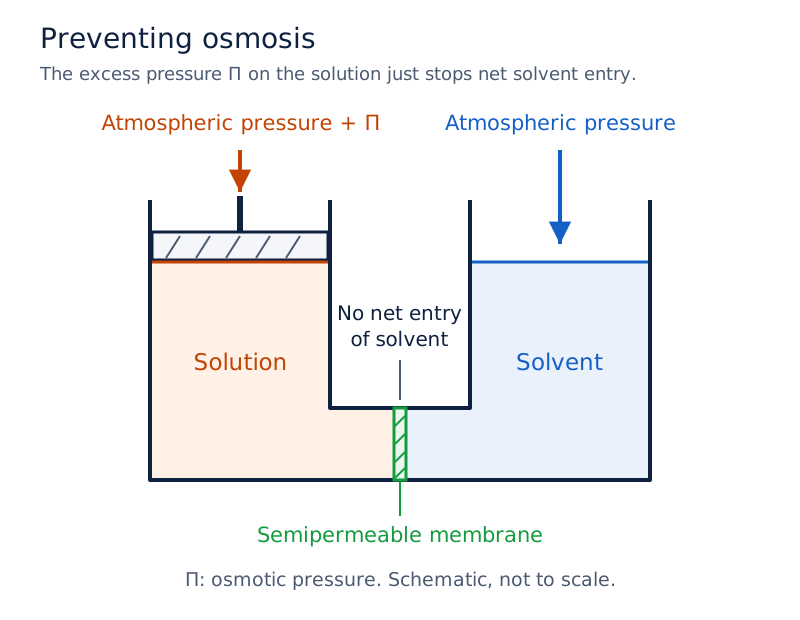
Connected solution and solvent compartments are separated by a semipermeable membrane. Atmospheric pressure acts on the solvent side; atmospheric pressure plus Π acts on the solution side. The extra solution-side pressure prevents net solvent entry.
Drawn by One Young India.
Worked example 7. A 200 cm³ protein solution contains 1.26 g protein and has osmotic pressure 2.57 × 10⁻³ bar at 300 K. Here cm³ means cubic centimetre; 200 cm³ = 0.200 L. Take R = 0.083 L bar mol⁻¹ K⁻¹.
Formula: M₂ = w₂RT/(ΠV). Substitute: M₂ = (1.26 × 0.083 × 300)/(2.57 × 10⁻³ × 0.200). Answer: M₂ ≈ 61,000 g mol⁻¹ (three significant figures).
What are isotonic solutions and reverse osmosis?
Isotonic solutions have equal osmotic pressures at a given temperature; no net osmosis occurs between them across a suitable membrane. A hypertonic solution has higher osmotic pressure than the reference solution; a hypotonic solution has lower osmotic pressure.
Relative to blood cells, sodium chloride solution above 0.9% mass by volume is hypertonic and causes water loss and shrinkage. Below 0.9% it is hypotonic and causes water entry and swelling. The 0.9% solution is called normal saline.
Reverse osmosis occurs when pressure greater than the osmotic pressure is applied to the solution. Solvent then flows out through the membrane. It is used to desalinate sea water; a cellulose acetate membrane allows water through while retaining impurities and ions.
How do association and dissociation produce abnormal molar masses?
Association joins solute molecules into larger groups, reducing particle number. Dissociation separates a solute into smaller particles, often ions. An electrolyte forms ions in solution. An abnormal molar mass differs from the expected value when particle-number changes are ignored.
Ethanoic acid molecules dimerise in benzene through hydrogen bonding. Dimerisation joins two molecules into one group: 2 CH₃COOH ⇌ (CH₃COOH)₂. The double arrow denotes a reversible process. This normally happens in solvents of low dielectric constant, a measure of how the medium reduces electrostatic interactions.
Potassium chloride dissociates into potassium and chloride ions: KCl → K⁺ + Cl⁻. Superscript + and − indicate positive and negative ionic charges. Ignoring interionic attractions, complete dissociation doubles the number of dissolved particles per mole of salt.
What is the van’t Hoff factor?
The van’t Hoff factor i is the observed colligative property divided by its calculated value assuming no association or dissociation. It also equals normal molar mass divided by uncorrected apparent molar mass.
If Mₙ denotes normal molar mass and Mₐ apparent molar mass, i = Mₙ / Mₐ. Association gives i < 1 and an apparent mass that is too high; dissociation gives i > 1 and an apparent mass that is too low.
For aqueous potassium chloride, i is close to 2; for ethanoic acid in benzene it is nearly 0.5. These are not unconditional exact values. For potassium chloride, sodium chloride and magnesium sulphate, i approaches 2 as solutions become very dilute.
| Property | Corrected dilute-solution expression |
|---|---|
| Relative lowering of vapour pressure | Δp/p₁⁰ ≈ i n₂/n₁ |
| Boiling-point elevation | ΔTᵦ = i Kᵦ m |
| Freezing-point depression | ΔTf = i Kf m |
| Osmotic pressure | Π = i C R T |
How is degree of association or dissociation calculated?
Let α be the degree of dissociation, meaning the fraction of original formula units that dissociate, and ν the number of particles formed from each dissociated unit. Starting from one mole gives (1 − α) undissociated moles and να product moles.
Thus i = 1 + α(ν − 1), so α = (i − 1)/(ν − 1). For complete dissociation of potassium chloride, ν = 2. Particle counting assumes the products behave as independent solute particles.
For association, use α for the fraction of original molecules associated and q for the number joining in each group. One original mole becomes (1 − α) unassociated moles plus α/q moles of groups, giving i = 1 − α + α/q.
For dimers, q = 2, so i = 1 − α/2 and α = 2(1 − i). Percentage association is 100α.
Worked example 8. A solution of 2 g benzoic acid, normal molar mass 122 g mol⁻¹, in 25 g benzene has freezing-point depression 1.62 K. Use the supplied Kf = 4.9 K kg mol⁻¹ and assume dimer formation.
Formula: Mₐ = 1000Kf w₂/(ΔTf w₁); i = Mₙ/Mₐ; α = 2(1 − i). Substitute: Mₐ = 9800/40.5 = 241.98 g mol⁻¹; i ≈ 0.504. Answer: α = 0.992, giving 99.2% association.
Note: Use the solvent constant explicitly supplied in a numerical problem. The benzoic-acid example supplies Kf = 4.9 K kg mol⁻¹; do not replace it with the benzene value in the earlier table.
Glossary
- Solution — A homogeneous mixture whose composition and properties are uniform throughout its volume.
- Solvent — The component generally present in the largest quantity, determining the solution’s physical state.
- Mole fraction — The amount of a component in moles divided by the total moles of all components.
- Molarity — The amount of solute in moles present per litre of the complete solution.
- Molality — The amount of solute in moles present per kilogram of solvent.
- Normality — The number of gram-equivalents of solute per litre of solution for a specified reaction.
- Solubility — The maximum amount of solute dissolving in a specified solvent quantity at a specified temperature.
- Ideal solution — A solution that obeys Raoult’s law over the entire range of concentration.
- Azeotrope — A binary mixture with equal liquid and vapour compositions that boils at constant temperature.
- Colligative property — A property depending on relative solute particle number rather than the particles’ chemical identity.
- Semipermeable membrane — A membrane that permits passage of solvent while preventing passage of the solute considered.
- Osmotic pressure — The excess pressure required on a solution to prevent solvent entering through a semipermeable membrane.
- Isotonic solutions — Solutions that have equal osmotic pressures when compared at the same temperature.
- van’t Hoff factor — The ratio of observed colligative property to that calculated assuming no solute association or dissociation.
- Degree of dissociation — The fraction of the original solute formula units that dissociate into smaller particles.
Common errors and misconceptions
- Misconception: Molarity uses solvent volume. Correct: Molarity uses total solution volume; molality uses solvent mass in kilograms.
- Misconception: All concentration measures change with temperature. Correct: Mass percentage, mass-based ppm, mole fraction and molality are independent of temperature; molarity depends on volume.
- Misconception: A larger Henry’s law constant means greater gas solubility. Correct: In p = Kₕx, a larger Kₕ gives lower dissolved mole fraction at the same pressure.
- Misconception: Nearly ideal mixtures are perfectly ideal. Correct: A perfectly ideal solution is rare; nearly equal molecular attractions produce nearly ideal behaviour.
- Misconception: Fractional distillation separates an azeotrope completely. Correct: At its azeotropic composition, the vapour and liquid have the same composition.
- Misconception: The exact mole-fraction denominator can always be replaced by solvent moles. Correct: Neglecting solute moles requires the dilute-solution approximation.
- Misconception: Osmotic pressure and reverse-osmosis pressure are identical thresholds for solvent exit. Correct: Osmotic pressure just stops net entry; a larger applied pressure reverses the flow.
- Misconception: Association increases a colligative effect. Correct: Association reduces particle number and the effect, giving i below one and an uncorrected molar mass above the normal value.
Exam-style questions with model answers
Q1. Define molarity and molality, stating the denominator and unit of each. [2 marks]
- Molarity is the amount of solute in moles per litre of solution, expressed in mol L⁻¹.
- Molality is the amount of solute in moles per kilogram of solvent, expressed in mol kg⁻¹.
Q2. A solution contains 5 g sodium hydroxide in 450 mL solution. Its molar mass is 40 g mol⁻¹. Calculate its molarity and normality for acid neutralisation, taking one equivalent per mole of sodium hydroxide. [3 marks]
- Convert mass to amount using the supplied molar mass: n = 5/40 = 0.125 mol of sodium hydroxide.
- The solution volume is 450/1000 = 0.450 L. Therefore its molarity is C = 0.125/0.450 = 0.278 mol L⁻¹.
- The specified reaction gives one equivalent per mole, so N = fC with f = 1. Its normality is consequently 0.278 equivalents per litre.
Q3. State Henry’s law and calculate the dissolved mole fraction of nitrogen at 293 K when its partial pressure is 0.987 bar and Kₕ = 76.48 kbar. Use 1 kbar = 1000 bar. Explain the effect of increasing Kₕ at the same pressure. [3 marks]
- At constant temperature, dissolved gas mole fraction x is proportional to its partial pressure p above the solution: p = Kₕx.
- Convert Kₕ to 76,480 bar. Thus x = p/Kₕ = 0.987/76,480 = 1.29 × 10⁻⁵, a dimensionless mole fraction.
- At the same pressure, x varies inversely with Kₕ. A larger Henry’s law constant therefore gives a smaller dissolved mole fraction and lower gas solubility.
Q4. Derive the relation between relative lowering of vapour pressure and solute molar mass for a dilute binary solution of a non-volatile solute that neither associates nor dissociates. Define the quantities used. [4 marks]
- Let p₁⁰ be pure-solvent vapour pressure and p₁ its solution value at the same temperature. Raoult’s law gives p₁ = x₁p₁⁰, where x₁ is solvent mole fraction.
- Hence (p₁⁰ − p₁)/p₁⁰ = 1 − x₁ = x₂, where x₂ is solute mole fraction.
- For solvent and solute amounts n₁ and n₂, x₂ = n₂/(n₁ + n₂). In a dilute solution, n₂ is much smaller, giving x₂ ≈ n₂/n₁.
- If w₁, w₂ are solvent and solute masses and M₁, M₂ their molar masses, substitution gives (p₁⁰ − p₁)/p₁⁰ ≈ w₂M₁/(M₂w₁).
Q5. Explain why 18 g glucose dissolved in 1 kg water raises its boiling point, then calculate that boiling point. Use glucose molar mass 180 g mol⁻¹, Kᵦ = 0.52 K kg mol⁻¹, and pure-water boiling point 373.15 K at 1.013 bar. Treat glucose as non-volatile and non-associating. [5 marks]
- A non-volatile solute lowers the solvent’s vapour pressure. At the pure-water boiling temperature, the solution therefore has insufficient vapour pressure to boil at 1.013 bar.
- The amount of glucose is its mass divided by its molar mass: n = 18/180 = 0.1 mol.
- Molality uses the solvent mass in kilograms, so m = 0.1/1 = 0.1 mol kg⁻¹.
- For the dilute-solution calculation, ΔTᵦ = Kᵦm = 0.52 × 0.1 = 0.052 K.
- Add the elevation to the pure-water boiling point: Tᵦ = 373.15 + 0.052 = 373.202 K. The higher temperature brings the solution’s vapour pressure up to the external pressure.
Q6. Explain positive and negative deviations from Raoult’s law using ethanol-acetone and chloroform-acetone, respectively. Define an azeotrope and distinguish its two types. [5 marks]
- Positive deviation means vapour pressure exceeds Raoult’s prediction. Unlike-molecule attractions are weaker than like-molecule attractions, making escape into the vapour easier.
- In ethanol-acetone, acetone disrupts some hydrogen bonds between ethanol molecules. Weaker attractions explain the positive deviation of this mixture.
- Negative deviation means vapour pressure falls below Raoult’s prediction. Chloroform forms hydrogen bonds with acetone, strengthening unlike-molecule attractions and reducing escape.
- An azeotrope is a binary mixture having the same liquid and vapour composition and boiling at constant temperature. Fractional distillation cannot separate it further at that composition.
- Large positive deviations produce minimum-boiling azeotropes; large negative deviations produce maximum-boiling azeotropes, each at a specific composition. Ethanol-water and nitric acid-water illustrate the respective types.
Q7. A solution of 1.00 g non-electrolyte in 50 g benzene lowers its freezing point by 0.40 K. Given Kf = 5.12 K kg mol⁻¹ and no association, calculate the solute molar mass and explain the lowering. [4 marks]
- The dissolved solute lowers the liquid solvent’s vapour pressure. Equilibrium with pure solid benzene is consequently reached at a lower temperature.
- Use ΔTf = Kf m for the dilute solution. Its molality is m = 0.40/5.12 = 0.078125 mol kg⁻¹.
- The solvent mass is 50/1000 = 0.050 kg. The amount of solute is therefore 0.078125 × 0.050 = 0.00390625 mol.
- Molar mass equals solute mass divided by amount: M₂ = 1.00/0.00390625 = 256 g mol⁻¹.
Q8. Benzoic acid forms dimers in benzene. Its normal molar mass is 122 g mol⁻¹ and its apparent molar mass from freezing-point depression is 241.98 g mol⁻¹. Calculate its van’t Hoff factor and percentage association, rounding i to three decimals. [3 marks]
- The van’t Hoff factor is the normal molar mass divided by the apparent value: i = 122/241.98 ≈ 0.504.
- For degree of association α into dimers, one original mole gives (1 − α) moles of separate molecules and α/2 moles of dimers. Thus i = 1 − α/2.
- Therefore α = 2(1 − 0.504) = 0.992, giving 99.2% association. Particle-number reduction explains both i below one and the larger apparent molar mass.
Key takeaways
- A solution is homogeneous, and its solvent determines its physical state; solutes and solvents can each occur in different states.
- Molarity uses solution volume, molality uses solvent mass, and normality additionally requires a specified reaction and equivalent basis.
- At constant temperature, Henry’s law relates dissolved gas mole fraction to partial pressure; larger Kₕ means lower solubility at fixed pressure.
- Raoult’s law relates component vapour pressure to liquid mole fraction, while Dalton’s law adds the component partial pressures.
- Large deviations produce azeotropes at specific compositions with identical liquid and vapour compositions, preventing further separation by fractional distillation.
- For dilute solutions, boiling-point elevation and freezing-point depression are proportional to molality, with constants determined by the solvent.
- Osmotic pressure just prevents solvent entry through a semipermeable membrane; applying greater pressure to the solution produces reverse osmosis.
- Association decreases particle number and dissociation increases it; the van’t Hoff factor corrects colligative-property calculations for these changes.
Test yourself
Why does a 10% glucose solution by mass contain 90 g water per 100 g solution?
The 100 g total includes both components. Subtracting 10 g glucose leaves 90 g water as solvent.
Why can molarity change with temperature while molality does not?
Molarity contains solution volume, which changes with temperature. Molality contains solvent mass, which does not depend on temperature.
What distinguishes x₁ from y₁ in a volatile liquid mixture?
The symbol x₁ denotes component 1’s liquid mole fraction; y₁ denotes its mole fraction in the equilibrium vapour.
Which direction of deviation results from stronger unlike-molecule attraction?
Negative deviation results because stronger attractions reduce molecular escape and lower vapour pressure below the ideal prediction.
Why must both vapour pressures in relative lowering refer to the same temperature?
Vapour pressure itself changes with temperature. Comparing at the same temperature isolates the change caused by dissolving the solute.
How do you obtain solution freezing temperature from its positive freezing-point depression?
Subtract the depression from the pure-solvent freezing temperature: Tf = Tf⁰ − ΔTf.
What happens between isotonic solutions separated by a suitable semipermeable membrane?
There is no net osmosis because their osmotic pressures are equal at the same temperature.
Why can association cause an overestimate of molar mass?
Association reduces solute particle number and the measured colligative effect. Ignoring it makes the calculated amount too small and molar mass too large.
Write about it
Turn a question from this chapter into a paper.
The Writing Studio has a structure guide, a rubric and citation tools for 15 formats, from essays to research papers. Drafting is free with an account. Learnacy Essential adds feedback from an AI writing coach and submission to The OYI Review.
Publication depends on review and is not guaranteed.