
Some Basic Concepts of Chemistry | CBSE Class 11 Chemistry Notes
On this page
Watch & explore
Start with a few high-quality watches, then dive into the notes below.

This note covers the scope of chemistry, classification of matter, measurement and SI units, significant figures, laws of chemical combination, atomic and molecular masses, the mole concept, percentage composition, empirical and molecular formulas, stoichiometry, limiting reagents and solution concentration.
What does chemistry study, and why is it useful?
Chemistry examines the preparation, composition, structure, properties and reactions of substances. It connects the materials that we can handle with the atoms and molecules that constitute them. Rusting of iron and the formation of curd from milk are familiar examples of changes involving substances.
How did chemical knowledge develop?
Early chemical investigations were associated with alchemy and the search for substances that could transform base metals into gold or grant immortality. Practical knowledge also grew through work with metals, medicines, dyes, cosmetics and glass.
In ancient India, chemical knowledge included metallurgy and the manufacture of useful materials. Archaeological remains at Harappa and Mohenjodaro include baked bricks and pottery. Preparing pottery involved mixing materials, moulding them and heating them to obtain desired properties.
Nagarjuna's Rasratnakar discussed mercury compounds and methods of extracting metals such as gold, silver, tin and copper. Such work illustrates the connection between chemical processes and practical needs, even before chemistry developed as a modern scientific discipline.
Where are chemical principles applied?
Chemistry supports the manufacture of fertilisers, acids, alkalis, salts, dyes, polymers, soaps and detergents. It also helps scientists isolate useful substances from natural materials and synthesise new substances. Chemical industries contribute to the economy and provide employment.
Understanding chemical properties makes it possible to develop materials with particular magnetic, electrical or optical behaviour. Examples include conducting polymers, superconducting ceramics and optical fibres. Environmental work includes developing alternatives to harmful refrigerants and addressing problems associated with greenhouse gases.
The quantitative foundation of this work is measurement. A chemist needs to connect a measured mass with the number of particles present and with the amounts that participate in a reaction.
How are matter, mixtures and pure substances classified?
Definition: Matter has mass and occupies space. Its physical state and its chemical composition provide two different ways of describing it.
Particles in a solid are closely arranged with little freedom of movement. In a liquid they remain close but can move around. In a gas they are widely separated and move more freely.
| State | Shape | Volume |
|---|---|---|
| Solid | Definite | Definite |
| Liquid | Takes the container's shape | Definite |
| Gas | Takes the container's shape | Occupies the available container space |
Changing temperature and pressure can interconvert these states. On heating, a solid usually becomes a liquid and then a gas. Cooling can reverse these changes. Classification by state does not establish whether a material is a pure substance or a mixture.
What the figure shows
Arrangement of particles in three states
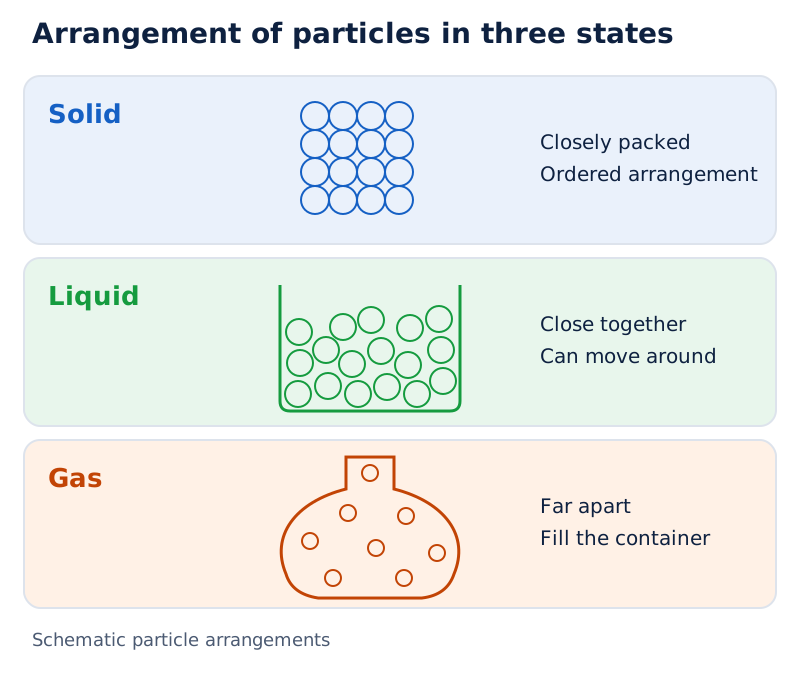
The solid is shown as an ordered cluster of touching spheres. The liquid has closely grouped spheres in the lower part of a beaker. The gas has widely spaced spheres throughout a flask.
Drawn by One Young India. See Fig. 1.1 in your NCERT textbook
How does composition distinguish substances?
A mixture contains two or more pure substances in variable proportions. Its constituents are called components and can be separated by physical methods. A pure substance has particles of the same chemical nature and a fixed composition.
| Category | Distinguishing feature | Examples |
|---|---|---|
| Homogeneous mixture | Uniform composition throughout | Air; sugar solution |
| Heterogeneous mixture | Non-uniform composition | Salt mixed with sugar |
| Element | Contains one type of atom | Copper; hydrogen |
| Compound | Different elements chemically combined in a fixed ratio | Water; carbon dioxide |
An element can have atoms or molecules as its constituent particles. Hydrogen and oxygen occur as diatomic molecules. A compound can have properties very different from its elements: hydrogen burns and oxygen supports combustion, whereas water is used to extinguish fires.
What the figure shows
Classification of matter
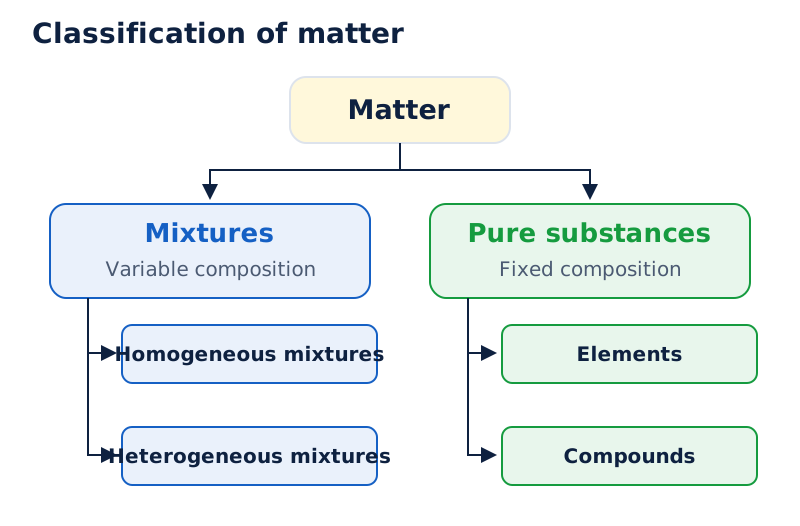
A branching chart places matter at the top. It divides into mixtures and pure substances. Mixtures divide into homogeneous and heterogeneous mixtures; pure substances divide into elements and compounds.
Drawn by One Young India. See Fig. 1.2 in your NCERT textbook
Physical separation, such as filtration, crystallisation or distillation, can separate mixture components. Separating a compound into simpler substances requires chemical methods. A uniform appearance alone therefore does not make a material a pure substance.
How are physical quantities measured and expressed in SI units?
A physical property, such as colour, density or melting point, can be observed without changing a substance's chemical identity. Observing a chemical property, such as combustibility or reaction with an acid, involves a chemical change.
A quantitative measurement needs both a numerical value and a unit. The SI system provides seven base units; quantities such as volume and density use units derived from these.
| Quantity | SI unit | Symbol |
|---|---|---|
| Length | metre | m |
| Mass | kilogram | kg |
| Time | second | s |
| Electric current | ampere | A |
| Thermodynamic temperature | kelvin | K |
| Amount of substance | mole | mol |
| Luminous intensity | candela | cd |
The SI unit of length is the metre. The SI unit of mass is the kilogram. The SI unit of time is the second. The SI unit of thermodynamic temperature is the kelvin. The SI unit of amount of substance is the mole.
How do mass, volume and density differ?
Mass describes the amount of matter, whereas weight is the gravitational force on an object. Mass remains constant when location changes; weight can change with gravity. An analytical balance measures the small masses commonly used in a laboratory.
Volume measures occupied space. The litre is commonly used for liquids, although the SI unit of volume is the cubic metre. Useful conversions are:
A graduated cylinder, burette or pipette measures liquid volume. A volumetric flask is used to prepare a known volume of solution. Density relates mass to volume.
Derivation: The SI unit of density
- Start with the definition: Here is density, is mass and is volume.
- Volume has the dimensions of length cubed, so its SI unit follows as
- Substitute the mass and volume units:
connects a measured mass with the space it occupies. Chemists also commonly express density in .
Temperature is commonly measured on Celsius, Fahrenheit and kelvin scales. If and denote their numerical readings, and is absolute temperature, the conversions are:
How do scientific notation and significant figures express uncertainty?
Scientific notation makes extremely large or small numbers easier to handle. A number is written as , where is the digit term in the range and is the integer exponent. The exponent records the movement of the decimal point.
For example, , whereas . In multiplication, multiply the digit terms and add exponents. In division, divide the digit terms and subtract exponents. For addition or subtraction, first express the numbers using the same exponent.
Which digits are significant?
Significant figures include the digits known with certainty and the final estimated digit. They communicate the limits of a measurement, rather than simply making its written form longer.
| Rule | Example | Significant figures |
|---|---|---|
| Non-zero digits count | Three | |
| Leading zeros do not count | Two | |
| Zeros between non-zero digits count | Four | |
| Trailing decimal zeros count | Three | |
| Scientific notation states precision clearly | Three |
Exact counts do not have measurement uncertainty. For measured numbers, trailing zeros without a decimal point can be unclear; scientific notation makes the intended precision explicit.
For addition and subtraction, retain the least precise decimal place among the measurements. For multiplication and division, retain no more significant figures than the measurement with the fewest significant figures.
When rounding, increase the retained digit if the discarded digit is greater than five; leave it unchanged if less than five. For the halfway cases illustrated here, retain an even last digit: rounds to , and rounds to .
How do precision and accuracy differ?
Precision describes agreement among repeated measurements. Accuracy describes agreement with the true value. For a true mass of , readings of and are close together but not accurate.
Readings of and are both close together and close to the true value. Repeated agreement alone therefore does not establish accuracy.
How does dimensional analysis convert units correctly?
Dimensional analysis, also called the factor label method, converts a quantity by multiplying it by suitable unit factors. A unit factor expresses the ratio of two equivalent quantities. Its value is one, so it changes the units without changing the physical quantity.
Choose the orientation that places the unwanted unit in the denominator and the desired unit in the numerator. Several factors can be multiplied in sequence. Unit cancellation provides a check on the direction of every conversion.
Worked example 1. Convert the volume of of milk into cubic metres.
For a cube, , where is its volume and is its edge length; . For a volume conversion, cube the entire length conversion factor.
- Convert litres to cubic centimetres:
- Use the length relation:
- Convert the volume:
Answer: of milk.
The factor for a cubic unit must also be cubed. Applying a simple length factor to a volume would leave uncancelled units and an incorrect numerical value.
Worked example 2. Find the number of seconds in two days.
Let denote the duration. Multiply it by successive day-to-hour, hour-to-minute and minute-to-second unit factors.
- Convert days to hours:
- Convert hours to minutes:
- Convert minutes to seconds:
Answer: 172800 s.
In each line, the previous unit cancels and the next unit remains. A final number is incomplete unless its remaining unit answers the quantity requested.
What do the laws of chemical combination establish?
The laws of chemical combination describe regular relationships between the quantities that react. Their statements need to distinguish mass relationships from gas-volume relationships, because the conditions attached to them differ.
Which laws compare masses?
The law of conservation of mass, associated with Antoine Lavoisier, states that matter is neither created nor destroyed during a chemical change. The total mass of reactants is therefore equal to the total mass of products.
The law of definite proportions, associated with Joseph Proust, states that a given compound contains its constituent elements in a fixed proportion by mass, irrespective of its source. Natural and synthetic samples of the same compound therefore have the same elemental composition.
The law of multiple proportions, proposed by Dalton, applies when two elements form more than one compound. For a fixed mass of one element, the masses of the other element are in a small whole-number ratio.
For example, of hydrogen combines with of oxygen in water and in hydrogen peroxide. The comparison concerns the oxygen masses for the same hydrogen mass: .
What conditions apply to gas-volume laws?
Gay Lussac's law of gaseous volumes states that gaseous reactants and products have simple whole-number volume ratios, provided all volumes are measured at the same temperature and pressure. Hydrogen and oxygen combine to form water vapour in the volume ratio .
Avogadro's law states that equal volumes of gases contain equal numbers of molecules at the same temperature and pressure. It relates gas volume to particle number, not to equal masses of different gases.
What the figure shows
Gas volumes in water formation
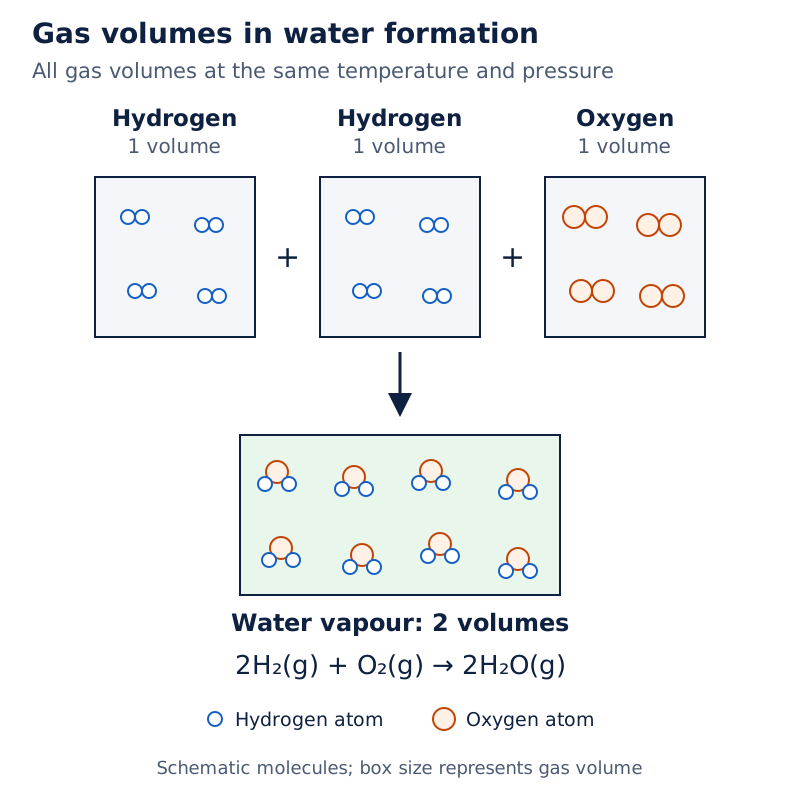
Two separate boxes are each labelled one volume of hydrogen. A third box represents one volume of oxygen. An arrow leads to a larger box labelled two volumes of water vapour, with the particles grouped into water molecules.
Drawn by One Young India. See Fig. 1.9 in your NCERT textbook
Note: The conditions of equal temperature and pressure belong in a statement comparing gas volumes. Also distinguish water vapour from liquid water when using the gaseous volume ratio.
How do Dalton's theory and atomic masses describe particles?
Dalton's atomic theory offered a particle explanation for the laws of chemical combination. Its historical postulates are:
- Matter consists of indivisible atoms.
- Atoms of a given element have identical properties, including mass; atoms of different elements differ in mass.
- Compounds form through combination of atoms of different elements in fixed ratios.
- A chemical reaction reorganises atoms without creating or destroying them.
The theory explained the laws of chemical combination but did not explain gaseous volume relationships or why atoms combine. Its postulates should be recognised as the theory's original statements. The existence of isotopes is relevant when calculating the masses used today.
What is the atomic mass standard?
The unified atomic mass unit, symbol , is one-twelfth of the mass of a carbon-12 atom. Carbon-12 is assigned an atomic mass of exactly . This relative scale is convenient because individual atomic masses are extremely small.
Many elements occur naturally as more than one isotope. Their average atomic mass is a weighted average: each isotope's mass contributes according to its fractional abundance. Simply averaging isotope masses without their abundances would discard essential information.
Here is the average atomic mass, labels each isotope, is that isotope's fractional abundance and is its atomic mass; means to add the contributions from all isotopes. For the carbon isotope data, the calculation is , giving approximately .
How do molecular mass and formula mass differ?
Molecular mass is the sum of the atomic masses in one molecule, including the number of atoms of each element. For methane, .
Formula mass is used for substances such as solid sodium chloride, which consists of an ionic arrangement rather than separate molecules. Its formula mass is . A formula unit states the ion ratio without implying a discrete molecule.
How does the mole connect particle numbers with measurable masses?
The mole is the SI unit of amount of substance. It provides a convenient way to count enormous populations of microscopic entities. Those entities must be specified: atoms, molecules, ions, electrons or formula units are different kinds of particles.
Definition: One mole contains exactly specified elementary entities. The Avogadro constant expresses this number per mole.
Thus, one mole of hydrogen atoms, one mole of water molecules and one mole of sodium chloride formula units contain the same number of their specified entities. They do not have equal masses because the entities themselves have different masses.
What is molar mass?
Molar mass, denoted here by , is mass per mole of a substance. When expressed in , its numerical value corresponds to the atomic, molecular or formula mass expressed in .
For example, the molecular mass of water is about , while its molar mass is about . The numerical similarity must not hide the distinction between one molecule and a mole of molecules.
Here is amount of substance in moles, is sample mass, is molar mass, is the number of specified elementary entities and is the Avogadro constant.
The first relation converts mass into amount of substance. The second converts amount into particle number. Reversing them gives the mass or amount required when a particle count is known.
Worked example 3. Calculate the molecular mass of glucose, C₆H₁₂O₆. Use atomic masses C = , H = and O = .
- Sum the contributions of its atoms:
- Evaluate each contribution:
- Add the masses:
Answer: before rounding, or to two decimal places. The corresponding molar mass is .
The subscripts determine how many times each atomic mass enters the sum. They describe the composition of glucose and must remain unchanged during a calculation.
How are percentage composition and chemical formulas determined?
Percentage composition expresses how much of a compound's mass comes from each element. It can be calculated from a known formula or used, with experimental measurements, to determine a formula.
For an element , let be its mass percentage, its mass in the sample and the total mass of that compound sample.
Both masses in the ratio refer to the same sample and use the same units. For a one-mole sample, the numerator is the total mass contributed by that element, including every atom of it in the formula.
An empirical formula gives the simplest whole-number atomic ratio. A molecular formula gives the actual numbers of atoms in a molecule. Mass percentages first determine mole ratios; they cannot be copied directly into formula subscripts.
What sequence converts composition into a formula?
Worked example 4. A compound contains hydrogen, carbon and chlorine. Its molar mass is . Use elemental molar masses H = , C = and Cl = . Determine both formulas.
Formula: ; . Here is the molar mass corresponding to the empirical formula, is the compound's molecular molar mass and is the whole-number multiplier that converts empirical-formula subscripts into molecular-formula subscripts.
Substitute: take a sample, so the stated percentages become element masses in grams.
- Convert each mass to moles:
- Divide by the smallest amount. The units cancel:
- Write the empirical formula CH₂Cl and calculate its corresponding molar mass:
- Find the multiplier:
- Multiply every empirical subscript by that multiplier: The molecular formula is .
Answer: empirical formula CH₂Cl; molecular formula C₂H₄Cl₂, with molar mass 98.96 g per mole.
The multiplier is dimensionless. Multiplying every subscript preserves the simplest ratio while giving the required molecular mass. If the first mole ratios are not whole numbers, multiply all of them by a suitable common factor.
Percentages may show small rounding differences. Use the complete set of element amounts and retain enough intermediate digits to recognise the intended whole-number ratio.
How do balanced equations and limiting reagents determine product amounts?
Stoichiometry uses balanced equations to calculate amounts of reactants and products. A balanced equation conserves the number of atoms of every element. Change coefficients when balancing; changing formula subscripts would change the substances themselves.
For methane combustion, the balanced equation is:
The stoichiometric coefficients represent ratios of molecules and of moles. They do not directly represent mass ratios. The state symbols identify gases, liquids and solids as , and .
Worked example 5. Calculate the mass of water produced by complete combustion of of methane, with sufficient oxygen.
Formula: ; . The equation supplies the intermediate mole ratio.
Substitute: use for methane and for water.
- Convert methane mass into moles:
- Apply the reaction ratio:
- Convert water amount to mass:
Answer: 36 g of water.
How is the limiting reagent identified?
The limiting reagent is consumed first and limits product formation. Compare the available amounts with the balanced equation's requirements. The smallest mass is not automatically limiting because different substances have different molar masses and stoichiometric coefficients.
Worked example 6. Identify the limiting reagent and ammonia yield when of nitrogen reacts with of hydrogen. Use molar masses N₂ = , H₂ = and NH₃ = .
- Convert both reactants to moles:
- Calculate hydrogen needed for all the nitrogen: Available hydrogen is insufficient, so hydrogen is limiting.
- Use the available hydrogen to obtain ammonia:
- Using , calculate the product mass:
Answer: hydrogen is the limiting reagent; the ammonia mass is 56.2 kg, retaining intermediate digits and rounding the final result to three significant figures.
A calculation using the excess reactant alone overestimates the product. The limiting reagent sets the amount that can actually react, even though some of the other reactant remains.
How are mass percentage, mole fraction and molarity used for solutions?
Concentration describes how much solute is present relative to a specified amount of solution or solvent. Different concentration measures use different denominators. Identify that denominator before inserting numerical values.
Mass percentage compares solute mass with total solution mass. For a solution made by adding a solute to water, total mass includes both the solute and the water.
Let denote solute mass percentage, the solute mass and the total solution mass.
Worked example 7. Find the mass percentage when of substance A is added to of water.
- Calculate the solution mass:
- Calculate the percentage:
Answer: 10 per cent by mass. The denominator is the solution mass, not the water mass.
How does mole fraction differ from molarity?
Mole fraction compares one component's amount with the total amount of all components. For a solution containing components A and B, and are their amounts in moles, and and are their respective mole fractions:
The mole units cancel, so mole fraction has no unit. By contrast, molarity measures solute moles per litre of solution. It is commonly denoted by , with units .
Worked example 8. Calculate the molarity when of NaOH is dissolved in enough water to make of solution.
Formula: ; .
Substitute: use the NaOH molar mass , and express the final solution volume in litres.
- Calculate solute amount:
- Convert solution volume:
- Calculate molarity:
Answer: 0.4 mol per litre.
Molarity depends on temperature because solution volume depends on temperature. Making up a final solution volume is different from adding that volume of water to a solute.
How do dilution and molality calculations work?
Dilution reduces concentration by adding solvent. If solute is neither added nor removed, its amount remains the same while the solution volume increases. A concentrated solution used to prepare a more dilute one is called a stock solution.
Derivation: The dilution equation
Let , and denote the initial solute amount, molarity and solution volume; , and denote the corresponding values after dilution.
- Rearrange the definition of molarity for the initial solution: Molarity in multiplied by volume in gives amount in .
- Apply the same relationship after dilution: Use compatible concentration units and the same volume unit on both sides.
- Conserve solute amount during dilution:
applies when dilution changes solvent quantity while conserving solute amount.
Worked example 9. Prepare of NaOH from a stock solution.
- Calculate the solute required:
- Find the stock volume containing this amount:
- Dilute this portion to the required final volume. Check:
Answer: take 200 mL of stock solution and dilute to a final volume of one litre.
Why does molality use solvent mass?
Molality is solute amount per kilogram of solvent. To avoid confusing its symbol with mass, denote it here by ; the conventional symbol is also often .
Use solvent mass in kilograms to obtain . Molality does not change with temperature because mass is unaffected by temperature. This distinguishes it from molarity, whose denominator is solution volume.
Worked example 10. Find the molality of a NaCl solution with density .
Formula: ; . Choose a one-litre solution sample.
Substitute: use NaCl molar mass , and subtract solute mass from total solution mass.
- Find solute amount:
- Find solute mass:
- Find solution mass:
- Obtain solvent mass:
- Calculate molality:
Answer: approximately 2.79 mol per kilogram of solvent, using the stated concentration as the calculation value.
Note: Solution mass and solvent mass are different denominators. Subtract the dissolved solute before calculating molality; use the total solution volume when calculating molarity.
Glossary
- Matter — Anything that has mass and occupies space, including substances in solid, liquid and gaseous states.
- Element — A pure substance containing one type of atom, with particles that may be atoms or molecules.
- Compound — A substance in which atoms of different elements combine in a fixed and definite ratio.
- Homogeneous mixture — A mixture whose components are uniformly distributed, giving the same composition throughout its bulk.
- Significant figures — The meaningful digits in a measurement, including certain digits and a final estimated or uncertain digit.
- Precision — The closeness of repeated measurements of the same quantity to one another.
- Accuracy — The closeness of a measured result to the true value of the quantity.
- Atomic mass unit — A mass unit defined as one-twelfth of the mass of a carbon-12 atom.
- Mole — The SI unit of amount of substance, containing exactly specified elementary entities.
- Molar mass — The mass per mole of a substance, commonly expressed in grams per mole.
- Empirical formula — A chemical formula showing the simplest whole-number ratio of atoms of different elements in a compound.
- Limiting reagent — The reactant consumed first, which consequently limits the amount of product formed in a reaction.
- Molarity — The amount of solute in moles divided by the volume of solution in litres.
- Molality — The amount of solute in moles divided by the mass of solvent in kilograms.
Common errors and misconceptions
- Misconception: Every uniform material is a pure substance. Correct: A homogeneous mixture is also uniform; its components can occur in variable proportions.
- Misconception: Mass and weight are interchangeable. Correct: Mass measures matter, while weight is gravitational force and can vary with location.
- Misconception: All zeros are insignificant. Correct: Leading zeros do not count, but zeros between non-zero digits and trailing decimal zeros can be significant.
- Misconception: Precise measurements must be accurate. Correct: Repeated readings can be close together while differing from the true value.
- Misconception: Formula subscripts can be changed when balancing equations. Correct: Adjust coefficients while preserving each substance's formula.
- Misconception: The reactant with the smallest mass is necessarily limiting. Correct: Convert masses to moles and compare them using the balanced reaction's coefficients.
- Misconception: Molarity and molality use the same denominator. Correct: Molarity uses solution volume in litres; molality uses solvent mass in kilograms.
- Misconception: Dilution reduces the number of solute moles. Correct: Adding solvent reduces concentration while the solute amount remains unchanged.
Exam-style questions with model answers
Q1. Distinguish precision from accuracy. [2 marks]
- Precision is agreement among repeated measurements of the same quantity.
- Accuracy is agreement with the true value. Closely grouped readings can therefore be precise without being accurate if they differ from the true value.
Q2. Distinguish an element, a compound and a mixture, giving examples. [3 marks]
- An element contains only one type of atom. Copper and hydrogen are examples; an element's constituent particles may be atoms or molecules.
- A compound contains different elements chemically combined in a definite ratio. Water is an example, and its constituents require chemical methods for separation.
- A mixture contains two or more pure substances in variable proportions. Sugar solution is an example. Its components can be separated by physical methods.
Q3. State the laws of definite proportions, multiple proportions and gaseous volumes. [3 marks]
- The law of definite proportions states that a particular compound has the same proportions of its elements by mass, irrespective of the sample's source.
- The law of multiple proportions compares different compounds of two elements. For a fixed mass of one element, the masses of the other are in small whole-number ratios.
- Gay Lussac's law states that reacting gases and gaseous products have simple volume ratios, provided volumes are compared at the same temperature and pressure.
Q4. Explain how empirical and molecular formulas are obtained from percentage composition and molar mass. [5 marks]
- Take a convenient sample mass of . Each element's mass percentage then gives its mass in grams in that sample. This provides masses on a common basis.
- Divide each elemental mass by its molar atomic mass to obtain the amount in moles. Ratios of these amounts correspond to ratios of atom numbers.
- Divide all the mole values by the smallest one. If necessary, multiply the complete set of ratios by a suitable factor to obtain whole numbers.
- Use those whole numbers as subscripts to write the empirical formula. Calculate the molar mass corresponding to this formula by adding its elemental contributions.
- Divide the given molecular molar mass by the empirical-formula molar mass. Multiply every empirical subscript by the resulting whole-number factor to obtain the molecular formula.
Q5. Calculate the mass of water formed from complete combustion of 16 g of methane with sufficient oxygen. Use molar masses of 16 g mol⁻¹ for methane and 18 g mol⁻¹ for water. [3 marks]
- Write the balanced equation: Its coefficients give mole ratios, so convert the methane mass before using the ratio.
- Find the amount of methane:
- Find water amount and mass: The available oxygen is sufficient, so the methane amount determines this water yield.
Q6. Derive the dilution relationship and explain its use and condition. [5 marks]
- Molarity is solute amount divided by solution volume. Rearranging for the initial solution gives The product of and has the required amount unit, .
- For the final diluted solution the same definition gives The final volume includes the added solvent, so it is larger than the original solution volume.
- During dilution without loss or addition of solute, the amount remains constant: Substitute the two expressions to obtain
- Use consistent units for both concentrations and both volumes. The equation calculates how much stock solution contains the required solute amount. Add solvent to reach the specified final solution volume. Adding that whole final volume as solvent would not be the same preparation.
Q7. Explain molarity and molality, including their temperature dependence. [3 marks]
- Molarity is solute amount in moles per litre of solution. Its denominator is total solution volume, and its unit is .
- Molality is solute amount in moles per kilogram of solvent. Its denominator excludes solute mass, and its unit is .
- Molarity changes with temperature because solution volume can change. Molality does not change with temperature because the masses of solute and solvent remain unaffected.
Q8. What is a limiting reagent, and how should it be identified? [2 marks]
- The limiting reagent is consumed first and limits product formation.
- Convert reactant quantities to moles and compare their availability with the balanced equation's requirements. Do not choose it simply by comparing masses.
Key takeaways
- Matter can be classified by physical state or by composition; these classifications answer different questions about the same material.
- Pure substances have fixed composition, while mixture components can occur in variable proportions and be separated physically.
- A measurement requires a number and a unit; significant figures communicate its precision and final uncertain digit.
- Unit factors convert measurements without changing physical quantities, and cancellation checks whether the intended unit remains.
- Chemical combination laws describe mass or gas-volume relationships; gas-volume comparisons require the same temperature and pressure.
- The mole connects particle numbers with measurable masses, but the kind of elementary entity must be specified.
- Empirical formulas show simplest atom ratios, while molecular formulas require additional information about the compound's molar mass.
- Balanced coefficients give mole ratios, and the limiting reagent controls the amount of product that can form.
- Molarity uses solution volume, molality uses solvent mass, and dilution preserves solute amount while lowering concentration.
Test yourself
Why is air a mixture despite having a uniform composition?
Air contains different components. Uniform distribution makes it a homogeneous mixture rather than a pure substance.
How many significant figures are present in ?
Three significant figures: the leading zero does not count, but the two trailing decimal zeros do.
What quantity is the SI unit mole used to measure?
The mole measures amount of substance in terms of a specified population of elementary entities.
Why is formula mass used for solid sodium chloride?
Solid sodium chloride contains an extended arrangement of ions rather than discrete molecules, so its formula unit supplies the composition.
Why must mass percentages be converted to moles before writing an empirical formula?
Formula subscripts express atom ratios. Mole amounts give those ratios, whereas equal masses of different elements need not contain equal atom numbers.
What condition accompanies Avogadro's law?
The gases must have equal volumes at the same temperature and pressure for their molecule numbers to be equal.
Why can a reaction stop while one reactant remains?
The limiting reagent has been consumed, preventing further reaction even though the other reactant is still available.
What remains unchanged when a solution is diluted with solvent?
The amount of solute remains unchanged, provided none is added or lost during the dilution.