
Structure of Atom | CBSE Class 11 Chemistry Notes
On this page
Watch & explore
Start with a few high-quality watches, then dive into the notes below.

Learnacy Labs Try it hands-on: open the The Atom lab
This note covers subatomic particles, atomic models, atomic and mass numbers, electromagnetic radiation, quantum theory, the photoelectric effect, hydrogen spectra, Bohr’s model, matter waves, uncertainty, atomic orbitals, quantum numbers and electronic configurations.
How were the electron, proton and neutron discovered?
What did discharge tubes reveal?
Experiments with electrical discharge through gases showed that atoms contain smaller particles. A cathode ray discharge tube contains metal electrodes inside a glass tube. At very low gas pressure and sufficiently high voltage, particles travel from the negative cathode towards the positive anode.
Cathode rays are not directly visible. Their arrival is detected using materials that glow when struck. A perforated anode allows the rays to reach a zinc sulphide coating behind it, producing a bright spot.
- Without an electric or magnetic field, cathode rays travel in straight lines.
- Their deflection in electric and magnetic fields indicates that they carry negative charge.
- Their properties do not depend on the electrode material or the gas inside the tube.
- These negatively charged particles, called electrons, are therefore constituents of all atoms.
J. J. Thomson measured the electron’s charge-to-mass ratio using electric and magnetic fields. Millikan’s oil drop experiment determined its charge. Combining these results gives the electron’s mass. The symbol denotes the positive magnitude of the electronic charge; an electron carries . The symbol denotes the electron’s mass.
Millikan found that the magnitude of a droplet’s charge occurs in integral multiples of the elementary charge: , where is a positive integer. The SI unit of electric charge is the coulomb, . The SI unit of mass is the kilogram, .
How do the three particles compare?
Canal rays contain positively charged gaseous ions. Their masses and charge-to-mass ratios depend on the gas. The lightest positive ion, obtained from hydrogen, is the proton. Chadwick discovered neutrons by bombarding beryllium with alpha particles.
| Particle | Charge | Mass | Relative charge |
|---|---|---|---|
| Electron | |||
| Proton | |||
| Neutron |
The neutron is electrically neutral and slightly heavier than the proton. Proton and neutron masses are each approximately one atomic mass unit; the electron has a much smaller mass.
What did Thomson’s and Rutherford’s atomic models explain?
How did scattering reveal the nucleus?
In Thomson’s model, positive charge forms a uniform sphere with electrons embedded in it. Mass is assumed to be distributed throughout the atom. This arrangement explains electrical neutrality, but it could not account for the scattering results obtained later.
Rutherford’s experiment directed energetic alpha particles at a thin gold foil. A surrounding fluorescent zinc sulphide screen detected their arrival through tiny flashes. Most particles passed through undeflected, a small fraction changed direction, and very few returned almost backwards.
| Observation | Conclusion about the atom |
|---|---|
| Most particles passed straight through. | Most atomic space is empty. |
| A small fraction were deflected. | Positive charge is concentrated in a small region. |
| About one particle in 20,000 bounced back. | The concentrated region can strongly repel approaching positive particles. |
Rutherford placed nearly all the mass and positive charge in a tiny nucleus. Electrons moved around it, held by electrostatic attraction. The approximate atomic radius is , compared with a nuclear radius of .
What the figure shows
Rutherford’s scattering experiment
The upper drawing labels an alpha-particle source, lead plate, gold foil and surrounding photographic plate. The lower drawing shows a beam approaching the foil, with straight paths and several deflected paths.
See Fig. 2.5 in your NCERT textbook
Why was Rutherford’s model incomplete?
An electron following a circular path accelerates because its direction changes. Classical electromagnetic theory predicts that an accelerating charged particle radiates energy. Losing energy should make the electron spiral into the nucleus, contradicting the observed stability of atoms.
Stationary electrons do not solve this problem: attraction would pull them towards the nucleus. Rutherford’s model also did not explain how electrons are distributed or what energies they possess. A new description of electronic energy was needed.
How do atomic number, mass number and isotopes identify an atom?
What does the nuclear symbol tell us?
The atomic number, , counts protons in the nucleus. It identifies the element. A neutral atom contains the same number of electrons as protons. Hydrogen has one proton, whereas sodium has eleven.
The mass number, , counts protons and neutrons together. These nuclear particles are called nucleons. Writing the neutron count as , the relationships are:
The notation places mass number above atomic number to the left of the element symbol. Before counting electrons, check whether the species is neutral or carries a charge. Ion formation changes electron count without changing the identity of the nucleus.
Note: Equal proton and electron counts apply to a neutral atom. A cation has fewer electrons than protons; an anion has more. The neutron count is still .
How do isotopes differ from isobars?
| Type | Shared quantity | Different quantity | Example |
|---|---|---|---|
| Isotopes | Atomic number | Mass number and neutron count | |
| Isobars | Mass number | Atomic number |
The hydrogen isotopes protium, deuterium and tritium each contain one proton. They contain zero, one and two neutrons respectively. Chlorine also has isotopes with different neutron counts, represented by and .
Isotopes have the same chemical behaviour because their neutral atoms have the same electron count. Neutrons have very little effect on chemical properties. Distinguishing isotopes from isobars therefore requires checking both numbers, rather than relying on mass number alone.
How are wavelength, frequency and wavenumber related?
What is an electromagnetic wave?
Electromagnetic radiation consists of oscillating electric and magnetic fields. These fields are perpendicular to one another and to the direction of propagation. Unlike sound waves, electromagnetic waves can travel through a vacuum without a material medium.
All electromagnetic radiation travels at the same speed in vacuum, approximately . Different regions of the electromagnetic spectrum have different wavelengths and frequencies. Visible light occupies only a small part of this spectrum.
Frequency is the number of waves passing a point each second. The SI unit of frequency is the hertz, , equivalent to . The SI unit of wavelength is the metre, .
Wavenumber counts wavelengths per unit length. The SI unit of wavenumber is the reciprocal metre, , although spectroscopy often uses . Keeping the wavelength unit consistent is essential when taking its reciprocal.
Here is frequency, is wavelength and is wavenumber.
For a fixed wave speed, wavelength and frequency vary inversely. A shorter wavelength corresponds to a higher frequency. Wavenumber also increases as wavelength decreases; it is not the number of oscillations per second.
Worked example 1. A radio station broadcasts at . Find its wavelength.
Formula: .
Answer:
- Convert the frequency: .
- Substitute with units: .
- Calculate: . This is radio radiation.
Worked example 2. Find the wavenumber and frequency of yellow radiation of wavelength .
Formula: , .
Substitute: first express wavelength in metres and centimetres.
Answer:
- Convert length: .
- Take its reciprocal: .
- Calculate frequency: .
Why are radiation and the photoelectric effect described using quanta?
What did Planck propose?
A black body is an ideal absorber and emitter. Its radiation distribution depends on temperature. As temperature rises, the wavelength of maximum intensity shifts towards shorter wavelengths. Classical wave theory could not satisfactorily explain the observed distribution.
Planck proposed that matter emits or absorbs energy in discrete amounts called quanta. For radiation of frequency , each quantum has energy , where is Planck’s constant, . The SI unit of energy is the joule, .
Permitted exchanges occur in integral multiples of this amount: . For light, the quantum is called a photon. Radiation exhibits wave behaviour in interference and diffraction, while its interactions with matter reveal particle behaviour.
Worked example 3. Calculate the energy associated with one mole of photons of frequency .
Formula: , , where is molar photon energy and is the Avogadro constant, .
Substitute: calculate one photon’s energy before multiplying by the number per mole.
Answer:
- Find photon energy: .
- Find molar energy: .
- Convert units: . Thus one mole carries approximately .
Worked example 4. A bulb emits monochromatic radiation of wavelength . Calculate photons emitted per second.
Formula: , , where is the emitted radiation power and is the number of photons emitted per second.
Substitute: express power as energy emitted per second.
Answer:
- Convert the data: , and .
- Find photon energy: .
- Divide power by photon energy: .
How does photon energy eject an electron?
The photoelectric effect is electron emission from a metal surface illuminated by suitable radiation. Each metal has a threshold frequency. Below it, increasing brightness does not cause emission. Above it, electrons appear without an observable time lag.
The minimum energy needed is the work function, , where is the metal’s threshold frequency. Energy exceeding this requirement becomes electron kinetic energy. At fixed frequency above threshold, greater intensity increases the number of emitted electrons; increasing frequency raises their kinetic energy.
Here is the emitted electron’s kinetic energy and is its speed.
What the figure shows
Photoelectric apparatus
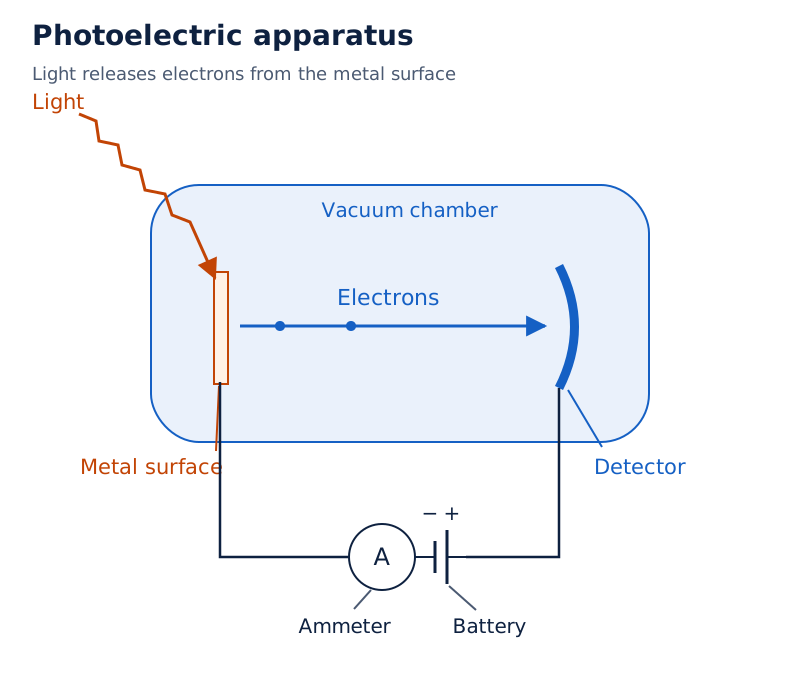
Light enters a vacuum chamber and strikes a metal surface. An electron arrow points towards a detector. The circuit includes a labelled ammeter and battery.
Drawn by One Young India. See Fig. 2.9 in your NCERT textbook
Worked example 5. A metal has threshold frequency . Find the electron kinetic energy for incident frequency .
Formula: .
Answer:
- Subtract frequencies: .
- Multiply by Planck’s constant: .
- Evaluate: .
How do atomic spectra reveal discrete energy levels?
How do emission and absorption spectra differ?
A continuous spectrum contains an uninterrupted range of wavelengths. White light dispersed by a prism produces a continuous visible spectrum. By contrast, excited gas-phase atoms emit radiation at specific wavelengths, producing bright lines separated by dark spaces.
An emission spectrum records radiation released by an energised substance. An absorption spectrum is obtained by passing continuous radiation through a sample. Absorbed wavelengths are missing from the transmitted light and appear as dark lines.
Each element has a characteristic line spectrum. These lines can identify elements in unknown samples. Their discrete positions show that electronic energy changes are restricted, rather than having every possible value.
Which series occur in hydrogen?
For hydrogen, the positive wavenumber of a spectral line is given by the Rydberg expression. Here is the lower level and the higher level:
| Series | Lower level | Higher levels | Spectral region |
|---|---|---|---|
| Lyman | Ultraviolet | ||
| Balmer | Visible | ||
| Paschen | Infrared | ||
| Brackett | Infrared | ||
| Pfund | Infrared |
In an emitting collection of atoms, different atoms undergo different allowed transitions. A single atom need not produce all lines at once. The intensity of a line depends on how many photons of that wavelength are emitted or absorbed.
What the figure shows
Hydrogen transitions
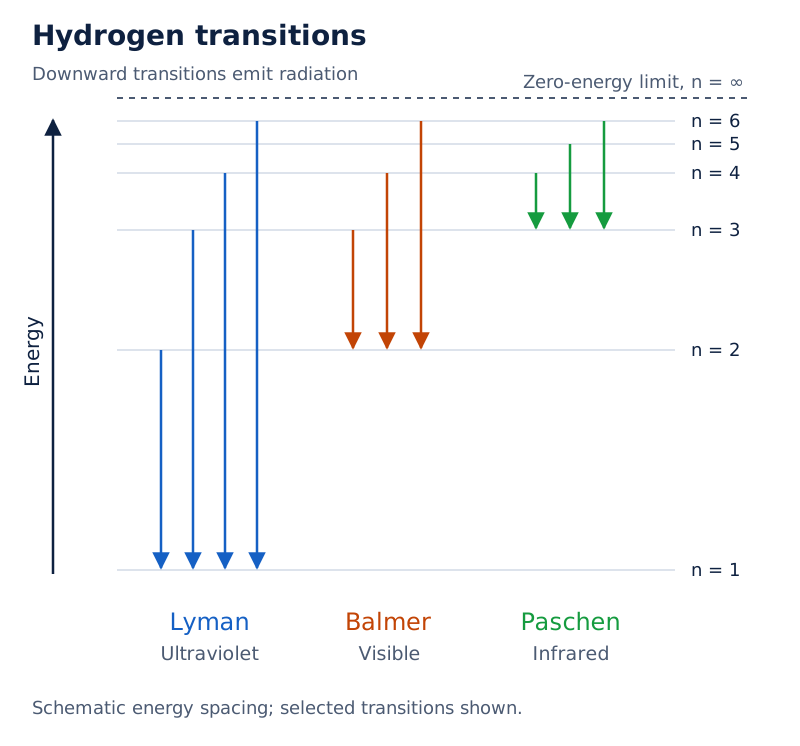
Horizontal energy levels crowd together towards the zero-energy limit. Downward arrows end at the first, second and third levels, labelled Lyman, Balmer and Paschen series. The diagram identifies ultraviolet, visible and infrared regions respectively.
Drawn by One Young India. See Fig. 2.11 in your NCERT textbook
How does Bohr’s model explain hydrogen energies and spectra?
What are the postulates and energy expressions?
Bohr proposed stationary states: permitted circular orbits with fixed radii and energies. An electron does not continuously lose energy while occupying one of these states. Energy is absorbed or emitted when it changes states.
The angular momentum is quantised: , where is the orbit radius, is the electron’s orbital speed and is the principal quantum number. The radiation frequency corresponds to the difference between the higher and lower energy levels divided by Planck’s constant.
For a hydrogen-like species containing one electron, is the electron’s energy and is its orbit radius in the state with principal quantum number . The permitted values are:
Hydrogen has . The same model applies to He⁺, Li²⁺ and Be³⁺. At fixed principal quantum number, increasing nuclear charge makes the radius smaller and the energy more negative.
The ground state is the lowest-energy state. A free electron infinitely far from the nucleus is assigned zero energy. Negative energy therefore indicates a bound electron, with energy lower than this reference. Removing it requires an energy input.
Derivation: energy change between hydrogen levels
Let and be the initial and final principal quantum numbers, respectively.
- Write the initial energy: .
- Write the final energy: .
- Subtract initial from final energy: .
- Collect the terms: .
Result: Absorption has ; emission has . The emitted photon’s energy is the positive magnitude .
Derivation: spectral frequency and wavenumber
- For emission from an upper level to a lower level , the emitted photon energy is .
- Use the photon relation: .
- Substitute Planck’s constant: .
- Divide by wave speed: .
Result: The level differences give the form of the Rydberg expression. Frequency and wavenumber remain positive for emitted radiation.
Worked example 6. Find the frequency and wavelength emitted in hydrogen when and .
Formula: , , .
Substitute: use the positive photon energy after calculating the atomic energy change.
Answer:
- Calculate the atomic change: .
- Calculate photon frequency: .
- Calculate wavelength using the unrounded frequency: . The transition belongs to the Balmer series.
What are the limitations of the model?
Bohr’s model cannot explain multi-electron spectra, fine details of hydrogen lines, splitting in magnetic or electric fields, or chemical bonding. It also ignores electron wave behaviour and assumes definite paths inconsistent with the uncertainty principle.
Why do matter waves and uncertainty rule out definite electron paths?
What is the de Broglie relation?
De Broglie proposed that moving matter has both particle and wave properties. The wavelength associated with a particle depends on its momentum, . For mass and speed , the relation is:
Electron diffraction provides evidence of this wave character. For ordinary objects, large masses make the associated wavelengths too short to detect. Electron wavelengths can be experimentally significant, and their wave behaviour is used in electron microscopy.
Worked example 7. Find the wavelength of a ball of mass moving at .
Formula: , .
Substitute: calculate the momentum first.
Answer:
- Calculate momentum: .
- Substitute: .
- Use to simplify: .
Worked example 8. An electron has mass and kinetic energy . Find its wavelength.
Formula: , .
Substitute: calculate speed and retain its unrounded value for wavelength.
Answer:
- Calculate squared speed: .
- Take the square root: .
- Calculate wavelength: .
What does the uncertainty principle state?
Heisenberg’s uncertainty principle prevents simultaneous exact determination of an electron’s position and momentum. Improving the precision of one increases uncertainty in the other. For the same spatial direction:
Here is the uncertainty in position along the x direction, is the uncertainty in the momentum component along that direction, and is the uncertainty in the corresponding velocity component.
A definite trajectory requires both position and velocity to be known precisely. This requirement cannot be met for an electron. The uncertainties are significant for microscopic particles but negligible in the motion of ordinary macroscopic objects.
What replaces an orbit in the quantum mechanical model?
What does a wave function represent?
Quantum mechanics incorporates wave-particle duality and the uncertainty principle. It describes microscopic systems through allowed energies and wave functions, instead of assigning electrons fixed circular paths.
For a system whose energy does not change with time, the Schrödinger equation is written , where is the wave function, is the energy of the state and is the Hamiltonian operator. This operator represents the system’s energy, including kinetic energy and the relevant attractive and repulsive interactions.
Solving this equation for hydrogen gives allowed energies and corresponding wave functions. Quantisation arises naturally from the acceptable solutions. Exact solutions for multi-electron atoms are not available in the same way, so approximate methods are used.
Definition: An atomic orbital is a one-electron wave function, , in an atom. It is specified by three quantum numbers and contains information about the electron’s allowed state.
How is probability different from a path?
The wave function itself has no direct physical meaning. Its squared magnitude, , gives probability density. Multiplying this by a sufficiently small volume gives the probability of finding the electron within that volume.
High probability density means a greater likelihood per unit volume. It does not show an electron travelling along a drawn line. The orbital describes a spatial probability distribution, whereas an orbit is a proposed trajectory.
Bound electrons have quantised energies. An orbital can contain at most two electrons. In multi-electron atoms, orbital energies depend on both the principal and azimuthal quantum numbers; in hydrogen-like species, energy depends on the principal quantum number alone.
How do the four quantum numbers describe electrons?
Which values are allowed?
The principal quantum number identifies the shell and influences orbital size and energy. Shells with successive values are named K, L, M and N. Increasing the principal quantum number generally increases orbital size.
The azimuthal quantum number identifies a subshell and its orbital shape. The magnetic orbital quantum number distinguishes spatial orientations. Electron spin is described separately; it does not supply another spatial orbital.
| Quantum number | Allowed values | Information |
|---|---|---|
| Principal, | Shell, size and energy information | |
| Azimuthal, | Subshell and orbital shape | |
| Magnetic orbital, | Orbital orientation | |
| Spin, | Electron spin orientation |
How many orbitals and electrons fit?
A shell has subshells and orbitals. A subshell has orbitals. Since each orbital can hold two electrons with opposite spins, a shell’s maximum electron capacity is .
| Subshell | Azimuthal value | Orbitals | Maximum electrons |
|---|---|---|---|
| s | 1 | 2 | |
| p | 3 | 6 | |
| d | 5 | 10 | |
| f | 7 | 14 |
The allowed numbers must be checked in sequence. Choose the shell first, then an allowed subshell, then an allowed magnetic value. An orbital is identified by this set of three numbers; specifying an electron also requires its spin quantum number.
Opposite spin values permit two electrons to occupy the same spatial orbital. They do not mean that the electrons occupy different subshells. Similarly, different magnetic values within one subshell identify different orbitals, rather than different shells.
What shapes and nodes do atomic orbitals have?
How should boundary surfaces be interpreted?
A boundary surface encloses a region with a high probability of containing the electron, commonly about 90%. It is a representation of the orbital, not a rigid container or a definite path.
All s orbitals are spherically symmetric. At a given distance from the nucleus, their probability density is the same in every direction. Higher s orbitals have larger spatial extent. A p orbital has two lobes on opposite sides of a nodal plane.
What the figure shows
s-orbital representations
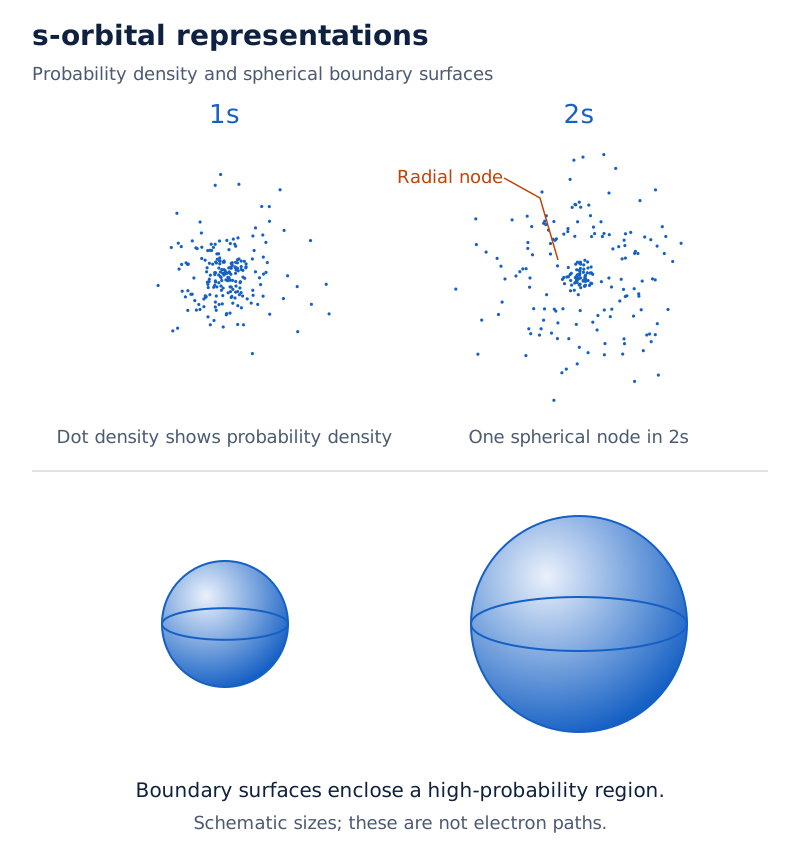
Dot-density pictures compare the and distributions. Beneath them, spherical boundary surfaces show the sphere larger than the sphere.
Drawn by One Young India. See Fig. 2.13 in your NCERT textbook
What the figure shows
Three p orbitals
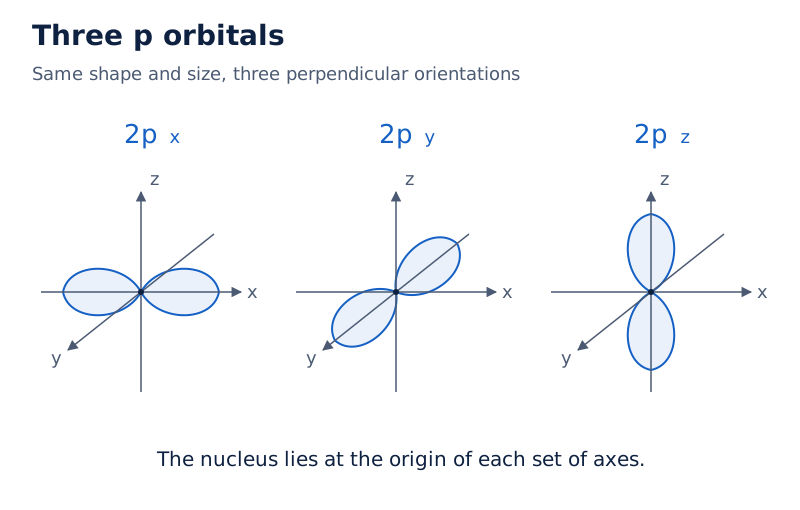
The drawings label , and against coordinate axes. Each has two lobes, with the three drawings showing different orientations.
Drawn by One Young India. See Fig. 2.14 in your NCERT textbook
The three p orbitals in one subshell have identical size, shape and energy but different orientations. There is no simple assignment of all three magnetic quantum number values to the three Cartesian directions.
What the figure shows
Five d orbitals
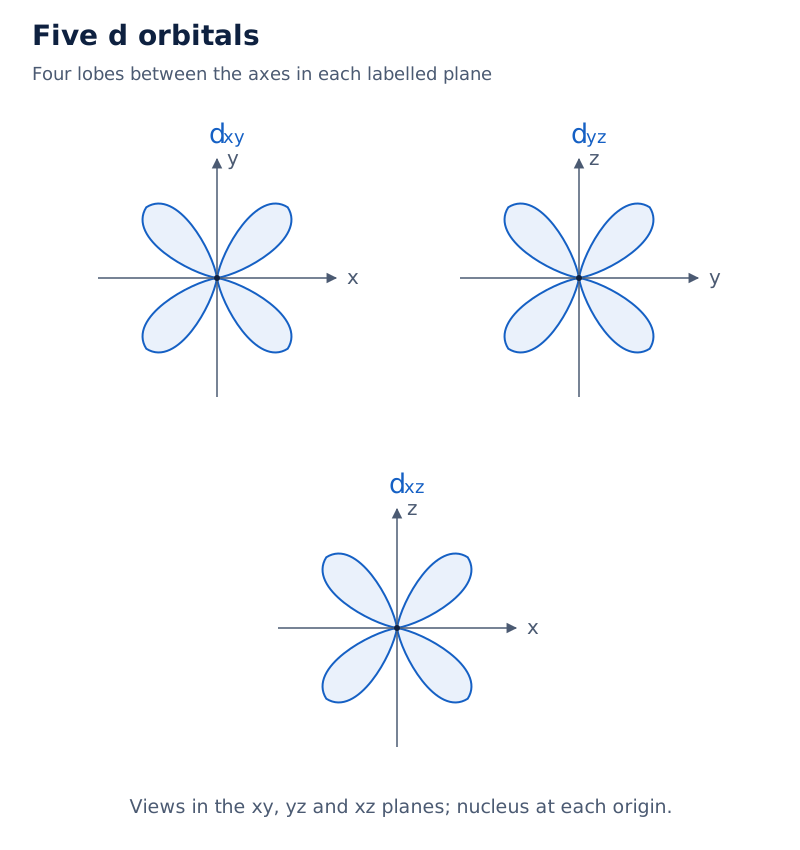
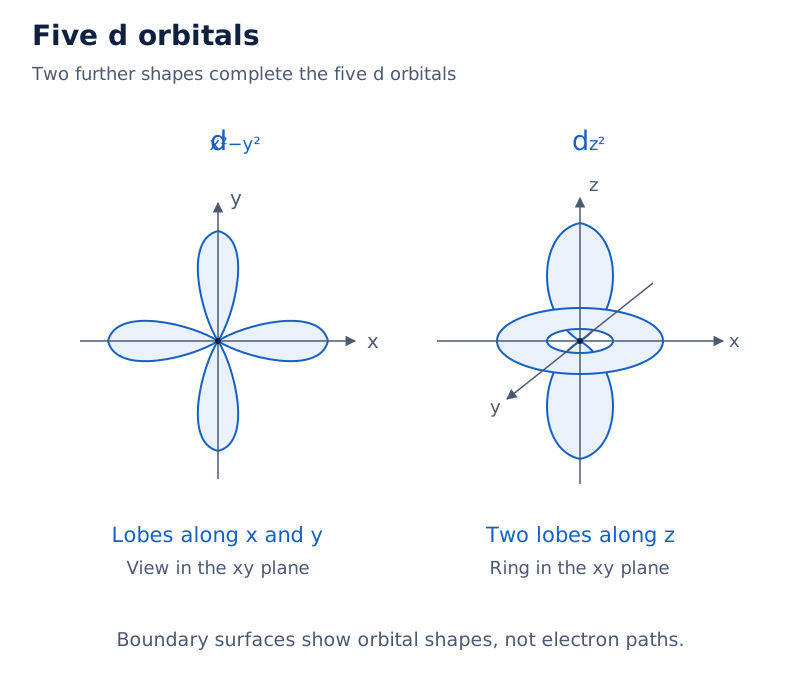
Four drawings show four-lobed shapes labelled , , and . The drawing has two axial lobes and a ring around the middle.
Drawn by One Young India. See Fig. 2.15 in your NCERT textbook
What are radial and angular nodes?
A node is a region where probability density is zero. Radial nodes occur at particular distances from the nucleus; angular nodes arise from the directional form of an orbital.
Writing the numbers of radial, angular and total nodes as , and , respectively:
The orbital has one radial node, whereas has two. The p orbitals have one angular node; the d orbitals have two. A nodal region must be distinguished from a boundary surface, which represents a chosen high-probability enclosure.
How are orbital energies and electronic configurations determined?
Why do multi-electron orbital energies differ?
In hydrogen, orbitals with the same principal quantum number are degenerate, meaning equal in energy. In multi-electron atoms, electron repulsion and shielding make energies depend on the subshell as well as the shell.
Inner electrons partly screen the nucleus from outer electrons. The remaining attraction is described using effective nuclear charge. Different orbital shapes produce different penetration and shielding, so subshells within the same shell need not have equal energies.
The rule is a useful guide: lower sums generally indicate lower energy. If two sums are equal, the smaller principal quantum number takes precedence. The filling order is a guide with exceptions, rather than a universal fixed ordering for every atom.
Which three rules control filling?
- Aufbau principle: In a ground-state atom, electrons fill available orbitals in order of increasing energy.
- Pauli exclusion principle: No two electrons in an atom have the same four quantum numbers. Two electrons in one orbital must have opposite spins.
- Hund’s rule: Degenerate orbitals in a subshell receive one electron each with parallel spins before pairing begins.
The useful initial filling sequence is . Orbital-box diagrams use arrows to show individual electrons and their spins. Superscript notation records how many electrons occupy each subshell.
| Atom | Electronic configuration | Filling feature |
|---|---|---|
| Hydrogen | One electron in the lowest orbital | |
| Helium | Two electrons with opposite spins | |
| Lithium | The next electron enters another shell | |
| Nitrogen | Three singly occupied p orbitals | |
| Neon | Filled second shell | |
| Chromium | Half-filled d subshell | |
| Copper | Filled d subshell |
Why are chromium and copper exceptions?
The close energies of the relevant subshells allow configurations with extra stability. Completely filled and half-filled subshells have symmetrical electron distributions. Parallel-spin electrons in degenerate orbitals also produce an exchange energy contribution that stabilises the arrangement.
Thus chromium and copper have the configurations shown above. This stability does not justify moving electrons arbitrarily in every element. The ground-state configuration must correspond to the lowest total electronic energy.
Glossary
- Electron — A negatively charged subatomic particle found as a constituent of every atom.
- Proton — A positively charged nuclear particle whose count determines the element’s atomic number.
- Neutron — An electrically neutral nuclear particle with a mass slightly greater than a proton’s.
- Isotopes — Atoms of the same element with identical atomic numbers but different mass numbers.
- Photon — A quantum of electromagnetic radiation with energy determined by its frequency.
- Work function — The minimum energy needed to eject an electron from a particular metal surface.
- Threshold frequency — The minimum radiation frequency required for photoelectric emission from a given metal.
- Ground state — The lowest available energy state of an atom or its electron arrangement.
- Atomic orbital — A one-electron wave function describing an allowed electronic state in an atom.
- Probability density — Probability per unit volume, represented by the squared magnitude of the orbital wave function.
- Node — A region in an orbital where the electron probability density becomes zero.
- Degenerate orbitals — Orbitals with equal energies, such as those within the same atomic subshell.
- Electronic configuration — The distribution of an atom’s electrons among its available atomic orbitals.
Common errors and misconceptions
- Misconception: Mass number is the electron count. Correct: It counts protons and neutrons. Electron count equals atomic number only for a neutral atom.
- Misconception: Isotopes have different proton numbers. Correct: Their proton numbers are identical; their neutron numbers and mass numbers differ.
- Misconception: Sufficiently bright light ejects electrons at any frequency. Correct: The radiation must reach the metal’s threshold frequency.
- Misconception: A negative atomic energy means a photon has negative energy. Correct: It denotes binding relative to a free electron. Emitted photons carry positive energy.
- Misconception: An orbital is a circular electron path. Correct: It is a wave function from which an electron probability distribution can be obtained.
- Misconception: A p subshell is one orbital holding six electrons. Correct: It contains three orbitals, each holding at most two electrons.
- Misconception: Electrons pair immediately in degenerate orbitals. Correct: Hund’s rule requires single occupation with parallel spins before pairing begins.
- Misconception: The usual filling sequence has no exceptions. Correct: Closely spaced orbital energies permit exceptions, including the ground-state configurations of chromium and copper.
Exam-style questions with model answers
Q1. Distinguish isotopes from isobars with examples. [2 marks]
- Isotopes have the same atomic number but different mass numbers, as in and .
- Isobars have the same mass number but different atomic numbers, as in and .
Q2. Explain Rutherford’s observations and the conclusions drawn from them. [3 marks]
- Most alpha particles crossed the thin gold foil without deflection. This indicated that most of the space inside an atom is empty.
- A small fraction changed direction. Repulsion of positive alpha particles showed that positive charge was concentrated in a small part of the atom.
- Very few particles bounced back. The model placed nearly all atomic mass and positive charge in a tiny nucleus, with electrons occupying the surrounding space.
Q3. Explain the roles of frequency and intensity in the photoelectric effect. [3 marks]
- Each metal has a threshold frequency. Radiation below this frequency does not eject electrons, even when its intensity is increased.
- A photon supplies energy . After the work function has been supplied, the remaining energy becomes electron kinetic energy: .
- Above threshold, increasing frequency increases kinetic energy. Increasing intensity at fixed frequency increases the number of photons and hence the number of emitted electrons, rather than their kinetic energy.
Q4. State Bohr’s postulates and discuss the limitations of the model. [5 marks]
- An electron can occupy certain stationary circular orbits with fixed energies and radii. Its energy does not change continuously while it remains in an allowed orbit.
- Its angular momentum is restricted by , with positive integral values of the principal quantum number.
- Absorption moves the electron to a higher state; emission accompanies movement to a lower state. Photon energy equals the magnitude of the difference between the two electronic energies.
- The model explains the main hydrogen spectrum and applies to one-electron ions. It does not explain multi-electron spectra, fine spectral details, Zeeman or Stark splitting, or chemical bonding.
- It ignores the electron’s wave character and assumes a definite path, conflicting with the uncertainty principle.
Q5. Describe the four quantum numbers and their allowed values. [5 marks]
- The principal quantum number has values . It identifies the shell and determines orbital size and much of the energy information.
- The azimuthal quantum number ranges from to . It identifies the subshell and orbital shape. The first four subshell labels are s, p, d and f.
- The magnetic orbital quantum number ranges from to in integral steps. It describes orientation, giving orbitals in the subshell.
- The spin quantum number has values and . It distinguishes the two spin orientations of an electron.
- Three quantum numbers identify an orbital. All four are required to distinguish electrons, and no two electrons in an atom share the complete set.
Q6. Distinguish an orbit from an orbital and explain probability density. [3 marks]
- An orbit is the definite circular path assumed in Bohr’s model. Such a precise electron trajectory is incompatible with simultaneous position and momentum uncertainty.
- An orbital is a one-electron wave function characterised by three quantum numbers. It describes an allowed state rather than a travelled path.
- The squared magnitude represents probability density. Multiplying it by a sufficiently small volume gives the probability of finding the electron within that volume.
Q7. Explain the three orbital-filling rules and chromium’s configuration. [4 marks]
- The aufbau principle fills available orbitals in increasing energy order for a ground-state atom.
- Pauli’s exclusion principle permits no identical sets of four quantum numbers. Each orbital therefore accommodates at most two electrons with opposite spins.
- Hund’s rule fills degenerate orbitals singly with parallel spins before pairing.
- Chromium has configuration . Its half-filled d subshell gains stability from symmetrical distribution and exchange energy, so the simple expected arrangement is modified.
Key takeaways
- Atoms contain electrons, protons and neutrons; atomic number counts protons, while mass number counts all nucleons.
- Rutherford’s scattering observations established a small concentrated nucleus, but classical electron orbits could not explain atomic stability.
- Electromagnetic radiation exhibits wave and particle behaviour; photon energy increases with frequency and decreases with wavelength.
- Photoelectric emission requires a threshold frequency; intensity controls electron number while frequency controls their kinetic energy.
- Hydrogen spectral lines arise from transitions between discrete energy levels, with photon energy equal to the magnitude of their difference.
- Matter waves and uncertainty replace definite electron trajectories with orbitals and spatial probability distributions in quantum mechanics.
- Quantum numbers describe shells, subshells, orbital orientations and spin, while Pauli’s principle limits each orbital to two electrons.
- Aufbau, Pauli and Hund guide electron arrangements, with chromium and copper illustrating important exceptions to the simple filling sequence.
Test yourself
Why did cathode rays imply that all atoms contain electrons?
Their properties remained independent of both the gas in the tube and the material of its electrodes.
What changes between different isotopes of one element?
The neutron number changes, producing different mass numbers while the proton number remains the same.
What does a negative bound-electron energy mean?
The electron has lower energy than a free electron infinitely far from the nucleus, whose energy is assigned zero.
Why can intense low-frequency light fail to eject electrons?
Individual photons may have less energy than the metal’s work function; greater intensity does not increase each photon’s energy.
Which lower level defines the Balmer series?
The lower level has ; emission involves transitions to it from higher permitted levels.
What is the difference between a node and an orbital boundary?
A node has zero probability density. A boundary surface encloses a chosen high-probability region and is not an electron path.
Why can two electrons occupy the same orbital?
They can share the three orbital quantum numbers while having opposite spin quantum numbers, satisfying Pauli’s exclusion principle.
When does pairing begin within the three p orbitals?
Pairing begins with the fourth electron, after each orbital has received one electron with parallel spin.