
Study of the First Element: Hydrogen | ICSE Class 9 Chemistry Notes
On this page
This note covers hydrogen’s position in the periodic table, its formation from water, dilute acids and alkalis, laboratory preparation and collection, removal of impurities, industrial manufacture by the Bosch process, and oxidation and reduction through oxygen, hydrogen and electron changes.
Why does hydrogen have a special position in the periodic table?
An element contains one kind of atom, the basic unit that identifies the element. A compound contains different elements chemically combined in a fixed proportion.
Hydrogen, symbol H, is the first element in the periodic table, the arrangement of elements by atomic number. Its atomic number is 1: each hydrogen atom has one proton, a positively charged particle in its central nucleus.
A neutral hydrogen atom also has one electron, a negatively charged particle. This is its sole valence electron, meaning an electron in the outermost occupied shell. A shell is an energy level occupied by electrons around the nucleus.
How does it resemble two different groups?
A group is a vertical column of the periodic table. Hydrogen resembles the alkali metals, the metals of Group 1, in having one valence electron. Loss of that electron gives H⁺, a hydrogen ion with one positive charge.
An ion is an atom or group of atoms carrying an electrical charge. Hydrogen can also gain one electron to form H⁻, the negatively charged hydride ion. Its first shell then contains two electrons, a complete duplet.
In gaining one electron to complete its outer shell, hydrogen resembles the halogens, the elements of Group 17. This resemblance does not make hydrogen a halogen or an alkali metal. It is a non-metal, an element lacking typical metallic properties such as good electrical conductivity, and has a special position at the top of the table.
What do its formula and burning show?
Hydrogen gas consists of diatomic molecules, meaning molecules with two atoms. Its formula is H₂. A molecule is a bonded group of atoms; the small ₂ means that each hydrogen molecule contains two hydrogen atoms. Hydrogen has valency 1, meaning a combining capacity of one.
Hydrogen burns in oxygen to form water. Oxygen gas has the formula O₂, and water has the formula H₂O. Oxygen’s element symbol is O. The balanced equation is 2H₂ + O₂ → 2H₂O; the arrow means “forms”.
This combustion, or burning reaction, illustrates hydrogen’s combination with oxygen. Formation of an oxide on burning is not enough to classify an element as a metal. Hydrogen’s electron arrangement, ion formation and non-metallic character must be considered together.
How do chemical equations and the activity series explain hydrogen preparation?
A reactant is a starting substance in a chemical reaction, while a product is a substance formed. Reactants appear to the left of the arrow in an equation and products to the right. A plus sign separates substances reacting together or produced together.
A balanced equation has equal numbers of atoms of each element on its two sides. A number written before a formula is a coefficient: it multiplies the whole formula. A subscript belongs to the formula and must not be changed merely to balance an equation.
What does the activity series predict?
An acid produces hydrogen ions in aqueous solution. Aqueous means dissolved in water. A solution is a uniform mixture in which a solute, the dissolved substance, is mixed with a solvent, the substance that dissolves it.
The activity series, also called the reactivity series, arranges metals in decreasing chemical reactivity. Hydrogen is included as a reference even though it is a non-metal. Metals above hydrogen can displace it from dilute acids such as hydrochloric acid.
Displacement means that one element replaces another in a compound. The position of a metal in the series helps explain whether hydrogen is liberated. The reaction conditions still matter: reacting with cold water and reacting with steam are different tests.
| Position or set | Symbols and names | Connection with hydrogen |
|---|---|---|
| Highly reactive metals | K: potassium; Na: sodium; Ca: calcium | React with cold water, with differing vigour |
| Metals above hydrogen | Mg: magnesium; Al: aluminium; Zn: zinc; Fe: iron | Displace hydrogen from dilute hydrochloric acid |
| Another metal above hydrogen | Pb: lead | Its position alone does not make it a convenient laboratory choice |
| Reference element | H: hydrogen | Separates metals that can displace it from dilute acids from those below it |
| Metals below hydrogen | Cu: copper; Hg: mercury; Ag: silver; Au: gold | Do not displace hydrogen from dilute hydrochloric acid |
Read the series together with the specified reagent, meaning the substance used to bring about a reaction. Dilute describes a solution containing relatively little dissolved substance compared with its solvent. A concentrated solution contains relatively more solute. Changing the acid, concentration or temperature can change the reaction observed.
How do cold water and hot water produce hydrogen with metals?
Potassium and sodium react violently with cold water. These reactions are exothermic, meaning they release heat. The heat released is sufficient for the hydrogen produced to catch fire. They are therefore unsuitable choices for a controllable laboratory preparation of hydrogen.
A hydroxide contains the hydroxide ion, OH⁻, a group of one oxygen and one hydrogen atom with one negative charge. The cold-water reactions form potassium hydroxide, KOH, and sodium hydroxide, NaOH, respectively, as well as hydrogen.
| Metal and condition | Balanced equation | Observation or product |
|---|---|---|
| Potassium with cold water | 2K + 2H₂O → 2KOH + H₂ | Violent reaction; hydrogen catches fire |
| Sodium with cold water | 2Na + 2H₂O → 2NaOH + H₂ | Violent reaction; hydrogen catches fire |
| Calcium with cold water | Ca + 2H₂O → Ca(OH)₂ + H₂ | Less violent reaction; gas bubbles stick to the metal |
| Magnesium with hot water | Mg + 2H₂O → Mg(OH)₂ + H₂ | Magnesium hydroxide and hydrogen form |
Why does calcium behave differently from sodium?
Calcium hydroxide has the formula Ca(OH)₂. Brackets show that the final subscript applies to the whole enclosed group: this formula contains two hydroxide groups. Calcium’s reaction releases insufficient heat for the hydrogen to catch fire.
Calcium starts floating because hydrogen bubbles formed during the reaction stick to its surface. The observation is therefore linked to gas production. It should not be explained as proof that the unreacted metal itself is less dense than water.
Why must the water condition be stated for magnesium?
Magnesium does not react with cold water in this comparison. It reacts with hot water to form magnesium hydroxide, Mg(OH)₂, and hydrogen. It also starts floating because hydrogen bubbles stick to its surface.
The word “hot” is part of the chemical description. A statement that magnesium reacts with water without specifying the condition loses the distinction between its behaviour and that of sodium or calcium. Likewise, the vigorous cold-water behaviour of sodium cannot be transferred to every metal.
For each reaction, connect four things: the named metal, the water condition, the balanced equation and the visible observation. Effervescence means the production of gas bubbles in a liquid. In these reactions, those bubbles contain hydrogen.
How does steam react with metals and carbon?
Steam is water in the gaseous state. Aluminium, zinc and iron do not react with either cold or hot water in the comparison above, but they react with steam to produce hydrogen and a metal oxide. An oxide is a compound of oxygen with another element.
Aluminium oxide is Al₂O₃, zinc oxide is ZnO, and the iron oxide formed in this reaction is Fe₃O₄. These products must be distinguished from the hydroxides formed in the cold-water and hot-water reactions already discussed.
| Heated metal | Balanced reaction with steam | Solid product |
|---|---|---|
| Aluminium | 2Al + 3H₂O → Al₂O₃ + 3H₂ | Aluminium oxide |
| Zinc | Zn + H₂O → ZnO + H₂ | Zinc oxide |
| Red-hot iron | 3Fe + 4H₂O → Fe₃O₄ + 4H₂ | Iron oxide, Fe₃O₄ |
What the figure shows
Action of steam on a metal
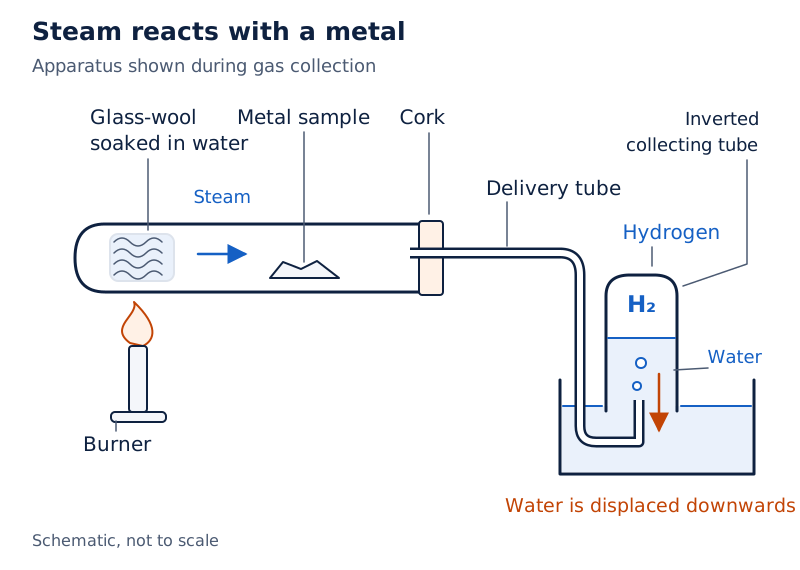
The horizontal tube contains glass-wool soaked in water and a metal sample. One burner is shown beneath the water-soaked glass-wool. A cork and delivery tube connect it to an inverted water-filled tube, where hydrogen collects above the water.
Drawn by One Young India.
Derivation: How is the iron and steam equation balanced?
Start with . Keep each chemical formula unchanged and adjust only the coefficients to conserve the atoms of every element.
- Balance oxygen first. One formula unit of Fe₃O₄ contains four oxygen atoms, so put 4 before H₂O: .
- The four water molecules contain eight hydrogen atoms. Put 4 before H₂ to give eight hydrogen atoms on the right: .
- The oxide contains three iron atoms. Put 3 before Fe: . Both sides now contain three iron atoms, eight hydrogen atoms and four oxygen atoms.
Balanced equation: . Here (s) means solid and (g) means gas. Writing H₂O(g) specifies steam.
Why is the iron reaction reversible?
A reversible reaction can proceed in either direction under suitable conditions. Passing steam over red-hot iron gives Fe₃O₄ and hydrogen. Conversely, passing hydrogen over heated Fe₃O₄ can regenerate iron and produce water vapour.
The reverse equation is Fe₃O₄ + 4H₂ → 3Fe + 4H₂O. The double arrow in 3Fe + 4H₂O ⇌ Fe₃O₄ + 4H₂ indicates reversibility. It does not mean that equal amounts of all four substances must be present.
In producing hydrogen, the gas is led away while steam is supplied to the heated iron. To demonstrate the reverse change, hydrogen is supplied to the heated oxide. State the supplied gas and the solid being heated, rather than treating both experiments as identical.
What happens when steam passes over carbon?
Carbon, symbol C, is a non-metal. Steam passed over red-hot coke, a carbon-rich solid, forms carbon monoxide and hydrogen: C + H₂O → CO + H₂. Carbon monoxide has the formula CO.
This mixture is called water gas. It is not pure hydrogen, because carbon monoxide is a second gaseous product. Its formation supplies the first stage of the Bosch process. The next stage uses additional steam to increase the hydrogen obtained.
How do dilute acids liberate hydrogen, and why are some reagents unsuitable?
Hydrochloric acid, HCl in water, and sulphuric acid, H₂SO₄, liberate hydrogen from suitable metals when dilute. Cl is the symbol for chlorine, and S is the symbol for sulphur. A salt forms when the metal replaces the acid’s hydrogen.
Magnesium, aluminium, zinc and iron lie above hydrogen in the activity series. They produce their chlorides with dilute hydrochloric acid and their sulphates with dilute sulphuric acid. The names chloride and sulphate identify the acid-derived parts of these salts.
| Metal | With dilute hydrochloric acid | With dilute sulphuric acid |
|---|---|---|
| Magnesium | Mg + 2HCl → MgCl₂ + H₂ | Mg + H₂SO₄ → MgSO₄ + H₂ |
| Aluminium | 2Al + 6HCl → 2AlCl₃ + 3H₂ | 2Al + 3H₂SO₄ → Al₂(SO₄)₃ + 3H₂ |
| Zinc | Zn + 2HCl → ZnCl₂ + H₂ | Zn + H₂SO₄ → ZnSO₄ + H₂ |
| Iron | Fe + 2HCl → FeCl₂ + H₂ | Fe + H₂SO₄ → FeSO₄ + H₂ |
The products are magnesium chloride or sulphate, aluminium chloride or sulphate, zinc chloride or sulphate, and iron(II) chloride or sulphate. The Roman numeral II indicates iron’s positive charge of two in these salts. Do not replace them with iron(III) salts.
How does the choice of metal affect the preparation?
With dilute hydrochloric acid, reactivity decreases in the order magnesium, aluminium, zinc, iron. Magnesium gives the fastest bubbling in this comparison. Copper gives no bubbles and no temperature change because it does not react with dilute hydrochloric acid.
Sodium and potassium are too vigorous for this preparation. Lead develops a coating of sparingly soluble lead chloride or lead sulphate, which obstructs further reaction. Aluminium’s surface oxide can delay its reaction, while iron reacts more slowly than zinc.
Granulated zinc, zinc in small grains, gives a convenient, controllable gas supply with a suitable dilute acid. Pure zinc reacts slowly; small metallic impurities in commercial granulated zinc help the reaction proceed more readily. Copper, silver and gold are unsuitable because they lie below hydrogen. A metal’s availability alone does not determine whether it can liberate hydrogen.
Why is nitric acid not the usual choice?
Nitric acid, HNO₃, contains nitrogen, symbol N. It is a strong oxidising agent, a substance that causes oxidation of another substance. Here oxidation means the addition of oxygen to hydrogen. Thus it converts the hydrogen formed into water and is itself converted into nitrogen oxides.
There is a stated exception: magnesium and manganese react with very dilute nitric acid to evolve hydrogen. Manganese has the symbol Mn. Retain both qualifications, the named metals and “very dilute”; “nitric acid never gives hydrogen” is incorrect.
Hot concentrated sulphuric acid is also unsuitable for the ordinary preparation because it can act as an oxidising agent. The instruction to use dilute acid is therefore part of the method, not an optional detail.
How do aluminium, zinc and lead liberate hydrogen from alkalis?
An alkali is a base soluble in water; a base reacts with an acid to form salt and water. Sodium hydroxide and potassium hydroxide are alkalis. With suitable heating, concentrated alkaline solutions react with aluminium, zinc and lead to liberate hydrogen.
This behaviour is associated with the amphoteric character of their oxides and hydroxides, meaning their ability to react with both acids and bases. Do not generalise the reaction to all metals: producing hydrogen with an acid does not guarantee the same behaviour with an alkali.
Which equations represent these reactions?
The following are the conventional equations using aluminate, zincate and plumbite formulae for the aluminium-, zinc- and lead-containing products. Water is included where required to balance hydrogen and oxygen. The corresponding potassium compounds form when potassium hydroxide is used.
| Metal and alkali | Balanced equation on warming | Named salt product |
|---|---|---|
| Aluminium and sodium hydroxide | 2Al + 2NaOH + 2H₂O → 2NaAlO₂ + 3H₂ | Sodium aluminate |
| Aluminium and potassium hydroxide | 2Al + 2KOH + 2H₂O → 2KAlO₂ + 3H₂ | Potassium aluminate |
| Zinc and sodium hydroxide | Zn + 2NaOH → Na₂ZnO₂ + H₂ | Sodium zincate |
| Zinc and potassium hydroxide | Zn + 2KOH → K₂ZnO₂ + H₂ | Potassium zincate |
| Lead and sodium hydroxide | Pb + 2NaOH → Na₂PbO₂ + H₂ | Sodium plumbite |
| Lead and potassium hydroxide | Pb + 2KOH → K₂PbO₂ + H₂ | Potassium plumbite |
For zinc and sodium hydroxide, the reaction produces sodium zincate and hydrogen. It does not produce zinc hydroxide as the final salt in this representation. Writing the correct product formula is necessary before balancing the equation.
Compare aluminium’s equation with zinc’s. Aluminium produces three hydrogen molecules for every two aluminium atoms represented, while zinc’s displayed equation produces one hydrogen molecule for each zinc atom. These are equation coefficients, not measured volumes or masses.
Note: These equations use conventional school-level salt formulae. Keep each formula intact while balancing. Changing Na₂ZnO₂ into a different formula to make the atom counts agree changes the named product rather than balancing its equation.
How is hydrogen prepared, collected and tested in the laboratory?
The standard laboratory method uses granulated zinc and dilute sulphuric acid, with dilute hydrochloric acid as an alternative. The sulphuric acid reaction is Zn + H₂SO₄ → ZnSO₄ + H₂. The zinc sulphate remains in the reaction mixture while hydrogen leaves as a gas.
Hydrogen is sparingly soluble in water, meaning only a small amount dissolves. It can therefore be collected over water by downward displacement of water: incoming gas occupies space in an inverted, initially water-filled vessel and pushes the water out.
What is the function of each part of the apparatus?
| Part | Arrangement | Function |
|---|---|---|
| Generating flask | Contains zinc and dilute acid | Provides the site of hydrogen formation |
| Thistle funnel | A funnel with a long stem dipping below the liquid level | Allows acid addition while preventing gas escaping through the stem |
| Delivery tube | Leads from above the liquid to the collecting vessel | Carries the gas out of the flask |
| Water trough and inverted gas jar | The jar begins filled with water, with its mouth under water | Allow gas collection by displacement of water |
Diagram
Laboratory preparation and collection of hydrogen
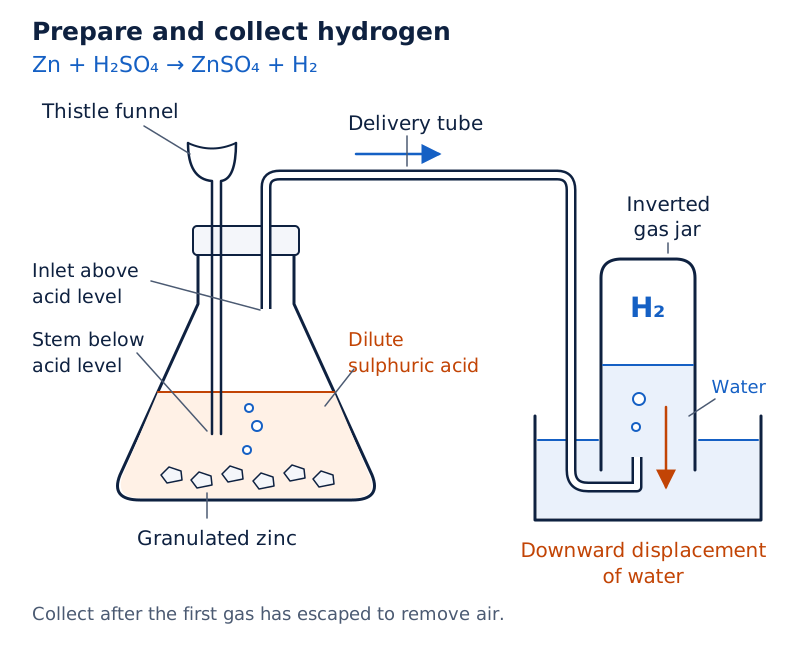
Draw a stoppered flask containing zinc and dilute sulphuric acid. Show the thistle-funnel stem below the acid level and the delivery-tube inlet above it. Lead the delivery tube beneath an inverted water-filled gas jar in a water trough.
Drawn by One Young India.
What sequence and precautions are necessary?
- Arrange the zinc, flask, funnel, delivery tube and collecting vessel so that gas follows the intended route without leaking from the stopper.
- Add dilute acid to contact the zinc. Observe effervescence as hydrogen forms and leaves the reaction mixture.
- Allow the first gas to escape safely because the apparatus initially contains air. This initial gas is not a pure hydrogen sample.
- Collect the later gas over water. Keep flames away from the generating flask and gas delivery system.
- For identification, test a small separate sample under laboratory supervision. Hydrogen burns with a characteristic pop in the small-sample test.
The initial escape of gas removes air from the apparatus. A hydrogen-air mixture can be explosive, so the pop test must not be attempted at the mouth of the generating flask. Gas collection and a separate identification test serve different purposes.
What the figure shows
Testing hydrogen formed from zinc and acid
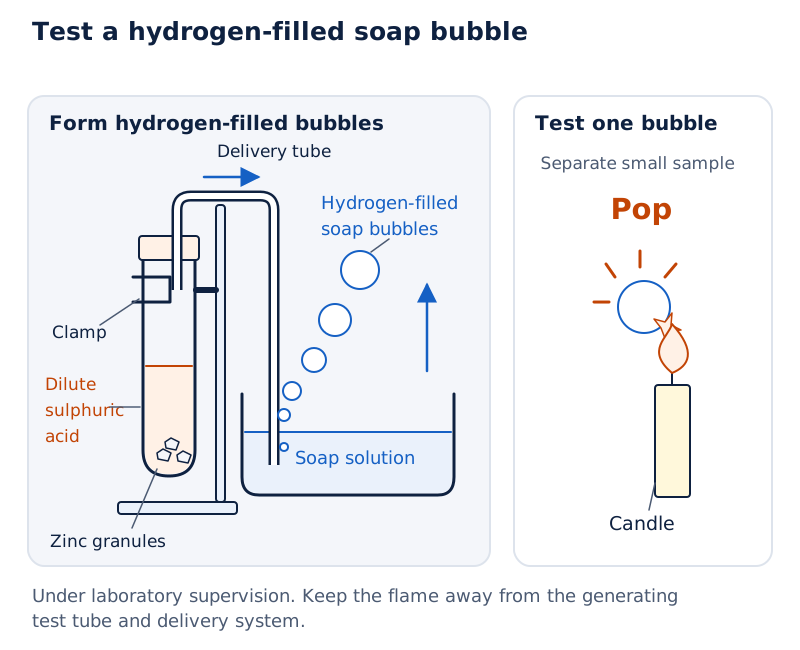
A clamped test tube holds zinc granules and dilute sulphuric acid. A delivery tube dips into soap solution. Hydrogen-filled soap bubbles rise, and a candle is shown producing a pop as a bubble burns.
Drawn by One Young India.
Collection over water yields moist gas, gas containing water vapour. If dry hydrogen is required, drying must be included in a suitable gas-handling arrangement. Collecting a gas over water after drying it would introduce water vapour again.
How are impurities removed from laboratory hydrogen?
Purification removes unwanted substances from a gas. Hydrogen prepared using commercial zinc may contain impurities derived from the zinc or reagents. Removing these impurities is different from expelling the air initially present in the apparatus.
Possible gaseous impurities include hydrogen sulphide, H₂S; phosphine, PH₃; arsine, AsH₃; carbon dioxide, CO₂; and sulphur dioxide, SO₂. P denotes phosphorus and As denotes arsenic. These are possible contaminants, not substances that must occur in every preparation.
How does a purification train work?
A wash bottle makes the gas pass through a selected liquid. The liquid removes particular impurities by absorption or reaction. Several stages can be used in sequence because one washing reagent need not remove every contaminant.
| Unwanted substance | Removal material | Purpose |
|---|---|---|
| Hydrogen sulphide | Lead nitrate solution | Removes hydrogen sulphide by formation of insoluble lead sulphide |
| Phosphine and arsine | Silver nitrate solution | Removes these impurities from the gas stream |
| Carbon dioxide and sulphur dioxide | Potassium hydroxide solution | Absorbs these acidic gases |
| Water vapour | Anhydrous calcium chloride | Dries the gas after wet purification |
A precipitate is an insoluble solid formed in a solution. Lead sulphide is the precipitate produced when lead nitrate solution removes hydrogen sulphide. Anhydrous means without water of crystallisation, the water incorporated into a substance’s crystalline structure.
A drying agent removes moisture without being used to make the gas itself. Anhydrous calcium chloride is therefore placed after liquid washing stages. Washing a dried gas through another aqueous solution would expose it to moisture again; aqueous means dissolved in water.
Keep three tasks distinct: discarding the first gas removes air, washing removes specified chemical impurities, and drying removes water vapour. A sample can be dry yet chemically impure, or chemically purified yet moist.
How does the Bosch process manufacture hydrogen?
The Bosch process manufactures hydrogen from steam and coke through water gas. It combines gas formation, conversion of carbon monoxide and separation of unwanted gases. Hydrogen is present after the first reaction, but that initial mixture is not the purified product.
What are the main reactions and conditions?
- Pass steam over red-hot coke at about 1000°C. The symbol °C means degrees Celsius, a unit of temperature. Carbon reacts with steam: C + H₂O → CO + H₂.
- Mix the resulting water gas with additional steam. The extra steam supplies water for reaction with the carbon monoxide already formed.
- Pass the mixture over iron(III) oxide with chromium(III) oxide at about 450°C. Iron(III) oxide, Fe₂O₃, acts as a catalyst, changing reaction rate without being consumed overall; chromium(III) oxide, Cr₂O₃, acts as a promoter, improving the catalyst’s effectiveness. Cr is the symbol for chromium, and III indicates a positive charge of three in these oxides.
- Carbon monoxide reacts with steam: CO + H₂O → CO₂ + H₂. This forms further hydrogen and converts carbon monoxide into carbon dioxide.
- Remove carbon dioxide and the remaining carbon monoxide from the hydrogen-containing mixture in separate purification stages.
A catalyst changes the rate of a reaction without being consumed overall. A promoter improves a catalyst’s effectiveness. The second reaction is the water-gas shift reaction. Its carbon dioxide product should not be confused with the carbon monoxide present in the original water gas.
How are carbon dioxide and carbon monoxide separated?
Carbon dioxide can be removed by washing with water under pressure. Remaining carbon monoxide is absorbed by ammoniacal cuprous chloride, a copper(I) chloride solution containing ammonia. Ammonia is the compound NH₃. The numeral I denotes copper’s positive charge of one.
The two removal stages have different targets. Removing carbon dioxide does not establish that carbon monoxide has also been removed. Likewise, forming more hydrogen in the shift reaction does not itself complete purification.
Diagram
Stages of the Bosch process
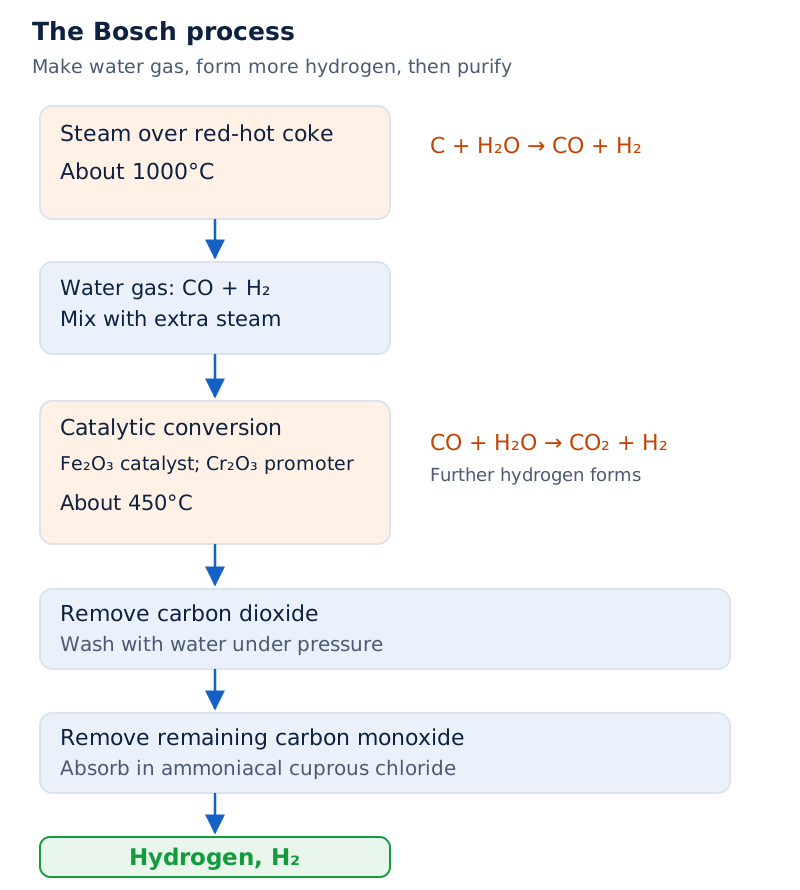
Draw connected boxes for steam over red-hot coke, water gas mixed with extra steam, catalytic conversion, carbon dioxide removal and carbon monoxide removal. Label the final gas hydrogen. Put each reaction and its temperature beside the appropriate conversion box.
Drawn by One Young India.
Adding the two reaction equations and cancelling the intermediate carbon monoxide gives C + 2H₂O → CO₂ + 2H₂. An intermediate is formed in one stage and used in a later stage. This combined equation summarises the chemistry but does not replace the separate conditions and purification steps.
How do oxidation, reduction and electron transfer describe hydrogen reactions?
Oxidation is addition of oxygen or removal of hydrogen. Reduction is removal of oxygen or addition of hydrogen. These descriptions identify the change undergone by a particular substance, so both the starting substance and its product must be examined.
What happens when hydrogen passes over heated copper oxide?
Copper(II) oxide, CuO, is black. Passing hydrogen over the heated oxide produces brown copper and water: CuO + H₂ → Cu + H₂O. Copper(II) oxide loses oxygen, while hydrogen gains it. The same oxygen transfer explains both changes.
Copper(II) oxide is reduced because oxygen is removed from it. Hydrogen is oxidised because oxygen is added to it. A redox reaction is one in which oxidation and reduction occur simultaneously.
A reducing agent causes reduction of another substance and is itself oxidised. Hydrogen is the reducing agent here. An oxidising agent causes oxidation of another substance and is itself reduced. Copper(II) oxide is the oxidising agent in this reaction.
| Basis of comparison | Oxidation | Reduction |
|---|---|---|
| Oxygen | Gain of oxygen | Loss of oxygen |
| Hydrogen | Loss of hydrogen | Gain of hydrogen |
| Electrons | Loss of electrons | Gain of electrons |
| Agent undergoing the change | The reducing agent is oxidised | The oxidising agent is reduced |
How does the electron definition extend these ideas?
In the electronic concept, oxidation is loss of electrons and reduction is gain of electrons. The symbol e⁻ denotes one electron. A half-reaction records one electron-loss or electron-gain part of the overall change.
For zinc reacting with acid, zinc loses two electrons: Zn → Zn²⁺ + 2e⁻. Zn²⁺ denotes a zinc ion carrying two positive charges. Hydrogen ions accept those electrons: 2H⁺ + 2e⁻ → H₂. H⁺ is the usual shorthand for hydrogen ions in aqueous acid.
In water, a hydrogen ion is associated with water molecules; H₃O⁺, the hydronium ion, represents its combination with one water molecule. Writing H⁺ in the simplified half-reaction does not mean that isolated, bare hydrogen ions exist freely in the solution.
The two half-reactions contain equal numbers of electrons lost and gained. Adding them cancels the electrons and gives Zn + 2H⁺ → Zn²⁺ + H₂. Zinc is oxidised and acts as the reducing agent; hydrogen ions are reduced and act as the oxidising agent.
Derivation: How do electron transfers give the sodium hydride equation?
In forming sodium hydride, NaH, hydrogen gains electrons and is reduced. The ionic compound contains sodium ions, Na⁺, and hydride ions, H⁻. Combining the electron changes gives the overall reaction.
- Two sodium atoms each lose one electron. The oxidation half-reaction is .
- One hydrogen molecule gains those two electrons to form two hydride ions. The reduction half-reaction is .
- Add the half-reactions and cancel the two electrons lost and gained. The two sodium ions and two hydride ions constitute two formula units of NaH, giving .
Overall equation: . Sodium is oxidised and acts as the reducing agent; hydrogen is reduced and acts as the oxidising agent.
Do not assign a permanent role to hydrogen based on one example. Determine whether it gains or loses electrons in the reaction being considered. Its role with copper(II) oxide differs from its role in sodium hydride formation.
Glossary
- Valence electron — An electron in the outermost occupied shell of an atom, involved in its chemical behaviour.
- Diatomic molecule — A molecule containing two atoms, as in a molecule of hydrogen gas.
- Activity series — An arrangement of metals in decreasing reactivity, with hydrogen included as a reference.
- Displacement — A reaction in which one element replaces another element in a compound.
- Exothermic reaction — A chemical reaction that releases heat to its surroundings as products form.
- Alkali — A base soluble in water, such as sodium hydroxide or potassium hydroxide.
- Amphoteric — Able to react with both acids and bases, as certain metal oxides and hydroxides do.
- Water gas — A mixture of carbon monoxide and hydrogen formed by reacting steam with hot carbon.
- Catalyst — A substance that changes a reaction’s rate without being consumed in the overall reaction.
- Oxidation — Loss of electrons, also described through oxygen gain or hydrogen loss in appropriate reactions.
- Reduction — Gain of electrons, also described through oxygen loss or hydrogen gain in appropriate reactions.
- Oxidising agent — A substance that causes oxidation of another substance and is itself reduced.
- Reducing agent — A substance that causes reduction of another substance and is itself oxidised.
- Redox reaction — A chemical reaction in which oxidation and reduction take place together.
Common errors and misconceptions
- Misconception: Hydrogen is an alkali metal because it has one valence electron. Correct: It is a non-metal with similarities to both Group 1 and Group 17 elements.
- Misconception: Every metal releases hydrogen from cold water. Correct: Water reactions depend on the metal and conditions; magnesium needs hot water in the stated comparison.
- Misconception: Iron and steam form iron(III) oxide, Fe₂O₃. Correct: The reaction produces Fe₃O₄ and hydrogen, with red-hot iron.
- Misconception: Nitric acid never gives hydrogen with a metal. Correct: Magnesium and manganese evolve hydrogen with very dilute nitric acid.
- Misconception: The first gas from the preparation flask is pure hydrogen. Correct: It contains air initially present in the apparatus and must escape before collection.
- Misconception: Water gas is another name for pure hydrogen. Correct: It contains carbon monoxide as well as hydrogen.
- Misconception: A reducing agent is itself reduced. Correct: It causes another substance’s reduction and is itself oxidised.
- Misconception: Dry hydrogen must also be free of other impurities. Correct: Drying removes water vapour; separate treatments remove other unwanted gases.
Exam-style questions with model answers
Q1. A neutral hydrogen atom has one electron. It may lose this electron or gain one to complete its first shell. Explain its resemblance to Group 1 and Group 17 elements. [2 marks]
- Hydrogen resembles Group 1 elements because it has one valence electron and can lose it to form a positively charged ion.
- It resembles Group 17 elements because it can gain one electron to complete its outer shell, forming a negatively charged hydride ion.
Q2. Sodium reacts violently with cold water and its hydrogen catches fire. Calcium reacts less violently, releases insufficient heat to ignite hydrogen, and develops surface bubbles. Explain the different burning observations and why calcium floats. [3 marks]
- Sodium’s reaction is sufficiently exothermic to ignite the hydrogen being produced. The flame is therefore linked to the heat released by the vigorous reaction.
- Calcium’s less violent reaction releases insufficient heat to ignite the hydrogen, so hydrogen production does not produce the same burning observation.
- Hydrogen bubbles stick to calcium’s surface and cause it to float. Floating should not be taken as proof that the unreacted metal is less dense than water.
Q3. Heated iron reacts with steam to form Fe₃O₄ and H₂; hydrogen passed over the heated oxide reforms iron and water vapour. Balance both equations and explain the meaning of reversibility in this example. [3 marks]
- The forward equation is 3Fe + 4H₂O → Fe₃O₄ + 4H₂. Steam is supplied to red-hot iron, and hydrogen is produced.
- The reverse equation is Fe₃O₄ + 4H₂ → 3Fe + 4H₂O. Hydrogen is supplied to the heated oxide, forming iron and water vapour.
- Reversibility means that the change can proceed in either direction under suitable conditions. It does not require equal amounts of all reactants and products.
Q4. A laboratory has granulated zinc, dilute sulphuric acid, a flask, a thistle funnel, a delivery tube, a water trough and a gas jar. Zinc forms zinc sulphate and hydrogen; hydrogen is sparingly soluble in water and forms an explosive mixture with air. Describe its preparation and collection with necessary precautions. [5 marks]
- Put granulated zinc in the flask and add dilute sulphuric acid. The reaction is Zn + H₂SO₄ → ZnSO₄ + H₂, with gas bubbles showing hydrogen formation.
- Fit the flask so that gas travels through the delivery tube. Keep the thistle-funnel stem below the acid level to prevent gas escaping through it.
- Allow the first gas to escape safely before collection, because the apparatus initially contains air and this first gas is mixed with it.
- Collect the later hydrogen in an inverted water-filled gas jar over the trough. Its low solubility permits collection by downward displacement of water.
- Keep flames away from the generating flask and delivery system because hydrogen mixed with air can explode. Any identification test uses a small separate sample.
Q5. Nitric acid oxidises hydrogen to water during many metal-acid reactions. Magnesium and manganese are exceptions when the acid is very dilute. Explain why nitric acid is not the standard acid for preparing hydrogen and state the qualified exception. [2 marks]
- Nitric acid acts as an oxidising agent and converts the hydrogen produced into water, so it is not the standard acid for hydrogen preparation.
- Magnesium and manganese can evolve hydrogen with very dilute nitric acid. The exception requires both the specified metals and the very dilute condition.
Q6. In a Bosch-process description, steam reacts with coke at about 1000°C to form CO and H₂. Additional steam converts CO to CO₂ and H₂ at about 450°C over Fe₂O₃ with Cr₂O₃. Carbon dioxide is washed out with water under pressure, and remaining CO is absorbed by ammoniacal cuprous chloride. Explain these stages and distinguish the catalyst from the promoter. [5 marks]
- Steam reacts with red-hot coke to form water gas: C + H₂O → CO + H₂. The stated temperature for this first stage is about 1000°C.
- Additional steam reacts with carbon monoxide through CO + H₂O → CO₂ + H₂. This shift reaction at about 450°C increases the hydrogen produced.
- Iron(III) oxide, Fe₂O₃, is the catalyst, while chromium(III) oxide, Cr₂O₃, is the promoter that improves the catalyst’s effectiveness in the conversion stage.
- Water under pressure removes carbon dioxide from the resulting mixture. This separation is distinct from the preceding reaction that forms additional hydrogen.
- Ammoniacal cuprous chloride removes remaining carbon monoxide. Removing carbon dioxide alone would leave any residual carbon monoxide with the hydrogen, so a separate treatment is needed.
Q7. Hydrogen passes over heated black copper(II) oxide: CuO + H₂ → Cu + H₂O. The solid becomes brown copper. Identify the reduced substance, oxidised substance, reducing agent and oxidising agent, explaining each choice. [4 marks]
- Copper(II) oxide is reduced because it loses oxygen and becomes copper. The black solid’s change to brown copper is the stated observation.
- Hydrogen is oxidised because it gains oxygen and becomes water. Its change accompanies the removal of oxygen from copper(II) oxide.
- Hydrogen is the reducing agent because it removes oxygen from copper(II) oxide. The reducing agent is itself oxidised during the reaction.
- Copper(II) oxide is the oxidising agent because it supplies oxygen to hydrogen. The oxidising agent is itself reduced during this redox reaction.
Q8. Consider the half-reactions Zn → Zn²⁺ + 2e⁻ and 2H⁺ + 2e⁻ → H₂, where e⁻ denotes an electron. Explain the oxidation and reduction, combine the half-reactions, and identify both agents. [4 marks]
- Zinc loses two electrons to form a zinc ion carrying two positive charges. Loss of electrons identifies this half-reaction as oxidation.
- Hydrogen ions gain the two electrons to form hydrogen gas. Gain of electrons identifies this half-reaction as reduction.
- The equal electron terms cancel on adding the half-reactions, giving the overall equation Zn + 2H⁺ → Zn²⁺ + H₂.
- Zinc is the reducing agent because it donates electrons, while hydrogen ions are the oxidising agent because they accept those electrons.
Key takeaways
- Hydrogen is a non-metal with one valence electron and similarities to both Group 1 and Group 17 elements.
- The metal and water condition determine hydrogen formation: distinguish cold water, hot water and steam reactions.
- Red-hot iron reacts with steam to form Fe₃O₄ and hydrogen, and the change can be reversed under suitable conditions.
- Dilute hydrochloric and sulphuric acids liberate hydrogen from suitable metals above hydrogen in the activity series.
- Aluminium, zinc and lead can also liberate hydrogen from alkalis; this behaviour must not be generalised to all metals.
- Laboratory preparation requires controlled gas generation, removal of initial air and collection based on hydrogen’s low solubility.
- The Bosch process forms water gas, converts carbon monoxide using extra steam, and separately removes unwanted carbon gases.
- Oxidation means electron loss and reduction means electron gain; an agent’s own change differs from the change it causes.
Test yourself
Why does H₂ describe a diatomic molecule?
The subscript ₂ shows that one hydrogen molecule contains two hydrogen atoms bonded together.
What products form when magnesium reacts with hot water?
Magnesium hydroxide and hydrogen form: Mg + 2H₂O → Mg(OH)₂ + H₂. The hot-water condition is essential to this description.
Why is copper unsuitable for preparing hydrogen with dilute hydrochloric acid?
Copper lies below hydrogen in the activity series and does not displace hydrogen from dilute hydrochloric acid.
What salt forms when zinc reacts with sodium hydroxide in the conventional equation?
Sodium zincate, Na₂ZnO₂, forms along with hydrogen: Zn + 2NaOH → Na₂ZnO₂ + H₂.
Why must the first gas escape before hydrogen is collected?
It contains air initially present in the apparatus. Hydrogen mixed with air can be explosive.
What is the difference between water gas and water vapour?
Water gas is a mixture of carbon monoxide and hydrogen. Water vapour is gaseous water, H₂O.
What distinguishes purification from drying?
Purification removes unwanted chemical substances; drying specifically removes water vapour. A dry sample can still contain other impurities.
Why is hydrogen a reducing agent in its reaction with heated copper(II) oxide?
Hydrogen removes oxygen from copper(II) oxide, reducing it to copper. Hydrogen itself gains oxygen and is oxidised to water.
Write about it
Turn a question from this chapter into a paper.
The Writing Studio has a structure guide, a rubric and citation tools for 15 formats, from essays to research papers. Drafting is free with an account. Learnacy Essential adds feedback from an AI writing coach and submission to The OYI Review.
Learnacy Essential is ₹1,499 for the year. Publication depends on review and is not guaranteed.