
Water | ICSE Class 9 Chemistry Notes
On this page
This note covers water as a solvent, solutions, suspensions and colloids, saturation and solubility curves, crystallisation, hydrated and anhydrous substances, changes caused by atmospheric moisture, drying and dehydrating agents, water hardness, softening methods and the purification of drinking water.
Why is water called a universal solvent?
What dissolves in water?
A solvent is a substance that dissolves another substance. The substance being dissolved is the solute, and the resulting homogeneous mixture is a solution. Homogeneous means that the composition is uniform throughout the mixture.
In sugar solution, sugar is the solute and water is the solvent. Common salt also forms a solution in water. Water is called a universal solvent because it dissolves a wide variety of substances. This description does not mean that water dissolves every substance.
Sand remains undissolved in water, while oil and water form separate layers. These examples show why the word universal must be understood carefully. Dissolving a substance and merely mixing it with water are different outcomes.
How is a solution a mixture?
A mixture contains substances physically combined. A compound contains elements chemically combined in a fixed proportion; an element contains one kind of atom, the basic particle of an element. A sugar solution can contain different proportions of sugar and water. A well-stirred sugar solution has the same composition throughout, whereas a mixture of sand and water is non-uniform.
A non-uniform mixture is called heterogeneous. The sand particles can be seen and settle on standing. Observations such as uniformity, settling and passage through filter paper help distinguish mixtures that may initially look similar.
Definition: An aqueous solution is a solution in which water is the solvent. The word aqueous identifies the solvent; it does not specify which solute is dissolved or how much is present.
Water has the chemical formula H₂O. Here H represents hydrogen, O represents oxygen, and the small numeral ₂ indicates two hydrogen atoms in each water molecule. A molecule is a group of bonded atoms; an atom is a basic particle of an element.
Keeping these ideas separate is useful: H₂O represents the compound water, but salt solution represents a mixture containing water and dissolved salt. A clear appearance alone does not establish that a sample contains pure water.
How do solutions, suspensions and colloids differ?
What do the particles reveal?
A suspension is a heterogeneous mixture in which undissolved particles remain distributed through a medium for a time. Sand in water is an example. Its particles are visible to the naked eye and settle when the mixture is left undisturbed.
A colloid contains particles larger than those of a solution but smaller than those of a suspension. Milk is an example. Colloidal particles remain dispersed and do not settle on standing, although the mixture is heterogeneous.
The size unit nanometre, written nm, means one billionth of a metre. Solution particles have diameters below 1 nm; colloidal particles have diameters from 1 to 1000 nm; suspension particles have diameters above 1000 nm.
| Property | Solution | Suspension | Colloid |
|---|---|---|---|
| Nature | Homogeneous | Heterogeneous | Heterogeneous, though it may appear uniform |
| Example | Common salt in water | Sand in water | Milk |
| Particles visible to the naked eye | No | Yes | No |
| Settling on standing | No | Yes | No |
| Scattering of a light beam | Not in a transparent solution | Yes | Yes |
| Ordinary filtration | Does not separate dissolved solute | Can retain larger undissolved particles | Does not separate colloidal particles |
What is the Tyndall effect?
The Tyndall effect is the scattering of light by particles. A beam passing through a colloid or suspension has a visible path because particles scatter its light. The path is not visible in a transparent solution.
In a colloid, the scattered particles form the dispersed phase. The material through which they are distributed is the dispersion medium. These terms correspond broadly to the solute-like and solvent-like components, but a colloid is not a true solution.
Use several observations together. Both milk and a salt solution resist settling, so settling alone does not distinguish them. Light scattering provides another test. Likewise, filtration may remove larger particles from muddy water while the water often remains cloudy.
What do saturated, unsaturated and supersaturated mean?
Why must temperature be specified?
Solubility is the maximum amount of a solute that dissolves in a specified quantity of solvent at a given temperature. For the salt data used here, it is expressed as grams of solute per 100 grams of water. The abbreviation g means gram, a unit of mass.
A saturated solution cannot dissolve more of that solute at the stated temperature. An unsaturated solution can dissolve more. These descriptions refer to the amount already dissolved compared with the solubility limit, not simply to how dark or clear the liquid looks.
A supersaturated solution contains more dissolved solute than the normal saturation amount at that temperature. Such a solution is unstable: disturbance or the addition of a suitable crystal can cause excess solute to crystallise, meaning separate as crystals. A crystal is a solid with particles arranged in a regular geometric pattern.
| Type | Relation to the solubility limit | Important distinction |
|---|---|---|
| Unsaturated | Below the limit at the stated temperature | More solute can dissolve |
| Saturated | At the limit at the stated temperature | Extra solute does not dissolve at that temperature |
| Supersaturated | Above the normal limit at the stated temperature | The excess is dissolved until crystallisation occurs |
Is concentrated the same as saturated?
Concentration describes the amount of solute present in a given amount of solvent or solution. Concentrated and dilute compare relative amounts. Saturated and unsaturated compare a solution with its dissolving limit at a stated temperature. These are different comparisons.
Adding more solid to a saturated solution does not by itself make the solution supersaturated. The extra solid can remain undissolved at the bottom. A supersaturated solution contains its excess solute in dissolved form.
Note: A saturation statement needs a temperature. The same dissolved amount may be below the limit at one temperature and above the normal limit at another.
For many solid solutes, a hot saturated solution can hold more solute than a cooler saturated solution. Cooling may therefore lead to crystallisation. Whether a supersaturated solution persists depends on whether crystallisation has begun.
How does temperature affect solubility and its graph?
What trends should be recognised?
The solubility of a solid in a liquid generally increases with temperature. The word generally matters: different substances behave differently. The solubility of gases in liquids generally decreases as temperature increases.
Potassium nitrate shows a marked rise in solubility as water becomes hotter. Sodium chloride changes only slightly over the temperatures below. Calcium sulphate is a contrasting case: over the higher-temperature range, its solubility decreases on heating; its full curve is not simply a straight falling line.
Temperature is shown in degrees Celsius, written °C. The following values give grams of dissolved salt per 100 g of water, not per 100 g of solution. Each row concerns a different salt and must be read against the correct temperature heading.
| Salt | 10 °C | 20 °C | 30 °C | 40 °C | 60 °C | 80 °C |
|---|---|---|---|---|---|---|
| Potassium nitrate | 21 | 32 | 45 | 62 | 106 | 167 |
| Sodium chloride | 36 | 36 | 36.3 | 36.5 | 37 | 37 |
| Potassium chloride | 35 | 35 | 37.4 | 40 | 46 | 54 |
| Ammonium chloride | 24 | 37 | 41 | 41 | 55 | 66 |
How is a solubility curve read?
A solubility curve is a graph relating solubility to temperature. Its horizontal axis, called the x-axis, shows temperature. Its vertical axis, called the y-axis, shows solubility. An axis is a reference line against which graph values are measured.
What the figure shows
Solubility curves
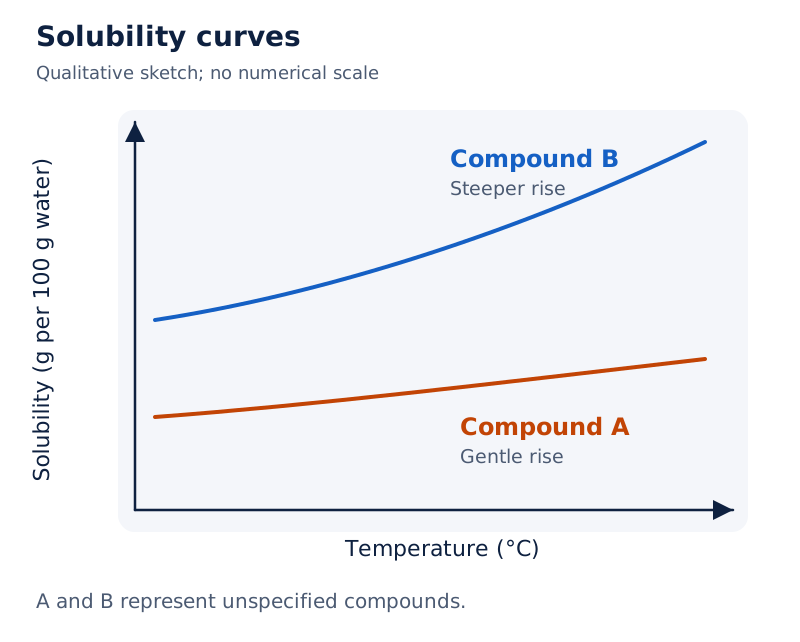
The horizontal axis shows temperature in °C and the vertical axis shows solubility in grams per 100 g water. The lower red curve, labelled compound A, rises gently; the upper blue curve, labelled compound B, rises more steeply.
Drawn by One Young India.
Read a temperature on the horizontal axis, move vertically to the appropriate curve, then horizontally to the solubility axis. Here A and B are labels for two unspecified compounds. They must not be identified as particular salts without further information.
Derivation: How is the mass needed for saturation calculated?
At a fixed temperature, let be the mass of solute, in grams, that saturates 100 g of water. Let be the available water mass and the required solute mass, both in grams.
- Read the solubility at the required temperature. The reference solvent mass is 100 g of water, not 100 g of solution.
- For the same solute and temperature, the saturated solutions have the same solute-to-water mass ratio: .
- Multiply both sides by the available water mass to obtain . The water masses cancel in the scaling factor, leaving the solute mass in grams.
Result: Scale the solute mass in the same proportion as the water mass, keeping the temperature fixed.
Worked example 1. At 40 °C, potassium nitrate has a solubility of 62 g per 100 g water. What mass is required to saturate 50 g water?
Answer: 50 g water is half of 100 g water. Substituting gives , so 31 g of potassium nitrate is required. The symbol × means multiply and = means equals. The final solution contains both water and dissolved salt.
How does crystallisation separate a dissolved solid?
Why do crystals form during cooling?
A crystal is a solid whose particles form a regular geometric arrangement. Crystallisation is the formation of crystals from a saturated solution. It can separate a solid from a solution and help purify the solid.
For a substance whose solubility increases with temperature, a hot saturated solution contains more dissolved material than can remain dissolved after cooling. The excess separates as a pure solid, often as crystals. The liquid does not need to disappear completely.
Derivation: How is the mass crystallised on cooling calculated?
Let and be the solute masses that saturate 100 g water at the hot and cool temperatures. The water mass stays constant. Assume the solubility decreases on cooling and excess solute crystallises, leaving a saturated solution.
- Scale the hot solubility to the actual water mass. The initially dissolved solute mass is .
- Scale the cool solubility to the same water mass. The solute mass remaining dissolved is .
- The initial solute is divided between dissolved solute and separated solid. Therefore the crystallised solute mass is .
- Substitute the two solubility expressions and factor out the unchanged water mass: . All masses are in grams.
Result: Subtract the mass that remains dissolved from the starting dissolved mass. For 100 g of water, the solubility values give these masses directly.
Worked example 2. An unspecified compound B has solubility 287 g per 100 g water at 60 °C and 241 g per 100 g water at 40 °C. Cool a saturated solution containing 100 g water between these temperatures, with no loss of water.
Answer: The starting dissolved mass is 287 g. At the lower temperature, 241 g can remain dissolved. Hence . The separated mass is 46 g. The minus sign means subtract. This calculation assumes crystallisation occurs.
How are copper sulphate crystals prepared?
- Prepare a hot saturated copper sulphate solution. Copper sulphate is a salt whose hydrated crystals are blue. During this supervised activity, a teacher adds a drop of dilute sulphuric acid to help prevent unwanted reactions. Sulphuric acid is the acid represented by H₂SO₄, where S means sulphur. Dilute means that the acid forms a small proportion of the acid-water mixture.
- Filter the hot solution to remove insoluble impurities. Filtration passes a mixture through a material that retains particles; the liquid passing through is the filtrate.
- Collect the filtrate in a clean beaker, cover it with a watch glass and leave it to cool slowly without disturbance.
- Separate the crystals by filtration, rinse them with cold water and allow them to dry on a watch glass.
What the figure shows
Crystallisation of copper sulphate
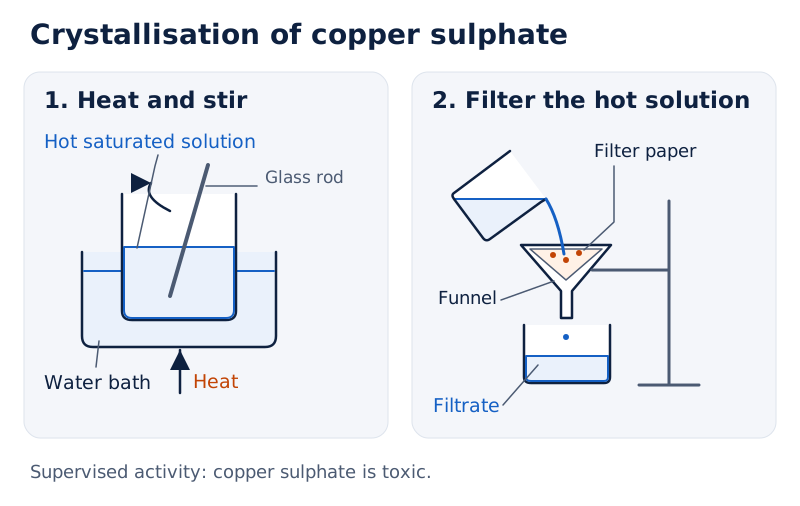
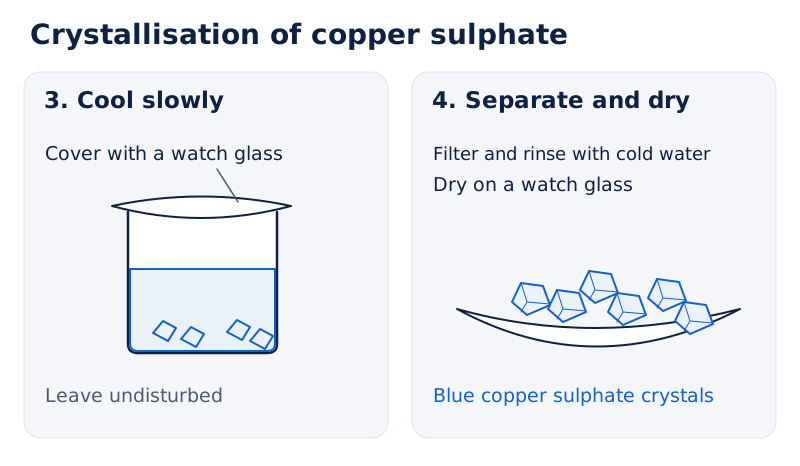
Four drawings show a beaker heated in a water bath while stirred, hot solution poured through a funnel, filtrate cooling under a watch glass, and blue crystals on a watch glass.
Drawn by One Young India.
Slow cooling gives particles time to form larger, well-shaped crystals. Rapid cooling produces smaller, less well-formed crystals. Sulphuric acid is required for crystallisation of only some salts. Copper sulphate is toxic, so the preparation requires adult supervision and care in handling.
What are water of crystallisation and hydrated substances?
How should a hydrate formula be read?
Water of crystallisation is the fixed number of water molecules present in one formula unit of a salt. A formula unit expresses the simplest chemical ratio in an ionic compound. An ionic compound contains positively and negatively charged particles called ions.
A hydrated substance contains water of crystallisation. Its crystals can appear dry while containing chemically associated water. This water is different from water merely clinging to the outside of a wet crystal.
In the formulae below, Cu means copper, Fe iron, Na sodium and C carbon; H, O and S retain their earlier meanings. The written chemical name identifies the whole compound.
In the formula CuSO₄·5H₂O, the dot separates the salt formula from its water of crystallisation. The 5 means five water molecules per formula unit. Subscripts within a formula give the number of the immediately preceding atom, or bracketed group, represented.
In copper(II) and iron(II), the Roman numeral II identifies metal ions with two positive charges. It does not give the number of water molecules.
| Hydrated substance | Formula | Water molecules per formula unit |
|---|---|---|
| Hydrated copper(II) sulphate | CuSO₄·5H₂O | 5 |
| Hydrated iron(II) sulphate, or ferrous sulphate | FeSO₄·7H₂O | 7 |
| Hydrated sodium carbonate, or washing soda | Na₂CO₃·10H₂O | 10 |
| Hydrated sodium sulphate | Na₂SO₄·10H₂O | 10 |
The water number is written after the dot in the hydrate formula. Compare copper sulphate and iron sulphate carefully: their hydrate formulae contain different fixed numbers of water molecules, although both are examples of hydrated salts.
What does heating copper sulphate show?
Blue hydrated copper sulphate loses water on heating and turns white. Water droplets appear in the cooler part of the boiling tube. Adding water to the white salt restores the blue colour. This links an observable colour change with the presence of water of crystallisation.
The change can be written CuSO₄·5H₂O → CuSO₄ + 5H₂O, with heating required. The arrow means produces; the plus sign separates substances. CuSO₄ is anhydrous copper sulphate, meaning copper sulphate without water of crystallisation.
How do anhydrous substances respond to atmospheric moisture?
Does anhydrous mean insoluble?
An anhydrous substance has no water of crystallisation. Anhydrous does not mean insoluble: solubility describes dissolving in a solvent, while hydration describes water associated with the solid structure.
Examples are sodium nitrate, NaNO₃; potassium chloride, KCl; lead(II) chloride, PbCl₂; and potassium sulphate, K₂SO₄. In these formulae N represents nitrogen, K potassium, Cl chlorine and Pb lead. Lead(II) indicates lead ions carrying two positive charges.
How do three moisture-related changes differ?
Efflorescence is the loss of water of crystallisation by a hydrated substance on exposure to air. Washing soda is an example. The change concerns water already present in the crystals, rather than absorption of new moisture.
Deliquescence is absorption of atmospheric water vapour by a substance until it dissolves in the absorbed water and forms a solution. Ferric chloride, FeCl₃, is an example. Ferric means iron(III), whose iron ions carry three positive charges.
Hygroscopy is the absorption of moisture from the surroundings. In the usual school comparison with deliquescence, the hygroscopic substance takes up moisture without forming a solution by dissolving in the absorbed water. Examples include quicklime and concentrated sulphuric acid.
Quicklime is calcium oxide, CaO, where Ca means calcium. Sulphuric acid has formula H₂SO₄. Concentrated sulphuric acid contains a large proportion of acid relative to water; dilute acid contains a smaller proportion.
| Property | Direction of water transfer | Example | Key outcome |
|---|---|---|---|
| Efflorescence | From crystals to air | Washing soda | Loss of water of crystallisation |
| Deliquescence | From air to substance | Ferric chloride | Formation of a solution in absorbed water |
| Hygroscopy | From surroundings to substance | Quicklime or concentrated sulphuric acid | Uptake of moisture |
Ask first whether water is lost or gained. If gained, ask whether a solid dissolves in the absorbed water. This distinguishes the named behaviours more reliably than describing every change simply as becoming wet or dry.
How are drying agents different from dehydrating agents?
What does a drying agent remove?
A drying agent removes moisture from another substance, such as water vapour mixed with a gas. Quicklime is an example. A suitable drying agent must remove the water without reacting with the substance that is meant to be dried.
Quicklime takes up water by reacting with it to form calcium hydroxide. Calcium hydroxide has formula Ca(OH)₂, where OH represents a group containing oxygen and hydrogen; the ₂ outside brackets means two such groups.
The balanced equation is CaO + H₂O → Ca(OH)₂. A balanced equation contains equal numbers of each kind of atom on its two sides. This reaction gives out heat, so it is described as exothermic.
What does a dehydrating agent remove?
A dehydrating agent removes chemically combined water, or removes hydrogen and oxygen from a compound in the proportion in which they form water. Concentrated sulphuric acid is an example. Dehydration can therefore change the chemical substance itself.
| Feature | Drying | Dehydration |
|---|---|---|
| Water removed | Moisture present with a substance | Chemically combined water, or its constituent elements in water-forming proportion |
| Main purpose | Obtain a substance free from moisture | Remove water chemically from a compound |
| Example of agent | Quicklime | Concentrated sulphuric acid |
The name of an agent describes its role in a particular process. The distinction is not simply between a solid reagent and a liquid reagent. A reagent is a substance used to bring about a chemical change.
Drying must also be distinguished from purifying drinking water. Removing moisture from a gas is not a method of making water potable. Likewise, removing suspended mud from water is filtration, not dehydration.
To explain a drying process, identify the moist substance, the water being removed and the compatible drying agent. To explain dehydration, identify the compound from which water or its constituent elements are removed.
What causes hardness, and how does soap detect it?
What happens when soap is added?
Soft water readily forms lather with soap. Hard water does not readily form lather because dissolved calcium and magnesium salts react with soap. Lather means the mass of bubbles or foam formed during shaking or washing.
The insoluble material produced is called scum. It is a precipitate, an insoluble solid formed by a reaction in solution. Insoluble means unable to dissolve appreciably in the solvent under the conditions considered. The reaction uses up soap, so a larger amount is needed before effective washing and lathering occur.
- Place equal volumes of a soft-water sample and a hard-water sample in separate test tubes.
- Add equal amounts of the same soap solution to the two samples.
- Shake both test tubes for the same length of time so that the comparison is fair.
- Compare lather and scum. Soft water forms lather more readily; hard water forms a white curdy precipitate and less readily forms foam.
Detergents are cleansing agents that remain effective in hard water because they do not form the same insoluble precipitates with calcium and magnesium ions. A detergent test therefore cannot replace the soap test for hardness.
Which salts cause the two types of hardness?
| Type | Cause | Effect of boiling |
|---|---|---|
| Temporary hardness | Dissolved calcium and magnesium hydrogencarbonates | Can be removed by boiling |
| Permanent hardness | Dissolved calcium and magnesium chlorides and sulphates | Not removed by boiling |
Hydrogencarbonate, also called bicarbonate, is the negatively charged group represented by HCO₃⁻. The superscript minus sign denotes one negative charge. The presence of dissolved salts, not the presence of visible suspended dirt, causes hardness.
Soft water saves soap and avoids hardness deposits in heating equipment. Water softened by removal of calcium and magnesium salts contributes less of these minerals than the original hard water. This is a limitation when comparing their mineral content, not a claim that soft water is inherently unsafe. Hard water supplies dissolved calcium and magnesium, but wastes soap and can form scale, a hard deposit on heated surfaces. Scale obstructs pipes and reduces efficient heat transfer.
Softness alone does not establish drinking-water safety. Soft water may contain disease-causing organisms or harmful chemicals. Conversely, hardness and visible dirt are different properties that need different tests and treatments.
How do boiling and washing soda remove hardness?
Why does boiling remove temporary hardness?
Boiling breaks down the hydrogencarbonates responsible for temporary hardness. Insoluble solids form and can be separated. This removes the dissolved substances that previously reacted with soap.
For calcium hydrogencarbonate, the equation is Ca(HCO₃)₂ → CaCO₃ + CO₂ + H₂O, with boiling required. CaCO₃ is calcium carbonate, the insoluble solid; CO₂ is carbon dioxide, a gas. Brackets group HCO₃ together, and the following ₂ applies to the entire group.
For magnesium hydrogencarbonate, the overall change on boiling is Mg(HCO₃)₂ → Mg(OH)₂ + 2CO₂. Mg represents magnesium. Mg(OH)₂ is insoluble magnesium hydroxide. The leading 2 means two molecules of carbon dioxide in the equation's stated ratio.
The formation of an insoluble solid is central to softening: the calcium or magnesium is removed from its dissolved form. Let the solid settle and separate it from the water. Boiling does not remove permanent hardness caused by chlorides and sulphates.
Why is washing soda useful?
Washing soda, Na₂CO₃·10H₂O, supplies dissolved sodium carbonate, Na₂CO₃. The carbonate reacts with dissolved calcium and magnesium salts to produce insoluble carbonates. The solids can then be removed, leaving softened water.
A representative reaction is CaCl₂ + Na₂CO₃ → CaCO₃ + 2NaCl. CaCl₂ is calcium chloride, and NaCl is sodium chloride. The calcium carbonate precipitates; the sodium chloride remains dissolved and does not cause calcium or magnesium hardness.
Another example is MgSO₄ + Na₂CO₃ → MgCO₃ + Na₂SO₄. MgSO₄ is magnesium sulphate, MgCO₃ magnesium carbonate and Na₂SO₄ sodium sulphate. The insoluble magnesium carbonate separates from the water.
- Identify whether the dissolved hardness is temporary, permanent or a mixture of both.
- For temporary hardness, use boiling to decompose the hydrogencarbonates.
- For permanent hardness, add washing soda so that insoluble carbonates form.
- Separate the precipitated solids and test the treated water with soap to assess the change in lather formation.
Softening means reducing hardness. It is not the same as removing every dissolved substance, and it is not proof that water is safe to drink.
How is water made potable, and why does pollution matter?
Which treatment removes which problem?
Potable water is water suitable for drinking. Its preparation must address suspended matter, disease-causing organisms and harmful dissolved substances as needed. A treatment that removes one kind of impurity may leave another behind.
Sedimentation is settling of suspended particles under gravity. Decantation is carefully pouring off the upper liquid from settled material. Very fine particles may remain suspended, so these processes alone do not necessarily produce clear water.
Alum, a white crystalline substance used in water purification, acts as a coagulant: it makes fine suspended particles clump together. The clumps settle more readily. Coagulation is this formation of larger clumps from fine particles.
What the figure shows
Coagulation with alum
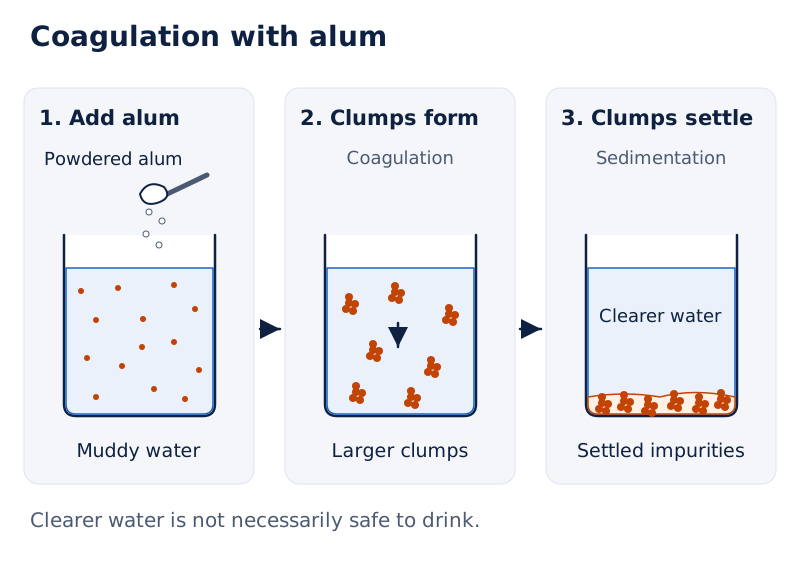
Three drawings show powdered alum being added to muddy water, the suspended impurities clumping, and impurities settled at the bottom beneath clearer water.
Drawn by One Young India.
| Treatment | Main purpose | Distinction to remember |
|---|---|---|
| Coagulation with alum | Clump fine suspended particles | The resulting solids still need separation |
| Filtration | Remove suspended particles retained by the filter | Ordinary filtration does not remove dissolved salts |
| Chlorination | Disinfect water using chlorine | Disinfection targets disease-causing organisms |
| Defluoridation | Remove excess dissolved fluoride | It addresses a dissolved chemical impurity |
Chlorination is treatment with chlorine to destroy disease-causing organisms. Disinfection means destroying or inactivating such organisms. Defluoridation reduces excess fluoride, a dissolved form of fluorine. Neither term means simply removing visible mud.
What are the consequences of polluted water?
Polluted water can transmit diarrhoea, typhoid, cholera, dysentery, hepatitis A and polio. Diarrhoea involves frequent loose stools; dysentery is an intestinal infection associated with blood in stools. Typhoid and cholera are bacterial diseases; hepatitis A affects the liver, while polio can affect the nervous system.
Chemical contamination can also contribute to cancer and organ damage. Cancer involves uncontrolled abnormal cell growth. These effects must not be confused with infections: their causes depend on the contaminant and exposure, and every polluted sample does not cause every listed disease.
Clear water is not necessarily potable. Dissolved chemicals and microorganisms, organisms too small to see individually without magnification, may be present without obvious cloudiness. Softening, clarification and disinfection answer different questions about water quality.
Glossary
- Solvent — A substance that dissolves a solute to form a homogeneous solution.
- Solute — The substance dissolved in a solvent when a solution is formed.
- Solubility — The maximum quantity of solute dissolving in a specified quantity of solvent at a stated temperature.
- Saturated solution — A solution that cannot dissolve more of the same solute at its stated temperature.
- Supersaturated solution — An unstable solution containing more dissolved solute than its normal saturation amount at that temperature.
- Colloid — A mixture containing dispersed particles larger than solution particles that do not settle on standing.
- Crystallisation — Formation of solid crystals from a saturated solution, used to separate or purify substances.
- Water of crystallisation — The fixed number of water molecules associated with one formula unit of a salt.
- Efflorescence — Loss of water of crystallisation from a hydrated substance when exposed to air.
- Deliquescence — Absorption of atmospheric moisture until a substance dissolves in the absorbed water.
- Hygroscopy — Uptake of moisture from the surroundings by a substance such as quicklime.
- Drying agent — A substance that removes moisture without reacting with the material being dried.
- Hard water — Water containing dissolved calcium or magnesium salts that hinder lather formation with soap.
- Coagulation — Clumping of fine suspended particles into larger groups that can settle more readily.
- Potable water — Water suitable for drinking, with its safety assessed beyond visible clarity or softness.
Common errors and misconceptions
- Misconception: A universal solvent dissolves everything. Correct: Water dissolves many substances, but sand remains undissolved and oil forms a separate layer.
- Misconception: Any solution with extra solid at the bottom is supersaturated. Correct: Supersaturation concerns excess dissolved solute; undissolved solid may simply accompany a saturated solution.
- Misconception: Heating increases the solubility of every substance. Correct: Solid solubility generally increases, but the response depends on the substance; gas solubility generally decreases.
- Misconception: Water of crystallisation makes crystals visibly wet. Correct: It is part of the hydrate's composition; hydrated crystals can appear dry.
- Misconception: Efflorescence and deliquescence both absorb water. Correct: Efflorescence loses water of crystallisation; deliquescence absorbs atmospheric moisture and produces a solution.
- Misconception: Boiling removes every kind of hardness. Correct: It removes temporary hardness; permanent hardness requires another method, such as adding washing soda.
- Misconception: Any clear, soft water is safe to drink. Correct: Clarity and softness do not establish absence of harmful microorganisms or dissolved chemicals.
- Misconception: Alum, chlorine and defluoridation all perform the same task. Correct: Alum coagulates fine particles, chlorine disinfects, and defluoridation removes excess fluoride.
Exam-style questions with model answers
Q1. Define solute and solvent, identifying each in sugar dissolved in water. [2 marks]
- A solute is the substance that dissolves; sugar is the solute in this solution.
- A solvent is the substance that dissolves the solute; water is the solvent here.
Q2. Potassium nitrate has a solubility of 62 g per 100 g water at 40 °C. Calculate the mass needed to saturate 50 g water at 40 °C and explain the scaling. [3 marks]
- The stated solubility means that 100 g of water dissolves 62 g of potassium nitrate at saturation at 40 °C.
- The available 50 g of water is half that mass, so the amount of salt required is also halved at the same temperature.
- The required mass is 62 × 50 ÷ 100 = 31 g of potassium nitrate; the denominator refers to water, not total solution.
Q3. An unspecified compound B has solubility 287 g per 100 g water at 60 °C and 241 g per 100 g water at 40 °C. A saturated solution containing 100 g water is cooled from 60 °C to 40 °C without losing water. If crystallisation occurs, explain the change and calculate the separated mass. [3 marks]
- The solution initially contains 287 g of dissolved compound B because it is saturated at 60 °C and contains exactly 100 g of water.
- At 40 °C, that unchanged water mass can retain 241 g of B in solution at saturation. The excess therefore separates as solid when crystallisation occurs.
- The separated mass is the initial dissolved mass minus the final dissolved mass: 287 − 241 = 46 g.
Q4. Describe four differences between a common salt solution and a suspension of sand in water: uniformity, particle visibility, settling and ordinary filtration. [4 marks]
- Common salt solution is homogeneous, with uniform composition throughout. A sand suspension is heterogeneous and does not have uniform composition throughout.
- The dissolved salt particles cannot be seen individually with the naked eye. Sand particles in the suspension can be seen.
- Dissolved salt does not settle on standing. Sand particles settle when the mixture is left undisturbed.
- Ordinary filter paper does not remove dissolved salt from water, whereas it can retain the larger undissolved sand particles.
Q5. The formula of hydrated copper sulphate is CuSO₄·5H₂O. Explain water of crystallisation and the meaning of 5H₂O. State the colour change on heating, evidence that water is released, and the effect of adding water to the cooled white salt. [5 marks]
- Water of crystallisation is the fixed number of water molecules present in one formula unit of a salt; it is not merely external surface moisture.
- The formula's 5H₂O means five water molecules are associated with each formula unit of copper sulphate. The crystals can therefore contain water while appearing dry.
- On heating, the initially blue hydrated copper sulphate loses its water of crystallisation and becomes white anhydrous copper sulphate.
- Water droplets appear in the cooler part of the boiling tube, providing observable evidence that water has been released from the heated crystals.
- Adding water to the cooled white salt restores the blue colour, showing the connection between hydration and the observed colour.
Q6. Explain temporary and permanent hardness, naming their calcium and magnesium salt causes. State which type boiling removes and name the reagent used to remove permanent hardness. [4 marks]
- Temporary hardness is hardness caused by dissolved calcium and magnesium hydrogencarbonates. It prevents water from readily forming lather with soap.
- Permanent hardness is caused by dissolved calcium and magnesium chlorides and sulphates. These salts also interfere with soap lather formation.
- Boiling removes temporary hardness by decomposing the hydrogencarbonates and forming insoluble solids that can be separated from the water.
- Washing soda removes permanent hardness by forming insoluble carbonates. Boiling alone does not remove this type of hardness.
Q7. Water contains fine suspended mud, disease-causing organisms and excess dissolved fluoride. Explain six points in its treatment, covering alum, settling, filtration, chlorination, defluoridation and why visual clarity is insufficient. [6 marks]
- Addition of alum causes fine suspended particles to clump together by coagulation. The larger clumps are easier to separate than the original fine particles.
- Allow the clumps to settle under gravity. This sedimentation collects suspended material at the bottom so that the upper liquid can be separated.
- Filtration removes suspended particles retained by the filter. Ordinary filtration is not a method for removing the excess dissolved fluoride mentioned in the question.
- Chlorination disinfects the water by acting against disease-causing organisms. It serves a different purpose from settling mud or filtering suspended material.
- Defluoridation is required to reduce the excess dissolved fluoride. Removing this chemical impurity is distinct from destroying organisms through disinfection.
- Clear appearance does not prove that the treated water is potable. Harmful dissolved chemicals and microorganisms may remain invisible to the naked eye.
Q8. Distinguish efflorescence, deliquescence and hygroscopy, giving washing soda, ferric chloride and quicklime respectively as examples. [3 marks]
- Efflorescence is loss of water of crystallisation to the air. Washing soda illustrates a hydrated substance losing water rather than absorbing atmospheric moisture.
- Deliquescence is absorption of atmospheric moisture until the substance dissolves in the absorbed water. Ferric chloride is an example of this behaviour.
- Hygroscopy is uptake of moisture from the surroundings; quicklime is an example. In the school comparison, it does not form a solution by dissolving in absorbed water.
Key takeaways
- Water dissolves many substances, but the description universal solvent does not mean that every substance dissolves in it.
- Solutions, suspensions and colloids differ in particle size, settling behaviour, filtration and their effect on a light beam.
- Saturation depends on temperature; a supersaturated solution contains excess dissolved solute, rather than simply extra undissolved solid.
- Solubility curves connect temperature with dissolving capacity; potassium nitrate and sodium chloride show very different degrees of change.
- Hydrated salts contain fixed amounts of water of crystallisation, even when their crystals appear completely dry.
- Efflorescence loses water, while deliquescence and hygroscopy involve moisture uptake; deliquescence produces a solution in the absorbed water.
- Calcium and magnesium salts cause hardness; boiling removes temporary hardness and washing soda removes permanent hardness.
- Potable water needs appropriate purification: coagulation, filtration, chlorination and defluoridation address different kinds of impurity.
Test yourself
Why is the phrase “at a given temperature” essential when defining saturation?
Solubility changes with temperature, so the amount required for saturation must be linked to a specified temperature.
How can light help distinguish milk from a transparent salt solution?
Milk scatters a light beam and makes its path visible. A transparent salt solution does not show this scattering.
Does adding excess solid to a saturated solution necessarily make it supersaturated?
No. The added solid may remain undissolved; supersaturation requires excess solute actually dissolved at that temperature.
What does the dot followed by 10H₂O in washing soda represent?
It represents ten water molecules of crystallisation associated with each formula unit of sodium carbonate.
Which way does water move during efflorescence?
Water is lost from the hydrated crystals to the surrounding air, rather than absorbed from the air.
Why should soap, rather than detergent, be used to compare water hardness?
Soap forms insoluble scum with calcium and magnesium salts, whereas detergents remain effective in hard water.
Why is boiling not sufficient for permanent hardness?
The dissolved calcium and magnesium chlorides and sulphates responsible for permanent hardness are not removed by boiling.
How do the purposes of alum and chlorine differ in water treatment?
Alum clumps fine suspended particles for separation; chlorine disinfects the water by acting against disease-causing organisms.
Write about it
Turn a question from this chapter into a paper.
The Writing Studio has a structure guide, a rubric and citation tools for 15 formats, from essays to research papers. Drafting is free with an account. Learnacy Essential adds feedback from an AI writing coach and submission to The OYI Review.
Learnacy Essential is ₹1,499 for the year. Publication depends on review and is not guaranteed.