
The World of Numbers | CBSE Class 9 Maths Notes
On this page

This note covers the development of counting, zero and integers, rational-number arithmetic, number-line representations, absolute value, density, irrationality proofs, square-root constructions, pi, decimal expansions, recurring-decimal conversions, cyclic numbers and the real-number system.
How did counting lead to natural numbers?
One-to-one correspondence means matching each object in one collection with one object in another. A herder might put a pebble in a pot for each cow leaving to graze, then remove a pebble for each returning cow. Remaining pebbles would indicate missing cows.
This matching process expresses the idea behind natural numbers, the counting numbers. The symbol ℕ names their collection: ℕ = {1, 2, 3, 4, …}. Braces enclose the members of a collection, the equals sign means “is equal to”, and the dots mean that the sequence continues.
What do tally records suggest?
Tally marks record quantities through individual strokes or notches. The Lebombo Bone has 29 deliberately carved notches and dates back approximately 35,000 years. Researchers believe it was a lunar phase counter or a menstrual calendar.
The Ishango bone dates to around 20,000 BCE, meaning Before Common Era. Its grouped notches include 11, 13, 17 and 19. These are prime numbers, natural numbers greater than 1 whose positive factors, integers that divide them exactly, are only 1 and themselves. Another column seems to demonstrate doubling.
Why were larger numbers needed?
Trade in centres such as Lothal and Harappa required standardised weights, measures and accounting. Indian work with powers of 10 supported the development of the decimal place-value system, in which a digit’s value depends on its position. A power expresses repeated multiplication: 10² = 10 × 10. Here ² means “squared”, and × means multiplication.
Worked example 1. A merchant receives 15 copper ingots for every 2 bags of spices. How many ingots does he receive for 12 bags?
Answer: The 12 bags contain 12 ÷ 2 = 6 groups. Each group earns 15 ingots, giving 6 × 15 = 90 ingots. Here ÷ means division.
How do zero and negative numbers extend counting?
Śhūnya means zero, while śhūnyatā refers to emptiness or nothingness. A placeholder marks an empty position in a numeral. Treating zero as a number goes further: zero can participate in arithmetic. The Bakhśhālī Manuscript uses a bold dot, or bindu, to represent zero.
Brahmagupta’s rules connect zero to subtraction and explain its arithmetic. Let a represent a number. Then a − a = 0, where − means subtraction. Also, a + 0 = a, a − 0 = a and a × 0 = 0, where + means addition.
How do fortunes and debts explain integers?
Positive numbers are greater than zero; negative numbers are less than zero. Brahmagupta described positive quantities as fortunes, or dhana, and negative quantities as debts, or ṛiṇa. This interpretation makes a negative quantity meaningful instead of treating it as an impossible count.
Integers, denoted by ℤ, comprise the positive natural numbers, zero and their negative counterparts: …, −2, −1, 0, 1, 2, …. The whole numbers are zero together with the natural numbers. Subtracting a larger integer from a smaller one can give a negative result.
| Operation | Example | Interpretation |
|---|---|---|
| Add two fortunes | 5 + 4 = 9 | The result is a fortune. |
| Add two debts | (−5) + (−4) = −9 | The debts combine. |
| Multiply a debt and a fortune | (−3) × 4 = −12 | Four debts of 3 make a debt of 12. |
| Multiply two negative numbers | (−3) × (−4) = 12 | Removing four debts of 3 improves the position by 12. |
Worked example 2. In Ladakh, the temperature is 4 °C at noon and falls by 15 °C by midnight. Find the midnight temperature. The symbol °C means degrees Celsius.
Answer: Subtract the fall from the initial temperature: 4 − 15 = −11. The midnight temperature is −11 °C. The negative sign places the result below zero on the temperature scale.
What makes a number rational?
A fraction represents parts of a whole. Its numerator is the number above the division bar, and its denominator is the number below it. The additive inverse of a number gives zero when added to that number: −3 is the additive inverse of 3.
Positive fractions also have additive inverses, called negative fractions. The minus sign can be attached to the numerator, denominator or whole fraction: −1/5 = (−1)/5 = 1/(−5). Here the slash / is another way to write the division bar.
Definition: A rational number can be expressed as p/q, where p and q are integers and q ≠ 0. The letters p and q denote the numerator and denominator, and ≠ means “is not equal to”. The collection is denoted by ℚ.
Every integer is rational because it can be written with denominator 1. For example, 5 = 5/1 and −10 = −10/1. Rational numbers therefore include the natural numbers, whole numbers, integers and both positive and negative fractions.
Why can one rational number have several representations?
Equivalent fractions represent the same number. For example, −1/3 = −2/6 = −3/9 = −10/30. Dividing the numerator and denominator by a common factor, a number that divides both exactly, preserves the fraction’s value.
A fraction is in lowest terms when its numerator and denominator are co-prime, meaning they have no common positive factor other than 1. For number-line work, choose this simplified representation. Equivalent forms name the same point rather than different positions.
Worked example 3. Reduce 12/30 to lowest terms.
Answer: Both 12 and 30 have the common factor 6. Dividing both by 6 gives 12/30 = 2/5. Since 2 and 5 have no common positive factor other than 1, the fraction is now in lowest terms.
Which arithmetic properties do rational numbers follow?
For the rules below, let a, b, c and d be integers. The denominators b and d must be non-zero. Two rational numbers a/b and c/d are equal exactly when ad = bc. Writing letters together, as in ad, means multiplying their values.
Property: Arithmetic with fractions
For addition and subtraction, first express both fractions with a common denominator, the same denominator. Then add or subtract their numerators: a/b + c/b = (a + c)/b and a/b − c/b = (a − c)/b. The denominator remains unchanged.
For multiplication, multiply numerators together and denominators together: (a/b) × (c/d) = ac/bd. For division, multiply by the reciprocal, the fraction obtained by interchanging the non-zero numerator and denominator of the divisor: (a/b) ÷ (c/d) = (a/b) × (d/c).
Note: In the division rule, c must also be non-zero. Dividing by a rational number equal to zero is not permitted. Keep this restriction even when the fractions have been simplified.
Property: Closure, commutativity and distributivity
Closure means that applying an operation to members of a collection produces another member. Rational numbers are closed under addition, subtraction and multiplication. Division also produces a rational number provided that the divisor is not zero.
Commutativity means that changing the order leaves the result unchanged. Addition and multiplication of rational numbers are commutative. Distributivity means multiplying a sum term by term: for rational numbers p, q and r, p(q + r) = pq + pr. Here each letter denotes a rational number.
Worked example 4. Find 2/5 + 3/10.
Answer: Write 2/5 as 4/10 so that both denominators are 10. Then 4/10 + 3/10 = (4 + 3)/10 = 7/10. Adding the denominators would not follow the addition rule.
Worked example 5. Find (2/3) ÷ (3/10).
Answer: The divisor 3/10 is non-zero and its reciprocal is 10/3. Therefore (2/3) × (10/3) = 20/9. Multiplication by the reciprocal gives the required quotient, meaning the result of division.
How are rational numbers and distances shown on a number line?
A number line represents numbers as positions on a straight line. Its origin is the point labelled 0. Consecutive integers are equally spaced. Positive numbers lie to the right of zero, and negative numbers lie to its left.
A unit interval is the distance between consecutive integers. To locate a fraction, use a positive denominator and divide each unit interval into that many equal parts. Count the required parts rightwards for a positive number or leftwards for a negative number.
What the figure shows
Fractions between integers
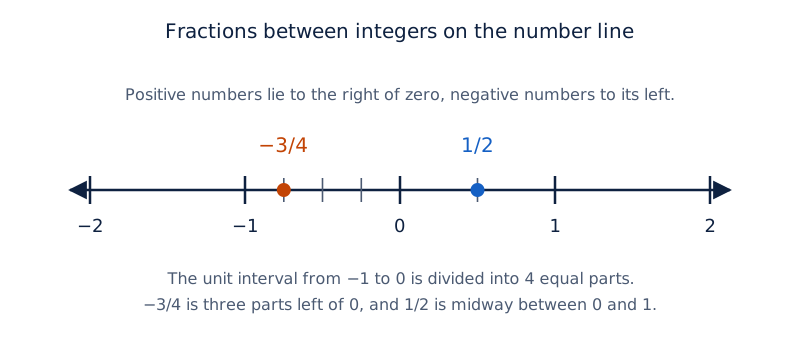
The number line marks the integers from −2 to 2. The point 1/2 lies midway between 0 and 1, while −3/4 lies between −1 and 0.
Drawn by One Young India. See Fig. 3.4 in your NCERT textbook
Worked example 6. Locate 9/4 on a number line.
Answer: Write 9/4 = 2 + 1/4. Divide the interval from 2 to 3 into four equal parts. The first division to the right of 2 represents 9/4, so its position lies between 2 and 3.
What is absolute value?
The absolute value of a rational number x is its distance from zero. Here x denotes the number being considered, and |x| denotes its absolute value. Thus |5/3| = 5/3, |−5/3| = 5/3 and |0| = 0.
Distance is non-negative, meaning zero or positive, so |x| ≥ 0; the symbol ≥ means “greater than or equal to”. For rational numbers a and b, the distance between their positions is |a − b|. The subtraction may be negative, but its absolute value is not.
What the figure shows
Distance across zero
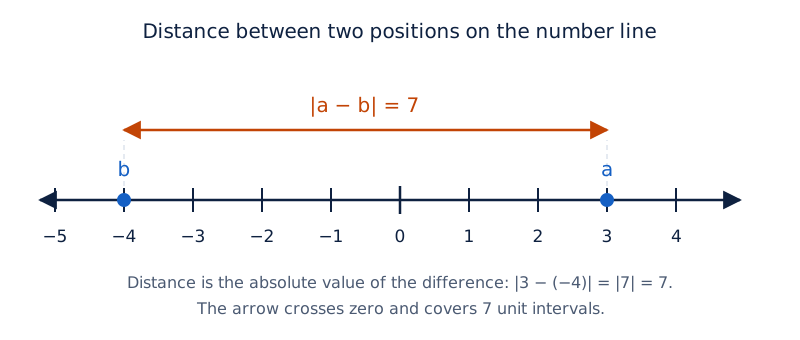
A horizontal arrow extends between the points labelled b at −4 and a at 3. Its label gives |a − b| = 7, the distance between the two positions.
Drawn by One Young India. See Fig. 3.8 in your NCERT textbook
Why are there infinitely many rational numbers between two rational numbers?
Density means that another rational number can be found between any two distinct rational numbers, however close they are. “Distinct” means different. For instance, 3/2 lies between 1 and 2, and 5/4 lies between 1 and 3/2.
Result: The average gives a number between the endpoints
Let a and b be rational numbers with a < b, where < means “is less than”. Their average is their sum divided by 2, namely (a + b)/2. Closure under addition and division by a non-zero number makes this average rational.
- Begin with a < b, so the first endpoint is smaller.
- Add a to both sides to obtain 2a < a + b. Dividing by 2 gives a < (a + b)/2.
- Add b to the original inequality to obtain a + b < 2b. Dividing by 2 gives (a + b)/2 < b.
- The average is therefore strictly between the endpoints. Repeating the construction between an endpoint and the new average produces further rational numbers.
Worked example 7. Find a rational number between 1 and 3/2.
Answer: Their average is (1 + 3/2)/2 = (5/2)/2 = 5/4. Since 1 < 5/4 < 3/2, the result is strictly between the given numbers. The endpoints themselves do not answer the question.
This process has no final step that exhausts the available numbers. There are infinitely many rational numbers between two distinct rational numbers. However, this does not establish that every point on the line is rational. To decide that separate question, lengths such as the diagonal of a unit square must also be considered.
What are irrational numbers, and how can irrationality be proved?
An irrational number is a number on the number line that cannot be written as a ratio of two integers. The symbol √ denotes the non-negative square root: √2 is the positive number whose square is 2. Squaring means multiplying a number by itself.
In a square of side 1 unit, let d denote its diagonal length. The Baudhāyana-Pythagoras theorem gives 1² + 1² = d², so d² = 2 and d = √2. The diagonal joins opposite corners of the square.
What the figure shows
The diagonal of a unit square
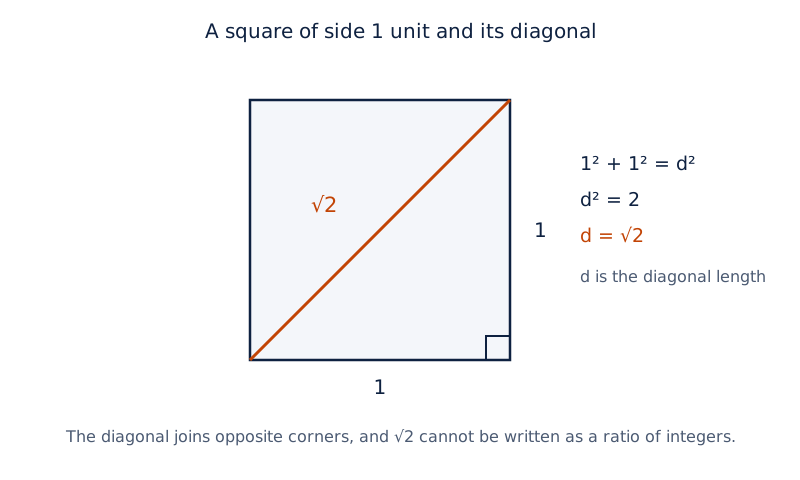
A square has its bottom and right sides labelled 1. Its diagonal runs from the lower-left corner to the upper-right corner and is labelled √2.
Drawn by One Young India. See Fig. 3.10 in your NCERT textbook
Theorem: √2 is irrational
A proof by contradiction assumes the opposite of the desired conclusion and shows that it leads to incompatible statements. Here the assumption is that √2 has a rational representation in lowest terms. An even integer is an integer divisible by 2.
- Assume √2 = p/q, where p and q are co-prime integers and q ≠ 0.
- Square both sides and multiply by q². This gives p² = 2q².
- Therefore p² is even, so p is even. Write p = 2k, where k is an integer.
- Substitute to obtain 4k² = 2q². Dividing by 2 gives q² = 2k².
- Thus q² is even, so q is even too. Both p and q have the common factor 2.
- This contradicts their being co-prime. The rational assumption fails, proving that √2 is irrational.
How does the method extend to √3?
Assume √3 = p/q in lowest terms. Squaring gives p² = 3q². If an integer’s square is divisible by 3, that integer is divisible by 3. Hence p = 3k for an integer k. Substitution gives 9k² = 3q² and then q² = 3k².
It follows that q is also divisible by 3, contradicting the assumption that p and q are co-prime. Therefore √3 is irrational. The essential structure matches the √2 proof: establish a common factor that the lowest-terms assumption explicitly rules out.
How can irrational lengths be constructed?
A length can be constructed exactly even if it cannot be expressed as a fraction. To construct √2, use the hypotenuse of a right triangle with two sides of length 1. A right angle is an angle of 90°, where ° denotes degrees; the hypotenuse is its opposite side.
How is √2 placed on the number line?
- Mark the origin O and the point A at 1 on the number line. The segment OA has length 1 unit.
- At A, draw a perpendicular, a line meeting the number line at a right angle. Mark B on it so that AB = 1 unit.
- Join O to B. The right triangle OAB has OB² = OA² + AB² = 2, and therefore OB = √2 units.
- With O as centre and OB as radius, draw an arc meeting the positive number line at P. The radius is the fixed distance from the centre; an arc is part of a circle.
The segment OP equals OB, so P represents √2. Each pair of capital letters names the segment joining the two named points. Transferring the length with a compass preserves it; no rounded decimal is required to define the point.
What the figure shows
Transferring an irrational length
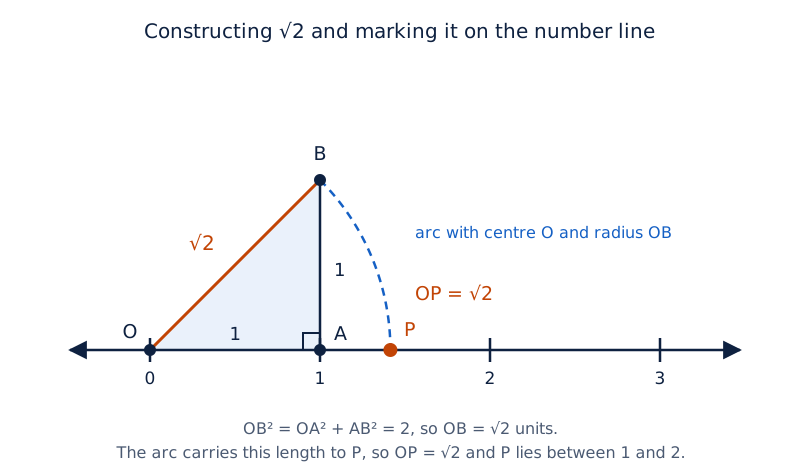
The number line has O at 0 and A at 1, with B above A. The diagonal OB is labelled √2. An arc transfers this distance to P between 1 and 2.
Drawn by One Young India. See Fig. 3.11 in your NCERT textbook
How does the square root spiral continue the idea?
The square root spiral joins successive right triangles. Begin with perpendicular sides of length 1, giving a hypotenuse √2. Use that hypotenuse as one side of the next triangle and add a perpendicular unit side. Its new hypotenuse is √3.
Continue by adding a unit side perpendicular to the preceding hypotenuse. Each step increases the squared hypotenuse length by 1. This constructs successive square-root lengths using the same geometric relation, rather than treating irrational lengths as gaps that cannot be drawn.
What the figure shows
Successive right triangles
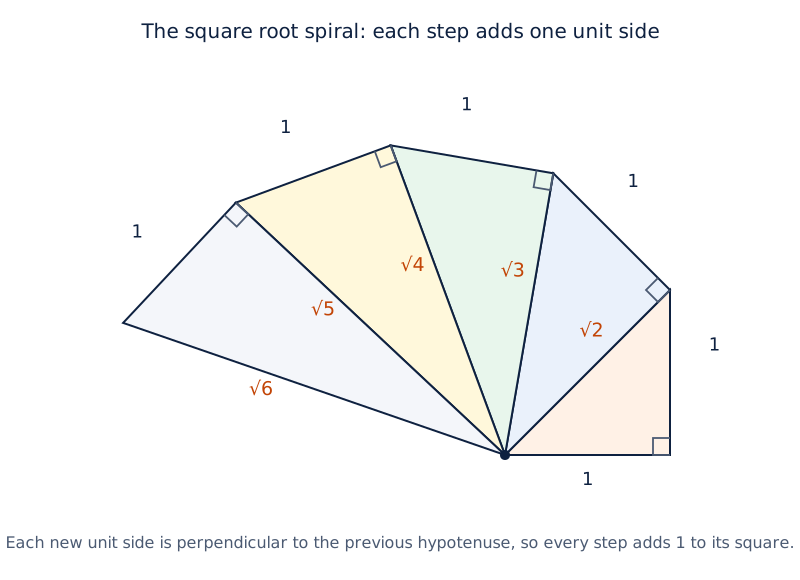
Coloured triangles fan around a common point. Their outer edges are labelled 1, and small squares mark right angles where successive triangles meet.
Drawn by One Young India. See Fig. 3.14 in your NCERT textbook
How does π connect approximation with an infinite series?
The symbol π, read as pi, denotes the ratio of a circle’s circumference to its diameter. The circumference is the distance around the circle, and its diameter is a segment through the centre joining two points on the circle.
π is irrational, so a fraction cannot equal it exactly. A useful approximation is a nearby value used in place of an exact value. Āryabhaṭa gave 3927/1250 = 3.1416 in 499 CE, where CE means Common Era.
He called this an asanna, or approximation, and indicated that an exact fraction could likely not be found. The word “likely” preserves the distinction between this indication and a proof. Lambert formally proved the irrationality of π in 1761.
What does Mādhava’s series express?
Mādhava of Sangamagrama discovered an infinite series, a sum that continues without a final term:
π = 4 × (1 − 1/3 + 1/5 − 1/7 + …).
Here a term is an individual contribution to the sum, including its sign. The denominators are successive odd positive integers, meaning positive integers not divisible by 2. The signs alternate between addition and subtraction, and the dots indicate continuation of this rule.
Adding infinitely many terms means considering the value approached as more terms are added from the beginning. A finite calculation gives an approximation; the infinite series expresses the exact value. This separates the usefulness of rational approximations from the nature of the irrational number they approximate.
How do decimal expansions identify rational numbers?
A decimal expansion writes a number using place values based on powers of 10. Dividing a rational number’s numerator by its denominator gives either a terminating decimal or a non-terminating repeating decimal. A remainder is the amount left at a stage of division.
A terminating decimal stops after finitely many decimal places because division reaches remainder zero. A repeating decimal continues indefinitely with a fixed block of digits recurring. The repetition may begin immediately after the decimal point or after some initial non-repeating digits.
| Fraction | Decimal | Type |
|---|---|---|
| 3/8 | 0.375 | Terminating |
| 5/11 | 0.454545… | Repeating block 45 |
| 1/7 | 0.142857142857… | Repeating block 142857 |
Why must a non-terminating rational decimal repeat?
When dividing by 7, the possible non-zero remainders are 1, 2, 3, 4, 5 and 6. If the division does not terminate, a remainder eventually recurs. The same remainder produces the same subsequent steps, so the sequence of decimal digits repeats.
Result: The denominator test for termination
First reduce p/q to lowest terms and take q positive. Its decimal terminates precisely when q has no prime factors other than 2 and 5. Prime factorisation expresses a positive integer as a product of primes. A denominator of 1 also gives a terminating decimal.
The reason is that a suitable multiplication makes the denominator a power of 10. For example, 10² means 10 × 10. Once the denominator is a power of 10, the decimal can be written with finitely many places.
Worked example 8. Explain why 3/20 terminates and find its decimal value.
Answer: The fraction is in lowest terms, and 20 = 2² × 5. Multiply numerator and denominator by 5: 3/20 = 15/100 = 0.15. The denominator contains only the permitted prime factors, and the calculation supplies the terminating expansion.
How can terminating and repeating decimals be converted to fractions?
For a terminating decimal, use a denominator that is a suitable power of 10, then simplify. For a repeating decimal, multiply so that two copies of the same infinite repeating tail align. Subtracting these equations removes the repeating tail.
Worked example 9. Convert 0.35 into a fraction in lowest terms.
Answer: There are two decimal places, so 0.35 = 35/100. Dividing numerator and denominator by 5 gives 7/20. This preserves the value while reducing the fraction.
How are pure repeating decimals converted?
A pure repeating decimal begins its repeating block immediately after the decimal point. Let x denote the decimal being converted and n the number of digits in its repeating block. Multiplying by 10ⁿ moves one whole block before the decimal point; 10ⁿ means 10 multiplied by itself n times.
Worked example 10. Convert 0.6666…, with the digit 6 repeating indefinitely, into a fraction.
Answer: Set x = 0.6666…. Then 10x = 6.6666…. Subtract x from 10x: 9x = 6. Hence x = 6/9 = 2/3. The equal repeating tails cancel completely, so the result is exact.
Worked example 11. Convert 0.454545…, with the block 45 repeating, into a fraction.
Answer: Set x = 0.454545…. Two digits repeat, so 100x = 45.454545…. Subtracting gives 99x = 45, hence x = 45/99 = 5/11. Multiplying by 100 aligns the full two-digit block.
How are general repeating decimals converted?
A general repeating decimal has some non-repeating decimal digits before its recurring block. First move these initial digits before the decimal point. Then shift by one complete repeating block. Subtract the first shifted equation from the second shifted equation.
Worked example 12. Convert 0.16666…, where only 6 repeats, into a fraction.
Answer: Set x = 0.16666…. The first shift gives 10x = 1.6666…, and the second gives 100x = 16.6666…. Subtract: 100x − 10x = 15, so 90x = 15 and x = 1/6.
Worked example 13. Convert 2.357777…, where 35 does not repeat and 7 repeats, into a fraction.
Answer: Set x = 2.357777…. Then 100x = 235.7777… and 1000x = 2357.7777…. Their difference gives 900x = 2122, so x = 2122/900 = 1061/450.
The recurring block must be identified before choosing the shifts. For 2.45373737…, the non-repeating digits are 45 and the recurring block is 37. The two shifted equations are 100x = 245.373737… and 10000x = 24537.373737…, giving x = 24292/9900 = 6073/2475.
How do cyclic patterns and irrational decimals fit into the real-number system?
A cyclic number displays rotations of its digits in specified multiples. The recurring block of 1/7 is 142857. Multiplying it by 1 through 6 produces the same digits in cyclic order, with the starting position changing.
| Multiplication | Product |
|---|---|
| 142857 × 1 | 142857 |
| 142857 × 2 | 285714 |
| 142857 × 3 | 428571 |
| 142857 × 4 | 571428 |
| 142857 × 5 | 714285 |
| 142857 × 6 | 857142 |
What distinguishes irrational decimals?
Irrational decimals neither terminate nor eventually repeat a fixed block. For example, √2 = 1.4142135623730950488… and π = 3.1415926535897932384…. A visible rule for generating digits is not enough to make a decimal rational: a fixed block must recur indefinitely.
The real numbers, denoted by ℝ, consist of all rational and irrational numbers together. Natural numbers belong to the integers, and integers belong to the rational numbers. Irrational numbers are separate from rational numbers, but both collections occupy positions on the real number line.
Can a number have two decimal representations?
A terminating decimal has an alternative expansion ending in recurring 9s. Thus 1.000… = 0.999… and 2.47000… = 2.46999…. These are equal values, not pairs of merely close approximations.
Worked example 14. Show that 0.999…, with 9 repeating indefinitely, equals 1.
Answer: Let x = 0.999…. Then 10x = 9.999…. Subtraction gives 9x = 9, so x = 1. The infinite decimal equals 1 exactly; stopping after finitely many 9s would give a different number.
No real number has a negative square. Consequently, √(−1) has no position on the real number line. It motivates a further kind of number beyond the real numbers, while the rational and irrational numbers together complete the real line considered here.
Glossary
- Natural numbers — The counting numbers beginning with 1 and continuing without a final member.
- Integers — The collection containing zero, the positive natural numbers and their negative counterparts.
- Rational number — A number expressible as a ratio of integers with a non-zero denominator.
- Co-prime integers — Integers having no common positive factor other than the number 1.
- Equivalent fractions — Different fractional representations that have exactly the same numerical value.
- Reciprocal — The fraction formed by interchanging the numerator and denominator of a non-zero fraction.
- Absolute value — The non-negative distance of a number from zero on the number line.
- Density of rational numbers — The existence of another rational number between any two distinct rational numbers.
- Irrational number — A number on the number line that cannot be expressed as a ratio of integers.
- Proof by contradiction — A proof that rejects an assumption by showing that it leads to incompatible conclusions.
- Terminating decimal — A decimal expansion that ends after a finite number of decimal places.
- Repeating decimal — A non-terminating decimal in which a fixed block of digits eventually repeats indefinitely.
- Cyclic number — A number whose digits rotate in a cyclic order in specified successive multiples.
- Real numbers — The rational and irrational numbers together, represented on the complete real number line.
- Infinite series — A sum with indefinitely many terms, interpreted through values approached by successive finite sums.
Common errors and misconceptions
- Misconception: Every rational number must be a non-integer fraction. Correct: Integers are rational too; for example, 5 = 5/1.
- Misconception: Zero is allowed as a rational number’s denominator. Correct: The denominator must be non-zero, and division by zero is excluded.
- Misconception: Addition of fractions means adding both numerators and denominators. Correct: First obtain a common denominator, then add only the numerators.
- Misconception: A negative number has a negative absolute value. Correct: Absolute value measures distance, so |−5/3| = 5/3.
- Misconception: Density proves that all real numbers are rational. Correct: Irrational numbers such as √2 also lie on the number line.
- Misconception: Every non-terminating decimal is irrational. Correct: Non-terminating repeating decimals are rational; irrational decimals do not eventually repeat a fixed block.
- Misconception: The denominator test can be applied before simplifying. Correct: Reduce the fraction to lowest terms before inspecting the denominator’s prime factors.
- Misconception: 0.999… is slightly less than 1. Correct: With 9 repeating indefinitely, the value is exactly 1.
Exam-style questions with model answers
Q1. Define a rational number and explain why −10 is rational. [2 marks]
- A rational number is expressible as p/q, where p and q are integers and q ≠ 0.
- Since −10 = (−10)/1, it has integer numerator and non-zero integer denominator, so it is rational.
Q2. A trader takes a loan of ₹850, then makes a profit of ₹1,200 and later incurs a loss of ₹450. Here ₹ means rupees. Write an integer expression for these changes and calculate their net financial effect. [3 marks]
- Represent the loan and loss as negative quantities, and the profit as positive. The required expression is −850 + 1200 − 450, in rupees.
- Combining the loan and profit first gives −850 + 1200 = 350. The positive intermediate amount represents a surplus of ₹350.
- Subtract the loss: 350 − 450 = −100. The net effect of the stated changes is a debt of ₹100.
Q3. Calculate 2/5 + 3/10 and (2/3) ÷ (3/10), showing the fraction rule used in each calculation. [4 marks]
- For addition, make the denominators equal. Multiplying the numerator and denominator of 2/5 by 2 gives the equivalent fraction 4/10.
- Add the numerators while retaining the denominator: 4/10 + 3/10 = 7/10.
- For division, the divisor 3/10 is non-zero. Its reciprocal is 10/3, so multiply 2/3 by 10/3.
- Multiply the numerators and denominators: (2/3) × (10/3) = 20/9. This is the required quotient.
Q4. Locate 9/4 on a number line and calculate the distance between the points representing −4 and 3. [3 marks]
- Write 9/4 = 2 + 1/4. This shows that the point lies between the integers 2 and 3 on the number line.
- Divide that unit interval into four equal parts and mark its first division to the right of 2. This is the point representing 9/4.
- Distance is the absolute value of the difference. Hence the distance between −4 and 3 is |3 − (−4)| = |7| = 7 units.
Q5. Prove that √2 is irrational by contradiction. You may use the fact that an integer is even if its square is even. [5 marks]
- Assume √2 is rational. Write √2 = p/q, where p and q are co-prime integers and q ≠ 0. Choosing lowest terms is essential to the contradiction.
- Square both sides to obtain 2 = p²/q². Multiply by q², giving p² = 2q². Therefore p² is an even integer.
- Using the given fact, p is even. Write p = 2k, where k is an integer. Substitution gives 4k² = 2q².
- Divide by 2 to get q² = 2k². Therefore q² is even and, using the same given fact, q is even.
- Both p and q are divisible by 2, contradicting their being co-prime. The assumption of rationality must be false, so √2 is irrational.
Q6. Predict whether 3/20 has a terminating decimal, find its decimal value, and explain the denominator test you used. [3 marks]
- The fraction 3/20 is in lowest terms. Its denominator factorises as 20 = 2² × 5, so its prime factors are only 2 and 5.
- A lowest-terms rational number terminates when its positive denominator has no prime factors other than 2 and 5, because a power-of-10 denominator can be obtained.
- Multiply numerator and denominator by 5: 3/20 = 15/100 = 0.15. This gives the terminating decimal predicted by the test.
Q7. Convert 2.357777…, where 35 is non-repeating and 7 repeats indefinitely, into a fraction in lowest terms. Explain the two decimal shifts. [5 marks]
- Let x denote 2.357777…. There are two non-repeating digits after the decimal point, followed by the one-digit recurring block 7.
- Multiply by 100 to move both non-repeating digits before the decimal point. This gives 100x = 235.7777…, with the recurring part now beginning immediately.
- Multiply that shifted equation by 10 to move one complete recurring block. The resulting equation is 1000x = 2357.7777….
- Subtract the two shifted equations. The identical infinite tails cancel, so 1000x − 100x = 2357 − 235, giving 900x = 2122.
- Divide by 900 and simplify: x = 2122/900 = 1061/450. This is an exact fractional representation of the specified infinite repeating decimal.
Q8. Using algebra, prove that 0.999…, with 9 repeating indefinitely, is exactly equal to 1. [3 marks]
- Let x denote 0.999…. Because the block has one digit, multiplying by 10 gives 10x = 9.999… with the same recurring tail.
- Subtract the original equation from the shifted equation. The infinite repeating tails are identical and cancel, leaving 10x − x = 9, or 9x = 9.
- Dividing by 9 gives x = 1. Thus the specified infinite decimal is exactly 1, rather than a number slightly below 1.
Key takeaways
- Natural numbers express counting; zero and negative numbers extend the collection to the integers.
- Rational numbers are ratios of integers with non-zero denominators, and equivalent fractions represent the same value.
- Rational arithmetic follows common-denominator, reciprocal, closure, commutative and distributive rules, with division by zero excluded.
- Absolute value gives distance from zero, while the absolute difference gives distance between two number-line positions.
- The average of two distinct rational numbers lies between them, allowing infinitely many rational numbers between endpoints.
- Contradiction proves irrationality by showing that a supposed lowest-terms representation would have a common factor.
- Right triangles and compass arcs construct exact square-root lengths and transfer them to the number line.
- Rational decimals terminate or eventually repeat; irrational decimals neither terminate nor eventually repeat a fixed block.
- Repeating-decimal conversion aligns identical infinite tails so that subtraction produces an equation with an exact fractional solution.
- Real numbers combine rational and irrational numbers; different decimal representations can sometimes name exactly the same value.
Test yourself
What is the difference between a placeholder and zero as a number?
A placeholder marks an empty numeral position; zero as a number also participates in arithmetic operations.
Why does (−3) × (−4) represent a positive change in the debt interpretation?
Removing four debts of 3 improves the financial position by 12, so the product is positive.
Why is a lowest-terms representation useful in the proof that √2 is irrational?
It rules out common factors at the start, so deriving a common factor of 2 creates a contradiction.
What rational number is obtained by averaging 1 and 3/2?
The average is (1 + 3/2)/2 = 5/4, which lies strictly between the two endpoints.
Why does 1/7 have a repeating decimal expansion?
The non-zero remainders must eventually recur, and a repeated remainder reproduces the same sequence of division steps.
Which digits repeat in 2.45373737…, and what fraction represents it?
The block 37 repeats after the non-repeating digits 45. Subtracting the appropriately shifted equations gives 6073/2475.
Does an indefinitely continuing digit pattern necessarily make a decimal rational?
No. Rationality requires eventual repetition of a fixed block, rather than merely some rule for generating digits.
Is 3927/1250 exactly π?
No. It equals 3.1416, an approximation to π; π is irrational and cannot equal a single fraction.
Write about it
Turn a question from this chapter into a paper.
The Writing Studio has a structure guide, a rubric and citation tools for 15 formats, from essays to research papers. Drafting is free with an account. Learnacy Essential adds feedback from an AI writing coach and submission to The OYI Review.
Learnacy Essential is ₹1,499 for the year. Publication depends on review and is not guaranteed.