
Triangles | CBSE Class 10 Maths Notes
On this page
Watch & explore
Start with a few high-quality watches, then dive into the notes below.

These Mathematics notes cover similar figures, corresponding vertices, scale factors, the Basic Proportionality Theorem and its converse, triangle similarity criteria, proportional sides, indirect measurement using shadows, and the relationship between corresponding medians of similar triangles.
What makes two figures similar?
How do similarity and congruence differ?
Similar figures have the same shape, but their sizes need not be equal. Congruent figures have both the same shape and the same size. Consequently, congruent figures are similar, while similar figures need not be congruent.
All circles are similar, all squares are similar, and all equilateral triangles are similar. Within each family, changing the size preserves the shape. However, a circle and a square are not similar, and neither are a triangle and a square.
Definition: Two polygons with the same number of sides are similar when their corresponding angles are equal and their corresponding sides are proportional. Both conditions belong to the general definition of polygon similarity.
The word corresponding identifies matching parts of the figures. An angle must be compared with its matching angle, and a side with its matching side. Similarity concerns these relationships across the whole figure, rather than one isolated measurement.
Why are both polygon conditions necessary?
A square and a non-square rectangle have equal corresponding angles, but their corresponding sides are not proportional. Equal angles alone therefore do not establish similarity for quadrilaterals. A square and a non-square rhombus illustrate the other difficulty: proportional sides do not ensure equal corresponding angles.
| Pair of figures | Relevant comparison | Conclusion |
|---|---|---|
| Two circles | The shape remains the same even when radii differ. | They are similar. |
| Two squares | Angles agree and corresponding sides have a common ratio. | They are similar. |
| A square and a non-square rectangle | Angles agree, but corresponding side ratios differ. | They are not similar. |
| A square and a non-square rhombus | Side ratios agree, but corresponding angles differ. | They are not similar. |
An enlargement of a photograph preserves shape when every corresponding length changes by the same factor. Changing just one dimension would not meet the proportionality condition. The important idea is a common multiplier for corresponding lengths, together with unchanged corresponding angles.
How do correspondence and scale factor describe similar triangles?
How should a similarity statement be read?
Let name the vertices of one triangle and those of another. The notation means triangle ABC; means its angle at vertex A; and denotes the side joining A and B, or its length in a ratio.
The symbol means “is similar to”, while means “corresponds to”. The statement fixes the vertex correspondence , , and . The order of the letters is part of the mathematical information.
The corresponding angles satisfy , , and . The corresponding side ratios satisfy . Here, the fraction bar denotes division of one side length by its matching side length.
The scale factor is this common ratio of corresponding sides. The direction of comparison matters: use sides of the same triangle consistently in the numerators. Reversing every ratio is valid, but reversing just one changes the comparison.
Note: A different starting vertex is allowed if the correspondence stays consistent. Thus expresses the same matching as .
How does equal-angle construction fix the ratio?
Worked example 1. Triangles ABC and DEF have base lengths and , with and . Find the remaining angles and the ratio of corresponding sides. The unit means centimetres and means degrees.
Answer:
- Use the angle sum property in the first triangle: .
- Apply the same calculation in the second triangle: .
- All corresponding angles agree, so the AAA similarity criterion gives .
- Divide the given corresponding bases: . Consequently, .
The equal angles determine the common shape, while the chosen bases determine the relative size. A drawing measured with a ruler can show small measurement errors; the exact ratio follows from the similarity criterion.
What does the Basic Proportionality Theorem prove?
Theorem: A parallel line divides two sides proportionally
The Basic Proportionality Theorem, also called the Thales Theorem, states that a line drawn parallel to one side of a triangle, intersecting the other two sides in distinct points, divides those sides in the same ratio.
In triangle ABC, let D lie between A and B, and E between A and C. Suppose , where means “is parallel to”. The theorem gives the part-to-part ratio .
Derivation: Why do the two ratios agree?
Join BE and CD. Let M and N be the feet of perpendiculars from D to AC and from E to AB, respectively. Thus and , where means “is perpendicular to”. Write for the area of triangle ADE.
- Triangles ADE and BDE have bases on AB and share altitude EN. Their areas are The centred dot means multiplication.
- Divide these areas and cancel the common positive altitude and the factor one-half:
- Use bases on AC and common altitude DM instead:
- Divide this second pair of areas:
- Triangles BDE and DEC have the same base DE and lie between the same parallels DE and BC. Therefore
- The area ratios in steps 2 and 4 consequently have equal denominators and the same numerator. Hence
Result: The theorem compares the two parts of each intersected side. Its proof uses equal-area relationships before it establishes proportional side lengths.
What the figure shows
Area proof of proportionality
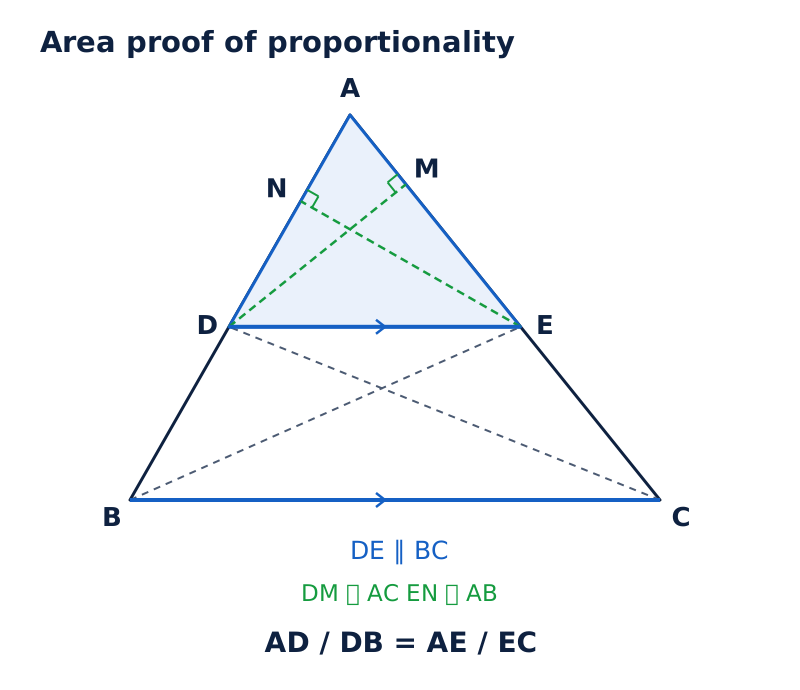
Triangle ABC contains D on AB and E on AC. The segment DE crosses the triangle above BC. Auxiliary segments BE and CD and perpendiculars DM and EN are drawn, with right-angle markers at M and N.
Drawn by One Young India. See Fig. 6.10 in your NCERT textbook
The parallel-line condition is essential to this argument. It makes the two triangles on base DE equal in area. Without that condition, the equality of the denominators has not been established, so the final proportionality cannot simply be assumed.
How does the converse establish that two lines are parallel?
Theorem: Equal division ratios imply parallelism
The converse of the Basic Proportionality Theorem reverses the direction of the original statement. If a line divides two sides of a triangle in the same ratio, then it is parallel to the third side.
Let D and E be interior points of sides AB and AC of triangle ABC. Here the starting information is , and the required conclusion is . Equal ratios are the evidence; parallelism is what must be proved.
Derivation: Why must the parallel meet the same point?
Draw through D a line parallel to BC meeting AC at , pronounced “E prime”. This new point is introduced to compare the given line with a line whose parallelism is already known.
- Apply the Basic Proportionality Theorem to the constructed parallel:
- Compare this result with the given equality:
- Add one to each side, combining each pair of adjacent segments into AC:
- Cancel the common positive length AC to obtain . Since E and lie on the same side AC at the same distance from C, they coincide.
- The given segment is therefore the constructed parallel, and hence .
Result: A matching pair of side-division ratios is sufficient to identify the parallel line. The proof explains why the two intersection points cannot be different.
| Statement | Given information | Conclusion |
|---|---|---|
| Basic Proportionality Theorem | ||
| Converse theorem |
For midpoints, each side is divided into equal halves. Their part-to-part ratios are therefore both one, so the segment joining the midpoints is parallel to the third side. Conversely, a parallel through one midpoint bisects the other intersected side.
How should side ratios be calculated and checked?
How can part-to-part ratios become part-to-whole ratios?
Keep the segment order consistent. With D on AB, E on AC, and , the numerator AD is adjacent to A, and DB is the remaining segment. The corresponding pair on AC is AE followed by EC.
- Start with the theorem: .
- Take reciprocals of the positive ratios: .
- Add one to both sides: .
- Replace the sums by whole sides: .
- Take reciprocals again to obtain .
Whole-side ratios are useful when the question gives complete side lengths. When using the converse in its part-to-part form, first subtract to find the remaining segments. The following cases all place E on PQ and F on PR of triangle PQR, whose vertices are P, Q and R.
Worked example 2. Given , , , and , determine whether EF is parallel to QR.
Answer:
- Compare the parts of the first side: .
- Compare the matching parts of the second side: .
- The ratios differ: , where means “is not equal to”. If EF were parallel to QR, the theorem would require equality. Therefore EF is not parallel to QR.
Worked example 3. Given , , , and , determine whether EF is parallel to QR.
Answer:
- Reverse endpoint order only to name the same segment: and .
- Calculate the first ratio: .
- Calculate the second ratio: .
- Since the two part-to-part ratios agree, the converse theorem gives .
Worked example 4. Given , , , and , determine whether EF is parallel to QR.
Answer:
- Find the remainder of PQ: .
- Find the remainder of PR: .
- Calculate the first ratio: .
- Calculate the second ratio: .
- The ratios agree, so the converse theorem establishes .
These calculations distinguish a failed proportionality test from a successful one. Retaining exact fractions makes the equality clear and avoids deciding parallelism from rounded decimal values or the appearance of a sketch.
Why do two equal angles establish triangle similarity?
Theorem: AAA and AA similarity
The AAA similarity criterion states that when the corresponding angles of two triangles are equal, their corresponding sides are proportional and the triangles are similar. AAA stands for Angle-Angle-Angle. It supplies the side condition from the angle condition.
The AA similarity criterion uses just two pairs of equal angles. AA stands for Angle-Angle. The third pair is then equal because the angles of each triangle add to a straight angle. Thus checking a third pair separately is unnecessary.
Derivation: How does AA lead to AAA?
For triangles ABC and DEF, suppose the given pairs are and . The remaining angles are at C and F.
- Write the angle sum in triangle ABC as .
- Write the corresponding equation in triangle DEF as .
- Substitute the two given angle equalities to obtain . All corresponding angles agree, so by AAA.
Result: AA and AAA establish the same similarity relationship. AA simply avoids repeating information that the angle sum property already determines.
Look for angle relationships created by parallel lines, intersecting lines, or an angle shared by two triangles. The equality must be justified, rather than inferred because the triangles look alike or face the same direction.
For example, take segments PS and QR intersecting at O, with . Here O names their intersection. Alternate angles give and , establishing by AA.
Note: Triangle angle criteria are stronger than the corresponding test for general polygons. Equal corresponding angles are sufficient for triangles, but the square and rectangle comparison shows why that rule cannot be extended to every quadrilateral.
How does the SSS criterion use three side ratios?
Theorem: SSS similarity
The SSS similarity criterion, meaning Side-Side-Side, states that if the sides of one triangle are proportional to the corresponding sides of another, their corresponding angles are equal and the triangles are similar.
For triangles ABC and DEF, the condition is . Every equality compares sides in the same direction. Establishing just two of these ratios does not complete an SSS argument.
Worked example 5. Triangle ABC has , , and . Triangle DEF has , , and . Determine whether the triangles are similar.
Answer:
- Calculate the ratio for the first matching sides: .
- Calculate the ratio for the second matching sides: .
- Calculate the ratio for the third matching sides: .
- All three ratios agree, so by SSS. The scale factor from the second triangle's lengths to the first triangle's lengths is .
How does similarity differ from SSS congruence?
SSS congruence requires equality of the corresponding side lengths. SSS similarity requires a common ratio, which need not be one. The worked example therefore establishes common shape even though each corresponding pair has different lengths.
The correspondence determines the angle conclusions: , , and . These equalities are consequences of SSS similarity; they do not need to be measured as additional assumptions.
State the criterion after showing all the required side ratios. This makes the argument complete and allows the similarity statement to be checked against the pairs actually compared. Consistent vertex order also determines which sides to use in any later calculation.
When does an included angle make SAS similarity possible?
Theorem: SAS similarity
The SAS similarity criterion, meaning Side-Angle-Side, requires two proportional pairs of corresponding sides and equality of their included angles. The included angle is the angle between the two sides being compared, not an arbitrary angle elsewhere in the triangle.
For triangles ABC and DEF, the conditions and give . Sides AB and AC meet at A; their matching sides DE and DF meet at D.
Worked example 6. Given , , , , and , establish similarity and find the ratio of BC to EF.
Answer:
- Calculate the first side ratio: .
- Calculate the second side ratio: .
- The given equal angles, , are included between these side pairs. Therefore by SAS.
- Corresponding third sides have the same ratio, so .
How should the available information guide the choice?
| Criterion | Sufficient information | Check before using it |
|---|---|---|
| AA or AAA | Two or three equal corresponding angle pairs | Match vertices using the angle equalities. |
| SSS | Three equal corresponding side ratios | Use all three ratios in a consistent order. |
| SAS | Two equal side ratios and equal included angles | The equal angles must lie between the compared sides. |
| RHS | Proportional hypotenuses and one corresponding side in two right triangles | Both triangles must be right-angled. |
In RHS similarity, RHS means Right angle-Hypotenuse-Side. The hypotenuse is the side opposite the right angle. This criterion applies specifically to two right triangles; its requirement of right angles is part of the statement.
In a written argument, identify the given data before selecting a criterion. Two side ratios suggest SAS only when the included-angle equality is also available. If angles provide the evidence instead, AA can establish the correspondence before any unknown side is calculated.
How can shadows be used for indirect measurement?
How does a lamp-post create similar triangles?
Indirect measurement uses a known length and a similarity relationship to find another length. In a shadow problem, distinguish the object's own shadow from the larger triangle's ground distance. Both distances must be matched with the correct vertical heights.
What the figure shows
Girl and lamp-post
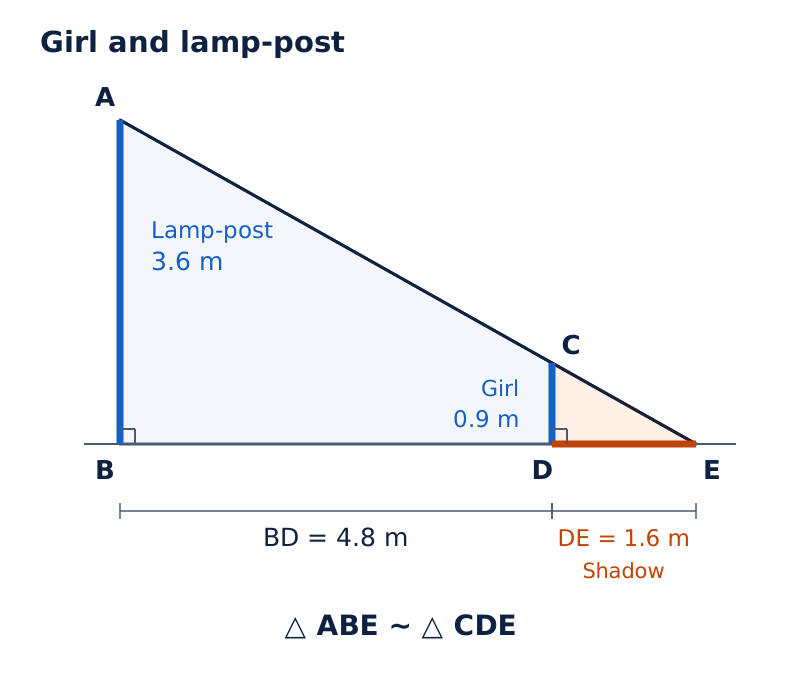
The lamp-post has top A and base B. The girl is shown with top C above ground point D. Points B, D and E lie along the ground, and the sloping line from A passes through C to shadow tip E.
Drawn by One Young India. See Fig. 6.32 in your NCERT textbook
Worked example 7. A girl of height walks from the base of a lamp-post at . The lamp is above the ground. Find her shadow length after . Here means metres, seconds, and metres per second.
Answer: Let AB be the lamp-post, CD the girl's height, and E the shadow tip. Let denote the numerical length of DE in metres. Both verticals stand on the same horizontal ground.
- Convert the girl's height to metres: .
- Find the distance she walks: .
- Both triangles have a right angle and share the angle at E: and . Thus by AA.
- Match ground distances to heights: . Since , substitution gives .
- Multiply by the positive number : .
- Subtract from both sides: .
- Divide by three: . The shadow length is therefore .
- Check the ratio with the answer: .
How does a pole's shadow help measure a tower?
Worked example 8. A vertical pole high casts a shadow long. At the same time, a tower casts a shadow long. Find the tower's height, taking both vertical objects on level ground under the same sunlight.
Answer: Let denote the numerical height of the tower in metres.
- The pole and tower each form a right triangle with the ground. Their sunlight angles agree, so the two triangles are similar by AA.
- Use matching height-to-shadow ratios: .
- Multiply both sides by twenty-eight: .
- Calculate the product and division: . The tower is high.
- Check the result: , so the height-to-shadow ratios match.
Unit consistency is necessary before substitution. In the lamp-post example, converting the girl's height puts both heights in metres. In the tower example, the height and shadow measurements already use the same unit, so their ratios can be compared directly.
How are the medians of similar triangles related?
What does a median contribute to the proof?
A median joins a vertex to the midpoint of the opposite side. Suppose . Let M be the midpoint of AB and N the midpoint of PQ, so CM and RN are corresponding medians.
The given similarity matches A with P, B with Q, and C with R. This gives equal corresponding angles and proportional corresponding sides. The midpoint information then converts the full-base ratio into the same ratio for the half-bases.
What the figure shows
Corresponding medians
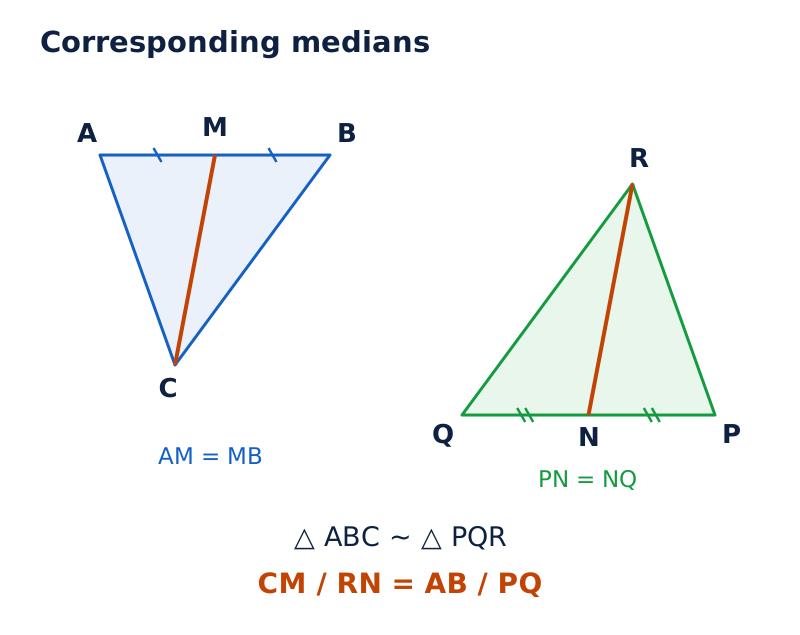
One triangle is labelled A, B and C, with M on AB and segment CM drawn. The other is labelled P, Q and R, with N on PQ and segment RN drawn. The triangles are shown in different orientations.
Drawn by One Young India. See Fig. 6.33 in your NCERT textbook
Derivation: Why do medians have the same ratio as sides?
- Use the given similarity to obtain and .
- Since M and N are midpoints, and . Consequently, .
- Combine the ratios to get . Also, , because M and N lie on the respective base sides.
- Apply SAS to these side pairs and their included angles: .
- Corresponding sides of these smaller triangles satisfy .
- Combine this with the original side ratio:
Result: Corresponding medians of similar triangles have the same ratio as corresponding sides. The proof establishes a second pair of similar triangles before using the median lengths.
How can the remaining smaller triangles be compared?
- Because M and N are midpoints, .
- The original similarity gives , and the median result gives .
- Therefore , establishing by SSS.
The order of vertices still matters when a triangle is split. In the first pair, M corresponds to N and C to R. In the second pair, B corresponds to Q. Keeping those matches explicit prevents a median from being paired with an unrelated side.
Glossary
- Similar figures — Figures that have the same shape, although their sizes need not be the same.
- Congruent figures — Figures that have both the same shape and the same size.
- Corresponding vertices — Vertices matched in the same positions when expressing a similarity relationship between figures.
- Proportional sides — Corresponding side lengths whose ratios are equal when compared in a consistent order.
- Scale factor — The common ratio of corresponding side lengths in two similar polygons.
- Equiangular triangles — Two triangles whose corresponding angles are equal to one another.
- Basic Proportionality Theorem — A line parallel to one triangle side divides the other two sides in the same ratio.
- AA similarity — A criterion establishing triangle similarity from two pairs of equal corresponding angles.
- SSS similarity — A criterion establishing triangle similarity when all three pairs of corresponding sides are proportional.
- SAS similarity — A criterion using two proportional side pairs and equality of the angles included between them.
- Included angle — The angle formed between the two sides being considered in a triangle.
- Median — A segment joining a triangle's vertex to the midpoint of its opposite side.
- Hypotenuse — The side opposite the right angle in a right-angled triangle.
Common errors and misconceptions
- Misconception: Similar figures must have equal sizes. Correct: Similarity requires the same shape; congruence requires both the same shape and the same size.
- Misconception: Equal corresponding angles prove that any two polygons are similar. Correct: General polygon similarity also requires proportional corresponding sides. The angle-only criterion applies to triangles.
- Misconception: The letters in a triangle similarity statement can be reordered independently. Correct: Vertex order identifies corresponding parts, so any reordering must preserve the established matching.
- Misconception: Two proportional side pairs and any equal angle establish SAS similarity. Correct: The equal angles must be included between the proportional side pairs.
- Misconception: The Basic Proportionality Theorem proves parallelism directly from ratios. Correct: Its converse proves parallelism from equal division ratios; the original theorem begins with parallelism.
- Misconception: A complete side can be substituted for a remaining segment in a part-to-part ratio. Correct: Identify each segment precisely, subtracting the given part from the whole when necessary.
- Misconception: In the lamp-post problem, the girl's distance from the post equals her shadow length. Correct: Her shadow begins at her feet, while the larger triangle's ground length includes both her walking distance and her shadow.
- Misconception: SSS similarity requires equal corresponding lengths. Correct: It requires equal corresponding ratios. Equal lengths are the stronger condition used for SSS congruence.
Exam-style questions with model answers
Q1. State the two conditions for similarity of polygons with the same number of sides. [2 marks]
- The corresponding angles must be equal, with each angle compared to the angle at its matching vertex.
- The corresponding sides must be proportional, meaning that every matching pair gives the same ratio in a consistent direction.
Q2. In triangle PQR, E lies on PQ and F on PR. Given , , , and , determine whether EF is parallel to QR. [3 marks]
- Compare the two parts of the first side in order from vertex P: .
- Compare the matching parts of the second side in the same order: . Thus .
- Both points lie on the stated sides, and their division ratios are equal. Therefore , by the converse of the Basic Proportionality Theorem.
Q3. Triangles ABC and DEF have , , , , , and . Show that they are similar and state their vertex correspondence. [4 marks]
- Compare AB with DE: . Both lengths use centimetres, so the ratio is dimensionless.
- Compare the second pair in the same direction: , agreeing with the first ratio.
- Check the third corresponding pair: . All three required ratios are now equal.
- Therefore by SSS similarity. The vertex correspondence is , , and .
Q4. In triangles ABC and DEF, , , , , and . Prove similarity and obtain the ratio of BC to EF. [3 marks]
- The first pair of corresponding sides gives . The second gives , so the two side pairs are proportional.
- The equal angles lie between those side pairs. Therefore by the SAS similarity criterion.
- BC and EF are corresponding sides under the established vertex order. Their ratio is consequently .
Q5. In triangle ABC, D lies between A and B, E lies between A and C, and . Prove using areas. You may construct perpendiculars. [5 marks]
- Join BE and CD. Construct and , where N and M are the respective feet. Write for triangle area.
- Triangles ADE and BDE share altitude EN. Thus and . Division gives .
- Using altitude DM, and . Therefore .
- Triangles BDE and DEC have common base DE and lie between the same parallels DE and BC. Their areas are equal: .
- The two area ratios consequently have the same numerator and equal denominators. Equating them yields , proving the required proportional division.
Q6. A girl tall walks away from a lamp-post's base at . The lamp is above horizontal ground. The girl and post are vertical. Find her shadow length after , starting at the base. [5 marks]
- Let AB be the post, CD the girl's vertical height, and E the shadow tip, with B, D and E in ground order and A, C and E collinear. Convert height: .
- Her walking distance is . Let denote her numerical shadow length in metres; then and .
- The triangles have and . Thus by AA, giving .
- Substitute: . Multiply by to get , then subtract to obtain .
- Divide by three: . Her shadow is long. Checking gives , as required.
Q7. Given , M is the midpoint of AB and N the midpoint of PQ. Prove that the medians CM and RN satisfy . [4 marks]
- From the given similarity, and . These match corresponding full sides and their included angles.
- The midpoint conditions give and . Hence .
- Since M lies on AB and N on PQ, . The proportional sides and equal included angles establish by SAS.
- Corresponding sides of these smaller triangles give . Combining this with the original similarity yields .
Q8. A vertical pole high casts a shadow. At the same time, a vertical tower casts a shadow. Both stand on level ground, and sunlight makes the same angle with it. Find the tower's height. [3 marks]
- The pole and tower each form a right triangle with the ground. The sunlight angles also agree, so the triangles are similar by AA.
- Let be the numerical tower height in metres. Matching height-to-shadow ratios gives . Multiplying by twenty-eight yields .
- The tower is therefore high. Rechecking the proportions gives , confirming that corresponding lengths have the required ratio.
Key takeaways
- Similar figures have the same shape, while congruent figures have both the same shape and the same size.
- Polygon similarity requires equal corresponding angles and proportional corresponding sides; triangle criteria can establish one condition from the other.
- The order of vertices in a triangle similarity statement fixes which angles and sides correspond.
- The Basic Proportionality Theorem starts with a parallel line and concludes that two sides are divided proportionally.
- The converse theorem starts with equal side-division ratios and concludes that the joining line is parallel to the third side.
- AA uses two equal angle pairs; SSS uses three proportional side pairs; SAS requires equal included angles between proportional sides.
- Shadow calculations require correctly matched heights and ground lengths, together with consistent units before numerical substitution.
- Corresponding medians of similar triangles have the same ratio as corresponding sides, established by comparing smaller triangles.
Test yourself
Are all congruent figures similar?
Yes. Congruent figures share the same shape and size, so they satisfy the shape requirement for similarity.
Why can equal angles fail to establish quadrilateral similarity?
A square and a non-square rectangle have equal corresponding angles, but their corresponding sides are not proportional.
What does vertex order tell you in a similarity statement?
It identifies the matching vertices, allowing corresponding angles and sides to be paired consistently.
Which theorem establishes parallelism from equal side-division ratios?
The converse of the Basic Proportionality Theorem establishes parallelism when a line divides two triangle sides in the same ratio.
Why does AA similarity not require checking a third angle separately?
The angle sum property makes the remaining angles equal when two corresponding angle pairs already agree.
What is special about the equal angle in SAS similarity?
It must be the included angle between the two sides whose corresponding ratios are equal.
What is required before applying RHS similarity?
Both triangles must be right-angled, with proportional hypotenuses and one other pair of corresponding sides.
How do corresponding medians compare in similar triangles?
Their ratio equals the common ratio of corresponding sides in the two similar triangles.