


Letter from the chairs
Dear delegates,
We will chair the Digital Economy and Artificial Intelligence Working Group at the Model G20 Summit 2027. Our group asks one hard question: should G20 members agree common safety tests for the most powerful AI models before they are released?
Read this guide twice. The first time, read for the story of how governments began testing AI models, and why they disagree about who should test, when, and by whose rules. The second time, read it as your member’s negotiator and mark every line that helps or hurts your case.
In the room we will look for clauses that name who acts, what they do and by when. We will also look for delegates who bring a member that wants binding rules and one that wants room to innovate to the same text, and who can show a source for every claim they make.
Bring your white paper, your member’s row from Section 8 and one draft clause. We look forward to meeting you at FLAME University in June.
Warm regards,
Your chairs, Digital Economy and Artificial Intelligence Working Group
How the G20 and this simulation work
The real G20
The Group of Twenty has 21 members: 19 countries and two regional bodies, the European Union and the African Union7. The African Union became a permanent member at the New Delhi summit in 20237. Together the members account for around 85% of the world’s economic output, over 75% of world trade and about two-thirds of its people7.
The G20 began in 1999, after the Asian financial crisis, as a meeting of finance ministers and central bank governors7. Leaders first met in Washington DC in 2008, and they have met every year since 20117. Each year one member holds the presidency and sets the agenda, helped by the members that held it before and will hold it after. These three are called the troika7. The United States took over the presidency on 1 December 2025 and cut the number of working groups from 16 to four7. The United Kingdom holds the presidency in 2027 and will host the Leaders’ Summit in Manchester on 27 and 28 November 20278,9.
Two tracks
The G20 process is led by the sherpas, each leader’s personal representative. The work runs in two tracks, the Finance Track and the Sherpa Track. Within the two tracks, working groups bring together officials from the members, invited countries and international organisations7.
Agreement by everyone
In September 2026 G20 finance ministers issued their text as a Chair’s Statement10. A note to it says it was agreed by all G20 members present except China, which objected to four of its paragraphs10. In this simulation a text is agreed only when no member objects; the Rules of Procedure 2027 explain how.
This simulation
The Model G20 Summit 2027 is set in 2027, the year the United Kingdom holds the G20 presidency. The Model G20 secretariat chairs every working group, and the UK delegation is an ordinary member. All 21 members are seated in every group. Each group also has four invited seats for international organisations or guest countries; they take part in the debate but are not members. Model G20 is organised by One Young India and is independent of the G20 and of every G20 government.
Each working group is modelled on a group that has met in the real G20 in recent years, so delegates learn how the forum works. Your group negotiates one short text on its agenda. On Sunday afternoon the working groups’ texts come together in the communiqué, which the Leaders’ Session adopts by consensus at the closing ceremony. The Rules of Procedure 2027 explain how debate, amendments and the final text work.
This working group
The working group is modelled on the work of the G20’s digital economy ministers. Meeting in Maceió in 2024, under Brazil’s presidency, they reaffirmed the G20 AI Principles11. In 2025 the leaders’ declaration agreed under South Africa’s presidency said that, for AI to be safe and trustworthy, issues including regulation, safety and human oversight “must be addressed”12. In 2026 the US presidency held an Innovation Ministerial in Chapel Hill, North Carolina13, whose statement calls on members to “preserve national sovereignty in the governance of emerging technologies”14. The UK Prime Minister has said he will put AI at the heart of the UK’s presidency in 202715.
The issue explained
The most powerful models
The countries at the AI Safety Summit at Bletchley Park in 2023 described “frontier” AI as highly capable general-purpose models that can match or exceed the most advanced models of today3. Telling which models are the most powerful is not simple. The EU’s AI Act uses the amount of computing power used to train a model as one way to estimate what it can do2. Above 10²⁵ operations, it presumes a model has high-impact capabilities2, and the Act’s recitals say a model should be considered to present systemic risks if it has such capabilities or a significant impact on the EU market because of its reach2.
What a safety test does
The Bletchley Declaration says those building the most powerful AI systems have “a particularly strong responsibility” for their safety, “including through systems for safety testing, through evaluations, and by other appropriate measures”3. It names cybersecurity and biotechnology as areas of special concern3. Tests try to find out how far a model could help someone attack a computer system or misuse biology, and whether its safeguards hold when people try to get round them6,16.
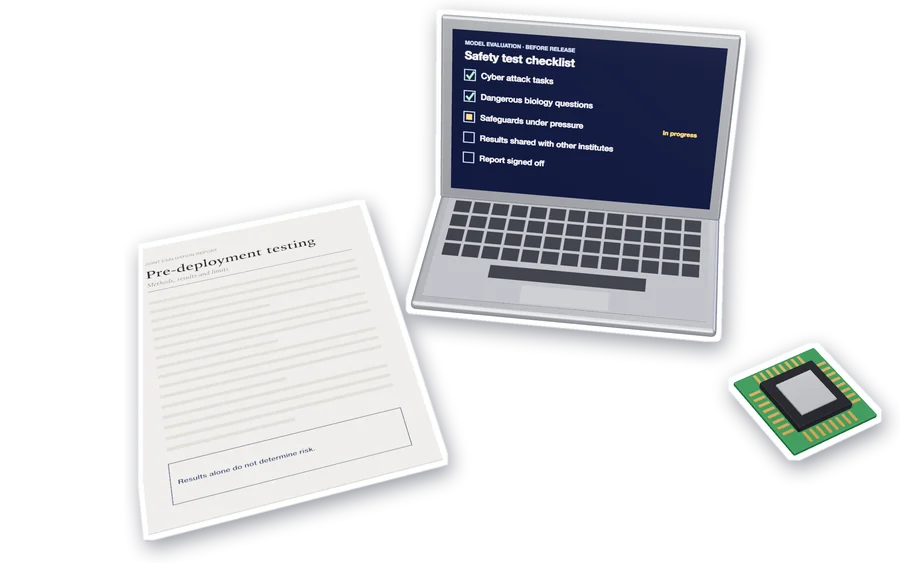
Governments have built teams to run these tests. The UK’s AI Security Institute says it tests leading AI systems before and after they are released5. The EU requires the makers of the most powerful models to evaluate them using standardised methods, including adversarial testing, and to report serious incidents to its AI Office2,17. A test is not a verdict: in one joint UK and US evaluation, the institutes warned that the results of their safeguard tests “cannot on their own determine the model’s risks”6. They called its findings preliminary, as they did in a second joint evaluation6,18. Figure 1 shows where testing fits in a model’s life.
Figure 1Section 3
Where safety testing fits in the life of an AI model, and who does it.
Why agreeing on tests is hard
Tests are hard to compare. When the US, UK and Singapore institutes first tested a model together, in 2024, they found that small differences in method “can have a large impact”: on one test their results differed by more than 5 percentage points until they found the cause and aligned their results19. In their third joint exercise, in 2025, testing AI agents was so new that the main focus was on methods, not on results20.
Members also take different routes. The EU, Korea and China have binding rules2,21,22, while the US testing centre plans voluntary agreements16. Even so, the 2026 Innovation Ministerial statement, which the White House calls a consensus statement, warns: “Outdated or inflexible regulatory approaches can unintentionally restrict innovation”13,14. In February 2026 the United States registered its “strong objection” to the UN scientific panel on AI “as currently constituted”23. Writing about the new panel, UN News said that diverging attitudes towards regulation and growing geopolitical tensions could make consensus hard to forge24.
What has happened so far
- 30 Oct 2023G7 leaders agree guiding principles and a voluntary code of conduct for AI developers25
- 1 to 2 Nov 2023Countries at the AI Safety Summit issue the Bletchley Declaration3
- 21 May 2024The AI Seoul Summit issues a statement on international cooperation on AI safety science26
- 13 Sep 2024G20 digital economy ministers meet in Maceió, under Brazil’s presidency11
- 21 Nov 2024Ten participants launch the International Network of AI Safety Institutes in San Francisco26
- 10 to 11 Feb 2025The AI Action Summit in Paris brings together participants from over 100 countries27
- 10 Jul 2025The voluntary General-Purpose AI Code of Practice, prepared by independent experts, is published28
- 17 Jul 2025The Network publishes the results of its third joint testing exercise20
- 2 Aug 2025The EU AI Act’s obligations for general-purpose AI models begin; enforcement powers follow from 2 August 202617
- 22 Nov 2025A leaders’ declaration agreed under South Africa’s presidency includes a section on AI12
- 12 Feb 2026The UN General Assembly appoints the 40 members of its scientific panel on AI, by 117 votes to 223
- 6 to 7 Jul 2026The first UN Global Dialogue on AI Governance takes place29
- 2 Sep 2026The G20 Innovation Ministerial in Chapel Hill ends with a statement13
- 22 Sep 2026The UK Prime Minister tells the UN General Assembly he will put AI at the heart of the UK’s 2027 G20 presidency15
What the G20 has already said
The leaders’ declaration agreed under South Africa’s presidency, Johannesburg, November 2025:
“To ensure safe, secure, and trustworthy AI development, deployment and use, the protection of human rights, transparency and explainability, fairness, accountability, regulation, safety, appropriate human oversight, ethics, biases, privacy, data protection and data governance must be addressed.”12
G20 Innovation Ministerial Statement, Chapel Hill, September 2026:
“We call on members to develop their own policies and preserve national sovereignty in the governance of emerging technologies, while allowing for engagement in international discussions.”14
Facts that matter
| Figure | Value | Year | Ref. |
|---|---|---|---|
| Global AI market (UNCTAD projection) | US$189 billion to US$4.8 trillion | 2023 to 2033 | 1 |
| Share of world AI research and development by 100 companies | 40% | 2022 | 1 |
| Jobs that AI could affect, UNCTAD | 40% of jobs worldwide | 2025 report | 1 |
| EU threshold for presuming high-impact capabilities | 10²⁵ operations used in training | from August 2025 | 2,17 |
| Highest EU fine for makers of general-purpose AI models | 3% of yearly worldwide turnover or €15 million, whichever is higher | from August 2026 | 2,17 |
| Organisations signing the Frontier AI Safety Commitments | 16, plus 4 added later | 2024 | 30 |
| Participants at the launch of the Network of AI Safety Institutes | 10 | 2024 | 26 |
| Public cyber challenges solved in the US institute’s pre-release tests (40 in each test) | upgraded Claude 3.5 Sonnet 32.5%; o1 45%; best reference model 35% | 2024 | 6,18 |
| Safety tests on leaks of sensitive information and fraud passed by AI agents in English, third joint testing exercise | about 40% overall | 2025 | 20 |
| UN vote appointing the scientific panel on AI | 117 in favour, 2 against | 2026 | 23 |
| Members of the UN scientific panel | 40, 19 women and 21 men | 2026 | 23,24 |
| Delegations the White House lists as present at the 2026 G20 Innovation Ministerial, besides the US host | 20, including Poland | 2026 | 13 |
Core tensions
Test before release, or keep room to innovate
For testing before release. The Bletchley Declaration gives the builders of the most powerful systems a particularly strong responsibility for safety, including through safety testing3. The EU AI Act’s recitals, which explain its rules, say providers should perform the necessary model evaluations “in particular prior to its first placing on the market”2. The UK Prime Minister has promised to work towards “a single set of global principles and standards” so that AI development is safe15.
For room to innovate. The 2026 Innovation Ministerial statement warns that inflexible rules can restrict innovation14. Even the Bletchley Declaration says countries should consider “a pro-innovation and proportionate governance and regulatory approach”3.
Common tests, or national choices
For common tests. Small differences in method can have a large impact on results19, so tests run separately are hard to compare. Safety institutes from several countries have already tested models together three times20.
For national choices. The 2026 Innovation Ministerial statement calls on members to develop their own policies and keep national sovereignty over how emerging technologies are governed14. The Global AI Governance Action Plan also lists respecting national sovereignty among its principles31. It was published at the 2025 World AI Conference and posted by China’s Foreign Ministry31.
Voluntary, or required by law
For voluntary commitments. At the 2024 Seoul summit, companies agreed to assess the risks of their frontier models before deploying them, and to set thresholds at which severe risks, unless adequately mitigated, would be deemed intolerable30. The US government’s testing centre says it will make voluntary agreements with AI developers16.
For law. The EU AI Act requires model evaluation and adversarial testing, with fines of up to 3% of yearly worldwide turnover2. Korea’s Framework Act on AI sets a duty to ensure safety for systems above a computing threshold21, and China requires security assessments for some AI services22.
Case studies
The UK and US test models before release
On 19 November 2024 the UK and US AI safety institutes published a joint evaluation of an upgraded Claude 3.5 Sonnet model, made by Anthropic, carried out during a limited period before its release6. On 18 December 2024 they published a joint evaluation of OpenAI’s o1 model, tested in three areas, including cybersecurity18. In each evaluation the US institute ran a suite of 40 public cybersecurity challenges: the upgraded Claude 3.5 Sonnet solved 32.5% and o1 solved 45%, against 35% for the best reference model in each6,18. In the Claude 3.5 Sonnet evaluation the institutes warned that their safeguard results “cannot on their own determine the model’s risks”6. Both write-ups call their findings preliminary6,18. In 2026 the US testing centre also assessed models from the Chinese company Z.ai after they were released16.
What it shows. Governments can test a model before release when its maker gives them access, and the results still need careful reading. Question for your group. Should every maker of the most powerful models be expected to give governments access before release, or only those that agree?
The EU’s Code of Practice
The General-Purpose AI Code of Practice, prepared by independent experts, was published on 10 July 202528. It has three chapters: transparency, copyright, and safety and security, and the safety chapter applies only to makers of the most advanced models28. The Commission describes that chapter as setting out state-of-the-art practices for managing systemic risks28. Signatories set up a taskforce, chaired by the EU’s AI Office, to apply the Code consistently28. The Commission’s powers to enforce the AI Act’s rules for these models began on 2 August 202617.
What it shows. A voluntary code can sit alongside binding law and explain how to meet it. Question for your group. Could a G20 text borrow this model: shared practices first, binding rules where members choose?
China’s security assessments
Under China’s 2023 interim measures (in an unofficial English translation by China Law Translate), providers of generative AI services with “public opinion properties” or the capacity for social mobilisation must carry out security assessments and file their algorithms22. The measures took effect on 15 August 202322. They say the state places equal emphasis on development and security and carries out “tolerant and cautious graded management by category” of these services22. In 2025 the Global AI Governance Action Plan, published at a conference and posted by China’s Foreign Ministry, said: “We need to explore categorized and tiered management approaches, build a risk testing and evaluation system for AI”31.
What it shows. A large AI power can require security assessments at home while calling for respect for national sovereignty abroad. Question for your group. Can a G20 text on testing work for members whose systems differ this much?
Country positions
One row for each of the 21 members. “Stake” and “On the record” come from official sources, except where a row names a broadcaster or a translation. “Our reading”, in italics, is what we think that record suggests: test it in your research. Where the record is silent, the row says so. Signing the Bletchley Declaration or the Paris summit statement, or attending the 2026 Innovation Ministerial, is not a position on testing. The label under each name shows the member’s place in the record: institute (it has a national AI safety or security institute or testing centre), binding rules (it has a law that requires testing or assessment), or not clear. Australia, Canada and France are labelled not clear, but they took part in the Network’s third joint testing exercise20. Bring this section to the summit and tick each row as members speak.
| Member | Stake | On the record | Our reading | Mark |
|---|---|---|---|---|
 Argentina | It attended the 2026 Innovation Ministerial13, and is on neither the Bletchley nor the Paris summit list3,27. | No public statement found. Research it. | Not clear from the record. Research it. | AllyOpp.Swing |
 Australia | It was one of the ten participants at the launch of the International Network of AI Safety Institutes26. | It took part in the Network’s third joint testing exercise in July 202520, and is on the Bletchley and Paris summit lists3,27. | Pushes for: Joint testing between institutes. Allies: Canada, Japan, the United Kingdom. Not clear from the record: red line. Research it. | AllyOpp.Swing |
 Brazil | Its Senate approved an AI bill in December 2024 and sent it to the Chamber of Deputies in March 202532. | The Maceió declaration, agreed under its 2024 presidency, reaffirmed the G20 AI Principles11. It is on the Bletchley and Paris summit lists3,27. | Not clear from the record. Research it. | AllyOpp.Swing |
 Canada | It was one of the ten participants at the launch of the Network of AI Safety Institutes26. | The Network met in Vancouver in July 2025, alongside its third joint testing exercise33. It is on the Bletchley and Paris summit lists3,27. | Pushes for: Joint testing between institutes. Allies: The United Kingdom, Japan, Australia. Not clear from the record: red line. Research it. | AllyOpp.Swing |
 China | Its 2023 measures, in an unofficial English translation by China Law Translate, require some generative AI services to carry out security assessments and file their algorithms22. | Its Foreign Ministry posted the Global AI Governance Action Plan, published at the 2025 World AI Conference, which calls on all parties to act on principles including respecting national sovereignty and ensuring safety31. The plan says: “We need to explore categorized and tiered management approaches, build a risk testing and evaluation system for AI”31. | Pushes for: Testing under national rules. Not clear from the record: red line, allies. Research it. | AllyOpp.Swing |
 France | It hosted the AI Action Summit in Paris in February 202527, and took part in the Network’s third joint testing exercise, with the European Commission and others20. | The Paris summit statement says that harnessing the benefits of AI “depends on advancing Trust and Safety”27. | Pushes for: Trust and safety alongside innovation. Allies: The European Union. Not clear from the record: red line. Research it. | AllyOpp.Swing |
 Germany | Its government reports that a national AI safety institute, AISI Deutschland, has opened34. | It is on the Bletchley and Paris summit lists3,27. No further public statement on testing found. | Not clear from the record. Research it. | AllyOpp.Swing |
INDIndia not clear | It hosted the India AI Impact Summit in 2026; the national broadcaster reports that its declaration was endorsed by 88 countries and organisations35. | The same report says the declaration holds that the benefits of AI must be equitably shared35. | Pushes for: Sharing the benefits of AI. Not clear from the record: red line, allies. Research it. | AllyOpp.Swing |
 Indonesia | It is on the Bletchley and Paris summit lists3,27 and attended the 2026 Innovation Ministerial13. | No public statement found. Research it. | Not clear from the record. Research it. | AllyOpp.Swing |
 Italy | It is on the Bletchley and Paris summit lists3,27 and attended the 2026 Innovation Ministerial13. | No public statement found. Research it. | Not clear from the record. Research it. | AllyOpp.Swing |
 Japan | Ten ministries and five government-affiliated organisations set up the Japan AI Safety Institute in February 202436. | Its AI Promotion Act of 2025 calls for measures such as transparency in how AI is developed and used, because misuse could help crimes, leaks of personal information and copyright infringement37. It took part in the Network’s third joint testing exercise20. | Pushes for: Joint testing between institutes. Allies: The United Kingdom, Canada, Korea. Not clear from the record: red line. Research it. | AllyOpp.Swing |
 Republic of Korea | Its Framework Act on AI requires operators of systems trained with computing power above a threshold set by decree to assess and reduce risks and to monitor safety incidents21. | With the UK it announced the organisations that agreed the Frontier AI Safety Commitments at the 2024 Seoul summit30. | Pushes for: Safety duties above a computing threshold. Allies: The European Union, Japan. Not clear from the record: red line. Research it. | AllyOpp.Swing |
 Mexico | It attended the 2026 Innovation Ministerial13, and is on the Paris summit list but not the Bletchley Declaration list3,27. | No public statement found. Research it. | Not clear from the record. Research it. | AllyOpp.Swing |
RUSRussia not clear | It attended the 2026 Innovation Ministerial13, and is on neither the Bletchley nor the Paris summit list3,27. | No public statement found. Research it. | Not clear from the record. Research it. | AllyOpp.Swing |
KSASaudi Arabia not clear | It is on the Bletchley Declaration list3 but not the Paris summit list27, and attended the 2026 Innovation Ministerial13. | No public statement found. Research it. | Not clear from the record. Research it. | AllyOpp.Swing |
 South Africa | It held the G20 presidency in 202512. | The declaration agreed under its presidency commended the presidency’s leadership in advancing global discussions on AI12 and welcomed the AI for Africa Initiative12. | Pushes for: AI that serves Africa. Allies: The African Union. Not clear from the record: red line. Research it. | AllyOpp.Swing |
 Türkiye | It is on the Bletchley Declaration list3 but not the Paris summit list27, and attended the 2026 Innovation Ministerial13. | No public statement found. Research it. | Not clear from the record. Research it. | AllyOpp.Swing |
 United Kingdom | It holds the G20 presidency in 20278. Its AI Security Institute calls itself the first state-backed organisation dedicated to ensuring advanced AI is safe, secure and beneficial4. | In September 2026 its Prime Minister promised to work towards “a single set of global principles and standards” and to put AI at the heart of its G20 presidency15, and said the UK would bring forward new laws “if that is what is needed”15. With the US, its institute tested two models before their release in 20246,18. | Pushes for: Shared global standards for testing. Allies: Canada, Japan, France. Not clear from the record: red line. Research it. | AllyOpp.Swing |
 United States | It held the G20 presidency in 20267 and hosted the Innovation Ministerial13. Its testing centre says it will make voluntary agreements with developers and lead evaluations of risks to national security16. | In February 2026, citing sovereignty, it registered its “strong objection” to the UN scientific panel on AI “as currently constituted”, voted against appointing its members and urged the UN not to “attempt to regulate or stifle the development of” cutting-edge technologies23. Its testing centre aims to guard against “burdensome and unnecessary regulation of American technologies by foreign governments” and to ensure US dominance of international standards16. | Pushes for: Voluntary testing and national choice. Red line: A UN role in regulating AI. Not clear from the record: allies. Research it. | AllyOpp.Swing |
 European Union | Its AI Act requires makers of general-purpose models with systemic risk to evaluate them, including with adversarial testing, and to report serious incidents to the AI Office2. | Its enforcement powers over these rules began on 2 August 202617. In 2023 the European Commission welcomed the G7’s voluntary code of conduct for AI developers25. The EU is on the Bletchley and Paris summit lists3,27. | Pushes for: Binding evaluation of the most powerful models. Allies: France, Germany, Korea. Not clear from the record: red line. Research it. | AllyOpp.Swing |
AUAfrican Union not clear | The declaration agreed under South Africa’s presidency in 2025 welcomed the AI for Africa Initiative, a voluntary platform for cooperation between the G20 and the African Union12. | The Paris summit statement cites the African Union’s Continental AI Strategy among existing initiatives on AI27. | Pushes for: Help for Africa to build and use AI. Allies: South Africa. Not clear from the record: red line. Research it. | AllyOpp.Swing |
Invited seats (not members)
- OECD. Its AI Principles were adopted in May 2019 and updated in May 202438.
- International Telecommunication Union. Its Secretary-General is Vice-Chair of the AI for Good Global Commission, which first met at the AI for Good Global Summit 2026, held back-to-back with the first UN Global Dialogue on AI Governance29.
- UNESCO. Its Recommendation on the Ethics of AI was adopted by all 193 member states in November 202139.
- Singapore (guest country). One of the ten participants at the launch of the Network26, and one of three institutes that led its first pilot test19.
The camps
Options on the table
Each option is something the G20 can actually do: commit its own members, call on others, or ask international bodies to act and report. Who may back or resist each option is our reading of the record in Section 8, for you to test in your research.
A. Voluntary commitments to test before release
What it is. Members ask the makers of the most powerful models to let national institutes test them before release, by agreement. Who runs it. National institutes and the companies. Precedent. The 2024 Frontier AI Safety Commitments, in which companies agreed to assess risks before deploying their models and to set thresholds at which severe risks, unless adequately mitigated, would be deemed intolerable30, and the US testing centre’s stated plan to establish voluntary agreements with developers16. For. It can start at once, without new laws. Against. A company that does not agree is not tested. May back it. The United States and the United Kingdom.
B. Joint testing between national institutes
What it is. Members’ institutes agree shared methods and test models together, so that one test can count in many countries. Who runs it. The International Network of AI Safety Institutes26. Precedent. The Network ran three joint testing exercises between November 2024 and July 202520. For. Shared methods make results comparable: in the first joint test, results that differed by more than 5 percentage points were aligned once the institutes found the cause together19. Against. Fewer than half of G20 members took part in the Network’s launch26. May back it. Japan, Canada, France and Australia, all Network participants26.
C. Binding law
What it is. Members require by law that the most powerful models are evaluated before release. Who runs it. Each member’s regulator. Precedent. The EU AI Act, with fines of up to 3% of yearly worldwide turnover or €15 million, whichever is higher2; its recitals ask for evaluation “in particular prior to its first placing on the market”2. Korea’s Framework Act also sets safety duties above a computing threshold21. For. It reaches every covered model sold in a member’s market. Against. The 2026 Innovation Ministerial statement warns that inflexible rules can restrict innovation14. May back it. The European Union and Korea. May resist it. The United States.
D. Shared standards for testing
What it is. Members work through standards bodies on common methods for testing AI models. Who runs it. National and international standards bodies. Precedent. The 2026 Innovation Ministerial statement says technical standards and regulations should give investment certainty and avoid unnecessary obstacles to international trade14. For. Standards can be agreed without a new treaty. Against. Standards take time to agree, and models change fast. May back it. The United States and the United Kingdom15,16.
E. Report serious incidents
What it is. Makers of the most powerful models report serious incidents to a national authority, and members share what they learn. Who runs it. National authorities, with the OECD tracking incidents38. Precedent. The EU AI Act requires makers of models with systemic risk to report serious incidents to the AI Office2,17. For. It adds evidence from real use after release; one pre-release evaluation warned that its safeguard results “cannot on their own determine the model’s risks”6. Against. It acts after the harm. May back it. The European Union and Korea.
What the communiqué must answer
- Which models are covered: by computing power, by capability, or both?
- What must a test check, and who runs it?
- Before release, after, or both?
- Are results shared between members, and with the public?
- Voluntary, or required by law?
- Who reports progress, to whom, and by when?
Draft paragraph, as amendedWeak, then strong
We recognise the importance of safe, secure and trustworthy AI and encourage continued international discussion. We commit that our national AI safety or security institutes will agree, by the end of 2028, a shared set of methods for testing the most powerful AI models before release, and will recognise each other’s results where the same methods are used. We call on developers of these models to give our institutes access before release, and ask the OECD to report progress to our Digital Ministers by October 2028.
The weak paragraph names no one and promises nothing. The strong one commits only G20 members and calls on everyone else. It is an example, not the answer: your group may decide on a different course, or on none.
Preparation
Your white paper
Write at most 1,000 words, with numbered sources, and send it to your chairs by Monday 31 May 2027 (Rules of Procedure 9.2). Use five parts:
- Your member’s stake, in three numbers with sources.
- Its position on each question in Section 10.
- Its red lines: what it will not accept.
- One draft paragraph in the style of a communiqué, beginning “We commit” or “We call on”.
- Your sources, numbered, official ones first.
Five questions to research for your member
- Does your member have a national AI safety or security institute, or a law on AI?
- Did it sign the Bletchley Declaration, and is it in the Network of AI Safety Institutes?
- Do companies based in your member build some of the most powerful models?
- What did it say at the 2026 Innovation Ministerial or at the UN about AI?
- Which members are most likely to agree with it, and which one in the other camp could it win over?
Starter sources
- The Bletchley Declaration, reference 3
- The G20 Innovation Ministerial Statement, 2026, reference 14
- The 2025 declaration agreed under South Africa’s presidency, reference 12
- The UK AI Security Institute, reference 4
- The US testing centre, reference 16
- The EU’s Code of Practice, reference 28
- The third joint testing exercise, reference 20
- UNCTAD on the AI market, reference 1
 Pocket card
Your first hour as a delegate
- Roll call. Hold up your placard and answer “present” when your member is called.
- Opening speech. Give your member’s stake in one number, its position, and one thing it wants in the text.
- Listen. As members speak, mark their rows in Section 8: ally, opponent or swing.
- First caucus. Find two allies, one in your camp and one in the other.
- By the break. Bring one clause that names who acts, what they do, and by when.
Glossary
- Adversarial testing
- Testing a model by trying on purpose to make it misbehave, for example by getting round its safeguards2,6.
- AI agent
- An AI system that can take actions on its own, such as browsing or running code.
- Compute
- The computing power used to train or run an AI model.
- Frontier AI
- Highly capable general-purpose AI models that can match or exceed today’s most advanced models3.
- General-purpose AI model
- A model that can do many different tasks, rather than one.
- Incident
- An event in which an AI system causes or nearly causes serious harm.
- Mutual recognition
- Members accepting each other’s test results.
- Pre-deployment testing
- Testing an AI model before it is released to the public.
- Safeguard
- A measure that stops a model from being misused, such as refusing harmful requests.
- Systemic risk
- In EU law, the risk from a general-purpose AI model with high-impact capabilities or a large effect on the market2.
- Threshold
- A level of capability or risk at which stronger rules apply.
References
All sources accessed 20 and 21 November 2026. Numbers in the text refer to this list.
- UNCTAD. “AI market projected to hit $4.8 trillion by 2033, emerging as dominant frontier technology” (Technology and Innovation Report 2025). https://unctad.org/news/ai-market-projected-hit-48-trillion-2033-emerging-dominant-frontier-technology
- European Union. Regulation (EU) 2024/1689 (Artificial Intelligence Act), Official Journal L, 2024, EUR-Lex. https://eur-lex.europa.eu/legal-content/EN/TXT/HTML/?uri=OJ:L_202401689
- GOV.UK. “The Bletchley Declaration by Countries Attending the AI Safety Summit, 1-2 November 2023”. https://www.gov.uk/government/publications/ai-safety-summit-2023-the-bletchley-declaration/the-bletchley-declaration-by-countries-attending-the-ai-safety-summit-1-2-november-2023
- UK AI Security Institute, home page. https://www.aisi.gov.uk/
- GOV.UK. AI Security Institute, “Frontier AI Trends report factsheet”. https://www.gov.uk/government/publications/ai-security-institute-frontier-ai-trends-report-factsheet/ai-security-institute-frontier-ai-trends-report-factsheet
- UK AI Security Institute. “Pre-deployment evaluation of Anthropic’s upgraded Claude 3.5 Sonnet”, 19 November 2024 (joint with US AISI). https://www.aisi.gov.uk/blog/pre-deployment-evaluation-of-anthropics-upgraded-claude-3-5-sonnet
- Ministry of External Affairs, India. “Group of Twenty - G20” (brief), July 2026. https://www.mea.gov.in/Portal/ForeignRelation/G20_2026.pdf
- Prime Minister’s Office, GOV.UK. “Growth and opportunity set to be at the heart of UK-hosted G20”, 22 November 2025. https://www.gov.uk/government/news/growth-and-opportunity-set-to-be-at-the-heart-of-uk-hosted-g20
- Cabinet Office, GOV.UK. “Manchester to host world leaders at the 2027 G20 Summit”, 23 September 2026. https://www.gov.uk/government/news/manchester-to-host-world-leaders-at-the-2027-g20-summit
- US Department of the Treasury. “G20 Chair’s Statement”, Second Meeting of G20 Finance Ministers and Central Bank Governors, Asheville, 31 August and 1 September 2026 (press release sb0620). https://home.treasury.gov/news/press-releases/sb0620
- G20 Ministers responsible for the Digital Economy. “G20 Ministerial Declaration”, Maceió, 13 September 2024 (Brazilian presidency), copy on GOV.UK. https://www.gov.uk/government/publications/g20-ministerial-declaration-maceio-13-september-2024/g20-ministerial-declaration-13-september-2024
- G20. “G20 South Africa Summit: Leaders’ Declaration”, Johannesburg, 22 November 2025 (South African presidency), copy hosted by the G20 Research Group, University of Toronto. https://g20.utoronto.ca/2025/251122-declaration.html
- The White House. “G20 Innovation Ministerial Concludes with Consensus Statement”, 2 September 2026. https://www.whitehouse.gov/releases/2026/09/g20-innovation-ministerial-concludes-with-consensus-statement/
- G20 Ministers. “G20 Innovation Ministerial Statement”, Chapel Hill, 2 September 2026 (US presidency), PDF published by the UK Government on GOV.UK. https://assets.publishing.service.gov.uk/media/6a996786f5b35599aec19180/g20-innovation-ministerial-statement.pdf
- Prime Minister’s Office, GOV.UK. “PM speech at UNGA: 22 September 2026” (transcript as delivered). https://www.gov.uk/government/speeches/pm-speech-at-unga-22-september-2026
- NIST. Center for Advancing Innovation and Standards for Super Intelligence (CAISSI), also called the Center for AI Standards and Innovation (CAISI). https://www.nist.gov/caissi
- European Commission. “Guidelines for providers of general-purpose AI models”, Shaping Europe’s digital future. https://digital-strategy.ec.europa.eu/en/policies/guidelines-gpai-providers
- UK AI Security Institute. “Pre-Deployment evaluation of OpenAI’s o1 model”, 18 December 2024 (joint with US AISI). https://www.aisi.gov.uk/blog/pre-deployment-evaluation-of-openais-o1-model
- NIST. “Improving International Testing of Foundation Models: A Pilot Testing Exercise from the International Network of AI Safety Institutes”. https://www.nist.gov/document/aisi-pilot-testing-exercise-blog
- UK AI Security Institute. “International joint testing exercise: Agentic testing”, 17 July 2025. https://www.aisi.gov.uk/blog/international-joint-testing-exercise-agentic-testing
- Korea Legislation Research Institute. “Framework Act on the Development of Artificial Intelligence and the Creation of a Foundation for Trust” (English translation, Korea). https://elaw.klri.re.kr/eng_service/lawViewContent.do?hseq=73499
- “Interim Measures for the Management of Generative Artificial Intelligence Services” (China, 2023), English translation by China Law Translate (unofficial), on Georgetown University’s Emerging Technology Observatory, AGORA. https://agora.eto.tech/instrument/1137
- United Nations Regional Information Centre. “General Assembly Appoints Artificial Intelligence Panel”, UN press release. https://unric.org/en/general-assembly-appoints-artificial-intelligence-panel/
- UN News. “AI ‘moving at the speed of light’ warns Guterres, unveiling recommendations for UN expert panel”, 4 February 2026. https://news.un.org/en/story/2026/02/1166891
- European Commission. “Hiroshima Process International Code of Conduct for Advanced AI Systems”. https://digital-strategy.ec.europa.eu/en/library/hiroshima-process-international-code-conduct-advanced-ai-systems
- Innovation, Science and Economic Development Canada. “The International Network of AI Safety Institutes: Mission statement”, 21 November 2024. https://www.ised-isde.canada.ca/site/ised/en/international-network-ai-safety-institutes-mission-statement
- Élysée (French Presidency). “Statement on Inclusive and Sustainable Artificial Intelligence for People and the Planet”, AI Action Summit, Paris, 10 and 11 February 2025, posted 11 February 2025. https://www.elysee.fr/en/emmanuel-macron/2025/02/11/statement-on-inclusive-and-sustainable-artificial-intelligence-for-people-and-the-planet
- European Commission. “The General-Purpose AI Code of Practice”, Shaping Europe’s digital future. https://digital-strategy.ec.europa.eu/en/policies/contents-code-gpai
- ITU. “AI for Good and WSIS Forum 2026 close with global push for AI for everyone”, press release, July 2026. https://www.itu.int/en/mediacentre/Pages/PR-2026-07-10-Geneva-Digital-Week-closing.aspx
- GOV.UK. “Frontier AI Safety Commitments, AI Seoul Summit 2024”. https://www.gov.uk/government/publications/frontier-ai-safety-commitments-ai-seoul-summit-2024/frontier-ai-safety-commitments-ai-seoul-summit-2024
- Ministry of Foreign Affairs of the People’s Republic of China. “Global AI Governance Action Plan” (July 2025). https://www.mfa.gov.cn/mfa_eng/xw/zyxw/202507/t20250729_11679232.html
- Federal Senate of Brazil. “PL 2338/2023” (bill on the use of artificial intelligence), the bill’s progress page. https://www25.senado.leg.br/web/atividade/materias/-/materia/157233
- European Commission. “AI Office contributes to the third joint testing exercise of the International Network of AI Safety Institutes”, Shaping Europe’s digital future, July 2025. https://digital-strategy.ec.europa.eu/en/news/ai-office-contributes-third-joint-testing-exercise-international-network-ai-safety-institutes
- Die Bundesregierung (German federal government). “AISI Deutschland: KI-Sicherheitsinstitut eröffnet” (German). https://www.bundesregierung.de/breg-de/aktuelles/eroeffnung-ki-sicherheitsinstitut-2449410
- Akashvani (All India Radio, Prasar Bharati), News On AIR. “India-AI Impact Summit concludes with adoption of New Delhi Declaration”, 21 February 2026. https://www.newsonair.gov.in/india-ai-impact-summit-2026-adopts-new-delhi-declaration
- Japan AI Safety Institute (J-AISI). “Factsheet of AI Safety in Japan 2025”, 31 March 2026. https://aisi.go.jp/assets/pdf/j-aisi_factsheet_2025_en.pdf
- Japan, Japanese Law Translation database. “Act on Promotion of Research and Development, and Utilization of Artificial Intelligence-Related Technology” (Act No. 53 of 4 June 2025), English translation. https://www.japaneselawtranslation.go.jp/en/laws/view/5066/en
- OECD.AI. “AI Principles Overview”. https://oecd.ai/en/ai-principles
- UN News. “193 countries adopt first-ever global agreement on the Ethics of Artificial Intelligence”, 25 November 2021. https://news.un.org/en/story/2021/11/1106612