


Letter from the chairs
Dear delegates,
We will chair the Energy Transitions Working Group at the Model G20 Summit 2027. Our group asks one hard question: who should refine the world’s critical minerals, the countries that mine them, or new plants in the countries that buy them?
Read this guide twice. The first time, read for the story of how a rock dug out of the ground becomes a battery, and why the step in the middle has become a contest between countries. The second time, read it as your member’s negotiator and mark every line that helps or hurts your case.
In the room we will look for clauses that name who acts, what they do and by when. We will also look for delegates who bring a mining country and a buying country to the same text, and who can show a source for every claim they make.
Bring your white paper, your member’s row from Section 8 and one draft clause. We look forward to meeting you at FLAME University in June.
Warm regards,
Your chairs, Energy Transitions Working Group
How the G20 and this simulation work
The real G20
The Group of Twenty has 21 members: 19 countries and two regional bodies, the European Union and the African Union6. The African Union became a permanent member at the New Delhi summit in 20236. Together the members account for around 85% of the world’s economic output, over 75% of world trade and about two-thirds of its people6.
The G20 began in 1999, after the Asian financial crisis, as a meeting of finance ministers and central bank governors6. Leaders first met in Washington DC in 2008, and they have met every year since 20116. Each year one member holds the presidency and sets the agenda, helped by the members that held it before and will hold it after. These three are called the troika6. The United States took over the presidency on 1 December 2025 and cut the number of working groups from 16 to four6. The United Kingdom holds the presidency in 2027 and will host the Leaders’ Summit in Manchester on 27 and 28 November 20277,8.
Two tracks
The G20 process is led by the sherpas, each leader’s personal representative. The work runs in two tracks, the Finance Track and the Sherpa Track. Within the two tracks, working groups bring together officials from the members, invited countries and international organisations6.
Agreement by everyone
In Houston in September 2026, the energy ministers’ Pillar I text, on energy security principles, was issued as a Chair’s Statement, and a note says it was agreed by all G20 members present except Brazil9. It is a separate text from the Critical Minerals Statement. In this simulation a text is agreed only when no member objects; the Rules of Procedure 2027 explain how.
This simulation
The Model G20 Summit 2027 is set in 2027, the year the United Kingdom holds the G20 presidency. The Model G20 secretariat chairs every working group, and the UK delegation is an ordinary member. All 21 members are seated in every group. Each group also has four invited seats for international organisations or guest countries; they take part in the debate but are not members. Model G20 is organised by One Young India and is independent of the G20 and of every G20 government.
Each working group is modelled on a group that has met in the real G20 in recent years, so delegates learn how the forum works. Your group negotiates one short text on its agenda. On Sunday afternoon the working groups’ texts come together in the communiqué, which the Leaders’ Session adopts by consensus at the closing ceremony. The Rules of Procedure 2027 explain how debate, amendments and the final text work.
This working group
The Energy Transitions Working Group is modelled on the real G20 group of the same name, which G20 leaders named in their 2024 declaration10. In 2023 the leaders took note of principles on critical minerals proposed by India’s presidency11. In 2025 the declaration agreed under South Africa’s presidency welcomed a G20 Critical Minerals Framework, which it called “a voluntary, non-binding blueprint”12. In 2026 the US presidency ran an Energy Abundance Working Group, with one pillar on critical minerals and supply chains13; the White House says G20 energy ministers agreed a Critical Minerals Statement in Houston13.
The issue explained
From the ground to a battery
G20 energy ministers call critical minerals essential inputs for energy security, manufacturing, digital infrastructure and new technologies4. Lithium, cobalt, nickel and graphite go into batteries, the rare earths into magnets, and gallium into chips2.
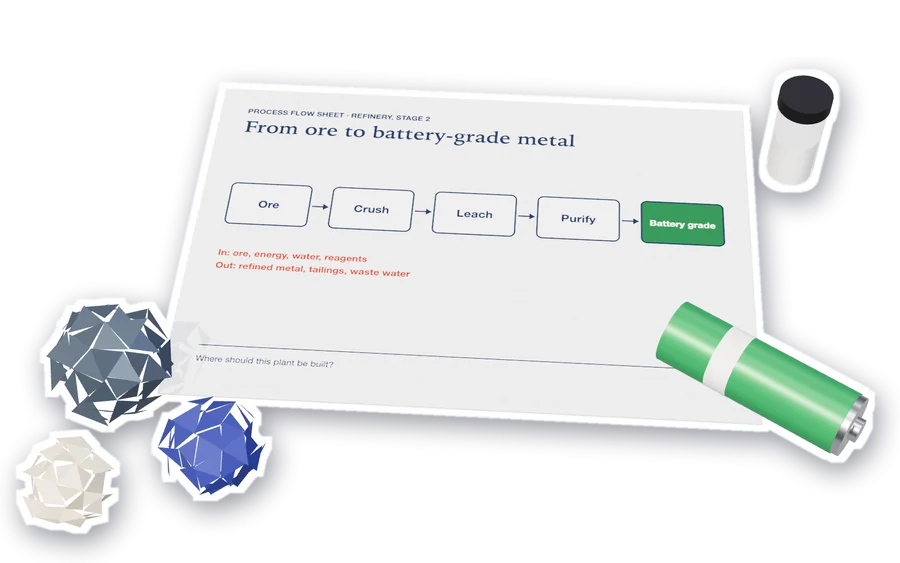
Digging a mineral out of the ground and refining it are different steps. Refining is part of what the UK calls midstream processing: turning mined or recycled material into refined or upgraded forms that factories can use5. It needs a lot of money and a lot of energy14. Cobalt, for example, is mined as a by-product of copper and nickel, and is usually turned into a chemical, cobalt sulphate or oxide, before it goes into a battery15. Figure 1 shows the chain.
Figure 1Section 3
The value chain of a critical mineral, and the two answers to where refining should happen.
Who mines and who refines
The countries that mine a mineral are often not the ones that refine it. The Democratic Republic of the Congo supplied about 73% of the world’s mined cobalt in 2025, while China remained the leading producer of refined cobalt2. In 2021 the World Bank said almost all refined cobalt from the Congo was refined further in China or elsewhere15. IEA figures cited by the Bank of Finland put China’s share of world copper, cobalt and nickel ore output at only 2% to 8%, though Chinese firms own many mines abroad1. Yet its share of refining is 74% for lithium, 76% for cobalt and 94% for battery-grade graphite1.
The G20’s own framework describes the result. Demand is concentrated in industrialised economies, while many developing countries rich in minerals struggle to capture a fair share of the value: they export raw materials and import finished products16. Buyer countries have their own gaps. In 2025 a US mine in Michigan sent its nickel concentrate to Canada or overseas to be processed2, and the last US primary nickel refinery closed in 19852.
Why it became a contest
Producer countries want the refineries: South Africa’s minister wants investors to process more manganese at home17, and the African Union says Africa must move beyond raw mineral exports18. G20 texts now say the same. The leaders’ declaration agreed under South Africa’s presidency says critical minerals “should become a catalyst for value-addition and broad-based development, rather than just raw material exports”12, and the G20 framework calls for local processing in producer countries16. Indonesia stopped exporting nickel ore and built a processing industry3.
Buyer countries want to depend less on one supplier: the EU wants no more than 65% of its needs to come from any one outside country19. China tightened export controls on rare earths in 20252. According to the Bank of Finland, the IEA estimates that full implementation of China’s export restrictions would put about US$6.5 trillion of yearly production outside China at risk1, and IEA figures put European prices of gallium and of two heavy rare earths, dysprosium and terbium, at about five times China’s domestic prices1.
What has happened so far
- 22 Nov 2019The EU asks Indonesia for WTO consultations over its nickel export restrictions and processing rules20
- 30 Nov 2022A WTO panel finds Indonesia’s nickel export ban and processing requirement inconsistent with WTO rules; Indonesia appeals on 8 December20
- 22 Jul 2023G20 energy ministers in Goa take note of India’s principles on critical minerals21
- Aug 2023China starts export controls on gallium2
- 18 Nov 2024G20 leaders in Rio back supply chains for minerals “beneficiated at source”10
- Feb 2025The Democratic Republic of the Congo bans cobalt exports for a time; quotas replace the ban in October2
- Apr 2025China tightens export controls on rare earths; it expands them in October and in November 2025 suspends the October controls for one year2
- 20 Oct 2025The United States and Australia announce a framework on mining and processing critical minerals22
- 31 Oct 2025Canada announces 26 investments and partnerships for critical minerals projects23
- 22 Nov 2025The leaders’ declaration agreed under South Africa’s presidency welcomes the G20 Critical Minerals Framework12
- 16 Sep 2026G20 energy ministers end their Houston meeting; the White House says they reached consensus on four outcomes, one of them a Critical Minerals Statement13
- 3 Nov 2026Indonesia’s energy ministry says the government is preparing to control nickel output so that prices recover24
What the G20 has already said
G20 leaders, Johannesburg Leaders’ Declaration, agreed under South Africa’s presidency, November 2025:
“Critical minerals should become a catalyst for value-addition and broad-based development, rather than just raw material exports.”12
The White House, 21 September 2026, summarising the Houston energy ministerial:
“Ministers agreed in the Critical Minerals Statement on voluntary cooperation to build resilient, affordable, secure, and diversified critical minerals value chains through information sharing, innovation, investment, capacity building, and local value addition.”13
Facts that matter
| Figure | Value | Year | Ref. |
|---|---|---|---|
| China’s share of refining (IEA figures, via the Bank of Finland) | lithium 74%, cobalt 76%, battery graphite 94% | 2026 report | 1 |
| China’s share of rare earth refining for magnets (IEA, via the Bank of Finland) | 84% | 2026 report | 1 |
| China’s share of world natural graphite production | 82% | 2025 | 2 |
| China’s share of world low-purity gallium production | 99% | 2025 | 2 |
| Congo’s share of world mined cobalt | 73% | 2025 | 2 |
| Indonesia’s nickel mine output | 2.6 million of the world’s 3.9 million tons | 2025 | 2 |
| Chinese-owned share of Indonesia’s nickel refining capacity (Bank of Finland) | about 75% | 2026 report | 1 |
| Indonesia’s nickel exports | from about US$3.3 billion to over US$40 billion | 2017 to 2025 | 3 |
| Chinese firms’ investment in mines abroad (IEA, via the Bank of Finland) | roughly US$120 billion | 2023 to 2025 | 1 |
| European price of gallium and two heavy rare earths against China’s (IEA, via the Bank of Finland) | about five times higher | 2026 report | 1 |
| Congo’s cobalt export quota | up to 96,600 tons a year | 2026 and 2027 | 2 |
| US rare earth compounds and metals imported from China | 71% | 2021 to 2024 | 2 |
Core tensions
Refine where it is mined, or where it is used
For refining where it is mined. South Africa holds 37% of the world’s manganese ore reserves, but only 2% is processed locally, its minister says17. The African Union says Africa must move beyond raw mineral exports and build value chains that encourage local beneficiation18. Brazil’s mines ministry aims to develop mineral processing in Brazil14. Indonesia’s nickel exports rose more than tenfold after it stopped exporting ore3.
For refining where it is used. The EU aims to process at least 40% of its yearly needs at home by 203019. The US government lent US$150 million for a plant in California to separate heavy rare earths2. The UK aims to use its strengths in recycling and midstream processing5.
Export bans, or open trade
For bans and controls. Indonesia’s minister calls processing at home the key to adding value to its natural resources, and its ban came with a fast rise in exports of processed nickel3. China’s commerce ministry calls its rare earth controls a legitimate step under its laws, says it has taken note of the military uses of medium and heavy rare earths, and says it will grant licences to eligible applications25.
For open trade. A WTO panel found that Indonesia’s nickel ban and processing rule broke WTO rules20. Indonesia appealed, and with the WTO’s Appellate Body not working, the EU considered the appeal’s deadlines suspended20. The G20 framework also asks for “open non-discriminatory trade and diversified supply routes”16.
Local refining, or local ownership
Refining at home is enough. Indonesia’s minister says processing at home creates jobs and widens markets for value-added products3.
Ownership matters too. As Indonesia shows, a plant in a producer country can still be owned by foreign firms: Chinese-owned firms control about 75% of Indonesia’s nickel refining capacity, the Bank of Finland reports1.
Case studies
Indonesia’s nickel ore ban
Indonesia mined about 2.6 million of the world’s 3.9 million tons of nickel in 20252. It stopped exporting nickel ore and built a processing industry, and its nickel exports rose from about US$3.3 billion in 2017 to 2018 to more than US$40 billion in 20253. Chinese-owned firms control about 75% of its nickel refining capacity, the Bank of Finland reports1. The EU challenged the ban at the WTO in 201920. In 2022 a WTO panel found the ban and the processing requirement broke WTO rules, and that Indonesia had not shown they were temporary measures against a critical shortage20. Indonesia appealed20, and with the Appellate Body not working, the EU considered the appeal’s deadlines suspended20. In November 2026 Indonesia’s energy ministry said the government was preparing to limit nickel output so that prices recover24.
What it shows. A producer can build refineries by keeping its ore at home, but the plants may belong to others, and the trade rules remain disputed. Question for your group. Should the G20 accept processing requirements like Indonesia’s, and on what conditions?
China’s controls on gallium and rare earths
China produced 99% of the world’s low-purity gallium in 20252. It began export controls on gallium in August 2023, banned all gallium exports to the United States in December 2024, and in November 2025 lifted that ban for one year2. On rare earths it tightened controls in April 2025, expanded them in October, and in November 2025 suspended the October controls for one year2. Check what has happened to both pauses since. Between 2021 and 2024, 71% of the rare earth compounds and metals the United States imported came from China2.
What it shows. When refining sits in one country, its export rules can reach buyers far beyond its borders: in October 2025 China extended its rare earth rules to some goods made abroad, then postponed enforcement until 10 November 20261. Question for your group. What should G20 members promise each other about export controls on minerals?
Buyer countries build their own refineries
The last US primary nickel refinery closed in 19852. In 2025 three companies were considering or developing nickel refinery projects in Missouri, Oklahoma and Texas2, and the US government has lent US$150 million for a rare earth separation plant in California2. In October 2025 the United States and Australia said they were taking measures to provide at least US$1 billion in financing to projects in each country within six months, under a non-binding framework22. The EU has set a goal of processing at least 40% of its yearly needs at home by 2030, and speeds up permits for selected projects19.
What it shows. Buyers are rebuilding refining with public money2,22. Question for your group. Should buyer countries’ refineries be built at home, or in partnership with producer countries?
Country positions
One row for each of the 21 members. “Stake” and “On the record” come from official sources and state news agencies. “Our reading”, in italics, is what we think that record suggests: test it in your research. Where the record is silent, the row says so. Every member except South Africa is on the list of participants Japan’s Ministry of the Environment printed for the Houston ministerial in September 202626; the White House’s list of those present also leaves out South Africa13. Taking part is not a position. The label under each name shows the member’s place in the record: producer, buyer, refiner, or not clear. Bring this section to the summit and tick each row as members speak.
| Member | Stake | On the record | Our reading | Mark |
|---|---|---|---|---|
 Argentina | Its economy ministry says Argentina is the world’s fifth-largest lithium producer, with 6 projects in production and more than 41 at advanced stages27. | The ministry expects lithium exports, US$645 million in 2024, to pass US$11 billion by 2035, helped by an investment regime introduced in 202427. | Pushes for: Investment in its lithium mines. Not clear from the record: red line, allies. Research it. | AllyOpp.Swing |
 Australia | With the United States it said in October 2025 that it was taking measures to provide at least US$1 billion in financing to projects in each country, under a non-binding framework22. | The US and Australia framework says the two will mobilise government and private support for projects through guarantees, loans or equity22. | Pushes for: Partnerships with buyer countries. Allies: The United States. Not clear from the record: red line. Research it. | AllyOpp.Swing |
 Brazil | Its ministry of mines and energy says Brazil holds proven and expanding reserves of lithium, nickel, copper, graphite and rare earths14. The US Geological Survey estimates it mined 12,000 tons of lithium and 70,000 tons of nickel in 20252. | The ministry says the market needs “robust geographic diversification in the processing and refining stages”, and aims to develop mineral processing in Brazil14. A note to the Houston Chair’s Statement on energy security says it was agreed by all G20 members present except Brazil9. | Pushes for: More refining in Brazil. Allies: South Africa, the African Union. Not clear from the record: red line. Research it. | AllyOpp.Swing |
 Canada | In October 2025 it announced 26 investments, partnerships and measures for critical minerals projects, with partners from nine allied countries, among them the United States and Australia23. | It says working with international partners encourages more investment in Canadian mining and processing projects23. | Pushes for: Investment in its own mines and refineries. Allies: The United States, Australia. Not clear from the record: red line. Research it. | AllyOpp.Swing |
 China | It produced 99% of the world’s low-purity gallium in 20252; IEA figures cited by the Bank of Finland put its share of lithium refining at 74% and cobalt at 76%1. | Its commerce ministry calls its rare earth export controls a legitimate step to refine its export control system, and says it will grant licences to eligible applications25. | Pushes for: Its right to control its own exports. Not clear from the record: red line, allies. Research it. | AllyOpp.Swing |
 France | In May 2023 it announced a critical minerals investment fund, with €500 million from the State, aiming to raise €2 billion28. | The fund invests as a minority holder alongside industrial or mining firms, and aims to secure supplies from its projects for French and European industry28. | Pushes for: Partnerships in mining and refining projects. Allies: Germany, the European Union. Not clear from the record: red line. Research it. | AllyOpp.Swing |
 Germany | In October 2024 KfW began setting up a raw materials fund on behalf of the federal government, to help the German economy secure access to strategic raw materials29. | KfW says the fund covers mining, processing and recycling projects, usually with €50 million to €150 million each29. | Pushes for: Secure supply through investment in mining, processing and recycling projects. Allies: France, the European Union. Not clear from the record: red line. Research it. | AllyOpp.Swing |
INDIndia buyer | In January 2025 its Cabinet approved a National Critical Mineral Mission, with Rs 34,300 crore over seven years30. | The Mission covers exploration, mining, processing and recycling, with processing parks30. It removed customs duties on most critical minerals in its 2024-25 budget, which it says will encourage industry to set up processing facilities in India30. | Pushes for: Processing at home. Not clear from the record: red line, allies. Research it. | AllyOpp.Swing |
 Indonesia | Its nickel exports rose from about US$3.3 billion in 2017 to 2018 to more than US$40 billion in 2025, after it stopped exporting ore3; it targets at least US$45 billion in 20263. | In November 2026 its ministry said it holds the world’s largest nickel reserves and prepared to curb output24. It was the respondent in the EU’s WTO case over its nickel rules20. | Pushes for: The right to require processing at home. Red line: A text that rules out export bans. Allies: South Africa, the African Union. | AllyOpp.Swing |
 Italy | Its environment and energy security ministry says many critical raw materials are essential to renewable energy, electric mobility and digital technology31. | No public statement on refining found. Research it. | Not clear from the record. Research it. | AllyOpp.Swing |
 Japan | Its vice-minister for the environment took part in the Houston ministerial and held talks with five countries26. | No public statement on refining found. Research it. | Not clear from the record. Research it. | AllyOpp.Swing |
 Republic of Korea | Its foreign ministry says critical minerals are indispensable for semiconductors, batteries and electric vehicles32. | Its foreign ministry announced in June 2024 that Korea would chair the Minerals Security Partnership for one year from 1 July32, and in February 2025 Korea held talks on critical minerals with Tanzania, South Africa and Zimbabwe33. | Pushes for: Partnerships with producer countries. Allies: South Africa. Not clear from the record: red line. Research it. | AllyOpp.Swing |
 Mexico | Its presidential decrees created a state body, Litio para México, and declared a lithium mining reserve zone34. | No public statement on refining found. Research it. | Not clear from the record. Research it. | AllyOpp.Swing |
RUSRussia not clear | It took part in the Houston ministerial26. | No public statement found. Research it. | Not clear from the record. Research it. | AllyOpp.Swing |
KSASaudi Arabia not clear | It took part in the Houston ministerial26. | Its news agency reports its industry minister stressing global partnerships to develop critical minerals supply chains35. | Pushes for: Partnerships on supply chains. Not clear from the record: red line, allies. Research it. | AllyOpp.Swing |
 South Africa | Its minister says it holds 37% of the world’s manganese ore reserves, but only 2% is processed locally17. | He said the government would that year intensify its engagement with manganese producers and investors to invest in local beneficiation17. The G20 Critical Minerals Framework was issued under its 2025 presidency16. | Pushes for: Refining where minerals are mined. Allies: The African Union, Indonesia, Brazil. Not clear from the record: red line. Research it. | AllyOpp.Swing |
 Türkiye | Its energy ministry says Eti Mining Operations built a pilot plant to process bastnaesite, a rare earth ore36. | Its energy ministry says 80% of refined rare earth production is in China36. | Not clear from the record. Research it. | AllyOpp.Swing |
 United Kingdom | It holds the G20 presidency in 20277. It expects demand for lithium to rise by 1,100% by 20355. | Its strategy aims to secure critical minerals and use its strengths in recycling and midstream processing5, and says supply chains have become more concentrated5. | Pushes for: Recycling and processing at home. Allies: The United States, the European Union. Not clear from the record: red line. Research it. | AllyOpp.Swing |
 United States | Its last primary nickel refinery closed in 1985, and it lent US$150 million for a rare earth separation plant in California2. It held the G20 presidency in 202626. | Its Interior Secretary said the Houston consensus supports “diversify supply, strengthen domestic and regional capacity” and respect for “each nation’s sovereignty over its natural resources”13. | Pushes for: Refining at home and with partners. Allies: Australia, Canada. Not clear from the record: red line. Research it. | AllyOpp.Swing |
 European Union | Its Critical Raw Materials Act sets 2030 goals of at least 40% of yearly needs processed in the EU and no more than 65% from a single outside country19. | It brought the WTO case against Indonesia’s nickel export rules20. | Pushes for: Open trade in ore, and more refining at home. Red line: Export bans on ore. Allies: Germany, France. | AllyOpp.Swing |
AUAfrican Union producer | Its Africa Green Minerals Strategy is a roadmap for value addition at source and regional industry18. | The strategy says Africa must move beyond raw mineral exports and build value chains that encourage local beneficiation18. | Pushes for: Refining in Africa. Allies: South Africa, Brazil. Not clear from the record: red line. Research it. | AllyOpp.Swing |
Invited seats (not members)
- International Energy Agency. Estimates that Chinese firms invested roughly US$120 billion in mines abroad in 2023 to 2025, and that full implementation of China’s export restrictions would put about US$6.5 trillion of yearly production outside China at risk (cited by the Bank of Finland)1.
- International Renewable Energy Agency. An invited seat; research its work on critical materials for the energy transition.
- World Bank. Reported in 2021 that China refined 67% of the world’s cobalt in 2019, up from 53% in 201515.
- Democratic Republic of the Congo (mining guest country). The world’s leading source of mined cobalt, which has used a temporary export ban and then export quotas2.
The camps
Options on the table
Each option is something the G20 can actually do: commit its own members, call on others, or ask international bodies to act and report. Who may back or resist each option is our reading of the record in Section 8, for you to test in your research.
A. Accept local processing requirements
What it is. G20 members accept that a producer country may require minerals to be refined at home, under agreed conditions. Who runs it. Each producer country. Precedent. Indonesia’s processing requirement and ban on nickel ore exports, challenged at the WTO by the EU20. For. Indonesia’s energy ministry says its nickel shows that resources bring far greater benefit when they are processed before they are sold3. Against. A WTO panel found Indonesia’s measures broke WTO rules20. May back it. Indonesia, South Africa and the African Union. May resist it. The European Union.
B. Buyer countries fund refineries at home
What it is. Buyer countries lend to or invest in refineries on their own soil. Who runs it. Buyer governments and their banks. Precedent. The US government’s US$150 million loan for a heavy rare earth separation plant in California2. For. It answers a risk the IEA puts at about US$6.5 trillion of yearly production outside China if China’s export restrictions are fully implemented (cited by the Bank of Finland)1. Against. It does nothing for producer countries that want to refine their own ore16. May back it. The United States and the European Union.
C. Partnerships and regional processing hubs
What it is. Buyers and producers finance refineries in producer regions together, with development banks and export credit agencies. Who runs it. Members, export credit agencies and development banks. Precedent. The Houston Critical Minerals Statement says members may bolster partnerships through export credit agencies and multilateral development banks, and fund feasibility studies together4. For. It answers both sides of the question. Against. Partnerships are voluntary, and the statement commits no money4. May back it. Korea, which held minerals talks with three African countries, and France, whose fund also invests abroad28,33.
D. Stockpiles
What it is. Members keep emergency stores of critical minerals, so that a ban does not stop their factories at once. Who runs it. Each member. Precedent. The Congo’s cobalt quota for 2026 and 2027 sets aside 9,600 tons for national strategic reserves2. For. It buys time in a crisis. Against. Stockpiles do not change who refines. May back it. The United States and Australia, whose framework names US stockpiling infrastructure and Australia’s Critical Mineral Strategic Reserve22.
E. Standards, tracing and price floors
What it is. Shared standards and tracing for minerals, and trade at agreed minimum prices among members that adopt them. Who runs it. The members that sign up. Precedent. The G20 framework’s call to develop tracing systems together and make them work with each other16, and the US and Australia framework’s plan for standards-based trade with price floors or similar measures22. For. A price floor can steady a producer: the US Department of Defense set a ten-year floor for some rare earth products to guarantee one producer’s operational stability1. Against. Members outside the scheme may see it as a closed club. May back it. The United States and Australia22.
What the communiqué must answer
- May producer countries require minerals to be refined at home, and on what conditions?
- Should buyer countries build refineries at home, in producer countries, or both?
- Who finances new refineries, and who owns them?
- What may members do with export bans, quotas and controls?
- Which standards and tracing rules apply?
- Who reports progress, to whom, and by when?
Draft paragraph, as amendedWeak, then strong
We recognise the importance of resilient critical mineral supply chains and encourage further cooperation. We commit to finance, through our export credit agencies and development banks, at least one new refining project in a producer country for each new project we support at home, and to give six months’ notice before any new export control on critical minerals. We call on the multilateral development banks to set up a joint facility for processing hubs in producer regions, and ask the World Bank to report progress to our Energy Ministers by October 2028.
The weak paragraph names no one and promises nothing. The strong one commits only G20 members and calls on everyone else. It is an example, not the answer: your group may decide on a different course, or on none.
Preparation
Your white paper
Write at most 1,000 words, with numbered sources, and send it to your chairs by Monday 31 May 2027 (Rules of Procedure 9.2). Use five parts:
- Your member’s stake, in three numbers with sources.
- Its position on each question in Section 10.
- Its red lines: what it will not accept.
- One draft paragraph in the style of a communiqué, beginning “We commit” or “We call on”.
- Your sources, numbered, official ones first.
Five questions to research for your member
- Which critical minerals does your member mine, refine or buy?
- Does it have a strategy, a fund or a law on critical minerals?
- Has it used, or been hit by, an export ban or control on minerals?
- What did it say at the Houston energy ministerial in 2026?
- Which members are most likely to agree with it, and which one in the other camp could it win over?
Starter sources
- The G20 Critical Minerals Statement, Houston 2026, reference 4
- The G20 Critical Minerals Framework, 2025, reference 16
- US Geological Survey figures for each mineral, reference 2
- Who refines what: IEA figures via the Bank of Finland, reference 1
- The WTO case on Indonesia’s nickel ban, reference 20
- The EU Critical Raw Materials Act, reference 19
- The United States and Australia framework, reference 22
- Cobalt in the Democratic Republic of the Congo (World Bank), reference 15
 Pocket card
Your first hour as a delegate
- Roll call. Hold up your placard and answer “present” when your member is called.
- Opening speech. Give your member’s stake in one number, its position, and one thing it wants in the text.
- Listen. As members speak, mark their rows in Section 8: ally, opponent or swing.
- First caucus. Find two allies, one in your camp and one in the other.
- By the break. Bring one clause that names who acts, what they do, and by when.
Glossary
- Beneficiation
- Processing minerals near where they are mined, so that more of their value stays there.
- By-product
- A material produced alongside the main product, as cobalt is mined with copper and nickel15.
- Cobalt
- A metal used in many rechargeable batteries.
- Concentrate
- Ore that has been crushed and upgraded, but not yet refined.
- Critical minerals
- Minerals that are essential inputs for energy security, manufacturing and digital technology4.
- Export control
- A rule that limits sales abroad, or allows them only with a licence.
- Export quota
- A limit on how much of a good may be sold abroad.
- Gallium
- A metal used in chips and electronics.
- Graphite
- A form of carbon used in batteries.
- Lithium
- A light metal used in batteries.
- Ore
- Rock dug out of the ground that contains a useful mineral.
- Price floor
- A minimum price agreed for a good.
- Rare earths
- A group of metals used in magnets for motors and wind turbines.
- Refining
- Turning mined or recycled material into refined or upgraded forms factories can use5.
- Stockpile
- A store of a material kept for an emergency.
References
All sources accessed 20 and 21 November 2026. Numbers in the text refer to this list.
- BOFIT (Bank of Finland Institute for Emerging Economies). “China retains dominance of critical raw material production”, BOFIT Weekly Review 32/2026, 7 August 2026. A research body of the Bank of Finland; it cites IEA figures. https://www.bofit.fi/en/monitoring/weekly/2026/vw202632_2/
- US Geological Survey. “Mineral Commodity Summaries 2026” (version 1.3, May 2026; chapters dated February 2026). https://pubs.usgs.gov/periodicals/mcs2026/mcs2026.pdf
- Ministry of Energy and Mineral Resources (ESDM), Indonesia. “Ekspor Nikel Ditargetkan Tembus USD45 Miliar pada 2026, Menko Bahlil: Hilirisasi Kunci Kemandirian Ekonomi”, 14 October 2026 (in Indonesian). https://www.esdm.go.id/id/media-center/arsip-berita/ekspor-nikel-ditargetkan-tembus-usd45-miliar-pada-2026-menko-bahlil-hilirisasi-kunci-kemandirian-ekonomi
- White House. “G20 Energy Abundance Ministerial Statement, Pillar III: Critical Minerals”, Houston, September 2026. https://www.whitehouse.gov/wp-content/uploads/2026/09/4-G20-EAWG-Critical-Minerals-Statement.pdf
- UK Government. “Vision 2035: Critical Minerals Strategy”, GOV.UK. https://www.gov.uk/government/publications/uk-critical-minerals-strategy/vision-2035-critical-minerals-strategy
- Ministry of External Affairs, India. “Group of Twenty - G20” (brief), July 2026. https://www.mea.gov.in/Portal/ForeignRelation/G20_2026.pdf
- Prime Minister’s Office, GOV.UK. “Growth and opportunity set to be at the heart of UK-hosted G20”, 22 November 2025. https://www.gov.uk/government/news/growth-and-opportunity-set-to-be-at-the-heart-of-uk-hosted-g20
- Cabinet Office, GOV.UK. “Manchester to host world leaders at the 2027 G20 Summit”, 23 September 2026. https://www.gov.uk/government/news/manchester-to-host-world-leaders-at-the-2027-g20-summit
- US Department of Energy. “G20 Energy Abundance Ministerial Chair’s Statement” (Pillar I: G20 Voluntary Energy Security Principles), 16 September 2026. https://www.energy.gov/articles/g20-energy-abundance-ministerial-chairs-statement
- G20. “G20 Rio de Janeiro Leaders’ Declaration”, 18 November 2024; copy hosted by the G20 Research Group, University of Toronto. https://g20.utoronto.ca/2024/241118-declaration.html
- G20. “G20 New Delhi Leaders’ Declaration”, 9 September 2023; copy hosted by the G20 Research Group, University of Toronto. https://g20.utoronto.ca/2023/230909-declaration.html
- G20. “G20 South Africa Summit: Leaders’ Declaration”, Johannesburg, 22 November 2025; copy hosted by the G20 Research Group, University of Toronto. https://g20.utoronto.ca/2025/251122-declaration.html
- The White House. “G20 Energy Abundance Ministerial Concludes with Four Consensus Outcomes”, 21 September 2026. https://www.whitehouse.gov/releases/2026/09/g20-energy-abundance-ministerial-concludes-with-four-consensus-outcomes/
- Ministry of Mines and Energy (MME), Brazil. “Brazil’s Critical Minerals: A Guide for Foreign Investors 2026”. https://www.gov.br/mme/pt-br/assuntos/secretarias/geologia-mineracao-e-transformacao-mineral/guia-investidor-minerais-criticos/guia-investidor-estrangeiro-em-minerais-criticos/2026/investors-guide-en-us.pdf
- World Bank. “Cobalt in the Democratic Republic of Congo: Market Analysis”, June 2021. https://documents1.worldbank.org/curated/en/099500001312236438/pdf/P1723770a0f570093092050c1bddd6a29df.pdf
- G20 South Africa Presidency. “G20 Critical Minerals Framework”, 1 December 2025; copy hosted by the G20 Research Group, University of Toronto. https://g20.utoronto.ca/2025/251201-critical-minerals-framework.html
- South African Government News Agency. “Africa must assert minerals advantage - Minister Mantashe”, February 2025. https://www.sanews.gov.za/south-africa/africa-must-assert-minerals-advantage-minister-mantashe
- African Union. “Africa’s Green Minerals Strategy (AGMS)”, document page, 18 March 2025. https://au.int/en/documents/20250318/africas-green-minerals-strategy-agms
- European Commission. “Critical Raw Materials Act” (Directorate-General for Internal Market, Industry, Entrepreneurship and SMEs). https://single-market-economy.ec.europa.eu/sectors/raw-materials/areas-specific-interest/critical-raw-materials/critical-raw-materials-act_en
- World Trade Organization. “DS592: Indonesia - Measures Relating to Raw Materials”, dispute summary. https://www.wto.org/english/tratop_e/dispu_e/cases_e/ds592_e.htm
- G20. “G20 Energy Ministers Meetings Outcome Document and Chair’s Summary”, Goa, 22 July 2023; copy hosted by the G20 Research Group, University of Toronto. https://g20.utoronto.ca/2023/230722-energy.html
- The White House. “United States-Australia Framework For Securing of Supply in the Mining and Processing of Critical Minerals and Rare Earths”, 20 October 2025. https://www.whitehouse.gov/briefings-statements/2025/10/united-states-australia-framework-for-securing-of-supply-in-the-mining-and-processing-of-critical-minerals-and-rare-earths/
- Natural Resources Canada. “Canada unlocks 26 new investments and partnerships with 9 allied countries to secure critical minerals supply chains”, 31 October 2025. https://www.canada.ca/en/natural-resources-canada/news/2025/10/canada-unlocks-25-new-investments-and-partnerships-with-9-allied-countries-to-secure-critical-minerals-supply-chains.html
- Ministry of Energy and Mineral Resources (ESDM), Indonesia. “Pasokan Nikel Berlebih, Bahlil Siapkan Pengetatan RKAB untuk Jaga Harga”, 3 November 2026 (in Indonesian). https://esdm.go.id/en/media-center/news-archives/pasokan-nikel-berlebih-bahlil-siapkan-pengetatan-rkab-untuk-jaga-harga
- Ministry of Commerce of the PRC. Spokesperson’s remarks on the export control measures on rare earths and related items (answers to questions on the announcement of 9 October 2025). https://english.mofcom.gov.cn/News/SpokesmansRemarks/art/2025/art_c202dcc0433d476db52b1e7f7fe53926.html
- Ministry of the Environment, Japan. “Outcomes of the G20 Energy Abundance Ministerial Meeting”, press release, 17 September 2026. https://www.env.go.jp/en/press/press_02831.html
- Ministerio de Economía, Argentina. “Informe litio”, June 2025 (in Spanish). https://www.argentina.gob.ar/sites/default/files/informe_litio_junio_2025.pdf
- Ministère de l’Économie, des Finances et de la Souveraineté industrielle et numérique. “France 2030 : le Gouvernement annonce le lancement d’un fonds d’investissement dédié aux minerais et métaux critiques”, press release no. 834, 11 May 2023 (in French). https://presse.economie.gouv.fr/11052023-france-2030-le-gouvernement-annonce-le-lancement-dun-fonds-dinvestissement-dedie-aux-minerais-et-metaux-critiques/
- KfW. “KfW establishes raw materials fund”, press release, 2 October 2024. https://www.kfw.de/About-KfW/Newsroom/Latest-News/Pressemitteilungen-Details_824192.html
- Press Information Bureau, Government of India. “Cabinet Approves ‘National Critical Mineral Mission’...”, 29 January 2025. https://archive.pib.gov.in/newsite/PrintRelease.aspx?relid=266658
- Ministero dell’Ambiente e della Sicurezza Energetica, Italy. “Materie Prime Critiche” (in Italian). https://www.mase.gov.it/portale/materie-prime-critiche
- Ministry of Foreign Affairs, Republic of Korea. “Korea Assumes Chairmanship of Minerals Security Partnership (MSP)”, press release, 27 June 2024. https://www.mofa.go.kr/eng/brd/m_5676/view.do?seq=322611
- Korea.net (Government of the Republic of Korea). “Critical minerals talks held with 3 Southern African countries”, 7 February 2025. https://www.korea.net/NewsFocus/policies/view?articleId=266106
- Government of Mexico (gob.mx). Report on the third stage of LitioMx, 29 August 2024, with its list of legal instruments (in Spanish). https://www.gob.mx/cms/uploads/attachment/file/944860/IGG_3a_Etapa_LitioMx.pdf
- Saudi Press Agency. “Industry Minister Stresses Global Partnerships to Develop Critical Minerals Supply Chains at Istanbul Forum”. https://www.spa.gov.sa/en/N2573441
- Ministry of Energy and Natural Resources, Republic of Türkiye. “Rare Earths” (Info Bank page). https://enerji.gov.tr/infobank-naturalresources-rareearthelements