
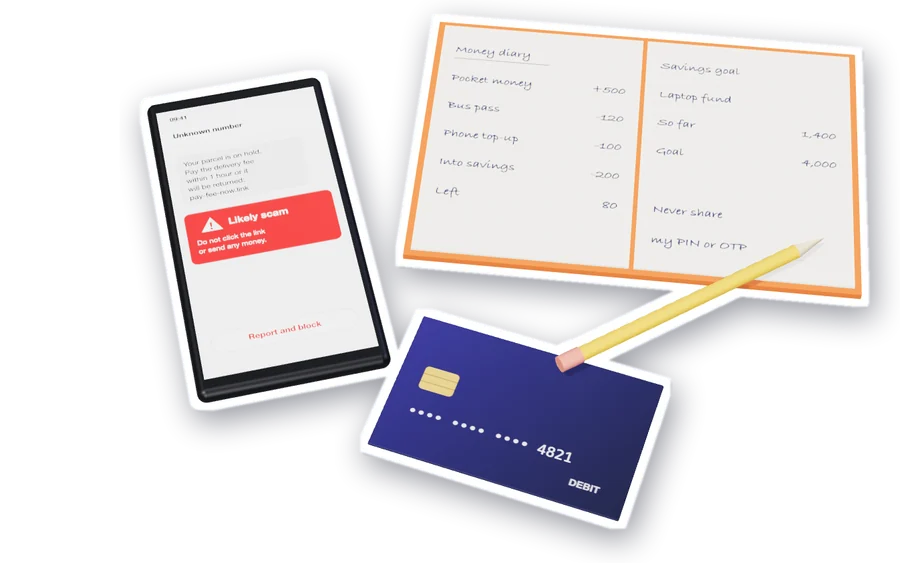


Letter from the chairs
Dear delegates,
We will chair the Financial Inclusion Working Group at the Model G20 Summit 2027. Our group asks one hard question about online payment scams that cross borders: how should G20 members protect young people and teach them to manage money safely?
Read this guide twice. The first time, read for the story of how a message on a phone becomes money in an account abroad, and why getting it back is so hard. The second time, read it as your member’s negotiator and mark every line that helps or hurts your case.
In the room we will look for clauses that name who acts, what they do and by when. We will also look for delegates who bring a member that writes strict rules for banks and one that puts its trust in schools and police to the same text, and who can show a source for every claim they make.
Bring your white paper, your member’s row from Section 8 and one draft clause. We look forward to meeting you at FLAME University in June.
Warm regards,
Your chairs, Financial Inclusion Working Group
How the G20 and this simulation work
The real G20
The Group of Twenty has 21 members: 19 countries and two regional bodies, the European Union and the African Union6. The African Union became a permanent member at the New Delhi summit in 20236. Together the members account for around 85% of the world’s economic output, over 75% of world trade and about two-thirds of its people6.
The G20 began in 1999, after the Asian financial crisis, as a meeting of finance ministers and central bank governors6. Leaders first met in Washington DC in 2008, and they have met every year since 20116. Each year one member holds the presidency and sets the agenda, helped by the members that held it before and will hold it after. These three are called the troika6. The United States took over the presidency on 1 December 2025 and cut the number of working groups from 16 to four6. The United Kingdom holds the presidency in 2027 and will host the Leaders’ Summit in Manchester on 27 and 28 November 20277,8.
Two tracks
The G20 process is led by the sherpas, each leader’s personal representative. The work runs in two tracks, the Finance Track and the Sherpa Track. Within the two tracks, working groups bring together officials from the members, invited countries and international organisations6.
Agreement by everyone
In September 2026 G20 finance ministers issued their text as a Chair’s Statement9. A note to it says it was agreed by all G20 members present except China, which objected to four of its paragraphs9. In this simulation a text is agreed only when no member objects; the Rules of Procedure 2027 explain how.
This simulation
The Model G20 Summit 2027 is set in 2027, the year the United Kingdom holds the G20 presidency. The Model G20 secretariat chairs every working group, and the UK delegation is an ordinary member. All 21 members are seated in every group. Each group also has four invited seats for international organisations or guest countries; they take part in the debate but are not members. Model G20 is organised by One Young India and is independent of the G20 and of every G20 government.
Each working group is modelled on a group that has met in the real G20 in recent years, so delegates learn how the forum works. Your group negotiates one short text on its agenda. On Sunday afternoon the working groups’ texts come together in the communiqué, which the Leaders’ Session adopts by consensus at the closing ceremony. The Rules of Procedure 2027 explain how debate, amendments and the final text work.
This working group
The Financial Inclusion Working Group is modelled on the G20’s Global Partnership for Financial Inclusion (GPFI), launched in Seoul in December 2010 to carry out the G20 Financial Inclusion Action Plan10. Its 2014 action plan lists a subgroup on financial consumer protection and financial literacy, set up in 201311. In 2023 the leaders’ declaration agreed under India’s presidency endorsed a new Financial Inclusion Action Plan and supported efforts to strengthen digital financial literacy and consumer protection12. In 2025 the declaration agreed under South Africa’s presidency reiterated the commitment to financial inclusion and pledged to enhance the use of financial services “in a manner that supports consumer protection and trust”13. For 2026 the US Treasury listed “improving cross-border payments and addressing payments fraud and scams; and promoting financial literacy” among its G20 priorities14.
The issue explained
Money now lives on phones
In 2024, 79% of adults worldwide had an account2,3. In low- and middle-income economies, 84% of adults own a mobile phone and 3 billion have smartphones2. Young people start early. In the OECD’s 2022 PISA test, 63% of 15-year-olds across OECD countries said they held an account with a bank or similar institution, and 62% said they held a payment or debit card4.
An account on a phone lets a family get paid, save and send money home quickly. The World Bank’s Global Findex 2025, a survey carried out in 2024, contains the first globally comparable data on mobile phone ownership, internet use and digital safety3.
How a payment scam works
The UK regulator separates two kinds of payment fraud. In unauthorised fraud, someone pays without the owner’s permission, for example with a stolen card5. In the second, which the regulator calls an authorised push payment (APP) scam, a person is tricked into sending money to a fraudster by bank transfer5. Usually the victim logs in online to their own account, enters the fraudster’s account details and approves the payment themselves15.
The difference matters when a victim asks for the money back. Under the Reserve Bank of India’s rules, for example, a customer bears no loss for an unauthorised fraudulent electronic transaction caused by a breach by a third party, if they report it to the bank within five days16. That rule is for unauthorised transactions16. For a payment the customer approved, Germany’s regulator BaFin reminds customers that whoever gives a transfer order continues to bear the responsibility, and that the order can usually no longer be cancelled once the bank has received it17.
Artificial intelligence makes scams more convincing. INTERPOL says AI boosts both the efficiency and the effectiveness of fraud, so fraudsters can target more victims and make each conversation more believable1. Figure 1 shows how a scam moves money and where it can be stopped.
Figure 1Section 3
How a cross-border payment scam moves money, and four points where it can be stopped.
Why young people
Young people meet fraud from both sides. INTERPOL says fraud networks include unemployed young people who work as recruiters or money mules1. In one African region, scam operations use mobile messaging to recruit mainly students and unemployed youths aged 16 to 25, then use mobile money platforms to exploit and extort them1. Member countries in North America have reported to INTERPOL that fraudsters demand money from teenage boys aged 14 to 17 by threatening to expose fake intimate images made with AI1. Canada’s Anti-Fraud Centre says younger Canadians are being targeted more than ever18.
In PISA 2022, students at the top level of financial literacy could, for example, spot a scam email and respond to it sensibly4. Across OECD countries, 18% of 15-year-olds did not reach the baseline level4.
Why borders make it hard
A scam can start in one country, take money from a victim in a second and end in an account in a third. Fraudsters make greater use of bank accounts opened in the victim’s own country, often through local money mules, which makes a payment less likely to raise the red flags of an international transfer1. INTERPOL says victims from nearly 80 countries have been trafficked into online scam centres, and people who have lost money may be targeted again by fraudsters posing as recovery agents or police1.
In India a bank may take up to 60 calendar days to deal with a complaint about a fraudulent cross-border transaction, against 45 days for a domestic one16. The Financial Stability Board (FSB) reports on progress under the G20’s plan to improve cross-border payments19. It found that countries made little progress in 2026 on sharing targeted payments data, such as fraud information, across borders20. Although many jurisdictions say some data sharing with foreign authorities is allowed, data-protection rules may make it uncertain whether information can be exchanged in time, particularly when it is needed to prevent cross-border payment fraud20. The UK’s refund rule for scam victims does not apply to international payments15.
What has happened so far
- Nov to Dec 2010G20 leaders in Seoul list the Financial Inclusion Action Plan and the Global Partnership for Financial Inclusion among the summit’s results; the partnership is launched in December10,21
- 9 Sep 2023G20 leaders in New Delhi endorse the 2023 Financial Inclusion Action Plan and back work on digital financial literacy and consumer protection12
- 7 Oct 2024The UK’s refund rule for authorised push payment scams starts22
- 13 Feb 2025Australia’s competition and consumer regulator welcomes the passage of the Scams Prevention Framework laws23
- Jul 2025China announces that China, Myanmar and Thailand have agreed to step up cooperation to dismantle telecom scam compounds24
- 9 Oct 2025Under an EU regulation, all banks in Germany must check that the payee matches the account number for euro transfers17
- 27 Nov 2025EU negotiators agree new payment rules that include refunds for impersonation fraud; the deal still needed formal adoption25
- Jan 2026Korea amends its law so that financial, telecom and investigation authorities can share data on suspicious accounts26
- 19 Feb 2026The US Treasury lists payments fraud and scams, and financial literacy, among its G20 priorities14
- Mar 2026INTERPOL publishes its Global Financial Fraud Threat Assessment1
- 31 Aug to 1 Sep 2026G20 finance ministers in Asheville issue a Chair’s Statement with paragraphs on financial literacy, cross-border payments and the FATF’s work on fraud9
- 20 Oct 2026Japan’s finance minister says addressing financial fraud is a major challenge27
- 16 Nov 2026The FSB reports that progress for the users of cross-border payments remains gradual and uneven19
What the G20 has already said
G20 finance ministers, Asheville Chair’s Statement, 1 September 2026, paragraph 12:
“We acknowledge that financial education can help consumers protect their personal finances and strengthen financial resilience by providing knowledge and tools to identify and avoid fraud attempts.”9
The same statement, paragraph 17:
“We are encouraged by the FATF’s renewed focus on combatting illicit finance and money laundering originating from fraud, especially the evolving threat emanating from scam compounds and exploitation of AI by fraudsters.”9
China’s objections to the Asheville statement were to paragraphs 4, 10, 11 and 13, not to these two9.
Facts that matter
| Figure | Value | Year | Ref. |
|---|---|---|---|
| Estimated losses worldwide to financial fraud | US$442 billion | 2025 | 1 |
| Estimated scam losses in East and South-East Asia, Australia and New Zealand | US$88.3 to 114.1 billion | 2025 | 28 |
| Fraud losses reported in the United States | nearly US$4 billion to US$16.6 billion | 2020 to 2024 | 1 |
| Share of Canada’s fraud losses that are reported | an estimated 5 to 10 per cent | 2025 | 29 |
| Transnational fraud cases INTERPOL supported | more than 1,500, US$1.1 billion in lost assets | 2024 to 2025 | 1 |
| Countries and territories whose people were found in South-East Asian scam compounds | at least 80 | reported 2026 | 28 |
| Adults worldwide with an account | 79% | 2024 | 2,3 |
| 15-year-olds below the baseline in financial literacy, OECD average | 18% | 2022 | 4 |
| Faster Payments APP scams the £85,000 limit would fully cover, if in scope (the regulator’s estimate when it set the limit) | 99.8% by number, 90% by value | 2024 | 30 |
Core tensions
Who repays the victim
For making payment firms repay. Since 2024 UK payment firms must repay victims of authorised push payment scams, up to £85,000 per claim, and the bank that received the money pays half15,22,30. A bank that must pay for a scam has a strong reason to stop it.
For other answers. A bank that must always repay may pass the cost on to all its customers, and some customers may take less care. Another answer is a check before the money moves. Since 9 October 2025, under an EU regulation, every bank in Germany must verify that the payee of a euro transfer matches the account number17. Germany’s regulator BaFin says that if a bank has run the check and the money still goes to the wrong person, the bank is not liable17.
Teach young people, or change the system
For teaching. G20 finance ministers acknowledged in 2026 that financial education can give consumers the knowledge and tools to identify and avoid fraud attempts9. Students at the top level in PISA can spot a scam email4, yet 18% of 15-year-olds in OECD countries fall below the baseline4.
For changing the system. AI makes each scam more convincing1, and in an authorised push payment scam the victim approves the payment themselves15. Lessons in school cannot keep up with every new trick. Duties on banks, phone companies and platforms protect people who never had the lesson, including older people, who in Canada report the highest losses18.
Case studies
The United Kingdom: a refund by rule
From 7 October 2024, UK payment firms must reimburse victims of authorised push payment scams made over Faster Payments and CHAPS, two UK payment systems, up to £85,000 per claim, and most people can expect to be repaid within five business days22,30. The firm that banked the fraudster pays half of each refund to the victim’s bank, subject to limits15. When it set the limit, the regulator said it would mean 99.8% of Faster Payments APP scams by number, and 90% by value, would be fully repaid, if they fell within the policy30. The rule does not apply to international payments15.
What it shows. A rule can make a refund the normal outcome for a scam at home22, and it stops at the border15. Question for your group. Should a G20 text extend refunds to payments sent abroad, and which bank should pay: the sender’s or the receiver’s?
Scam compounds in South-East Asia
UNODC estimated that countries in East and Southeast Asia lost up to US$37 billion to cyber-enabled fraud in 202331, and that in 2024 the United States alone reported US$10 billion in losses to scam operations based in Southeast Asia32. In July 2026 UNODC said people from at least 80 countries and territories have been identified in scam compounds in the region28.
In July 2025 China’s Ministry of Public Security announced that China, Myanmar and Thailand had agreed to step up cooperation to dismantle telecom scam compounds; the news agency Xinhua reported that over 5,400 Chinese nationals suspected of fraud in Myawaddy had been sent back to China in 202524. In September 2025 the ministry proposed an international alliance against telecom and cyber fraud33.
What it shows. Some of the people inside a scam compound are victims too, and both the money and the people cross many borders1,28. Question for your group. What can the G20 do about scam compounds in countries that are not G20 members?
Country positions
One row for each of the 21 members. “Stake” and “On the record” come from official sources. “Our reading”, in italics, is what we think that record suggests: test it in your research. Where the record is silent, the row says so. The label under each name is the main tool in the member’s record: a refund rule, a refund rule for unauthorised payments, rules for firms, data sharing, policing or education. The African Union is labelled as a regional body. Where the record shows no main tool, the label says not clear. Bring this section to the summit and tick each row as members speak.
| Member | Stake | On the record | Our reading | Mark |
|---|---|---|---|---|
 Argentina | In February 2022 its central bank set new technical requirements to reduce fraud for providers and banks that offer e-wallets34. | Its central bank warns that virtual scams are more and more frequent and keep changing, and advises people not to open links sent by WhatsApp or Telegram, even from a number that looks like a bank’s35. | Pushes for: Rules for payment apps, and public warnings. Allies: Brazil, Mexico. Not clear from the record: red line. Research it. | AllyOpp.Swing |
 Australia | Australians reported $2.18 billion in scam losses in 2025, and almost 1,200 job-scam reports from people aged 25 to 34, up 102.5%36. | Its Scams Prevention Framework, passed in February 202523, requires banks, telecommunications providers and digital platforms to prevent, detect, disrupt, report and respond to scams, mostly from 31 March 202737. The deputy chair of its competition and consumer regulator, the ACCC, called scams “an unacceptable threat to the Australian community”23. | Pushes for: Duties on the whole chain, platforms included. Allies: The European Union. Not clear from the record: red line. Research it. | AllyOpp.Swing |
 Brazil | In a presentation on 2 October 2025 about its September 2025 security resolutions for Pix, its central bank said the payer’s bank must reject a Pix payment when there is well-founded suspicion of fraud and may hold a suspicious one for 30 or 60 minutes; objective criteria for suspicion were still to be set38. | The G20 Rio de Janeiro declaration, agreed under its presidency in 2024, recognised the significant role of financial inclusion in improving financial wellbeing39. | Pushes for: Holds on suspicious instant payments. Allies: Argentina, India. Not clear from the record: red line. Research it. | AllyOpp.Swing |
 Canada | Canadians reported losing more than $704 million to fraud in 2025, an estimated 5 to 10 per cent of actual losses29. Its Anti-Fraud Centre says younger Canadians are targeted more than ever18. | Its Department of Finance says no single organisation can tackle fraud alone, and that a coordinated approach that improves information sharing is needed29. | Pushes for: Information sharing across sectors. Allies: Korea. Not clear from the record: red line. Research it. | AllyOpp.Swing |
 China | Its courts concluded 41,000 telecom and online fraud cases in 2025, and about 69,000 people were charged with such crimes40. | In September 2025 its Ministry of Public Security proposed an international alliance against telecom and cyber fraud33. Xinhua reported that China’s cross-border law enforcement cooperation with countries including Myanmar, Thailand and Cambodia had led to 68,000 fraud suspects being caught overseas and sent back to China33. A senior official called such fraud a global challenge that needs stronger international law enforcement cooperation33. | Pushes for: Police cooperation across borders. Not clear from the record: red line, allies. Research it. | AllyOpp.Swing |
 France | It co-chaired the Global Partnership for Financial Inclusion in 2011, with Korea and Mexico10. | Launching its Financial Education Week on 16 March 2026, the Banque de France said talking about money helps everyone protect themselves against risks and scams; for the Week, the partners of its national strategy EDUCFI said they would focus as a priority on young people, people in financial difficulty and entrepreneurs41. | Pushes for: Financial education for young people. Allies: Italy, Mexico, the United States. Not clear from the record: red line. Research it. | AllyOpp.Swing |
 Germany | Since 9 October 2025, under an EU regulation, every bank in Germany must check that the payee of a euro transfer matches the account number17. | Its financial regulator BaFin says a bank that has run the check is not liable if the money still goes to the wrong person17. | Pushes for: Checks on the payee before money moves. Allies: The European Union. Not clear from the record: red line. Research it. | AllyOpp.Swing |
INDIndia refund rule (unauthorised payments) | G20 leaders endorsed the 2023 Financial Inclusion Action Plan in the declaration agreed under its presidency12. | Under its central bank’s 2026 rules, a customer bears no loss for an unauthorised fraudulent electronic transaction caused by a breach by a third party, if reported within five days; banks have up to 45 calendar days to examine a fraud complaint, establish liability and respond, and 60 days if the transaction was cross-border16. | Pushes for: Consumer protection together with digital financial literacy. Allies: Brazil, South Africa, the African Union. Not clear from the record: red line. Research it. | AllyOpp.Swing |
 Indonesia | A G20 member6. | No public statement found. Research it. | Not clear from the record. Research it. | AllyOpp.Swing |
 Italy | Its central bank’s 2025 campaign, launched on 3 October, aimed to raise awareness of preventing online fraud, including scams that use AI, and of using instant transfers responsibly42. | The Banca d’Italia says the campaign offers content for everyone, from younger users to seasoned internet veterans42. | Pushes for: Public awareness campaigns. Allies: France. Not clear from the record: red line. Research it. | AllyOpp.Swing |
 Japan | Its finance minister said in October 2026 that frauds misusing bank transfers and internet banking are on the rise27. | She said addressing financial fraud is a major challenge, and that the Financial Services Agency asked financial institutions on 9 October 2026 to take steps such as checking account holders’ identity by reading IC chip information27. | Pushes for: Stronger identity checks by banks. Not clear from the record: red line, allies. Research it. | AllyOpp.Swing |
 Republic of Korea | It co-chaired the Global Partnership for Financial Inclusion in 2011, with France and Mexico10. | Its January 2026 law, passed by the National Assembly on 15 January and expected to take effect in July 2026, lets finance, telecom and investigation authorities share data on suspicious accounts, of victims as well as fraudsters, to be used for steps such as freezing accounts suspected of links to phone scams26. | Pushes for: Data sharing and fast freezes. Allies: Canada. Not clear from the record: red line. Research it. | AllyOpp.Swing |
 Mexico | From January to March 2026, 37.4% of the 22,199 claims made to its financial consumer protection agency were linked to possible fraud43. It co-chaired the Global Partnership for Financial Inclusion in 201110. | The agency’s president stressed stronger financial education as a key tool to protect families’ assets43. | Pushes for: Financial education. Allies: France, Argentina. Not clear from the record: red line. Research it. | AllyOpp.Swing |
RUSRussia not clear | Its central bank recorded 495,761 cases it calls “authorised frauds” in the first quarter of 2026, with 5.7% of the money reimbursed44. | In 2014 it co-chaired the G20 subgroup on financial consumer protection and financial literacy with the United States and China11. | Not clear from the record. Research it. | AllyOpp.Swing |
KSASaudi Arabia not clear | It held the G20 presidency in 202045. | The Riyadh declaration, agreed under its presidency, endorsed the G20 guidelines on digital financial inclusion for youth, women and small businesses45. | Not clear from the record. Research it. | AllyOpp.Swing |
 South Africa | It held the G20 presidency in 202513. | The Johannesburg declaration, agreed under its presidency, reiterated the commitment to financial inclusion and pledged to enhance the use of financial services across payments, savings, credit, insurance and remittances, “in a manner that supports consumer protection and trust”13. | Pushes for: Financial inclusion with consumer protection. Allies: India, Brazil, the African Union. Not clear from the record: red line. Research it. | AllyOpp.Swing |
 Türkiye | Its central bank runs FAST, an instant payment system open 24/7/365, and in April 2024 raised the limit for a FAST transfer to TRY 100 thousand46. | The central bank says its “Economics for All” website aims to reach different parts of society with financial literacy and economics education46. | Not clear from the record. Research it. | AllyOpp.Swing |
 United Kingdom | It holds the G20 presidency in 20277. Its refund rule for authorised push payment scams has applied since 7 October 202422, with cover up to £85,000 per claim22,30. | Its regulator says the rule does not apply to international payments15. Under the UK’s 2026 to 2028 presidency of the FATF, the FATF has stepped up its focus on fraud, especially scam compounds and the misuse of AI by fraudsters20. | Pushes for: Refunds at home and FATF action on fraud. Allies: The European Union. Not clear from the record: red line. Research it. | AllyOpp.Swing |
 United States | Fraud losses reported in the United States rose from nearly US$4 billion in 2020 to US$16.6 billion in 20241. It held the G20 presidency in 20266. | Its Treasury put “addressing payments fraud and scams; and promoting financial literacy” among its 2026 G20 priorities14. The Asheville statement welcomed its Financial Literacy Solutions Sprint, supported by the World Bank Group9. | Pushes for: Financial literacy and action against scams. Allies: France, Italy. Not clear from the record: red line. Research it. | AllyOpp.Swing |
 European Union | A G20 member in its own right6. | Its November 2025 deal on payment rules, which still needed formal adoption when it was announced, requires a full refund in impersonation fraud if the customer reports it to the police and the provider, and makes online platforms liable to payment providers that have repaid victims if the platforms fail to remove fraudulent content they are told about25. The European Parliament’s lead negotiator said the deal sets liability for platforms where fraud started25. | Pushes for: Liability for online platforms. Allies: The United Kingdom, Australia. Not clear from the record: red line. Research it. | AllyOpp.Swing |
AUAfrican Union regional body | A permanent G20 member since 20236. | In 2024 it said cybercrime has a significant financial impact on African countries, particularly those with under-protected infrastructures47. | Pushes for: Help for countries whose digital infrastructure is under-protected. Allies: South Africa. Not clear from the record: red line. Research it. | AllyOpp.Swing |
Invited seats (not members)
- World Bank. Its Global Findex 2025 surveyed about 148,000 adults in 141 economies during 2024 and includes the first globally comparable data on digital safety3; it supported the US presidency’s Financial Literacy Solutions Sprint9.
- OECD. Runs PISA, which in 2022 tested the financial literacy of 15-year-olds: across OECD countries 18% fell below the baseline and 11% were top performers4.
- Bank for International Settlements. Its Committee on Payments and Market Infrastructures works with the FSB on the G20 plan to improve cross-border payments19.
- INTERPOL. Supported member countries in more than 1,500 transnational fraud cases, with lost assets valued at US$1.1 billion, and rates the global risk from financial fraud as high1.
The camps
Options on the table
Each option is something the G20 can actually do: commit its own members, call on others, or ask international bodies to act and report. Who may back or resist each option is our reading of the record in Section 8, for you to test in your research.
A. Make payment firms repay scam victims
What it is. Each member requires banks and payment firms to repay victims of authorised push payment scams, up to a set limit. Who runs it. National regulators, as the Payment Systems Regulator does in the UK22. Precedent. The UK rule, from 7 October 2024, with cover up to £85,00022. In the EU’s November 2025 deal, a provider must refund the full amount when a scammer posing as its employee tricks a customer, if the customer reports it to the police and to the provider25. For. Victims get their money back, and banks have a reason to stop scams. Against. The UK rule does not cover payments sent abroad15; refunds across borders need banks in two countries to agree who pays. May back it. The United Kingdom and the European Union. May resist it. Members whose banks would carry new costs.
B. Legal duties on banks, phone companies and online platforms
What it is. Every business in the chain of a scam, from the advert to the payment, must act to prevent it. Who runs it. National regulators for each sector. Precedent. Australia’s Scams Prevention Framework requires banks, telecommunications providers and digital platforms to prevent, detect, disrupt, report and respond to scams; most duties apply from 31 March 202737. In the EU deal, online platforms will be liable to payment providers that have repaid victims, if the platform was told of fraudulent content and failed to remove it25. For. Many scams start with a message, a call or an advert, long before the payment. Against. Many platforms are based abroad, and the rules of one member may not reach them. May back it. Australia and the European Union.
C. Check the payee before money moves, and hold suspicious payments
What it is. Banks confirm that the name of the person being paid matches the account, and may hold a payment that looks like fraud. Who runs it. Banks and payment systems, under central bank rules. Precedent. Since 9 October 2025, under an EU regulation, all banks in Germany must verify that the recipient of a euro transfer matches the account number17. The FSB’s 2026 report says discussions at a fraud summit it held with the Institute of International Finance considered how tools such as payment pre-validation, which verifies the payee, can support fraud prevention, especially of authorised push payment fraud20. For. It warns the victim before the money leaves, and it fits the G20’s own work on cross-border payments20. Against. A name check does not stop a victim who knowingly pays a fraudster’s own account, and holds slow down every payment that is checked. May back it. Germany, and Brazil, whose central bank has set out holds on suspicious Pix payments38.
D. Share fraud data and freeze stolen money across borders
What it is. Banks, phone companies, regulators and police share data on suspicious accounts, inside each member and across borders, and freeze those accounts quickly. Who runs it. National authorities, with INTERPOL, the FATF and the FSB. Precedent. In January 2026 Korea amended its law so that finance, telecom and investigation authorities can share suspicious data on an AI-based platform, including accounts of victims as well as fraudsters26. In Operation HAECHI VI, 40 countries recovered US$439 million and blocked 68,000 bank accounts1. For. It follows the money to the mule account before it moves on. Against. The FSB found little progress in 2026 on sharing payment fraud data across borders20, and data-protection rules may make it uncertain whether information can be exchanged in time20. May back it. Korea, Canada and China.
E. Teach young people to spot scams and manage money
What it is. Each member makes money and scam safety part of what students learn by the age of 15. Who runs it. Ministries of education with central banks, which already run campaigns in several members41,42,46. Precedent. France’s national strategy EDUCFI, with the Banque de France as national operator alongside about thirty partners, aims among other things to develop budget and financial education for young people41. In 2026 G20 finance ministers encouraged members to keep advancing financial literacy, including through international collaboration9. For. It reaches every young person, including those no rule will protect. Against. It takes years to show results, and new tricks appear faster than new lessons. May back it. France, Italy, Mexico and the United States.
What the communiqué must answer
- Which scams does the text cover: all payment scams, or only those that cross borders?
- Who repays a victim, and up to what amount?
- What must banks, phone companies and online platforms do, and by when?
- What fraud data do members share across borders, how fast, and under what privacy rules?
- What should every young person learn about money and scams, and by what age?
- Who reports progress, to whom, and by when?
Draft paragraph, as amendedWeak, then strong
We recognise the growing threat of fraud and scams and encourage further efforts to promote financial literacy. We commit, by the end of 2028, to require payment service providers in our jurisdictions to verify the payee before a transfer and to repay victims of authorised push payment scams up to a published limit, including for payments sent abroad. We commit to teach every student money and scam safety by the age of 15. We ask the FSB, working with the FATF and INTERPOL, to report to our Finance Ministers by October 2028 on the cross-border sharing of fraud data.
The weak paragraph names no one and promises nothing. The strong one commits only G20 members and calls on everyone else. It is an example, not the answer: your group may decide on a different course, or on none.
Preparation
Your white paper
Write at most 1,000 words, with numbered sources, and send it to your chairs by Monday 31 May 2027 (Rules of Procedure 9.2). Use five parts:
- Your member’s stake, in three numbers with sources.
- Its position on each question in Section 10.
- Its red lines: what it will not accept.
- One draft paragraph in the style of a communiqué, beginning “We commit” or “We call on”.
- Your sources, numbered, official ones first.
Five questions to research for your member
- Does your member have a rule that makes payment firms repay scam victims, and does it cover payments sent abroad?
- What must its banks, phone companies and online platforms do to stop scams?
- How did its 15-year-olds do in the PISA test of financial literacy, if it took part?
- What did its finance ministry or central bank say about fraud and scams in 2026?
- Which members are most likely to agree with it, and which one in the other camp could it win over?
Starter sources
- INTERPOL’s global report on financial fraud, reference 1
- What G20 finance ministers said in 2026, reference 9
- The FSB’s 2026 report on cross-border payments, reference 20
- The UK’s refund rule for scam victims, reference 22
- The EU’s 2025 deal on payment fraud, reference 25
- Australia’s Scams Prevention Framework, reference 37
- PISA results in financial literacy, reference 4
- The World Bank’s survey of accounts and digital safety, reference 2
 Pocket card
Your first hour as a delegate
- Roll call. Hold up your placard and answer “present” when your member is called.
- Opening speech. Give your member’s stake in one number, its position, and one thing it wants in the text.
- Listen. As members speak, mark their rows in Section 8: ally, opponent or swing.
- First caucus. Find two allies, one in your camp and one in the other.
- By the break. Bring one clause that names who acts, what they do, and by when.
Glossary
- Authorised push payment scam
- A scam in which a person is tricked into sending money to a fraudster by bank transfer5.
- FATF
- The Financial Action Task Force, which sets global standards against money laundering.
- Financial literacy
- The knowledge and skills to manage money well and avoid harm.
- FSB
- The Financial Stability Board, which reports to the G20 on the financial system and on cross-border payments.
- Impersonation fraud
- A scam in which the fraudster pretends to be someone trusted, such as a bank employee25.
- Money mule
- A person who lets criminals move money through their bank account.
- Unauthorised fraud
- A payment made without the owner’s permission, for example with a stolen card5.
References
All sources accessed 20 and 21 November 2026. Numbers in the text refer to this list.
- INTERPOL. “Global Financial Fraud Threat Assessment”, second edition, March 2026. https://www.interpol.int/content/download/24291/file/INTERPOL+Global+Financial+Fraud+Threat+Assessment+2026.pdf
- World Bank. “The Global Findex Database 2025” (survey of about 148,000 adults in 141 economies, conducted in 2024). https://www.worldbank.org/en/publication/globalfindex
- World Bank. “The Global Findex Database 2025: Report”. https://www.worldbank.org/en/publication/globalfindex/report
- OECD. “PISA 2022 Results (Volume IV): Factsheets, Canadian provinces”. https://www.oecd.org/content/dam/oecd/en/publications/reports/2024/06/pisa-2022-results-volume-iv-country-notes_1ac5350e/canada_b7b78235/3edcdd11-en.pdf
- Payment Systems Regulator (UK). “APP fraud reimbursement protections” (consumer page). https://www.psr.org.uk/information-for-consumers/app-fraud-reimbursement-protections/
- Ministry of External Affairs, India. “Group of Twenty - G20” (brief), July 2026. https://www.mea.gov.in/Portal/ForeignRelation/G20_2026.pdf
- Prime Minister’s Office, GOV.UK. “Growth and opportunity set to be at the heart of UK-hosted G20”, 22 November 2025. https://www.gov.uk/government/news/growth-and-opportunity-set-to-be-at-the-heart-of-uk-hosted-g20
- Cabinet Office, GOV.UK. “Manchester to host world leaders at the 2027 G20 Summit”, 23 September 2026. https://www.gov.uk/government/news/manchester-to-host-world-leaders-at-the-2027-g20-summit
- US Department of the Treasury. “G20 Chair’s Statement”, Second Meeting of G20 Finance Ministers and Central Bank Governors, Asheville, 31 August and 1 September 2026 (press release sb0620). https://home.treasury.gov/news/press-releases/sb0620
- Global Partnership for Financial Inclusion. “Report to the Leaders”, G20 Leaders Summit, Cannes, 5 November 2011, copy hosted by the G20 Research Group, University of Toronto. https://www.g20.utoronto.ca/2011/2011-cannes-global-partnership-report.pdf
- Global Partnership for Financial Inclusion. “2014 Financial Inclusion Action Plan”, September 2014, copy hosted by the G20 Research Group, University of Toronto. https://www.g20.utoronto.ca/2014/2014_g20_financial_inclusion_action_plan.pdf
- G20. “G20 New Delhi Leaders’ Declaration”, 9 September 2023 (Indian presidency), copy hosted by the G20 Research Group, University of Toronto. https://www.g20.utoronto.ca/2023/230909-declaration.html
- G20. “G20 Johannesburg Leaders’ Declaration”, 22 November 2025 (South African presidency), copy hosted by the G20 Research Group, University of Toronto. https://www.g20.utoronto.ca/2025/251122-declaration.html
- US Department of the Treasury. “Secretary Bessent Announces 2026 G20 Finance Track Agenda and Finance Ministers and Central Bank Governors Meeting in Asheville, North Carolina”, 19 February 2026 (sb0398). https://home.treasury.gov/news/press-releases/sb0398
- Payment Systems Regulator (UK). “PS25/5 APP scams reimbursement requirement: consolidated policy statement”, May 2025. https://www.psr.org.uk/media/rhelv4op/ps25-5-app-scams-reimbursement-consolidated-policy-statement-may-2025.pdf
- Reserve Bank of India. “Reserve Bank of India (Commercial Banks - Responsible Business Conduct) Third Amendment Directions, 2026”, index of RBI circulars. https://www.rbi.org.in/Scripts/BS_CircularIndexDisplay.aspx?Id=13543
- BaFin (Federal Financial Supervisory Authority, Germany). “Verification of payee” (consumer page). https://www.bafin.de/EN/verbraucherinnen-verbraucher/themen-finanzprodukte/konten-zahlungen/zahlungen/ueberweisungen-und-lastschriften/empfaengerueberpruefung/empfaengerueberpruefung_en.html
- Canadian Anti-Fraud Centre. “The rise of fraud”, 2026. https://antifraudcentre-centreantifraude.ca/features-vedette/2026/02/rise-fraud-montee-fraude-eng.htm
- Financial Stability Board. “Further work by jurisdictional authorities and private sector necessary to enhance cross-border payments”, press release, 16 November 2026. https://www.fsb.org/2026/11/further-work-by-jurisdictional-authorities-and-private-sector-necessary-to-enhance-cross-border-payments/
- Financial Stability Board. “G20 Roadmap for Enhancing Cross-border Payments: Consolidated progress report for 2026”, 16 November 2026. https://www.fsb.org/uploads/P161126.pdf
- G20. “The G20 Seoul Summit Leaders’ Declaration”, Seoul, 12 November 2010, copy hosted by the G20 Research Group, University of Toronto. https://www.g20.utoronto.ca/2010/g20seoul.html
- Payment Systems Regulator (UK). “Groundbreaking new protections for victims of APP scams start today”, October 2024. https://www.psr.org.uk/news-and-updates/latest-news/news/groundbreaking-new-protections-for-victims-of-app-scams-start-today/
- Australian Competition and Consumer Commission. “ACCC welcomes passage of world-first scams prevention laws”, 13 February 2025. https://www.accc.gov.au/media-release/accc-welcomes-passage-of-world-first-scams-prevention-laws
- Xinhua, published on english.www.gov.cn (Chinese government portal). “China, Myanmar, Thailand endeavour to eradicate telecom fraud networks”, 6 July 2025. https://english.www.gov.cn/news/202507/06/content_WS686a3544c6d0868f4e8f3e25.html
- European Parliament. “Payment services deal: More protection from online fraud and hidden fees”, press release, 27 November 2025. https://www.europarl.europa.eu/news/en/press-room/20251121IPR31540/payment-services-deal-more-protection-from-online-fraud-and-hidden-fees
- Financial Services Commission (Republic of Korea). “Legislative Ground Established to More Effectively Prevent Suspicious Transactions Linked to Vishing Scams”, press release, 15 January 2026. https://www.fsc.go.kr/eng/pr010101/86070
- Financial Services Agency (Japan). “Press Conference by KATAYAMA Satsuki, Minister of Finance and Minister of State for Financial Services (October 20, 2026)”, provisional English translation, excerpt. https://www.fsa.go.jp/en/conference/minister/2026/20261020.html
- UNODC. Press release on the report on South-East Asia’s interconnected criminal economy, July 2026. https://www.unodc.org/unodc/en/press/releases/2026/July/new-unodc-report-reveals-scale-of-south-east-asias-ever-more-interconnected-criminal-economy.html
- Department of Finance Canada. “Policy Statement: Canada’s National Anti-Fraud Strategy” (page dated 6 November 2026). https://www.canada.ca/en/department-finance/programs/financial-sector-policy/policy-statement-canadas-national-anti-fraud-strategy.html
- Payment Systems Regulator (UK). “PS24/7 Faster Payments APP scams reimbursement requirement: Confirming the maximum level of reimbursement”. https://www.psr.org.uk/publications/policy-statements/ps247-faster-payments-app-scams-reimbursement-requirement-confirming-the-maximum-level-of-reimbursement/
- UNODC. “Inflection Point: Global Implications of Scam Centres, Underground Banking and Illicit Online Marketplaces in Southeast Asia”, Technical Policy Brief, April 2025. https://www.unodc.org/roseap/uploads/documents/Publications/2025/Inflection_Point_2025.pdf
- UNODC. “A global wake-up call to organized fraud”, March 2026. https://www.unodc.org/unodc/frontpage/2026/March/a-global-wake-up-call-to-organized-fraud.html
- Xinhua, published on english.www.gov.cn (Chinese government portal). “Chinese police proposes international alliance to counter telecom, cyber fraud”, 19 September 2025. https://english.www.gov.cn/news/202509/19/content_WS68cca861c6d00fa19f7a28e4.html
- Banco Central de la República Argentina. “The BCRA reinforced measures to improve the security of e-wallets”, 24 February 2022. https://www.bcra.gob.ar/en/news/the-bcra-reinforced-measures-to-improve-security-of-e-wallets/
- Banco Central de la República Argentina. “Recomendaciones del BCRA para evitar estafas virtuales” (in Spanish). https://www.bcra.gob.ar/archivos/Pdfs/Noticias/recomendaciones-bcra-estafas-virtuales.pdf
- National Anti-Scam Centre (ACCC). “Targeting scams: Report of the National Anti-Scam Centre on scams data and activity 2025”, March 2026. https://www.accc.gov.au/system/files/targeting-scams-report-2025.pdf
- Australian Competition and Consumer Commission. “Scams Prevention Framework”. https://www.accc.gov.au/about-us/scams-prevention-framework
- Banco Central do Brasil. “Fórum Pix”, plenary presentation, 2 October 2025 (in Portuguese). https://bcb.gov.br/content/estabilidadefinanceira/pix/Forum_Pix_Plenaria/20251002-Forum_Pix.pdf
- G20. “G20 Rio de Janeiro Leaders’ Declaration”, 18 November 2024 (Brazilian presidency), copy hosted by the G20 Research Group, University of Toronto. https://www.g20.utoronto.ca/2024/241118-declaration.html
- China Daily, published on english.court.gov.cn (Supreme People’s Court of China). “Nation intensifies crackdown on telecom, online fraud”, 10 March 2026. https://english.court.gov.cn/2026-03/10/c_1166570.htm
- Banque de France. “Semaine de l’Éducation Financière : une mobilisation nationale portée par la Banque de France et les acteurs de la stratégie nationale EDUCFI”, press release, March 2026 (in French). https://www.banque-france.fr/fr/communiques-de-presse/semaine-de-leducation-financiere-une-mobilisation-nationale-portee-par-la-banque-de-france-et-les
- Banca d’Italia. “I Navigati - The 2025 cybersecurity awareness campaign”. https://www.bancaditalia.it/media/notizia/i-navigati-the-2025-cybersecurity-awareness-campaign/
- CONDUSEF (Mexico). “CONDUSEF alerta sobre incremento de fraudes y llama a fortalecer la educación financiera”, press release (in Spanish). https://www.gob.mx/condusef/prensa/condusef-alerta-sobre-incremento-de-fraudes-y-llama-a-fortalecer-la-educacion-financiera
- Bank of Russia. “Review of Reporting on Information Security Incidents Related to Funds Transfers”, Q1 2026, 14 May 2026. http://cbr.ru/eng/statistics/ib/review_1q_2026/
- G20. “Leaders’ Declaration, G20 Riyadh Summit”, 21-22 November 2020 (Saudi presidency), copy hosted by the UN Convention to Combat Desertification. https://www.unccd.int/sites/default/files/library/562_Resources_g20-riyadh-summit-leaders-declaration_en.pdf
- Central Bank of the Republic of Türkiye. “Annual Report 2024”. https://www3.tcmb.gov.tr/yillikrapor/2024/pdf/TCMB-Annual-Report-2024.pdf
- African Union. “African Union strengthens investigation capabilities on virtual assets and cybercrime”, press release, 22 May 2024. https://au.int/en/pressreleases/20240522/african-union-strengthens-investigation-capabilities-virtual-assets-and