
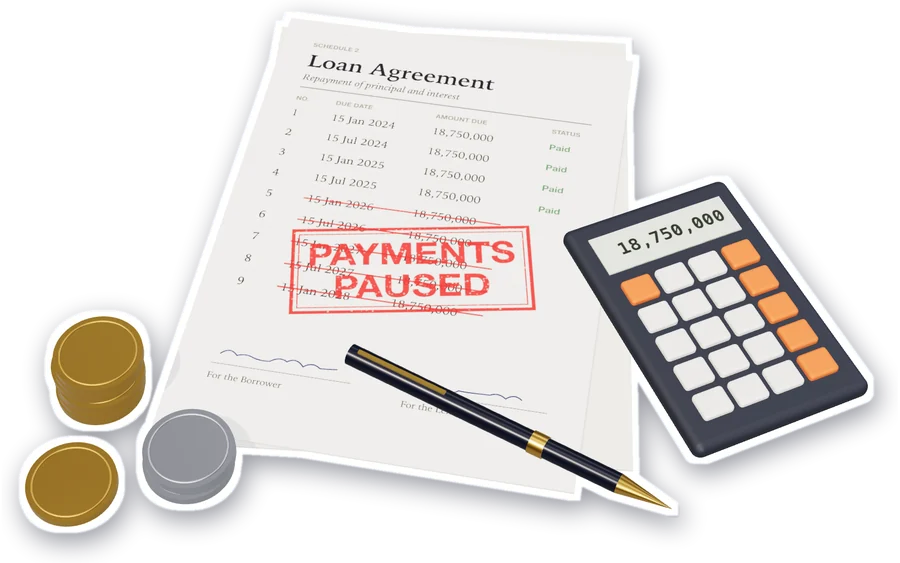


Letter from the chairs
Dear delegates,
We will chair the International Financial Architecture Working Group at the Model G20 Summit 2027. Our group asks one hard question: should G20 creditors, private lenders included, pause debt payments for the poorest countries?
Read this guide twice. The first time, read for the story of how a country comes to owe more than it can pay, and why the fix takes years. The second time, read it as your member’s negotiator and mark every line that helps or hurts your case.
In the room we will look for clauses that name who acts, what they do and by when. We will also look for delegates who bring a creditor and a borrower to the same text, and who can show a source for every claim they make.
Bring your white paper, your member’s row from Section 8 and one draft clause. We look forward to meeting you at FLAME University in June.
Warm regards,
Your chairs, International Financial Architecture Working Group
How the G20 and this simulation work
The real G20
The Group of Twenty has 21 members: 19 countries and two regional bodies, the European Union and the African Union3. The African Union became a permanent member at the New Delhi summit in 20233. Together the members account for around 85% of the world’s economic output, over 75% of world trade and about two-thirds of its people3.
The G20 began in 1999, after the Asian financial crisis, as a meeting of finance ministers and central bank governors3. Leaders first met in Washington DC in 2008, and they have met every year since 20113. Each year one member holds the presidency and sets the agenda, helped by the members that held it before and will hold it after. These three are called the troika3. The United States took over the presidency on 1 December 2025 and cut the number of working groups from 16 to four3. The United Kingdom holds the presidency in 2027 and will host the Leaders’ Summit in Manchester on 27 and 28 November 20274,5.
Two tracks
The G20 process is led by the sherpas, each leader’s personal representative. The work runs in two tracks, the Finance Track and the Sherpa Track. Within the two tracks, working groups bring together officials from the members, invited countries and international organisations3.
Agreement by everyone
In September 2026 G20 finance ministers issued their text as a Chair’s Statement6. A note to it says it was agreed by all G20 members present except China, which objected to four of its paragraphs6. In this simulation a text is agreed only when no member objects; the Rules of Procedure 2027 explain how.
This simulation
The Model G20 Summit 2027 is set in 2027, the year the United Kingdom holds the G20 presidency. The Model G20 secretariat chairs every working group, and the UK delegation is an ordinary member. All 21 members are seated in every group. Each group also has four invited seats for international organisations or guest countries; they take part in the debate but are not members. Model G20 is organised by One Young India and is independent of the G20 and of every G20 government.
Each working group is modelled on a group that has met in the real G20 in recent years, so delegates learn how the forum works. Your group negotiates one short text on its agenda. On Sunday afternoon the working groups’ texts come together in the communiqué, which the Leaders’ Session adopts by consensus at the closing ceremony. The Rules of Procedure 2027 explain how debate, amendments and the final text work.
This working group
The International Financial Architecture Working Group is modelled on the real G20 group of the same name in the Finance Track. South Africa’s 2025 calendar listed four meetings of the group, in January, March, June and September 20257. In 2026 the United States put debt on its Finance Track agenda: Treasury Secretary Bessent listed “enhancing debt transparency and facilitating debt restructuring processes” among its priorities8.
The issue explained
Governments borrow
Governments borrow for the same reasons families and companies do. They borrow to build roads, power lines and schools, to pay salaries when tax income falls short, and to cope with emergencies. The money comes from development banks such as the World Bank, from the governments of other countries, and from private lenders, meaning banks and investors who buy the government’s bonds. Official lenders charge the poorest countries less than private lenders do1. A bond is a loan cut into pieces that investors can buy and sell. Figure 1 shows who a borrowing country owes.
Debt owed to lenders in other countries is called external debt. In 2025 the external debt of developing countries rose 5.5% to a record US$9.4 trillion1.
Figure 1Section 3
Who a borrowing country owes. Four kinds of lender, and the rule that ties them together.
Why it goes wrong
Three things can turn a manageable debt into one a country cannot pay. When interest rates rise in the rich world, every new loan costs more. When the country’s own currency falls, each dollar it owes takes more of its own money to repay. And when a shock arrives, such as a pandemic, a jump in fuel prices or a hurricane, tax income drops just when the government must spend more.
Private lenders charge poorer countries much more than official lenders do1. In 2025 the countries poor enough to borrow from the World Bank’s International Development Association (IDA) paid an average of 8.2% on new loans from private lenders, the highest rate since 19891. The gap between what they paid private and official lenders widened from 3.4 percentage points in 2016 to 5.5 in 20251.
Money spent on interest cannot be spent on clinics or classrooms. UNCTAD, the UN’s trade and development body, reported in October 2026 that in 51 developing countries, home to 3.7 billion people, interest payments on public debt were larger than government spending on health or on education9.
When a country cannot pay
A government that misses a payment is in default. It must then agree new terms with its lenders: more time to pay, a lower interest rate, or a smaller amount owed. This is called a restructuring. While it drags on, the country finds it hard to borrow.
Why it is hard to fix
Every lender wants to be repaid first. A lender that agrees to wait fears that the money it gives up will simply pay the other lenders in full, so each waits for the others to move.
The G20’s answer is a process called the Common Framework, agreed in November 202010. It works like this. The borrowing country asks for help2. How much relief it needs is based on an IMF and World Bank debt sustainability analysis and on its government lenders’ joint assessment, and the deal must fit an IMF-supported programme2. Its government lenders, from the G20, the Paris Club and any others willing, then agree the key terms together. The terms go into a memorandum of understanding, signed by the lenders and the country, which is not legally binding2. They cover changes in debt payments during the IMF programme, a cut in the debt’s value where needed, and more time to repay2; in principle they do not write off or cancel the debt2.
The key rule is called comparability of treatment. A country that signs a deal with its government lenders must seek terms at least as good from all its other government lenders and from its private lenders2. The rule is meant to share the burden fairly among lenders2. Making it work for private lenders is the problem at the centre of your group’s agenda: when the G20 called on them to join the 2020 to 2021 pause, only one did11.
What has happened so far
- May 2020The G20’s Debt Service Suspension Initiative (DSSI) begins: a pause on debt payments for eligible countries during the pandemic11
- 13 Nov 2020G20 finance ministers endorse the Common Framework, also agreed by the Paris Club10
- 1 Feb 2021Zambia asks for a Common Framework treatment12
- Dec 2021The DSSI ends: 48 of 73 eligible countries took part, and US$12.9 billion of payments were suspended11
- Apr 2022Sri Lanka suspends payments on its external public debt while it seeks a restructuring13
- 16 Jun 2022Zambia’s official creditor committee forms, co-chaired by France and China12
- 19 Dec 2022Ghana suspends payments on its Eurobonds, commercial loans and most of its bilateral debt14
- Apr 2023The Global Sovereign Debt Roundtable meets, bringing borrowers, government lenders and private lenders to one table15
- 22 Jun 2023Zambia agrees terms with its official creditors, almost two and a half years after asking12
- Mar 2024Zambia agrees terms with its bondholders, which its official creditors confirm are comparable16
- 1 Jul 2024Hurricane Beryl strikes Grenada, which later defers two bond payments under a disaster clause17
- 1 Sep 2026G20 finance ministers in Asheville acknowledge “the need for faster and more predictable debt treatments”; China objects to that paragraph and three others6
- 21 Oct 2026The UK Treasury’s G20 adviser starts work, focusing on development finance for the UK presidency18
- 5 Nov 2026The World Bank reports a record US$9.4 trillion of developing-country external debt1
What the G20 has already said
The Common Framework, November 2020, on comparability of treatment:
“A debtor country that signs an MoU with participating creditors will be required to seek from all its other official bilateral creditors and private creditors a treatment at least as favorable as the one agreed in the MoU.”2
G20 finance ministers, Asheville Chair’s Statement, 1 September 2026, paragraph 13:
“We remain committed to addressing ongoing challenges to debt sustainability and acknowledge the need for faster and more predictable debt treatments to improve debt sustainability and growth outcomes.”6
Facts that matter
| Figure | Value | Year | Ref. |
|---|---|---|---|
| External debt of developing countries | US$9.4 trillion, up 5.5% | 2025 | 1 |
| External debt of IDA-eligible countries | US$1.3 trillion, up 8.1% | 2025 | 1 |
| Average interest on IDA countries’ new private loans | 8.2%, highest since 1989 | 2025 | 1 |
| Gap between private and official lending rates for IDA countries | 3.4 points (2016) to 5.5 points (2025) | 2016 to 2025 | 1 |
| Principal and interest paid by low- and middle-income countries | US$1.4 trillion, fifth rise in a row | 2025 | 1 |
| Debt service paid above new financing received, developing countries | US$436 billion | 2022 to 2025 | 1 |
| Net interest paid on public debt by developing countries | almost US$1 trillion | 2025 | 9 |
| Average interest rate on public debt | 5.2% developing, 2.2% developed | reported 2026 | 9 |
| Developing countries where interest exceeds health or education spending | 51 countries, 3.7 billion people | reported 2026 | 9 |
| Countries that used the 2020 to 2021 pause | 48 of 73 eligible | 2020 to 2021 | 11 |
| Payments suspended by the 2020 to 2021 pause | US$12.9 billion | 2020 to 2021 | 11 |
| Private creditors that joined the 2020 to 2021 pause | one | 2020 to 2021 | 11 |
Core tensions
Speed against fairness
For speed. A pause works only if it comes fast. Zambia asked for help on 1 February 2021 and agreed terms with its official creditors only on 22 June 202312. For almost two and a half years the country waited while the deal was negotiated12. Even the G20 finance ministers’ 2026 Chair’s Statement acknowledges “the need for faster and more predictable debt treatments”, though China objected to that paragraph6. A pause that starts at once would protect a country while the slow part goes on.
For fairness. A creditor that pauses gives up money it is owed, at least for a time. If one lender pauses and another keeps collecting, the first ends up paying the second. The Common Framework requires a country that signs a deal with its government lenders to seek terms at least as favourable from its other government and private lenders2. A fast but uneven pause may make the next deal harder, because lenders who felt cheated will be slower to agree.
Government lenders against private lenders
The case for binding private lenders. Private lenders charge the poorest countries more than official lenders do: 8.2% on new loans in 2025, 5.5 percentage points more1. In the 2020 to 2021 pause, the G20 asked private creditors to join on comparable terms, and only one did11. When government lenders pause and private lenders do not, the money freed by taxpayers in creditor countries can flow straight to bondholders.
The case for caution. The G20 can call on private lenders to join, but in the 2020 to 2021 pause only one did11. Rules that force private lenders to take losses may stop them lending to poor countries at all. In 2025 bond issuance by public entities in developing countries rose nearly 35%, to US$251 billion, as markets reopened1. Some members will say a pause aimed at private lenders would close that door again.
Relief now against borrowing later
For relief now. From 2022 to 2025 developing countries paid US$436 billion more in debt service than they received in new financing1. Money that leaves a country to pay old debts is money it cannot spend on schools, clinics or roads.
For protecting future borrowing. A country that asks for a pause may fear that lenders will charge it more later, or not lend at all, so its finance minister may prefer to keep paying at great cost. A pause that applies to all eligible countries by rule may remove that fear.
Who qualifies
The poorest only. The Common Framework is open to the countries that were eligible for the 2020 pause2. Keeping the circle small makes a deal easier, keeps the cost to creditors down, and helps the countries with the least room to cope.
Wider. Debt trouble does not stop at the poorest. Sri Lanka and Ghana both suspended payments in 202213,14. G20 finance ministers’ 2026 Chair’s Statement welcomed progress on a separate IMF and World Bank “3-Pillar approach” for countries whose debts are sustainable but whose payments crowd out investment6. Some members will want any new pause to reach countries like these.
Case studies
Zambia: the long wait
Zambia asked for a Common Framework treatment on 1 February 202112. Its official creditor committee, 16 countries co-chaired by France and China with South Africa as vice-chair, formed on 16 June 202212. It agreed the terms on 16 June 2023, and on 22 June 2023 China and France presented them to Zambia in Paris12. Zambia’s was the second deal under the Common Framework, after Chad’s in November 202212.
The IMF’s Managing Director called it a “unique and innovative agreement” that set both a baseline treatment and a second one that would start automatically if the assessment of Zambia’s economic performance and policies improved19. Zambia then had to find terms at least as good with its private creditors12. In March 2024 it reached a deal with its bondholders, and its official creditors confirmed the terms were comparable16.
What it shows. The Common Framework can bring the Paris Club and China to the same deal, but slowly. Question for your group. Would a pause from the day of Zambia’s request have changed the outcome, and who would have paid for it?
Grenada: a pause written into the contract
Hurricane Beryl struck Grenada’s islands of Carriacou and Petite Martinique as a Category 4 storm on 1 July 202417. Grenada’s bonds contained a disaster clause. It used the clause to defer two payments, the first time such a clause had been used17. The payments, due in November 2024 and May 2025, came to about US$12 million, 0.9% of Grenada’s annual output, and were added to what Grenada repays when the bond ends in 203017.
What it shows. A clause agreed in advance let Grenada defer payments after a disaster17. Question for your group. Should every new loan to a poor country carry a clause like Grenada’s, and who should decide what counts as a disaster?
The 2020 to 2021 pause
At the start of the pandemic the World Bank and the IMF urged the G20 to set up a pause on debt payments. The Debt Service Suspension Initiative began in May 202011. Before it ended in December 2021, 48 of the 73 eligible countries took part, and US$12.9 billion of payments were suspended11. Countries that took part committed to spend the money freed on health, social or economic needs, to disclose all their public sector borrowing, and to limit new loans on non-concessional terms11. The G20 asked private creditors to join on comparable terms. Only one did11.
What it shows. Government lenders can agree a pause together; private lenders, with one exception, stayed out11. Question for your group. What would make private lenders join next time: a reward, a rule, or a law?
Country positions
One row for each of the 21 members. “Stake” and “On the record” come from official sources. “Our reading”, in italics, is what we think that record suggests: test it in your research. Where the record is silent, the row says so. Bring this section to the summit and tick each row as members speak.
| Member | Stake | On the record | Our reading | Mark |
|---|---|---|---|---|
 Argentina | In April 2025 the IMF approved a 48-month arrangement for Argentina worth US$20 billion20. Argentina has also joined Paris Club treatments as a lender21. | In October 2024 its economy minister, speaking at the IMF for six South American countries, said post-pandemic sovereign debt is “not sustainable” in “some of the major economies of the world” and in less systemically important places, must be addressed urgently, and that support should include debt relief22. | Pushes for: Debt relief as part of international support. Not clear from the record: red line, allies. Research it. | AllyOpp.Swing |
 Australia | A Paris Club member on Sri Lanka’s creditor committee21,23. | With Japan, it acknowledged in 2022 the need to improve creditor coordination “by swiftly implementing the Common Framework”, and in 2023 welcomed Zambia’s deal24,25. | Pushes for: Faster cases under the existing rules. Allies: Japan, Korea, Canada. Not clear from the record: red line. Research it. | AllyOpp.Swing |
 Brazil | A Paris Club member since 201621; it held the presidency in 202426. | The G20 Rio declaration agreed under its presidency (paragraph 74) committed all members to step up the Common Framework’s implementation “in a predictable, timely, orderly, and coordinated manner” and welcomed the Africa-led debates on debt that Brazil’s presidency convened26. | Pushes for: A stronger voice for African borrowers. Allies: South Africa, India, the African Union. Not clear from the record: red line. Research it. | AllyOpp.Swing |
 Canada | A Paris Club member on Sri Lanka’s creditor committee21,23. | As G7 president in 2025 it published the G7 finance ministers’ communique, which looked forward to G20 work on improving how the Common Framework is put into practice27. | Pushes for: A more predictable Common Framework. Allies: France, Germany, Japan, the UK. Not clear from the record: red line. Research it. | AllyOpp.Swing |
 China | Takes part in the Paris Club case by case since 201321; co-chaired Zambia’s creditor committee12. | In 2026 it objected to four paragraphs of the G20 finance ministers’ statement, including paragraph 13 on debt6. In 2024, with 53 African countries, it called on international financial institutions and commercial creditors to take part in debt treatment of African countries “in line with the principle of joint action and fair burden-sharing”28. | Pushes for: Development banks and private lenders to share the cost of any pause. Red line: A pause that binds government lenders while others are repaid in full. Allies: The African Union and African countries, whose leaders issued the 2024 Beijing Declaration with it28. | AllyOpp.Swing |
 France | Chairs the Paris Club12; co-chaired Zambia’s creditor committee and co-led Sri Lanka’s12,29. | Signed its bilateral debt deal with Zambia on 8 December 2024, which the French Treasury calls the first bilateral agreement to apply the memorandum Zambia agreed with its official creditors in October 202330. | Pushes for: The Common Framework as the main route. Red line: A deal that leaves non-Paris Club lenders out. Allies: Japan and India (Sri Lanka), Germany, the EU. | AllyOpp.Swing |
 Germany | A Paris Club member on Sri Lanka’s creditor committee21,23. | Its finance ministry says Germany is pressing at the highest level in the G20 for structural improvements to the Common Framework, which has delivered results for Zambia, Chad, Ghana and Ethiopia31. | Pushes for: Structural improvements to the Common Framework. Allies: France, Italy, the EU. Not clear from the record: red line. Research it. | AllyOpp.Swing |
INDIndia creditor | Takes part in the Paris Club case by case since 201921; sat on Zambia’s committee and co-led Sri Lanka’s12,29. | The G20 New Delhi declaration agreed under its presidency (2023) stood by the Common Framework and welcomed the creditor committee for Sri Lanka32. Its finance ministry says the Global Sovereign Debt Roundtable began as a joint initiative of the IMF, the World Bank and India’s presidency33. | Pushes for: Coordinated deals that also cover middle-income cases like Sri Lanka. Allies: Japan and France (Sri Lanka), Brazil, South Africa. Not clear from the record: red line. Research it. | AllyOpp.Swing |
 Indonesia | Held the presidency in 202234. | The G20 Bali declaration agreed under its presidency (paragraph 33) welcomed Chad’s deal and encouraged Zambia’s by early 2023; a footnote records that one member, not named, wanted multilateral development banks to share in debt treatments34. | Not clear from the record. Research it. | AllyOpp.Swing |
 Italy | A Paris Club member on Zambia’s creditor committee12,21. | The G20 Rome declaration agreed under its presidency (2021) stressed that private creditors and other government lenders should give terms at least as favourable, in line with comparability of treatment35. | Pushes for: Comparability of treatment applied to private lenders. Allies: France, Germany, the EU. Not clear from the record: red line. Research it. | AllyOpp.Swing |
 Japan | A Paris Club member that co-led Sri Lanka’s creditor committee21,29. | In October 2024 it said implementing the Common Framework in a predictable, timely, orderly and coordinated manner is “vital” for low-income countries, asked for the lessons of Sri Lanka’s deal to be used for future middle-income cases, and said restructurings should rest on the IMF’s analysis and comparability among creditors29. | Pushes for: The Sri Lanka model for middle-income countries. Red line: A deal not based on the IMF’s debt analysis. Allies: France, India, Australia. | AllyOpp.Swing |
 Republic of Korea | A Paris Club member since 2016, on Sri Lanka’s creditor committee21,23. | No public statement found. Find one. | Not clear from the record. Research it. | AllyOpp.Swing |
 Mexico | Has joined Paris Club treatments as a lender21. | In April 2022 its finance secretary said low-income countries had received debt relief while emerging economies had been left out36. | Pushes for: Relief that reaches emerging and middle-income economies. Allies: Argentina. Not clear from the record: red line. Research it. | AllyOpp.Swing |
RUSRussia creditor | A Paris Club member on Zambia’s and Sri Lanka’s creditor committees12,21,23. | No public statement found. Find one. | Not clear from the record. Research it. | AllyOpp.Swing |
KSASaudi Arabia creditor | Held the presidency in 2020; sat on Zambia’s creditor committee and has joined Paris Club treatments12,21,37. | The G20 Riyadh declaration agreed under its presidency committed members to the 2020 pause, including its extension through June 2021 (paragraph 7), and endorsed the Common Framework (paragraph 8)37. | Pushes for: The Common Framework it helped launch. Not clear from the record: red line, allies. Research it. | AllyOpp.Swing |
 South Africa | A prospective Paris Club member since 2022 and vice-chair of Zambia’s creditor committee12,21; held the presidency in 202538. | The G20 Johannesburg declaration agreed under its presidency noted the voluntary use of crisis resilient debt clauses, which can give “vital breathing space and liquidity” (paragraph 19), and reaffirmed its call for debt transparency from all stakeholders, private creditors included (paragraph 17)38. | Pushes for: Disaster clauses and transparency from private lenders. Allies: The African Union, Brazil, India. Not clear from the record: red line. Research it. | AllyOpp.Swing |
 Türkiye | Has joined Paris Club treatments as a lender21. | In April 2026 its finance minister, speaking at the IMF for a group of countries, said Common Framework progress “has often been slow and outcomes uncertain”39. | Pushes for: A faster, more certain process. Not clear from the record: red line, allies. Research it. | AllyOpp.Swing |
 United Kingdom | A Paris Club member on Sri Lanka’s creditor committee21,23; holds the presidency in 20274; the Chancellor’s external adviser on the G20 is to focus particularly, but not only, on development finance18. | In April 2026 it backed a faster, more predictable Common Framework extended to middle-income countries, and wider use of pause clauses in official and private lending40. | Pushes for: Pause clauses, and a Common Framework for middle-income countries. Allies: The EU, Japan, South Africa. Not clear from the record: red line. Research it. | AllyOpp.Swing |
 United States | A Paris Club member on Sri Lanka’s creditor committee21,23; held the presidency in 2026 and co-chaired the Global Sovereign Debt Roundtable41. | In April 2026 the Treasury said the IMF and the World Bank must “restore momentum” in debt restructuring and advance the Common Framework42; its 2026 priorities included debt transparency8. | Pushes for: Transparency about who has lent what, and faster restructurings. Allies: Japan, the UK. Not clear from the record: red line. Research it. | AllyOpp.Swing |
 European Union | A G20 member in its own right3. | It supports debt relief for low-income countries in unsustainable debt, wants the Common Framework to be more timely and predictable, and supports extending it to middle-income countries43. | Pushes for: A wider, faster Common Framework. Allies: France, Germany, Italy, the UK, Japan. Not clear from the record: red line. Research it. | AllyOpp.Swing |
AUAfrican Union regional body | A permanent G20 member since 20233. | Its heads of state adopted a Common African Position on Debt in February 2026, and a July 2026 African Union dialogue on debt aimed to help shape one African position on reform of the Common Framework44. | Pushes for: Reform of the Common Framework along the lines of its common position. Allies: South Africa, Brazil, China. Not clear from the record: red line. Research it. | AllyOpp.Swing |
Invited seats (not members)
- International Monetary Fund. With the World Bank, it urged the G20 to set up the 2020 pause; their joint debt analysis, with the creditors’ own assessment, sets how much relief a country needs2,11.
- World Bank. Publishes the International Debt Report, the source of many of this guide’s debt figures1, and tracked the 2020 pause11.
- Zambia (borrowing guest country). Waited almost two and a half years for its Common Framework deal12.
- Institute of International Finance (private creditors). Took part for the private sector in the Global Sovereign Debt Roundtable in 202315.
The camps
Options on the table
Each option is something the G20 can actually do: commit its own members, call on others, or ask international bodies to act and report. Who may back or resist each option is our reading of the record in Section 8, for you to test in your research.
A. A new time-limited pause for the poorest countries
What it is. A pause on debt payments for a fixed period, modelled on the 2020 to 2021 pause11. Who runs it. G20 government lenders, with the World Bank and the IMF monitoring spending, as they did for the 2020 to 2021 pause11. Who pays. Creditors wait for their money; whether interest keeps adding up decides how much it costs them. Precedent. The DSSI: 48 of 73 eligible countries took part11. For. It is fast and it has been done before. Against. Last time only one private creditor joined11. May back it. Borrowing members and the African Union. May resist it. Members worried that their relief would pay private lenders.
B. A pause from the day a country asks for help
What it is. Payments stop automatically from the day a country requests a Common Framework treatment until it agrees terms, or for a set number of months. Who runs it. The creditors in each Common Framework case, under rules the G20 writes. Who pays. Creditors carry the cost of waiting; deadlines limit how long. Precedent. None in the Common Framework text, which sets out the terms of a final deal but no pause while a case is negotiated2. Zambia waited almost two and a half years for its deal12. For. It removes the reason to delay. All G20 members present at Asheville except China agreed a text that acknowledges “the need for faster and more predictable debt treatments”6. Against. Some lenders may fear that a country will ask for help just to stop paying. May back it. Borrowing members and the African Union. May resist it. Creditors who want each case judged on its own.
C. Disaster clauses in all new loans
What it is. Every new loan to a poor or small island country includes a clause that pauses payments after a severe disaster. Who runs it. Each lender, in its own contracts. Who pays. The lender waits; the deferred payments are added to the end of the loan, as in Grenada17. Precedent. In November 2022 UK Export Finance announced it would offer such clauses, the first export credit agency to do so, and a model version for private lending was published the same week45,46. Grenada used its clause after Hurricane Beryl struck in July 202417. For. The pause starts at once, without a negotiation. Against. It helps only after disasters, and only on new loans. May back it. The United Kingdom, whose export credit agency was the first to offer the clauses45, and small island and climate-vulnerable borrowers.
D. Debt swaps for nature or climate
What it is. A country’s expensive debt is bought back with a cheaper loan, and the country commits savings to conservation or climate work. Who runs it. The borrowing country with banks, development lenders and insurers. Precedent. In May 2023 Ecuador exchanged US$1.628 billion of bonds for a US$656 million loan linked to protecting the Galápagos, backed by US political risk insurance and an Inter-American Development Bank guarantee, and expects more than US$1.126 billion in savings47. For. It cuts debt and pays for conservation at the same time. Against. Each deal is slow to build, and it does not help a country in crisis now.
E. A faster, more predictable Common Framework
What it is. Fixed deadlines for each step of a Common Framework case, a standard memorandum of understanding, and earlier sharing of information. Who runs it. G20 creditors, with the IMF, the World Bank and the Global Sovereign Debt Roundtable15. Precedent. In 2026 G20 finance ministers welcomed the publication of an illustrative, non-binding G20 template memorandum of understanding for future Common Framework cases6. For. Every G20 member present at Asheville except China accepted “the need for faster and more predictable debt treatments”6. Against. Deadlines without a pause still leave a country paying while it negotiates.
What the communiqué must answer
- Which countries qualify?
- Which creditors join: G20 governments only, all official lenders, private lenders too?
- What starts a pause, and how long does it last?
- Does interest keep adding up during the pause, and who carries the cost?
- What must borrowers and lenders publish about their loans?
- Who reports progress, to whom, and by when?
Draft paragraph, as amendedWeak, then strong
We recognise the importance of debt sustainability and call for further efforts to support vulnerable countries. We commit, as bilateral official creditors, to suspend debt service for IDA-eligible countries from the date they request a Common Framework treatment until an agreement in principle is reached or for 12 months, whichever is sooner, on terms that leave the value of our claims unchanged. We call on private creditors to offer comparable terms and ask the IMF and the World Bank to report progress to our Finance Ministers by October 2027.
The weak paragraph names no one and promises nothing. The strong one commits only G20 members and calls on everyone else. It is an example, not the answer: your group may decide on a different pause, or on none.
Preparation
Your white paper
Write at most 1,000 words, with numbered sources, and send it to your chairs by Monday 31 May 2027 (Rules of Procedure 9.2). Use five parts:
- Your member’s stake, in three numbers with sources.
- Its position on each question in Section 10.
- Its red lines: what it will not accept.
- One draft paragraph in the style of a communiqué, beginning “We commit” or “We call on”.
- Your sources, numbered, official ones first.
Five questions to research for your member
- Is your member mainly a lender to other governments, a borrower, or both?
- Is it a member of the Paris Club, and has it sat on a Common Framework creditor committee?
- What did its finance ministry say about debt at the 2026 G20 meetings?
- What would a pause cost it, and what would it gain?
- Which members are most likely to agree with it, and which one in the other camp could it win over?
Starter sources
- The latest debt figures, reference 1
- The Common Framework text, reference 2
- The Paris Club and its members, reference 21
- The 2020 to 2021 pause, country by country, reference 11
- What G20 finance ministers said in 2026, reference 6
- The Global Sovereign Debt Roundtable, reference 15
- Interest against health and education spending, reference 9
- Climate resilient debt clauses, reference 45
 Pocket card
Your first hour as a delegate
- Roll call. Hold up your placard and answer “present” when your member is called.
- Opening speech. Give your member’s stake in one number, its position, and one thing it wants in the text.
- Listen. As members speak, mark their rows in Section 8: ally, opponent or swing.
- First caucus. Find two allies, one in your camp and one in the other.
- By the break. Bring one clause that names who acts, what they do, and by when.
Glossary
- Bond
- A loan cut into pieces that investors can buy and sell.
- Common Framework
- The G20 process, agreed in 2020, for poorer countries to rework debts owed to governments10.
- Comparability of treatment
- The rule that a country that gets relief from its government lenders must seek terms at least as good from its other government and private lenders2.
- Creditor
- A lender: the person, bank or government that is owed money.
- Debt service
- The payments of interest and principal a borrower must make.
- Debt sustainability analysis
- The IMF and World Bank check of whether a country can keep paying its debts.
- Default
- Missing a payment that is due.
- Disaster clause
- A term in a loan that pauses payments after a severe disaster.
- Debt swap
- A deal that cuts a country’s debt in return for spending on a goal such as conservation.
- External debt
- Debt owed to lenders in other countries.
- IDA country
- A country poor enough to borrow from the World Bank’s International Development Association.
- IMF programme
- An agreement under which the IMF lends to a country that commits to economic reforms.
- Interest rate
- The price of borrowing: a share of the loan paid each year.
- Memorandum of understanding
- A written record of agreed terms; under the Common Framework it is not legally binding.
- Multilateral lender
- A lender owned by many governments, such as the World Bank or the IMF.
- Official creditor
- A government, or a body owned by governments, that has lent money.
- Paris Club
- An informal group of creditor governments, formed in 1956, that agree debt relief together10.
- Private creditor
- A bank, fund or investor that has lent money.
- Restructuring
- New terms agreed after a country cannot pay: more time, lower interest or a smaller debt.
- Standstill
- An agreed pause in debt payments.
References
All sources accessed 20 November 2026. Numbers in the text refer to this list.
- World Bank. “Developing Countries’ External Debt Surges to Record $9.4 Trillion” (International Debt Report 2026), press release, 5 November 2026. https://www.worldbank.org/en/news/press-release/2026/11/05/developing-countries-external-debt-surges-to-record-9-4-trillion
- G20 and Paris Club. “Common Framework for Debt Treatments beyond the DSSI”, annex to the Paris Club press release of 13 November 2020, published by the Paris Club Secretariat (French Treasury). https://bercy1.applis.finances.gouv.fr/files/live/sites/clubdeparis/files/contributed/02%20Actualit%c3%a9s-PJ%20et%20image(s)/2020/PRannex-CommonFramework-20201113.pdf
- Ministry of External Affairs, India. “Group of Twenty - G20” (brief), July 2026. https://www.mea.gov.in/Portal/ForeignRelation/G20_2026.pdf
- Prime Minister’s Office, GOV.UK. “Growth and opportunity set to be at the heart of UK-hosted G20”, 22 November 2025. https://www.gov.uk/government/news/growth-and-opportunity-set-to-be-at-the-heart-of-uk-hosted-g20
- Cabinet Office, GOV.UK. “Manchester to host world leaders at the 2027 G20 Summit”, 23 September 2026. https://www.gov.uk/government/news/manchester-to-host-world-leaders-at-the-2027-g20-summit
- US Department of the Treasury. “G20 Chair’s Statement”, Second Meeting of G20 Finance Ministers and Central Bank Governors, Asheville, 31 August and 1 September 2026 (press release sb0620). https://home.treasury.gov/news/press-releases/sb0620
- G20 South Africa Presidency. “Concept Note and Calendar” (2025 presidency), copy published by the South African Institute of International Affairs. https://saiia.org.za/wp-content/uploads/2025/02/G20-CONCEPT-NOTE-SOUTH-AFRICA.pdf
- US Department of the Treasury. “Secretary Bessent Announces 2026 G20 Finance Track Agenda and Finance Ministers and Central Bank Governors Meeting in Asheville, North Carolina”, 19 February 2026 (sb0398). https://home.treasury.gov/news/press-releases/sb0398
- UNCTAD. “Rising debt costs are stalling development”, 7 October 2026. https://unctad.org/news/rising-debt-costs-are-stalling-development
- Paris Club. “Endorsement with the G20 of a common framework to coordinated debt treatments”, 13 November 2020. https://bercy1.applis.finances.gouv.fr/en/clubdeparis/accueil/actualites1/2020/cadre-comun-dette-2020.html
- World Bank. “COVID-19 Debt Service Suspension Initiative”, brief. https://www.worldbank.org/en/topic/debt/brief/covid-19-debt-service-suspension-initiative
- Paris Club. “The Paris Club welcomes Zambia’s debt restructuring agreement”, 23 June 2023. https://bercy1.applis.finances.gouv.fr/en/clubdeparis/accueil/actualites1/2023/zambie-23-06-2023.html
- Ministry of Finance, Sri Lanka. Notice on the restructuring of external public debt (article 112). https://www.treasury.gov.lk/news/article/112
- Ministry of Finance, Ghana. “Suspension of Payments on Selected External Debts of the Government of Ghana”, press release, 19 December 2022. https://www.mofep.gov.gh/sites/default/files/news/Suspension-of-Payments-on-Selected-External-Debts-of-The-GoG.pdf
- IMF. “Global Sovereign Debt Roundtable Co-Chairs Press Statement”, Press Release No. 23/117, 12 April 2023. https://www.imf.org/en/News/Articles/2023/04/12/pr23117-global-sovereign-debt-roundtable-cochairs-press-stmt
- World Bank. “World Bank Group Statement on Debt Restructuring Agreement for Zambia”, 26 March 2024. https://www.worldbank.org/en/news/statement/2024/03/26/world-bank-group-statement-on-debt-restructuring-agreement-for-afe-zambia
- IMF. Grenada: 2025 Article IV Consultation, Press Release and Staff Report, Country Report No. 26/9, January 2026. https://www.imf.org/-/media/files/publications/cr/2026/english/1grdea2026001-source-pdf.pdf
- HM Treasury. “Terms of Reference for Shriti Vadera as External Adviser to the Chancellor on the delivery of the G20”. https://assets.publishing.service.gov.uk/media/6aecb863c6ec9e28ff7bd079/Shriti_Vadera_ToR_.pdf
- IMF. “IMF Managing Director Welcomes Debt Treatment Agreement Reached by Zambia and Its Official Creditors under the G20 Common Framework”, Press Release No. 23/235, 22 June 2023. https://www.imf.org/en/News/Articles/2023/06/22/pr23235-imf-welcomes-debt-treatment-agreement-reached-by-zambia
- IMF. “IMF Executive Board Approves 48-month US$20 billion Extended Arrangement for Argentina”, IMF News, 12 April 2025. https://www.imf.org/en/news/articles/2025/04/12/pr25101-argentina-imf-executive-board-approves-48-month-usd20-billion-extended-arrangement
- Paris Club. “Who are the members of the Paris Club?” https://bercy1.applis.finances.gouv.fr/en/who-are-the-members-of-the-paris-club
- IMF. International Monetary and Financial Committee, Fiftieth Meeting, 24-25 October 2024, Statement No. 50-19, Statement by Mr. Caputo (Argentina), on behalf of Argentina, Bolivia, Chile, Paraguay, Peru and Uruguay. https://meetings.imf.org/en/-/media/amsm/files/am2024/imfc/argentina.pdf
- Paris Club. “Agreement in principle between the Official Creditor Committee and Sri Lanka”, 29 November 2023. https://bercy1.applis.finances.gouv.fr/en/clubdeparis/accueil/actualites1/2023/sri-lanka-29-11-2023.html
- Treasury, Australian Government. “Australia-Japan Economic Dialogue Joint Statement”, 1 November 2022. https://treasury.gov.au/media-release/australia-japan-economic-dialogue-joint-statement
- Treasury, Australian Government. “Japan-Australia Economic Dialogue Joint Statement”, 20 October 2023. https://treasury.gov.au/media-release/japan-australia-economic-dialogue-joint-statement
- G20. “G20 Rio de Janeiro Leaders’ Declaration”, 18-19 November 2024 (Brazilian presidency), PDF hosted by the Global Development Policy Center, Boston University. https://www.bu.edu/gdp/files/2024/12/g20-rio-de-janeiro-leaders-declaration-final.pdf
- Department of Finance Canada. “G7 Finance Ministers and Central Bank Governors’ Communique”, May 2025 (Canadian G7 presidency). https://www.canada.ca/en/department-finance/news/2025/05/g7-finance-ministers-and-central-bank-governors-communique.html
- Ministry of Foreign Affairs, People’s Republic of China. “Beijing Declaration on Jointly Building an All-Weather China-Africa Community with a Shared Future for the New Era” (FOCAC summit, September 2024). https://www.fmprc.gov.cn/eng/xw/zyxw/202409/t20240905_11485993.html
- Ministry of Finance, Japan. Statement by the Honorable Kato Katsunobu, Governor of the IMF for Japan, at the Fiftieth Meeting of the IMFC, 25 October 2024. https://www.mof.go.jp/english/policy/international_policy/imf/imfc/imfc_20241025_2.pdf
- Direction generale du Tresor, France. “Signature de l’accord bilateral France - Zambie de restructuration de dette”, 9 December 2024. https://www.tresor.economie.gouv.fr/Articles/2024/12/09/signature-de-l-accord-bilateral-france-zambie-de-restructuration-de-dette
- Federal Ministry of Finance, Germany. “International strategy to provide relief to heavily indebted countries” (English page). https://www.bundesfinanzministerium.de/Content/EN/Standardartikel/Topics/Financial_markets/Articles/international-debt-strategy.html
- G20. “G20 New Delhi Leaders’ Declaration”, 9-10 September 2023 (Indian presidency), copy hosted by the G20 Research Group, University of Toronto. https://g20.utoronto.ca/2023/230909-declaration.html
- Press Information Bureau, Government of India (Ministry of Finance). “Ministry of Finance Year Ender 2023: Department of Economic Affairs”. https://www.pib.gov.in/PressReleaseIframePage.aspx?PRID=1990745
- G20. “G20 Bali Leaders’ Declaration”, 15-16 November 2022 (Indonesian presidency), PDF hosted by the G20 Research Group, University of Toronto. https://www.g20.utoronto.ca/2022/G20%20Bali%20Leaders-%20Declaration,%2015-16%20November%202022.pdf
- G20. “G20 Rome Leaders’ Declaration”, 30-31 October 2021 (Italian presidency), copy hosted by the G20 Research Group, University of Toronto. https://g20.utoronto.ca/2021/211031-declaration.html
- Secretaria de Hacienda y Credito Publico, Mexico. Comunicado No. 31, “Participa el secretario de Hacienda en la reunion de ministros de Finanzas del G20”, 20 April 2022. https://www.gob.mx/shcp/prensa/comunicado-no-31-participa-el-secretario-de-hacienda-en-la-reunion-de-ministros-de-finanzas-del-g20?idiom=fr
- G20. “Leaders’ Declaration, G20 Riyadh Summit”, 21-22 November 2020 (Saudi presidency), copy hosted by the UN Convention to Combat Desertification. https://www.unccd.int/sites/default/files/library/562_Resources_g20-riyadh-summit-leaders-declaration_en.pdf
- G20. “G20 South Africa Summit: Leaders’ Declaration”, Johannesburg, 22-23 November 2025 (South African presidency), PDF published by the Government of the Netherlands (Officiële Bekendmakingen). https://zoek.officielebekendmakingen.nl/dossier/blg-1234461.pdf
- IMF. International Monetary and Financial Committee, Fifty-Third Meeting, 16-17 April 2026, Statement No. 53-23, Statement by Mr. Simsek (Republic of Turkiye), on behalf of the Central and Eastern European Countries Constituency. https://meetings.imf.org/en/-/media/amsm/files/sm2026/imfc/turkiye.pdf
- HM Treasury and FCDO, GOV.UK. “World Bank Group and International Monetary Fund 2026 Spring Meetings: UK Governors’ statement”, April 2026. https://www.gov.uk/government/publications/world-bank-group-and-international-monetary-fund-2026-spring-meetings-development-committee-uk-governors-statement/world-bank-group-and-international-monetary-fund-2026-spring-meetings-uk-governors-statement
- IMF. “Global Sovereign Debt Roundtable - 7th Co-Chairs Progress Report”, IMF News, 14 October 2026. https://www.imf.org/en/news/articles/2026/10/14/pr26337-gsdr-7th-co-chairs-progress-report
- US Department of the Treasury. “Secretary Bessent IMFC-DC Statement”, 15 April 2026 (sb0442). https://home.treasury.gov/news/press-releases/sb0442
- European Union Delegation to the UN in New York (EEAS). “EU General Statement - 4th International Conference on Financing for Development: 1st PrepCom Session” (Roundtable 3, debt, written statement). https://www.eeas.europa.eu/delegations/un-new-york/eu-general-statement-%E2%80%93-4th-international-conference-financing-development-1st-prepcom-session_en
- African Union Commission. “African Union Dialogue on Debt Sustainability and Reform”, Harare, 1-3 July 2026, event page. https://au.int/en/newsevents/20260701/african-union-dialogue-debt-sustainability-and-reform
- UK Export Finance, GOV.UK. “UK Export Finance launches new debt solution to help developing countries with climate shocks”, 8 November 2022. https://www.gov.uk/government/news/uk-export-finance-launches-new-debt-solution-to-help-developing-countries-with-climate-shocks
- HM Treasury, GOV.UK. “COP27 Finance Day: building resilience for countries hit by natural disasters”, 9 November 2022. https://www.gov.uk/government/news/cop27-finance-day-building-resilience-for-countries-hit-by-natural-disasters
- US International Development Finance Corporation. “Financial Close Reached in Largest Debt Conversion for Marine Conservation to Protect the Galápagos”, 9 May 2023. https://www.dfc.gov/media/press-releases/financial-close-reached-largest-debt-conversion-marine-conservation-protect