


Letter from the chairs
Dear delegates,
We will chair the Trade and Investment Working Group at the Model G20 Summit 2027. Our group asks one hard question about tariffs and the equal treatment rule: should the WTO’s most favoured nation principle be reformed?
Read this guide twice. The first time, read for the story of a rule that has shaped world trade since 1947, and why some of its oldest supporters now want to change it. The second time, read it as your member’s negotiator and mark every line that helps or hurts your case.
In the room we will look for clauses that name who acts, what they do and by when. We will also look for delegates who bring a member that defends the rule and one that wants to change it to the same text, and who can show a source for every claim they make.
Bring your white paper, your member’s row from Section 8 and one draft clause. We look forward to meeting you at FLAME University in June.
Warm regards,
Your chairs, Trade and Investment Working Group
How the G20 and this simulation work
The real G20
The Group of Twenty has 21 members: 19 countries and two regional bodies, the European Union and the African Union4. The African Union became a permanent member at the New Delhi summit in 20234. Together the members account for around 85% of the world’s economic output, over 75% of world trade and about two-thirds of its people4.
The G20 began in 1999, after the Asian financial crisis, as a meeting of finance ministers and central bank governors4. Leaders first met in Washington DC in 2008, and they have met every year since 20114. Each year one member holds the presidency and sets the agenda, helped by the members that held it before and will hold it after. These three are called the troika4. The United States took over the presidency on 1 December 2025 and cut the number of working groups from 16 to four4. The United Kingdom holds the presidency in 2027 and will host the Leaders’ Summit in Manchester on 27 and 28 November 20275,6.
Two tracks
The G20 process is led by the sherpas, each leader’s personal representative. The work runs in two tracks, the Finance Track and the Sherpa Track. Within the two tracks, working groups bring together officials from the members, invited countries and international organisations4.
Agreement by everyone
After G20 trade ministers met in Milwaukee on 30 September and 1 October 2026, the United States, as president, drafted and circulated a Chair’s Statement in its own name7. According to the chair, the entire G20 reached consensus on a separate statement on the weaponization of food; consensus was not reached on a statement on forced labour, and a few members rejected one on excess capacity7,8. In this simulation a text is agreed only when no member objects; the Rules of Procedure 2027 explain how.
This simulation
The Model G20 Summit 2027 is set in 2027, the year the United Kingdom holds the G20 presidency. The Model G20 secretariat chairs every working group, and the UK delegation is an ordinary member. All 21 members are seated in every group. Each group also has four invited seats for international organisations or guest countries; they take part in the debate but are not members. Model G20 is organised by One Young India and is independent of the G20 and of every G20 government.
Each working group is modelled on a group that has met in the real G20 in recent years, so delegates learn how the forum works. Your group negotiates one short text on its agenda. On Sunday afternoon the working groups’ texts come together in the communiqué, which the Leaders’ Session adopts by consensus at the closing ceremony. The Rules of Procedure 2027 explain how debate, amendments and the final text work.
This working group
The Trade and Investment Working Group is modelled on the real G20 group of the same name, which in 2025 was part of the Sherpa Track9. South Africa’s 2025 calendar listed four meetings of the group, before trade ministers met in Gqeberha on 10 October 20259,10. G20 leaders have backed reform of the WTO: in 2024 they supported “the necessary reform of the WTO”11, and in 2025 the declaration agreed under South Africa’s presidency said “meaningful, necessary and comprehensive reform of the WTO is essential”12. In 2026 the US presidency chose four priorities for the G20 Trade Working Group, one of them reform of the MFN principle7.
The issue explained
The rule
Under the WTO agreements, countries cannot normally discriminate between their trading partners. This is the most favoured nation (MFN) principle3. The WTO puts it simply: grant someone a special favour, such as a lower tariff, and you have to do the same for all other WTO members3. Article I of the General Agreement on Tariffs and Trade (GATT) says the favour must be given “immediately and unconditionally”13. The rule applies to all 166 WTO members1, and it also covers trade in services and intellectual property3.
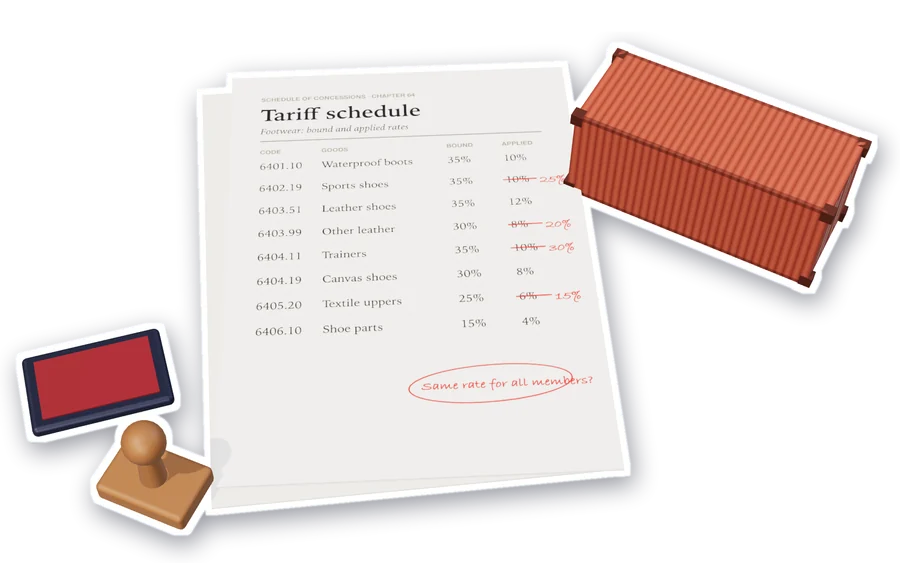
The WTO says MFN has made bargaining manageable14. Without it, each tariff change could affect each partner differently, and the number of deals needed would multiply by the number of products and partners14. The WTO says MFN also limits the ability of the largest economies to win disproportionate advantages through bargaining power alone, and gives smaller economies stronger reasons to take part14. India’s commerce minister calls MFN “a key guarantee” that the same terms apply to the smallest trader and the largest15. Since 1947, average industrial tariffs have fallen from around 22% among four major economies to low single digits in many economies14. Figure 1 shows how the rule works.
Figure 1Section 3
How the most favoured nation rule works, its two main exceptions, and the reform ideas raised in 2026.
The exceptions
The rule has exceptions, allowed only under strict conditions. Members of a free trade agreement may give each other lower tariffs, and developing countries may receive special access to markets3. A free trade area must remove duties on “substantially all the trade” between its members16, and its duties on outsiders may not rise16. The 1979 Enabling Clause lets members give developing countries better treatment without giving it to everyone else17. By 1 October 2026, 388 regional trade agreements were in force, and the WTO had identified at least 84 more in force that had not been notified to it by October 202618.
Why some members want change
The WTO’s World Trade Report 2026 describes a potential problem with the rule: a “free-rider” incentive. A member might stay out of negotiations in the hope of enjoying the tariff cuts that others agree14. Members also promise maximum tariffs, called bound rates, that can sit far above the tariffs they actually charge. This gap averages 19.69 percentage points in high-income economies and 45.53 in low-income ones14.
The United States, as G20 president in 2026, framed the debate by saying MFN “has failed to promote reciprocity and balance in the trading system”7. Its April 2025 order argued that WTO members agreed to bind their tariffs on an MFN basis but did not agree to bind them at similarly low levels, nor to apply them on a reciprocal basis19. The Chair’s Statement, drafted by the United States after Milwaukee, says many members called MFN a cornerstone of the trading system, while an increasing number said they see merit in considering how it might be improved7.
What is happening to trade now
Tariff actions have cut the share of world goods trade on MFN terms from 80% at the start of 2025 to 72% at the end of July 20261. In April 2025 the United States imposed an extra duty of at least 10% on imports from all its trading partners, with higher rates for many19. In February 2026 its Supreme Court held that the emergency law used for those tariffs does not authorise the President to impose them20, and a temporary surcharge of 10% followed under another law21. Yet world goods trade grew 4.6% in 202522, and in October 2026 the WTO raised its forecast for 2026 to 3.9%, from 1.9% in March2.
What has happened so far
- 1947The trading system begins as a tariff agreement among fewer than two dozen economies14
- 28 Nov 1979The GATT parties adopt the Enabling Clause, an exception for developing countries17
- 11 Dec 2019The WTO’s Appellate Body stops working after members cannot agree on new appointments23
- Nov 2024In Rio de Janeiro, G20 leaders call for a “non-discriminatory” trading system with the WTO at its core (paragraph 75)11
- 4 Feb 2025China asks the United States for WTO consultations over new US tariffs24
- 2 Apr 2025The United States imposes an extra duty on imports from all trading partners19
- 24 Jul 2025The United Kingdom and India sign a trade agreement25
- 10 Oct 2025G20 trade ministers in Gqeberha say “meaningful, necessary and comprehensive reform of the WTO is essential”10
- 20 Feb 2026The US Supreme Court rules on the emergency tariffs; a temporary 10% surcharge follows20,21
- 30 Mar 2026The WTO’s ministerial conference in Yaoundé ends, with work to continue in Geneva26
- 15 Jul 2026The UK and India trade agreement enters into force25
- 24 Jul 2026The temporary surcharge ends; US duties of 10% to 12.5% take effect after a US investigation into forced labour, according to the French Treasury27
- 30 Sep to 1 Oct 2026G20 trade ministers in Milwaukee discuss MFN reform; the Chair’s Statement, drafted by the United States, says the sessions marked “the beginning of a serious and necessary deliberation”7
- 17 Nov 2026The WTO reports that import restrictions introduced since 2009 and still in force covered 21.3% of world imports on 30 June 20262
What the G20 has already said
G20 leaders, Rio de Janeiro Leaders’ Declaration, November 2024, paragraph 75:
“we emphasize the need to ensure a rules-based, non-discriminatory, fair, open, inclusive, equitable, sustainable and transparent multilateral trading system, with the WTO at its core”11
The Chair’s Statement issued after the G20 trade ministers’ meeting in Milwaukee, October 2026, paragraph 15, drafted by the United States as president:
“Overall, the wide range of views expressed by G20 members underscored that these sessions marked the beginning of a serious and necessary deliberation about MFN reform.”7
Facts that matter
| Figure | Value | Year | Ref. |
|---|---|---|---|
| World goods trade on MFN terms | 72%, down from 80% | end-July 2026 | 1 |
| Trade covered by import restrictions introduced since 2009 and still in force | US$5.4 trillion, 21.3% of world imports | 30 June 2026 | 2 |
| New restrictive trade measures | 333 | first half of 2026 | 2 |
| Regional trade agreements in force | 388, and at least 84 more not notified by October 2026 | 1 October 2026 | 18 |
| Gap between bound and applied tariffs | 19.69 points (high-income), 45.53 (low-income) | 2026 report | 14 |
| Rise in tariffs | 10% developed, 16% developing, 18% least developed countries | 2025 | 28 |
| WTO forecast for world goods trade | up 3.9% | 2026 | 2 |
| Average industrial tariff | around 22% among four major economies (1947); low single digits in many (today) | 1947 to 2026 | 14 |
Core tensions
One rule for all, or give as much as you get
For one rule for all. India’s commerce minister says MFN ensures that the same terms apply to the smallest trader and the largest15. China’s mission to the WTO warned that weakening MFN “won’t level the playing field” and risks moving the system from rules-based to power-based29. Newsweek reported that Russia’s economy minister, in an article he shared with the magazine, called MFN an “anchor” for trade among WTO members and said removing it would be a mistake30.
For reciprocity. The United States says MFN in its current form “fails to promote reciprocity and balance within the system”31. Its April 2025 order argued that WTO members did not agree to bind their tariffs at similarly low levels19, and the WTO notes that the gap between bound and applied rates can allow members to raise tariffs within their bindings without breaching commitments14. The EU has also asked members to reflect on “the role of MFN and reciprocity”32.
All members together, or clubs of the willing
For clubs. The Chair’s Statement, drafted by the United States after Milwaukee, says some members suggested “closed” plurilateral agreements, in which only parties that take on strong commitments receive MFN treatment and benefits7. The EU wants plurilaterals that cannot be blocked by one member or a small group, in particular when they are MFN-based32, and says reform should also consider “club approaches among likeminded, where benefits are only available to participants, on a reciprocal basis”32. Clubs let the willing move faster.
For all together. The MFN rule binds all 166 WTO members, large and small1. A club whose benefits stay inside may leave out the members that most need access to markets. UNCTAD reports that tariffs rose more for the least developed countries (18%) than for developed ones (10%) in 202528.
Case studies
US tariffs, 2025 to 2026
On 2 April 2025 the United States imposed an extra duty on imports from all its trading partners, starting at 10%, with higher rates for many partners19. Its order declared a national emergency over the goods trade deficit and argued that WTO members had bound their tariffs on an MFN basis but not at similarly low levels19. Earlier, in February and March 2025, China and Canada had asked the United States for WTO consultations over other US duties on their goods, claiming that those duties appear inconsistent with the MFN article of the GATT, among others24,33. In China’s case, the United States accepted consultations but said the actions concern national security, which in its view is not open to WTO dispute settlement24.
On 20 February 2026 the US Supreme Court held that the emergency law does not authorise the President to impose tariffs20. A temporary surcharge of 10% took effect four days later under the Trade Act of 197421. Between the start of 2025 and the end of July 2026, the WTO estimates, the share of world goods trade on MFN terms fell from 80% to 72%, which it links to a significant increase in the use of tariff actions1.
What it shows. Tariff actions can change how much of world trade follows the rule1. Question for your group. Can a G20 text bring tariff actions like these back under shared rules, and what would make the United States accept it?
The appeal body that stopped
The WTO’s Appellate Body is a standing body of seven people that hears appeals against the rulings of dispute panels34. It has been unable to work since 11 December 2019, after members could not agree on new appointments because of objections from the United States23. Since then panel reports can be appealed “into the void”, which prevents their adoption14. In 2020 the EU, China and several other members set up a voluntary appeal arrangement of their own14. Members have also settled more disputes by agreement: almost three times as often as in the previous decade14.
What it shows. A rule is only as strong as the means of enforcing it. Question for your group. Should MFN reform wait until disputes can be settled again, or come first?
The UK and India trade agreement
The United Kingdom and India signed a trade agreement on 24 July 2025, and it entered into force on 15 July 202625. Under it, 99% of Indian goods entering the UK and 90% of UK goods entering India became duty free or got lower tariffs35. Such an agreement is an allowed exception to MFN, but only under strict conditions3. On 29 October 2026 the WTO’s committee on regional trade agreements took note of its notification36.
What it shows. Two large members can give each other better terms than they give everyone else35, and the WTO’s committee has taken note of the agreement36. Question for your group. Are agreements like this the way forward, or do they weaken the rule for everyone else?
Country positions
One row for each of the 21 members. “Stake” and “On the record” come from official sources, except where the row names a news report; each stake gives the member’s simple average MFN tariff in 2025 and its simple average bound rate, the average ceiling it has promised not to exceed on the tariff lines it has bound. “Our reading”, in italics, is what we think that record suggests: test it in your research. Where the record is silent, the row says so. The label under each name shows the member’s place in the MFN debate on the record: defends MFN, proposes reform, open to reform, or not clear. Bring this section to the summit and tick each row as members speak.
| Member | Stake | On the record | Our reading | Mark |
|---|---|---|---|---|
 Argentina | Its average MFN tariff in 2025 was 12.4%, against an average bound rate of 31.8%37. A November 2025 USTR fact sheet says that, under a framework agreed with Argentina, the United States will give MFN-tariff treatment to certain products38. | The Milwaukee Chair’s Statement, drafted by the United States, commends Argentina and Mexico for supporting a statement on forced labour in supply chains, on which consensus was not reached7. No public statement on MFN found. | Not clear from the record. Research it. | AllyOpp.Swing |
 Australia | Its average MFN tariff in 2025 was 2.1%, against an average bound rate of 9.4%39. | No public statement found. Research it. | Not clear from the record. Research it. | AllyOpp.Swing |
 Brazil | Its average MFN tariff in 2025 was 12.0%, against an average bound rate of 31.3%40. | In April 2026 President Lula said the paralysis of the WTO and the deadlock at its last conference show the need to rethink and reform the institution41. | Pushes for: Reform of the WTO as an institution. Not clear from the record: red line, allies. Research it. | AllyOpp.Swing |
 Canada | Its average MFN tariff in 2025 was 3.7%, against an average bound rate of 6.5%42. In March 2025 it asked the United States for WTO consultations over US duties, citing the MFN article of the GATT33. | In Milwaukee its minister stressed Canada’s commitment to open, predictable and rules-based trade, and ministers exchanged views on the MFN principle43. At the WTO’s ministerial conference in Cameroon in March 2026 he discussed “high ambition WTO reform” and advancing plurilateral agreements44. | Pushes for: Rules-based trade and plurilateral deals. Allies: The European Union. Not clear from the record: red line. Research it. | AllyOpp.Swing |
 China | Its average MFN tariff in 2025 was 7.5%, against an average bound rate of 10.0%45. In February 2025 it asked the United States for WTO consultations over US tariffs, citing the MFN article24. | Its WTO mission said in March 2026 that weakening the WTO and its core principles, such as most favoured nation treatment, “won't level the playing field”29. | Pushes for: Keeping MFN unconditional. Red line: MFN made conditional on reciprocity. Allies: India, Russia. | AllyOpp.Swing |
 France | The French Treasury says the US Supreme Court ruling cancelled, for the EU, the 15% rate charged under the emergency law on most EU exports to the United States, a rate that included the MFN duty27. | The French Treasury says the temporary 10% US surcharge of February to July 2026 came on top of the MFN duties already in force before January 202527. No public statement on MFN reform found. | Allies: The European Union. Not clear from the record: pushes for, red line. Research it. | AllyOpp.Swing |
 Germany | With Korea it supports the EU-Korea free trade agreement46. | In an October 2026 joint statement with Korea it said both sides will strive to cooperate in the WTO to “uphold, strengthen and reform” the trading order46, and in one with Japan it agreed to cooperate there to the same end47. | Pushes for: Reform that keeps the system’s rules. Allies: Japan, Korea, the European Union. Not clear from the record: red line. Research it. | AllyOpp.Swing |
INDIndia defends MFN | Its average MFN tariff in 2025 was 16.0%, against an average bound rate of 50.8%48. | All India Radio, the government broadcaster, reported that in Milwaukee the commerce minister said India’s trade with G20 members depends on a transparent, non-discriminatory, rules-based system15, and called MFN “a key guarantee” of that system15. | Pushes for: Keeping MFN as it is. Red line: MFN made conditional on reciprocity. Allies: China, Russia. | AllyOpp.Swing |
 Indonesia | Its average MFN tariff in 2025 was 8.0%, against an average bound rate of 37.1%49. Its February 2026 trade agreement with the United States refers to its MFN rates of April 202250. | No public statement found. Research it. | Not clear from the record. Research it. | AllyOpp.Swing |
 Italy | A G20 member4. | No public statement found. Research it. | Not clear from the record. Research it. | AllyOpp.Swing |
 Japan | Its average MFN tariff in 2025 was 3.7%, against an average bound rate of 4.0%51. | In October 2026, with Germany, it agreed to cooperate in the WTO to “uphold, strengthen and reform” the trading system47. A Japanese official is one of four facilitators of the WTO reform talks, for decision-making issues52. | Pushes for: Reform that keeps the system’s rules. Allies: Germany, Korea. Not clear from the record: red line. Research it. | AllyOpp.Swing |
 Republic of Korea | Its average MFN tariff in 2025 was 13.5%, against an average bound rate of 18.2%53. | In October 2026, with Germany, it said both sides will strive to cooperate in the WTO to “uphold, strengthen and reform” the trading order46. | Allies: Germany, Japan. Not clear from the record: pushes for, red line. Research it. | AllyOpp.Swing |
 Mexico | Its average MFN tariff in 2025 was 8.5%, against an average bound rate of 36.2%54. | The Milwaukee Chair’s Statement, drafted by the United States, commends Mexico and Argentina for supporting a statement on forced labour in supply chains, on which consensus was not reached7. No public statement on MFN found. | Not clear from the record. Research it. | AllyOpp.Swing |
RUSRussia defends MFN | Its average MFN tariff in 2025 was 6.6%, against an average bound rate of 7.6%55. | Newsweek reported on 30 September 2026 that Russia’s economy minister, in an article shared with the magazine, called MFN an “anchor” for trade relations among WTO members and wrote that “removing this backbone of the system would, in our view, be a mistake”30. | Pushes for: Keeping MFN. Allies: China, India. Not clear from the record: red line. Research it. | AllyOpp.Swing |
KSASaudi Arabia not clear | Its average MFN tariff in 2025 was 5.9%, against an average bound rate of 11.0%56. | Its trade authority said that at the WTO in March 2026 the Kingdom “reaffirmed its full support for WTO reform efforts, including dispute settlement”57. | Pushes for: Reform of dispute settlement. Not clear from the record: red line, allies. Research it. | AllyOpp.Swing |
 South Africa | Its average MFN tariff in 2025 was 7.6%, against an average bound rate of 19.0%58. | Under its 2025 presidency, G20 trade ministers said “meaningful, necessary and comprehensive reform of the WTO is essential”10. | Pushes for: Reform of the WTO. Allies: The African Union. Not clear from the record: red line. Research it. | AllyOpp.Swing |
 Türkiye | Its average MFN tariff in 2025 was 17.3%, against an average bound rate of 28.9%59. | No public statement found. Research it. | Not clear from the record. Research it. | AllyOpp.Swing |
 United Kingdom | It holds the G20 presidency in 20275. Its average MFN tariff in 2025 was 3.7%, against an average bound rate of 5.0%60. In March 2026 it said it would raise its maximum MFN steel tariffs at the WTO to 50%61. | In Geneva in October 2026 it said it “continues to want an inclusive process” on WTO reform and that “inaction has a cost”62. | Pushes for: An inclusive WTO reform process. Allies: Japan. Not clear from the record: red line. Research it. | AllyOpp.Swing |
 United States | Its average MFN tariff in 2025 was 3.3%, against an average bound rate of 3.4%63. | As G20 president it said MFN “has failed to promote reciprocity and balance in the trading system”7, and told the WTO that members need to discuss “the link between MFN and reciprocity” and consider how MFN status “may be adjusted or made conditional”64. | Pushes for: MFN linked to reciprocity. Not clear from the record: red line, allies. Research it. | AllyOpp.Swing |
 European Union | Its average MFN tariff in 2025 was 4.9%, against an average bound rate of 4.9%65. According to the French Treasury, under its 2025 framework with the United States, most European goods faced a US floor duty of 15% that included the MFN rate27. | Its January 2026 WTO submission asks members to reflect on “the role of MFN and reciprocity”32, wants plurilateral cooperation that a small group of members cannot block, in particular when it is MFN-based32, and says reform should also consider club approaches whose benefits are only available to participants32. | Pushes for: Plurilateral deals inside WTO rules. Allies: Canada. Not clear from the record: red line. Research it. | AllyOpp.Swing |
AUAfrican Union not clear | The African Continental Free Trade Area entered into force on 30 May 2019, and trading under it began on 1 January 202166. | The Johannesburg declaration, a G20 text agreed under South Africa’s presidency with the African Union as a member, called regional integration, including the African Continental Free Trade Area, a key enabler of growth12. | Pushes for: Room for regional integration in Africa. Allies: South Africa. Not clear from the record: red line. Research it. | AllyOpp.Swing |
Invited seats (not members)
- WTO. Its Director-General said in November 2026 that “restraint in the use of new trade restrictions and a continued commitment to open, predictable and transparent trade will be essential”2.
- UNCTAD. Reports that tariffs rose in 2025 by 10% for developed, 16% for developing and 18% for least developed countries28.
- OECD. G20 trade ministers in 2025 noted a toolbox on investment policies developed with UNCTAD10; the Milwaukee Chair’s Statement, drafted by the United States, recalls that in 2016 they decided by consensus to take part in an OECD Steel Committee meeting that led to the Global Forum on Steel Excess Capacity7.
- Singapore (guest country). A WTO staff blog of January 2025, using 2022 data, found that almost all of Singapore’s imports came in on MFN duty-free terms67.
The camps
Options on the table
Each option is something the G20 can actually do: commit its own members, call on others, or ask international bodies to act and report. Who may back or resist each option is our reading of the record in Section 8, for you to test in your research.
A. Keep MFN, but check free trade agreements more strictly
What it is. WTO members review each free trade agreement against the GATT conditions, and notify every agreement they have signed. Who runs it. The WTO’s committee on regional trade agreements. Precedent. The WTO already reviews notified agreements, but at least 84 agreements in force had not been notified by October 202618. The Chair’s Statement, drafted by the United States after Milwaukee, lists reviewing GATT Article XXIV among changes various members identified in 2026; it does not say whether the review would tighten or loosen it7. For. It keeps the rule and closes a gap. Against. Members with many agreements may not want them examined. May back it. Not clear from the record.
B. Widen the exceptions to MFN
What it is. New, agreed exceptions, for example for economic security, written into WTO rules7. Who runs it. WTO members, by agreement. Precedent. The 1979 Enabling Clause lets members treat developing countries better without giving the same to all17. For. It meets the concerns of members that want to treat partners differently, inside the rules7. Against. Each new exception makes the rule weaker for everyone. May back it. The United States, which wants members to consider how MFN status may be adjusted or made conditional64.
C. Clubs whose benefits stay with their members
What it is. Groups of members make “closed” agreements whose benefits go only to the parties7. Who runs it. The members of each club. Precedent. Several Tokyo Round codes were agreements that applied only to the GATT members that signed them, according to a 2026 US submission to the WTO64. For. The willing can move ahead without waiting for all 166 members1. Against. Members left outside lose the access the rule now guarantees them. May back it. The European Union, which says reform should consider club approaches whose benefits are only available to participants32, and Canada, which backs plurilateral agreements in general44. May resist it. India and China.
D. MFN only for members that give as much in return
What it is. A member receives MFN treatment only if it offers comparable openness. Who runs it. Each member, under new WTO rules. Precedent. According to a 2026 US submission to the WTO, the 1778 treaty between the United States and France contained the first US conditional MFN clause64. For. It answers the “free-rider” problem14. Against. It replaces one rule for all with many separate bargains, the problem MFN was meant to solve14. May back it. The United States64. May resist it. India, China and Russia.
E. Keep MFN and fix the tools around it
What it is. Leave the rule as it is, and repair dispute settlement and trade remedies so that members trust it again. Who runs it. WTO members, through the dispute settlement reform talks. Precedent. The voluntary appeal arrangement used while the Appellate Body cannot work68. The Chair’s Statement, drafted by the United States after Milwaukee, says several members suggested making trade remedies faster, more automatic and more targeted7. For. It keeps the rule that most trade still follows1. Against. It does not answer the United States, which says MFN has failed to promote reciprocity and balance, undermining fairness7. May back it. Saudi Arabia, which supports WTO reform including dispute settlement57.
What the communiqué must answer
- Does MFN stay as it is, change, or gain new exceptions?
- Must a member give as much as it gets before it receives MFN treatment?
- May groups of members make deals whose benefits go only to them, and on what conditions?
- How should free trade agreements be checked?
- How are disputes settled while the Appellate Body cannot work?
- Who reports progress, to whom, and by when?
Draft paragraph, as amendedWeak, then strong
We support the necessary reform of the WTO and will continue discussions on its core principles. We commit to keep most favoured nation treatment as the basis of our trade with one another, and to notify all our free trade agreements to the WTO by the end of 2028. We call on WTO members to agree, by the next Ministerial Conference, the conditions under which groups of members may conclude agreements whose benefits apply only to their parties, and ask the WTO Director-General to report progress to our Trade Ministers by October 2028.
The weak paragraph names no one and promises nothing. The strong one commits only G20 members and calls on everyone else. It is an example, not the answer: your group may decide on a different course, or on none.
Preparation
Your white paper
Write at most 1,000 words, with numbered sources, and send it to your chairs by Monday 31 May 2027 (Rules of Procedure 9.2). Use five parts:
- Your member’s stake, in three numbers with sources.
- Its position on each question in Section 10.
- Its red lines: what it will not accept.
- One draft paragraph in the style of a communiqué, beginning “We commit” or “We call on”.
- Your sources, numbered, official ones first.
Five questions to research for your member
- What is your member’s average MFN tariff, and how far is it below its bound rate?
- Which free trade agreements has it signed, and with whom?
- Has it brought or faced a WTO dispute over tariffs since 2025?
- What did its trade minister say about MFN in Milwaukee or at the WTO in 2026?
- Which members are most likely to agree with it, and which one in the other camp could it win over?
Starter sources
- How much trade is on MFN terms, reference 1
- The WTO’s own explanation of MFN, reference 3
- The World Trade Report 2026, reference 14
- What G20 trade ministers said in Milwaukee, reference 7
- The WTO’s November 2026 report on trade restrictions, reference 2
- Regional trade agreements, reference 18
- The Appellate Body, reference 34
- The EU’s ideas for WTO reform, reference 32
 Pocket card
Your first hour as a delegate
- Roll call. Hold up your placard and answer “present” when your member is called.
- Opening speech. Give your member’s stake in one number, its position, and one thing it wants in the text.
- Listen. As members speak, mark their rows in Section 8: ally, opponent or swing.
- First caucus. Find two allies, one in your camp and one in the other.
- By the break. Bring one clause that names who acts, what they do, and by when.
Glossary
- Appellate Body
- The WTO’s standing body of seven people that hears appeals in trade disputes34.
- Bound rate
- The highest tariff a WTO member has promised not to exceed.
- Enabling Clause
- The 1979 decision that lets members treat developing countries better without giving the same to all17.
- Free trade agreement
- A deal in which members remove tariffs on substantially all the trade between them.
- GATT
- The General Agreement on Tariffs and Trade, the WTO’s basic rulebook for trade in goods.
- Most favoured nation (MFN)
- The rule that a member must normally treat all its trading partners equally3.
- Reciprocity
- Giving the same in return: lowering your barriers when the other side lowers its own.
- Tariff
- A tax on imported goods.
- WTO
- The World Trade Organization, which sets and enforces the rules of trade between its 166 members1.
References
All sources accessed 20 and 21 November 2026. Numbers in the text refer to this list.
- WTO. “Share of world merchandise trade on MFN tariff terms” (figures as of end-July 2026). https://www.wto.org/english/res_e/reser_e/world_merchandise_trade_on_mfn_tariff_e.htm
- WTO. “New trade-restrictive measures surge but WTO members step up trade facilitation efforts”, news item on the Director-General’s annual overview of trade monitoring, 17 November 2026. https://www.wto.org/english/news_e/news26_e/tmwto_17nov26_552_e.htm
- WTO. “Understanding the WTO: Basics, Principles of the trading system”. https://www.wto.org/english/thewto_e/whatis_e/tif_e/fact2_e.htm
- Ministry of External Affairs, India. “Group of Twenty - G20” (brief), July 2026. https://www.mea.gov.in/Portal/ForeignRelation/G20_2026.pdf
- Prime Minister’s Office, GOV.UK. “Growth and opportunity set to be at the heart of UK-hosted G20”, 22 November 2025. https://www.gov.uk/government/news/growth-and-opportunity-set-to-be-at-the-heart-of-uk-hosted-g20
- Cabinet Office, GOV.UK. “Manchester to host world leaders at the 2027 G20 Summit”, 23 September 2026. https://www.gov.uk/government/news/manchester-to-host-world-leaders-at-the-2027-g20-summit
- G20 Trade Ministerial. “G20 Chair’s Statement”, Milwaukee, Wisconsin, 30 September to 1 October 2026 (drafted and circulated by the United States as 2026 G20 presidency), PDF published by the Office of the US Trade Representative (USTR). https://ustr.gov/sites/default/files/files/Press/Releases/G20%20Chair's%20Statement.pdf
- USTR. “Chair’s Statement of the G20 Trade Ministerial”, press release, 2 October 2026. https://ustr.gov/about/policy-offices/press-office/press-releases/2026/october/chairs-statement-g20-trade-ministerial
- G20 South Africa Presidency. “Concept Note and Calendar” (2025 presidency), copy published by the South African Institute of International Affairs. https://saiia.org.za/wp-content/uploads/2025/02/G20-CONCEPT-NOTE-SOUTH-AFRICA.pdf
- G20. “G20 Trade and Investment Ministerial Statement”, Gqeberha, South Africa, 10 October 2025 (South African presidency), copy hosted by the G20 Research Group, University of Toronto. https://g20.utoronto.ca/2025/251010-trade-statement.html
- G20. “G20 Rio de Janeiro Leaders’ Declaration”, 18-19 November 2024 (Brazilian presidency), PDF hosted by the Global Development Policy Center, Boston University. https://www.bu.edu/gdp/files/2024/12/g20-rio-de-janeiro-leaders-declaration-final.pdf
- G20. “G20 South Africa Summit: Leaders’ Declaration”, Johannesburg, 22-23 November 2025 (South African presidency), PDF published by the Government of the Netherlands (Officiele Bekendmakingen). https://zoek.officielebekendmakingen.nl/dossier/blg-1234461.pdf
- WTO. “The General Agreement on Tariffs and Trade (GATT 1947), Articles I to XVII”, legal text (Article I, General Most-Favoured-Nation Treatment). https://www.wto.org/english/docs_e/legal_e/gatt47_01_e.htm
- WTO. “World Trade Report 2026: A critical juncture for the world trading system” (WTO Secretariat publication). https://www.wto.org/english/res_e/booksp_e/wtr26_e.pdf
- Government of India broadcaster (All India Radio, News on AIR). “Commerce Minister Piyush Goyal calls for WTO-compliant approach to correct global trade distortions”, 2 October 2026 (report of the minister’s remarks at the G20 trade ministers’ meeting; not a ministry text). https://newsonair.gov.in/commerce-minister-piyush-goyal-calls-for-wto-compliant-approach-to-correct-global-trade-distortions/
- WTO. “The General Agreement on Tariffs and Trade (GATT 1947), Articles XVIII to XXXVIII”, legal text (Article XXIV, customs unions and free-trade areas). https://www.wto.org/english/docs_e/legal_e/gatt47_02_e.htm
- WTO. “Differential and More Favourable Treatment, Reciprocity and Fuller Participation of Developing Countries” (the “Enabling Clause”), GATT decision of 28 November 1979, legal text. https://www.wto.org/english/docs_e/legal_e/enabling1979_e.htm
- WTO. “Regional trade agreements”, facts and figures page (as of 1 October 2026). https://www.wto.org/english/tratop_e/region_e/region_e.htm
- The President of the United States. Executive Order 14257 of 2 April 2025, “Regulating Imports With a Reciprocal Tariff To Rectify Trade Practices That Contribute to Large and Persistent Annual United States Goods Trade Deficits”, Federal Register, vol. 90, no. 65, 7 April 2025, copy on govinfo.gov. https://www.govinfo.gov/content/pkg/FR-2025-04-07/html/2025-06063.htm
- Supreme Court of the United States. Learning Resources, Inc. v. Trump (No. 24-1287) and Trump v. V.O.S. Selections, Inc. (No. 25-250), slip opinion with syllabus, decided 20 February 2026. https://www.supremecourt.gov/opinions/25pdf/24-1287_4gcj.pdf
- The President of the United States. Proclamation 11012 of 20 February 2026, “Imposing a Temporary Import Surcharge To Address Fundamental International Payments Problems”, Daily Compilation of Presidential Documents, copy on govinfo.gov. https://www.govinfo.gov/content/pkg/DCPD-202600129/html/DCPD-202600129.htm
- WTO. “Global Trade Outlook and Statistics, March 2026”. https://www.wto.org/english/res_e/booksp_e/gtos0326_e.pdf
- WTO. 14th Ministerial Conference, post-MC14 briefing note, “WTO reform/dispute settlement reform”. https://www.wto.org/english/thewto_e/minist_e/mc14_e/briefing_notes_e/wtoreform_e.htm
- WTO. Dispute settlement, “DS633: United States - Additional Tariff Measures on Goods from China”, Secretariat summary. https://www.wto.org/english/tratop_e/dispu_e/cases_e/ds633_e.htm
- Department for Business and Trade, GOV.UK. “UK-India Trade Deal”, collection (last updated 15 July 2026). https://www.gov.uk/government/collections/uk-india-trade-deal
- WTO. “MC14 concludes with adopted decisions, progress on key outstanding issues”, news item, 30 March 2026. https://www.wto.org/english/news_e/news26_e/mc14_30mar26_354_e.htm
- Direction generale du Tresor, French Ministry of the Economy. “Droits de douane americains et position europeenne : informations pour les entreprises” (page in French; Treasury summary of US tariff measures and the EU-US framework). https://www.tresor.economie.gouv.fr/services-aux-entreprises/droits-de-douane-americains-et-reponse-europeenne-informations-pour-les-entreprises
- UNCTAD. “Global Trade Update (May 2026): Invisible barriers - the costs of non-tariff measures”. https://unctad.org/publication/global-trade-update-may-2026-invisible-barriers-costs-non-tariff-measures
- China, Permanent Mission to the WTO (MOFCOM site). “China’s Intervention on WTO Reform Breakout Session at MC14 - Level Playing Field Issues”, 27 March 2026. https://wto.mofcom.gov.cn/meetingsandstatements/art/2026/art_6cee90e894954e38b40e67163e8cf8e5.html
- Newsweek (news report, 30 September 2026), quoting an article by Russian Minister for Economic Development Maxim Reshetnikov shared with Newsweek. https://www.newsweek.com/putin-economy-chief-warns-of-disintegration-of-world-trade-12499288
- USTR. “MC14 Message by United States Trade Representative Jamieson Greer”, March 2026. https://ustr.gov/sites/default/files/files/Issue_Areas/Trade%20Organizations/MC14%20Message%20by%20USTR%20Greer.pdf
- European Union. “EU submission on WTO reform” (dated 22 January 2026 on the page), Permanent Mission of the EU to the WTO, European External Action Service. https://www.eeas.europa.eu/delegations/world-trade-organization-wto/eu-submission-wto-reform_en
- WTO. Dispute settlement, “DS634: United States - Additional Import Duties on Goods from Canada”, Secretariat summary. https://www.wto.org/english/tratop_e/dispu_e/cases_e/ds634_e.htm
- WTO. Dispute settlement, “Appellate Body”. https://www.wto.org/english/tratop_e/dispu_e/appellate_body_e.htm
- British Deputy High Commission Mumbai and British High Commission New Delhi, GOV.UK. “Historic UK-India Free Trade Agreement is now in effect”, 17 July 2026. https://www.gov.uk/government/news/historic-uk-india-free-trade-agreement-is-now-in-effect
- WTO. “Members review regional trade agreements, confirm meeting frequency, adopt annual report”, news item on the Committee on Regional Trade Agreements meeting of 29 October 2026. https://www.wto.org/english/news_e/news26_e/rta_29oct26_532_e.htm
- WTO, ITC and UNCTAD. “World Tariff Profiles 2026”, country profile, Argentina, Part A.1 (Tariffs and imports: summary and duty ranges; MFN applied tariff data for 2025, import data for 2024). https://www.wto.org/english/res_e/statis_e/daily_update_e/tariff_profiles/AR_e.pdf
- USTR. “Fact Sheet: The United States and Argentina Agree to a Framework for an Agreement on Reciprocal Trade and Investment”, November 2025 (US description of the framework). https://ustr.gov/about/policy-offices/press-office/fact-sheets/2025/november/fact-sheet-united-states-and-argentina-agree-framework-agreement-reciprocal-trade-and-investment
- WTO, ITC and UNCTAD. “World Tariff Profiles 2026”, country profile, Australia, Part A.1 (Tariffs and imports: summary and duty ranges; MFN applied tariff data for 2025, import data for 2024). https://www.wto.org/english/res_e/statis_e/daily_update_e/tariff_profiles/AU_e.pdf
- WTO, ITC and UNCTAD. “World Tariff Profiles 2026”, country profile, Brazil, Part A.1 (Tariffs and imports: summary and duty ranges; MFN applied tariff data for 2025, import data for 2024). https://www.wto.org/english/res_e/statis_e/daily_update_e/tariff_profiles/BR_e.pdf
- Presidency of Brazil (Planalto). “Statement by President Lula at the opening of Hannover Messe 2026”, 19 April 2026. https://www.gov.br/planalto/en/follow-the-government/speeches-statements/2026/statement-by-president-lula-at-the-opening-of-hannover-messe-2026
- WTO, ITC and UNCTAD. “World Tariff Profiles 2026”, country profile, Canada, Part A.1 (Tariffs and imports: summary and duty ranges; MFN applied tariff data for 2025, import data for 2024). https://www.wto.org/english/res_e/statis_e/daily_update_e/tariff_profiles/CA_e.pdf
- Global Affairs Canada. “Minister Sidhu strengthens partnerships and advances Canada’s trade priorities at G20 Trade Ministers’ Meeting”, news release, 2 October 2026. https://www.canada.ca/en/global-affairs/news/2026/10/minister-sidhu-strengthens-partnerships-and-advances-canadas-trade-priorities-at-g20-trade-ministers-meeting.html
- Global Affairs Canada. “Minister Sidhu advances Canada’s trade priorities at the 14th WTO Ministerial Conference in Cameroon”, news release, 30 March 2026. https://www.canada.ca/en/global-affairs/news/2026/03/minister-sidhu-advances-canadas-trade-priorities-at-the-14th-wto-ministerial-conference-in-cameroon.html
- WTO, ITC and UNCTAD. “World Tariff Profiles 2026”, country profile, China, Part A.1 (Tariffs and imports: summary and duty ranges; MFN applied tariff data for 2025, import data for 2024). https://www.wto.org/english/res_e/statis_e/daily_update_e/tariff_profiles/CN_e.pdf
- Federal Government of Germany and Republic of Korea. “Joint Statement between the Republic of Korea and the Federal Republic of Germany”, 29 October 2026, PDF on bundesregierung.de. https://www.bundesregierung.de/resource/blob/992814/2458968/04d45fc00585b1901c2089563e2c29f6/2026-10-29-joint-statement-between-the-republic-of-korea-and-the-federal-republic-of-germany-data.pdf?download=1
- Federal Government of Germany and Japan. “Japan-Germany Joint Leaders’ Statement”, 28 October 2026, PDF on bundesregierung.de. https://www.bundesregierung.de/resource/blob/975228/2458850/f8df7cd25c44e51829148867a181326b/2026-10-28-japan-germany-joint-leaders-statement-data.pdf?download=1
- WTO, ITC and UNCTAD. “World Tariff Profiles 2026”, country profile, India, Part A.1 (Tariffs and imports: summary and duty ranges; MFN applied tariff data for 2025, import data for 2024). https://www.wto.org/english/res_e/statis_e/daily_update_e/tariff_profiles/in_e.pdf
- WTO, ITC and UNCTAD. “World Tariff Profiles 2026”, country profile, Indonesia, Part A.1 (Tariffs and imports: summary and duty ranges; MFN applied tariff data for 2025, import data for 2024). https://www.wto.org/english/res_e/statis_e/daily_update_e/tariff_profiles/ID_e.pdf
- United States and Indonesia. “Agreement between the United States of America and the Republic of Indonesia on Reciprocal Trade”, signed 19 February 2026, text published by USTR (pending entry into force when published). https://ustr.gov/sites/default/files/files/Press/Releases/2026/02.19.26%20US-IDN%20ART%20Full%20Agreement%20-%20US%20Final%20for%20Website%20sanitized.pdf
- WTO, ITC and UNCTAD. “World Tariff Profiles 2026”, country profile, Japan, Part A.1 (Tariffs and imports: summary and duty ranges; MFN applied tariff data for 2025, import data for 2024). https://www.wto.org/english/res_e/statis_e/daily_update_e/tariff_profiles/JP_e.pdf
- WTO. “Members take stock of latest discussions on WTO reform”, news item on the transparency session of 30 September 2026. https://www.wto.org/english/news_e/news26_e/refrm_30sep26_503_e.htm
- WTO, ITC and UNCTAD. “World Tariff Profiles 2026”, country profile, Korea, Republic of, Part A.1 (Tariffs and imports: summary and duty ranges; MFN applied tariff data for 2025, import data for 2024). https://www.wto.org/english/res_e/statis_e/daily_update_e/tariff_profiles/KR_e.pdf
- WTO, ITC and UNCTAD. “World Tariff Profiles 2026”, country profile, Mexico, Part A.1 (Tariffs and imports: summary and duty ranges; MFN applied tariff data for 2025, import data for 2024). https://www.wto.org/english/res_e/statis_e/daily_update_e/tariff_profiles/MX_e.pdf
- WTO, ITC and UNCTAD. “World Tariff Profiles 2026”, country profile, Russian Federation, Part A.1 (Tariffs and imports: summary and duty ranges; MFN applied tariff data for 2025, import data for 2024). https://www.wto.org/english/res_e/statis_e/daily_update_e/tariff_profiles/RU_e.pdf
- WTO, ITC and UNCTAD. “World Tariff Profiles 2026”, country profile, Saudi Arabia, Kingdom of, Part A.1 (Tariffs and imports: summary and duty ranges; MFN applied tariff data for 2025, import data for 2024). https://www.wto.org/english/res_e/statis_e/daily_update_e/tariff_profiles/SA_e.pdf
- General Authority for Foreign Trade (GAFT), Kingdom of Saudi Arabia. “Saudi Arabia concludes participation in the Fourteenth WTO Ministerial Conference, emphasizing the importance of reform”, 30 March 2026. https://gaft.gov.sa/en/lists/news/saudi-arabia-concludes-participation-in-the-fourteenth-wto-ministerial-conference-emphasizing-the-importance-of-reform
- WTO, ITC and UNCTAD. “World Tariff Profiles 2026”, country profile, South Africa, Part A.1 (Tariffs and imports: summary and duty ranges; MFN applied tariff data for 2025, import data for 2024). https://www.wto.org/english/res_e/statis_e/daily_update_e/tariff_profiles/ZA_e.pdf
- WTO, ITC and UNCTAD. “World Tariff Profiles 2026”, country profile, Türkiye, Part A.1 (Tariffs and imports: summary and duty ranges; MFN applied tariff data for 2025, import data for 2024). https://www.wto.org/english/res_e/statis_e/daily_update_e/tariff_profiles/TR_e.pdf
- WTO, ITC and UNCTAD. “World Tariff Profiles 2026”, country profile, United Kingdom, Part A.1 (Tariffs and imports: summary and duty ranges; MFN applied tariff data for 2025, import data for 2024). https://www.wto.org/english/res_e/statis_e/daily_update_e/tariff_profiles/GB_e.pdf
- Department for Business and Trade, GOV.UK. “Welsh steel industry backed with new trade measure and strategy”, 23 March 2026. https://www.gov.uk/government/news/welsh-steel-industry-backed-with-new-trade-measure-and-strategy
- Foreign, Commonwealth & Development Office, GOV.UK. “WTO Reform - Statement by the Chairperson” (UK statement delivered in Geneva on 5 October 2026 by Kumar Iyer; published 8 October 2026). https://www.gov.uk/government/speeches/wto-reform-statement-by-the-chairperson
- WTO, ITC and UNCTAD. “World Tariff Profiles 2026”, country profile, United States of America, Part A.1 (Tariffs and imports: summary and duty ranges; MFN applied tariff data for 2025, import data for 2024). https://www.wto.org/english/res_e/statis_e/daily_update_e/tariff_profiles/US_e.pdf
- United States. Communication to the WTO General Council, “US Further Perspectives on WTO Reform”, document WT/GC/W/998, March 2026, PDF published by USTR. https://ustr.gov/sites/default/files/files/Issue_Areas/Trade%20Organizations/US%20Further%20Perspectives%20on%20WTO%20Reform%20-%20March%202026.pdf
- WTO, ITC and UNCTAD. “World Tariff Profiles 2026”, country profile, European Union, Part A.1 (Tariffs and imports: summary and duty ranges; MFN applied tariff data for 2025, import data for 2024). https://www.wto.org/english/res_e/statis_e/daily_update_e/tariff_profiles/CE_E.pdf
- African Union. “The African Continental Free Trade Area” (AfCFTA overview page). https://au.int/en/african-continental-free-trade-area
- WTO. “Over 80 per cent of global merchandise trade is on most-favoured-nation basis”, WTO Data Blog by Tomasz Gonciarz and Thomas Verbeet (the blog states the views of WTO staff), January 2025. https://www.wto.org/english/blogs_e/data_blog_e/blog_dta_21jan25_e.htm
- WTO. “Alternative Dispute Resolution Procedures” (including the Multi-Party Interim Appeal Arbitration Arrangement, MPIA). https://www.wto.org/english/tratop_e/dispu_e/mpia_e.htm