
Alcohols, Phenols and Ethers | CBSE Class 12 Chemistry Notes
On this page
Watch & explore
Start with a few high-quality watches, then dive into the notes below.
Alcohols, phenols and ethers: classification, nomenclature, functional-group structures, hydrogen bonding, preparation methods, acidity, substitution, dehydration, oxidation, important named reactions, commercial alcohols and solved reaction problems.
How are alcohols, phenols and ethers classified?
An alcohol has a hydroxyl group attached to an aliphatic carbon, whereas a phenol has a hydroxyl group directly attached to an aromatic ring. An ether has oxygen joining two alkyl or aryl groups. The position of the oxygen-containing group determines the class.
Definition: Monohydric, dihydric, trihydric and polyhydric compounds contain one, two, three and many hydroxyl groups respectively. This classification counts hydroxyl groups; primary, secondary and tertiary describe the carbon carrying a hydroxyl group.
In general formulae, , and represent alkyl groups, and represents an aryl group. The symbol represents a halogen atom. In reaction schemes, an arrow indicates conversion and labels over it give reagents or conditions.
Which carbon carries the hydroxyl group?
| Class | Structural feature | Representative structure |
|---|---|---|
| Primary alcohol | The hydroxyl-bearing carbon is primary | |
| Secondary alcohol | The hydroxyl-bearing carbon is secondary | |
| Tertiary alcohol | The hydroxyl-bearing carbon is tertiary | |
| Allylic alcohol | The hydroxyl-bearing saturated carbon is next to a carbon-carbon double bond | |
| Benzylic alcohol | The hydroxyl-bearing saturated carbon is next to an aromatic ring | |
| Vinylic alcohol | The hydroxyl group is attached directly to a double-bonded carbon |
Allylic and benzylic alcohols may themselves be primary, secondary or tertiary. Their hydroxyl-bearing carbon is -hybridised, meaning that its bonding uses hybrid orbitals formed from one s and three p orbitals. Vinylic and phenolic hydroxyl-bearing carbons are -hybridised.
Symmetrical ethers have identical groups on oxygen, as in diethyl ether. Unsymmetrical ethers have different groups, as in ethyl methyl ether and ethyl phenyl ether. A benzene ring somewhere in a molecule does not by itself make the compound a phenol.
How are these compounds named?
How does alcohol nomenclature work?
The common name combines the alkyl-group name with “alcohol”. In IUPAC nomenclature, replace the final e of the parent alkane by ol. Choose the longest parent chain containing the hydroxyl group and number from the end nearer that group.
For polyhydric alcohols, retain the e and use diol or triol with the appropriate locants. Ethylene glycol is ethane-1,2-diol; glycerol is propane-1,2,3-triol. In cyclic alcohols, the hydroxyl-bearing ring carbon is assigned position one.
| Common name | IUPAC name | Condensed structure |
|---|---|---|
| Methyl alcohol | Methanol | |
| Isopropyl alcohol | Propan-2-ol | |
| Isobutyl alcohol | 2-Methylpropan-1-ol | |
| tert-Butyl alcohol | 2-Methylpropan-2-ol | |
| Dimethyl ether | Methoxymethane | |
| Anisole | Methoxybenzene |
How are phenols and ethers named?
Phenol is both a common and an accepted IUPAC name. Ortho, meta and para denote the 1,2-, 1,3- and 1,4-arrangements of two substituents. The corresponding cresols are 2-, 3- and 4-methylphenol.
Catechol, resorcinol and hydroquinone are benzene-1,2-diol, benzene-1,3-diol and benzene-1,4-diol. For ether common names, write the two group names alphabetically and add ether. For IUPAC names, treat the smaller group with oxygen as an alkoxy substituent on the larger parent hydrocarbon.
Worked example 7.1. Give IUPAC names of: (i) ; (ii) ; (iii) phenol with methyl groups at both ortho positions; (iv) cyclohexane with adjacent ethoxy and nitro groups.
Answer: (i) 4-Chloro-2,3-dimethylpentan-1-ol; (ii) 2-Ethoxypropane; (iii) 2,6-Dimethylphenol; (iv) 1-Ethoxy-2-nitrocyclohexane.
How do structure and hydrogen bonding affect physical properties?
What is the geometry around oxygen?
In alcohols, a sigma bond joins carbon and oxygen through overlap of their hybrid orbitals. Repulsion involving oxygen’s unshared electron pairs makes the carbon-oxygen-hydrogen angle slightly smaller than the tetrahedral angle. In ethers, repulsion between bulky alkyl groups makes the carbon-oxygen-carbon angle slightly larger.
What the figure shows
Structures of methanol, phenol and methoxymethane
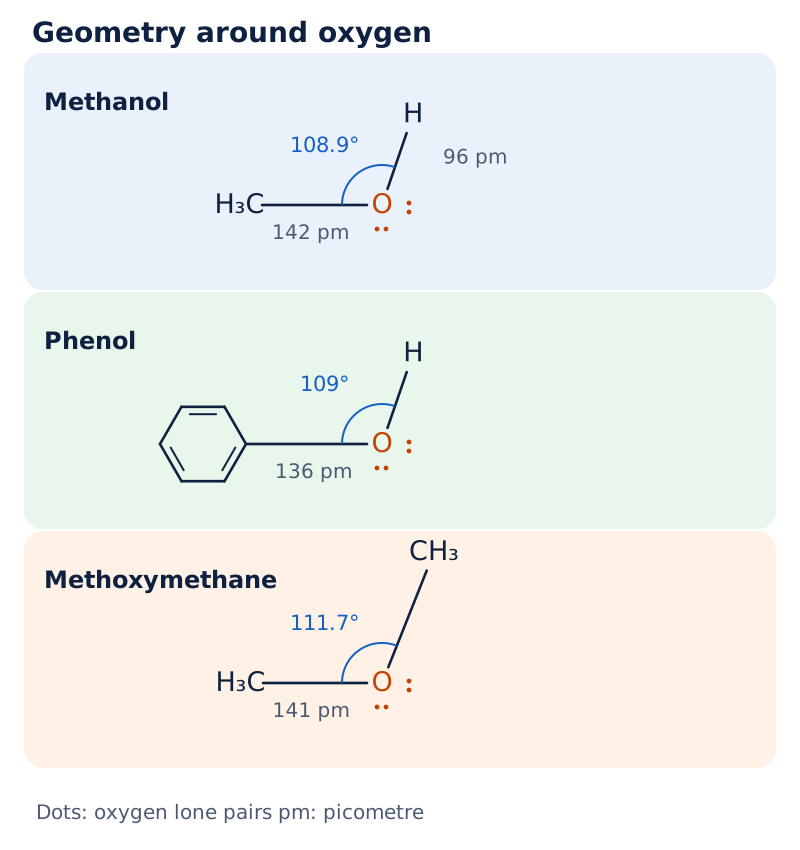
The three drawings show oxygen lone pairs and bond angles. Methanol has carbon-oxygen and oxygen-hydrogen distances of and , and angle . Phenol shows and ; methoxymethane shows and . Here pm means picometre and the degree sign measures angle.
Drawn by One Young India. See Fig. 7.1 in your NCERT textbook
The shorter carbon-oxygen bond in phenol reflects partial double-bond character from conjugation of an oxygen lone pair with the ring, together with the -hybridisation of the ring carbon. An ether’s oxygen has two bond pairs and two lone pairs in an approximately tetrahedral arrangement.
Why do boiling point and solubility change?
Intermolecular hydrogen bonding raises the boiling points of alcohols and phenols compared with hydrocarbons, ethers and halogen compounds of comparable molecular masses. Increasing carbon-chain size increases van der Waals forces. Greater branching decreases surface area and lowers alcohol boiling points.
Diagram
Hydrogen-bonded alcohols and phenols
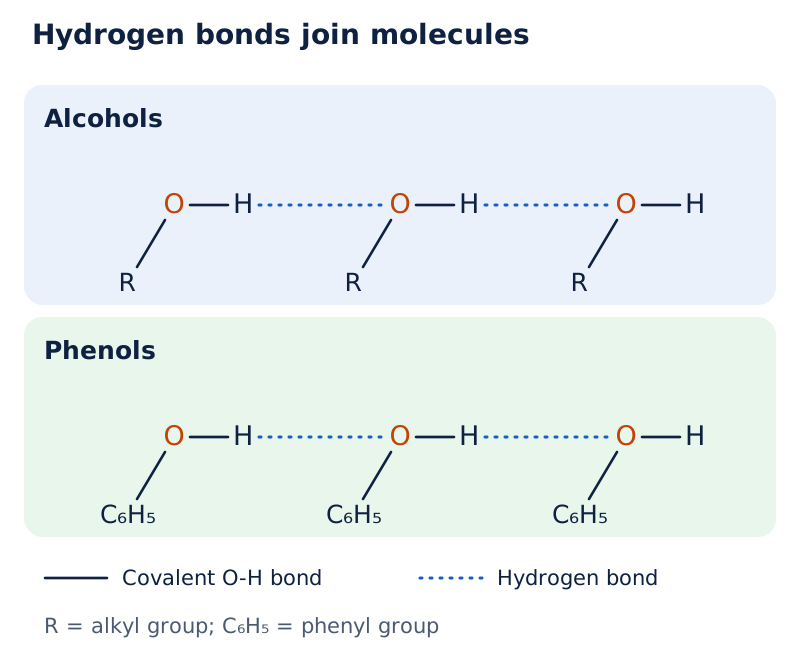
Draw several hydroxyl-containing molecules with dotted links from the hydroxyl hydrogen of one molecule to the oxygen of another. Keep these intermolecular links distinct from the covalent oxygen-hydrogen bonds within each molecule.
Drawn by One Young India.
Alcohols, phenols and ethers can form hydrogen bonds with water. Alcohol and phenol solubility decreases as the hydrophobic alkyl or aryl portion becomes larger. Several lower molecular mass alcohols mix with water in all proportions. Ether molecules lack the hydroxyl hydrogen needed for self-association of this kind.
Worked example 7.3. Arrange in increasing boiling point: (a) pentan-1-ol, butan-1-ol, butan-2-ol, ethanol, propan-1-ol, methanol; (b) pentan-1-ol, n-butane, pentanal, ethoxyethane.
Answer: (a) Methanol, ethanol, propan-1-ol, butan-2-ol, butan-1-ol, pentan-1-ol. (b) n-Butane, ethoxyethane, pentanal, pentan-1-ol.
How are alcohols prepared from alkenes?
What happens in acid-catalysed hydration?
Alkenes add water in the presence of an acid catalyst. With unsymmetrical alkenes, addition follows Markovnikov’s rule. Propene therefore gives propan-2-ol. The symbol denotes a proton, and denotes the hydronium ion present in acidic water.
The mechanism proceeds through a carbocation, an intermediate with a positively charged carbon. Water attacks this electron-deficient intermediate, and the resulting protonated alcohol then loses a proton.
- Step 1: Protonation. Hydronium forms from water and acid: . Proton addition to the alkene produces a carbocation.
- Step 2: Nucleophilic attack. Water uses an oxygen lone pair to bond to the positively charged carbon, producing an oxonium ion, a positively charged oxygen species.
- Step 3: Deprotonation. Another water molecule removes a proton from the oxonium ion, forming the alcohol and regenerating hydronium.
What changes in hydroboration-oxidation?
Hydroboration-oxidation gives the alcohol with the orientation opposite to Markovnikov addition. Diborane reacts with the alkene to form a trialkylborane. Boron becomes attached to the double-bonded carbon carrying more hydrogen atoms.
For propene, the first addition of a borane unit can be written as:
For propene, the successive boron-containing products are , and . Oxidation with hydrogen peroxide in aqueous sodium hydroxide gives propan-1-ol in excellent yield.
The two alkene routes must therefore be distinguished by reagent and product orientation. Acid-catalysed hydration of propene gives the secondary alcohol, whereas hydroboration-oxidation gives the primary alcohol. Reversing these products reverses the central distinction between the methods.
How do carbonyl compounds and Grignard reagents give alcohols?
Which products result from reduction?
Aldehydes give primary alcohols and ketones give secondary alcohols on reduction. Catalytic hydrogenation uses finely divided platinum, palladium or nickel. Sodium borohydride and lithium aluminium hydride also reduce aldehydes and ketones.
Carboxylic acids give primary alcohols with lithium aluminium hydride. Its expense limits its use to special preparations. Commercially, acids can first be converted to esters, which are then reduced by catalytic hydrogenation.
Numbered reagents over and under an arrow indicate successive treatments: the second is introduced after the first reaction is complete. They do not mean that both reagents are mixed at the beginning.
What determines the Grignard product?
A Grignard reagent, represented by , adds to a carbonyl group to form an adduct. Hydrolysis of the adduct gives an alcohol. Methanal gives a primary alcohol, other aldehydes give secondary alcohols, and ketones give tertiary alcohols.
- Step 1: Addition. With methanal, the reaction is .
- Step 2: Hydrolysis. The adduct gives .
The corresponding sequences for other aldehydes and for ketones retain the groups already attached to the carbonyl carbon and add the alkyl group from the Grignard reagent:
Worked example 7.2. Give the structures and IUPAC names of products from (a) catalytic reduction of butanal; (b) hydration of propene with dilute sulphuric acid; (c) propanone with methylmagnesium bromide followed by hydrolysis.
Answer: (a) , butan-1-ol; (b) , propan-2-ol; (c) , 2-methylpropan-2-ol.
How is phenol prepared?
Phenol, also called carbolic acid, can be prepared from haloarenes, benzenesulphonic acid, diazonium salts and cumene. These routes replace an existing group or transform a side chain, so their reagents and intermediate stages should be kept separate.
What are the benzene-derivative routes?
Chlorobenzene is fused with sodium hydroxide at , where K denotes kelvin, under a pressure of , where atm denotes atmosphere. The sodium phenoxide formed is acidified to phenol. The intermediate is a salt, so acidification is an essential final operation.
Benzene is sulphonated with oleum. Heating benzenesulphonic acid with molten sodium hydroxide gives sodium phenoxide, and subsequent acidification gives phenol.
Aniline reacts with nitrous acid, generated from sodium nitrite and hydrochloric acid, at to form a diazonium salt. Warming the salt with water or treating it with dilute acid produces phenol.
Why is cumene important industrially?
Most worldwide phenol production is from cumene, or isopropylbenzene. Air oxidation produces cumene hydroperoxide. Dilute acid then converts this intermediate to phenol and acetone, both obtained in large quantities.
The coproduct is acetone, not an alcohol. The hydroperoxide stage distinguishes this preparation from direct substitution routes through sodium phenoxide or a diazonium salt.
Why are phenols more acidic than alcohols?
What do reactions with bases and metals show?
Alcohols and phenols are Brønsted acids: they donate protons to stronger bases. Active metals such as sodium, potassium and aluminium produce alkoxides or phenoxides with hydrogen. Phenol also reacts with aqueous sodium hydroxide.
Aluminium reacts with tert-butyl alcohol to form aluminium tert-butoxide:
Electron-releasing alkyl groups reduce the polarity of the oxygen-hydrogen bond and decrease alcohol acidity. The order is primary, then secondary, then tertiary. Alkoxide ions are stronger bases than hydroxide ions. Alcohols also accept protons through oxygen lone pairs and therefore behave as Brønsted bases.
Water can donate a proton to an alkoxide, illustrating the stronger basic character of alkoxide compared with hydroxide:
How does resonance stabilise phenoxide?
In an alkoxide ion, the negative charge is localised on oxygen. In a phenoxide ion, it is delocalised through the aromatic system. This stabilisation favours phenol ionisation. The more electronegative carbon also increases the polarity of the oxygen-hydrogen bond.
Diagram
Phenoxide resonance
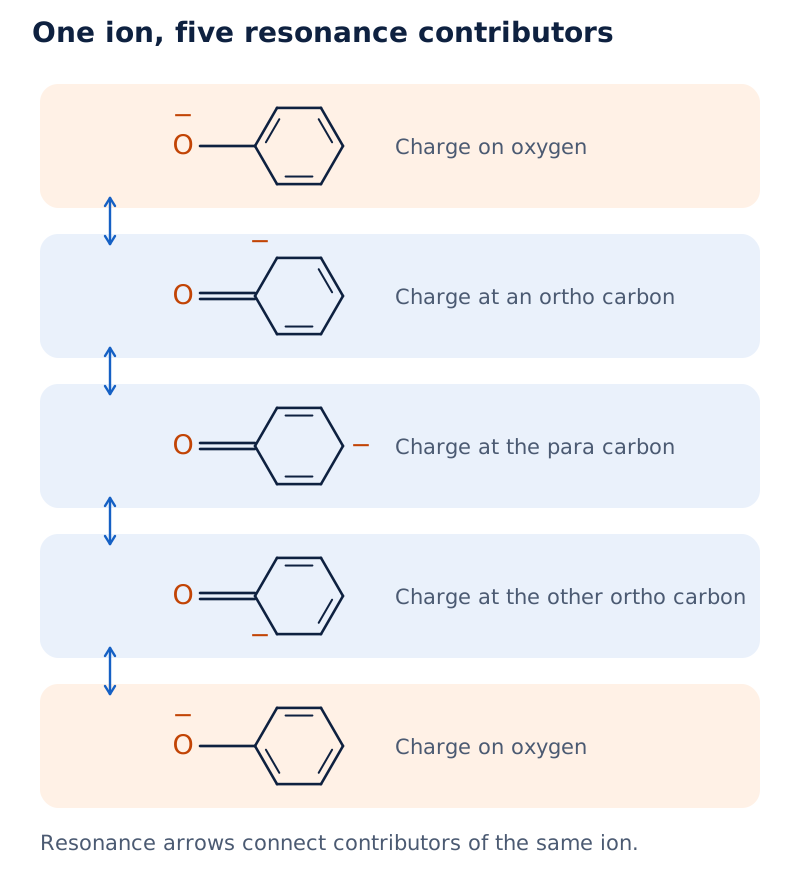
Draw the five contributing structures of phenoxide with resonance arrows between them. Show negative charge on oxygen in the oxygen-centred forms and on the two ortho and the para carbons in the ring-centred forms.
Drawn by One Young India.
Electron-withdrawing nitro groups increase phenol acidity, especially at ortho and para positions where delocalisation is effective. Electron-releasing alkyl groups generally decrease acidity. The symbol denotes the logarithmic acid-strength measure; a larger value indicates a weaker acid.
| Compound | Comparison with phenol | |
|---|---|---|
| o-Nitrophenol | Stronger acid | |
| m-Nitrophenol | Stronger acid | |
| p-Nitrophenol | Stronger acid | |
| Phenol | Reference compound | |
| o-Cresol and p-cresol | Weaker acids | |
| m-Cresol | Weaker acid | |
| Ethanol | Much weaker acid |
Worked example 7.4. Arrange in increasing acid strength: propan-1-ol, 2,4,6-trinitrophenol, 3-nitrophenol, 3,5-dinitrophenol, phenol, 4-methylphenol.
Answer: Propan-1-ol, 4-methylphenol, phenol, 3-nitrophenol, 3,5-dinitrophenol, 2,4,6-trinitrophenol.
How do esterification, substitution and dehydration occur?
Which reactions involve the hydroxyl hydrogen?
Alcohols and phenols form esters with carboxylic acids, acid anhydrides and acid chlorides. Their oxygen-hydrogen bond is involved in these reactions. In the following schemes, means an alkyl or aryl group.
A small amount of concentrated sulphuric acid catalyses reactions with acids and anhydrides. Removing water favours ester formation in the reversible acid reaction. With acid chlorides, pyridine neutralises hydrogen chloride. Introduction of an acetyl group is acetylation; acetylation of salicylic acid produces aspirin.
In the aspirin preparation, the phenolic hydroxyl group of salicylic acid is acetylated by ethanoic anhydride:
Which reactions cleave the carbon-oxygen bond?
Alcohols react with hydrogen halides to form alkyl halides. Phosphorus tribromide also converts alcohols to alkyl bromides. In the Lucas test, concentrated hydrochloric acid and zinc chloride form a reagent in which alcohols dissolve but their halides produce turbidity.
Tertiary alcohols give immediate turbidity. Primary alcohols do not give turbidity at room temperature. The observation concerns formation of an immiscible halide, rather than formation of a gaseous product.
Dehydration removes water to form an alkene. Ethanol gives ethene with concentrated sulphuric acid at . Secondary and tertiary alcohols dehydrate under milder conditions; ease of dehydration decreases from tertiary to secondary to primary.
The milder conditions for secondary and tertiary alcohols are illustrated by these phosphoric-acid reactions. The percentage specifies acid concentration:
What are the numbered dehydration steps?
- Step 1: Protonation. . Oxygen accepts a proton, giving protonated ethanol.
- Step 2: Water loss. . Carbocation formation is the slow, rate-determining step in this representation.
- Step 3: Proton elimination. . Ethene forms and the acid is regenerated.
Removing ethene as it forms drives the equilibrium towards products. Carbocation stability helps explain the relative ease of dehydration: tertiary carbocations are more stable and easier to form than secondary and primary carbocations.
How does oxidation distinguish the three alcohol classes?
Alcohol oxidation can form a carbon-oxygen double bond through cleavage of oxygen-hydrogen and carbon-hydrogen bonds. The product depends on alcohol class, oxidising reagent and reaction conditions. A primary alcohol can give an aldehyde and then a carboxylic acid.
Which reagent gives which product?
| Starting material | Reagent or condition | Outcome |
|---|---|---|
| Primary alcohol | Acidified potassium permanganate | Carboxylic acid |
| Primary alcohol | Chromium trioxide in anhydrous medium | Aldehyde |
| Primary alcohol | Pyridinium chlorochromate | Aldehyde in good yield |
| Secondary alcohol | Chromium trioxide | Ketone |
| Tertiary alcohol | Strong oxidant and elevated temperature | Carbon-carbon cleavage and a mixture of smaller carboxylic acids |
PCC means pyridinium chlorochromate, a complex of chromium trioxide with pyridine and hydrogen chloride. It can oxidise the primary alcohol group in an unsaturated alcohol while retaining the carbon-carbon double bond shown here.
Tertiary alcohols are resistant to oxidation, but this must not be turned into an unlimited claim. Under strong conditions, cleavage of carbon-carbon bonds gives acids containing fewer carbon atoms.
What happens over heated copper?
Passing primary or secondary alcohol vapours over copper at causes dehydrogenation, giving an aldehyde or ketone. Under the same stated treatment, tertiary alcohols undergo dehydration. The copper conditions therefore give different kinds of reaction for the three classes.
How does phenol undergo electrophilic substitution?
The hydroxyl group activates the aromatic ring and directs incoming electrophiles to ortho and para positions. Resonance increases electron density at these positions. Reagent concentration, solvent and temperature control whether one or several substituents enter the ring.
How do nitration and bromination depend on conditions?
With dilute nitric acid at , phenol gives ortho- and para-nitrophenol. Concentrated nitric acid gives 2,4,6-trinitrophenol, called picric acid, but the yield is poor. Picric acid is also prepared through phenol-2,4-disulphonic acid followed by treatment with concentrated nitric acid.
o-Nitrophenol is steam volatile because it has intramolecular hydrogen bonding. Para-nitrophenol has intermolecular hydrogen bonding, associates with other molecules and is less volatile. The isomers can therefore be separated by steam distillation.
Diagram
Hydrogen bonding in nitrophenols
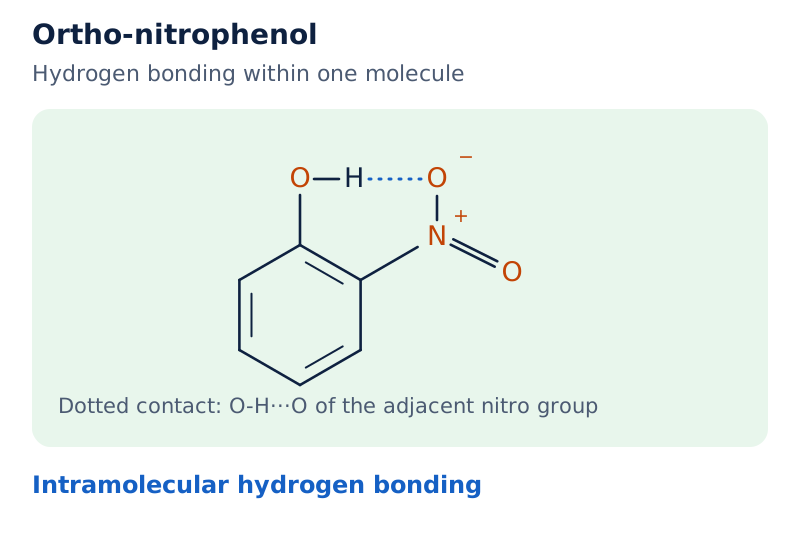
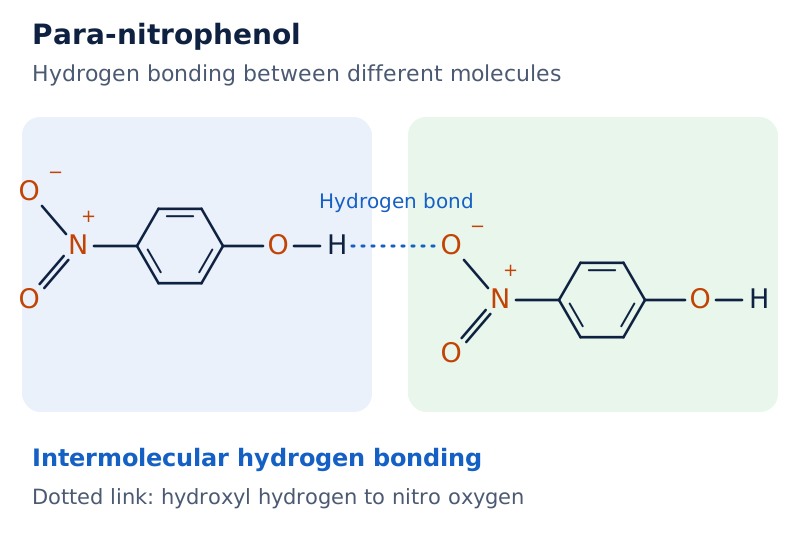
In ortho-nitrophenol, draw a dotted hydrogen bond from the hydroxyl hydrogen to oxygen of the adjacent nitro group within one molecule. For para-nitrophenol, draw dotted links between hydroxyl and nitro groups belonging to different molecules.
Drawn by One Young India.
Bromine in low-polarity solvents such as carbon disulphide or chloroform at low temperature gives monobromophenols. The scheme with carbon disulphide at shows the para product as major. Bromine water instead produces a white precipitate of 2,4,6-tribromophenol.
A Lewis acid catalyst is unnecessary for phenol bromination because the strongly activating hydroxyl group enables polarisation of bromine.
What happens when two directing groups are present?
Worked example 7.5. Predict the major structures from (a) mononitration of 3-methylphenol; (b) dinitration of 3-methylphenol; (c) mononitration of phenyl methanoate.
Answer: (a) With the phenolic carbon numbered one and methyl retained at position three, nitro enters position four or six. (b) Nitro groups occupy positions four and six. (c) Para nitration gives . The hydroxyl and methyl groups jointly influence the first two outcomes.
What are Kolbe’s and Reimer-Tiemann reactions?
How is a carboxyl group introduced?
In Kolbe’s reaction, phenol first reacts with sodium hydroxide to form phenoxide. This ion is more reactive than phenol towards electrophilic aromatic substitution and reacts with carbon dioxide, a weak electrophile. Acidification gives ortho-hydroxybenzoic acid, or salicylic acid, as the main product.
How is an aldehyde group introduced?
In the Reimer-Tiemann reaction, phenol is treated with chloroform and aqueous sodium hydroxide. An ortho-substituted benzal chloride intermediate forms. Alkaline hydrolysis followed by acidification gives salicylaldehyde, which has a formyl group adjacent to the hydroxyl group.
The abbreviation aq. means aqueous, or dissolved in water. Distinguish the products by the newly introduced group: Kolbe’s reaction introduces a carboxyl group, whereas Reimer-Tiemann introduces an aldehyde group. Both products have the new group ortho to the hydroxyl group.
How can phenol be reduced or oxidised?
Heating phenol with zinc dust converts it into benzene. Oxidation with chromic acid gives benzoquinone, a conjugated diketone. Phenols also undergo slow oxidation in air, producing dark-coloured mixtures containing quinones.
Note: Salicylic acid and salicylaldehyde are different products. Write the reagent sequence as well as the product name; replacing carbon dioxide by chloroform changes the functional group introduced into the ring.
How are methanol and ethanol produced commercially?
What are the important facts about methanol?
Methanol, historically called wood spirit, was obtained by destructive distillation of wood. Most methanol is now produced by catalytic hydrogenation of carbon monoxide using zinc oxide and chromium oxide at high pressure and temperature.
Methanol is colourless and boils at . It is used in paints and varnishes as a solvent and chiefly in making formaldehyde. It is highly poisonous: even small quantities can cause blindness, and larger quantities can cause death.
How does fermentation produce ethanol?
Fermentation converts sugars from molasses, sugarcane or fruits into ethanol. Invertase converts sucrose into glucose and fructose. Zymase, present in yeast, converts these sugars into ethanol and carbon dioxide under anaerobic conditions, meaning in the absence of air.
The two products in this first reaction are glucose and fructose respectively.
Zymase activity is inhibited once alcohol concentration exceeds 14 per cent. If air enters, oxygen oxidises ethanol to ethanoic acid and spoils the taste of the drink. Large quantities of ethanol are also produced by hydration of ethene.
Ethanol is a colourless liquid boiling at , used as a solvent and in preparing other carbon compounds. Denaturation makes commercial alcohol unfit for drinking: copper sulphate provides colour and pyridine gives an unpleasant smell.
The distinction between methanol and ethanol matters beyond their preparation routes. Methanol’s toxicity makes it unsuitable as a substitute for ethanol, even though both belong to the primary alcohol family and are colourless liquids.
How are ethers prepared, and what limits Williamson synthesis?
When does alcohol dehydration give an ether?
Ethanol heated with sulphuric acid gives ethene at , but ethoxyethane is the main product at . Ether formation involves attack by an alcohol molecule on protonated alcohol through bimolecular nucleophilic substitution, abbreviated .
- Step 1: Protonation. .
- Step 2: Substitution. .
- Step 3: Proton loss. .
This preparation suits unhindered primary alkyl groups at low temperature. With secondary or tertiary alcohols, elimination competes strongly with substitution and alkenes form readily. Changing the conditions can therefore change both the principal product and the reaction pathway.
Why does the choice of alkyl halide matter?
Williamson synthesis combines an alkyl halide with sodium alkoxide. It prepares symmetrical and unsymmetrical ethers, including ethers with secondary or tertiary alkyl groups, provided the halide partner is chosen appropriately.
Primary alkyl halides give better results because the alkoxide attacks by . With secondary and tertiary halides, elimination competes. A tertiary halide gives an alkene rather than an ether because alkoxide is also a strong base.
Worked example 7.6. Sodium ethoxide and tert-butyl chloride are proposed for preparing tert-butyl ethyl ether. (i) What is the major product? (ii) Give a suitable preparation of the ether.
Answer: (i) 2-Methylprop-1-ene is the major product because sodium ethoxide acts as a strong base and elimination predominates. (ii) Use sodium tert-butoxide with ethyl chloride:
Phenols also form ethers by this method. Convert phenol into sodium phenoxide, then allow it to react with an alkyl halide. The phenol supplies the phenoxide portion, while substitution occurs on the alkyl halide.
How do ethers behave physically and chemically?
Why can ethers dissolve in water?
Ether carbon-oxygen bonds are polar, giving a net dipole moment. Their boiling points resemble those of alkanes of comparable molecular masses and are much lower than those of alcohols. Ether oxygen can nevertheless accept hydrogen bonds from water.
| Compound | Boiling point | Behaviour with water |
|---|---|---|
| n-Pentane | Essentially immiscible | |
| Ethoxyethane | per water | |
| Butan-1-ol | per water |
Here g means gram, a unit of mass, and mL means millilitre, a unit of volume. The comparison shows why low boiling point must not be used to infer inability to hydrogen-bond with water.
How does hydrogen iodide cleave ethers?
Concentrated hydrogen iodide or hydrogen bromide at high temperature cleaves ether bonds. Hydrogen halide reactivity decreases in the order HI, HBr, HCl. For methyl ethyl ether, protonation is followed by iodide attack at the less substituted carbon.
- Step 1: Protonation. .
- Step 2: Substitution. . Iodide displaces ethanol by attack.
- Step 3: Further reaction. With excess hydrogen iodide at high temperature, .
When one group is tertiary, cleavage gives the tertiary halide through a stable carbocation and unimolecular nucleophilic substitution, abbreviated . Alkyl aryl ethers cleave at the alkyl-oxygen bond. The aryl-oxygen bond has partial double-bond character and involves an carbon.
Worked example 7.7. Give the major products on heating these ethers with hydrogen iodide. The product pairs shown are the cleavage products; further conversion of an alcohol requires excess reagent under the conditions stated above.
- gives .
- gives .
- gives .
How does anisole undergo ring substitution?
The methoxy group activates anisole and directs substitution to ortho and para positions. Bromination with bromine in ethanoic acid needs no iron(III) bromide catalyst; para-bromoanisole is obtained in 90 per cent yield.
Friedel-Crafts alkylation with methyl chloride and acylation with ethanoyl chloride use anhydrous aluminium chloride. The para products are major. Concentrated nitric and sulphuric acids give ortho- and para-nitroanisole, again with the para product major.
Glossary
- Alcohol — A compound with a hydroxyl group attached directly to an aliphatic carbon atom.
- Phenol — A compound having a hydroxyl group directly attached to an aromatic ring carbon.
- Ether — A compound in which oxygen joins two alkyl or aryl groups.
- Allylic alcohol — An alcohol whose hydroxyl-bearing saturated carbon lies adjacent to a carbon-carbon double bond.
- Benzylic alcohol — An alcohol whose hydroxyl-bearing saturated carbon lies next to an aromatic ring.
- Hydrogen bonding — An intermolecular or intramolecular interaction responsible for association and several characteristic physical properties.
- Phenoxide ion — The conjugate base of phenol, stabilised by delocalisation of negative charge.
- Hydroboration-oxidation — Alkene conversion to an alcohol through borane addition followed by alkaline peroxide oxidation.
- Grignard reagent — An organomagnesium halide that adds to carbonyl compounds before hydrolysis produces alcohols.
- Dehydration — Removal of water during a reaction, giving an alkene or ether from alcohols.
- Acetylation — Introduction of an acetyl group into an alcohol or phenol during ester formation.
- Williamson synthesis — Ether preparation by reaction of an alkyl halide with a sodium alkoxide.
- Denaturation — Making commercial alcohol unfit for drinking by adding substances such as pyridine.
- Fermentation — Enzyme-mediated conversion of sugars into ethanol and carbon dioxide under anaerobic conditions.
Common errors and misconceptions
- Misconception: Every hydroxyl-containing molecule with a benzene ring is a phenol. Correct: The hydroxyl group must be directly attached to the ring; benzyl alcohol has an intervening saturated carbon.
- Misconception: Hydroboration-oxidation of propene gives propan-2-ol. Correct: It gives propan-1-ol; acid-catalysed hydration gives propan-2-ol.
- Misconception: A larger means a stronger acid. Correct: A larger value means a weaker acid, so ethanol is less acidic than phenol.
- Misconception: Phenol gives the same brominated product in every medium. Correct: Low-polarity solvent at low temperature gives monobromophenols; bromine water gives 2,4,6-tribromophenol.
- Misconception: A tertiary halide is suitable whenever the target ether contains a tertiary group. Correct: Use that group in the alkoxide and a suitable primary halide; a tertiary halide favours elimination.
- Misconception: Hydrogen iodide converts anisole into iodobenzene and methanol. Correct: Cleavage gives phenol and methyl iodide at the alkyl-oxygen bond.
- Misconception: Tertiary alcohols cannot be oxidised under any conditions. Correct: Strong oxidants and elevated temperature can cleave carbon-carbon bonds and form smaller carboxylic acids.
- Misconception: Ether oxygen cannot hydrogen-bond with water. Correct: Its lone pairs accept hydrogen bonds from water, even though ethers lack hydroxyl groups for alcohol-like self-association.
Exam-style questions with model answers
Q1. Explain why ethanol has a higher boiling point than methoxymethane despite their comparable molecular masses. [2 marks]
- Ethanol molecules form intermolecular hydrogen bonds through their hydroxyl groups.
- Methoxymethane lacks a hydroxyl hydrogen, so this self-association is absent. More energy is needed to separate the associated ethanol molecules.
Q2. Give the structures and IUPAC names of products from catalytic reduction of butanal, hydration of propene with dilute sulphuric acid, and reaction of propanone with methylmagnesium bromide followed by hydrolysis. [3 marks]
- Butanal undergoes reduction of its aldehyde group to a primary alcohol: , named butan-1-ol. The carbon chain is retained.
- Propene undergoes acid-catalysed hydration following Markovnikov’s rule, giving , named propan-2-ol, a secondary alcohol.
- Methylmagnesium bromide adds a methyl group to the carbonyl carbon of propanone. Hydrolysis then gives , named 2-methylpropan-2-ol, a tertiary alcohol.
Q3. Phenol, p-nitrophenol and ethanol have values of , and , respectively. Arrange them in increasing acidity and explain the effects of resonance and the nitro group. [3 marks]
- The increasing acidity order is ethanol, phenol, p-nitrophenol, because a smaller corresponds to greater acid strength.
- In ethoxide, negative charge is localised on oxygen. In phenoxide, the charge is delocalised through resonance, stabilising the conjugate base and favouring ionisation.
- The electron-withdrawing nitro group at the para position further stabilises the substituted phenoxide ion through effective delocalisation. Consequently p-nitrophenol is more acidic than phenol.
Q4. Describe phenol bromination using (a) bromine in carbon disulphide at , and (b) bromine water. Give the products, the visible observation in (b), and the reason a Lewis acid catalyst is unnecessary. [3 marks]
- Bromine in carbon disulphide at the stated low temperature gives ortho- and para-bromophenol, with the para isomer as the major product.
- Bromine water gives 2,4,6-tribromophenol as a white precipitate: .
- The hydroxyl group strongly activates the aromatic ring and makes ortho and para positions electron rich. Phenol can therefore polarise bromine without a Lewis acid catalyst such as iron(III) bromide.
Q5. Ethanol is heated with concentrated sulphuric acid at . Give the reaction and the three numbered mechanism steps. Identify the rate-determining step and explain how acid is regenerated and product formation is favoured. [5 marks]
- The reaction is dehydration to ethene: . Water is removed from the alcohol under these conditions.
- Step 1 is protonation of ethanol: . An oxygen lone pair accepts the proton and produces an oxonium ion.
- Step 2 is loss of water: . Formation of the carbocation is the slowest step and is therefore rate determining.
- Step 3 is proton elimination: . A carbon-carbon double bond forms as the proton is released.
- The proton used initially is regenerated in the final step. Removing ethene as it forms drives the equilibrium towards products and favours further dehydration.
Q6. Sodium ethoxide and tert-butyl chloride are proposed for making tert-butyl ethyl ether. Predict the major product and explain why. Then choose the appropriate sodium alkoxide and alkyl chloride for making the desired ether. [3 marks]
- The major product is 2-methylprop-1-ene. Sodium ethoxide is both a nucleophile and a strong base, and with the tertiary halide elimination predominates over substitution.
- Use sodium tert-butoxide as the alkoxide and ethyl chloride as the halide: .
- The halide is now primary, so nucleophilic substitution is favoured. The tertiary group remains in the alkoxide portion rather than serving as the carbon attacked in the halide.
Q7. Explain the principal cleavage products of anisole and tert-butyl methyl ether with hydrogen iodide. Give one equation for each and explain why the two ethers cleave differently. [5 marks]
- In both reactions, protonation of ether oxygen initiates cleavage. This produces an oxonium ion and makes the carbon-oxygen bond susceptible to breaking.
- Anisole gives phenol and methyl iodide: . Iodide attacks the methyl carbon through bimolecular nucleophilic substitution.
- The aryl-oxygen bond is more stable because the ring carbon is -hybridised and the bond has partial double-bond character. Phenol does not undergo further conversion to an aryl halide by this reaction.
- tert-Butyl methyl ether gives methanol and tert-butyl iodide: .
- The tertiary group forms a relatively stable carbocation after methanol departs. Iodide then combines with that carbocation, so this cleavage follows a unimolecular substitution pathway.
Q8. Distinguish Kolbe’s reaction from the Reimer-Tiemann reaction of phenol by giving the reagents, principal products and groups introduced. [3 marks]
- In Kolbe’s reaction, phenol is converted to sodium phenoxide, treated with carbon dioxide and then acidified. The main product is salicylic acid, with a carboxyl group introduced ortho to the hydroxyl group.
- In the Reimer-Tiemann reaction, phenol is treated with chloroform and aqueous sodium hydroxide. Hydrolysis of the substituted benzal chloride intermediate followed by acidification gives salicylaldehyde.
- The introduced group is therefore carboxyl in Kolbe’s reaction and aldehyde in Reimer-Tiemann, although both occupy an ortho position.
Key takeaways
- Classify alcohols by the carbon bearing the hydroxyl group; phenols have that group directly attached to an aromatic ring.
- Hydrogen bonding explains the relatively high boiling points of alcohols and phenols and their ability to interact with water.
- Acid-catalysed hydration follows Markovnikov orientation, whereas hydroboration-oxidation gives the alcohol with the opposite orientation.
- Grignard reagents give primary alcohols with methanal, secondary alcohols with other aldehydes and tertiary alcohols with ketones.
- Phenoxide resonance stabilisation makes phenol more acidic than alcohols; electron-withdrawing substituents further increase its acidity.
- Reagent concentration and solvent determine whether phenol bromination gives monobromophenols or a white precipitate of tribromophenol.
- Williamson synthesis works best with a primary alkyl halide; tertiary halides favour elimination because alkoxides are strong bases.
- Ether cleavage depends on the groups attached to oxygen; anisole gives phenol and methyl iodide with hydrogen iodide.
Test yourself
What distinguishes benzylic alcohol from phenol?
Benzylic alcohol has the hydroxyl group on a saturated carbon next to the ring; phenol has it directly on the ring.
Which alcohol is obtained from propene by hydroboration-oxidation?
Propan-1-ol forms, with orientation opposite to the product of acid-catalysed hydration.
Why does ortho-nitrophenol separate by steam distillation?
Its intramolecular hydrogen bonding makes it steam volatile, whereas para-nitrophenol forms intermolecular hydrogen bonds and is less volatile.
What does PCC stand for, and what is its useful oxidation product?
PCC is pyridinium chlorochromate, used to oxidise primary alcohols to aldehydes in good yield.
What are the products of acid treatment of cumene hydroperoxide?
Phenol and acetone form; acetone is a commercially useful coproduct of this preparation.
What does ethanol mainly form with sulphuric acid at and ?
Ethoxyethane is the main product at the lower temperature, whereas ethene forms at the higher temperature.
Which bond breaks when anisole reacts with hydrogen iodide?
The methyl-oxygen bond breaks, producing methyl iodide and phenol while retaining the aryl-oxygen bond.
Why is a tertiary alkyl halide unsuitable for ordinary Williamson ether synthesis?
Alkoxide acts as a strong base and promotes elimination, so an alkene forms rather than the intended ether.