
Amines | CBSE Class 12 Chemistry Notes
On this page
Watch & explore
Start with a few high-quality watches, then dive into the notes below.
This note covers the structure, classification and naming of amines, their preparation, physical properties, basic strength, characteristic reactions, identification tests, electrophilic substitution in aniline, diazonium salts, coupling reactions and aromatic conversions.
What are amines, and how are they classified and named?
Amines are derivatives of ammonia in which one, two or three hydrogen atoms are replaced by alkyl or aryl groups. They occur among proteins, vitamins, alkaloids and hormones. Synthetic amino compounds include drugs, dye stuffs and polymers.
Throughout the reactions below, , and represent alkyl groups unless otherwise specified; represents an aryl group. represents a halogen in a halide, and its corresponding anion. Different letters allow the attached groups to be different.
What determines the class of an amine?
| Class | Replacement in ammonia | General structure | Example |
|---|---|---|---|
| Primary | One hydrogen replaced | or | , methanamine |
| Secondary | Two hydrogens replaced | , dimethylamine | |
| Tertiary | Three hydrogens replaced | , trimethylamine |
Simple amines have identical alkyl or aryl groups attached to nitrogen; mixed amines have different groups. Classification counts groups directly attached to nitrogen. It does not depend on the total number of carbon atoms in the molecule.
Nitrogen is trivalent and carries an unshared electron pair. Its orbitals have hybridisation, meaning one s orbital and three p orbitals combine to form hybrid orbitals. Three participate in bonds, while the fourth contains the lone pair, giving a pyramidal shape.
What the figure shows
Pyramidal shape of trimethylamine
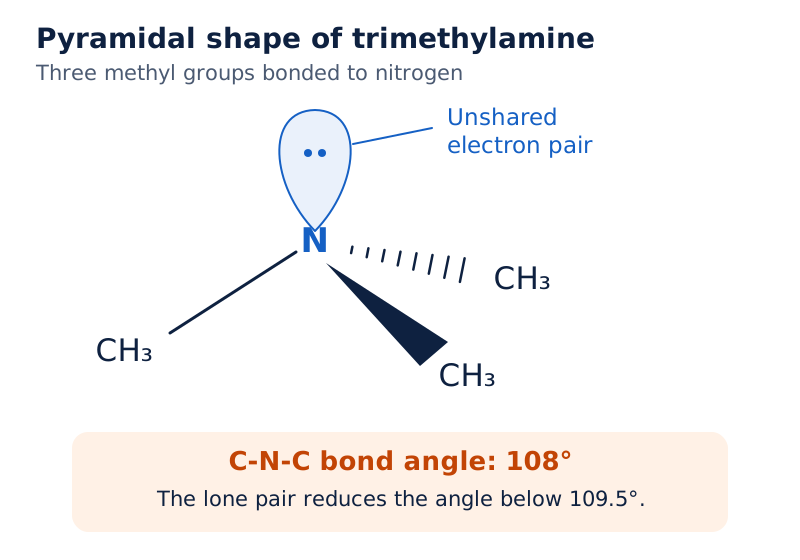
The drawing shows three methyl groups around nitrogen, an orbital labelled unshared electron pair above it, and a bond angle of . The lone pair reduces the bond angle below .
Drawn by One Young India. See Fig. 9.1 in your NCERT textbook
How do common and IUPAC names differ?
Common names combine the alkyl group name with “amine”; repeated groups take di or tri. IUPAC primary amine names replace the final e of the alkane with amine. The locant N identifies a substituent attached to nitrogen.
| Formula | Common name | IUPAC name |
|---|---|---|
| Ethylamine | Ethanamine | |
| n-Propylamine | Propan-1-amine | |
| Ethylmethylamine | N-Methylethanamine | |
| Trimethylamine | N,N-Dimethylmethanamine | |
| Aniline | Aniline or benzenamine |
For several amino groups, give their positions and use diamine or triamine, retaining the hydrocarbon's final e. Thus is ethane-1,2-diamine. In arylamines, the amino group is directly attached to the aromatic ring; aniline is the simplest example.
How are amines prepared by reduction?
How does reduction of a nitro compound work?
Nitro compounds give amines on reduction. Hydrogen with finely divided nickel, palladium or platinum can be used. Metals in acidic medium provide another route. Nitroalkanes similarly yield the corresponding alkanamines.
The nitrobenzene schemes use hydrogen with palladium in ethanol, or tin with hydrochloric acid, or iron with hydrochloric acid:
Reduction with iron scrap and hydrochloric acid is preferred because the iron(II) chloride formed undergoes hydrolysis and releases hydrochloric acid. Only a small amount of acid is therefore needed to initiate the reaction.
How do nitriles and amides give amines?
Nitriles give primary amines on reduction with lithium aluminium hydride or catalytic hydrogenation. Sodium amalgam with ethanol is an alternative reducing system. The nitrile carbon becomes the carbon of the methylene group next to nitrogen.
Here denotes sodium amalgam; the labels above and below the arrow give alternative reducing systems. Preparing a nitrile from an alkyl halide and then reducing it provides a route to a longer carbon chain.
Amides also undergo reduction with lithium aluminium hydride. The carbonyl carbon remains in the product, becoming a methylene carbon. The two numbered reagent operations are reduction and subsequent treatment with water:
Note: Reduction of an amide retains its carbonyl carbon. Hoffmann bromamide degradation removes that carbon from the amine product. These two preparations therefore give different carbon-chain lengths from the same amide.
How does ammonolysis produce amines and extend a carbon chain?
Ammonolysis is cleavage of the carbon-halogen bond by ammonia. An alkyl or benzyl halide reacts with ethanolic ammonia by nucleophilic substitution, replacing halogen with an amino group. The reaction takes place in a sealed tube at , where K denotes kelvin.
The initial substituted ammonium salt releases the free amine on treatment with a strong base. Sodium hydroxide gives the following reaction:
The primary amine is itself a nucleophile. Continued reaction with alkyl halide forms secondary and tertiary amines, followed by a quaternary ammonium salt. Consequently, ammonolysis usually produces a mixture. A large excess of ammonia makes the primary amine the major product.
The halide reactivity order is . This compares iodides, bromides and chlorides with the same alkyl group.
Worked example 1. Write chemical equations for the following reactions: (i) Reaction of ethanolic NH₃ with C₂H₅Cl. (ii) Ammonolysis of benzyl chloride and reaction of amine so formed with two moles of CH₃Cl.
Answer: (i) The successive products are ethanamine, N-ethylethanamine, N,N-diethylethanamine and a quaternary ammonium salt:
(ii) Benzylamine is followed by N,N-dimethylphenylmethanamine:
How is one carbon added through a nitrile?
Worked example 2. Write chemical equations for the following conversions: (i) into ; (ii) into .
Answer: (i) Chloroethane gives propanenitrile, followed by propan-1-amine:
(ii) Benzyl chloride gives phenylethanenitrile, also called benzyl cyanide, followed by 2-phenylethanamine:
In both conversions, cyanide substitution introduces a carbon atom before reduction. Direct ammonolysis of the original halide would replace chlorine with an amino group without introducing this additional carbon.
How do Gabriel synthesis and Hoffmann degradation prepare primary amines?
What is the sequence in Gabriel phthalimide synthesis?
Gabriel phthalimide synthesis prepares primary amines. Phthalimide first forms its potassium salt with ethanolic potassium hydroxide. Reaction with an alkyl halide introduces an alkyl group on nitrogen; alkaline hydrolysis then releases the corresponding primary amine.
- Treat phthalimide with ethanolic potassium hydroxide to form potassium phthalimide.
- Heat the potassium salt with the required alkyl halide.
- Form the N-alkylphthalimide intermediate through substitution.
- Hydrolyse with aqueous sodium hydroxide to obtain the primary amine and the sodium salt of phthalic acid.
In the condensed structures below, the two carbonyl groups belong to the cyclic phthalimide framework. The two carboxylate groups in the hydrolysis product occupy adjacent positions on the benzene ring.
Aromatic primary amines cannot be prepared by this method because aryl halides do not undergo the required nucleophilic substitution with the phthalimide anion. The limitation concerns the halide used in the substitution step.
Why does Hoffmann bromamide degradation shorten the chain?
An amide reacts with bromine in aqueous or ethanolic sodium hydroxide. An alkyl or aryl group migrates from the carbonyl carbon to nitrogen. The primary amine obtained has one carbon fewer than the original amide.
Worked example 3. Write structures and IUPAC names of (i) the amide which gives propanamine by Hoffmann bromamide reaction; (ii) the amine produced by the Hoffmann degradation of benzamide.
Answer: (i) Propanamine has three carbon atoms, so the required amide has four. It is butanamide, . (ii) Benzamide has seven carbon atoms and gives the six-carbon aromatic primary amine , aniline or benzenamine.
When selecting a preparation, check the carbon count before choosing reagents. Nitrile formation followed by reduction lengthens the chain relative to the starting halide; amide reduction retains the carbon count; bromamide degradation shortens it.
How does hydrogen bonding affect the physical properties of amines?
Lower aliphatic amines are gases with a fishy odour. Primary amines containing three or more carbon atoms are liquids, while still higher members are solids. Aniline and other arylamines are usually colourless but develop colour during storage because of atmospheric oxidation.
Why does water solubility decrease with increasing size?
Lower aliphatic amines form hydrogen bonds with water and are soluble in it. As molar mass increases, the hydrophobic alkyl portion becomes larger and solubility falls. Higher amines are essentially insoluble in water. Amines dissolve in organic solvents such as alcohol, ether and benzene.
Alcohols are more polar than amines and form stronger intermolecular hydrogen bonds. The nitrogen and oxygen electronegativities used for this comparison are and , respectively. The comparison concerns the strength of intermolecular association as well as molecular size.
What the figure shows
Intermolecular hydrogen bonding in primary amines
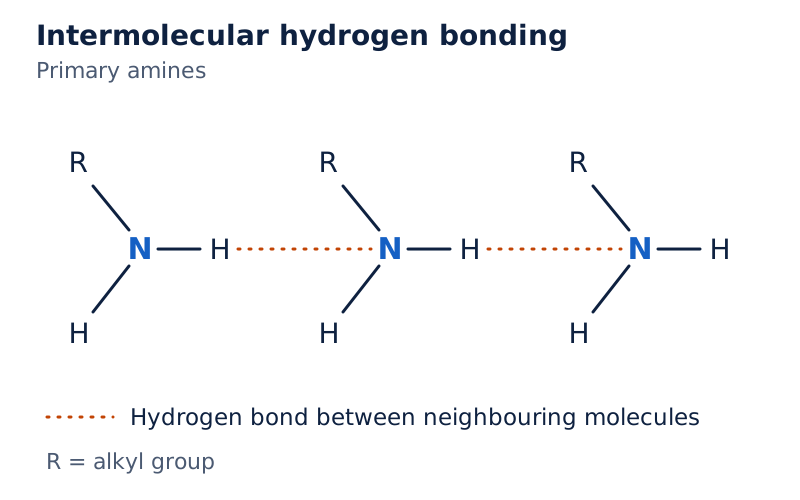
Several nitrogen atoms are shown bonded to an alkyl group and two hydrogens. Dotted links connect nitrogen on one molecule with hydrogen on a neighbouring molecule, forming an intermolecular network.
Drawn by One Young India. See Fig. 9.2 in your NCERT textbook
How do boiling points compare?
Primary amines have two nitrogen-bound hydrogens available for association, whereas secondary amines have one. Tertiary amines lack the nitrogen-bound hydrogen needed for such association between their own molecules. For isomeric amines, the order is:
| Compound | Molar mass | Boiling point in kelvin |
|---|---|---|
| 73 | 350.8 | |
| 73 | 329.3 | |
| 73 | 310.5 | |
| 72 | 300.8 | |
| 74 | 390.3 |
These substances have similar molecular masses, making the role of intermolecular forces clearer. The primary amine boils above the secondary and tertiary amines, while the alcohol has the highest boiling point in this comparison. The alkane lacks the hydrogen bonding present in the alcohol and primary amine.
How are the basic character and base dissociation constant of amines described?
Amines act as Lewis bases because nitrogen can donate its unshared electron pair. They accept a proton from an acid and form substituted ammonium salts. The ease of proton acceptance and stability of the resulting cation affect basic strength.
For aniline, hydrochloric acid forms anilinium chloride:
Amine salts are soluble in water but insoluble in organic solvents such as ether. Treatment with sodium hydroxide regenerates the parent amine. These changes provide the basis for separating amines from non-basic organic compounds that are insoluble in water.
Derivation: How is the base dissociation expression obtained?
Here denotes the equilibrium constant with water written explicitly, the base dissociation constant, and square brackets the equilibrium concentration of the enclosed species. is the hydroxide ion and the substituted ammonium ion.
- Step 1. Write the proton-transfer equilibrium with water:
- Step 2. Express the equilibrium constant:
- Step 3. Rearrange to place the water concentration with the constant:
- Step 4. Incorporate water concentration into the base dissociation constant:
Result: A larger base dissociation constant indicates a stronger base. The logarithmic measure is the negative base-ten logarithm of , written . A smaller value of this logarithmic measure indicates a stronger base.
Ammonia has . The methyl- and ethyl-substituted amines listed below have values from to and are stronger bases than ammonia. Aromatic amines are weaker, because direct attachment of the aryl group reduces the availability of nitrogen's lone pair for protonation.
Why do basicity orders change with molecular structure and solvent?
How do alkyl groups and hydration compete?
The positive inductive effect, written , is the electron-releasing influence of alkyl groups. It raises electron density on nitrogen and helps disperse positive charge in the substituted ammonium ion. Alkylamines therefore accept protons more readily than ammonia.
In the gaseous phase, the order is . In aqueous solution, solvation also stabilises the protonated ion. Its size, opportunities for hydrogen bonding and steric hindrance must be considered along with the inductive effect.
Solvation alone favours primary over secondary over tertiary substituted ammonium ions. Larger ions undergo less solvation. The final aqueous order reflects the combined effects rather than either inductive influence or hydration in isolation.
For methyl-substituted amines in water:
For ethyl-substituted amines in water:
| Amine in aqueous phase | |
|---|---|
| Methanamine | 3.38 |
| N-Methylmethanamine | 3.27 |
| N,N-Dimethylmethanamine | 4.22 |
| Ethanamine | 3.29 |
| N-Ethylethanamine | 3.00 |
| N,N-Diethylethanamine | 3.25 |
| Benzenamine | 9.38 |
| Phenylmethanamine | 4.70 |
| N-Methylaniline | 9.30 |
| N,N-Dimethylaniline | 8.92 |
Why is aniline a weaker base than ammonia?
In aniline, nitrogen's lone pair is conjugated with the benzene ring. Resonance delocalisation makes it less available for protonation. Aniline has five contributing structures, whereas the anilinium ion has two Kekulé structures. Proton acceptance therefore loses the additional resonance stabilisation of the amine.
Diagram
Resonance structures of aniline and anilinium ion
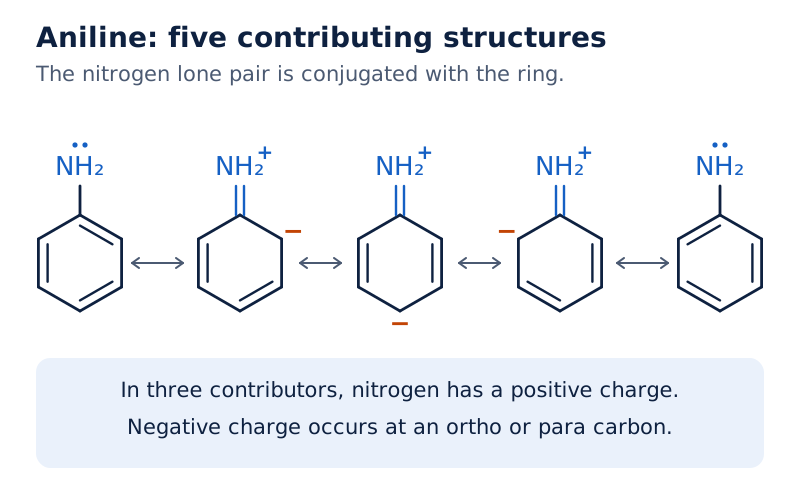
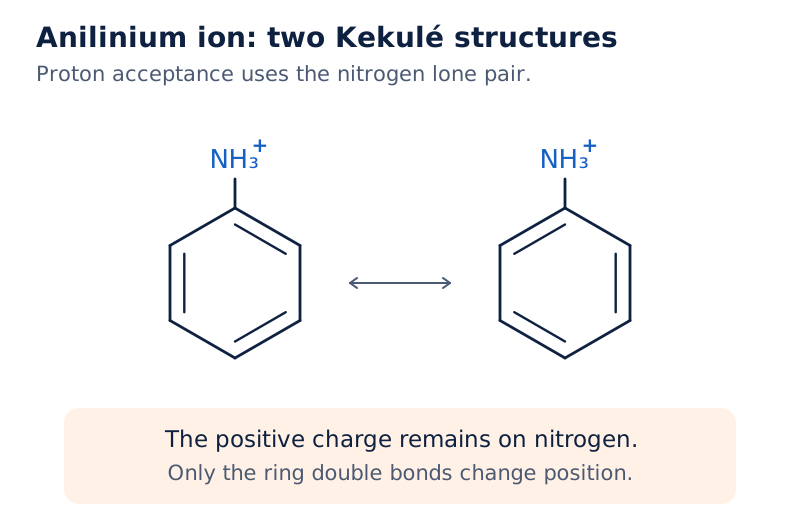
Draw the five contributing structures of aniline. In three, nitrogen bears positive charge and negative charge appears at an ortho or para carbon. Beneath them, draw the two Kekulé structures of the anilinium ion, with positive charge on nitrogen.
Drawn by One Young India.
Electron-releasing groups such as methoxy and methyl increase the basic strength of substituted anilines. Electron-withdrawing groups such as nitro, sulphonic acid, carboxyl and halogen decrease it. The negative inductive effect, written , means withdrawal of electron density through bonds.
Worked example 4. Arrange the following in decreasing order of their basic strength: .
Answer:
The secondary ethylamine leads this aqueous comparison, followed by ethylamine, ammonia and aniline. The difference between aliphatic and aromatic amines follows from the availability of the lone pair and the relative stabilisation of each amine and its protonated ion.
How do alkylation and acylation change amines?
Alkylation introduces alkyl groups by reaction with alkyl halides. Continued substitution can give a quaternary ammonium salt. Acylation instead replaces a nitrogen-bound hydrogen of a primary or secondary amine with an acyl group, producing an amide.
Which reagents carry out acylation?
Aliphatic and aromatic primary and secondary amines react with acid chlorides, anhydrides and esters through nucleophilic substitution. With acid chlorides, an added base such as pyridine accepts the hydrogen chloride produced and helps the reaction proceed towards the amide.
Ethanamine with ethanoyl chloride gives N-ethylethanamide:
N-Ethylethanamine gives N,N-diethylethanamide:
Aniline with ethanoic anhydride gives acetanilide, also called N-phenylethanamide, together with ethanoic acid:
What is benzoylation?
Reaction with benzoyl chloride is called benzoylation. Methanamine gives N-methylbenzamide:
These reactions depend on both the lone pair and the presence of a hydrogen attached to nitrogen. Acylation converts the strongly activating amino group of aniline into a less activating amide group, allowing more controlled substitution on the aromatic ring.
Note: An amine and a carboxylic acid form a salt at room temperature. Do not replace this acid-base product with an amide merely because acid chlorides and anhydrides undergo acylation.
How can characteristic reactions distinguish different amines?
What does the carbylamine test identify?
Aliphatic and aromatic primary amines form foul-smelling isocyanides on heating with chloroform and ethanolic potassium hydroxide. Secondary and tertiary amines do not show this reaction. It is called the carbylamine reaction or isocyanide test.
In , the organic group is bonded to nitrogen; this is an isocyanide. It should not be confused with a nitrile, whose organic group is attached to the carbon of the cyano group.
How do primary amines react with nitrous acid?
Nitrous acid is generated in the reaction mixture from sodium nitrite and a mineral acid. Primary aliphatic amines form unstable aliphatic diazonium salts, which release nitrogen gas quantitatively and give alcohols. This quantitative nitrogen evolution is used in estimating amino acids and proteins.
Primary aromatic amines instead form diazonium salts at to . These salts have sufficient stability at low temperature for further synthetic reactions. Secondary and tertiary amines react with nitrous acid differently.
How does the Hinsberg test distinguish the three classes?
Benzenesulphonyl chloride, , is Hinsberg's reagent. With ethylamine it forms N-ethylbenzenesulphonamide, which retains a nitrogen-bound hydrogen:
The strongly electron-withdrawing sulphonyl group makes this hydrogen acidic, so the product dissolves in alkali. Diethylamine instead forms N,N-diethylbenzenesulphonamide:
| Amine class | Reaction with Hinsberg's reagent | Behaviour in alkali |
|---|---|---|
| Primary | Sulphonamide with nitrogen-bound hydrogen | Acidic product dissolves |
| Secondary | Sulphonamide without nitrogen-bound hydrogen | Non-acidic product remains insoluble |
| Tertiary | Does not react with the reagent | No sulphonamide is formed |
The differing reactions allow identification and separation of amine mixtures. p-Toluenesulphonyl chloride is also used in place of benzenesulphonyl chloride. Keep formation of a product distinct from its solubility: a secondary amine reacts, even though its product does not dissolve in alkali.
How does the amino group control substitution in aniline?
The amino group is a powerful activating group and directs electrophilic substitution towards the ortho and para positions. Resonance increases electron density at these positions. Aniline can therefore react so readily that obtaining a monosubstituted product requires protection of the amino group.
In ring formulas below, , and denote ortho, meta and para positions. Numbered locants identify positions relative to the named parent compound.
Why does direct bromination give three substitutions?
Aniline reacts with bromine water at room temperature to give a white precipitate of 2,4,6-tribromoaniline:
For a monosubstituted derivative, acetylate aniline first. In acetanilide, nitrogen's lone pair interacts with the carbonyl oxygen and becomes less available for donation to the benzene ring. Bromination gives the para derivative as the major product; hydrolysis then restores the amino group.
Why does direct nitration produce a meta derivative?
Direct nitration gives tarry oxidation products as well as nitro derivatives. In strongly acidic medium, aniline is protonated to the anilinium ion, which is meta directing. A significant amount of meta product is therefore formed despite the ortho and para directing nature of the unprotonated amino group.
The product proportions are para , meta and ortho . Protection by acetylation permits controlled nitration, followed by hydrolysis, giving p-nitroaniline as the major product:
What happens during sulphonation and Friedel-Crafts conditions?
Concentrated sulphuric acid first forms anilinium hydrogensulphate. Heating at to produces sulphanilic acid, or p-aminobenzenesulphonic acid, as the major product. Its zwitterionic form has both positive and negative charges within the same molecule.
Aniline does not undergo Friedel-Crafts reaction because it forms a salt with the aluminium chloride catalyst. Nitrogen acquires positive charge, and the resulting group strongly deactivates the ring towards further reaction.
How are diazonium salts prepared and handled in reactions?
Arenediazonium salts contain an aryl group attached to the diazonium group, , and a counter-ion. Their general formula is . Here the counter-ion can be chloride, bromide, hydrogensulphate or tetrafluoroborate, so is used more broadly than for alkyl halides.
Names combine the parent hydrocarbon name, “diazonium”, and the anion name. Thus is benzenediazonium chloride and is benzenediazonium hydrogensulphate.
What is diazotisation?
Definition: Diazotisation is conversion of a primary aromatic amine into a diazonium salt by reaction with nitrous acid at low temperature.
Nitrous acid is produced in situ by sodium nitrite and hydrochloric acid. The preparation of benzenediazonium chloride uses to :
Arenediazonium ions are stabilised by resonance. Their salts remain stable for a short time in solution at low temperature, unlike the highly unstable alkyldiazonium salts formed from primary aliphatic amines. The prepared salt is generally used immediately rather than stored.
What physical properties affect their use?
Benzenediazonium chloride is a colourless crystalline solid and readily dissolves in water. It is stable in the cold but reacts with water on warming and decomposes easily in the dry state. Benzenediazonium fluoroborate is insoluble in water and stable at room temperature.
Diazonium reactions fall into two broad groups. In one, the diazonium group is displaced and nitrogen escapes as gas. In the other, coupling retains the two nitrogen atoms in an azo linkage joining aromatic rings. Recognising this distinction helps identify the product class.
How do diazonium salts produce substituted aromatic compounds and azo dyes?
Which reactions replace the diazonium group?
The diazonium group is a good leaving group. Its replacement introduces groups that may be difficult to introduce directly into an aromatic ring. In the following schemes, means heating, and is the aryl group retained in the product.
The Sandmeyer reaction introduces chloride, bromide or cyanide using copper(I) compounds. These schemes use cuprous chloride, cuprous bromide and cuprous cyanide:
The Gattermann reaction uses copper powder with the corresponding halogen acid. Sandmeyer gives a better yield than Gattermann in this comparison.
Iodide replacement uses potassium iodide. Fluoride replacement first precipitates the fluoroborate salt, which decomposes on heating:
Reductive removal replaces the group with hydrogen. Hypophosphorous acid, also called phosphinic acid, becomes phosphorous acid; ethanol becomes ethanal:
When the solution temperature rises to , hydrolysis gives phenol. Heating diazonium fluoroborate with aqueous sodium nitrite in the presence of copper replaces the group with a nitro group:
How does coupling retain nitrogen?
Azo coupling is electrophilic substitution in which two aromatic rings become joined by an azo linkage, . The extended conjugated products are often coloured and are used as dyes. Coupling with phenol or aniline takes place at the para position.
The phenol reaction gives p-hydroxyazobenzene, an orange dye:
The aniline coupling scheme gives p-aminoazobenzene, a yellow dye:
Diazonium intermediates provide routes to aryl fluorides, iodides and cyanides that are not available through the corresponding direct substitutions described here. They also permit temporary use of an amino group to control substitution, followed by its removal.
How can a multistep aromatic conversion be planned?
Worked example 5. How will you convert 4-nitrotoluene to 2-bromobenzoic acid?
Answer: Keep the methyl group at carbon 1 while following the first four transformations. Introduce bromine, reduce the nitro group, diazotise, remove the diazonium group, and finally oxidise the methyl group.
The order of transformations matters: the amino group is formed before diazotisation, the diazonium group is removed before the final oxidation, and the bromine position is retained throughout. Track the ring substituents at every stage instead of treating each reagent as an isolated fact.
Glossary
- Amine — An ammonia derivative formed by replacing hydrogen atoms with alkyl or aryl groups.
- Primary amine — An amine in which one hydrogen of ammonia has been replaced by an organic group.
- Secondary amine — An amine with two organic groups and one hydrogen directly attached to nitrogen.
- Tertiary amine — An amine with three organic groups directly attached to the nitrogen atom.
- Ammonolysis — Cleavage of a carbon-halogen bond by ammonia, leading to formation of an amine.
- Nucleophile — An electron-pair donor that attacks an electron-deficient centre during a chemical reaction.
- Acylation — Replacement of a nitrogen-bound hydrogen in an amine by an acyl group, producing an amide.
- Carbylamine reaction — Formation of an isocyanide by heating a primary amine with chloroform and ethanolic potassium hydroxide.
- Hinsberg's reagent — Benzenesulphonyl chloride, used to distinguish amine classes through their different sulphonamide formation and solubility behaviour.
- Solvation — Stabilisation of a dissolved ion by surrounding solvent molecules, including hydrogen bonding with water.
- Diazotisation — Conversion of a primary aromatic amine into a diazonium salt using nitrous acid at low temperature.
- Sandmeyer reaction — Replacement of an aromatic diazonium group by chloride, bromide or cyanide using copper(I) compounds.
- Azo coupling — Electrophilic substitution joining aromatic rings through an azo linkage to form an extended conjugated product.
Common errors and misconceptions
- Misconception: The number of carbon atoms decides whether an amine is primary. Correct: Count the organic groups directly bonded to nitrogen; a primary amine has one.
- Misconception: Ammonolysis gives only a primary amine. Correct: Further alkylation produces a mixture; excess ammonia makes the primary amine the major product.
- Misconception: Amide reduction and bromamide degradation give the same amine. Correct: Reduction retains the carbonyl carbon, whereas degradation gives an amine with one fewer carbon.
- Misconception: Tertiary amines are the strongest bases in every medium. Correct: Aqueous orders also depend on solvation and steric effects, and differ for methyl and ethyl groups.
- Misconception: A larger means a stronger base. Correct: A smaller , corresponding to a larger , indicates stronger basicity.
- Misconception: Aniline gives only ortho and para products during direct nitration. Correct: Protonation in strongly acidic medium forms the meta directing anilinium ion, producing a significant meta fraction.
- Misconception: Gabriel synthesis prepares aromatic primary amines from aryl halides. Correct: Aryl halides do not undergo the required substitution with the phthalimide anion.
- Misconception: Every diazonium reaction releases nitrogen gas. Correct: Replacement reactions release nitrogen, while coupling retains both nitrogen atoms within an azo linkage.
Exam-style questions with model answers
Q1. Classify and as primary or secondary amines, giving the structural reason in each case. [2 marks]
- Methanamine is a primary amine because nitrogen is directly attached to one methyl group.
- Dimethylamine is a secondary amine because nitrogen is directly attached to two methyl groups and one hydrogen.
Q2. Aqueous values are methanamine 3.38, dimethylamine 3.27, trimethylamine 4.22 and ammonia 4.75. Arrange them in decreasing basic strength and explain why the gas-phase order cannot simply be used in water. [3 marks]
- A smaller means a stronger base. The decreasing order is .
- Alkyl groups release electrons towards nitrogen and stabilise the protonated ion by dispersing positive charge.
- In water, solvation also stabilises these ions. Hydrogen bonding and steric effects combine with the inductive effect, so counting alkyl groups alone does not predict the aqueous basicity order.
Q3. Using ethanolic sodium cyanide followed by reduction, show how chloroethane is converted into propan-1-amine. Name the intermediate and explain the change in carbon count. [3 marks]
- Chloroethane first undergoes substitution with ethanolic sodium cyanide:
- The intermediate is propanenitrile. Cyanide supplies the additional carbon atom, increasing the chain from two carbons to three.
- Reduction changes the nitrile group into a primary amino group while retaining its carbon: The product is propan-1-amine, containing three carbon atoms.
Q4. Explain how benzenesulphonyl chloride distinguishes ethylamine, diethylamine and a tertiary amine. Give the equations for the first two and account for the products' behaviour in alkali. [5 marks]
- Ethylamine reacts to form N-ethylbenzenesulphonamide:
- This sulphonamide retains a hydrogen attached to nitrogen. The strongly electron-withdrawing sulphonyl group makes that hydrogen acidic. The product therefore dissolves in alkali, providing the characteristic behaviour of a primary amine in this test.
- Diethylamine forms N,N-diethylbenzenesulphonamide:
- The secondary amine product has no nitrogen-bound hydrogen. It is not acidic and remains insoluble in alkali, even though a reaction with the reagent has occurred.
- A tertiary amine does not react with benzenesulphonyl chloride. Distinguishing no reaction from formation of an insoluble sulphonamide separates the tertiary and secondary cases.
Q5. Explain why bromine water gives 2,4,6-tribromoaniline from aniline. Then give the reagent sequence for preparing 4-bromoaniline from aniline through protection, bromination and hydrolysis. [5 marks]
- The amino group strongly activates the benzene ring and directs substitution to ortho and para positions. Bromine water at room temperature therefore gives a white precipitate of 2,4,6-tribromoaniline:
- First protect the amino group by treating aniline with acetic anhydride in pyridine to form acetanilide.
- The nitrogen lone pair now participates in resonance with the carbonyl group, reducing its availability for donation to the aromatic ring. This lowers the activating effect.
- Brominate acetanilide with bromine in ethanoic acid. The para-bromo derivative is the major product.
- Hydrolyse the substituted amide using acid or alkali. This restores the amino group and gives 4-bromoaniline, completing the protection, substitution and deprotection sequence.
Q6. Write the preparation of benzenediazonium chloride from aniline using sodium nitrite and hydrochloric acid. State the temperature range and explain why the salt is generally used immediately. [3 marks]
- The reaction is
- Sodium nitrite and hydrochloric acid generate nitrous acid in the reaction mixture. Conversion of the primary aromatic amine into the diazonium salt is diazotisation.
- The salt is stable for only a short time in solution at low temperature. Because of its instability, it is generally used immediately after preparation rather than stored.
Q7. Identify the amide that gives propanamine by Hoffmann bromamide degradation. Give its structure, the reagents required and the reason for its carbon count. [2 marks]
- The amide is butanamide, , treated with bromine and aqueous or ethanolic sodium hydroxide.
- Propanamine has three carbons. Since degradation removes one carbon from the amide, the starting amide must contain four.
Q8. Starting from 4-nitrotoluene, give the five-stage reagent sequence leading to 2-bromobenzoic acid. Specify where bromine is introduced relative to the methyl group and what happens to the nitro group before the final oxidation. [5 marks]
- Brominate 4-nitrotoluene with bromine. Bromine enters position 2 relative to the methyl group, giving 2-bromo-4-nitrotoluene.
- Reduce the nitro group with tin and hydrochloric acid. The nitro substituent becomes an amino group while the bromine and methyl groups remain in their positions.
- Diazotise the amino group with sodium nitrite and hydrochloric acid at to , forming the corresponding diazonium chloride.
- Treat the diazonium compound with hypophosphorous acid and water. The diazonium group is replaced by hydrogen, leaving 2-bromotoluene.
- Oxidise the methyl group with potassium permanganate in alkaline medium, then acidify the resulting carboxylate. This gives 2-bromobenzoic acid, with bromine adjacent to the carboxyl group.
Key takeaways
- Classify an amine by the number of organic groups bonded directly to nitrogen, whose lone pair gives basic and nucleophilic behaviour.
- Excess ammonia favours primary amines during ammonolysis, but further alkylation can produce secondary amines, tertiary amines and quaternary ammonium salts.
- Nitrile formation followed by reduction adds a carbon relative to the starting halide; Hoffmann bromamide degradation removes the amide carbonyl carbon.
- Hydrogen bonding explains the water solubility of lower amines and the boiling-point differences between comparable primary, secondary and tertiary amines.
- Aqueous basicity depends on inductive effects, solvation and steric hindrance; aniline is less basic because resonance reduces lone-pair availability.
- Carbylamine formation identifies primary amines, while sulphonamide formation and alkali solubility distinguish amine classes in the Hinsberg test.
- Acetylation reduces the activating effect of aniline's amino group, allowing controlled ring substitution before hydrolysis restores the amine.
- Diazonium salts enable replacement reactions and azo coupling, providing routes to substituted aromatic compounds and often coloured conjugated dyes.
Test yourself
Why is the amino group in aniline different from that in an alkylamine?
It is directly attached to the aromatic ring, allowing the nitrogen lone pair to participate in conjugation.
What does the locant N mean in N-methylethanamine?
The methyl substituent is attached to nitrogen rather than to a carbon of the parent chain.
Why is excess ammonia used during ammonolysis?
It makes the primary amine the major product, although further alkylation can otherwise produce a mixture.
What product results from Hoffmann degradation of benzamide?
Aniline, also called benzenamine, forms with one carbon fewer than the starting benzamide molecule.
Why does dimethylamine's Hinsberg product remain insoluble in alkali?
The sulphonamide lacks a nitrogen-bound hydrogen, so it is not acidic and does not dissolve in alkali.
Why does aniline form a significant meta product on direct nitration?
Strongly acidic conditions protonate aniline to the anilinium ion, which directs substitution to the meta position.
What distinguishes a replacement reaction from azo coupling?
Replacement releases nitrogen gas, whereas coupling retains the two nitrogen atoms in a linkage between aromatic rings.
What colours are associated with the phenol and aniline coupling products?
The phenol product, p-hydroxyazobenzene, is orange; the aniline product, p-aminoazobenzene, is yellow.