
The d- and f-Block Elements | CBSE Class 12 Chemistry Notes
On this page
This note covers the positions and electronic configurations of d- and f-block elements, metallic properties, oxidation states, electrode potentials, magnetism, coloured ions, complex formation, catalysis, potassium dichromate, potassium permanganate, lanthanoid contraction, actinoids and applications.
What distinguishes d-block elements from transition elements?
The d-block occupies the middle of the periodic table, between the s- and p-blocks, and contains groups 3 to 12. Electrons progressively enter the d orbitals of the penultimate shell. The four series involve filling the , , and subshells.
Definition: A transition element has an incomplete d subshell in its neutral atom or in one of its ions. Membership of the d-block alone does not establish that an element is a transition element.
| Series | Elements included | Subshell involved |
|---|---|---|
| First | Scandium to zinc | |
| Second | Yttrium to cadmium | |
| Third | Lanthanum, then hafnium to mercury | |
| Fourth | Actinium, then rutherfordium to copernicium |
Why do scandium and zinc differ?
Scandium qualifies because its neutral atom contains an incomplete subshell. Its common ion having an empty d subshell does not cancel this classification. Either the atom or an ion can meet the definition.
Zinc, cadmium and mercury have complete subshells in their atoms and common oxidation states, so they are not regarded as transition elements. Their chemistry is nevertheless considered alongside the transition series because they occupy the end positions.
A filled d subshell in the neutral atom is not sufficient to exclude an element. Silver has a filled subshell in its atom, but can form with an incomplete d subshell. The definition therefore requires attention to ions as well as atoms.
How are electronic configurations written for atoms and ions?
The usual outer configuration is , where n is the principal quantum number of the outermost shell. The letters s and d identify subshells, and superscripts give their electron populations. Small energy differences between these subshells produce exceptions.
Chromium has , while copper has . Here denotes the argon electron core. Half-filled and completely filled sets of orbitals have additional stability; the configurations are not obtained by mechanically assigning two outer s electrons to every atom.
| Atom | Configuration outside the argon core | Divalent ion configuration outside the argon core |
|---|---|---|
| Chromium | ||
| Manganese | ||
| Iron | ||
| Cobalt | ||
| Copper | ||
| Zinc |
Which electrons leave first?
When d-block atoms form positive ions, outer s electrons leave before inner d electrons. Thus, forming removes the two electrons from iron; forming removes one further electron from the subshell.
Palladium provides another exception: its outer configuration is . Electronic configurations must therefore be checked for the particular atom. Once the ionic configuration is established, it helps explain oxidation-state stability, unpaired electrons and magnetic behaviour.
Why do metallic strength, radii and ionisation enthalpies vary?
Most transition metals possess metallic lustre, high tensile strength, malleability, ductility and good thermal and electrical conductivity. Participation of d electrons as well as s electrons in metallic bonding helps explain their generally high melting points and enthalpies of atomisation.
Enthalpy of atomisation measures the energy change associated with producing gaseous atoms from the element. Stronger interatomic interactions require more energy to overcome. Properties linked to bonding often reach high values near the middle of a series, but manganese illustrates that the trend is not perfectly regular.
How do atomic and ionic sizes change?
Across a series, increasing nuclear charge generally contracts atoms and ions of the same charge. Added d electrons do not completely shield the increasing charge. The variation within one transition series is relatively small compared with that across many main-group elements.
What the figure shows
Atomic radii across transition series
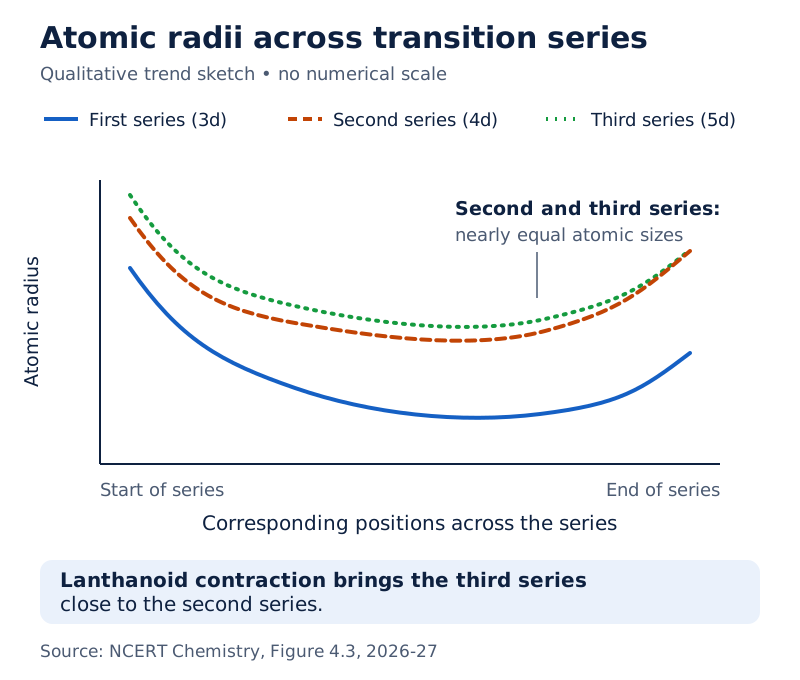
Three labelled curves compare corresponding positions in the first, second and third series. Each broadly falls and then rises towards its end. The second- and third-series curves lie much closer together than either does to the first.
Drawn by One Young India. See Fig. 4.3 in your NCERT textbook
The second series has larger atoms than the first, but corresponding second- and third-series atoms have nearly equal sizes because of lanthanoid contraction. Zirconium and hafnium have radii of and , respectively; pm denotes picometres.
Why is the ionisation trend irregular?
Ionisation enthalpy generally increases across a series, but electron repulsion, nuclear attraction and the stability of particular configurations disturb a smooth progression. Removing an electron from a stable half-filled or filled subshell can be especially difficult.
The second ionisation enthalpies of chromium and copper are high because their singly charged ions possess and configurations. The third ionisation enthalpy of manganese is high because it disrupts the configuration of .
Why do transition elements show variable oxidation states?
Variable oxidation states arise because both the outer s electrons and electrons in the incompletely filled d subshell can participate in bonding. Several successive oxidation states may occur, commonly differing by one rather than the two-unit differences often found among non-transition elements.
The greatest variety occurs near the middle of the first series. Manganese exhibits oxidation states from to . At the beginning there are fewer electrons available; towards the end, the increasingly occupied d subshell restricts the availability of orbitals for higher valence.
| Element or compound | Oxidation-state feature | Interpretation |
|---|---|---|
| Scandium | Commonly | Does not show the usual variety of oxidation states |
| Titanium | more stable than or | Early-series higher state is favoured |
| Manganese | to | Many states occur near the middle |
| Zinc | The filled d subshell remains uninvolved | |
| Ni(CO)₄ and Fe(CO)₅ | Metal oxidation state zero | Carbon monoxide stabilises low oxidation states |
How do oxygen and fluorine stabilise high states?
The small sizes and high electronegativities of oxygen and fluorine help stabilise high metal oxidation states. Oxygen can also form multiple bonds with metals. Manganese reaches in Mn₂O₇, whereas its highest simple fluoride is MnF₄.
Higher oxides generally show greater covalent and acidic character. CrO is basic, Cr₂O₃ is amphoteric and CrO₃ is acidic. V₂O₅ is amphoteric but mainly acidic. Thus, changing oxidation state can change acid-base behaviour as well as redox behaviour.
Higher oxidation states can be more stable among heavier members of a d-block group. Molybdenum(VI) and tungsten(VI) are more stable than chromium(VI); consequently, their trioxides do not show the strong oxidising behaviour of acidified dichromate.
How do electrode potentials explain stability and reactivity?
The standard reduction potential, written , describes a specified reduction under standard conditions and is expressed in volts, symbol V. A metal's tendency to form an aqueous ion depends on atomisation, ionisation and hydration, so electronic configuration alone is insufficient.
In the couple , M represents a metal. The reduction is . Here denotes an electron, aq an aqueous species, and s a solid. Hydration stabilises the resulting aqueous ions when the reverse oxidation is considered.
Why is copper unusual?
For copper, . Its hydration enthalpy does not compensate sufficiently for the energy required to produce the aqueous divalent ion from the metal. Copper consequently does not liberate hydrogen from dilute non-oxidising acids.
Oxidising acids can react with copper because the acid itself is reduced. Across the first series the potentials generally become less negative, but manganese, nickel and zinc deviate. Half-filled or filled subshell stability and particularly favourable hydration help explain these deviations.
Why can similar configurations behave differently?
Chromium(II) is reducing because conversion to chromium(III) gives a stable configuration. Manganese(III) is oxidising because reduction to manganese(II) gives a half-filled configuration. Both starting ions have configurations, but their favourable products differ.
Aqueous copper(I) undergoes disproportionation, in which the same oxidation state is both oxidised and reduced:
The more favourable hydration of copper(II) helps compensate for the second ionisation enthalpy. Also distinguish thermodynamic tendency from reaction rate: titanium and vanadium can be passive towards dilute non-oxidising acids at room temperature even when their potentials suggest oxidation is favourable.
How are magnetic moments calculated from unpaired electrons?
Paramagnetic substances are attracted by an applied magnetic field, whereas diamagnetic substances are repelled. Unpaired electrons produce paramagnetism. For many first-series transition-metal ions, the orbital contribution is effectively quenched, making a spin-only calculation useful.
Let denote magnetic moment and let denote the dimensionless number of unpaired electrons. BM means Bohr magneton, the unit used here. The spin-only relation is:
The subscript u distinguishes this electron count from the principal quantum number used earlier. First determine the ionic configuration, then count unpaired electrons for the stated ion. Experimental values can differ from the spin-only prediction, so the calculation is an estimate rather than an exact measured result.
How does the calculation work for hydrated ions?
Worked example 1. Aqueous manganese(II), with atomic number 25, has a configuration and five unpaired electrons. Calculate its spin-only moment.
Answer:
- Substitute the dimensionless count: .
- Evaluate: .
- Round: .
Worked example 2. Aqueous cobalt(II), with atomic number 27, has a configuration and three unpaired electrons. Calculate its spin-only moment.
Answer:
- Substitute: .
- Evaluate: .
- Round: .
Worked example 3. Hydrated titanium(III) has one unpaired electron in its configuration. Find its spin-only moment.
Answer:
- Substitute: .
- Evaluate: .
- Round: .
Worked example 4. Hydrated vanadium(II) has three unpaired electrons in its configuration. Calculate its spin-only moment.
Answer:
- Substitute: .
- Evaluate: .
- Round: .
Worked example 5. Hydrated chromium(II) has four unpaired electrons in its configuration. Calculate its spin-only moment.
Answer:
- Substitute: .
- Evaluate: .
- Round: .
Worked example 6. Hydrated copper(II) has one unpaired electron in its configuration. Find its spin-only moment.
Answer:
- Substitute: .
- Evaluate: .
- Round: .
Ions with different d-electron populations can have the same number of unpaired electrons, and therefore the same spin-only moment. The magnetic moment indicates the unpaired-electron count; by itself, it does not uniquely identify the element or its complete configuration.
Why are many ions coloured and able to form complexes?
In a suitable environment, an electron can absorb visible light and move from a lower-energy d orbital to a higher-energy d orbital. The observed colour is complementary to the absorbed light. The ligands, which are ions or molecules bound to the metal, influence the energy separation.
In hydrated ions the ligands are water molecules. The colour therefore refers to a particular ionic environment, not an unchanging property of an element in every compound. Ions with empty or completely filled d subshells do not show this d-electron excitation mechanism.
| Aqueous ion | Configuration | Colour |
|---|---|---|
| Purple | ||
| Green | ||
| Pink | ||
| Yellow | ||
| Blue | ||
| Colourless |
What the figure shows
Coloured aqueous ions
Seven flasks contain differently coloured solutions. The caption identifies them from left to right as vanadium(IV), vanadium(III), manganese(II), iron(III), cobalt(II), nickel(II) and copper(II).
See Fig. 4.5 in your NCERT textbook
Why is complex formation common?
Complex compounds form when metal ions bind anions or neutral molecules. Transition-metal ions are relatively small, may have high ionic charges, and have orbitals available for bonding. These features favour the formation of numerous complexes with characteristic properties.
Examples include , , and . The surrounding species affect properties, so conclusions about colour or stability should identify the ion and its environment rather than relying only on the name of the metal.
How do catalysis, interstitial compounds and alloys arise?
Catalytic activity is associated with variable oxidation states and complex formation. At a metal surface, reactant molecules bind to surface atoms. This concentrates reactants and weakens bonds in reacting molecules, lowering the activation energy needed for the reaction.
Finely divided iron catalyses the Haber process, nickel catalyses hydrogenation, and vanadium(V) oxide catalyses the oxidation of sulphur dioxide in the Contact process. These are specific examples of useful transition-metal chemistry rather than a claim that every metal catalyses every reaction.
How does an oxidation-state cycle regenerate a catalyst?
Iron(III) catalyses the reaction of iodide with peroxodisulphate. Its two reaction steps are:
- Iron(III) oxidises iodide:
- Peroxodisulphate regenerates iron(III):
The iron ions change oxidation state during the cycle and are regenerated. The net reaction is . Regeneration explains why the catalyst does not appear in the net equation.
How do interstitial compounds differ from alloys?
Interstitial compounds form when small atoms such as hydrogen, carbon or nitrogen occupy spaces within metal lattices. Examples include TiC and Mn₄N. They are usually non-stoichiometric and are neither typically ionic nor typically covalent.
- They have high melting points, often above those of the parent metals.
- They are very hard and retain metallic conductivity.
- They are chemically inert.
Alloys are blends of metals. Similar atomic radii allow atoms of one metal to replace those of another in solid solutions. Transition metals readily form alloys; chromium, manganese, tungsten, molybdenum and vanadium contribute to useful steels. Brass contains copper and zinc; bronze contains copper and tin.
How is potassium dichromate prepared and used as an oxidant?
Potassium dichromate, K₂Cr₂O₇, is prepared from chromite ore, FeCr₂O₄. The preparation first produces soluble chromate, then converts it into dichromate, and finally separates the less soluble potassium salt. Chromate is yellow and dichromate is orange.
What are the preparation stages?
- Fuse chromite with sodium carbonate in air:
- Filter the yellow solution and acidify it:
- Treat sodium dichromate solution with potassium chloride:
- Crystallise the orange potassium dichromate, which is less soluble than sodium dichromate.
Increasing alkalinity converts dichromate back into chromate:
This pH-dependent interconversion does not change chromium's oxidation state, which remains . The chromate ion is tetrahedral; dichromate contains two tetrahedra sharing one oxygen corner, with a chromium-oxygen-chromium angle of .
Derivation: How is the acidic dichromate half-reaction balanced?
The following numbered steps balance chromium, oxygen, hydrogen and electric charge in that order.
- Balance chromium: .
- Balance oxygen with water: .
- Balance hydrogen with hydrogen ions: .
- Balance charge with six electrons:
Result: Each dichromate ion accepts six electrons in acidic solution. The standard reduction potential is . The earlier steps are deliberately incomplete intermediate equations; only the final step balances both atoms and charge.
Acidified dichromate oxidises iodide to iodine, hydrogen sulphide to sulphur, tin(II) to tin(IV), and iron(II) to iron(III). For iron(II), the complete ionic equation is:
Potassium dichromate serves as a primary standard in volumetric analysis. Dichromates are also used as oxidants in organic chemistry; potassium dichromate has uses in the leather industry and in preparing azo compounds.
How does the reaction medium control potassium permanganate?
Potassium permanganate, KMnO₄, is obtained by oxidising manganese dioxide during fusion with an alkali. The dark green intermediate is potassium manganate, K₂MnO₄. In neutral or acidic solution, manganate disproportionates into permanganate and manganese dioxide.
Commercial preparation uses alkaline oxidative fusion followed by electrolytic oxidation of manganate. The manganate and permanganate ions are tetrahedral. Manganate has one unpaired electron and is paramagnetic; permanganate has no unpaired electrons and is diamagnetic.
Derivation: How is the acidic permanganate half-reaction balanced?
Balance the reduction to manganese(II), using water for oxygen and hydrogen ions for hydrogen because the medium is acidic.
- Balance manganese: .
- Balance oxygen: .
- Balance hydrogen: .
- Balance charge with five electrons:
Result: Each permanganate ion accepts five electrons when reduced to manganese(II) in acid. Its standard reduction potential is . As in the previous derivation, intermediate equations are incomplete until the final charge-balancing step.
Which products form in different media?
| Medium | Typical manganese product | Electrons accepted per permanganate ion |
|---|---|---|
| Acidic | Five | |
| Neutral or faintly alkaline | MnO₂ | Three |
| Strongly alkaline | One |
In acidic solution, permanganate oxidises iron(II) to iron(III). It also oxidises oxalate to carbon dioxide at , where K denotes kelvin:
In neutral or faintly alkaline solution, iodide is oxidised to iodate while permanganate forms manganese dioxide:
Note: Hydrochloric acid is unsuitable for permanganate titrations because it can be oxidised to chlorine. Specify the medium when writing a permanganate equation: the manganese product and electron requirement depend on it.
Permanganate forms dark purple crystals. On heating to , it decomposes:
Its oxidising power supports applications in analytical chemistry, organic preparations, textile bleaching and decolourisation of oils. Reaction rates still matter: a favourable reduction potential alone does not establish how quickly a particular oxidation will proceed.
What are lanthanoids and why does their contraction matter?
The lanthanoids are the fourteen elements from cerium to lutetium, following lanthanum. Lanthanum is usually discussed with them because of its close chemical similarity. Their chemistry involves progressive filling of the subshell and a predominant oxidation state.
Neutral atoms share an outer configuration, with variation in inner subshell occupancy. The tripositive lanthanoid ions have configurations running from to . Lanthanum(III), considered alongside them, has an empty f subshell.
What causes lanthanoid contraction?
Lanthanoid contraction is the overall decrease in atomic and ionic sizes from lanthanum to lutetium. Added f electrons imperfectly shield increasing nuclear charge. The resulting increased attraction contracts the electron cloud, with a particularly regular trend for tripositive ions.
What the figure shows
Ionic radii of lanthanoids
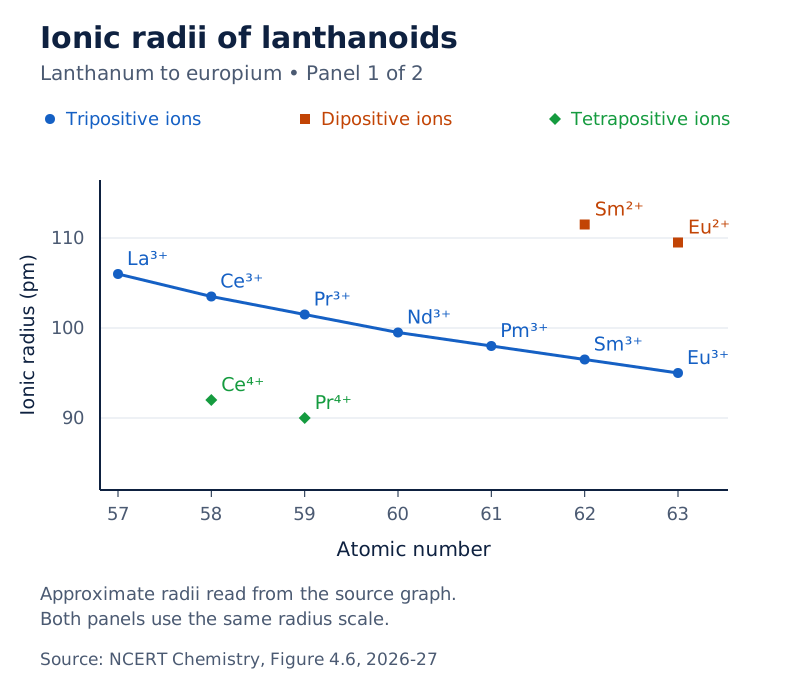
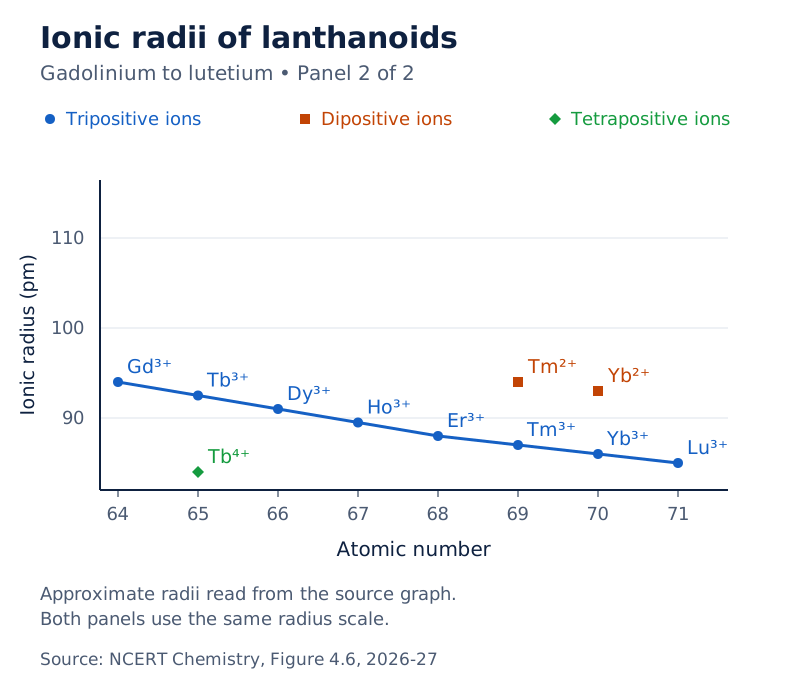
Ionic radius in picometres is plotted against atomic number. A descending sequence joins the labelled tripositive ions. Separate points for selected dipositive and tetrapositive ions lie above or below that sequence.
Drawn by One Young India. See Fig. 4.6 in your NCERT textbook
The contraction compensates for the size increase otherwise expected between corresponding second- and third-series transition metals. Zirconium and hafnium consequently have nearly identical radii, similar properties, occur together naturally and are difficult to separate.
Are all lanthanoid oxidation states identical?
The state predominates, but exceptions reflect the stability of empty, half-filled and filled f subshells. Cerium(IV) has , europium(II) has , and ytterbium(II) has . Cerium(IV) is an oxidant, whereas europium(II) and ytterbium(II) are reductants tending towards the common tripositive state.
Lanthanoid metals are silvery white and generally soft, and tarnish rapidly in air. They liberate hydrogen from dilute acids. Many tripositive ions are coloured and paramagnetic; ions with empty or completely filled f subshells do not have unpaired f electrons.
Mischmetall contains about 95 per cent lanthanoid metal and about 5 per cent iron, with traces of sulphur, carbon, calcium and aluminium. Lanthanoids are used in alloy steels; mixed oxides catalyse petroleum cracking, and some oxides provide phosphors for fluorescent surfaces.
How do actinoids compare with lanthanoids?
The actinoids comprise fourteen elements from thorium to lawrencium, following actinium. Their electronic structures involve the , and subshells. These subshells have comparable energies, permitting a wider range of oxidation states than in the lanthanoids.
The electrons are less deeply buried than the electrons and can participate more extensively in bonding. Actinoids are radioactive, which complicates their study. Their chemical behaviour is less uniform than that of the lanthanoids, especially in the earlier part of the series.
| Feature | Lanthanoids | Actinoids |
|---|---|---|
| Subshell progressively filled | ||
| Common oxidation behaviour | Predominantly , with some and | Commonly , with a wider range of higher states |
| Participation of f electrons | More deeply buried | More available for bonding |
| Size trend | Lanthanoid contraction | Greater contraction from element to element |
| Overall chemical pattern | Close similarities across the series | More irregular, particularly among early members |
Why are oxidation states and sizes less uniform?
The maximum oxidation state rises from in thorium to in protactinium, in uranium and in neptunium. Higher states are particularly important in the first half; the distribution across the entire series is uneven.
Actinoid contraction is the gradual decrease in atomic or tripositive-ion size across the series. Poor shielding by electrons makes the contraction greater from element to element than in the lanthanoid series. Similar size trends do not imply identical chemistry.
Actinoids are highly reactive, particularly when finely divided. Boiling water produces mixtures of oxides and hydrides; hydrochloric acid attacks the metals. Protective oxide layers can limit attack by nitric acid. Their reactivity, variable oxidation states and radioactivity all contribute to the complexity of their chemistry.
Glossary
- Transition element — An element with an incomplete d subshell in its neutral atom or in one of its ions.
- Penultimate shell — The shell immediately inside the outermost shell of an atom.
- Enthalpy of atomisation — Enthalpy change associated with converting an element into separate gaseous atoms.
- Ionisation enthalpy — Enthalpy required to remove an electron from an isolated gaseous atom or ion.
- Hydration enthalpy — Enthalpy change when gaseous ions become surrounded by water molecules in aqueous solution.
- Paramagnetism — Attraction towards an applied magnetic field associated with the presence of unpaired electrons.
- Diamagnetism — Magnetic behaviour in which a substance is repelled by an applied magnetic field.
- Ligand — An ion or molecule that binds to a metal in a complex species.
- Disproportionation — A reaction in which one oxidation state simultaneously forms a higher and a lower oxidation state.
- Interstitial compound — A compound formed when small atoms occupy spaces within a metal crystal lattice.
- Alloy — A blend of metals that may form a homogeneous solid solution.
- Lanthanoid contraction — The overall decrease in atomic and ionic radii from lanthanum to lutetium.
- Actinoid contraction — The gradual decrease in atomic or tripositive-ion sizes across the actinoid series.
Common errors and misconceptions
- Misconception: Every d-block element is a transition element. Correct: Zinc, cadmium and mercury have filled d subshells in their atoms and common ions and do not satisfy the transition-element definition.
- Misconception: Transition-metal atoms lose d electrons before s electrons. Correct: Outer s electrons are removed first when positive ions form.
- Misconception: A half-filled configuration makes every oxidation state equally stable in water. Correct: Atomisation, ionisation and hydration all affect stability; the surrounding medium matters.
- Misconception: Every transition-metal ion is coloured and paramagnetic. Correct: Empty and filled d subshells lack the usual d-electron colour mechanism and contain no unpaired d electrons.
- Misconception: Chromate-to-dichromate conversion oxidises chromium. Correct: Chromium remains in oxidation state ; acidity changes which oxoanion is favoured.
- Misconception: Permanganate always produces manganese(II). Correct: The reaction medium can favour manganese(II), manganese dioxide or manganate.
- Misconception: Lanthanoid contraction means every atomic radius changes perfectly regularly. Correct: The overall contraction is clearer and more regular for tripositive ions than for metallic atomic radii.
- Misconception: Lanthanoids exhibit no oxidation state except . Correct: Some also form or species, associated with favourable f-subshell configurations.
Exam-style questions with model answers
Q1. Define a transition element. Explain why scandium qualifies but zinc does not, given Sc: , Zn: , and Zn(II): . [2 marks]
- A transition element has an incomplete d subshell in its atom or an ion.
- Scandium has an incomplete d subshell in its atom. Zinc has a filled d subshell in both its atom and its common divalent ion, so it does not qualify.
Q2. Explain three characteristic properties of transition elements: high atomisation enthalpies, variable oxidation states and catalytic activity. [3 marks]
- Many transition-metal atoms contain several unpaired electrons. Participation of d and s electrons gives strong interatomic metallic bonding, so separating the solid into gaseous atoms requires substantial energy.
- Both outer s and inner d electrons can participate in bonding, allowing different oxidation states.
- Variable oxidation states and complex formation support catalytic cycles. On solid surfaces, adsorption increases reactant concentration and weakens bonds, lowering the activation energy of reaction.
Q3. Calculate the spin-only magnetic moment of aqueous Mn(II). Its configuration is , with five unpaired electrons. Use , where is magnetic moment, is the unpaired-electron count and BM means Bohr magneton. State its magnetic behaviour. [3 marks]
- The five electrons are unpaired, so the dimensionless count to substitute is . The unit of the calculated magnetic moment is Bohr magneton.
- Substitution gives .
- Evaluating and rounding gives . The ion is paramagnetic because it contains unpaired electrons and is attracted by an applied magnetic field. This is a spin-only prediction, not a claim of exact equality with an experimental measurement.
Q4. Explain why Cr(II) is reducing whereas Mn(III) is oxidising. Both have configurations; their relevant products are Cr(III), , and Mn(II), . [3 marks]
- Chromium(II) acts as a reducing agent by losing an electron. Its conversion into chromium(III) produces a configuration with one electron in each of the three lower-energy d orbitals, called the set, in the octahedral aqueous ion. This half-filled set gives extra stability.
- Manganese(III) acts as an oxidising agent by accepting an electron. This produces manganese(II), with its stable half-filled subshell.
- The different behaviour therefore depends on the stability of the products reached by oxidation or reduction. Identical initial d-electron counts do not imply identical redox behaviour in aqueous solution.
Q5. Describe preparation of K₂Cr₂O₇ from FeCr₂O₄ using sodium carbonate, air, acid and KCl. Give the balanced equations, explain crystallisation, and state what increasing pH does to dichromate. [5 marks]
- Fuse chromite ore with sodium carbonate in air to oxidise chromium and obtain sodium chromate: . Filter the yellow solution to separate insoluble material.
- Acidify the chromate solution to form orange dichromate: . This conversion leaves the oxidation state of chromium unchanged at .
- Add potassium chloride to sodium dichromate solution: .
- Orange potassium dichromate crystals separate because potassium dichromate is less soluble than sodium dichromate. This solubility difference makes isolation of the potassium salt possible.
- Increasing pH reverses the oxoanion conversion, favouring yellow chromate: . Thus acidity and alkalinity control which of the two chromium(VI) oxoanions predominates.
Q6. At in acidic solution, permanganate becomes Mn(II) and oxalate becomes CO₂. Balance the reaction using hydrogen ions and water, and explain why hydrochloric acid is unsuitable for permanganate titration. [5 marks]
- The permanganate reduction half-reaction is . Each permanganate ion therefore accepts five electrons in this acidic medium.
- The oxalate oxidation half-reaction is . Each oxalate ion supplies two electrons, so the electron transfer must be matched before adding the equations.
- Multiply the reduction by two and the oxidation by five, then cancel ten electrons. The complete equation is .
- The oxalate oxidation is carried out at . Both atoms and net electric charge are conserved in the final equation.
- Hydrochloric acid is unsuitable because permanganate can oxidise it to chlorine. That competing oxidation consumes oxidant and makes the titration unsatisfactory.
Q7. Define lanthanoid contraction, explain its cause, and relate it to zirconium and hafnium, whose atomic radii are and , respectively. [3 marks]
- Lanthanoid contraction is the overall decrease in atomic and ionic sizes from lanthanum to lutetium. The decrease is especially regular among tripositive ions.
- Added electrons do not completely shield increasing nuclear charge, so the outer electron cloud experiences increasing attraction.
- This contraction offsets the expected size increase between the second and third transition series. Zirconium and hafnium therefore have nearly identical radii and closely similar properties, helping explain their natural association and difficult separation.
Q8. Compare lanthanoids and actinoids with respect to subshell filling, oxidation states and participation of f electrons in bonding. [3 marks]
- Lanthanoids progressively fill the subshell, whereas actinoids progressively fill the subshell.
- Lanthanoids predominantly exhibit , with some and states. Actinoids show a wider range, especially among earlier members, because their , and energy levels are comparable.
- The electrons are less deeply buried and can participate more extensively in bonding than electrons. Actinoid chemistry is consequently less uniform, and radioactivity further complicates its study.
Key takeaways
- A transition element needs an incomplete d subshell in its atom or an ion; d-block location alone is insufficient.
- Remove outer s electrons before inner d electrons when writing the configurations of positive transition-metal ions.
- Variable oxidation states reflect participation of s and d electrons, while aqueous stability also depends strongly on hydration.
- Count unpaired electrons before calculating a spin-only magnetic moment, and retain Bohr magnetons throughout the calculation.
- Chromate and dichromate interconvert with changing acidity while chromium retains the same oxidation state in both ions.
- The medium determines whether permanganate reduction yields manganese(II), manganese dioxide or manganate, so reaction conditions are essential.
- Lanthanoid contraction explains nearly equal sizes and closely related properties of corresponding second- and third-series transition metals.
- Actinoids have more varied oxidation states because their available subshells have comparable energies and their f electrons participate more in bonding.
Test yourself
Why can silver qualify as a transition element despite its filled atomic d subshell?
Silver can form a dipositive ion with an incomplete d subshell, which satisfies the transition-element definition.
Why is the third ionisation enthalpy of manganese unusually high?
It removes an electron from the stable half-filled subshell of manganese(II), disrupting that favourable configuration.
What is the distinction between the calculated and observed magnetic moment?
The spin-only calculation uses the unpaired-electron count. An experimentally observed moment can differ because the simplified model does not capture every contribution.
Why does the colour of a transition-metal ion depend on its ligands?
Ligands affect the separation between d-orbital energies and therefore the frequency of light absorbed during electronic excitation.
What happens when aqueous dichromate is made more alkaline?
It is converted towards yellow chromate, without changing the chromium oxidation state from .
How many electrons does one acidified permanganate ion accept on forming manganese(II)?
It accepts five electrons; hydrogen ions and water complete the balanced reduction half-reaction in acidic solution.
Why do zirconium and hafnium resemble each other closely?
Lanthanoid contraction makes their atomic radii almost identical, contributing to similar properties and difficulty in separating them.
What distinguishes an interstitial compound from a substitutional alloy?
Small atoms occupy lattice spaces in an interstitial compound. In a substitutional alloy, atoms of one metal replace those of another.