
Coordination Compounds | CBSE Class 12 Chemistry Notes
On this page
Watch & explore
Start with a few high-quality watches, then dive into the notes below.
This note covers Werner’s theory, coordination terminology, ligand types, coordination number, oxidation state, systematic nomenclature, geometrical and optical isomerism, structural isomerism, valence bond theory, crystal field splitting, magnetic behaviour, colour, bonding in metal carbonyls and applications of coordination compounds.
How does Werner’s theory explain coordination compounds?
Coordination compounds contain a metal atom or ion attached to surrounding ions or molecules through sharing of electrons. The attached groups form a recognisable coordination entity. Werner distinguished two kinds of linkage to explain the behaviour of metal salts containing ammonia.
Primary and secondary valences
- Primary valences are normally ionisable and are satisfied by negative ions.
- Secondary valences are non-ionisable and are satisfied by neutral molecules or negative ions.
- The secondary valence corresponds to the coordination number. In Werner’s cobalt(III) chloride-ammonia examples, six groups remain directly attached to cobalt.
- Secondary linkages have characteristic spatial arrangements. These arrangements explain why compounds with the same composition may have different properties.
The groups enclosed within square brackets remain together under the precipitation conditions. Chloride outside the brackets can precipitate as silver chloride when excess silver nitrate is added in the cold. Chloride attached directly to cobalt does not behave in the same way under these conditions.
| Compound | Colour | Silver chloride from one mole | Electrolyte type |
|---|---|---|---|
| Yellow | |||
| Purple | |||
| Green | |||
| Violet |
Worked example 1. Find the amount of silver chloride from of with excess silver nitrate in the cold. There are three outside chloride ions per formula unit.
Answer: Let be the amount of complex salt and the amount of precipitate, both in moles.
The precipitate is 3 mol AgCl. The six ammonia ligands remain in the coordination entity; the three counter ions account for the precipitate.
Isomers explain the green and violet compounds: their overall composition is identical, but their arrangement differs. Werner’s theory accounts for coordination geometry and this difference without treating all chloride ions as chemically equivalent.
What do coordination entity, sphere and coordination number mean?
Definition: A coordination entity consists of a central metal atom or ion bonded to a definite number of surrounding ions or molecules called ligands.
The central atom or ion occupies the central position in the coordination entity and acts as a Lewis acid. For example, cobalt is the central metal in . Its surrounding groups are one chloride ligand and five ammonia ligands.
The coordination sphere includes the metal and the attached ligands inside square brackets. Counter ions lie outside. In , the sphere is , while potassium ions are the counter ions.
Count donor atoms, then identify the shape
The coordination number, abbreviated CN, counts donor atoms directly bonded to the metal through sigma bonds. Additional pi bonding does not increase this count. Thus, a ligand count alone is insufficient when some ligands attach through more than one atom.
In , six chloride donor atoms give a coordination number of six. In , en denotes ethane-1,2-diamine. Three didentate ligands also provide six donor atoms, so the coordination number is again six.
The coordination polyhedron describes the spatial arrangement of these donor atoms. The entity is octahedral, is tetrahedral, and is square planar. Coordination number four therefore does not uniquely identify the shape.
How do double salts differ from complexes?
Double salts, including Mohr’s salt and potash alum, dissociate completely into simple ions in water. A complex ion can retain its identity in solution: does not dissociate into separate iron(II) and cyanide ions under the described conditions.
A homoleptic complex contains one kind of donor group, as in . A heteroleptic complex contains more than one kind, as in . These terms classify ligand variety, rather than charge or geometry.
How are ligands classified by their donor atoms?
A ligand is an ion or molecule attached to the central metal. Ligands range from small species such as water and ammonia to large molecules and proteins. Their donor atoms supply electron pairs for bonding to the metal.
Denticity describes how many donor groups in a ligand attach to the same metal. A unidentate ligand uses one donor atom, a didentate ligand can use two, and a polydentate ligand has several potential donor atoms.
| Ligand | Classification | Donor information |
|---|---|---|
| NH₃ or H₂O | Unidentate | One donor atom per ligand |
| Unidentate | One chloride donor atom | |
| Ethane-1,2-diamine, en | Didentate | Two nitrogen donor atoms |
| Oxalate, | Didentate | Two donor atoms bind the metal |
| Hexadentate | Two nitrogen and four oxygen donor atoms |
Chelating and ambidentate ligands
Chelation occurs when a ligand attaches to the same metal through two or more donor atoms simultaneously. Such complexes tend to be more stable than similar complexes containing unidentate ligands. The comparison concerns similar complexes, rather than an unconditional stability ranking.
An ambidentate ligand offers two different kinds of donor atom but attaches through either one in a particular linkage. Nitrite can attach through nitrogen or oxygen; thiocyanate can attach through sulphur or nitrogen. This alternative attachment produces linkage isomerism.
Note: Didentate and ambidentate describe different situations. Ethane-1,2-diamine uses two donor atoms together; an ambidentate ligand offers alternative donor atoms for attachment.
Worked example 2. Determine the coordination number of iron in , given that each oxalate ligand is didentate.
Answer: There are three ligands, each supplying two donor atoms. Coordination number is a dimensionless count.
The three ligands supply six directly attached donor atoms; the negative charge of the entity does not change this count.
How are oxidation states and formulas determined?
The oxidation number of the central atom is the formal charge it would have if the ligands were removed with the shared electron pairs. It differs from both coordination number and the charge on the complete coordination entity.
Derivation: oxidation state from charge balance
Let be the metal oxidation number, the signed charge number of the coordination entity, the number of ligands of type , and their individual signed charge numbers. These are dimensionless numbers; means summation over ligand types.
- The total ligand charge number is where denotes the combined ligand charge number.
- The metal and ligand contributions give
- Rearrangement gives
Result: Determine the entity charge first, then subtract the ligand charge contribution. A neutral ligand contributes zero, but still counts towards coordination number.
Worked example 3. Find the oxidation number of copper in . Each cyanide ligand has charge number .
Answer: Oxidation and charge numbers are dimensionless.
Copper is therefore copper(I), even though the entity as a whole is negatively charged.
Writing a coordination formula
- Write the central metal first, then the ligands in alphabetical order, irrespective of charge. Use the first letter of an abbreviation when ordering an abbreviated ligand.
- Enclose polyatomic ligand formulas and ligand abbreviations in parentheses, and enclose the complete entity in square brackets.
- Write the charge of an isolated complex ion outside the bracket, with the number before the sign.
- Add counter ions in the proportion needed to balance the total charge. Do not insert spaces between the metal and ligands within the formula.
For potassium trioxalatoaluminate(III), three oxalate ligands surround aluminium(III). Their combined negative charge exceeds the metal’s positive charge by three, giving . For tetracarbonylnickel(0), neutral carbonyl ligands and nickel in oxidation state zero give .
How are coordination compounds named systematically?
Systematic nomenclature identifies the ligands, their numbers, the metal and its oxidation state. In a salt, name the cation before the anion. Within a coordination entity, name the ligands before the metal, using alphabetical order.
Ligand names and numerical prefixes
Common neutral ligand names include ammine for ammonia, aqua for water, carbonyl for carbon monoxide and nitrosyl for nitric oxide. Use the modern names chlorido and cyanido for the corresponding anionic ligands. Notice the double m in ammine.
Use di, tri and similar prefixes for repeated simple ligands. Use bis, tris or tetrakis when the ligand name already includes a numerical prefix, placing that ligand name in parentheses. Alphabetical ordering follows the ligand names rather than these multiplying prefixes.
For a cationic or neutral entity, retain the metal’s ordinary name. For an anionic entity, use a name ending in ate; some metals use a Latin-derived form, such as ferrate for iron. Give the metal oxidation state as a Roman numeral in parentheses.
| Formula | Systematic name |
|---|---|
| Triamminetriaquachromium(III) chloride | |
| Potassium trioxalatochromate(III) | |
| Dichloridobis(ethane-1,2-diamine)cobalt(III) chloride | |
| Pentaamminecarbonatocobalt(III) chloride | |
| Tetracarbonylnickel(0) |
Worked example 4. Determine the cobalt oxidation state in . Ethane-1,2-diamine is neutral and each sulphate ion has charge number .
Answer: Let be the charge number of each complex cation and the cobalt oxidation number; both are dimensionless.
The name is tris(ethane-1,2-diamine)cobalt(III) sulphate. The name of the salt does not state the numbers of complex cations and counter anions.
How can precipitation reveal coordination numbers?
Worked example 5. Find the silver chloride precipitate from of purple with excess silver nitrate in the cold, and explain the coordination number.
Formula: Let be the amount of salt, the number of outside chlorides per formula unit and the amount of precipitate. Let and count bound chloride and ammonia donor atoms. Then and , where is the dimensionless coordination number.
Substitute: The formula gives , and .
- The two outside chlorides precipitate:
- One bound chloride and five ammonia donors surround cobalt:
Answer: 2 mol AgCl precipitates. Cobalt has coordination number six; the bound chloride remains within the coordination sphere.
Worked example 6. Find the silver chloride precipitate from of either the green or violet form of with excess silver nitrate in the cold, and determine the coordination number.
Formula: With the amount of salt and its outside chloride count, the precipitate amount is . If and count bound chloride and ammonia donor atoms, the coordination number is .
Substitute: Both forms have , and .
- The single outside chloride precipitates:
- The bound donor atoms give
Answer: 1 mol AgCl precipitates from either form, and each has coordination number six. Their different colours do not imply different numbers of ionisable chloride ions.
Worked example 7. Aqueous gives of silver chloride per mole of compound with excess silver nitrate. Assign palladium’s secondary valence.
Answer: The observed 2 mol AgCl corresponds to two outside chloride ions per formula unit. Subtract these from the total chloride count to find how many chlorides remain bound.
- Bound chlorides:
- Four ammonia molecules supply four donor atoms:
The secondary valence is four. The coordination formulation is ; the two chloride counter ions account for the precipitate.
Worked example 8. Aqueous gives of silver chloride per mole of compound with excess silver nitrate. Assign nickel’s secondary valence.
Answer: The observed 2 mol AgCl places both chloride ions outside the coordination sphere. The six water molecules supply the donor atoms.
- Bound chlorides:
- Adding the six water donors gives
The secondary valence is six, with coordination formulation . The same precipitate amount as in the palladium example does not imply the same coordination number.
Worked example 9. Aqueous gives no silver chloride precipitate with excess silver nitrate. Assign platinum’s secondary valence.
Answer: The precipitate amount is 0 mol AgCl per mole of compound. No chloride is present as an outside counter ion under these conditions.
- Count all chlorides in the composition, including those written in the two HCl units:
- Subtract the outside chloride count:
- All six bound chlorides are unidentate donors, so
The secondary valence is six. The coordination formulation is ; hydrogen ions are outside the anionic coordination sphere.
How do geometrical and optical isomerism differ?
Stereoisomers have the same chemical formula and bonds but different spatial arrangements. Geometrical isomerism changes the relative positions of ligands; optical isomerism involves mirror images that cannot be superimposed.
Cis, trans, facial and meridional arrangements
In square planar , the chloride ligands can be adjacent in the cis form or opposite in the trans form. Octahedral also has adjacent and opposite chloride arrangements.
What the figure shows
Cis and trans platinum complexes
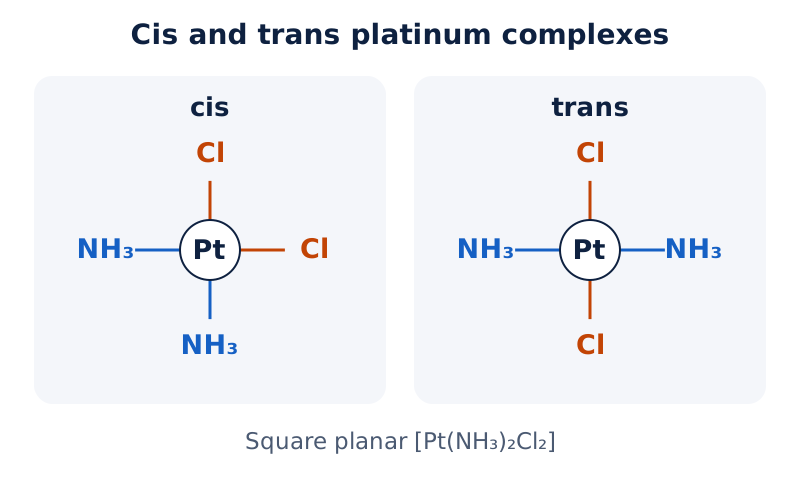
Two drawings place platinum at the centre with two chloride and two ammonia ligands. The cis drawing has adjacent chlorides; the trans drawing places the chlorides opposite one another.
Drawn by One Young India. See Fig. 5.2 in your NCERT textbook
Tetrahedral complexes with two types of unidentate ligand do not show this geometrical isomerism, because the relative positions of their ligand sites are equivalent. A two-dimensional sketch must therefore be interpreted using the actual three-dimensional geometry.
In octahedral , three identical donor groups may occupy a face, producing the facial or fac form. Their alternative arrangement around a meridian gives the meridional or mer form.
What the figure shows
Facial and meridional arrangements
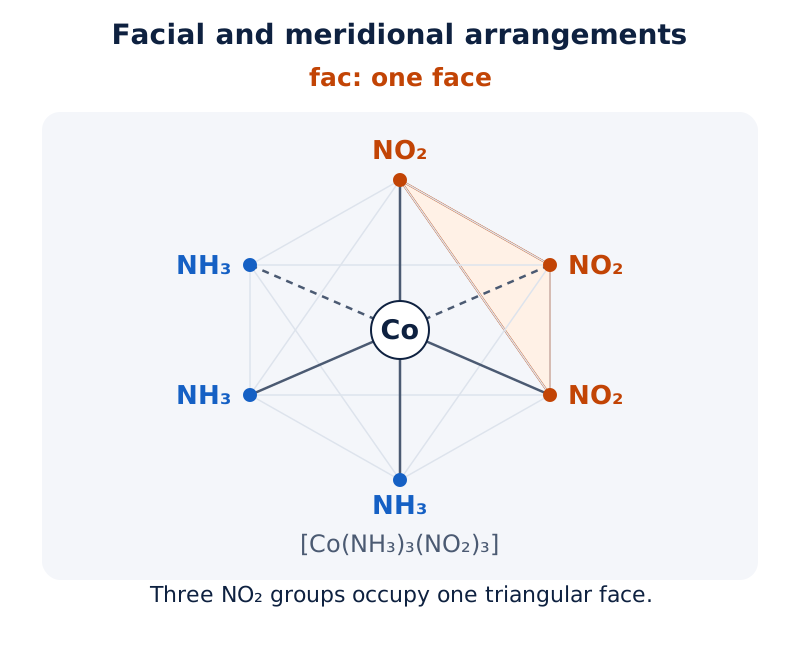
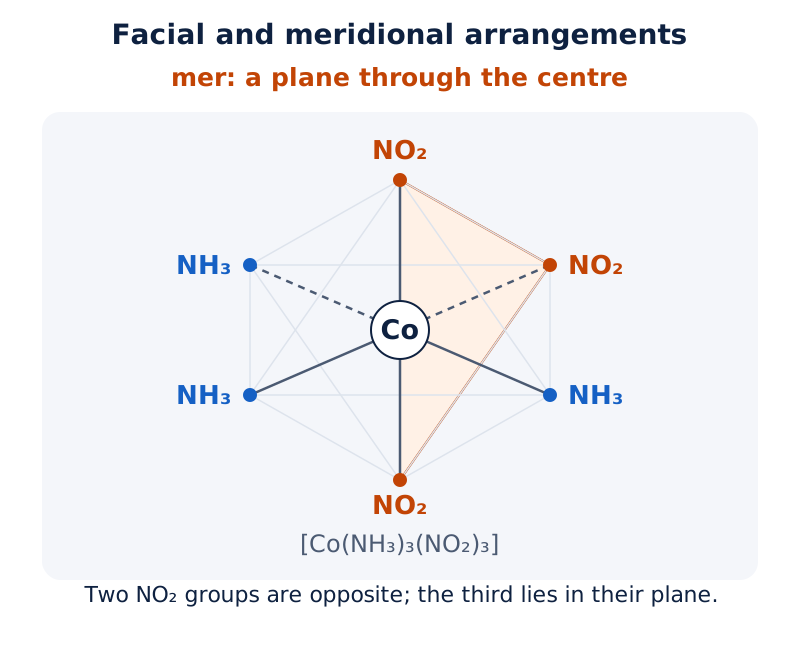
The cobalt complexes show three ammonia and three nitrite groups. A shaded triangular face marks the fac arrangement; the mer drawing places the corresponding groups around a section through the centre.
Drawn by One Young India. See Fig. 5.5 in your NCERT textbook
Optical activity and chirality
Enantiomers are non-superimposable mirror images. Such entities are chiral. The dextro form rotates plane-polarised light to the right and the laevo form to the left. Optical isomerism is common in octahedral complexes containing didentate ligands.
The ion has an optical pair. For , only the cis isomer shows optical activity. Thus, geometrical and optical classifications can both apply to members of the same family of complexes.
What the figure shows
Mirror-image cobalt complexes
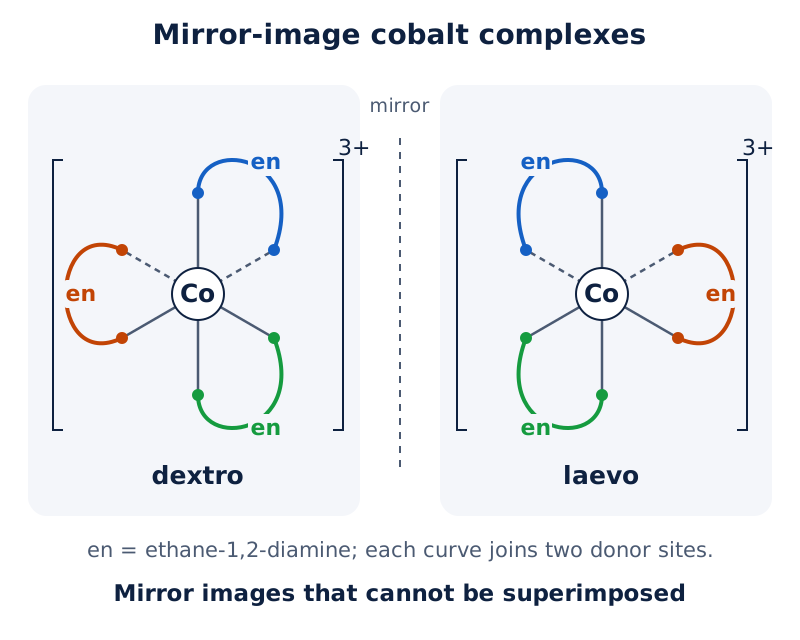
Two bracketed cobalt entities, each with three curved en connections and a three-positive charge, appear on either side of a mirror line. The drawings are labelled dextro and laevo.
Drawn by One Young India. See Fig. 5.6 in your NCERT textbook
What changes in structural isomerism?
Structural isomers differ in their bonds rather than merely in spatial arrangement. Coordination compounds show linkage, coordination, ionisation and solvate isomerism. The useful diagnostic question is which attachment changes between the two formulas.
Linkage and coordination isomerism
Linkage isomerism requires an ambidentate ligand. In cobalt ammine complexes containing nitrite, attachment through oxygen gives a red form, while attachment through nitrogen gives a yellow form. The ligand composition remains the same, but its donor atom changes.
Coordination isomerism exchanges ligands between complex cations and complex anions. In , ammonia surrounds cobalt and cyanide surrounds chromium. In , these ligand assignments are interchanged.
Ionisation and solvate isomerism
Ionisation isomerism exchanges a coordinated ligand with a counter ion capable of acting as a ligand. The pair and illustrates this distinction. They supply different free ions in solution.
The first supplies bromide, which precipitates with silver ions. The second supplies sulphate, which precipitates with barium ions. The diagnostic ionic equations, with aqueous species labelled aq and solid precipitates labelled s, are:
Solvate isomerism changes whether a solvent molecule binds directly to the metal or remains in the crystal lattice. When water is involved, it is called hydrate isomerism. Violet and grey-green provide an example.
Note: Distinguish a change of donor atom from a change of counter ion. The former identifies linkage isomerism; the latter can identify ionisation isomerism. Water outside the coordination brackets is not counted as a metal-bound ligand.
How does valence bond theory explain shape and magnetism?
Valence bond theory, or VBT, describes suitable metal orbitals combining into hybrid orbitals of definite geometry. Each can overlap with a ligand orbital containing an electron pair. Hybridisation is a mathematical description of the orbitals, rather than a separate set of physically pre-existing orbitals.
The letters , and identify orbital types; superscripts in hybridisation labels count the orbitals combined. By contrast, a configuration such as describes six electrons in the third-shell d subshell.
| Coordination number | Hybridisation | Geometry |
|---|---|---|
| Four | Tetrahedral | |
| Four | Square planar | |
| Five | Trigonal bipyramidal | |
| Six | Octahedral, inner orbital | |
| Six | Octahedral, outer orbital |
Inner and outer orbital complexes
In , cobalt(III) has a configuration. Electron pairing makes two inner d orbitals available for hybridisation. Six ammonia electron pairs occupy the bonding hybrids, producing a diamagnetic octahedral inner orbital complex.
In , cobalt(III) retains four unpaired electrons and uses outer d orbitals in hybridisation. It is an octahedral, paramagnetic outer orbital complex. The metal oxidation state alone therefore cannot determine magnetic behaviour.
Nickel complexes provide a useful comparison
| Entity | Nickel oxidation state | Shape and hybridisation | Magnetic behaviour |
|---|---|---|---|
| Tetrahedral, | Paramagnetic; two unpaired electrons | ||
| Square planar, | Diamagnetic; no unpaired electrons | ||
| Zero | Tetrahedral, | Diamagnetic; no unpaired electrons |
Paramagnetism indicates unpaired electrons, whereas these diamagnetic complexes contain no unpaired electrons. Magnetic susceptibility measurements help infer electron arrangements and structures, but VBT does not provide a quantitative interpretation of magnetic data.
VBT also fails to explain colour, distinguish weak and strong ligands, or give quantitative thermodynamic and kinetic stability predictions. Its predictions between tetrahedral and square planar structures for four-coordinate complexes are not exact. A different model is needed to explain orbital energy separations.
How does an octahedral crystal field split the d orbitals?
Crystal field theory, or CFT, treats metal-ligand interactions electrostatically. Anionic ligands are represented as point charges and neutral ligands as point dipoles. The five d orbitals of an isolated gaseous metal atom or ion have the same energy: they are degenerate.
A spherical field raises their energy equally. Six ligands arranged octahedrally do not repel all d orbitals equally. Orbitals directed towards the ligand positions experience greater repulsion than orbitals directed between those positions.
The higher set contains and ; the lower set contains , and . Here , and denote spatial coordinate axes; the orbital subscripts identify their orientations.
Let denote the octahedral crystal field splitting energy. The subscript o identifies the octahedral field. The average energy is the barycentre; relative to it, the lower set moves down and the higher set moves up.
What the figure shows
Octahedral crystal field splitting
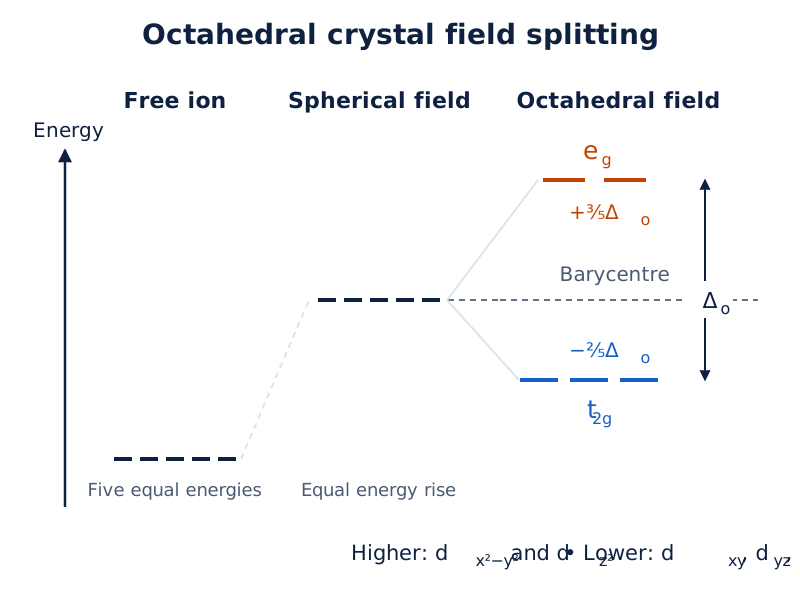
An upward energy axis accompanies levels for the free ion, spherical field and octahedral field. The final diagram has three lower levels labelled , two upper levels labelled , and a dashed barycentre between them.
Drawn by One Young India. See Fig. 5.8 in your NCERT textbook
Derivation: energies relative to the barycentre
Let and be the energies of individual orbitals in the lower and upper sets, measured relative to the barycentre. Both have the same energy units as .
- The separation of the two sets is
- The weighted average remains at the barycentre, so
- Substitute the first relation into the second:
- Solving gives
Result: Each lower orbital lies two-fifths of the splitting energy below the average, while each upper orbital lies three-fifths above it. These are orbital energy shifts, not a statement that every complex has the same total electronic energy.
What determines high spin, low spin and tetrahedral splitting?
The size of crystal field splitting depends on the ligand field and the charge on the metal ion. The experimentally determined spectrochemical series arranges ligands in increasing field strength.
The shared oxalate term joins the two lines into one increasing sequence. The SCN and NCS forms distinguish sulphur and nitrogen attachment of thiocyanate. Carbon monoxide lies towards the strong-field end, whereas halide ligands lie towards the weak-field end.
Compare splitting energy with pairing energy
Let denote the pairing energy, the energy required to pair electrons within one orbital. For the first three d electrons in an octahedral field, the lower orbitals fill singly. A fourth electron introduces a choice between pairing and occupying the higher set.
- If , the fourth electron enters the upper set. The configuration is , giving the high-spin arrangement.
- If , pairing in the lower set is energetically preferable. The configuration is , giving the low-spin arrangement.
Superscripts on these set labels count electrons. Strong-field cyanide complexes illustrate greater pairing: has one unpaired electron, while has five. An inner orbital complex need not be diamagnetic; it may retain unpaired electrons.
What changes in a tetrahedral field?
Let denote the tetrahedral splitting energy. For the same metal, ligands and metal-ligand distances, the relation is The tetrahedral order is inverted: the two-orbital e set lies lower and the three-orbital t set, labelled , lies higher.
Tetrahedral splitting is smaller, so it generally cannot force electron pairing; low-spin tetrahedral configurations are rarely observed. Tetrahedral complexes lack a centre of symmetry, so their level labels omit the g subscript used for centrosymmetric arrangements.
Why are coordination compounds coloured?
The observed colour depends on which wavelengths are removed from white light passing through a sample. A complex appears in a colour complementary to the absorbed light. In the CFT description, absorption can promote an electron between split d levels.
The titanium aqua complex
The violet ion contains titanium(III) with one d electron. In the ground state, it occupies the lower octahedral set. Absorption of blue-green light raises it to the upper set:
The absorbed wavelength is , where nm denotes nanometres. The remaining transmitted light gives the violet appearance. This is a d-d transition, connecting the colour with the separation of the metal’s d orbital energies.
Changing ligands changes the colour
Progressively replacing water in the nickel(II) aqua complex with ethane-1,2-diamine changes its colour. Each didentate en ligand replaces two coordinated water molecules. The following balanced substitutions show aqueous species with aq; the water released is written separately.
- Green changes to pale blue.
- The product is blue/purple.
- The product is violet.
CFT explains many colour and magnetic observations, but its limitations arise from the electrostatic assumptions. Treating ligands as point charges does not explain the observed spectrochemical ordering satisfactorily, and the model neglects covalent contributions to metal-ligand bonding.
For example, anionic ligands are not uniformly the strongest-field ligands. A theory that accounts for covalent interactions is needed for a fuller explanation. CFT remains valuable for connecting ligand arrangement, d orbital splitting, electron occupation and absorption.
How do metal carbonyls bond, and where are complexes useful?
Metal carbonyls contain carbon monoxide ligands. Homoleptic carbonyls contain only this ligand type. Tetracarbonylnickel(0) is tetrahedral, pentacarbonyliron(0) is trigonal bipyramidal and hexacarbonylchromium(0) is octahedral.
Synergic bonding
The metal-carbon bond has both sigma, written , and pi, written , character. The carbon donor supplies a lone pair to an empty metal orbital to form the sigma component.
For the pi component, a filled metal d orbital donates electron density into an empty antibonding orbital of carbon monoxide. The notation denotes that antibonding pi orbital. These interacting donations produce synergic bonding, strengthening the metal-carbonyl bond.
What the figure shows
Synergic bonding in a carbonyl complex
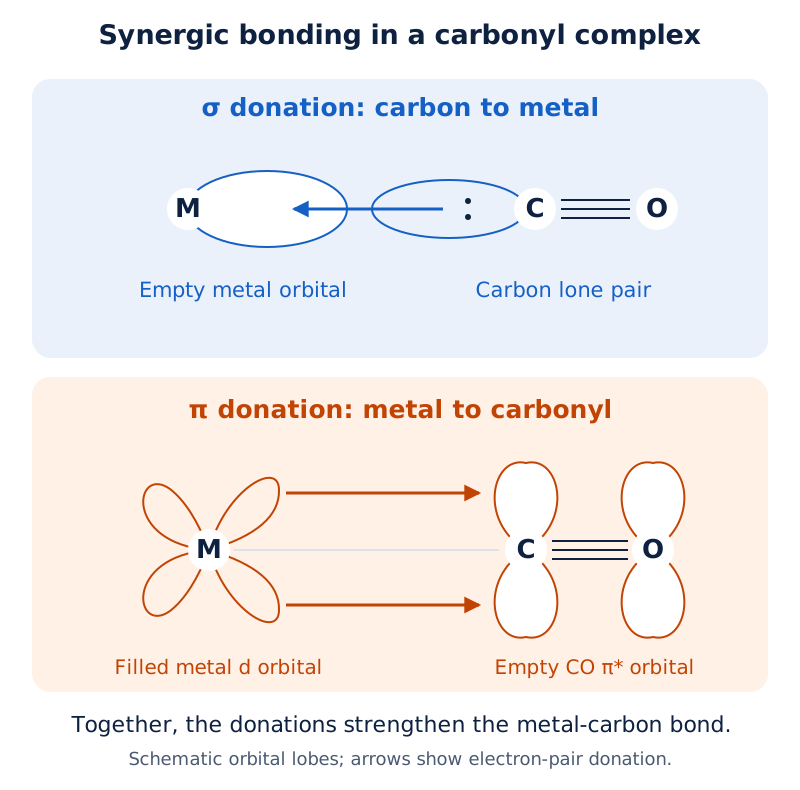
The drawing places the metal on the left and carbon monoxide on the right, with carbon towards the metal. Coloured orbital lobes and arrows distinguish sigma donation towards the metal from pi donation towards the carbonyl ligand.
Drawn by One Young India. See Fig. 5.14 in your NCERT textbook
Applications in analysis, biology and industry
| Area | Example and role |
|---|---|
| Chemical analysis | Ligands such as EDTA and dimethylglyoxime form complexes used to detect or estimate metal ions. |
| Water hardness | Calcium and magnesium form stable EDTA complexes, allowing hardness estimation by titration. |
| Metal extraction | Gold forms in cyanide solution with oxygen and water; zinc then separates metallic gold. |
| Nickel purification | Formation of , followed by decomposition, yields pure nickel. |
| Biological systems | Chlorophyll contains magnesium, haemoglobin contains iron, and vitamin B₁₂ contains cobalt. |
| Catalysis | Wilkinson’s rhodium complex catalyses the hydrogenation of alkenes. |
| Photography | Hypo dissolves undecomposed silver bromide by forming during fixing. |
Silver and gold can be electroplated more smoothly and evenly from their cyanide complex solutions than from simple metal-ion solutions. In medicine, chelating agents bind excess metals, while cisplatin and related platinum compounds inhibit tumour growth.
These applications depend on the ability of ligands to change a metal species’ chemical behaviour. Complex formation can help keep a metal in solution, separate it during analysis, transport it in a biological system or provide a useful catalyst.
Glossary
- Coordination entity — A central metal atom or ion bonded to a definite set of surrounding ligands.
- Ligand — An ion or molecule attached to the central metal through one or more donor atoms.
- Coordination number — The number of ligand donor atoms directly bonded to the central metal through sigma bonds.
- Coordination sphere — The metal and its attached ligands enclosed together within square brackets.
- Counter ion — An ion outside the coordination sphere that balances the charge of the complex ion.
- Denticity — The number of donor groups through which a ligand binds to the same metal.
- Ambidentate ligand — A ligand capable of binding through either of two different donor atoms.
- Chelate ligand — A ligand binding one metal simultaneously through two or more donor atoms.
- Homoleptic complex — A coordination complex in which the metal binds only one kind of donor group.
- Enantiomers — Two optical isomers whose mirror-image structures cannot be superimposed on one another.
- Crystal field splitting — Separation of initially degenerate d orbital energies caused by ligands in a definite geometry.
- Pairing energy — The energy required for electron pairing within a single orbital of the metal.
- Spectrochemical series — An experimentally determined arrangement of ligands in order of increasing crystal field strength.
- Synergic bonding — Interacting ligand-to-metal sigma donation and metal-to-ligand pi donation that strengthen metal-carbonyl bonding.
Common errors and misconceptions
- Misconception: Coordination number equals the number of ligand molecules. Correct: Count directly attached donor atoms; three didentate ligands can give coordination number six.
- Misconception: The oxidation state equals the complex charge. Correct: Include all ligand charges when calculating the formal oxidation number of the central metal.
- Misconception: An ambidentate ligand must attach through both donor atoms together. Correct: It can attach through either donor atom; simultaneous two-atom attachment describes didentate coordination.
- Misconception: Every chloride in a coordination compound precipitates immediately with silver nitrate. Correct: Distinguish outside chloride ions from chloride ligands retained in the sphere under the stated conditions.
- Misconception: Every four-coordinate complex is tetrahedral. Correct: Square planar complexes also occur; the nickel cyanide and nickel chloride complexes have different geometries.
- Misconception: Every inner orbital complex is diamagnetic. Correct: Inner orbital complexes can retain unpaired electrons, as in the iron(III) cyanide complex.
- Misconception: The observed colour is the absorbed colour. Correct: The observed colour is complementary to the light removed from the incident light.
- Misconception: Crystal field theory includes covalent metal-ligand bonding. Correct: Its electrostatic model neglects that contribution, which is one of its limitations.
Exam-style questions with model answers
Q1. Distinguish a didentate ligand from an ambidentate ligand, using ethane-1,2-diamine and nitrite as examples. [2 marks]
- A didentate ligand binds through two donor atoms together. Ethane-1,2-diamine can bind the same metal through its two nitrogen atoms.
- An ambidentate ligand offers alternative donor atoms. Nitrite binds through nitrogen or oxygen in a particular linkage, rather than through both as the defining feature.
Q2. One mole of reacts with excess silver nitrate in the cold. Each outside chloride ion gives one silver chloride unit; coordinated chloride remains attached. Calculate the precipitate amount. [2 marks]
- The formula contains two outside chloride ions. The third chloride is coordinated to cobalt and remains within the sphere under the specified conditions.
- Multiplying the amount of salt by its precipitation ratio gives The precipitate amount is therefore two moles.
Q3. Name , and determine the cobalt oxidation state and coordination number. Here en is neutral, didentate ethane-1,2-diamine; each chloride has charge number . [3 marks]
- The outside chloride requires a complex charge number of . Let be cobalt’s dimensionless oxidation number. Charge balance gives
- Solving the charge-balance equation gives
- Two chlorides provide two donor atoms and two en ligands provide four. The dimensionless coordination number is
- The name is dichloridobis(ethane-1,2-diamine)cobalt(III) chloride. Chlorido precedes ethane-1,2-diamine alphabetically; bis indicates two of the latter ligand.
Q4. Classify the isomerism of each pair and explain the difference: and ; and ; and . [3 marks]
- The first pair shows coordination isomerism. Ammonia and cyanide ligands exchange their attachment between cobalt and chromium in the complex cation and anion.
- The second pair shows ionisation isomerism. Sulphate and bromide exchange the roles of coordinated ligand and outside counter ion, producing different free ions in solution.
- The third pair shows hydrate, or solvate, isomerism. One water molecule changes from direct metal coordination to lattice water, while chloride enters the sphere.
Q5. Use VBT to compare , and . Nickel(II) is ; cyanide induces pairing whereas chloride does not. Nickel in the carbonyl has oxidation state zero and no unpaired electrons. State hybridisation, geometry and magnetism. [5 marks]
- In the cyanide complex, nickel(II) has eight d electrons. Pairing makes an inner d orbital available for combination with one s and two p orbitals. The resulting hybridisation gives square planar geometry. All electrons are paired, so the complex is diamagnetic.
- In the chloride complex, the nickel(II) d electrons do not undergo this pairing. The metal uses one s and three p orbitals to produce hybrids directed tetrahedrally. Two unpaired electrons remain, making the complex paramagnetic.
- The nickel carbonyl is also tetrahedral and uses hybridisation, but nickel has oxidation state zero. With no unpaired electrons, it is diamagnetic. Thus, identical coordination number or identical geometry need not imply identical magnetic behaviour.
Q6. Explain octahedral d orbital splitting and the two possible arrangements for a ion. Let be the splitting energy and the electron-pairing energy. Relate each arrangement to field strength. [5 marks]
- In an isolated gaseous metal ion, all five d orbitals are degenerate. Six octahedral ligands repel orbitals pointing towards them more strongly than those directed between the ligand positions.
- The and orbitals form the higher set; , and form the lower set. The letters x, y and z identify spatial axes. The separation is the octahedral splitting energy.
- The first three electrons occupy lower orbitals singly. If , occupying an upper orbital costs less than pairing. A weak field therefore gives the high-spin configuration .
- If , pairing in a lower orbital is preferable. A strong field gives the low-spin configuration . The comparison of the two energies determines the fourth electron’s position.
Q7. The violet octahedral ion has one d electron and absorbs blue-green light at . Explain its colour using CFT and give one limitation of that theory. [3 marks]
- The single d electron initially occupies the lower set. The next available higher level belongs to the set.
- Absorption of the given blue-green light promotes the electron: The transmitted light produces the complementary violet appearance, rather than the absorbed colour.
- CFT describes the ligand interaction electrostatically and neglects covalent metal-ligand bonding. Its point-charge assumptions also fail to explain the spectrochemical ordering fully.
Q8. Explain the two contributions to bonding in a metal carbonyl and state two applications of coordination compounds, with an example for each. [4 marks]
- The carbonyl carbon donates a lone pair into an empty metal orbital, forming the sigma contribution to the metal-carbon bond.
- A filled metal d orbital donates an electron pair into an empty antibonding pi orbital of carbon monoxide. These interacting donations produce synergic bonding and strengthen metal-carbonyl attachment.
- For water-hardness estimation, EDTA forms stable complexes with calcium and magnesium ions, enabling titration.
- For nickel purification, impure nickel forms nickel tetracarbonyl; decomposition of this coordination compound then yields pure nickel.
Key takeaways
- Werner’s distinction between ionisable and coordinated groups explains precipitation behaviour and the definite spatial arrangements of coordination entities.
- Coordination number counts donor atoms, whereas oxidation state follows formal charge balance and may differ from the entity charge.
- Systematic names identify ligands alphabetically, their numbers, the central metal, its oxidation state and any counter ions.
- Stereoisomerism changes spatial arrangement; structural isomerism changes attachment, including donor atoms, metal assignments, counter ions or solvent coordination.
- VBT connects hybridisation with geometry and magnetic behaviour but cannot adequately explain colours or distinguish ligand field strengths.
- The competition between octahedral splitting and pairing energy determines whether appropriate electron configurations are high spin or low spin.
- Absorption between split d levels explains many complex colours; the observed colour is complementary to the absorbed light.
- Synergic bonding stabilises metal carbonyls, while complex formation underlies applications in analysis, metallurgy, biology, catalysis and medicine.
Test yourself
Why can three en ligands give coordination number six?
Each ethane-1,2-diamine ligand supplies two donor atoms to the same metal, so three ligands provide six directly attached donors.
Which group lies outside the coordination sphere in ?
Potassium ions are the counter ions outside the sphere. The iron-cyanide entity remains enclosed within the coordination brackets.
Why does tetrahedral geometry not give the cis-trans distinction for two types of unidentate ligand?
The relative ligand positions are equivalent in a tetrahedron, so adjacent and opposite arrangements do not produce distinct geometrical isomers.
How does linkage isomerism differ from ionisation isomerism?
Linkage isomerism changes an ambidentate ligand’s donor atom; ionisation isomerism exchanges a coordinated ligand and a counter ion.
Does an inner orbital complex necessarily have no unpaired electrons?
No. Inner orbital complexes such as the iron(III) cyanide complex can retain an unpaired electron and remain paramagnetic.
What does a weak octahedral field favour when a fourth d electron is added?
It favours occupation of an upper orbital when splitting costs less energy than pairing, producing a high-spin arrangement.
What is the direction of pi donation in a metal carbonyl?
A filled metal d orbital donates electron density into a vacant antibonding pi orbital of the carbon monoxide ligand.
Which metals occur in chlorophyll, haemoglobin and vitamin B₁₂?
Chlorophyll contains magnesium, haemoglobin contains iron, and vitamin B₁₂ is a cobalt coordination compound.