
Haloalkanes and Haloarenes | CBSE Class 12 Chemistry Notes
On this page
Watch & explore
Start with a few high-quality watches, then dive into the notes below.
This note covers classification and nomenclature of haloalkanes and haloarenes, carbon-halogen bonding, preparation methods, physical properties, substitution mechanisms, stereochemistry, elimination, reactions with metals, aromatic substitution, and the uses and environmental effects of polyhalogen compounds.
How are haloalkanes and haloarenes classified?
Haloalkanes contain halogen attached to an alkyl carbon with hybridisation. In haloarenes, the halogen is attached directly to an aromatic ring carbon with hybridisation. The location of the halogen matters as much as the presence of an aromatic ring.
In the notation , R represents an alkyl group and X represents fluorine, chlorine, bromine or iodine. The alkyl halide homologous series has the formula , where is the number of carbon atoms.
Definition: Monohalogen, dihalogen and polyhalogen compounds contain one, two and multiple halogen atoms respectively. Classification by the number of halogens is separate from classification by the carbon bearing the halogen.
Which carbon carries the halogen?
| Class | Attachment of halogen | Example |
|---|---|---|
| Primary alkyl halide | Primary alkyl carbon | 1-Bromopentane |
| Secondary alkyl halide | Secondary alkyl carbon | 2-Bromopentane |
| Tertiary alkyl halide | Tertiary alkyl carbon | 2-Bromo-2-methylbutane |
| Allylic halide | carbon next to a carbon-carbon double bond | |
| Benzylic halide | carbon attached to an aromatic ring | |
| Vinylic halide | carbon of a carbon-carbon double bond | |
| Aryl halide | carbon within an aromatic ring | Chlorobenzene |
Benzylic and aryl halides must not be confused. Benzyl chloride has a carbon between chlorine and the ring. Chlorobenzene has chlorine bonded directly to a ring carbon. Likewise, an allylic halide has its halogen beside the double bond, whereas a vinylic halide has it on the double bond.
Geminal dihalides have both halogens on the same carbon. Vicinal dihalides have them on adjacent carbons. Their common names use alkylidene and alkylene dihalide respectively; systematic names identify them as dihaloalkanes.
How are halogen compounds named and their isomers identified?
Common names place the alkyl group before the halide name. Systematic names treat halogens as substituents of the parent hydrocarbon. Thus sec-butyl chloride is 2-chlorobutane, tert-butyl bromide is 2-bromo-2-methylpropane, and vinyl chloride is chloroethene.
For disubstituted benzene derivatives, ortho, meta and para correspond to positions 1,2; 1,3; and 1,4 respectively. Dichloromethane, trichloromethane and tetrachloromethane are the systematic names of methylene chloride, chloroform and carbon tetrachloride.
Worked example 6.1: Eight bromopentane isomers
Problem: List the eight structural isomers of C₅H₁₁Br, name them and classify the carbon carrying bromine. Answer: The complete set follows. Primary, secondary and tertiary refer to the bromine-bearing carbon, rather than the overall amount of branching.
| Condensed structure | IUPAC name | Class |
|---|---|---|
| 1-Bromopentane | Primary | |
| 2-Bromopentane | Secondary | |
| 3-Bromopentane | Secondary | |
| 1-Bromo-3-methylbutane | Primary | |
| 2-Bromo-3-methylbutane | Secondary | |
| 2-Bromo-2-methylbutane | Tertiary | |
| 1-Bromo-2-methylbutane | Primary | |
| 1-Bromo-2,2-dimethylpropane | Primary |
Worked example 6.2: Naming unsaturated bromides
Problem: Name the following six structures. Answer: Each row retains the double bond and bromine position. Numbering must identify the unsaturated parent correctly; the halogen is a substituent, not the principal functional group.
| Structure | Name |
|---|---|
| 4-Bromopent-2-ene | |
| 3-Bromo-2-methylbut-1-ene | |
| 4-Bromo-3-methylpent-2-ene | |
| 1-Bromo-2-methylbut-2-ene | |
| 1-Bromobut-2-ene | |
| 3-Bromo-2-methylpropene |
What does the carbon-halogen bond explain about physical properties?
Halogens attract bonding electrons more strongly than carbon. The carbon-halogen bond is polar: carbon carries a partial positive charge and halogen a partial negative charge. The symbols and denote these partial charges.
Halogen size increases from fluorine to iodine, so carbon-halogen bond length increases in the same direction. The methyl halide data illustrate the associated decrease in bond enthalpy. Picometres measure bond length; kilojoules per mole measure bond enthalpy; debye measures dipole moment.
| Compound | Bond length, | Bond enthalpy, | Dipole moment, debye |
|---|---|---|---|
| CH₃F | 139 | 452 | 1.847 |
| CH₃Cl | 178 | 351 | 1.860 |
| CH₃Br | 193 | 293 | 1.830 |
| CH₃I | 214 | 234 | 1.636 |
How do boiling point, solubility and density vary?
Pure alkyl halides are colourless, although bromides and iodides develop colour on exposure to light. Methyl chloride, methyl bromide, ethyl chloride and some chlorofluoromethanes are gases at room temperature; higher members are liquids or solids.
Halogen derivatives have stronger intermolecular attractions than comparable hydrocarbons. For the same alkyl group, increasing halogen size and mass strengthens van der Waals attractions. The boiling-point order is . Increased branching lowers the boiling points of isomeric haloalkanes.
Isomeric dihalobenzenes have nearly equal boiling points. Their para isomers have higher melting points because their greater symmetry permits better packing in the crystal lattice. Melting-point differences therefore require a packing explanation, not simply a molecular-mass explanation.
Low water solubility arises because the new attractions formed on mixing do not compensate adequately for breaking water hydrogen bonds and haloalkane attractions. Haloalkanes tend to dissolve in organic solvents, where the old and new attractions have more similar strengths.
Bromo, iodo and polychloro derivatives are heavier than water. For example, the densities of 1-chloropropane, 1-bromopropane and 1-iodopropane are respectively , and , where grams per millilitre express mass per unit volume.
How are haloalkanes prepared from alcohols and hydrocarbons?
Alcohols provide accessible starting materials. Concentrated halogen acids, phosphorus halides and thionyl chloride replace the hydroxyl group with halogen. Primary and secondary alcohols require zinc chloride with hydrochloric acid; tertiary alcohols react with concentrated hydrochloric acid at room temperature.
Which reagents replace the hydroxyl group?
The following reaction schemes use R for the alkyl group. In the phosphorus trihalide equation, X denotes chlorine or bromine. The chemical identities and products must be retained when choosing a preparation method.
For the red-phosphorus route, is bromine or iodine. Phosphorus tribromide or triiodide is generated within the reaction mixture. Alkyl iodides can also be prepared by heating alcohol with sodium or potassium iodide in 95% orthophosphoric acid.
Thionyl chloride is preferred because sulphur dioxide and hydrogen chloride escape as gases, facilitating isolation of pure alkyl chloride. Alcohol reactivity with a given haloacid decreases from tertiary through secondary to primary. These methods do not directly convert phenols to aryl halides because their carbon-oxygen bond has partial double-bond character.
Worked example 6.3: Monochlorination products
Problem: Identify the monochloro structural isomers from . Answer: Four different hydrogen environments give four products:
Free-radical halogenation generally produces mixtures of isomeric monohalogen and polyhalogen products. Separation is difficult and the yield of an individual compound is low. This limits its usefulness when a particular pure haloalkane is required.
For example, butane gives both terminally and internally chlorinated products under ultraviolet light or heat. UV denotes ultraviolet radiation; the reaction arrow displays the chlorinating reagent and conditions:
Worked example 6.4: Addition to alkenes
Problem: Find the products of the following additions. Answer: The first two additions give the displayed products; peroxide changes the orientation of hydrogen bromide addition in the third reaction.
Hydrogen halide addition to an unsymmetrical alkene usually gives a predominant product according to Markovnikov's rule. Propene and hydrogen iodide give 1-iodopropane as the minor product and 2-iodopropane as the major product:
Addition of bromine in carbon tetrachloride removes its reddish-brown colour and gives a colourless vicinal dibromide:
How do halogen exchange and diazonium salts provide halides?
What distinguishes Finkelstein and Swarts reactions?
The Finkelstein reaction replaces chlorine or bromine in an alkyl halide with iodine using sodium iodide in dry acetone. Here X represents chlorine or bromine. Precipitation of sodium chloride or sodium bromide helps the reaction proceed forward.
The Swarts reaction prepares alkyl fluorides by heating an alkyl chloride or bromide with a metallic fluoride. Silver fluoride, mercurous fluoride, cobalt fluoride and antimony trifluoride are suitable reagents. One example is:
How are haloarenes prepared?
Chlorination or bromination of an arene requires a Lewis acid catalyst such as iron or iron(III) chloride. With toluene, ring substitution gives ortho and para halotoluenes. The isomers can be separated using the considerable difference between their melting points.
For toluene, the ring-halogenation scheme is shown below. X represents chlorine or bromine; o and p identify the ortho and para positions of the halogen relative to methyl.
Iodination is reversible. An oxidising agent such as nitric acid or periodic acid removes the hydrogen iodide formed. Fluorine is too reactive for preparing fluoroarenes by this method.
In the Sandmeyer reaction, first treat a primary aromatic amine with sodium nitrite in cold aqueous mineral acid. The displayed temperature interval is , with K denoting kelvin. This produces a diazonium salt.
For the following schemes, X is chlorine or bromine. The first arrow represents diazonium-salt formation; the second represents displacement of the diazonium group.
Cuprous chloride or cuprous bromide supplies the corresponding halogen substitution. Potassium iodide replaces the diazonium group without requiring a cuprous halide:
What products form in nucleophilic substitution?
A nucleophile donates an electron pair to an electron-deficient site. In a haloalkane, it attacks the partially positive carbon bearing halogen. The halogen departs as a halide ion and is termed the leaving group.
Changing the nucleophile changes the functional group obtained. In the table, R is the original alkyl group, while and denote other alkyl groups. The entries specify the main substitution products rather than complete balanced equations.
| Reagent | Main product | Product class |
|---|---|---|
| Aqueous NaOH or KOH | Alcohol | |
| Water | Alcohol | |
| Ether | ||
| Sodium iodide | Alkyl iodide | |
| Ammonia | Primary amine | |
| Secondary amine | ||
| Tertiary amine | ||
| KCN | Nitrile | |
| AgCN | Isocyanide | |
| KNO₂ | Alkyl nitrite | |
| AgNO₂ | Nitroalkane | |
| Ester | ||
| LiAlH₄ | Hydrocarbon | |
| , where M denotes the metal counterion | Alkane |
Worked example 6.5: Why do KCN and AgCN differ?
Problem: Explain the different main products when haloalkanes react with KCN and AgCN. Answer: Cyanide has two possible electron-donating centres, carbon and nitrogen. Such a species is an ambident nucleophile.
KCN is predominantly ionic and supplies cyanide ions. Carbon attachment predominates because the resulting carbon-carbon bond is more stable than a carbon-nitrogen bond. AgCN is mainly covalent; nitrogen can donate its electron pair, so the chief product is an isocyanide.
Nitrite is also ambident. Oxygen attachment gives an alkyl nitrite, while nitrogen attachment gives a nitroalkane. The reagent therefore matters even when two reagents contain the same atoms: their bonding and available nucleophilic centres influence the product.
How does the bimolecular substitution mechanism work?
The notation means substitution, nucleophilic, bimolecular. Hydroxide reacts with chloromethane to form methanol and chloride ion. The reaction rate depends on the concentrations of both reactants, so the kinetics are second order.
What happens during the single reaction step?
- The hydroxide ion approaches the carbon from the side opposite chlorine.
- Carbon-oxygen bond formation and carbon-chlorine bond breaking proceed together. They are parts of one reaction step.
- At the transition state, the three carbon-hydrogen bonds lie in a plane. The incoming and outgoing groups are partially bonded to carbon.
- Chloride departs as the carbon-oxygen bond forms fully. The arrangement around the reacting carbon is inverted.
These numbered descriptions track a continuous process; they do not represent four separate elementary reactions. There is no intermediate. The transition state is unstable and cannot be isolated.
What the figure shows
Bimolecular substitution
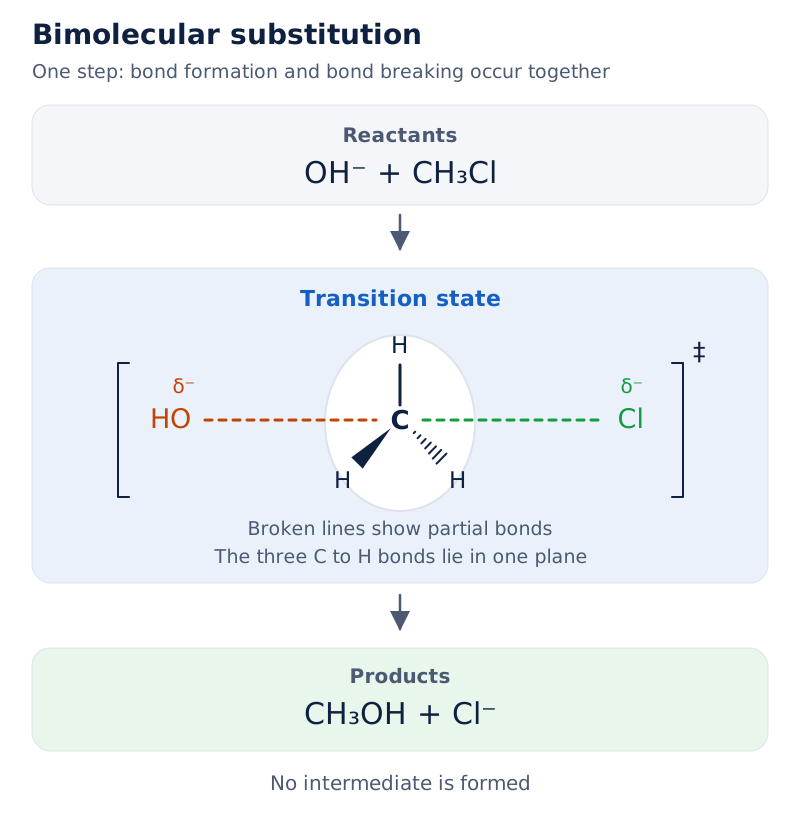
The ball models show an incoming hydroxide group, a central arrangement with incoming and outgoing groups on opposite sides, and the separated halide after substitution. Red marks the incoming hydroxide oxygen and green the outgoing halide.
Drawn by One Young India. See Fig. 6.2 in your NCERT textbook
Steric hindrance slows the approach of the nucleophile. Methyl halides react particularly rapidly, while increasing crowding near the reacting carbon decreases reactivity. Among simple alkyl halides, primary compounds react faster than secondary compounds, which react faster than tertiary compounds.
What the figure shows
Steric effects on substitution
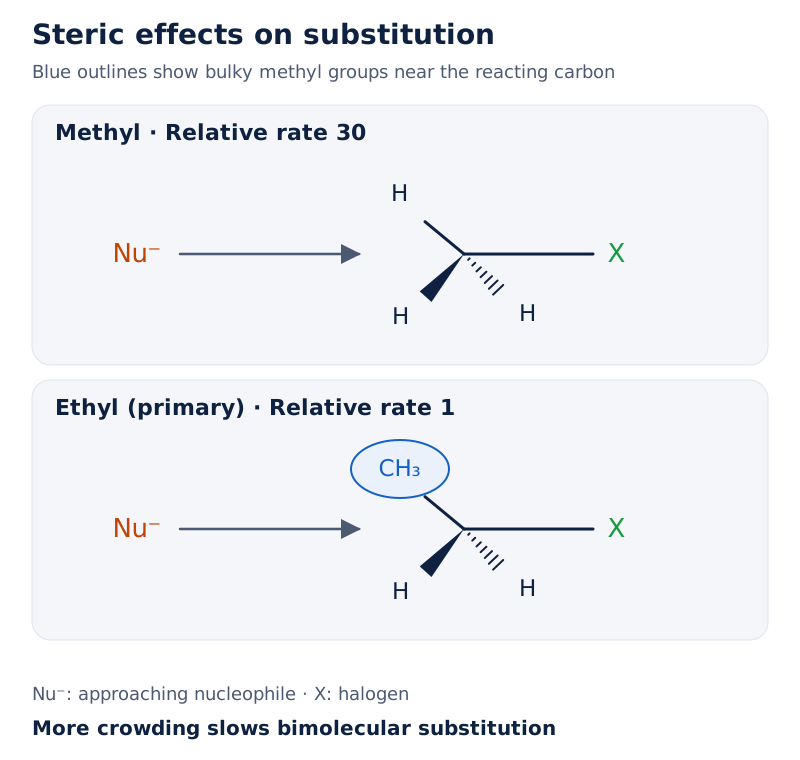
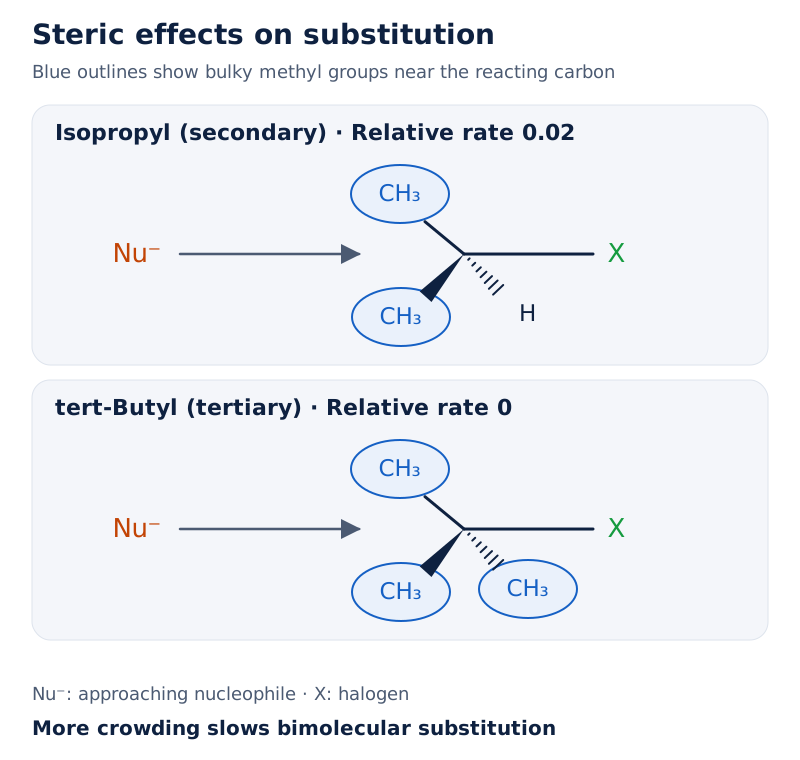
Four panels compare methyl, ethyl, isopropyl and tert-butyl groups. Arrows show nucleophile approach, while blue outlines mark increasing obstruction. The printed relative rates are 30, 1, 0.02 and 0 respectively.
Drawn by One Young India. See Fig. 6.3 in your NCERT textbook
Worked example 6.6: Which member reacts faster?
Problem: Compare cyclohexylmethyl chloride with chlorocyclohexane, and 1-iodobutane with 1-chlorobutane, for substitution. Answer: Cyclohexylmethyl chloride reacts faster because its chlorine-bearing carbon is primary. In the second pair, 1-iodobutane reacts faster because iodine is the better leaving group.
For a fixed alkyl group, the reactivity order in both substitution mechanisms is . The symbol means much greater than. Compare leaving groups only after recognising whether the carbon skeleton is being held the same.
How does unimolecular substitution differ from bimolecular substitution?
The notation means substitution, nucleophilic, unimolecular. These reactions generally use polar protic solvents such as water, alcohol or acetic acid. Tert-butyl bromide gives tert-butyl alcohol through a carbocation intermediate.
What are the two mechanism steps?
- Step 1, slow and reversible: Carbon-bromine bond cleavage gives a tert-butyl carbocation and bromide ion.
- Step 2: Hydroxide attacks the carbocation and forms the alcohol.
The slowest step determines the rate. Because only tert-butyl bromide participates in that step, the rate depends on its concentration and not on hydroxide concentration. Solvation of the halide by the protic solvent helps carbon-halogen bond cleavage.
Carbocation stability controls the ease of ionisation. Tertiary halides react faster than secondary and primary halides in this mechanism. Allylic and benzylic halides are especially reactive because resonance stabilises the carbocations they produce.
| Feature | ||
|---|---|---|
| Mechanistic steps | Two | One |
| Intermediate | Carbocation | No intermediate |
| Rate dependence | Haloalkane concentration | Haloalkane and nucleophile concentrations |
| Important structural factor | Carbocation stability | Steric accessibility |
| Chiral-substrate outcome | Racemisation | Inversion |
Worked example 6.7: Ordering bromide reactivity
Problem: Rank the four isomeric bromobutanes and the four benzylic bromides below in both mechanisms. Answer: The increasing order for the first set in is:
The order is the reverse. Of the two primary compounds, the branched alkyl group provides a greater electron-donating inductive effect for carbocation formation, but also greater steric obstruction to nucleophile approach.
For the second set, the decreasing order is:
Again, the order is the reverse. Two phenyl groups stabilise a carbocation more effectively by resonance than one phenyl group. However, a phenyl group is bulkier than a methyl group, making nucleophile approach more difficult.
How do chirality and optical activity reveal a mechanism?
A chiral molecule cannot be superimposed on its mirror image. An achiral molecule can. A tetrahedral carbon attached to four different groups is an asymmetric carbon or stereocentre. Butan-2-ol has such a centre; propan-2-ol has two identical methyl groups and is achiral.
Enantiomers are stereoisomers that are non-superimposable mirror images. Their melting points, boiling points and refractive indices are identical, but they rotate plane-polarised light in opposite directions. A polarimeter measures the angle of optical rotation.
Dextrorotatory substances rotate the plane clockwise and are labelled ; laevorotatory substances rotate it anticlockwise and are labelled . These signs describe observed rotation and do not by themselves specify the absolute arrangement of atoms.
What the figure shows
Chirality of butan-2-ol
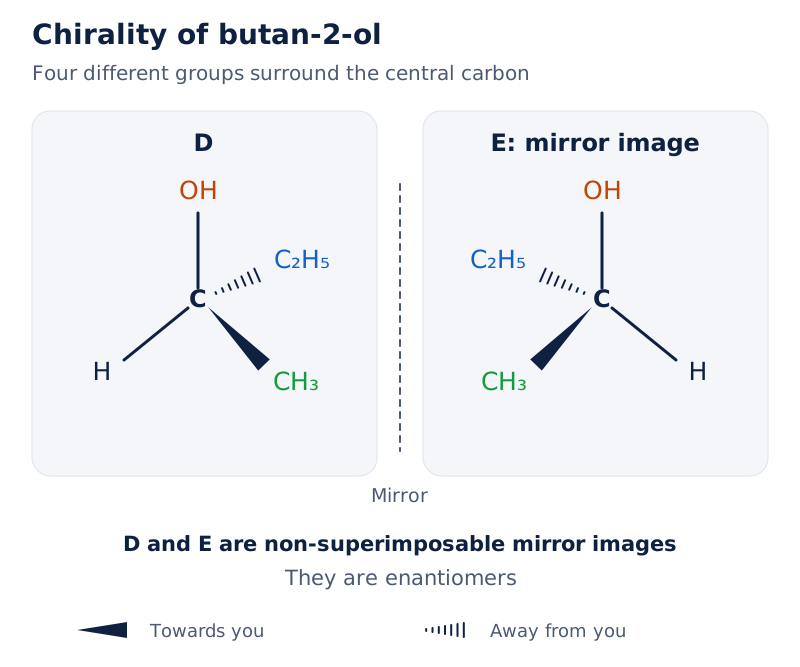
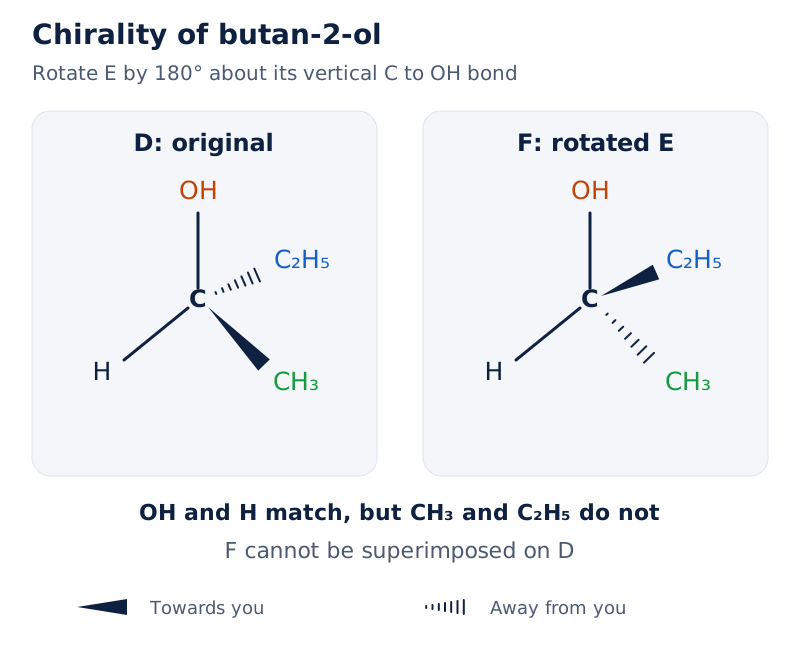
Structure D and its mirror image E carry hydroxyl, hydrogen, methyl and ethyl groups around the central carbon. Rotating E through produces F, which cannot be superimposed on D.
Drawn by One Young India. See Fig. 6.6 in your NCERT textbook
Worked example 6.8: Identifying chiral molecules
Problem: Identify the chiral member of each pair: and ; pentan-2-ol and pentan-3-ol; 2-bromobutane and 1-bromobutane. Answer: The chiral members are , pentan-2-ol and 2-bromobutane.
Each selected molecule has four different groups at the relevant tetrahedral carbon. The first rejected molecule has two bromine atoms at that carbon; pentan-3-ol has two ethyl groups; the bromine-bearing carbon in 1-bromobutane has two hydrogen atoms.
What do retention, inversion and racemisation mean?
Retention preserves the spatial arrangement at a stereocentre. When a reaction breaks no bond to that centre, its general configuration is retained. Heating negative-rotation 2-methylbutan-1-ol with concentrated hydrochloric acid gives positive-rotation 1-chloro-2-methylbutane with retention at the unchanged stereocentre.
Inversion reverses the arrangement around the reacting carbon. In , attack opposite the leaving group produces inversion. Thus negative-rotation 2-bromooctane gives positive-rotation octan-2-ol on reaction with sodium hydroxide, with hydroxyl entering opposite the departing bromide.
A racemic mixture contains equal proportions of two enantiomers and has zero net optical rotation. Conversion into such a mixture is racemisation. Equal and opposite rotations cancel; optical inactivity does not require every molecule in the mixture to be achiral.
In , the planar -hybridised carbocation permits attack from either face. Hydrolysis of optically active 2-bromobutane therefore gives racemic butan-2-ol. The stereochemical result connects the observed product mixture to the intermediate's geometry.
Note: A change from positive to negative rotation, or the reverse, does not prove inversion. Different compounds can retain the same configuration while having opposite signs of optical rotation.
How do elimination and reactions with metals transform haloalkanes?
The alpha carbon, written , bears the halogen. A neighbouring carbon is a beta carbon, written . Heating a haloalkane containing a beta hydrogen with alcoholic potassium hydroxide removes hydrogen from the beta carbon and halogen from the alpha carbon.
Which alkene becomes the major product?
This beta elimination, or dehydrohalogenation, forms a carbon-carbon double bond. If several alkenes can form, Saytzeff's rule usually favours the alkene having more alkyl groups attached to its doubly bonded carbons.
For 2-bromopentane, the displayed products are pent-2-ene, 81%, and pent-1-ene, 19%. These are the specific illustrated proportions, not universal percentages for every elimination.
Substitution and elimination compete. The outcome depends on the substrate, base or nucleophile strength and size, and reaction conditions. A bulky nucleophile tends to remove a proton instead of approaching the crowded carbon. Secondary halides can follow substitution or elimination according to these conditions.
Why must Grignard reagents remain dry?
A Grignard reagent is an alkylmagnesium halide. It contains a carbon-metal bond and is therefore organometallic. Formation requires magnesium and dry ether:
The carbon-magnesium bond is highly polar, with electron density drawn towards carbon. The magnesium-halogen bond is essentially ionic. Water, alcohols and amines can supply protons that convert the reagent into a hydrocarbon.
Even traces of moisture must therefore be excluded. Hydrolysis also provides a route from a halide, through its Grignard reagent, to the corresponding hydrocarbon.
In the Wurtz reaction, sodium couples alkyl halides in dry ether. Using one alkyl halide joins two identical alkyl groups and doubles the number of carbon atoms:
Why do haloarenes resist nucleophiles yet direct electrophiles?
What makes nucleophilic substitution difficult?
Resonance between halogen lone pairs and the aromatic system gives the carbon-halogen bond partial double-bond character. Cleaving it is harder than cleaving the corresponding single bond in a haloalkane.
The ring carbon has hybridisation and greater s-character than an alkyl carbon. It holds the bonding electron pair more tightly. The comparison gives carbon-chlorine lengths of in a haloarene and in a haloalkane.
A phenyl cation formed by self-ionisation lacks resonance stabilisation, making the usual route unsuitable. Possible repulsion also makes approach of an electron-rich nucleophile to an electron-rich arene less likely.
Chlorobenzene nevertheless gives phenol with aqueous sodium hydroxide at and , followed by acidification. Here atm means atmospheres, a pressure unit.
Ortho and para nitro groups increase reactivity by withdrawing electron density and stabilising the carbanion intermediate through resonance. A meta nitro group does not provide that stabilisation. Para-nitrochlorobenzene reacts at , while 2,4-dinitrochlorobenzene reacts at , using sodium hydroxide followed by acidification.
The corresponding transformations preserve each nitro group while replacing chlorine with hydroxyl. With three nitro groups at the 2, 4 and 6 positions, warming with water is sufficient:
Worked example 6.9: Why is chlorine ortho, para directing?
Problem: Explain why electron-withdrawing chlorine directs electrophilic substitution to ortho and para positions. Answer: Chlorine withdraws electrons through its inductive effect but donates electron density through resonance. The stronger inductive effect causes overall deactivation.
Resonance stabilisation is more effective for intermediates arising from ortho or para attack. These positions are consequently less deactivated than the meta position. Reactivity is controlled by the stronger inductive effect, while orientation reflects resonance donation.
Which electrophilic and coupling reactions occur?
Chlorobenzene undergoes halogenation, nitration, sulphonation and Friedel-Crafts reactions. Compared with benzene, these reactions are slower and need more drastic conditions. In the following schemes, o and p mean ortho and para, and denotes heating.
The para product is major and the ortho product minor in each illustrated scheme. These arrows show alternative organic products in a mixture, rather than stoichiometric formation of one molecule of each product from one reactant molecule.
Wurtz-Fittig coupling joins an aryl group and an alkyl group using sodium in dry ether. Fittig coupling joins two aryl groups. Their balanced forms are:
What are the uses and environmental effects of polyhalogen compounds?
Polyhalogen compounds contain more than one halogen atom. Their usefulness as solvents, refrigerants and insecticides must be considered alongside toxicity and environmental persistence. Stability can be useful during application but problematic when a compound remains in the environment.
What distinguishes the halogenated methanes?
| Compound | Uses | Important limitation |
|---|---|---|
| Dichloromethane, CH₂Cl₂ | Paint removal, aerosol propellant, drug processing and metal cleaning | Harms the central nervous system; direct contact can injure skin and eyes |
| Chloroform, CHCl₃ | Solvent for fats, alkaloids and iodine; production of refrigerant R-22 | Air and light can convert it into poisonous phosgene |
| Iodoform, CHI₃ | Former antiseptic use | Antiseptic action comes from liberated iodine; its objectionable smell limits use |
| Carbon tetrachloride, CCl₄ | Refrigerant and propellant manufacture, chemical feedstock and solvent applications | Serious toxicity and depletion of atmospheric ozone |
Chloroform was formerly used as a general anaesthetic but was replaced by safer, less toxic alternatives. Its vapour depresses the central nervous system. Chronic exposure may damage the liver and kidneys. Its oxidation explains storage in completely filled, closed, dark-coloured bottles:
The product COCl₂ is phosgene, also called carbonyl chloride. Excluding light and air limits its formation. Carbon tetrachloride exposure can damage nerve cells and affect the heart; there is some evidence linking exposure with liver cancer in humans.
Why do freons and DDT cause concern?
Freons are chlorofluorocarbon derivatives of methane and ethane. Their stability, low reactivity, non-corrosive character and ease of liquefaction support refrigerant and propellant applications. Freon 12, CCl₂F₂, is manufactured from tetrachloromethane through the Swarts reaction.
Most freon eventually reaches the atmosphere. It can diffuse unchanged into the stratosphere and initiate radical chain reactions that disturb the ozone balance. Ozone depletion is believed to increase ultraviolet exposure, with consequences for skin, eyes and possibly the immune system.
DDT, a chlorinated insecticide, was effective against malaria-carrying mosquitoes and typhus-carrying lice. Extensive use revealed insect resistance and high toxicity towards fish. Its chemical stability and fat solubility make environmental persistence particularly significant.
Animals do not metabolise DDT rapidly. It is stored in fatty tissues, so continuing intake can cause accumulation over time. These properties explain why an effective insecticide can also create a persistent biological burden.
Glossary
- Haloalkane — Organic halogen compound with halogen attached to an alkyl carbon having tetrahedral hybridisation.
- Haloarene — Organic halogen compound in which halogen is bonded directly to an aromatic ring carbon.
- Allylic halide — Compound whose halogen-bearing saturated carbon lies next to a carbon-carbon double bond.
- Benzylic halide — Compound with halogen attached to a saturated carbon directly connected to an aromatic ring.
- Nucleophile — Electron-rich species that donates an electron pair when attacking an electron-deficient reaction centre.
- Ambident nucleophile — Nucleophile with two possible bonding centres, permitting different products depending on the centre that attacks.
- Leaving group — Group that departs from the substrate during substitution, such as a halide ion.
- Steric hindrance — Obstruction caused by bulky groups that makes approach to a reaction centre more difficult.
- Chirality — Property of an object or molecule whose mirror image cannot be superimposed on it.
- Enantiomers — Pair of stereoisomers related as mirror images that cannot be superimposed on one another.
- Racemisation — Conversion of an enantiomer into an equal mixture of both enantiomers, cancelling net optical rotation.
- Inversion — Reversal of the spatial arrangement around the reacting stereocentre during a chemical transformation.
- Grignard reagent — Alkylmagnesium halide containing a highly polar carbon-magnesium bond and reacting readily with proton sources.
- Dehydrohalogenation — Elimination of hydrogen and halogen from neighbouring carbons to form a carbon-carbon double bond.
Common errors and misconceptions
- Misconception: Every halogen compound containing benzene is an aryl halide. Correct: In an aryl halide, the halogen is directly bonded to a ring carbon; benzyl halides are different.
- Misconception: A branched molecule must be a tertiary halide. Correct: Classify the halogen-bearing carbon. Neopentyl bromide is primary despite its branched skeleton.
- Misconception: KCN and AgCN give the same main product. Correct: KCN mainly gives nitriles, while AgCN mainly gives isocyanides through different attachment centres.
- Misconception: Both substitution mechanisms form a carbocation. Correct: has a carbocation intermediate; has a single step and a transition state.
- Misconception: Opposite signs of optical rotation prove opposite configurations. Correct: Rotation signs do not specify absolute configuration, and retention may accompany a sign change.
- Misconception: Chlorine activates benzene because it directs ortho and para. Correct: Its stronger inductive withdrawal deactivates the ring, while resonance controls orientation.
- Misconception: Moisture is harmless during Grignard preparation. Correct: Water supplies a proton and consumes the reagent to form a hydrocarbon.
- Misconception: A meta nitro group activates nucleophilic substitution in the same way as an ortho nitro group. Correct: The relevant resonance stabilisation operates at ortho and para positions.
Exam-style questions with model answers
Q1. Distinguish an allylic halide from a vinylic halide using the position and hybridisation of the halogen-bearing carbon. [2 marks]
- An allylic halide has halogen bonded to an -hybridised carbon adjacent to a carbon-carbon double bond.
- A vinylic halide has halogen directly bonded to an -hybridised carbon belonging to the double bond.
Q2. Explain why thionyl chloride is preferred for preparing an alkyl chloride from an alcohol. Write the reaction, using R for an alkyl group. [3 marks]
- Thionyl chloride replaces the hydroxyl group of the alcohol with chlorine, forming the corresponding alkyl chloride.
- The reaction is . The organic product retains the alkyl group of the starting alcohol.
- The other products, sulphur dioxide and hydrogen chloride, escape as gases. Their removal helps obtain pure alkyl chloride, which is the practical advantage of this reagent.
Q3. Explain why KCN mainly gives nitriles but AgCN mainly gives isocyanides when they react with a haloalkane. [3 marks]
- Cyanide is ambident: either carbon or nitrogen can act as the electron-pair donor. The attachment centre determines which product forms.
- KCN is predominantly ionic. Its cyanide ions attack mainly through carbon because carbon-carbon bonding is more stable than carbon-nitrogen bonding, giving a nitrile.
- AgCN is mainly covalent. Nitrogen is available to donate its electron pair, so attachment occurs mainly through nitrogen and gives an isocyanide.
Q4. Compare the mechanisms for hydroxide substitution in chloromethane and tert-butyl bromide. Include rate dependence, intermediate, steric effects and stereochemical outcome for chiral substrates. [5 marks]
- Chloromethane follows . Hydroxide approaches opposite chlorine while the carbon-oxygen bond forms and the carbon-chlorine bond breaks in one step. There is a transition state but no intermediate.
- Its rate depends on the concentrations of both chloromethane and hydroxide. Bulky groups near the reacting carbon hinder nucleophile approach; methyl halides are particularly reactive.
- Tert-butyl bromide follows . Slow, reversible ionisation forms a carbocation and bromide, followed by attack of hydroxide on the carbocation.
- The slow step involves only the haloalkane, so the rate depends on tert-butyl bromide concentration. A stable tertiary carbocation favours this mechanism.
- For chiral substrates, backside attack produces inversion. The planar carbocation in allows attack from either face and leads to racemisation.
Q5. Why is chlorobenzene less reactive than a haloalkane towards nucleophilic substitution? Give the conditions for conversion of chlorobenzene to phenol. [5 marks]
- Halogen lone pairs participate in resonance with the aromatic ring. This gives the carbon-chlorine bond partial double-bond character and makes cleavage more difficult.
- The ring carbon is -hybridised, with greater s-character than an alkyl carbon. It holds the shared electrons more tightly, producing a shorter, stronger bond.
- Self-ionisation would form a phenyl cation that is not stabilised by resonance. The usual carbocation pathway of is therefore unsuitable.
- Possible repulsion between an electron-rich nucleophile and the electron-rich aromatic system also makes nucleophile approach less likely.
- Conversion to phenol requires heating with aqueous sodium hydroxide at and , followed by acidification. Thus low reactivity does not mean complete inability to undergo substitution.
Q6. A haloalkane is heated with magnesium in dry ether, and the resulting reagent is then treated with water. Describe the transformations using R for alkyl and X for halogen, and explain the need for dry ether. [3 marks]
- Magnesium converts the haloalkane into an alkylmagnesium halide, called a Grignard reagent: .
- The carbon-magnesium bond is highly polar. Water acts as a proton source and converts the reagent to a hydrocarbon: .
- Dry ether prevents premature destruction of the reagent. Even traces of moisture consume it, so exclusion of water is essential during its preparation.
Q7. Explain why para-dihalobenzene isomers generally melt higher than their ortho and meta isomers even though their boiling points are nearly equal. [2 marks]
- The para isomer is more symmetrical than the ortho and meta isomers.
- This greater symmetry allows better packing in the crystal lattice, giving the para isomer a higher melting point despite the nearly equal boiling points.
Q8. Explain why chlorine deactivates an aromatic ring but directs further electrophilic substitution to ortho and para positions. [3 marks]
- Chlorine withdraws electron density through its inductive effect. This effect is stronger than its resonance donation, so the ring is less reactive overall than benzene.
- Through resonance, chlorine stabilises the intermediate carbocations associated with ortho and para attack more effectively. These positions are less deactivated than the meta position.
- Consequently, the stronger inductive effect determines reduced reactivity, while resonance donation determines the preferred orientation of substitution.
Key takeaways
- Classify a halide by the carbon directly bonded to halogen, distinguishing alkyl, allylic, benzylic, vinylic and aryl attachment.
- Alcohol conversion, alkene addition and halogen exchange provide preparation routes whose reagents and conditions determine the products.
- Bimolecular substitution occurs in one step, is sensitive to steric hindrance and inverts the reacting stereocentre.
- Unimolecular substitution forms a carbocation; its stability controls reactivity, while its planar shape explains racemisation.
- Alcoholic potassium hydroxide favours beta elimination, usually producing the more substituted alkene when alternative products are possible.
- Grignard reagents require dry conditions because water and other proton sources convert them into hydrocarbons.
- Haloarenes resist nucleophilic substitution, while their halogen substituents deactivate but direct electrophilic substitution towards ortho and para positions.
- The stability of freons and DDT helps explain their applications as well as their persistent environmental effects.
Test yourself
Why is benzyl chloride not an aryl halide?
Its chlorine is bonded to the saturated side-chain carbon, rather than directly to an aromatic ring carbon.
What drives the Finkelstein reaction forward in dry acetone?
Sodium chloride or sodium bromide precipitates from dry acetone, facilitating formation of the alkyl iodide.
Which is faster in bimolecular substitution: 1-iodobutane or 1-chlorobutane?
1-Iodobutane reacts faster because iodine is the better leaving group when the alkyl skeleton is unchanged.
Why is a racemic mixture optically inactive?
Equal amounts of the two enantiomers produce equal and opposite rotations, giving zero net optical rotation.
Which main alkene forms on eliminating hydrogen bromide from 2-bromopentane?
Pent-2-ene is the major product because it has more alkyl groups attached to its doubly bonded carbons.
Why are ortho and para nitro groups important in nucleophilic aromatic substitution?
They withdraw electron density and stabilise the carbanion intermediate through resonance, making substitution more favourable.
Why is chloroform stored away from light and air?
Air oxidises chloroform in light to poisonous phosgene, so closed, filled, dark-coloured bottles limit this conversion.
Why can DDT accumulate in animals?
DDT is fat-soluble and not rapidly metabolised, so continuing intake causes storage and accumulation in fatty tissues.