
Atoms | CBSE Class 12 Physics Notes
On this page
Watch & explore
Start with a few high-quality watches, then dive into the notes below.

This note covers atomic models, alpha-particle scattering, the nuclear atom, electron orbits, atomic spectra, Bohr’s postulates, hydrogen energy levels, excitation and ionisation, photon transitions, de Broglie’s standing-wave explanation, and the limitations of the Bohr model.
How did atomic models connect electrical neutrality with internal structure?
From electrons to a positive constituent
An atom is electrically neutral as a whole, but it contains negatively charged electrons. Its positive charge must therefore balance its negative charge. Discovering electrons raised a structural question: where are these two kinds of charge located within the atom?
J. J. Thomson’s discharge experiments in 1897 showed that atoms of different elements contain identical negatively charged constituents. His model, proposed in 1898, spread positive charge uniformly throughout the atomic volume and embedded electrons within it. This became known as the plum pudding model.
The important issue was the distribution of charge, rather than merely the presence of electrons. A spread-out positive charge and a concentrated positive charge would exert very different forces on a charged particle passing through an atom. Scattering could therefore test competing structural pictures.
How did the models differ?
| Feature | Thomson model | Rutherford model |
|---|---|---|
| Positive charge | Distributed throughout the atom | Concentrated in a tiny nucleus |
| Electrons | Embedded in the positive distribution | Revolving around the nucleus |
| Mass distribution | Nearly continuous | Highly non-uniform, with most mass in the nucleus |
| Overall electrical character | Neutral atom | Neutral atom |
The models did not propose substantially different overall atomic sizes. They differed in the arrangement of matter and charge inside that size. Rutherford’s picture placed most of the mass within a region much smaller than the atom, leaving most of its volume empty.
Atomic spectra supplied another test. Each element emits a characteristic pattern of wavelengths. A successful atomic model must account both for the scattering of incoming particles and for the discrete radiation emitted by the atom itself.
How did the Geiger-Marsden experiment reveal the nucleus?
Arrangement and detection
In 1911, Hans Geiger and Ernst Marsden investigated alpha-particle scattering at Rutherford’s suggestion. They directed alpha particles of energy towards a thin gold foil. The foil thickness was , allowing the scattering to be analysed as predominantly a single encounter.
A radioactive bismuth source supplied the particles. Lead bricks collimated them into a narrow beam. A rotatable detector contained a zinc sulphide screen and a microscope. Each particle striking the screen produced a brief flash, or scintillation, which could be counted through the microscope.
What the figure shows
Scattering apparatus
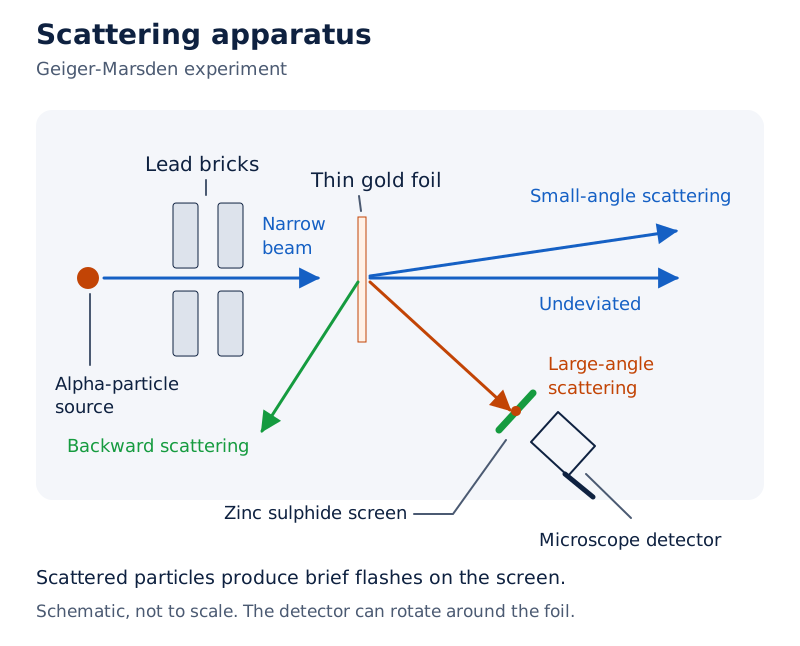
A source on the left sends alpha particles through lead bricks towards thin gold foil. Outgoing arrows show small-angle, large-angle and backward scattering. A zinc sulphide screen and microscope detector are shown beside the scattered paths.
Drawn by One Young India. See Fig. 12.2 in your NCERT textbook
From observations to conclusions
| Observation | Structural conclusion |
|---|---|
| Most particles pass through the foil | Most atomic volume is empty space |
| About scatter through more than | Strong deflection is uncommon |
| About one in 8000 deflect through more than | A small region can exert a very large repulsive force |
The rare backward deflections were decisive. A positively charged alpha particle can be turned back by intense repulsion from a compact positive region. This led to the nuclear model: the entire positive charge and most atomic mass occupy the nucleus, with electrons some distance away.
The experiment suggested nuclear sizes of about to , compared with an atomic size of about . Thus the atomic size is roughly ten thousand to one hundred thousand times the nuclear size. Light atomic electrons do not appreciably deflect the alpha particles.
Single scattering is an assumption justified by the thin foil. The gold nucleus is about fifty times heavier than an alpha particle, so treating it as stationary is reasonable for this analysis. These conditions matter when interpreting the measured deflections using electrostatic repulsion.
How do impact parameter and energy determine alpha-particle scattering?
Force and trajectory
Let be the magnitude of electronic charge, the target’s atomic number, the separation between particle and nucleus, and the permittivity of free space. The alpha-particle charge is ; the nuclear charge is .
Write , the electrostatic constant. The repulsive force magnitude follows Coulomb’s law: The force acts along the line joining the charges, and its magnitude and direction change along a deflected trajectory.
The impact parameter, , is the perpendicular distance from the initial line of motion to the nuclear centre. For particles with nearly the same incoming kinetic energy, small impact parameters produce large deflections. Large impact parameters correspond to particles passing farther away and suffering small deflections.
What the figure shows
Alpha-particle trajectories
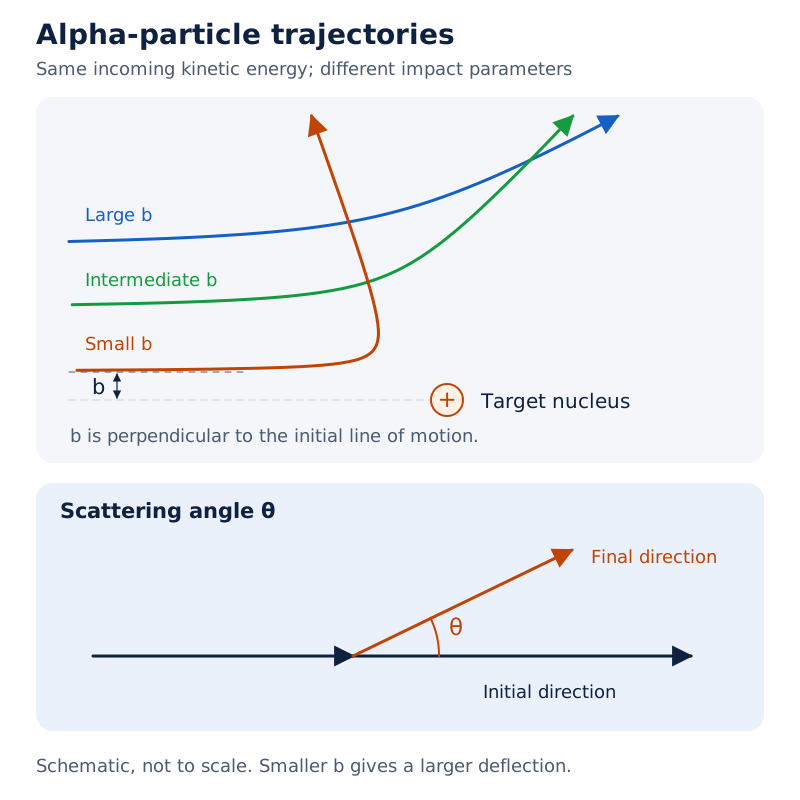
Several incoming paths approach a labelled target nucleus from the left. Paths close to the nucleus bend strongly; distant paths bend less. The drawing marks the impact parameter and scattering angle , the angle between initial and final directions.
Drawn by One Young India. See Fig. 12.4 in your NCERT textbook
Derivation: Distance of closest approach
For a head-on encounter, let denote initial kinetic energy, electrostatic potential energy, and the centre-to-centre distance at the turning point. Take the initial particle to be far away and the heavy nucleus to remain stationary.
- Initially, the potential energy is negligible, so initial total energy is
- At the turning point, the alpha particle is momentarily at rest. Final total energy is therefore
- Conservation of mechanical energy gives
- Rearranging produces
Result: For a fixed target nucleus, a more energetic head-on alpha particle approaches more closely. The turning distance sets an upper limit on nuclear size; it need not equal the nuclear radius.
Worked example 1. Find the closest approach of a alpha particle to gold. Use , , , and the rounded kinetic energy .
Answer: Formula: . Substitute:
- Insert the given values:
- Evaluate:
This is about , where the femtometre satisfies . The result is an upper limit, not evidence that the alpha particle touches the nuclear surface.
How are speed, kinetic energy and potential energy related in an electron orbit?
Circular motion under electrostatic attraction
For hydrogen, the nucleus contains one proton. Let denote electron mass and its orbital speed. In a circular orbit of radius , electric attraction supplies the required centripetal force. The model treats the much heavier nucleus as the centre of the electron’s motion.
Derivation: Total energy of a circular hydrogen orbit
- Equate electrostatic attraction and the force required for circular motion:
- Multiply by radius and identify kinetic energy:
- With potential energy zero at infinite separation, the attractive system has
- Add kinetic and potential energies to obtain total energy :
Result: The negative total energy indicates a bound electron. It does not mean that kinetic energy is negative. Kinetic energy is positive, while the attractive potential energy is negative and twice as large in magnitude.
The zero of energy is essential to this interpretation. Separating the electron and proton to infinity with no remaining kinetic energy requires adding enough energy to raise the total to zero. An electron with positive total energy does not follow a closed bound orbit in this picture.
Worked example 2. Hydrogen has ground-state total energy . Find its electron’s kinetic and potential energies. Use .
Answer: Formula: , . Substitute:
- The kinetic energy is
- The potential energy is
- Check the sum:
Units to keep consistent
The SI unit of force is the newton. The SI unit of energy is the joule. The SI unit of electric charge is the coulomb. The SI unit of orbital radius is the metre. The SI unit of frequency is the hertz.
Atomic energies are often quoted in electronvolts. Before combining an energy with Planck’s constant expressed in joule seconds, convert that energy to joules. A correctly calculated numerical value with mismatched units does not represent the required physical quantity.
Why could Rutherford’s model explain scattering but not stable atoms?
The classical stability problem
An electron moving around a circular orbit is accelerating even if its speed remains constant. Its velocity continually changes direction. According to classical electromagnetic theory, an accelerating charge radiates electromagnetic energy, so the orbiting electron should continuously lose energy.
As its energy decreases, the electron should spiral towards the nucleus and eventually fall into it. A nuclear atom governed entirely by this classical radiation picture would therefore be unstable. This contradicts the stability of ordinary matter.
The solar-system analogy does not resolve the problem. Planetary motion is governed by gravitational attraction, while the electron and nucleus interact electrically. The radiation expected from an accelerating electric charge introduces a difficulty absent from the simple planetary analogy used to motivate the nuclear model.
The separate spectral problem
Classically, radiation from the revolving electron would have the frequency of its revolution. As the electron spiralled inwards, its orbital frequency would change continuously. The radiation would consequently span a continuous range of frequencies, rather than form the observed line spectrum.
Worked example 3. Calculate the classical initial orbital frequency using and . Let denote revolutions per second.
Answer: Formula: . Substitute:
- Divide speed by circumference:
- The result is
This is the classical prediction for the initial radiation frequency. It is not Bohr’s rule for a spectral transition.
Note: Force balance can describe circular motion at an instant without explaining why a radiating electron would remain in that orbit. Rutherford’s model establishes the nucleus, but classical electrodynamics does not provide the required atomic stability.
What do emission and absorption spectra reveal about atoms?
Continuous radiation and isolated lines
Condensed matter and dense gases emit radiation containing a continuous distribution of wavelengths, with different intensities. Interactions between neighbouring atoms or molecules influence this radiation. In a rarefied gas, atoms are farther apart, so the emitted radiation can be associated with individual atoms.
When an atomic gas or vapour at low pressure is excited, usually by an electric current, its radiation contains certain specific wavelengths. An emission line spectrum appears as bright lines on a dark background. Each element’s characteristic pattern can help identify the gas.
What the figure shows
Hydrogen emission spectrum
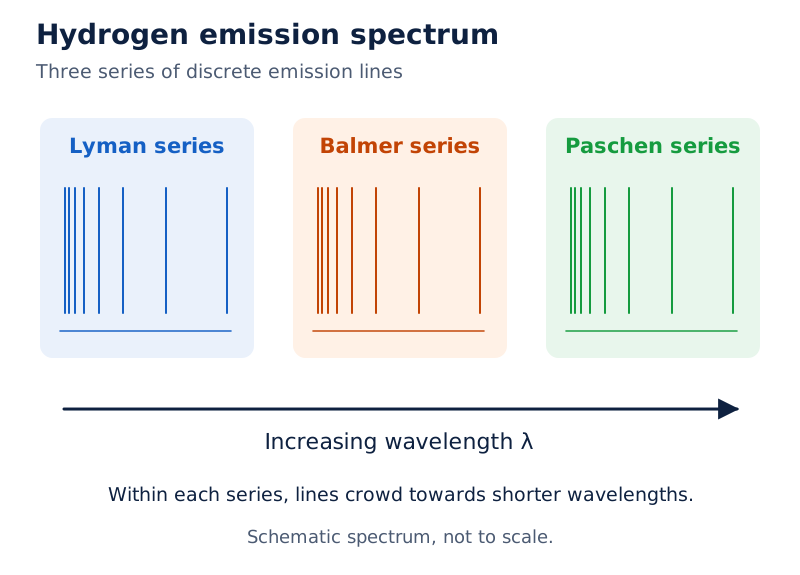
Vertical lines are grouped under Lyman, Balmer and Paschen series labels. A wavelength arrow points to the right. Within the groups, several lines lie increasingly close together towards the shorter-wavelength side.
Drawn by One Young India. See Fig. 12.5 in your NCERT textbook
Why are some transmitted wavelengths missing?
When white light passes through a gas, the transmitted spectrum can contain dark lines. These form an absorption spectrum. The missing wavelengths correspond to those associated with the gas’s emission lines, linking absorption and emission to the same internal atomic structure.
| Feature | Emission | Absorption |
|---|---|---|
| What is observed? | Bright lines | Dark lines in a continuous spectrum |
| Energy transfer | Atom gives energy to a photon | Atom receives energy from a photon |
| Electronic transition | Higher to lower energy | Lower to higher energy |
The spectrum therefore contains more information than the colour of the gas alone. Its individual line positions represent specific energy differences. The existence of separated lines suggests that an atom cannot possess every possible bound energy, a conclusion incorporated explicitly into Bohr’s model.
Discrete wavelengths are not a consequence of the atom having several electrons. Even hydrogen, with one proton and one electron, produces a pattern of spectral lines. A single electron can take part in different transitions between allowed energy states.
What are Bohr’s three postulates for the hydrogen atom?
Stationary states and quantised angular momentum
Bohr combined the nuclear atom with quantum ideas in 1913. His model retained circular electron motion but imposed restrictions that classical mechanics alone did not provide. These restrictions identified the allowed states and explained how radiation accompanies changes between them.
- Stationary states: An electron can revolve in certain stable orbits without emitting radiant energy. Each allowed state has a definite total energy.
- Angular-momentum quantisation: Let denote orbital angular momentum, Planck’s constant, and the principal quantum number. The permitted values satisfy
- Transition radiation: An electron changing from initial energy to a lower final energy emits a photon. If denotes photon frequency,
Planck’s constant has the approximate value . Its dimensions are those of angular momentum. The quantum number is a positive integer, so the angular momentum cannot vary continuously among allowed stationary orbits.
What does stationary mean?
A stationary state is a state of definite energy without continuous radiation. The term does not say that the electron is motionless. In Bohr’s picture, the electron continues revolving while the atom remains in that state.
Absorption reverses the energy transfer. To reach a higher state by absorbing a photon, the atom must receive precisely the required energy: Emission and absorption thus involve differences between two state energies, rather than the energy of one state alone.
The postulates address Rutherford’s two difficulties together. Non-radiating stationary states account for stability within the model. Transitions between discrete energy values account for discrete photon frequencies. Neither feature follows from applying classical electromagnetic theory to an unrestricted electron orbit.
How are the allowed radii and energies of hydrogen derived?
Derivation: Quantised orbital radius and energy
Let , and denote the orbital radius, speed and total energy in the state labelled by . Apply the circular-motion force equation together with the angular-momentum condition to the hydrogen atom.
- Write the force balance for the selected orbit:
- Rearrange angular-momentum quantisation to obtain speed:
- Substitute that speed into the force equation:
- Solve for radius, using the definition of the electrostatic constant:
- Insert this radius into the total-energy expression:
- With the physical constants substituted, the energy becomes
Result: Orbital radius increases with the square of the principal quantum number. Total energy remains negative for finite bound states, while its magnitude decreases as the quantum number increases.
Using the Bohr radius
The smallest allowed radius is the Bohr radius, written , approximately . Therefore . This relation concerns the electron’s allowed orbit in the model; it is not a formula for the size of the nucleus.
Worked example 4. The innermost hydrogen orbit has radius . Find the radii for and .
Answer: Formula: . Substitute:
- For the second orbit,
- For the third orbit,
The radii are four and nine times the innermost radius. Doubling the quantum number does not merely double the orbital radius.
How do energy levels distinguish excitation from ionisation?
Ground state, excited states and the zero of energy
The ground state is the lowest-energy state. For hydrogen it corresponds to , with energy . States with larger principal quantum numbers are excited states. Their energies are less negative and therefore higher.
| State | Principal quantum number | Energy |
|---|---|---|
| Ground state | ||
| First excited state | ||
| Second excited state | Approximately | |
| Ionisation limit |
What the figure shows
Hydrogen energy levels
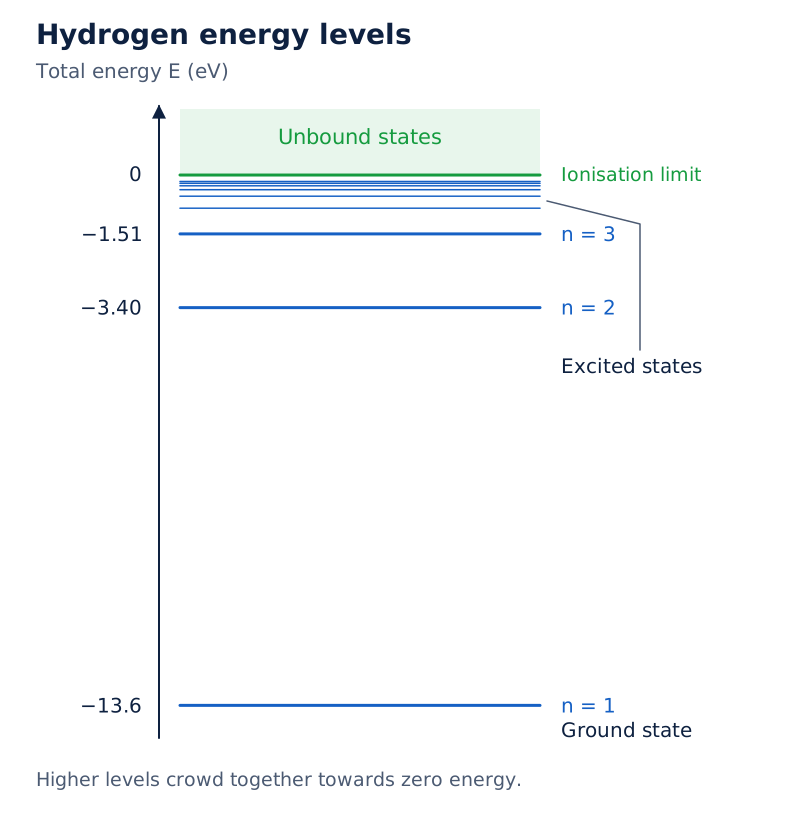
Horizontal lines mark the ground state and excited states on a vertical total-energy scale in electronvolts. The ground state lies at . Higher levels crowd together towards zero, above which a shaded region represents unbound states.
Drawn by One Young India. See Fig. 12.7 in your NCERT textbook
At room temperature, most hydrogen atoms are in their ground state. Energy supplied through processes such as electron collisions can raise an atom into an excited state. Excitation leaves the electron bound, whereas ionisation frees it from the atom.
Required energy is a difference
The ionisation energy from the ground state is . The zero-energy limit represents an electron infinitely far away and at rest. Above zero, a free electron can have a continuous range of total energies rather than the separated negative energies of bound states.
Worked example 5. Find the energy required to excite hydrogen from to , and then the additional energy needed to ionise it. Use .
Answer: Let denote excitation energy and the ionisation energy from the excited state. Formula: , . Substitute:
- Excitation requires
- Subsequent ionisation requires
The excited levels move closer together with increasing quantum number. Consequently, the energy needed to free the electron decreases as excitation increases. A larger orbit is associated with a less tightly bound electron, even though its total energy is numerically higher.
How do transitions produce discrete photon frequencies?
Calculating a spectral line
Let and denote initial and final principal quantum numbers. For emission, the initial state has higher energy and . The emitted photon removes exactly the positive difference between the two atomic energies.
- Start with Bohr’s photon condition:
- Insert the hydrogen energy expression:
- When using Planck’s constant in SI units, convert to joules:
Because the quantum numbers take integer values, transitions produce selected frequencies. The photon frequency belongs to the energy difference between states. It is generally not the electron’s revolution frequency in either of those states.
Worked example 6. Two atomic levels are separated by . Find the frequency emitted in a transition from the upper to the lower level. Use and .
Answer: Formula: , . Substitute:
- Convert the energy separation:
- Divide by Planck’s constant:
Checking direction and energy
A downward transition decreases atomic energy and emits a photon. An upward transition requires an energy input. Writing the final energy minus the initial energy for an emission photon would give a negative result, revealing that the subtraction order is wrong.
Different transitions can occur in different atoms of a gas, producing several lines in the observed spectrum. A single electron does not need to emit every line simultaneously. Each emitted photon corresponds to one transition and carries away its associated energy difference.
The model successfully predicts the frequencies associated with hydrogen’s allowed transitions. It does not, by itself, explain why some of those lines are more intense than others. Predicting a line’s position and predicting its relative intensity are distinct tasks.
How does de Broglie explain Bohr’s angular-momentum condition?
Standing waves around a closed orbit
De Broglie proposed that an electron has wave character as well as particle character. Let denote its matter wavelength and its momentum magnitude. The relation connects the wavelength to momentum.
For a non-relativistic electron, moving much more slowly than light, . Its matter wavelength is therefore . The wave associated with an allowed circular orbit must fit around that orbit as a standing wave.
What the figure shows
Standing matter wave
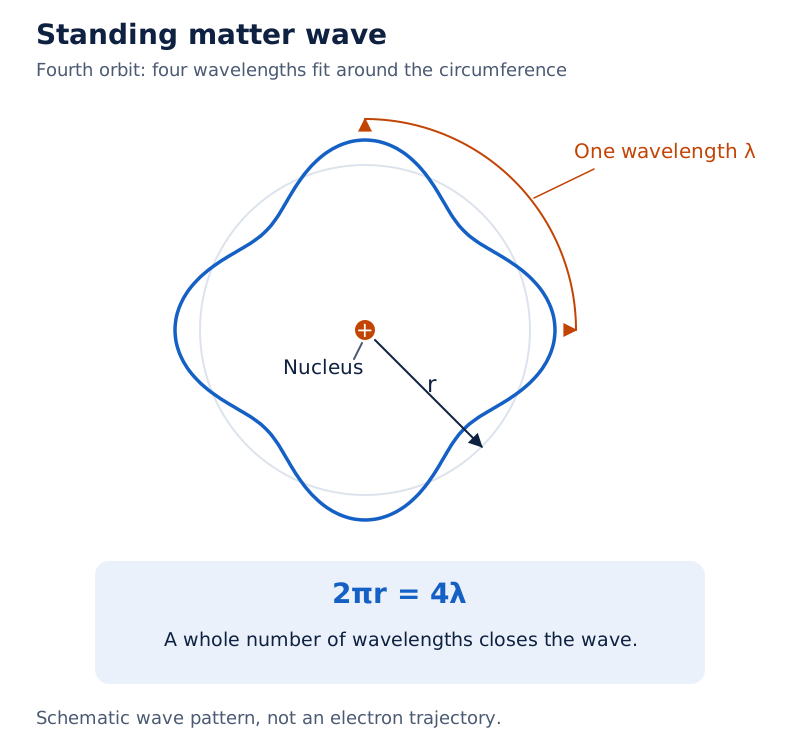
A circular arrangement surrounds a labelled nucleus. The radius and a wavelength are marked, and four wavelengths fit around the circumference. Alternating wave lobes illustrate the standing-wave pattern associated with the fourth orbit.
Drawn by One Young India. See Fig. 12.8 in your NCERT textbook
Derivation: Angular momentum from the wavelength condition
- Require the circumference to contain an integer number of wavelengths:
- Use the non-relativistic de Broglie relation:
- Substitute the wavelength into the circumference condition:
- Rearrange to obtain the permitted angular momentum:
Result: The standing-wave condition reproduces Bohr’s quantisation rule. It explains the special role of integer values: a persistent resonant wave must fit a whole number of wavelengths around the closed path.
The analogy is with standing waves on a string, where only certain wavelengths persist under the imposed boundary conditions. Other wavelengths interfere and their amplitudes rapidly diminish. For the circular orbit, the requirement is closure around the circumference rather than fixed ends on a straight string.
This explanation gives a wave basis for a condition Bohr originally postulated. It does not make the entire classical orbital picture exact. The distinction matters because successful reproduction of an angular-momentum rule is not a complete quantum description of the atom.
Where does Bohr’s model succeed, and what are its limitations?
Hydrogenic systems
A hydrogenic atom contains a nucleus of charge and a single electron. Examples include hydrogen, singly ionised helium and doubly ionised lithium. The absence of electron-electron interactions makes these systems suitable for the model’s basic approach.
The explicit numerical energy and radius formulas developed here are for hydrogen. A single-electron ion with a different nuclear charge should not automatically be assigned hydrogen’s ground-state energy or Bohr radius. The nuclear attraction changes when the nuclear charge changes.
For hydrogenic systems, Bohr’s model predicts the gross spectral features, including the frequencies emitted or selectively absorbed. Its prediction of hydrogen’s ionisation energy also agrees closely with observation. These successes make the model useful despite its incomplete physical picture.
Why can it not describe every atom?
The model cannot be extended successfully even to neutral helium with two electrons. Each electron interacts with the nucleus and with the other electron. The original formulation includes electron-nucleus attraction but omits the electron-electron forces required for a multi-electron atom.
Those additional forces are not negligible in the way planet-planet forces often are compared with the Sun’s attraction. Electron charges and their separations are of comparable orders of magnitude, so electron-electron interactions can be comparable to electron-nucleus interactions.
A second limitation is the inability to predict relative line intensities. Some transitions contribute stronger spectral lines than others. Knowing the allowed energy differences determines the possible frequencies, but does not explain why particular transitions are more favoured.
The precise orbital picture also conflicts with the uncertainty principle. Modern quantum mechanics replaces that simple trajectory description with a probability-based account of the electron. Bohr’s model remains a useful bridge between classical concepts and quantum ideas, rather than a complete description of atomic structure.
Glossary
- Nucleus — Tiny central region containing the entire positive charge and most of an atom’s mass.
- Alpha particle — Helium nucleus carrying two elementary units of positive electric charge.
- Impact parameter — Perpendicular distance from the initial line of particle motion to the target nucleus’s centre.
- Closest approach — Minimum centre-to-centre separation reached during a head-on repulsive encounter with a nucleus.
- Emission spectrum — Pattern of bright lines produced when excited atoms emit radiation at specific wavelengths.
- Absorption spectrum — Dark lines formed when atoms remove particular wavelengths from transmitted continuous radiation.
- Stationary state — Allowed atomic state with definite energy in which no continuous radiation is emitted.
- Principal quantum number — Positive integer labelling the permitted stationary states in Bohr’s atomic model.
- Bohr radius — Radius of the smallest allowed circular electron orbit in the hydrogen model.
- Ground state — Lowest-energy state of an atom, with hydrogen’s electron in its smallest permitted orbit.
- Excitation — Transfer of an atom into a higher-energy state while its electron remains bound.
- Ionisation energy — Minimum energy needed to remove a bound electron completely from an atom.
- Hydrogenic atom — System consisting of one electron bound to a positively charged nucleus.
- Standing matter wave — Persistent resonant wave pattern associated with an electron satisfying the orbital wavelength condition.
Common errors and misconceptions
- Misconception: Most alpha particles strike nuclei. Correct: Most pass through the foil; the rare large deflections reveal a small, concentrated positive region.
- Misconception: Closest approach directly measures the nuclear radius. Correct: A repelled particle can turn before reaching the nuclear surface, so the result is an upper limit.
- Misconception: Negative total energy means negative kinetic energy. Correct: Kinetic energy remains positive; the larger negative potential energy makes the electron bound.
- Misconception: Stationary states contain stationary electrons. Correct: Bohr’s electron revolves, but the state retains definite energy without continuous radiation.
- Misconception: A larger quantum number means lower total energy. Correct: Hydrogen’s energy becomes less negative, so its total energy increases.
- Misconception: Photon frequency equals orbital frequency. Correct: Bohr’s spectral frequency follows the difference between two state energies divided by Planck’s constant.
- Misconception: Bohr’s model describes neutral helium. Correct: It applies to single-electron systems and omits the electron-electron interactions present in neutral helium.
Exam-style questions with model answers
Q1. What is the impact parameter, and how does it affect scattering for alpha particles of the same incoming energy? [2 marks]
- The impact parameter is the perpendicular distance between the initial line of motion and the nuclear centre.
- Small impact parameters produce large deflections; large impact parameters produce smaller deflections because the particles pass farther from the nucleus.
Q2. Explain how alpha-particle scattering supports Rutherford’s nuclear model. [3 marks]
- Most incident alpha particles pass through the thin foil. This indicates that most atomic volume is empty space rather than filled with dense material.
- A very small fraction undergo large-angle or backward scattering. Such deflections require strong repulsion from concentrated positive charge.
- Rutherford therefore placed all positive charge and most atomic mass in a tiny nucleus, with the electrons occupying the much larger surrounding region. The nucleus accounts for rare strong deflections.
Q3. Why does applying classical electromagnetic theory to Rutherford’s atom fail to explain both stability and spectra? [3 marks]
- An orbiting electron accelerates because its velocity changes direction. Classical electromagnetic theory predicts that an accelerating charge radiates energy.
- Continuous energy loss would make the electron spiral inwards and eventually fall into the nucleus, contradicting the stability of atoms.
- The orbital frequency would change continuously during the inward spiral. The classical radiation frequency would also vary continuously, predicting a continuous spectrum instead of the observed discrete atomic lines.
Q4. State Bohr’s postulates and explain how they account for atomic stability and discrete emission lines. Define the symbols you use. [5 marks]
- An electron can occupy certain stable stationary orbits without emitting radiant energy. Every allowed state has a definite total energy, so the atom does not continuously lose energy while remaining in that state.
- Allowed orbital angular momentum satisfies , where is Planck’s constant and is a positive integer called the principal quantum number.
- A transition from higher initial energy to lower final energy emits a photon of frequency , with .
- The non-radiating stationary states provide stability within the model.
- Since the allowed energies are discrete, the possible energy differences are discrete too. Each difference determines a specific emitted frequency, explaining separated spectral lines rather than continuous radiation.
Q5. Derive hydrogen’s allowed orbital radius and energy using circular force balance and Bohr’s condition. Use electron mass , charge magnitude , Planck’s constant , vacuum permittivity , and . Let , , and denote radius, speed, total energy and principal quantum number. Take potential energy zero at infinity. [5 marks]
- For circular motion, electric attraction provides the centripetal force. Cancelling one radius factor gives
- Bohr’s quantisation condition fixes angular momentum. Solving it for the speed gives
- Substitution into the force balance removes the speed and leaves an equation for radius:
- Rearranging yields Thus allowed radii grow with the square of the quantum number.
- Kinetic energy is , while potential energy is . Adding them and inserting the derived radius gives The negative sign indicates a bound electron relative to the chosen zero at infinity.
Q6. Two atomic levels differ by . Find the frequency emitted in a downward transition. Use and . [3 marks]
- Let be the energy separation and the photon frequency. The emitted photon carries the positive energy lost by the atom: .
- Convert to SI energy units before using the supplied Planck constant:
- Divide energy by Planck’s constant: The frequency is positive, as required for an emitted photon.
Q7. Hydrogen’s ground-state total energy is . Find its electron’s kinetic and potential energies using the circular Coulomb-orbit model. [2 marks]
- Let , and denote total, kinetic and potential energies. The circular-orbit relation gives
- Potential energy is Their sum correctly reproduces the negative total energy.
Q8. Derive Bohr’s angular-momentum condition from de Broglie’s wavelength relation, explaining the standing-wave requirement. Use for Planck’s constant, for electron mass, for speed, for orbital radius and for matter wavelength. Assume non-relativistic motion. [4 marks]
- Only resonant standing matter waves can persist around the orbit; other wavelengths interfere with themselves and their amplitudes diminish.
- For the wave to fit the closed orbit, its circumference must contain a whole number of wavelengths. With positive integer , the condition is
- For non-relativistic motion, the matter wavelength is Substituting it gives
- Rearrange to obtain The left side is orbital angular momentum. Its allowed values are therefore integer multiples of Planck’s constant divided by twice pi, reproducing Bohr’s second postulate through the standing-wave condition.
Key takeaways
- Rare large-angle alpha-particle deflections reveal a compact positive nucleus, while widespread transmission shows that most atomic volume is empty space.
- Closest approach gives an upper limit to nuclear size because an alpha particle can reverse before touching the nucleus.
- A bound hydrogen electron has negative total energy, positive kinetic energy and an attractive negative potential energy.
- Bohr’s stationary states avoid continuous radiation, and quantised angular momentum restricts the permitted circular orbits.
- Hydrogen’s energy becomes less negative as its principal quantum number increases, making an excited electron easier to remove.
- Photon energies equal differences between allowed atomic energies, explaining the discrete frequencies in emission and absorption spectra.
- De Broglie’s standing-wave condition reproduces Bohr’s angular-momentum rule by fitting whole wavelengths around each allowed orbit.
- Bohr’s model describes gross hydrogenic spectral features but cannot explain multi-electron atoms or relative spectral-line intensities.
Test yourself
Why is a thin gold foil useful in the scattering analysis?
Its small thickness allows the analysis to assume no more than one scattering encounter during passage.
What happens in a head-on alpha-particle encounter?
The particle approaches the nucleus, momentarily stops at its closest approach, and reverses its direction.
Why can kinetic energy be positive when total energy is negative?
The negative potential energy has greater magnitude than the positive kinetic energy, so their sum is negative.
What is the distinction between excitation and ionisation?
Excitation raises an atom to a higher bound state; ionisation removes the electron from the atom.
What does zero total energy represent at hydrogen’s ionisation limit?
The electron is infinitely far from the nucleus and has no remaining kinetic energy.
Why do energy levels crowd together near the ionisation limit?
Hydrogen’s energy varies inversely with the square of its quantum number, so successive level separations decrease.
What makes an electron orbit acceptable in de Broglie’s explanation?
A whole number of matter wavelengths must fit around its circumference, allowing a persistent standing wave.
Why is singly ionised helium hydrogenic but neutral helium is not?
Singly ionised helium has one electron, whereas neutral helium has two and includes electron-electron interactions.
Write about it
Turn a question from this chapter into a paper.
The Writing Studio has a structure guide, a rubric and citation tools for 15 formats, from essays to research papers. Drafting is free with an account. Learnacy Essential adds feedback from an AI writing coach and submission to The OYI Review.
Learnacy Essential is ₹1,499 for the year. Publication depends on review and is not guaranteed.