
Nuclei | CBSE Class 12 Physics Notes
On this page
Watch & explore
Start with a few high-quality watches, then dive into the notes below.
This note covers nuclear composition, isotopes, atomic masses, nuclear size and density, mass-energy equivalence, mass defect, binding energy, nuclear forces, radioactivity, nuclear reactions, fission, fusion and energy generation in stars.
What are nuclei made of, and how are nuclides represented?
Where are an atom's mass and positive charge concentrated?
The nucleus is the small central region of an atom containing its positive charge and more than 99.9% of its mass. Its radius is about ten thousand times smaller than the atomic radius, so most of an atom's volume is empty space.
Protons carry positive charge, while neutrons are electrically neutral. Both are called nucleons. Atomic electrons lie outside the nucleus. The masses of a proton and a neutron are nearly equal, although the neutron is slightly heavier.
Let be the atomic number, or number of protons; the neutron number; and the mass number, or total number of nucleons. These counts obey . They are numbers of particles, not masses measured in kilograms.
A nuclide is written , where is the element's chemical symbol. For gold, , the nucleus contains 79 protons and 118 neutrons. Its mass number is 197.
Let denote the magnitude of the elementary charge, with . The nuclear charge is . A neutral atom has electrons, whose combined charge is , balancing the nuclear charge.
What established the existence of neutrons?
In 1932, James Chadwick investigated neutral radiation emitted when alpha particles bombarded beryllium. Conservation of energy and momentum supported the interpretation that it contained neutral particles with masses nearly equal to the proton mass. These particles were named neutrons.
A free neutron is unstable and decays into a proton, an electron and an antineutrino. Its mean life is about . The existence of neutrons explains how nuclei can differ in mass while containing the same number of protons.
Definition: A nucleon is a proton or a neutron. The mass number counts both types together, while the atomic number counts protons alone.
How do isotopes, isobars and isotones differ?
Isotopes have the same atomic number but different neutron numbers. Their neutral atoms have identical electronic structures and therefore identical chemical behaviour. They occupy the same position in the periodic table, despite differing in their masses and nuclear composition.
Isobars have the same mass number. Isotones have the same neutron number but different atomic numbers. These comparisons concern different nuclear counts, so identifying the shared quantity is the first step in classifying a pair of nuclides.
| Relationship | Shared quantity | Example |
|---|---|---|
| Isotopes | Atomic number | Deuterium and tritium |
| Isobars | Mass number | and |
| Isotones | Neutron number | and , each with 118 neutrons |
Diagram
Hydrogen isotope composition
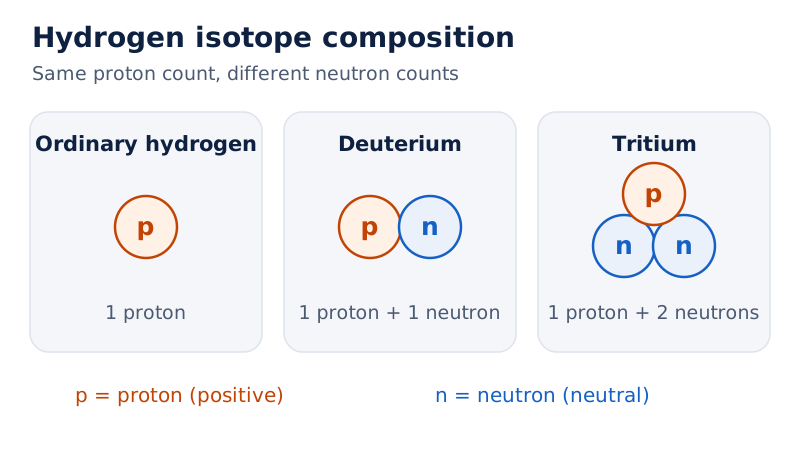
Draw three separate nuclear groups. Show one proton for ordinary hydrogen, one proton and one neutron for deuterium, and one proton and two neutrons for tritium. Label each group and provide a key distinguishing the two particles.
Drawn by One Young India.
Why can an element have a non-integral atomic mass?
The atomic mass unit, written , is one-twelfth of the mass of a carbon-12 atom. Its value is . A mass spectrometer measures atomic masses and reveals the presence of different isotopes.
The atomic mass of an element is a weighted average of its isotope masses, using their relative abundances. It need not be an integer even when the isotopic masses themselves are close to integral multiples of the hydrogen atom's mass.
Worked example 1. Chlorine isotopes have masses and , with abundances 75.4% and 24.6%. Calculate the average atomic mass. Let denote the weighted average atomic mass.
Answer:
- Use the abundances as fractions:
- Add the weighted contributions:
- Round consistently with the isotope masses:
The non-integral result reflects the mixture of isotopes; it does not represent a fractional number of nucleons in one nucleus.
How are nuclear radius and nuclear density related?
Scattering experiments probe nuclear size. Alpha-particle scattering initially gives an upper limit on nuclear radius. At higher projectile energies, deviations from predictions based entirely on Coulomb repulsion indicate the influence of short-range nuclear forces. Fast-electron scattering also allows nuclear radii to be measured.
Let be nuclear radius and the empirical radius constant. The relation is , with . A femtometre, abbreviated fm, is defined by .
Derivation: Why is nuclear density nearly independent of mass number?
Let be nuclear volume, nuclear mass, nuclear mass density and an approximate common mass of a nucleon. Treat the nucleus as spherical; denotes the circle constant.
- Start with the measured radius relation:
- Calculate the spherical volume:
- Approximate the mass by the nucleon count times the nucleon mass:
- Divide mass by volume and cancel the mass number:
Result: Nuclear density is nearly independent of mass number because nuclear mass and nuclear volume both increase in proportion to the number of nucleons. This approximation does not imply that the density of ordinary atomic matter is constant.
Worked example 2. Find the density of an iron nucleus of mass and mass number 56. Use and .
Answer: Formula: ; . Substitute:
- Convert the nuclear mass:
- Find the volume:
- Divide with units retained:
For comparison, water has a density of about , far below this nuclear density.
Nuclear matter is extraordinarily dense because almost all atomic mass occupies a very small nuclear volume. The large spaces within atoms make ordinary matter far less dense. Matter in neutron stars has a density comparable to nuclear density.
What does mass-energy equivalence mean in nuclear physics?
Einstein's mass-energy equivalence treats mass as a form of energy. Let denote the energy equivalent of mass , and let be the speed of light in vacuum. The relation is , with .
The law of conservation of energy applies provided the energy associated with mass is included. Initial and final energies must account for rest-mass energy as well as other forms, such as kinetic energy. Mass and energy are therefore treated through a unified conservation principle.
Which units are used?
| Quantity | SI unit | Use in this chapter |
|---|---|---|
| Mass | The SI unit of mass is kilogram. | Atomic masses are also expressed in . |
| Energy | The SI unit of energy is joule. | Nuclear energies are often expressed in MeV. |
| Length | The SI unit of length is metre. | Nuclear radii are conveniently expressed in femtometres. |
| Time | The SI unit of time is second. | Used for lifetimes and energy-release durations. |
| Electric charge | The SI unit of electric charge is coulomb. | A proton carries one positive elementary charge. |
The conversion connects nuclear energy calculations to SI units. The equivalent mass conversion is . Multiplication by converts this mass into energy, giving .
Worked example 3. Calculate the energy equivalent of of matter, using .
Answer:
- Convert the given mass to SI units:
- Substitute in the mass-energy relation:
- Evaluate, retaining the energy dimensions:
This is the energy equivalent of the entire stated mass. A nuclear reaction releases the energy corresponding to its mass difference, which must be calculated from the initial and final systems.
Chemical reactions also involve mass-energy changes in principle. Their binding-energy changes, and associated mass defects, are much smaller than nuclear ones. Nuclear reaction energies are typically in MeV, whereas chemical reaction energies are typically in electron volts.
How are mass defect and nuclear binding energy calculated?
A bound nucleus has less mass than its separated constituent protons and neutrons. This difference is the mass defect, denoted by . Let denote the free proton mass and the free neutron mass.
The binding energy, denoted by , is the energy required to separate the nucleus completely into its individual nucleons. The same amount of energy is released when those nucleons combine to form that nucleus.
Derivation: How does the constituent mass give the binding energy?
- The mass of the separated nucleons is the sum of proton and neutron contributions:
- Subtract the actual nuclear mass:
- Convert the mass difference into energy:
- Define , the binding energy per nucleon, and divide by the number of nucleons:
Result: Binding energy per nucleon is the average energy per nucleon needed for complete separation. It is more useful than total binding energy for comparing how tightly different nuclei are bound.
How should atomic masses be used?
An atomic mass includes electron masses; a nuclear mass does not. Let denote electron mass, the neutral atom's mass and the hydrogen atom's mass. Neglecting electronic binding-energy corrections, the atomic-mass formula follows in three steps.
- Remove the atomic electrons:
- Express the free proton mass using hydrogen:
- Substitute both expressions into the mass defect and cancel the electron terms:
Note: Do not use a bare proton mass together with a neutral atomic mass without correcting for the electrons. Also distinguish energy, measured in MeV, from mass expressed in .
Worked example 4. Find the binding energy of . Use atomic mass , , , , and .
Answer:
- Remove the eight electron masses:
- Sum the separated nucleon masses:
- Calculate the mass defect:
- Convert mass defect to binding energy:
The positive binding energy is the energy needed to separate this oxygen nucleus completely into eight protons and eight neutrons.
What does the binding-energy curve reveal about nuclear stability?
The binding-energy curve plots binding energy per nucleon against mass number. It rises rapidly across light nuclei, has a broad, nearly flat middle region, and decreases gradually towards very heavy nuclei. The vertical coordinate is an average per nucleon, not total nuclear binding energy.
What the figure shows
Binding energy per nucleon
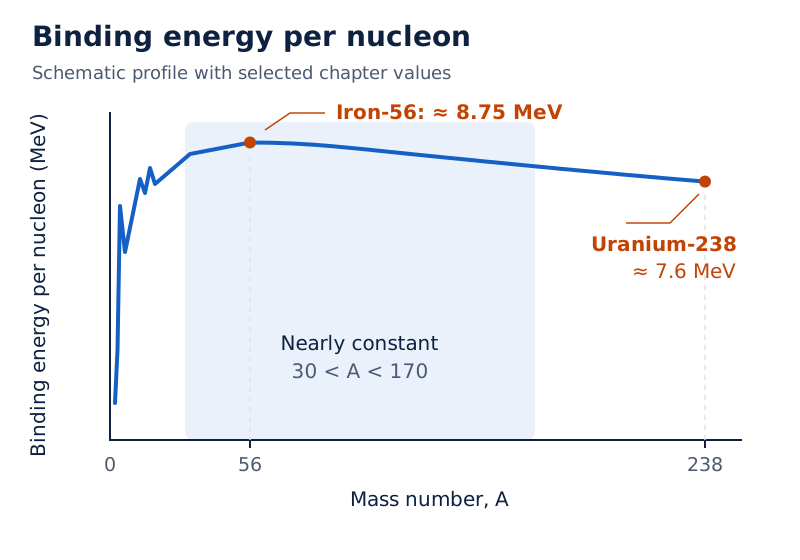
The horizontal axis shows mass number and the vertical axis binding energy per nucleon in MeV. The plotted line rises unevenly among light nuclei, reaches a high region near iron-56, then slopes gently down towards uranium-238.
Drawn by One Young India. See Fig. 13.1 in your NCERT textbook
For , the binding energy per nucleon is nearly constant at about . The curve reaches about near , while its value at is about .
Why can both fission and fusion release energy?
Heavy nuclei have lower binding energy per nucleon than nuclei of intermediate mass. Splitting a sufficiently heavy nucleus into suitable intermediate fragments can therefore increase the total binding energy. The more tightly bound final system has less rest mass, allowing energy to be released.
Very light nuclei can similarly form a more tightly bound heavier nucleus through fusion. Both processes release energy when the final total binding energy exceeds the initial total binding energy. The direction of change along the curve matters, rather than the name of the process alone.
The nearly constant middle region also indicates saturation of nuclear forces. In a sufficiently large nucleus, each nucleon interacts effectively with nearby neighbours. Adding distant nucleons does not greatly alter the binding energy of a nucleon already inside the nucleus.
Worked example 5. Calculate the binding energy of nitrogen-14 from atomic mass , hydrogen atomic mass , neutron mass , and . Nitrogen-14 contains seven protons and seven neutrons.
Answer:
- Use atomic masses consistently:
- Subtract the atomic mass from the constituent sum:
- Convert to energy:
The electron masses cancel in this atomic-mass method. The answer is a total binding energy, rather than the energy per nucleon.
How does the binding energy of a sample differ from that of one nucleus?
Worked example 6. A coin is assumed to consist entirely of copper-63, with 29 protons and 34 neutrons per nucleus. Find the energy needed to separate all its nuclei into individual nucleons. Use copper atomic mass , hydrogen atomic mass , neutron mass , , , and Avogadro constant .
Answer: Let be the number of copper atoms and their molar mass. Here denotes energy for the whole sample. Formula: ; . Substitute:
- Find the mass defect per nucleus:
- Calculate binding energy per nucleus:
- Find the dimensionless atom count:
- Multiply by energy per nucleus:
- Convert to joules:
This is energy that must be supplied for nuclear separation. Multiplying by the number of nuclei distinguishes the sample's total requirement from the binding energy of one nucleus.
What properties of nuclear forces hold nuclei together?
The nuclear force is sufficiently strong to overcome the electrostatic repulsion between protons inside nuclei. It binds both protons and neutrons within a tiny volume. Gravitational attraction is far too weak to account for this binding.
Nuclear forces are short-range: the interaction falls rapidly towards zero when nucleon separations exceed a few femtometres. This limited range explains why a nucleon in a medium or large nucleus is mainly affected by its nearby neighbours.
How does separation affect attraction and repulsion?
Let denote the separation between two nucleons and the separation at the potential-energy minimum. Here is about . The force is attractive above this separation within its effective range, and strongly repulsive below it.
What the figure shows
Potential energy of two nucleons
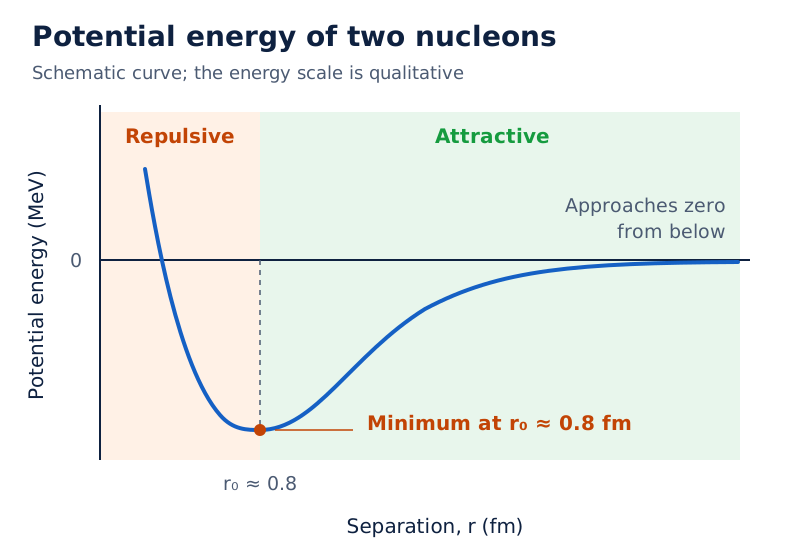
The horizontal axis is separation in femtometres and the vertical axis potential energy in MeV. The curve falls steeply from positive energy, reaches a negative minimum near the labelled separation, then approaches zero as separation increases.
Drawn by One Young India. See Fig. 13.2 in your NCERT textbook
The repulsive region at very small separation is as important as the attractive region. Saying that nuclear forces bind nucleons does not mean that the interaction remains attractive at every possible distance.
Does electric charge determine the nuclear force?
The nuclear interaction between neutron-neutron, proton-neutron and proton-proton pairs is approximately the same. This charge independence refers to the nuclear interaction itself. Protons also experience electric repulsion because they carry positive charge.
There is no simple mathematical expression for nuclear force comparable to the familiar expressions for electric or gravitational forces. Its strength, short range, repulsive behaviour at very small separations and approximate charge independence are established through experiments.
What is radioactivity, and what types of radiation are emitted?
Radioactivity is a nuclear phenomenon in which an unstable nucleus undergoes decay. A. H. Becquerel discovered it in 1896 through observations involving uranium compounds and the blackening of photographic plates. The emitted radiation could penetrate materials separating the compound from the plate.
Three types of radioactive decay occur in nature: alpha decay, beta decay and gamma decay. Their emitted particles or radiation differ, so the terms should not be used interchangeably.
| Decay type | Emission | Important distinction |
|---|---|---|
| Alpha | A helium nucleus, | The emitted nucleus contains two protons and two neutrons. |
| Beta | An electron or a positron | A positron has the electron's mass but the opposite charge. |
| Gamma | High-energy photons | The radiation is electromagnetic rather than a stream of helium nuclei. |
How is radioactivity related to instability?
Radioactivity indicates nuclear instability. For light stable nuclei, the neutron-to-proton ratio is around one to one. For heavy nuclei, the ratio increases to about three to two. Additional neutrons help counter the effect of repulsion among the protons.
Nuclei with an excess of neutrons or protons relative to the stability ratio are unstable. This connects radioactive behaviour to nuclear composition: knowledge of the mass number alone does not fully describe the balance between neutrons and protons.
A positron and an electron form a particle-antiparticle pair. They have equal masses and opposite electric charges. When they meet, they can annihilate, releasing energy as gamma-ray photons. This process also appears in the sequence of fusion reactions in the Sun.
How do nuclear reaction energies and fission work?
The Q-value, denoted by , measures a nuclear reaction's energy release. Let and denote total initial and final kinetic energies, and and total initial and final rest masses.
Conservation of mass-energy gives . A positive Q-value describes an exothermic reaction. A negative value describes an endothermic reaction requiring energy input.
What happens in uranium fission?
In fission, a heavy nucleus divides into intermediate-mass fragments. A neutron can induce fission of uranium-235. In reaction notation, represents a neutron; U, Ba and Kr are the chemical symbols for uranium, barium and krypton.
One possible reaction is:
Other fragment pairs are possible. The fragments are radioactive and emit beta particles in succession towards stable end products. The released energy first appears as kinetic energy of fragments and neutrons, then transfers to surrounding matter as heat.
The energy release is of the order of per fissioning uranium nucleus. Fission supplies the energy in nuclear reactors. The binding-energy curve explains this large release because suitable intermediate-mass fragments are more tightly bound per nucleon than the original heavy nucleus.
Worked example 7. All atoms in of pure plutonium-239 undergo fission, releasing an average per atom. Calculate the total energy released in MeV and joules. Use approximate molar mass , Avogadro constant , and .
Answer: Let be amount in moles, the atom count and total released energy. Formula: ; ; . Substitute:
- Convert the sample mass:
- Calculate the amount:
- Calculate the dimensionless atom count:
- Multiply by energy per fission:
- Convert to joules:
How does fusion generate energy in stars?
In nuclear fusion, light nuclei combine to form a larger, more tightly bound nucleus. They must approach closely enough for short-range nuclear attraction to become effective. Their positive charges produce a Coulomb barrier that opposes this approach.
Fusion achieved by raising the temperature so particles have enough kinetic energy to overcome electric repulsion is called thermonuclear fusion. The required energy depends on the charges and radii of the interacting nuclei.
What is the proton-proton cycle?
The Sun's fuel is hydrogen in its core. In the reactions below, denotes a positron, an electron, a neutrino and a gamma-ray photon. Hydrogen and helium nuclei are represented by H and He with their mass and atomic numbers.
- Two protons produce deuterium, a positron and a neutrino:
- The positron annihilates with an electron:
- Deuterium combines with another proton:
- Two helium-3 nuclei combine:
The first three reactions must each occur twice for the fourth reaction to occur. Overall, four hydrogen atoms form one helium-4 atom with an energy release of about . This multi-step process supplies stellar energy.
The Sun's interior temperature is about . Fusion there involves protons whose energies are much above the average energy. As stellar hydrogen is depleted, gravitational contraction can heat the core enough for further fusion involving helium.
What makes controlled fusion difficult?
At temperatures of order , fusion fuel is a plasma, a mixture of positive ions and electrons. Confining this very hot material is a major challenge because an ordinary container cannot withstand the temperature. Controlled fusion aims to sustain energy production under these conditions.
Worked example 8. Estimate how long fusion of of deuterium could power a lamp. Each pair of deuterium nuclei releases . Use molar mass , , , and ideal complete conversion into lamp energy.
Answer: Let be the deuterium nucleus count, the reaction count, lamp power and operating time. Formula: ; ; . Substitute:
- Convert the available mass:
- Find the deuterium nucleus count:
- Count pairs and obtain energy:
- Divide by power:
This ideal estimate assumes all the deuterium undergoes the specified reaction and all released energy is available to the lamp.
Worked example 9. Find the Coulomb barrier for two deuterons touching head-on. Each has radius and charge . Use Coulomb constant , , and .
Answer: Let be centre-to-centre separation and the electric potential energy at contact.
- Add the radii:
- Apply Coulomb potential energy:
- Convert the result:
The unit conversion identifies the calculated electric potential energy as an energy barrier.
Glossary
- Nucleus — The small, positively charged central region containing almost all of an atom's mass.
- Nucleon — A proton or a neutron, the two types of constituent particles found in nuclei.
- Atomic number — The number of protons in a nucleus, identifying the chemical element.
- Mass number — The total number of protons and neutrons present in a particular nucleus.
- Isotopes — Nuclides with the same atomic number but different neutron numbers and masses.
- Isobars — Nuclides sharing the same mass number, as in tritium and helium-3.
- Isotones — Nuclides having the same neutron number but different numbers of protons.
- Mass defect — The excess of separated constituent nucleon masses over the mass of the bound nucleus.
- Binding energy — Energy required to separate a nucleus completely into its individual protons and neutrons.
- Binding energy per nucleon — Total nuclear binding energy divided by the number of nucleons in that nucleus.
- Radioactivity — A nuclear phenomenon in which an unstable nucleus undergoes decay and emits radiation.
- Fission — Division of a heavy nucleus into smaller nuclear fragments, with possible energy release.
- Fusion — Combination of light nuclei into a larger nucleus, releasing energy when binding increases.
- Plasma — A mixture of positive ions and electrons, such as fusion fuel at very high temperatures.
Common errors and misconceptions
- Misconception: Mass number is the measured mass of a nucleus in atomic mass units. Correct: It counts nucleons and is dimensionless; measured nuclear mass need not equal that integer in atomic mass units.
- Misconception: Isotopes have different proton numbers. Correct: Their proton numbers are identical; their neutron numbers differ, giving different mass numbers.
- Misconception: Atomic and nuclear masses are interchangeable. Correct: Atomic masses include electrons. Subtract electron masses or use the consistent hydrogen-atom form of the mass-defect calculation.
- Misconception: Binding energy is energy already available without changing the nucleus. Correct: It is energy required for complete separation, or energy released when the nucleus forms from separated nucleons.
- Misconception: Nuclear forces are attractive at every separation. Correct: They become strongly repulsive below about , and their effect falls rapidly beyond a few femtometres.
- Misconception: The binding-energy graph plots total binding energy. Correct: It plots binding energy per nucleon against mass number, allowing nuclei of different sizes to be compared.
- Misconception: Every possible splitting of a nucleus releases energy. Correct: The sign of the Q-value determines whether energy is released or must be supplied.
- Misconception: Mass-energy conversion occurs only in nuclear reactions. Correct: Chemical binding-energy changes also involve mass differences, but these are much smaller than typical nuclear mass differences.
Exam-style questions with model answers
Q1. Define isotopes and isotones, and distinguish the quantities that remain the same. [2 marks]
- Isotopes have the same atomic number, so they contain the same number of protons, but different neutron numbers.
- Isotones have the same neutron number but different atomic numbers. Thus the shared quantity is proton count for isotopes and neutron count for isotones.
Q2. Given , derive why nuclear density is nearly independent of mass number. Here is radius, a constant and the nucleon count. Assume a spherical nucleus and approximately equal nucleon masses . [3 marks]
- The nuclear volume, denoted by , is , so volume is proportional to mass number.
- The nuclear mass, denoted by , is approximately , because the nucleus contains that many nucleons.
- The density, denoted by , is . The mass number cancels, so density is nearly independent of nuclear size within these approximations.
Q3. Find the binding energy of nitrogen-14, containing seven protons and seven neutrons. Its atomic mass is . Use hydrogen atomic mass , neutron mass , and , where is the speed of light. [3 marks]
- Use atomic masses consistently so that electron masses cancel. The mass defect, denoted by , is .
- The binding energy, denoted by , is .
- This positive energy must be supplied to separate the nitrogen nucleus completely into its individual nucleons. It is the total binding energy of the nucleus, not its binding energy per nucleon.
Q4. Describe the binding-energy-per-nucleon curve and explain how it accounts for both nuclear fission and fusion. [5 marks]
- The graph rises rapidly among light nuclei, remains nearly flat for intermediate mass numbers, and decreases gradually towards very heavy nuclei. Its vertical coordinate is binding energy per nucleon.
- For mass numbers roughly between 30 and 170, the binding energy per nucleon is about , with a maximum near iron-56.
- A heavy nucleus can split into intermediate-mass fragments with greater binding energy per nucleon. The final system is more tightly bound and has less rest mass, releasing energy.
- Light nuclei can combine into a more tightly bound heavier nucleus. This increase in total binding energy similarly permits energy release during fusion.
- Both processes therefore follow the same principle: a transition towards greater total binding releases energy. The initial and final masses determine the actual reaction energy.
Q5. Could iron-56 spontaneously split into two aluminium-28 nuclei with energy release? Use neutral atomic masses and , respectively, and . Iron has 26 protons and aluminium has 13. Define the sign of the Q-value. [3 marks]
- The electron masses cancel because the initial atom has 26 electrons and the two product atoms together also have 26. Atomic masses can therefore be used consistently at this precision.
- The initial mass minus final mass is .
- The reaction energy is . The negative sign means the reaction is endothermic and requires energy; it cannot provide spontaneous energy-releasing fission.
Q6. Explain the strength, range, separation dependence and charge independence of nuclear forces. [4 marks]
- Nuclear forces are strong enough to overcome electric repulsion between protons inside a nucleus. Gravitational attraction is much weaker and cannot explain nuclear binding.
- The force falls rapidly towards zero beyond a few femtometres, so it acts effectively between nearby nucleons.
- It is attractive above about within its range, but strongly repulsive at smaller separations.
- The nuclear interaction is approximately the same for proton-proton, proton-neutron and neutron-neutron pairs. This approximate charge independence concerns nuclear forces; electric forces between charged particles still exist.
Q7. Explain why fusion requires high temperatures, how hydrogen powers the Sun, and why confining fusion fuel is difficult. [5 marks]
- Light nuclei are positively charged and repel each other electrically. Fusion requires them to approach closely enough for short-range nuclear attraction to act.
- High temperatures provide kinetic energy that helps nuclei overcome the Coulomb barrier. Fusion achieved by heating is called thermonuclear fusion.
- Hydrogen in the Sun's core undergoes a multi-step proton-proton cycle. Overall, four hydrogen atoms produce a helium-4 atom with a release of about .
- Fusion in the Sun involves protons with energies much above the average energy. The energy release reflects the greater binding of the final nucleus.
- At the very high temperatures used for controlled fusion, the fuel is plasma containing positive ions and electrons. Confinement is difficult because ordinary containers cannot withstand these temperatures.
Key takeaways
- Nuclei contain protons and neutrons; atomic number counts protons, while mass number counts both kinds of nucleons.
- Isotopes share proton number, isobars share mass number, and isotones share neutron number despite differing atomic numbers.
- Nuclear radius grows with the cube root of mass number, making nuclear volume approximately proportional to nucleon count.
- Mass defect is the constituent mass sum minus nuclear mass; its energy equivalent is the nuclear binding energy.
- The binding-energy-per-nucleon curve explains why suitable heavy-nucleus fission and light-nucleus fusion can both release energy.
- Nuclear forces are strong, short-range and approximately charge-independent, but become strongly repulsive at very small nucleon separations.
- A positive Q-value indicates energy release; a negative Q-value means the nuclear reaction requires energy input.
- Fusion powers stars through nuclear binding-energy changes, while controlled fusion requires heating and confinement of very hot plasma.
Test yourself
What distinguishes a proton from a neutron electrically?
A proton carries one positive elementary charge, whereas a neutron has no net electric charge.
How many neutrons are in ?
The neutron count is , found by subtracting proton number from mass number.
Why does chlorine have a non-integral average atomic mass?
Its atomic mass is a weighted average of different isotope masses using their relative abundances.
Why does adding nucleons not make nuclear density increase proportionally?
Nuclear volume also increases approximately in proportion to nucleon count, leaving the mass-to-volume ratio nearly unchanged.
Does a larger total binding energy necessarily mean greater binding per nucleon?
No. Binding energy per nucleon is obtained by dividing total binding energy by the number of nucleons.
What particles are emitted in alpha decay?
Alpha decay emits helium nuclei, each containing two protons and two neutrons.
What does a negative nuclear Q-value mean?
The reaction requires an input of energy because its final rest mass exceeds its initial rest mass.
What prevents low-energy light nuclei from approaching each other easily?
Their positive charges create Coulomb repulsion, forming an energy barrier to close approach and fusion.
Write about it
Turn a question from this chapter into a paper.
The Writing Studio has a structure guide, a rubric and citation tools for 15 formats, from essays to research papers. Drafting is free with an account. Learnacy Essential adds feedback from an AI writing coach and submission to The OYI Review.
Learnacy Essential is ₹1,499 for the year. Publication depends on review and is not guaranteed.