
Ray Optics and Optical Instruments | CBSE Class 12 Physics Notes
On this page
Watch & explore
Start with a few high-quality watches, then dive into the notes below.
This note covers the ray model of light, reflection by spherical mirrors, Cartesian signs, refraction, total internal reflection, optical fibres, refraction at spherical surfaces, thin lenses, lens power, lens combinations, prisms, microscopes and astronomical telescopes.
How do rays, reflection and sign conventions describe light?
When is the ray model useful?
A ray represents the path along which light travels; a collection of rays forms a beam. The straight-line description is useful when the wavelength is very small compared with the dimensions of the objects involved. It does not remove the wave nature of light.
Visible light has wavelengths of about to . The symbol denotes the speed of light in vacuum; for ordinary calculations, . Light travels at a finite speed even though everyday travel times are very short.
The laws of reflection require the incident ray, reflected ray and normal at the point of incidence to lie in one plane. If is the angle of incidence and the angle of reflection, both measured from the normal, then .
How are distances signed?
The pole is the geometric centre of a spherical mirror. Its principal axis joins the pole and centre of curvature. The normal at any point on the mirror lies along the radius through that point. For a thin lens, distances are measured from its optical centre.
| Measurement | Cartesian rule |
|---|---|
| Along the direction of incident light | Positive distance |
| Opposite to the direction of incident light | Negative distance |
| Height above the principal axis | Positive height |
| Height below the principal axis | Negative height |
Let denote signed object distance, signed image distance, signed focal length and signed radius of curvature. The SI unit of object distance is the metre. The SI unit of image distance is also the metre.
The SI unit of focal length is the metre, and the SI unit of radius of curvature is the metre. Centimetres may be used consistently in a distance equation, but lens power requires focal length expressed in metres.
Note: Assign signs from the actual geometry before substitution. A negative distance identifies a direction relative to the incident light; it does not mean that a physical length has become negative.
How do spherical mirrors form images?
What are the focus and image?
Paraxial rays pass close to the principal axis and make small angles with it. Parallel paraxial rays converge at the principal focus of a concave mirror. For a convex mirror, their backward extensions meet at a virtual principal focus.
Within this approximation, . Both quantities are negative for a concave mirror and positive for a convex mirror under the stated convention. Rays parallel but inclined to the principal axis focus in the focal plane, which passes through the principal focus perpendicular to the axis.
A real image forms where rays actually converge. A virtual image forms where backward extensions of diverging rays meet. A screen reveals a real image by scattering light towards the eye; removing the screen does not remove the convergence of the rays.
For ray tracing, a ray parallel to the axis reflects through the focus, or appears to come from it. A ray along a radius retraces its path. A ray through the focus, or directed towards it, reflects parallel to the axis.
What the figure shows
Concave-mirror image formation
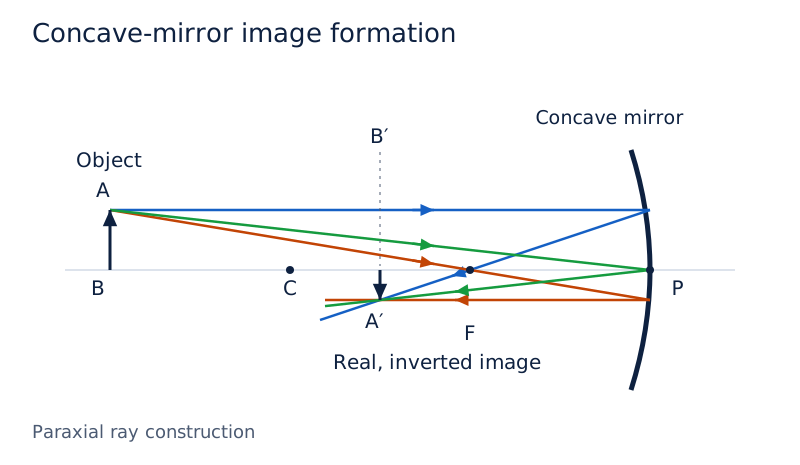
The upright object is labelled , and the inverted image is labelled . The pole , focus and centre of curvature lie on the axis. Three rays from the object tip meet at the image tip.
Drawn by One Young India. See Fig. 9.5 in your NCERT textbook
Derivation: How is the mirror formula obtained?
Consider a real inverted image formed by a concave mirror. Let , and be the positive magnitudes of object distance, image distance and focal length. Similar triangles formed by the axial and pole rays give the following steps.
- Equate the two expressions for the magnitude of the image-to-object height ratio:
- Apply the Cartesian signs for this arrangement:
- Substitute these distances and simplify:
- Divide the rearranged relation by the image distance:
Result: The mirror formula applies to spherical concave and convex mirrors with the correct signs, provided the paraxial approximation is appropriate.
Let be signed object height and signed image height, both measured in the same length unit. The linear magnification, , is dimensionless: A positive value indicates an erect image; a negative value indicates an inverted image.
Worked example 1. An object is 10 cm in front of a concave mirror whose radius of curvature has magnitude 15 cm. Find its image position and magnification.
Formula: , , .
Substitute:
Answer: The image forms 30 cm in front of the mirror. It is real, inverted and three times the object size.
Worked example 2. Move the object to 5 cm in front of the same concave mirror of radius-of-curvature magnitude 15 cm. Find the image position and magnification.
Formula: , , .
Substitute:
Answer: The image lies 15 cm behind the mirror. It is virtual, erect and enlarged threefold because the object is between the pole and focus.
How does refraction change a ray's direction?
What does Snell's law relate?
At an interface between transparent media, some light can be reflected while some enters the second medium. An obliquely incident transmitted ray generally changes direction. This bending is refraction. The incident ray, refracted ray and normal at the interface lie in one plane.
Let be the angle of refraction measured from the normal, and the refractive index of the second medium relative to the first. Snell's law is For a fixed pair of media and a fixed wavelength, this ratio is independent of the incidence angle.
Let and denote the absolute refractive indices of the first and second media. They are dimensionless, and . Thus the law can also be written . All angles in this equation refer to the normal, not the surface.
| Relative optical density | Direction of refraction |
|---|---|
| Second medium optically denser, | Ray bends towards the normal |
| Second medium optically rarer, | Transmitted ray bends away from the normal |
| Normal incidence | No change in the ray's direction |
Why do slabs and water give displaced images?
A ray passing through a parallel-sided slab surrounded by the same medium emerges parallel to the incident ray, but laterally displaced. The refraction at the second face restores the original direction; it does not generally restore the original path.
For an object in water viewed from air near the normal, let be real depth, apparent depth and the refractive index of water relative to air. Then . The bottom appears raised because the backward extensions of emerging rays meet above the actual object.
Note: Optical density is not mass density. Turpentine has lower mass density than water but is optically denser. Refraction depends on optical properties, so mass-density comparisons cannot determine the bending direction.
When does total internal reflection occur?
What is the critical angle?
Light travelling from an optically denser medium towards a rarer medium bends away from the normal. As incidence becomes more oblique, the refraction angle increases. The critical angle, , is the incidence angle for which the refracted ray grazes the interface.
At this limiting angle, . With the first medium denser than the second, Snell's law gives For incidence greater than the critical angle, no refracted ray emerges and the light undergoes total internal reflection.
- The light must approach the boundary from the optically denser medium.
- The adjoining medium must be optically rarer.
- The incidence angle, measured from the normal, must satisfy .
- At equality, the refracted ray grazes the boundary; this is the limiting case rather than incidence beyond the critical angle.
What the figure shows
Critical angle and total internal reflection
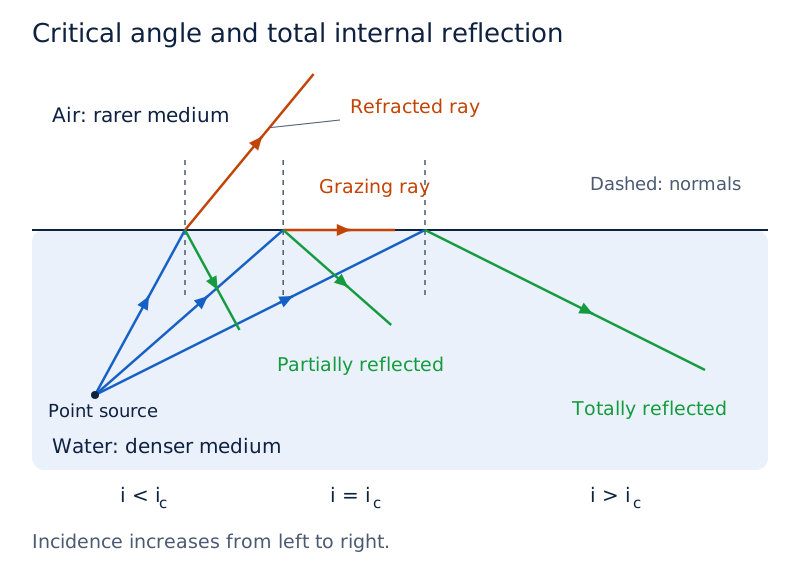
Rays from a point in water strike the water-air boundary at increasing incidence angles. The drawing shows refracted rays, partially reflected rays, a grazing refracted ray and a ray totally reflected into water.
Drawn by One Young India. See Fig. 9.11 in your NCERT textbook
How do optical fibres guide light?
An optical fibre has a transparent core surrounded by cladding of lower refractive index. Light entering at a suitable angle meets the core-cladding boundary above the critical angle and undergoes repeated total internal reflections. This guides the signal along the fibre, including suitably bent portions.
Fibres carry audio and video signals after conversion into light signals. Bundles also act as light pipes for viewing internal organs. Low absorption remains important: repeated total internal reflection does not mean that every practical fibre has absolutely zero transmission loss.
What the figure shows
Light guidance in a fibre
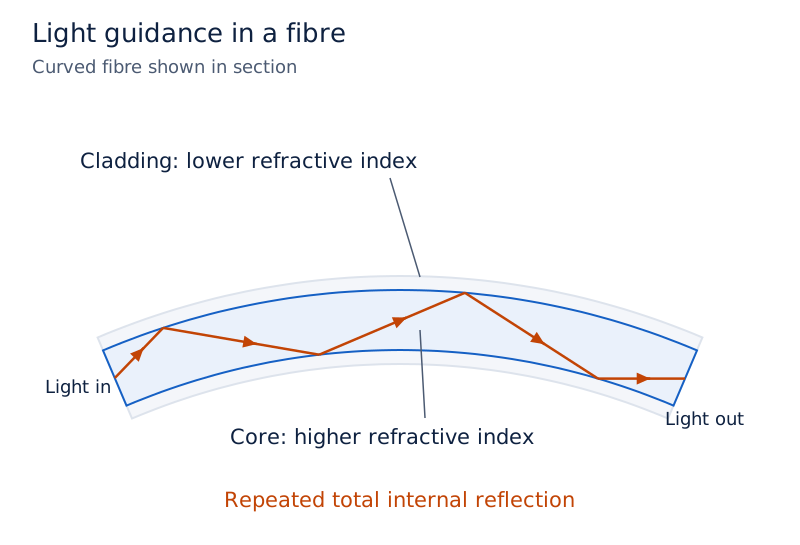
A zigzag ray passes through the curved high-index core. The surrounding material is labelled as having a lower refractive index, and the ray repeatedly reflects at the core boundary.
Drawn by One Young India. See Fig. 9.14 in your NCERT textbook
Totally reflecting prisms can turn light through or . For the illustrated right-angle arrangements, the material must have a critical angle below . Prisms can also invert an image without changing its size.
How does a spherical refracting surface form an image?
Which approximation is required?
A small portion of a spherical interface behaves locally like a plane surface. Its normal passes through the centre of curvature. Applying Snell's law at the point of incidence therefore requires the local radius as the normal, rather than a line parallel to the principal axis.
Take an object in a medium of index and a refracted image in a medium of index . Here , and are measured from the pole of the refracting surface. A positive radius places the centre of curvature in the direction of incident light.
Derivation: What is the spherical-surface formula?
Consider the geometry with the object on the left and a real image and centre of curvature on the right. Let be the small ray height, and , , the positive magnitudes of object distance, image distance and radius, respectively.
- Use small-angle geometry, with angles expressed in radians:
- Apply the paraxial form of Snell's law:
- Substitute the angular expressions and cancel the ray height:
- Insert the signed distances , , :
Result: This relation connects the object, image and curvature for paraxial refraction at one spherical interface. It is not the thin-lens formula, because only one change of medium has been considered.
Worked example 3. A point source in air is 100 cm before a spherical glass surface of radius 20 cm, with its centre inside the glass. Use air index and glass index . Find the image position.
Formula: .
Substitute:
Answer: The refracted rays form the image 100 cm from the surface, in the direction of the incident light.
How are the lens maker's formula and thin-lens formula derived?
Why must both surfaces be considered?
A lens is a transparent optical medium bounded by two surfaces, at least one of which is spherical. Refraction at its first surface produces an intermediate image that becomes the object for its second surface. The final image depends on both refractions.
For a thin lens, the separation of its surfaces is neglected when measuring axial distances. Let be the lens material's refractive index and that of the surrounding medium, assumed identical on both sides. Let and be the signed radii of the first and second surfaces.
What the figure shows
Two refractions through a convex lens
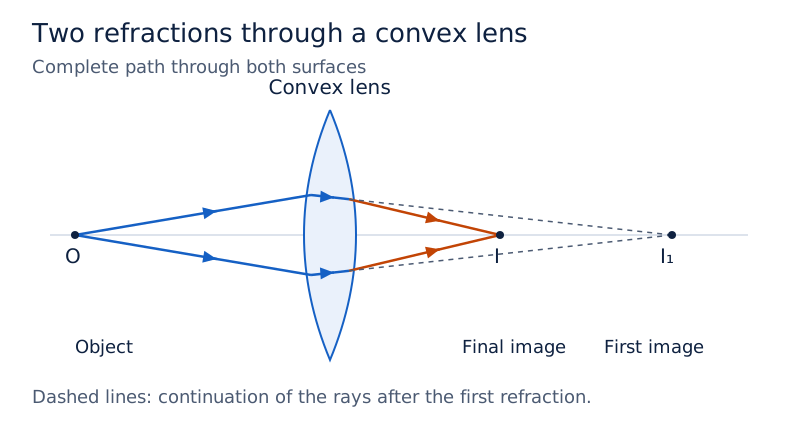
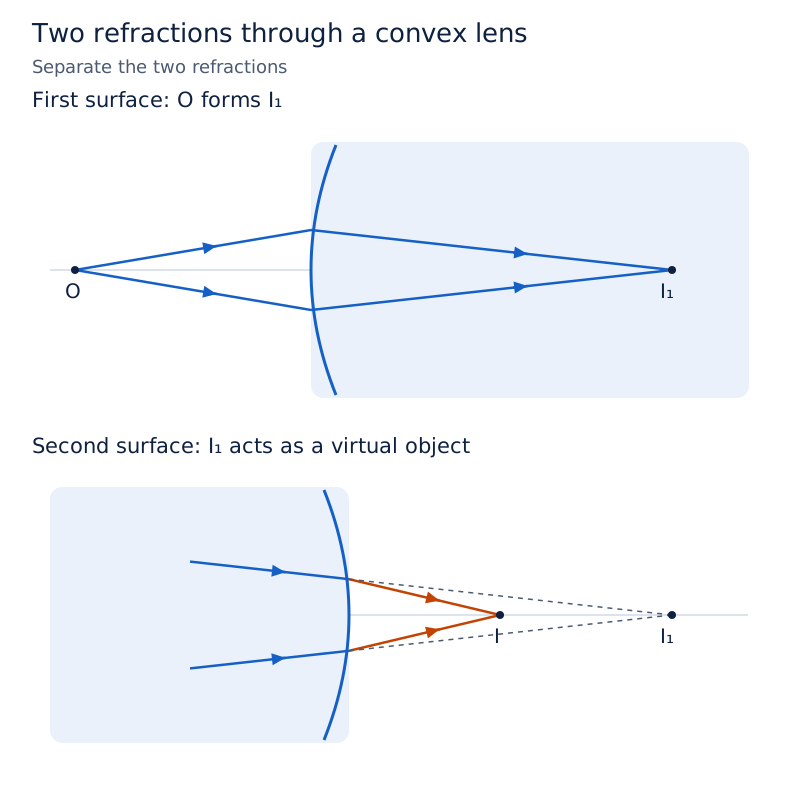
The three panels show the complete lens path, refraction at the first surface and refraction at the second surface. The intermediate image is labelled , while labels the final image.
Drawn by One Young India. See Fig. 9.16 in your NCERT textbook
Derivation: How are the two surface equations combined?
Let be the signed intermediate-image distance. In the thin-lens approximation this is also the signed object distance for the second surface. All distances use the same direction of incident light.
- Write the first-surface equation:
- Write the second-surface equation:
- Add the equations and divide by the surrounding index:
- For an object at infinity, the image is at the second focus. Set and :
- Substitute this focal-length expression into the combined equation:
Result: The lens maker's formula relates focal length to material and curvature. The thin-lens formula relates focal length to object and image distances. Both use the paraxial, thin-lens approximation.
Why does the surrounding medium matter?
The relevant factor is the relative refractive index of the lens material. For a double-convex glass lens in air with light travelling left to right, the first radius is positive and the second negative. A change of surrounding medium changes focal length even though the surfaces remain unchanged.
If the lens and liquid have equal refractive indices, the lens maker's right-hand side vanishes: . The lens then has no focusing power. In such a liquid the lens acts like a plane sheet of glass, so it can seem to disappear. This is an optical effect, not a loss of the glass itself.
Worked example 4. A glass convex lens has focal length 20 cm in air. Find its focal length in water, using glass index 1.5, water index 1.33 and air index 1.
Formula: For unchanged surfaces, let and denote the focal lengths in air and water. Then .
Substitute:
Answer: Its focal length becomes approximately 78.2 cm. It still converges light, but less strongly because the refractive-index contrast is smaller.
How are thin-lens images located and described?
Which rays simplify a diagram?
For a convex lens in air, an incident ray parallel to the axis passes through the second principal focus after refraction. A ray through the first focus emerges parallel to the axis. A ray through the optical centre proceeds without deviation in the thin-lens model.
For a concave lens in air, an incident parallel ray emerges as though it came from the first principal focus. A ray directed towards the second focus emerges parallel to the axis. Two suitable rays determine the image point; they represent only a selection from the available rays.
The lens magnification is Unlike the mirror expression, it has no additional minus sign. A real object has negative object distance; a real image on the opposite side has positive image distance, giving negative magnification and inversion.
How do position and orientation fit together?
A convex lens forms a virtual, erect enlarged image when the real object is inside its focal distance. A concave lens forms a virtual, erect diminished image for a real object. Apply the signed formula before interpreting the result, rather than deciding the sign from the word “virtual” alone.
Worked example 5. An object 3.0 cm tall stands 14 cm in front of a concave lens of focal-length magnitude 21 cm. Find the image distance, magnification and height.
Formula: , , .
Substitute:
Answer: The image is 8.4 cm from the lens on the object's side and 1.8 cm tall. It is virtual, erect and diminished.
As this real object is moved farther from the concave lens, its image approaches the focus on the object's side and becomes smaller. For a converging lens, image character instead depends on whether the object is inside or outside the focal distance.
How do lens power and lenses in contact combine?
What does power measure?
Lens power measures the convergence or divergence introduced by a lens. Let denote this power. Its relation to focal length is The SI unit of lens power is the dioptre, symbol , with .
A converging lens has positive power and a diverging lens has negative power. A shorter focal-length magnitude corresponds to stronger bending. The reciprocal must use metres if the answer is to be in dioptres; taking the reciprocal of a centimetre value without conversion gives the wrong unit.
Derivation: Why do powers add for lenses in contact?
Let and be the focal lengths of two thin lenses in contact. Their optical centres are treated as coincident. Let be the intermediate-image distance and the effective focal length of the combination.
- For the first lens, write
- Use that image as the second lens's object:
- Add the two relations:
- Let , and denote combined and individual powers. Then
Result: Powers add algebraically for thin lenses in contact. Opposite signs must be retained. For several lenses the same addition extends to every lens, while total magnification is the product of the individual magnifications.
Worked example 6. A convex lens of focal length 30 cm touches a concave lens of focal-length magnitude 20 cm. Find the effective focal length and decide whether the combination converges or diverges.
Formula: .
Substitute:
Answer: The effective focal length is negative, with magnitude 60 cm, so the combination is diverging.
When lenses are separated, the intermediate image's distance from the next lens must include that separation. The simple contact formula cannot be applied unchanged. Lens combinations are used in cameras, microscopes and telescopes to obtain suitable magnification and improve image quality.
How does a prism deviate light?
Which angles describe passage through a prism?
A triangular prism has two refracting faces inclined to each other. Let denote the refracting angle between them, the first incidence angle and the emergence angle. Let and be the angles that the internal ray makes with the first and second face normals.
The angle of deviation, , is the angle between the emergent ray and the original incident direction. Geometry gives All incidence and refraction angles are measured from the appropriate normal at each face.
As incidence changes, deviation first decreases and then increases. A deviation above the minimum can correspond to two incidence angles. The reversible light path exchanges incidence and emergence while leaving the total deviation unchanged.
What the figure shows
Deviation against incidence
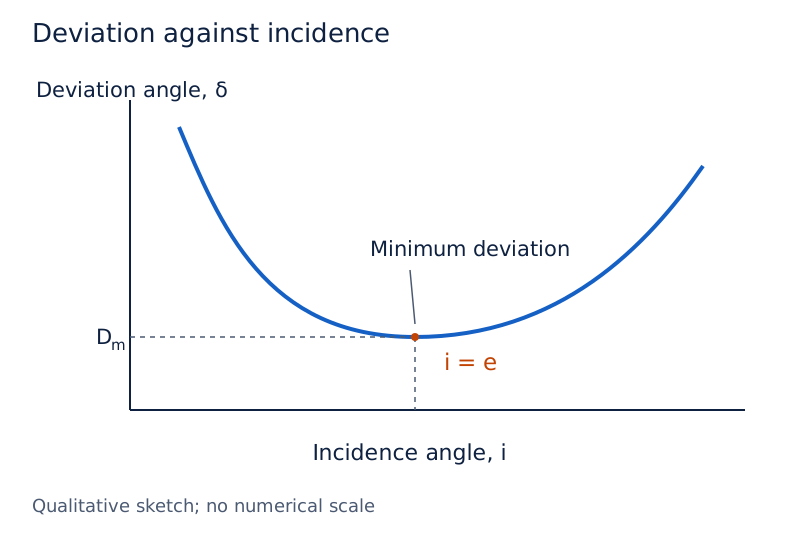
The horizontal axis shows incidence angle and the vertical axis deviation angle. The curve falls to a minimum and then rises. Its minimum is labelled with equality of incidence and emergence.
Drawn by One Young India. See Fig. 9.22 in your NCERT textbook
Derivation: How does minimum deviation determine refractive index?
Let be the minimum deviation and the prism's refractive index relative to its surroundings. At minimum deviation the path is symmetric, with equal incidence and emergence angles.
- Use the symmetry conditions:
- Let denote their common internal angle. The prism-angle relation becomes
- Use the deviation relation at the minimum:
- Substitute into Snell's law:
Result: Measuring the prism angle and minimum deviation determines the relative refractive index. For a prism in air, taking the refractive index of air as unity makes this approximately the prism material's absolute index.
For a thin prism with small angles, the sine can be approximated by its argument in radians. The minimum-deviation result then becomes . A thin prism consequently produces a small deviation.
Dispersion means separation of light into its constituent colours. Refractive index depends on wavelength, so a single refractive-index value in a prism calculation refers to the light being used. This wavelength dependence must not be confused with dependence on incidence angle for a fixed wavelength.
How does a simple microscope increase apparent size?
What is compared in angular magnification?
A simple microscope is a converging lens of short focal length held close to the eye. The object is placed at the focus or slightly inside it. The lens produces an erect, magnified virtual image that can be viewed comfortably at the near point or farther away.
Let denote the least distance of distinct vision, conventionally for a normal eye. This italic distance symbol differs from the upright dioptre unit . Let denote angular magnification, comparing the image's angular size with the unaided object's angular size at the near point.
The instrument lets the object be brought closer than the unaided near point while providing a clear image. Thus its usefulness does not require the image to subtend a larger angle than the actual nearby object. The comparison is with comfortable unaided viewing at the near point.
Derivation: What is the magnifying power for relaxed viewing?
Let be the small angle subtended by an unaided object of height at the near point, and the angle subtended by its image when the object is at the lens focus.
- For unaided viewing, write
- With the object at the focus, emerging rays are parallel and the final image is at infinity:
- Take the ratio of the two angles:
Result: The relaxed eye views the image at infinity. Angular magnification is dimensionless because it is a ratio of angles, and the distance ratio uses matching units.
For the final image at the near point, the lens is adjusted so that , and its magnifying power is . This gives greater magnification than relaxed viewing, but requires accommodation and is less comfortable for prolonged observation.
| Final-image position | Simple-microscope magnifying power | Viewing condition |
|---|---|---|
| At infinity | Relaxed eye; object at the focus | |
| At the near point | Object inside the focus; eye accommodates |
How does a compound microscope obtain greater magnification?
What do the objective and eyepiece do?
A compound microscope uses an objective near the object and an eyepiece near the observer. The objective produces a real, inverted enlarged intermediate image. The eyepiece acts as a simple magnifier, producing a further enlarged virtual image.
The intermediate image lies at the eyepiece's first focal plane for a final image at infinity. Moving it slightly inside that focal distance gives a finite virtual image. The final image remains inverted relative to the original object because the eyepiece does not reverse the objective's inversion.
What the figure shows
Compound microscope
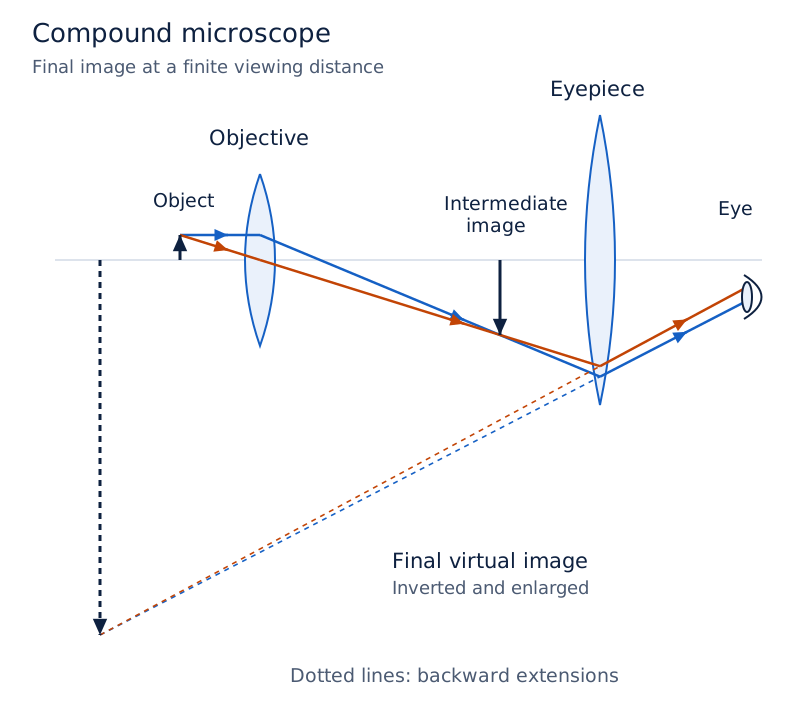
The drawing shows an upright object beside the objective, an enlarged inverted intermediate image before the eyepiece and diverging rays reaching the eye. Dotted backward extensions locate the final virtual image below the axis.
Drawn by One Young India. See Fig. 9.24 in your NCERT textbook
How are the magnifications combined?
Let and denote the objective and eyepiece focal lengths. Let denote the distance between the objective's second focal point and the eyepiece's first focal point, called the optical tube length here. This focal-point separation differs from the physical lens separation.
Let be the magnitude of the objective's linear magnification and the eyepiece's angular magnification. For the usual arrangement, These positive magnitudes describe enlargement; the image is inverted.
For a final image at the near point, use and multiply by the objective's magnification for that arrangement. Both lenses need short focal lengths for a high magnifying power. Illumination and correction of optical defects also affect image quality.
Worked example 7. A microscope has objective focal length 1.0 cm, eyepiece focal length 2.0 cm and optical tube length 20 cm. Find its approximate magnifying power with the final image at infinity. Take the near-point distance as 25 cm.
Formula: , , .
Substitute:
Answer: The angular magnification has magnitude approximately 250, with an inverted final image. The length units cancel in each ratio.
How do refracting and reflecting telescopes work?
How does an astronomical telescope magnify distant objects?
An astronomical telescope increases the angular size of a distant object. Its objective has a large focal length and a larger aperture than the eyepiece. The objective forms a real image near its second focal plane, and the eyepiece magnifies this image.
In normal adjustment, the final image is at infinity and the objective's second focal plane coincides with the eyepiece's first focal plane. The final image is inverted. Let denote lens separation. The magnifying-power magnitude and separation are
What the figure shows
Refracting telescope
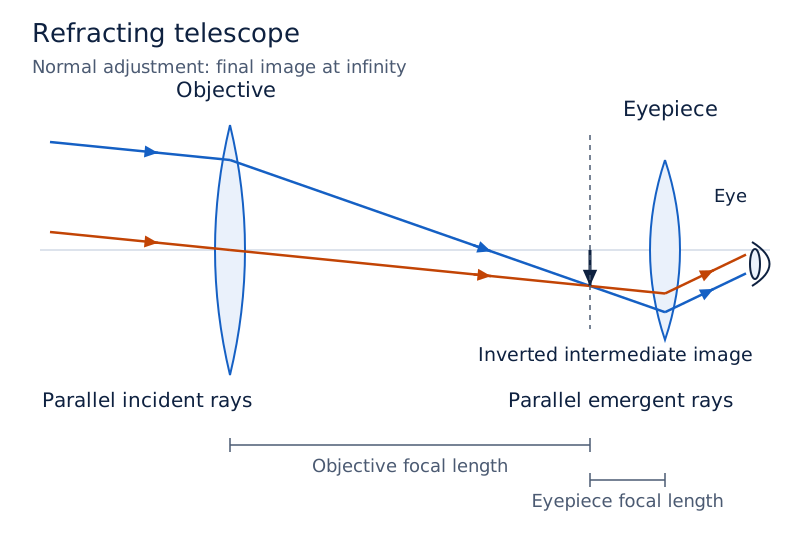
Parallel incident rays enter the objective and form an inverted intermediate image near the eyepiece. The emergent rays reach the eye. The objective focal length is drawn much longer than the eyepiece focal length.
Drawn by One Young India. See Fig. 9.25 in your NCERT textbook
Worked example 8. A telescope has objective focal length 144 cm and eyepiece focal length 6.0 cm. Find its angular magnification and lens separation in normal adjustment.
Formula: , .
Substitute:
Answer: The magnifying-power magnitude is 24 and the lenses are separated by 150 cm. The final image is inverted and at infinity.
Why use a mirror objective?
Light-gathering power depends on objective area: a larger aperture collects more light from faint objects. Resolving power concerns distinguishing closely spaced objects, and also depends on objective diameter. Merely increasing angular magnification does not replace these requirements.
A reflecting telescope uses a concave mirror as its objective. Mirrors avoid chromatic aberration and can be supported across their backs. Large lens objectives are heavy, difficult to support at their edges and difficult to manufacture without optical defects.
What the figure shows
Cassegrain reflecting telescope
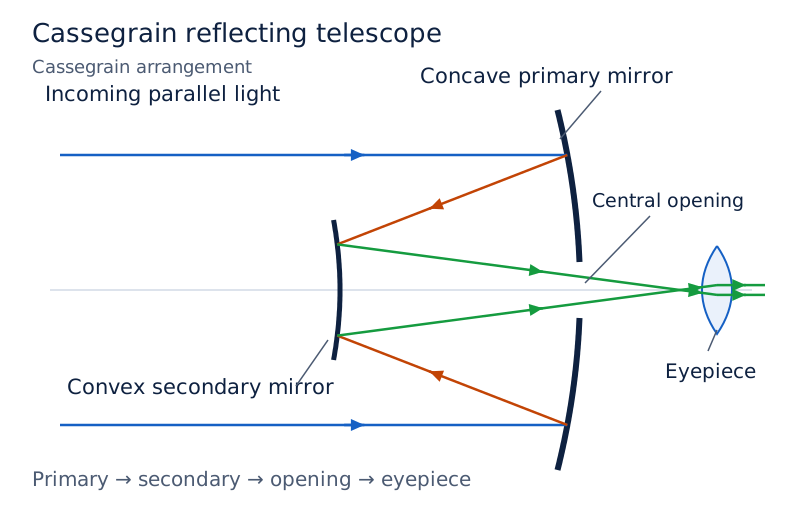
The primary concave mirror reflects incoming light towards a smaller secondary mirror. The secondary redirects the beam through a central opening in the primary towards the eyepiece behind it.
Drawn by One Young India. See Fig. 9.26 in your NCERT textbook
The Cassegrain arrangement uses a convex secondary mirror and provides a long effective focal length in a short tube. It also places the eyepiece behind the primary mirror, avoiding the need for the observer to occupy the primary focus inside the telescope.
| Instrument | Object and objective | Eyepiece role |
|---|---|---|
| Compound microscope | Nearby small object; short-focus objective | Magnifies a real enlarged intermediate image |
| Astronomical refracting telescope | Distant object; long-focus, large-aperture objective | Magnifies the real image formed near the objective focus |
Glossary
- Ray — A line representing the path followed by light in the geometrical description of propagation.
- Paraxial ray — A ray close to the principal axis and making a small angle with that axis.
- Principal focus — The axial point where rays initially parallel to the principal axis converge or appear to diverge.
- Real image — An image formed where rays from corresponding object points actually converge after reflection or refraction.
- Virtual image — An image located where backward extensions of diverging rays meet, although the rays do not actually meet there.
- Refraction — A change in light's propagation direction when it enters another transparent medium obliquely.
- Critical angle — The incidence angle in the denser medium for which refraction into the rarer medium grazes the interface.
- Total internal reflection — Complete reflection back into a denser medium when incidence at a rarer-medium boundary exceeds the critical angle.
- Optical fibre — A transparent core with lower-index cladding that guides suitably directed light through repeated total internal reflections.
- Lens power — The reciprocal of focal length in metres, expressing the convergence or divergence introduced by a lens.
- Minimum deviation — The least angular deviation produced by a prism as the angle of incidence is varied.
- Angular magnification — The ratio of an image's angular size through an instrument to the reference angular size of the object.
- Normal adjustment — A telescope arrangement with the final image at infinity and the relevant objective and eyepiece focal planes coincident.
- Dispersion — The separation of light into its constituent colours, associated with wavelength-dependent refraction in a transparent medium.
Common errors and misconceptions
- Misconception: Covering half a mirror removes half the image. Correct: The uncovered reflecting surface can still form the complete image, but fewer rays contribute and the image becomes dimmer.
- Misconception: A real image disappears when its screen is removed. Correct: The rays still converge at the image position; the screen makes that image visible by scattering light.
- Misconception: Optical density and mass density are interchangeable. Correct: They describe different properties. Turpentine is optically denser than water despite having lower mass density.
- Misconception: Total internal reflection occurs at every large incidence angle. Correct: Light must approach a rarer medium from a denser one, with incidence strictly greater than the critical angle.
- Misconception: Mirrors and lenses share the same magnification expression. Correct: Mirror magnification is , whereas thin-lens magnification is , with signed distances in both cases.
- Misconception: A convex lens has the same focal length in every liquid. Correct: Focal length depends on relative refractive index as well as curvature, and focusing vanishes when lens and liquid indices match.
- Misconception: Lens powers can always be added regardless of spacing. Correct: The simple algebraic addition used here assumes thin lenses in contact; separated lenses require intermediate-image distances.
- Misconception: A microscope and telescope require identical objective focal lengths. Correct: A compound microscope uses a short-focus objective, while an astronomical telescope uses a long-focus objective with a large aperture.
Exam-style questions with model answers
Q1. State the two conditions for total internal reflection and explain the critical angle. [2 marks]
- Light must travel from an optically denser medium towards a rarer medium.
- The incidence angle must exceed the critical angle. At the critical angle itself, the refracted ray makes with the normal and grazes the interface.
Q2. An object is 10 cm in front of a concave mirror of radius-of-curvature magnitude 15 cm. Find the image distance and magnification, and state the image's nature. [3 marks]
- Under the Cartesian convention, the object distance is . The mirror has , so its focal length is .
- Using the mirror equation,
- The magnification is . The negative image distance places the image in front of the mirror, and the negative magnification shows that it is inverted. It is a real image enlarged threefold.
Q3. Derive the lens maker's formula for a thin lens of refractive index , surrounded on both sides by a medium of index . Use signed surface radii and , and state the approximation. [5 marks]
- Let be object distance, final-image distance and intermediate-image distance. All are signed axial distances. For the first surface, spherical refraction gives
- The first image acts as the object for the second surface. Neglecting lens thickness gives
- Add these equations to eliminate the intermediate-image distance, then divide by the surrounding-medium index:
- For an object at infinity, the image distance becomes the focal length , while . Therefore
- This assumes a thin lens and paraxial rays. Both radii retain their Cartesian signs, and the surrounding medium is the same on both sides.
Q4. A convex lens of focal length 30 cm is in contact with a concave lens of focal-length magnitude 20 cm. Find the combined focal length and power, and identify its optical action. [3 marks]
- For thin lenses in contact, reciprocal focal lengths add with their signs. The convex lens has , while the concave lens has .
- Hence
- The combined power is . Its negative sign identifies a diverging combination. The stronger negative power of the concave lens outweighs the positive power of the convex lens.
Q5. Derive the relation between prism angle, minimum deviation and relative refractive index. Define the angles and explain the minimum-deviation condition. [5 marks]
- Let be the prism angle, incidence angle, emergence angle and , the internal angles measured from the face normals. Let be total deviation. Geometry gives
- The total deviation is the sum of the deviations at the two faces:
- At minimum deviation , the ray path is symmetric: and . If their common internal angle is , then
- The deviation equation becomes , giving This is the point at which deviation stops decreasing and starts increasing as incidence is varied.
- Let be the prism's index relative to the surrounding medium. Snell's law now gives Thus measured prism angle and minimum deviation determine relative refractive index. The minimum condition must be used; an arbitrary deviation cannot be substituted for it.
Q6. Explain how a compound microscope forms its image. Calculate its approximate magnifying power for final viewing at infinity if objective focal length is 1.0 cm, eyepiece focal length is 2.0 cm, optical tube length is 20 cm and near-point distance is 25 cm. [5 marks]
- The objective, nearest the small object, forms a real, inverted enlarged intermediate image.
- The eyepiece acts as a simple magnifier for this image and produces the final virtual image.
- The final image remains inverted relative to the original object.
- For viewing at infinity, the intermediate image lies in the eyepiece's first focal plane, so emerging rays are parallel. Here the given optical tube length is the separation of the relevant objective and eyepiece focal points.
- Using objective focal length , eyepiece focal length and near-point distance , This is the magnitude of angular magnification. The units cancel, and the positive stated magnitude describes enlargement rather than image orientation.
Q7. An astronomical telescope has objective focal length 144 cm and eyepiece focal length 6.0 cm. Calculate its magnifying power and lens separation in normal adjustment. Describe the intermediate and final images. [3 marks]
- Normal adjustment places the final image at infinity. The objective makes a real inverted intermediate image in its second focal plane, which coincides with the eyepiece's first focal plane.
- The angular magnifying-power magnitude is
- The lens separation is The eyepiece sends parallel rays towards the eye, and the final image is inverted relative to the distant object.
Q8. Give two advantages of a reflecting telescope over a large refracting telescope. [2 marks]
- A mirror objective does not produce chromatic aberration, avoiding the colour-related focusing difficulty of a refracting objective.
- The mirror can be supported over its entire back surface, making mechanical support easier than for a large lens supported at its rim.
Key takeaways
- Use Cartesian signs before substitution, measuring mirror distances from the pole and thin-lens distances from the optical centre.
- Mirror and lens equations differ in the sign of the object-distance term, and their magnification expressions also differ.
- Total internal reflection requires passage towards a rarer medium and incidence strictly greater than the critical angle.
- Thin-lens focal length depends on both surface curvatures and the refractive index relative to the surrounding medium.
- For thin lenses in contact, powers add algebraically; calculate each power using focal length expressed in metres.
- Minimum deviation gives a symmetric prism path and connects the measured deviation and prism angle to relative refractive index.
- A compound microscope enlarges a nearby object through its objective and eyepiece, leaving the final image inverted.
- A telescope uses a long-focus objective and short-focus eyepiece, while aperture affects light collection and resolution.
Test yourself
Why does covering half a concave mirror not remove half the image?
Rays from each object point still reach the uncovered mirror and form the complete image, with reduced brightness.
From which line are incidence and refraction angles measured?
They are measured from the normal to the interface at the point where the ray strikes.
What happens at the critical angle, and what changes above it?
At the critical angle the refracted ray grazes the interface. Above it, light undergoes total internal reflection.
Why must the core of an optical fibre have a higher index than its cladding?
The higher-index core allows suitably incident rays to undergo total internal reflection at the core-cladding boundary.
What happens to focusing when the surrounding liquid matches a lens's refractive index?
The lens loses its focusing power because the relative-index factor in the lens maker's formula becomes zero.
What distinguishes linear magnification from angular magnification?
Linear magnification compares image and object heights. Angular magnification compares their angular sizes under the specified viewing conditions.
Where is the intermediate image in a telescope under normal adjustment?
It lies in the objective's second focal plane, coincident with the eyepiece's first focal plane.
Why are mirror objectives easier to support in large telescopes?
They can be supported over their entire backs, whereas a large lens must be supported at its rim.
Write about it
Turn a question from this chapter into a paper.
The Writing Studio has a structure guide, a rubric and citation tools for 15 formats, from essays to research papers. Drafting is free with an account. Learnacy Essential adds feedback from an AI writing coach and submission to The OYI Review.
Learnacy Essential is ₹1,499 for the year. Publication depends on review and is not guaranteed.