
Electromagnetic Waves | CBSE Class 12 Physics Notes
On this page
Watch & explore
Start with a few high-quality watches, then dive into the notes below.

This note covers displacement current, the Ampere-Maxwell law, the production and transverse nature of electromagnetic waves, electric and magnetic field relations, wave speed, numerical calculations, the electromagnetic spectrum, and the production, detection and uses of its different regions.
How did Maxwell connect electricity, magnetism and light?
An electric current produces a magnetic field. A magnetic field that changes with time produces an electric field. Maxwell’s contribution was to recognise that a changing electric field must also act as a source of magnetic field.
This additional connection makes electricity and magnetism parts of a common description. The electric and magnetic fields can vary together and propagate through space. Such a travelling disturbance is an electromagnetic wave.
Definition: An electromagnetic wave consists of coupled, time-varying electric and magnetic fields that propagate through space. Visible light is one member of this family of waves.
Why was the predicted speed significant?
The speed predicted from electromagnetic theory agreed closely with the speed obtained from optical measurements. The agreement connected a result about electric and magnetic fields with the observed behaviour of light. It led to the conclusion that light is electromagnetic radiation.
The speed of electromagnetic waves in vacuum is denoted by , with the value . The SI unit of speed is metre per second, written .
The theory therefore links phenomena that initially seem separate: a current in a wire, a changing magnetic field and a light wave. The essential bridge is the magnetic effect of a changing electric field, expressed through displacement current.
Electromagnetic waves can carry energy between distant places. Broadcasting signals carry energy from a transmitting station, and sunlight carries energy from the Sun to Earth. These applications depend on the ability of the fields to propagate, including through empty space.
Why does a charging capacitor reveal a problem with Ampere’s law?
Consider a parallel plate capacitor being charged through connecting wires. The conduction current is the current associated with the flow of electric charges in those wires. Charge accumulates on the plates, but does not pass through the vacuum gap as a conduction current.
What happens when the surface is changed?
Let represent the magnetic field, a directed small length along a closed loop, the permeability of free space, the conduction current through a surface bounded by the loop, and time.
The original circuital law is . For a circular loop centred on the wire, let be the loop radius and the magnetic field magnitude. Symmetry gives .
A flat surface spanning the loop cuts the wire and encloses conduction current. A bulging surface with the same boundary can pass between the plates without cutting the wire. The conduction current through this second surface is zero.
The circulation of the magnetic field refers to the same loop in both cases. It cannot consistently acquire two values merely because the spanning surface has been changed. The difficulty shows that the original law omits a contribution when electric fields vary with time.
What the figure shows
Alternative surfaces at a charging capacitor
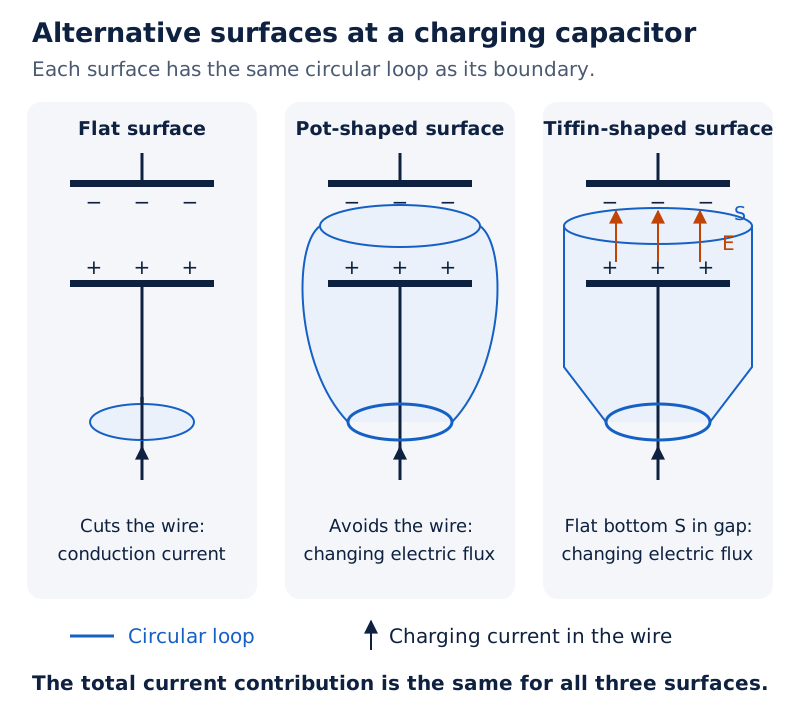
The three panels show the capacitor, a circular loop near its wire, and pot-shaped and tiffin-shaped surfaces sharing that loop. The final panel includes a flat surface between the plates and arrows showing the electric field.
Drawn by One Young India. See Fig. 8.1 in your NCERT textbook
The missing contribution comes from the changing electric flux through the gap. The surface through the wire captures the conduction contribution; the surface through the gap captures the displacement contribution. Both must give a consistent magnetic field.
How is displacement current derived for a parallel plate capacitor?
Use an ideal parallel plate capacitor in vacuum, with a uniform field between its plates and negligible field outside the plate area. Let be the area of either plate, the magnitude of charge on a plate, and the permittivity of free space.
Let be the electric field magnitude between the plates and the electric flux through a surface perpendicular to that field. The symbol denotes differentiation with respect to time. The displacement current is denoted by .
Derivation: Displacement current equals charging current
- The uniform electric field between the plates is This relation uses the ideal parallel plate approximation.
- For the surface covering the plate area, the field is perpendicular to the surface. Hence
- Keeping the plate geometry and vacuum permittivity constant, differentiate with respect to time:
- The conduction charging current is the rate of accumulation of charge:
- Multiply the flux derivative by the vacuum permittivity to obtain The displacement current across the gap equals the conduction current in the leads.
Result: A changing electric flux contributes to the magnetic field in the same way as conduction current. Equality here relates currents across different surfaces of the charging arrangement; it does not mean that charges cross the vacuum gap.
Which units belong to these quantities?
| Quantity | SI unit | Meaning in the calculation |
|---|---|---|
| Charge | The SI unit of charge is coulomb, . | Charge accumulated on a capacitor plate |
| Current | The SI unit of current is ampere, . | Rate of flow or accumulation of charge |
| Electric field | The SI unit of electric field is volt per metre, . | Field between the plates |
| Magnetic field | The SI unit of magnetic field is tesla, . | Field associated with the current contributions |
Unit symbols must be read in context. The symbol in the capacitor formula is an area; the upright following a numerical current denotes amperes. A physical quantity and its unit are different parts of the calculation.
What does the Ampere-Maxwell law say?
The Ampere-Maxwell law includes both conduction current and displacement current through the chosen surface. Let denote their total contribution. Then , and the complete circuital law is
The extra term removes the inconsistency of the charging capacitor. For a fixed bounding loop, changing the surface must not change the resulting magnetic circulation. Both contributions must be counted on whichever surface is selected.
How do conduction and displacement currents differ?
| Feature | Conduction current | Displacement current |
|---|---|---|
| Physical basis | Flow of electric charge | Time variation of electric flux |
| Ideal charging capacitor | Present in the connecting wire | Present across the vacuum gap |
| Magnetic effect | Acts as a source of magnetic field | Also acts as a source of magnetic field |
| Steady electric field | Can accompany a steady current in a wire | Vanishes when electric flux is constant |
In the ideal capacitor model, the two contributions occur in different regions. More generally, conduction and displacement currents can occur in the same region. Their distinction is therefore based on their physical origin, rather than a universal division between conductors and insulators.
What the figure shows
Fields between capacitor plates
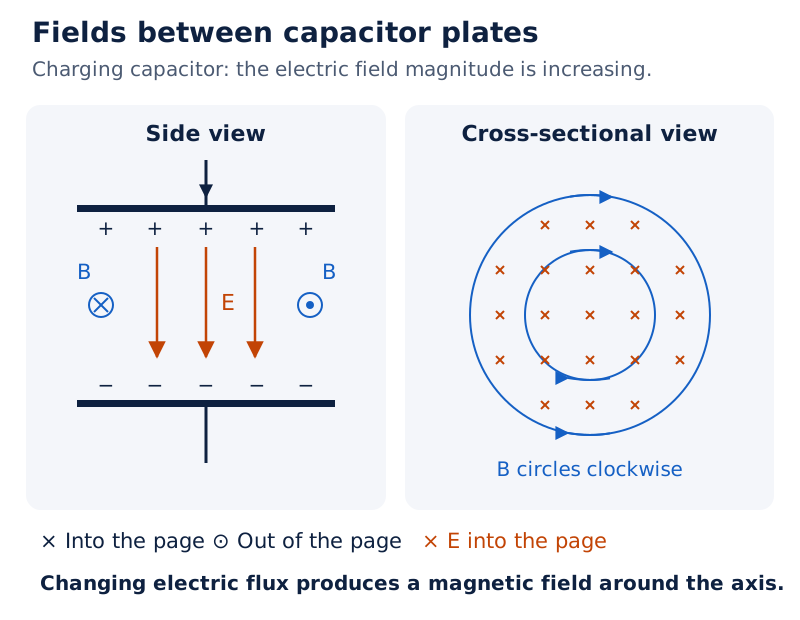
The side view shows electric and magnetic field directions near the plates. In the cross-sectional view, crosses represent the electric field into the page, while magnetic field arrows follow circles around the central axis.
Drawn by One Young India. See Fig. 8.2 in your NCERT textbook
Note: A non-zero electric field need not produce displacement current. Its flux must change with time. A constant flux has zero time derivative even when the field itself is strong.
The magnetic effect of displacement current complements Faraday’s law: a changing magnetic field produces an electric field, while a changing electric field produces a magnetic field. This relationship supports the existence of electromagnetic waves.
How are electromagnetic waves produced?
Accelerated charges emit electromagnetic waves. A stationary charge produces an electrostatic field, while steady currents produce magnetic fields that do not vary with time. An oscillating charge is different because its motion involves acceleration.
What happens around an oscillating charge?
- The oscillating charge produces an electric field that changes with time.
- The changing electric field is associated with a changing magnetic field.
- The changing magnetic field is associated with a changing electric field.
- The coupled fields propagate through space as an electromagnetic wave, carrying energy away from the source.
This description explains the relationship qualitatively. The wave energy comes from the energy of the source, so the fields do not create energy merely by sustaining one another. An electric dipole is a basic source of electromagnetic waves.
Let denote frequency, the number of oscillations per second. An electric charge oscillating harmonically at frequency produces electromagnetic waves of the same frequency. The SI unit of frequency is hertz, .
How were these waves demonstrated?
Hertz produced and detected electromagnetic waves in the laboratory. His observations established wave behaviour including reflection and refraction, linking the new waves to the known behaviour of light.
Jagdish Chandra Bose subsequently produced and observed shorter waves, with wavelengths from to . Marconi transmitted electromagnetic waves across distances of many kilometres, opening the way to communication using electromagnetic radiation.
The production process connects the source to the wave frequency. For instance, a charge oscillating at emits radiation at . The emitted radiation is a travelling field disturbance, rather than the material charge itself travelling to the receiver.
Why are electromagnetic waves transverse?
In a plane electromagnetic wave, the electric and magnetic fields are perpendicular to one another. Both are also perpendicular to the direction of propagation. This arrangement makes the wave transverse: the oscillating fields have no component along its direction of travel.
How are the field equations written?
Take mutually perpendicular Cartesian axes , and . For propagation along the positive -direction, let be the electric field component along , and the magnetic field component along .
Let and be the maximum electric and magnetic field magnitudes. Let be the wave number, position along the propagation axis, and angular frequency. The sinusoidal fields can be written as
The identical sine argument shows that the fields are in phase. They reach corresponding maxima, minima and zero values together at a given position. Their directions are perpendicular, but their oscillations do not have a quarter-cycle time delay.
What the figure shows
A transverse electromagnetic wave
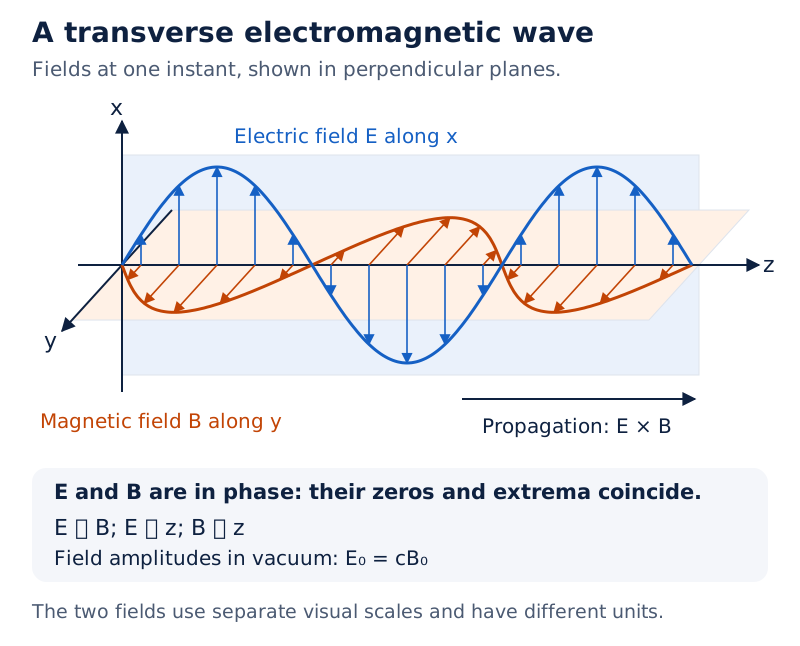
Two sinusoidal field patterns share the horizontal propagation axis marked . The electric field oscillates along the -direction, and the magnetic field oscillates along the -direction. The curves occupy perpendicular planes.
Drawn by One Young India. See Fig. 8.3 in your NCERT textbook
How are direction and amplitude checked?
The propagation direction is along , where is the electric field vector and the multiplication sign denotes the vector cross product. Specifying perpendicular fields is insufficient unless this directional relationship is also satisfied.
In vacuum, the amplitudes satisfy , or . Electric and magnetic fields have different units, so their numerical magnitudes are not equal in SI units. For the travelling plane wave, their instantaneous field magnitudes obey the corresponding relation .
The sinusoidal curves show how fields vary with position at a chosen instant. They do not represent material particles following wavy tracks through space. No material medium is required for these electromagnetic field oscillations.
How are wave speed, wavelength and frequency related?
Let denote wavelength, the spatial length of one complete wave cycle. The wave number and angular frequency are related to wavelength and frequency by and , respectively.
The SI unit of wavelength is metre, . Angular frequency is expressed in , while wave number is expressed in . The phase appearing inside the sine function is dimensionless.
Derivation: The vacuum wave relation
- For an electromagnetic wave in vacuum, the angular frequency and wave number satisfy
- Replace angular frequency and wave number by their frequency and wavelength expressions:
- Cancel the common factor and multiply by wavelength:
- Rearrange for whichever quantity is unknown:
Result: At constant propagation speed, increasing frequency reduces wavelength. All electromagnetic waves travel at the same speed in vacuum, so their different frequencies correspond to different wavelengths rather than different vacuum speeds.
What determines the speed in a medium?
The vacuum speed is . For a material medium, let be its permeability, its permittivity, and the electromagnetic wave speed. Then .
The speed therefore depends on the medium’s electric and magnetic properties. The vacuum constants must not be substituted for material values when a question specifies a medium. Conversely, a vacuum calculation uses the common speed of electromagnetic waves in free space.
Unit conversion is essential before numerical substitution. A frequency expressed in megahertz must be converted to hertz when the speed is expressed in metres per second. The resulting wavelength then comes out in metres.
How can field direction and wave equations be calculated?
A numerical solution should separate field magnitude, field direction and wave parameters. Use the vacuum relation for wavelengths, the amplitude relation for field strengths, and the cross product for direction. These checks answer different parts of a wave problem.
How does the electric field determine the magnetic field?
Worked example 1. A plane wave of frequency travels in vacuum along positive . At one point its electric field is along positive . Find the magnetic field there and the wavelength. Use .
Formula: and .
Substitute:
- Convert frequency:
- Calculate magnetic field magnitude:
- Calculate wavelength:
Answer: The magnetic field is along positive , and the wavelength is . Positive crossed with positive gives the specified positive -direction of travel.
How are parameters read from a field equation?
Worked example 2. A vacuum wave has . Find its wavelength, frequency and electric field. Use .
Formula: , and .
Substitute:
- Read the coefficients: , and .
- Find wavelength:
- Find frequency:
- Find electric field amplitude:
Answer: The wavelength is approximately , the frequency is , and the electric field is , where is its component along .
The positive sign between the position and time terms in this example means propagation along negative . At constant phase, increasing time requires decreasing position. An electric field along positive and magnetic field along positive give that propagation direction.
How are wavelength bands and field amplitudes found?
The same small set of equations handles many numerical questions. Identify whether a question supplies a single frequency, a frequency interval or a field amplitude. Convert the given units first, retain units during substitution, and interpret the result after the calculation.
How does a single frequency give wavelength?
Worked example 3. A plane electromagnetic wave travels in vacuum along with frequency . Find its wavelength using .
Formula: .
Substitute:
- Convert frequency: .
- Calculate:
Answer: The wavelength is . Both field vectors lie perpendicular to the -direction and are perpendicular to one another.
Why do the endpoints reverse for a frequency band?
Worked example 4. A radio tunes from to . Find the corresponding vacuum wavelength band, taking .
Formula: .
Substitute:
- At the lower frequency,
- At the higher frequency,
Answer: The wavelength band is to . The highest frequency gives the shortest wavelength, so frequency and wavelength endpoints appear in opposite order.
How are electric and magnetic amplitudes connected?
Worked example 5. A harmonic electromagnetic wave in vacuum has magnetic field amplitude . Find its electric field amplitude using .
Formula: .
Substitute:
- Convert the magnetic field: .
- Calculate the electric amplitude:
Answer: The electric field amplitude is . This is a peak field value because the supplied magnetic field is also an amplitude.
Worked example 6. A sinusoidal electromagnetic wave in vacuum has frequency and electric amplitude . Find its wavelength and magnetic amplitude using .
Formula: and .
Substitute:
- Calculate wavelength:
- Calculate magnetic amplitude:
Answer: The wavelength is , and the magnetic field amplitude is . Frequency sets the wavelength, while electric amplitude sets the magnetic amplitude.
How is the electromagnetic spectrum organised?
The electromagnetic spectrum classifies electromagnetic radiation by frequency or wavelength. In order of decreasing wavelength, its main regions are radio waves, microwaves, infrared, visible light, ultraviolet, X-rays and gamma rays. Frequency increases along this same sequence.
These are members of one family, sharing the same vacuum speed. Their different names reflect differences in their production, detection and interaction with matter. The boundaries are approximate and can overlap; they are not sharp physical divisions.
Which wavelength ranges help organise the regions?
| Region | Approximate wavelength range | Detection method |
|---|---|---|
| Radio | Greater than | Receiving aerials |
| Microwave | to | Point contact diodes |
| Infrared | to | Thermopiles, bolometers and infrared photographic film |
| Visible light | to | Eye, photocells and photographic film |
| Ultraviolet | to | Photocells and photographic film |
| X-rays | to | Photographic film, Geiger tubes and ionisation chambers |
| Gamma rays | Less than | Photographic film, Geiger tubes and ionisation chambers |
These approximate intervals provide an organising scheme. A boundary value should not be treated as an absolute test separating two kinds of radiation, particularly where the production mechanisms and the convention used for classification differ.
What the figure shows
The electromagnetic spectrum
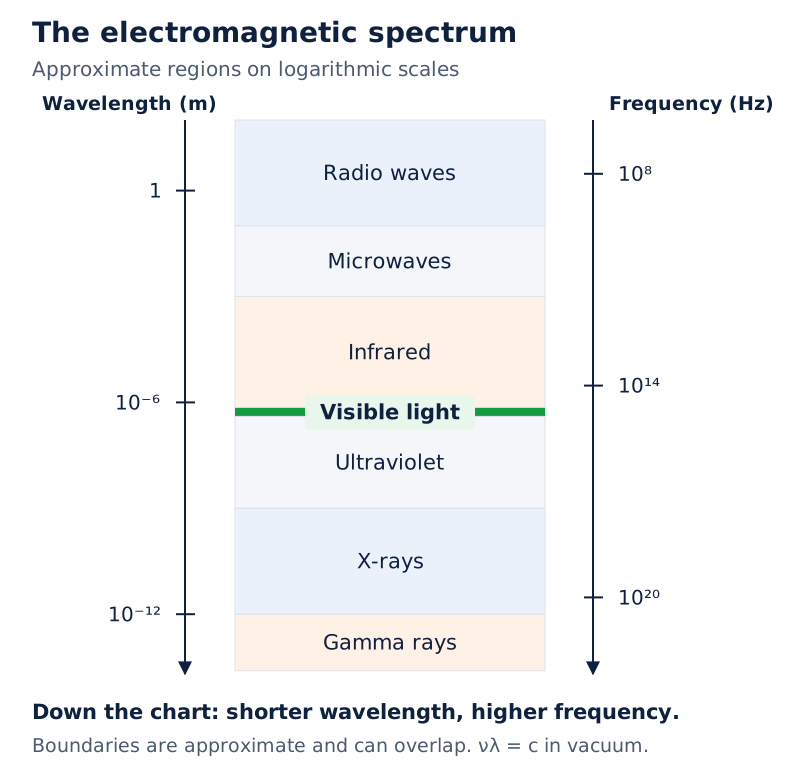
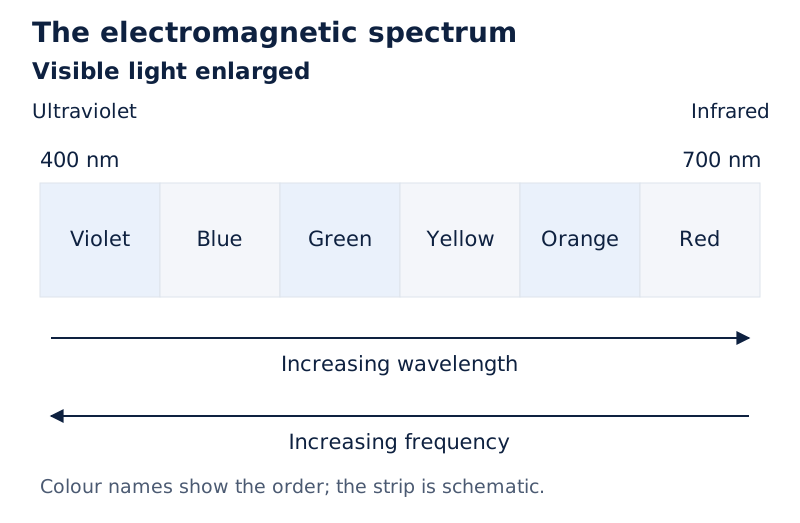
The chart places frequency and wavelength scales beside the named regions. An enlarged visible strip runs from violet near through blue, green, yellow and orange to red near .
Drawn by One Young India. See Fig. 8.4 in your NCERT textbook
Electromagnetic fields interact with charges in matter and can set them into oscillation. The resulting absorption or scattering depends both on wavelength and on the atoms and molecules present. This is why different regions of the spectrum suit different applications.
Visible light occupies only a small part of the complete spectrum. Human vision therefore detects a restricted range of electromagnetic radiation, although the physical family extends to much longer and much shorter wavelengths.
How are radio waves, microwaves and infrared radiation used?
What produces radio waves?
Radio waves are produced by accelerated charges in conducting wires. They are used in radio and television communication. A receiving aerial detects the radiation, connecting the travelling electromagnetic field with an electrical signal in the receiving system.
The amplitude-modulated radio band extends from to . The frequency-modulated radio band extends from to . These examples illustrate communication bands within the broader radio region.
A transmitting antenna radiates most efficiently when its size is of the same order as the wavelength. This links the physical scale of a source to the radiation it produces, although such a size comparison is not a universal rule for every emission process.
Why are microwaves useful in radar and ovens?
Microwaves are short-wavelength radio waves with frequencies in the gigahertz range. Devices such as klystrons and magnetrons produce them. Their short wavelengths make them useful in radar systems, including those used for aircraft navigation.
Radar also underlies speed measurements of vehicles, fast balls and tennis serves. In a microwave oven, energy from the electromagnetic radiation is transferred to water molecules in food, increasing molecular motion and raising the food’s temperature.
Communication, radar and heating are different applications of electromagnetic radiation. They should be linked to the relevant interaction with matter, rather than treated as evidence that microwaves have a different basic nature from other electromagnetic waves.
Why is infrared associated with heating?
Infrared radiation is produced by hot bodies and molecules. It lies beyond the long-wavelength end of visible light. Water molecules and other molecules, including CO₂ and NH₃, absorb infrared radiation, increasing their thermal motion and heating their surroundings.
Infrared lamps are used in physical therapy. Infrared detectors on Earth satellites are used for purposes including observing crop growth. Semiconductor light-emitting devices can produce infrared radiation for remote controls used with household electronic equipment.
Infrared radiation also contributes to the greenhouse effect. Earth’s surface absorbs incoming visible radiation and emits longer-wavelength infrared radiation. Greenhouse gases, including carbon dioxide and water vapour, absorb this outgoing radiation and help maintain Earth’s warmth.
Calling infrared “heat waves” emphasises its heating effects when absorbed. It does not mean that infrared alone carries energy. Radio waves, visible light and the other spectral regions also transport electromagnetic energy.
What distinguishes visible light, ultraviolet, X-rays and gamma rays?
Which electromagnetic waves can humans see?
Visible light is the spectral region detected by the human eye. Its approximate wavelength interval is to , corresponding broadly to frequencies from to .
Light emitted or reflected by surrounding objects supplies visual information. Electrons in atoms can emit visible radiation when moving from a higher energy level to a lower one. Human eyes, photocells and photographic film can detect this radiation.
The human visible interval is not a universal biological limit. Snakes can detect infrared radiation, while the visible range of many insects extends into ultraviolet. The wavelength sensitivity of a detector therefore matters when deciding what it can observe.
What are the sources and uses of ultraviolet?
Ultraviolet radiation lies beyond the short-wavelength end of the visible spectrum. Very hot bodies and special lamps produce it. The Sun is an important source, while the atmospheric ozone layer absorbs much of the incoming ultraviolet radiation.
Ultraviolet lamps are used to kill germs in water purifiers. Short wavelengths also allow narrow focusing for precision applications such as LASIK eye surgery. Welding arcs emit ultraviolet radiation, so welders use protective goggles or face masks.
Large ultraviolet exposures can harm humans. The protective role of atmospheric ozone explains concern about ozone depletion by chlorofluorocarbons. Production, useful applications and biological effects are separate aspects of the same spectral region.
How do X-ray and gamma-ray sources differ?
X-rays can be generated by bombarding a metal target with high-energy electrons. X-ray tubes and inner-shell electron processes are associated with their production. Medical diagnosis is a familiar application, and X-rays are also used in treating certain cancers.
Gamma rays arise in nuclear reactions and radioactive nuclear decay. They occupy the high-frequency end of the spectrum and are used in medicine to destroy cancer cells. Their nuclear origin helps distinguish them from radiation associated with atomic electron processes.
| Region | Representative production | Representative application |
|---|---|---|
| Visible | Electrons moving to lower atomic energy levels | Vision and information from surrounding objects |
| Ultraviolet | Very hot bodies and special lamps | Germ-killing lamps in water purifiers |
| X-rays | High-energy electrons striking a metal target | Medical diagnostic imaging |
| Gamma rays | Nuclear reactions and radioactive decay | Destruction of cancer cells |
X-rays can damage living tissue, so unnecessary exposure must be avoided. A medical use does not imply that unrestricted exposure is harmless. Across these regions, the wave’s frequency and its interaction with matter determine the effects that make an application possible.
Glossary
- Electromagnetic wave — A travelling disturbance consisting of coupled electric and magnetic fields varying in space and time.
- Conduction current — Electric current associated with the flow of charges through a conductor.
- Displacement current — The current contribution associated with the time rate of change of electric flux.
- Electric flux — A measure of the electric field passing through an oriented surface.
- Ampere-Maxwell law — The circuital law connecting magnetic circulation with both conduction and displacement current contributions.
- Transverse wave — A wave whose oscillating quantities are perpendicular to its direction of propagation.
- Amplitude — The maximum magnitude reached by an oscillating electric or magnetic field.
- Frequency — The number of complete oscillations occurring per second at a given position.
- Wavelength — The spatial length of one complete cycle of a periodic wave.
- Wave number — A spatial wave parameter equal to two pi divided by wavelength.
- Electromagnetic spectrum — The classification of electromagnetic radiation into regions according to frequency or wavelength.
- Infrared radiation — Electromagnetic radiation beyond the long-wavelength end of visible light, commonly emitted by hot bodies.
Common errors and misconceptions
- Misconception: Displacement current means charges cross a capacitor’s vacuum gap. Correct: It represents changing electric flux; conduction current involves charge flow in the connecting wires.
- Misconception: Any electric field produces displacement current. Correct: Electric flux must change with time; a steady flux gives zero displacement current.
- Misconception: Electric and magnetic fields oscillate along the direction of travel. Correct: Both are perpendicular to propagation and to each other in a plane electromagnetic wave.
- Misconception: Perpendicular fields must oscillate with a time delay. Correct: The fields in the sinusoidal travelling wave are in phase despite their perpendicular directions.
- Misconception: Gamma rays travel faster than radio waves in vacuum. Correct: Both travel at the same vacuum speed; their frequencies and wavelengths differ.
- Misconception: A higher frequency gives a longer vacuum wavelength. Correct: Frequency and wavelength are inversely related at constant speed.
- Misconception: Spectral regions have exact, non-overlapping boundaries. Correct: The ranges are approximate, with classification also reflecting production and detection methods.
- Misconception: Infrared is the only electromagnetic radiation that transports energy. Correct: All electromagnetic waves carry energy; infrared is particularly associated with heating through absorption.
Exam-style questions with model answers
Q1. Define displacement current and state its expression in vacuum, defining the symbols. [2 marks]
- Displacement current is the current contribution associated with changing electric flux.
- It is , where is displacement current, is vacuum permittivity, is electric flux and is time.
Q2. Explain why the original Ampere’s circuital law is inconsistent for a charging parallel plate capacitor, and state Maxwell’s correction. [3 marks]
- A flat surface bounded by a circular loop around the connecting wire is crossed by conduction current. The original law therefore predicts non-zero magnetic circulation around that loop.
- A bulging surface with the same boundary can pass through the capacitor gap without intersecting the wire. No conduction current crosses it, so the original expression would give zero circulation.
- Maxwell included displacement current due to changing electric flux. Adding this to conduction current makes the total consistent for the two surfaces and removes the contradiction.
Q3. For an ideal vacuum parallel plate capacitor, derive equality of displacement and charging currents. Use plate area , plate charge magnitude , uniform field , constant vacuum permittivity , and negligible edge effects. [5 marks]
- For the fixed plate geometry, the electric field magnitude is . The field is uniform over the plate area and perpendicular to the surface through the gap.
- The electric flux, denoted by , is therefore . This relates the flux through the gap to charge accumulated on a plate.
- Differentiate with respect to time : . Vacuum permittivity is constant during the charging process.
- Define the charging conduction current by . The displacement contribution is , so substitution gives .
- The two equal currents occur across different surfaces: conduction current flows in the wire and displacement current occurs across the gap. This equality does not require charges to pass through the vacuum between the plates.
Q4. State four properties of plane electromagnetic waves, covering field directions, phase, vacuum propagation and amplitude relation. Define the symbols in the relation. [4 marks]
- The electric and magnetic fields are perpendicular to each other and to the direction of propagation. This gives electromagnetic waves their transverse nature.
- For the sinusoidal travelling wave, the two fields are in phase: their corresponding maxima and zero values occur together.
- They can propagate in vacuum without a material medium. All electromagnetic waves have the same speed in vacuum.
- The amplitudes obey , where is electric field amplitude, is magnetic field amplitude and is vacuum wave speed.
Q5. A vacuum electromagnetic wave has frequency and electric field amplitude . Find its wavelength and magnetic amplitude. Use , where is vacuum light speed. [3 marks]
- Let be wavelength and frequency. Use . Substitution gives .
- Let and be the electric and magnetic field amplitudes. Use . Thus .
- The wavelength follows from frequency, whereas the magnetic amplitude follows from the electric amplitude. The supplied speed and the field relationship are both for propagation in vacuum.
Q6. Arrange all seven main electromagnetic spectral regions in increasing frequency. Explain why their boundaries are approximate, and give one production method and one use each for microwaves and gamma rays. [5 marks]
- The order is radio waves, microwaves, infrared, visible light, ultraviolet, X-rays and gamma rays. Wavelength decreases in this order because all these waves have the same speed in vacuum.
- The named regions are classifications based partly on how radiation is produced or detected. Adjacent regions do not have sharp boundaries, and wavelength intervals can overlap. The radiation still belongs to the same electromagnetic family.
- Microwaves can be produced by magnetrons or klystrons.
- One use of microwaves is radar for aircraft navigation; their short wavelengths make them suitable for radar systems.
- Gamma rays are produced in nuclear reactions and emitted by radioactive nuclei.
- One medical use of gamma rays is destroying cancer cells.
Q7. Why are infrared waves associated with heating? Explain their role in Earth’s greenhouse effect. [3 marks]
- Molecules such as water absorb infrared radiation. The absorbed energy increases their thermal motion, raising their temperature and allowing them to heat their surroundings.
- Earth’s surface absorbs incoming visible sunlight and emits radiation at longer, infrared wavelengths. This connects absorbed solar energy with outgoing thermal radiation.
- Greenhouse gases, including carbon dioxide and water vapour, absorb outgoing infrared radiation. This contributes to maintaining Earth’s warmth. The term heat waves describes infrared absorption effects, rather than suggesting that other electromagnetic waves carry no energy.
Q8. A radio receives frequencies from to . Calculate the corresponding vacuum wavelength range using wave speed . [2 marks]
- For wavelength and frequency , . At the lower frequency, .
- At the higher frequency, . The range is to , with higher frequency corresponding to shorter wavelength.
Key takeaways
- A changing electric flux supplies displacement current, completing the magnetic-field description of an ideal charging capacitor.
- The Ampere-Maxwell law includes conduction and displacement currents through the surface bounded by the chosen loop.
- Accelerating charges produce electromagnetic waves; an oscillating charge produces radiation at its own oscillation frequency.
- In a plane electromagnetic wave, the electric and magnetic fields are mutually perpendicular, transverse and in phase.
- All electromagnetic waves have the same vacuum speed, so higher frequency corresponds to shorter wavelength.
- Electric and magnetic field amplitudes are connected by the vacuum wave speed and must retain their respective units.
- The spectrum runs from radio waves through microwaves, infrared, visible, ultraviolet and X-rays to gamma rays in increasing frequency.
- Spectral regions have approximate boundaries, while their production, detection and interactions with matter explain their different applications.
Test yourself
What is missing if magnetic circulation is calculated using only conduction current through a charging capacitor’s gap?
The calculation omits displacement current, which arises from the changing electric flux between the capacitor plates.
Does a constant electric flux give a non-zero displacement current?
No. Displacement current depends on the time derivative of electric flux, which vanishes when the flux is constant.
Why can an oscillating charge radiate electromagnetic waves?
Its acceleration produces changing electric and magnetic fields that propagate through space, carrying energy away from the source.
For propagation along positive and electric field along positive , which magnetic field direction is required?
The magnetic field must point along positive , so the electric-field cross magnetic-field direction is positive .
What happens to vacuum wavelength when frequency increases?
Wavelength decreases because the product of frequency and wavelength remains equal to the constant vacuum wave speed.
Why is a material medium unnecessary for electromagnetic propagation?
The wave consists of coupled electric and magnetic field oscillations, which can propagate through vacuum without material vibrations.
Which radiation lies just beyond each end of the human visible spectrum?
Infrared lies beyond the long-wavelength end, while ultraviolet lies beyond the short-wavelength end of visible light.
What production process distinguishes gamma rays from X-rays generated in a metal target?
Gamma rays arise from nuclear processes, while target-generated X-rays result from bombardment by high-energy electrons.