
Dual Nature of Radiation and Matter | CBSE Class 12 Physics Notes
On this page

This note covers electron emission, work function, the photoelectric effect, experimental arrangements, photocurrent and stopping potential, threshold frequency, limitations of the classical wave picture, Einstein’s photoelectric equation, photons, numerical applications and the de Broglie wavelength of matter.
What allows an electron to escape from a metal surface?
Free electrons and the surface barrier
Metals contain free electrons responsible for electrical conductivity. These electrons can move inside the metal, but they cannot normally escape from its surface. An electron attempting to leave experiences an attractive pull from the positively charged metal.
The electron must receive enough energy to overcome this attraction. Being free inside a metal therefore does not mean being free to leave it. The energy needed for escape depends on the metal and the condition of its surface.
Definition: The work function, denoted by , is the minimum energy required by an electron to escape from a metal surface.
The electron volt is the energy gained by an electron accelerated through a potential difference of one volt. Its conversion into joules is . It is an energy unit, not a potential unit.
Electrons inside a metal do not all possess the same energy. An electron already having greater energy needs less additional energy to escape. The work function specifies the least additional energy needed, rather than an identical escape requirement for every electron.
Three methods of electron emission
| Process | How emission occurs | Condition |
|---|---|---|
| Thermionic emission | Heating supplies thermal energy to electrons. | The metal must be heated sufficiently. |
| Field emission | A strong electric field pulls electrons out. | Fields can be of the order of , as in a spark plug. |
| Photoelectric emission | Electrons absorb energy from incident radiation. | The light must have a suitable frequency. |
Electrons released by light are called photoelectrons. These are electrons, not a separate kind of particle. The names of the emission processes describe how escape is produced, while the emitted particle remains the same.
The SI unit of work function is the joule. The SI unit of electric potential difference is the volt. Keeping these quantities distinct helps prevent confusion between a stopping potential and the electron energy inferred from it.
What did Hertz, Hallwachs and Lenard observe?
Light can release charged particles
In 1887, Heinrich Hertz noticed that ultraviolet illumination enhanced high-voltage sparks across a detector loop during his electromagnetic-wave experiments. Light falling on a metal surface appeared to help negatively charged particles escape from it.
Hallwachs investigated a zinc plate connected to an electroscope. A negatively charged plate lost charge under ultraviolet illumination. An initially uncharged zinc plate became positively charged. These observations indicated the loss of negative charge from the plate.
Lenard used an evacuated tube containing two metal electrodes. Ultraviolet radiation falling on the emitter produced a current. When the radiation stopped, the current stopped too. Electrons leaving the illuminated plate travelled towards the positively charged collector.
The material and frequency matter
The effect was not produced by every frequency of light. Below a certain minimum frequency, electrons were not emitted. This threshold frequency depended on the emitter material, so a light source effective for one metal need not produce emission from another.
Zinc, cadmium and magnesium respond to ultraviolet light. Some alkali metals, including lithium, sodium, potassium, caesium and rubidium, are sensitive even to visible light. Thus, “light is incident” is an incomplete condition for photoelectric emission.
Definition: The photoelectric effect is the emission of electrons from a metal surface when radiation of suitable frequency falls on it.
Experiments on cathode rays, heating and illumination identified the emitted particles through their common charge-to-mass ratio. This supported the view that electrons are universal constituents of matter, even though the methods used to release them differ.
The early observations establish what needs explaining: radiation can transfer energy to an electron, but whether escape occurs depends on the radiation frequency and the surface. The later experiments measure the emitted current and the energies of these electrons separately.
How is the photoelectric effect studied experimentally?
Components and their functions
The apparatus contains an evacuated glass tube with a photosensitive emitter plate, labelled , and a collector plate, labelled . A light source, labelled , sends monochromatic radiation through a quartz window, labelled , onto the emitter.
The quartz window allows ultraviolet radiation to reach the photosensitive surface. A battery establishes a potential difference between the plates. A commutator reverses their polarity, allowing the collector to be positive or negative relative to the emitter.
| Component | Role |
|---|---|
| Photosensitive emitter | Releases electrons when suitable radiation falls on its surface. |
| Collector | Receives photoelectrons that can reach it under the applied potential. |
| Microammeter | Measures the photoelectric current in the external circuit. |
| Voltmeter | Measures the potential difference between emitter and collector. |
| Battery and commutator | Provide an adjustable potential difference and reverse the polarity. |
What the figure shows
Photoelectric apparatus
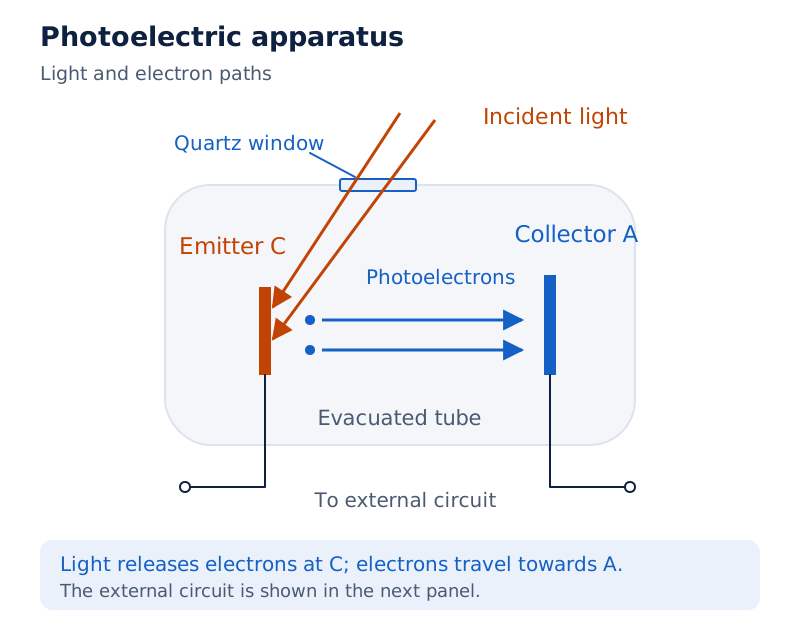
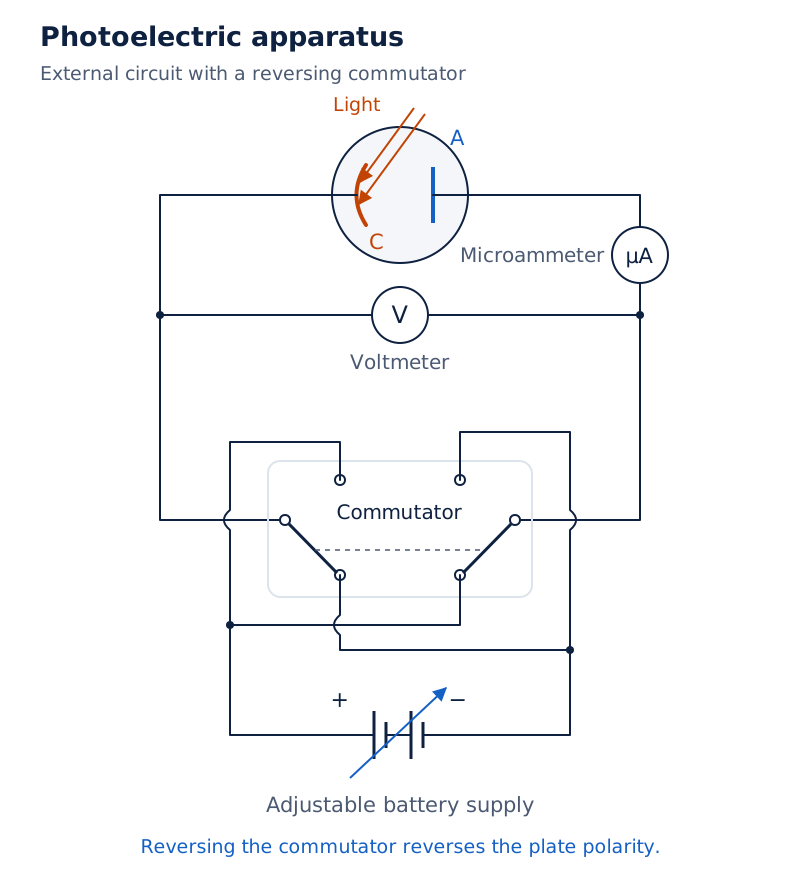
The drawing shows light entering through a quartz window towards the photosensitive plate . Electron arrows point towards plate . The external circuit includes a commutator, microammeter, voltmeter and battery arrangement.
Drawn by One Young India. See Fig. 11.1 in your NCERT textbook
Controlling the experiment
- Illuminate the emitter with monochromatic light of sufficiently high frequency to release electrons.
- Maintain the collector at a chosen potential relative to the emitter and measure the current.
- Change one variable, such as intensity, while holding the other relevant variables fixed.
- Repeat the measurements with different collector potentials, frequencies or emitter materials to identify their separate effects.
Different filters allow different frequencies to be selected. Changing the source’s distance from the emitter changes the light intensity. The apparatus therefore connects controlled changes in illumination and voltage to measurable changes in photocurrent.
The SI unit of electric current is the ampere. The small currents measured here are read using a microammeter. Current records charge flow through the circuit; it does not directly state the maximum energy of an individual photoelectron.
How do intensity and collector potential affect photocurrent?
Changing intensity at fixed frequency
Keep the emitter material, radiation frequency and positive collector potential fixed. Increasing the light intensity increases the photocurrent linearly. The frequency must be above the threshold for that surface. The larger current indicates a greater number of emitted electrons per second.
What the figure shows
Photocurrent against intensity
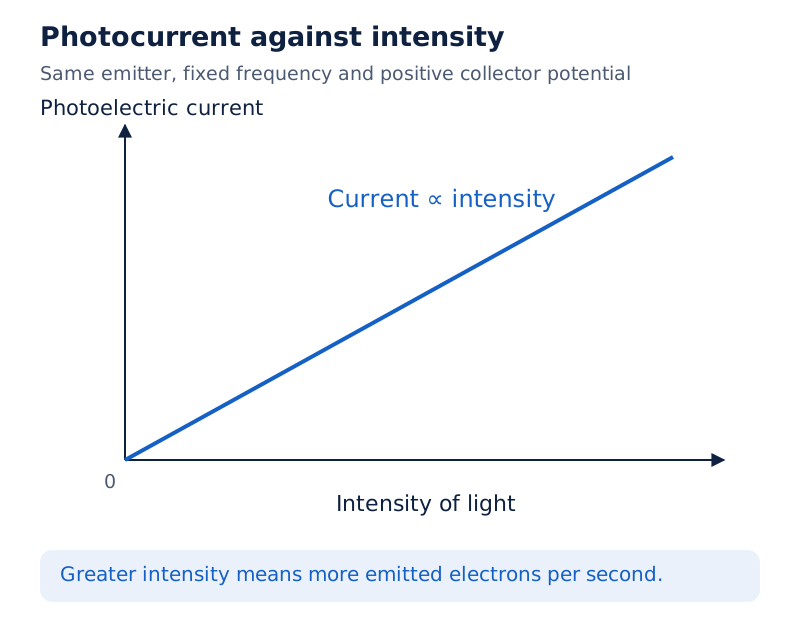
Photoelectric current is on the vertical axis and intensity of light on the horizontal axis. A straight line rises from the origin, representing direct proportionality under the fixed experimental conditions.
Drawn by One Young India. See Fig. 11.2 in your NCERT textbook
For a fixed frequency, stronger illumination does not give each emitted electron a greater maximum energy. It increases the number participating in emission. Separating electron number from electron energy is essential when interpreting the experiment.
Accelerating potential and saturation
With intensity and frequency fixed, making the collector more positive initially increases the collected current. Eventually all emitted photoelectrons reach the collector. Further increases in positive potential then leave the current unchanged.
Definition: Saturation current is the maximum photoelectric current obtained when all photoelectrons emitted by the illuminated surface reach the collector.
A more intense beam produces a higher saturation current at the same frequency. The plateau is therefore connected to the emission rate. Once collection is complete, a greater accelerating potential cannot collect more electrons than the emitter supplies.
Retarding potential and stopping potential
If the collector is negative relative to the emitter, it repels the outgoing electrons. Only sufficiently energetic electrons reach it. Increasing this retarding potential reduces the current until even the fastest photoelectrons cannot reach the collector.
Let denote the positive magnitude of the stopping potential, the minimum retarding potential needed to reduce photocurrent to zero. Let denote the magnitude of electron charge and the maximum photoelectron kinetic energy.
The energy relation is . The collector’s stopping voltage relative to the emitter is negative, written ; the magnitude used in the energy relation is positive.
What the figure shows
Different intensities at one frequency
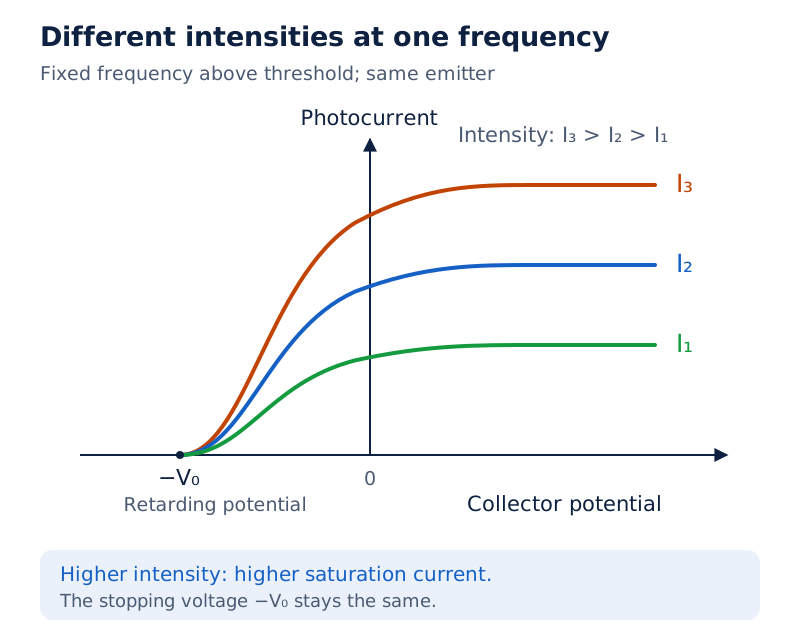
Three photocurrent curves have different saturation plateaux but meet the potential axis at the same negative stopping voltage. The intensity labels increase from the lowest curve to the highest.
Drawn by One Young India. See Fig. 11.3 in your NCERT textbook
At the stopping potential, zero collected current does not mean that illumination has ceased to eject electrons. The retarding field prevents even the most energetic emitted electrons from reaching the collector.
How does frequency affect stopping potential and emission?
A frequency threshold
Let denote incident radiation frequency and the threshold frequency of the emitter. If , no photoelectric emission occurs, however intense the radiation is. The threshold is characteristic of the particular surface.
Above threshold, increasing frequency increases maximum photoelectron kinetic energy. A greater retarding potential is then required to stop the most energetic electrons. For a given material, stopping potential varies linearly with frequency.
What the figure shows
Different incident frequencies
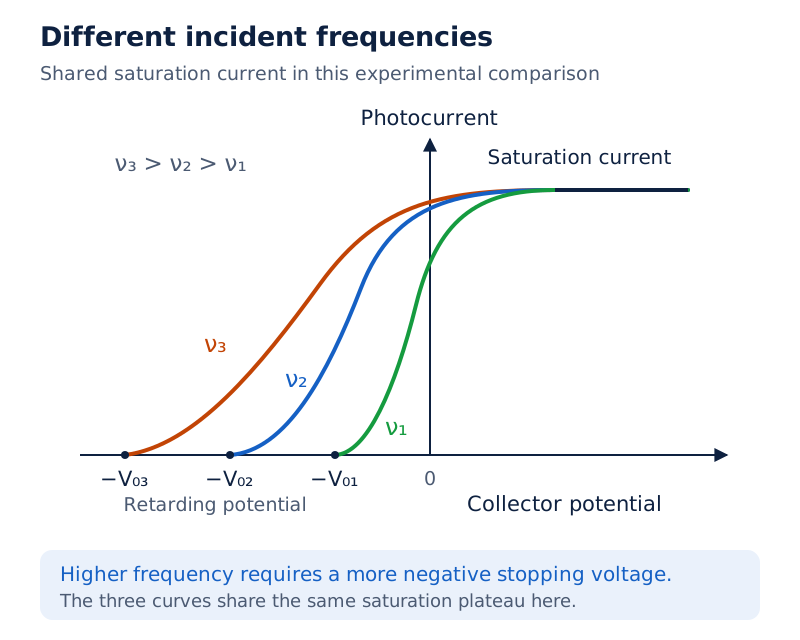
The three photocurrent curves share a saturation plateau but meet the potential axis at different negative voltages. The curve labelled with the greatest frequency extends furthest into the negative-potential region.
Drawn by One Young India. See Fig. 11.4 in your NCERT textbook
The shared plateau belongs to the experimental comparison illustrated. The essential frequency result is the change in stopping potential. It should not be confused with the separate intensity experiment, where the plateaux change but the stopping potential remains the same.
Reading the straight-line graph
What the figure shows
Stopping potential against frequency
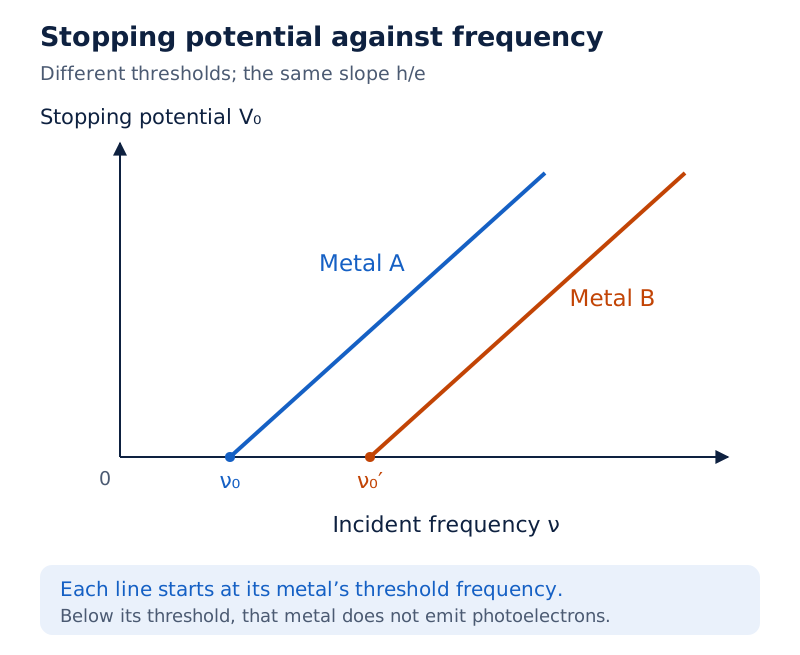
Two rising straight lines are labelled Metal A and Metal B. Each begins at its own threshold on the frequency axis. The horizontal axis represents incident frequency and the vertical axis represents stopping potential.
Drawn by One Young India. See Fig. 11.5 in your NCERT textbook
The frequency-axis intercept identifies the threshold. Beyond it, the stopping potential grows with frequency. Different metals can have different thresholds, even though the slope predicted by Einstein’s equation is independent of material.
The SI unit of frequency is the hertz. A frequency measures the number of oscillations per second. It is distinct from intensity, which concerns energy arriving per unit area per unit time.
Emission has no apparent time lag
For frequencies exceeding the threshold, emission begins without an apparent delay, even under very dim illumination. The observed timescale is of the order of or less. Reducing intensity does not introduce the long waiting period expected from gradual energy accumulation.
Note: Stopping potential depends on frequency and emitter material. At a fixed frequency for the same surface, it is independent of intensity. A change in current alone does not establish a change in maximum electron energy.
Why does the classical wave picture fail for photoelectric emission?
What the wave picture explains
Interference, diffraction and polarisation establish the wave nature of light. The classical electromagnetic description treats radiation energy as continuously distributed. That picture successfully explains these wave phenomena, but its energy-transfer assumptions fail to explain the photoelectric observations.
In the classical account of emission, surface electrons absorb radiation energy continuously. Stronger illumination means greater field amplitudes and was expected to supply more energy to individual electrons. This expectation does not match the measured behaviour of maximum photoelectron energy.
| Question | Classical expectation | Observation |
|---|---|---|
| What does stronger light do? | It should increase the energy gained by each electron. | Maximum kinetic energy is independent of intensity at fixed frequency. |
| Is there a minimum frequency? | Sufficiently intense radiation over sufficient time should supply enough energy at any frequency. | No emission occurs below the threshold frequency. |
| Must dim light act for a long time? | Slow continuous accumulation could produce a substantial delay. | Emission has no apparent time lag above threshold. |
Why the disagreement is decisive
The problem is not simply that a current appears under illumination. The difficulty is explaining all three restrictions together: a frequency threshold, an intensity-independent maximum energy and essentially immediate emission.
A theory based only on accumulating more energy by making the beam brighter cannot reproduce the threshold result. Similarly, interpreting greater current as greater energy per electron misses the stopping-potential evidence. These are different measured properties.
The failure of this classical explanation does not remove the evidence for waves. It shows that the interaction between radiation and electrons needs a different description. The photon picture supplies that description for energy and momentum transfer.
How does Einstein’s equation explain the photoelectric effect?
Energy arrives in quanta
Einstein proposed that radiation transfers energy in discrete packets. Let denote Planck’s constant and the energy of one light quantum, or photon. Then . A single electron absorbs a single quantum in the elementary photoelectric process.
Part of the absorbed energy enables the electron to escape. The remainder can appear as kinetic energy. More tightly bound electrons emerge with less kinetic energy, so the equation using the work function gives the maximum kinetic energy.
Derivation: Einstein’s energy balance and threshold relation
Use the photon energy, the minimum escape energy and conservation of energy for the most energetic emitted electron.
- Write the absorbed photon energy:
- Apply conservation of energy to escape and subsequent motion:
- Rearrange for maximum kinetic energy:
- At the threshold limit, kinetic energy is zero:
- Substitute the threshold relation into the energy balance:
Result: Einstein’s equation predicts a linear increase of maximum kinetic energy with frequency. Below threshold, the photon does not provide the minimum escape energy, so a negative calculated kinetic energy signifies no emission.
Derivation: The stopping-potential straight line
The retarding field stops even the most energetic emitted electrons when their kinetic energy equals the work required to move against the field.
- Express maximum kinetic energy using the stopping-potential magnitude:
- Insert this into Einstein’s energy balance:
- Divide by the positive elementary charge:
- Let denote the graph’s slope. Read the coefficient of frequency:
Result: The slope is independent of emitter material, while the threshold depends on work function. The relation applies for ; extending the line below threshold does not describe an emitted photocurrent.
Accounting for the observations
Intensity: More photons arrive per second under stronger illumination of fixed frequency. More electrons can absorb photons and escape, increasing current. Individual photon energy remains unchanged, so maximum electron energy remains unchanged.
Threshold: A photon below the required energy cannot release an electron through this process. Increasing the number of insufficient-energy photons does not change the energy of each quantum.
Immediate emission: The elementary absorption event supplies the energy in one quantum. An electron need not gradually accumulate a continuous supply of radiation energy. Dim illumination reduces the number of such events, rather than creating a long emission delay.
Millikan’s precise measurements confirmed the equation and allowed Planck’s constant to be obtained from the slope. The SI unit of Planck’s constant is the joule second. The measured relationship therefore tests both the linear prediction and its quantitative coefficient.
What properties do photons have, and how is their number calculated?
Energy and momentum of light quanta
Let denote the speed of light in vacuum, the radiation wavelength and the momentum of a photon. The photon relations are and .
Photons of the same frequency have the same energy and momentum, irrespective of beam intensity. Increasing intensity at fixed wavelength increases the number crossing a given area each second. It does not increase the energy of each photon.
Photons are electrically neutral and are not deflected by electric or magnetic fields. In a photon-particle collision, total energy and total momentum are conserved. Photon number need not be conserved because a photon may be absorbed or created.
The SI unit of photon energy is the joule. The SI unit of momentum is the kilogram metre per second. Energy and momentum both characterise the particle-like transfer involved in interactions of radiation with matter.
Worked photon-rate calculation
Worked example 1. A laser emits monochromatic light of frequency with power . Find each photon’s energy and the average emission rate. Use .
Let denote beam power and the number of photons emitted per second. Formula: , , . Substitute:
- Calculate photon energy:
- Divide power by the unrounded photon energy:
Answer: Each photon carries , and the rate is approximately photons per second. Power is energy transferred in 1 s; dividing by energy per photon gives the number emitted per second.
The distinction between power and photon energy matters here. Power describes the entire beam’s energy output per unit time. Photon energy describes one quantum. Their ratio counts how many quanta the source emits per second.
The numerical result is an average emission rate. The calculation does not mean that all the photons together form one packet of energy equal to the beam power. Each photon retains the energy determined by the frequency.
How are stopping-potential and work-function numericals solved?
Keep energy units consistent
Use joules throughout an energy balance involving Planck’s constant in joule seconds. Alternatively, convert all energy terms consistently into electron volts. Do not add a numerical value in volts to a work function in electron volts without first converting potential to electron energy.
For the following calculations, use the rounded elementary charge , so at this precision. Use and .
Worked example 2. Caesium has work function . Find its threshold frequency and the incident wavelength when the stopping potential is . Use the constants stated above.
Formula: , , . Substitute:
- Convert work function:
- Calculate threshold frequency:
- Find maximum kinetic energy:
- Add escape and kinetic energies:
- Find wavelength:
Answer: The threshold frequency is ; the incident wavelength is approximately 454 nm. The 0.60 V stopping potential measures the kinetic energy left after escape, rather than the full incident photon energy.
Converting a stopping voltage into energy
Worked example 3. The photoelectric cut-off voltage has magnitude . Find maximum electron kinetic energy using .
Formula: . Substitute:
- Multiply charge by stopping-potential magnitude:
- Convert into electron volts:
Answer: Maximum kinetic energy is , or . The given 1.5 V is a stopping-potential magnitude; kinetic energy is a positive quantity.
Using a measured graph slope
Worked example 4. The stopping-potential versus frequency graph has slope . Calculate Planck’s constant using .
Formula: , so . Substitute:
- Multiply elementary charge by slope:
- Use the charge-potential energy unit:
Answer: The measured slope gives . Multiplication by charge converts the voltage factor to energy, using .
Using incident and threshold frequencies
Worked example 5. A metal has threshold frequency . Radiation of frequency falls on it. Find the cut-off voltage using the stated values of Planck’s constant and elementary charge.
Formula: . Substitute:
- Find the excess frequency:
- Convert its energy into stopping potential:
Answer: The stopping-potential magnitude is approximately 2.03 V. The incident frequency exceeds threshold, so the positive result is consistent with photoelectric emission.
Numerical checks: Compare incident frequency with threshold before interpreting an answer. Keep extra digits during intermediate calculations and round the final result. A wavelength requires a length unit, while a frequency requires a reciprocal-time unit.
What is the de Broglie wavelength of a moving particle?
Wave-particle duality of matter
Light exhibits wave behaviour in interference, diffraction and polarisation, and particle-like energy transfer in the photoelectric effect. De Broglie proposed that moving material particles should also display wave-like properties under suitable conditions.
The de Broglie relation is , where now denotes the matter wavelength and the particle momentum. For a non-relativistic particle of mass and speed , momentum is , giving .
The relation connects a wave property, wavelength, with a particle property, momentum. It is a hypothesis for matter whose validity requires experiment. At equal momentum, the relation gives equal wavelengths regardless of particle charge or type.
Derivation: Checking the relation for a photon
Use photon momentum and the radiation frequency to compare the two wavelength expressions.
- Write the photon momentum relation:
- Substitute it into the de Broglie expression:
- Use the radiation wave relation:
Result: The de Broglie wavelength of a photon equals the wavelength of the radiation of which it is a quantum. This consistency does not by itself prove the hypothesis for material particles.
Comparing an electron with a ball
Worked example 6. Find the wavelengths of an electron moving at and a ball of mass moving at . Use electron mass and .
Formula: , . Substitute:
- Calculate electron momentum:
- Calculate electron wavelength:
- Convert ball mass:
- Calculate ball momentum:
- Calculate ball wavelength:
Answer: The electron wavelength is , while the ball wavelength is . The ball’s 150 g mass produces a much greater momentum and a far smaller wavelength.
The electron wavelength is comparable with X-ray wavelengths. The ball’s wavelength is far beyond practical measurement. This explains why wave character is significant in the subatomic domain but is not observed for ordinary macroscopic objects in everyday motion.
Dual nature does not mean choosing one permanent description for light or matter in every setting. The nature of the experiment determines which description is useful. For example, focusing light and absorbing its energy involve different aspects of its behaviour.
Glossary
- Work function — Minimum additional energy required by an electron to escape from a particular metal surface.
- Electron volt — Energy gained by an electron accelerated through a potential difference of one volt.
- Thermionic emission — Release of electrons from a metal after sufficient thermal energy is supplied by heating.
- Field emission — Emission produced when a very strong electric field pulls electrons out of a metal.
- Photoelectric effect — Emission of electrons from a metal surface illuminated by radiation of suitable frequency.
- Photoelectron — An electron emitted from a material following absorption of energy from incident radiation.
- Photocurrent — Electric current resulting when photoelectrons emitted from the illuminated surface reach the collector.
- Saturation current — Maximum photocurrent attained when the collector receives all photoelectrons emitted by the illuminated surface.
- Stopping potential — Minimum retarding potential magnitude that prevents even the most energetic photoelectrons from reaching the collector.
- Threshold frequency — Minimum radiation frequency corresponding to the escape-energy requirement of a particular photosensitive surface.
- Photon — A quantum of electromagnetic radiation with energy and momentum determined by its frequency.
- De Broglie wavelength — Wavelength associated with a moving particle, equal to Planck’s constant divided by its momentum.
Common errors and misconceptions
- Misconception: Free electrons can leave a metal without receiving energy. Correct: Freedom to move inside the metal does not remove the surface escape-energy requirement.
- Misconception: An electron volt is a voltage. Correct: It is an energy unit, defined through the energy gained by an electron accelerated across one volt.
- Misconception: Brighter light gives a larger maximum photoelectron energy. Correct: At fixed frequency and emitter material, intensity changes photocurrent, while maximum kinetic energy remains unchanged.
- Misconception: Sufficient intensity causes emission below threshold. Correct: Increasing intensity does not increase individual photon energy at fixed frequency, so the threshold restriction remains.
- Misconception: All photoelectrons have the energy given by Einstein’s equation. Correct: The work-function form gives maximum kinetic energy; more tightly bound electrons emerge with lower energies.
- Misconception: Zero current at stopping potential means electrons are no longer emitted. Correct: The retarding field prevents emitted electrons from reaching the collector.
- Misconception: Photons should be treated using the massive-particle expression for momentum. Correct: Use for photons; use for non-relativistic material particles.
- Misconception: A ball has no associated wavelength. Correct: Its de Broglie wavelength exists in the relation but is extraordinarily small for ordinary macroscopic motion.
Exam-style questions with model answers
Q1. Define work function and explain why a free electron inside a metal cannot normally leave its surface. [2 marks]
- Work function is the minimum energy needed by an electron to escape from the metal surface.
- The electron is attracted back towards the positively charged metal. Freedom to move inside it does not supply the energy needed for escape.
Q2. At fixed frequency above threshold, how does increasing intensity affect photocurrent, saturation current and stopping potential for the same emitter? Explain. [3 marks]
- Photocurrent increases with intensity under fixed collection conditions because more photoelectrons are emitted per second.
- Saturation current also increases because it represents collection of all the electrons emitted per second.
- Stopping potential is unchanged. Photon energy is fixed by frequency, so the maximum kinetic energy of the emitted electrons is unchanged even though their number increases.
Q3. Explain three observations that the classical continuous-energy wave picture fails to explain in the photoelectric effect. [3 marks]
- Maximum electron kinetic energy is independent of intensity at fixed frequency. Continuous absorption instead suggests stronger radiation should provide more energy to individual electrons.
- A threshold frequency exists. A continuous accumulation model suggests sufficient intensity and time should permit escape at any frequency.
- Emission begins without apparent delay even under dim light above threshold. Gradual energy collection predicts a waiting time.
Q4. Derive Einstein’s photoelectric equation and its stopping-potential form. Explain the threshold and the physical meaning of the graph’s slope. [5 marks]
- Let be Planck’s constant and the incident frequency. Each photon supplies energy to an absorbing electron. Here means the energy of one photon.
- Let be the work function and the maximum kinetic energy. Conservation of energy gives , hence .
- At the threshold frequency , maximum kinetic energy is zero, giving . Below this frequency the photon cannot supply the minimum escape energy.
- Let be the positive elementary charge and the stopping-potential magnitude. Since , the equation becomes .
- The graph’s slope is , independent of material. Its frequency-axis intercept gives the threshold. The straight line describes emission at or above the threshold limit.
Q5. A metal has threshold frequency . Find the stopping-potential magnitude for incident frequency . Use and . [3 marks]
- The incident frequency exceeds threshold, so emission is possible. Let be stopping-potential magnitude, incident frequency and threshold frequency. The required relation is .
- The frequency difference is .
- Substitution gives . This is the positive magnitude; the collector is negative relative to the emitter when stopping the electrons.
Q6. Calculate the de Broglie wavelength of a ball of mass travelling at . Use . Explain why its wave behaviour is not apparent in everyday motion. [3 marks]
- Let denote mass, speed, momentum and wavelength. Convert the mass: .
- Calculate momentum: .
- Use the de Broglie relation: . The wavelength is so small that wave behaviour is beyond practical measurement for this macroscopic object in everyday motion. The result follows from its large momentum compared with that of a subatomic particle.
Q7. Show that the de Broglie wavelength of a photon equals its radiation wavelength. Use photon momentum and the wave relation , where is Planck’s constant, frequency, light speed and radiation wavelength. [2 marks]
- Let denote the de Broglie wavelength. Substitution gives .
- The wave relation gives . Therefore , establishing equality between the photon’s associated wavelength and the radiation wavelength.
Key takeaways
- The work function is the minimum surface escape energy; free movement within a metal does not imply unrestricted escape.
- At fixed frequency above threshold, increasing intensity increases photocurrent and saturation current without changing the maximum photoelectron kinetic energy.
- Stopping potential measures the maximum kinetic energy through the work done against the retarding electric field.
- Below the threshold frequency, increasing the intensity cannot produce photoelectric emission through the single-photon absorption process.
- Einstein’s equation applies conservation of energy to photon absorption, electron escape and the maximum kinetic energy remaining.
- The stopping-potential graph is linear above threshold, with a material-independent slope and a material-dependent frequency intercept.
- Photon energy and momentum depend on frequency; stronger illumination at the same frequency supplies more photons.
- The de Broglie wavelength decreases as momentum increases, making matter-wave behaviour significant for subatomic particles.
Test yourself
Why is quartz used for the window of the photoelectric tube?
Quartz permits ultraviolet radiation to enter the tube and illuminate the photosensitive emitter surface.
What does saturation of photocurrent tell you about electron collection?
All emitted photoelectrons are reaching the collector, so further increasing its positive potential does not increase current.
What happens if intensity rises while frequency remains below threshold?
Photoelectric emission still does not occur because the energy of each photon remains below the surface’s escape requirement.
Why do different emitted electrons have different kinetic energies?
Electrons have different initial energies and escape requirements; more tightly bound electrons emerge with less than the maximum kinetic energy.
Why can a dim beam still produce immediate photoelectric emission above threshold?
An electron absorbs the required energy in one quantum. Lower intensity reduces the number of events rather than requiring gradual energy accumulation.
Does changing the emitter material change the predicted stopping-potential graph slope?
No. The slope is Planck’s constant divided by elementary charge, whereas changing material can change the threshold frequency.
How do photon energy and photon number respond to stronger light at fixed frequency?
Individual photon energy remains unchanged, while the number of photons crossing a given area each second increases.
Why are matter waves more evident for subatomic particles than for ordinary moving balls?
Subatomic particles can have measurable wavelengths, whereas the much greater momentum of ordinary balls gives extraordinarily small wavelengths.