
Binomial Theorem | CBSE Class 11 Maths Notes
On this page
Watch & explore
Start with a few high-quality watches, then dive into the notes below.
These Mathematics notes cover binomial expansions for positive integral powers, Pascal’s triangle, binomial coefficients, the binomial theorem and its proof, special expansions, numerical calculations, comparisons, divisibility, cancellation of terms and approximations.
What patterns appear when a binomial is raised to a power?
How do the powers change?
A binomial is an algebraic expression containing two terms. Let and denote its two quantities, and let denote the index, or power, to which their sum is raised. Here the theorem concerns positive integral indices, meaning positive whole-number powers.
Repeated multiplication gives familiar square and cube identities. However, it becomes lengthy for higher powers. The binomial theorem supplies the coefficients and powers directly, so the expansion can be assembled without repeatedly multiplying the entire expression by itself.
| Index | Expansion |
|---|---|
| Zero, with a non-zero base | , provided |
| One | |
| Two | |
| Three | |
| Four |
Property: Number of terms and total index
The standard expansion contains terms before any simplification caused by particular substitutions. The power of the first quantity decreases by one in each successive term. The power of the second quantity increases by one, beginning with zero.
The sum of the indices of the two quantities remains equal to the original index in every term. These observations control the arrangement of the expansion; they do not by themselves give its numerical coefficients. Pascal’s triangle supplies those coefficients for successive powers.
Note: Count powers of the two complete quantities being expanded. If a quantity already contains a power of a variable, the final simplified powers of that variable need separate calculation.
How does Pascal’s triangle generate binomial coefficients?
How is each new row formed?
Pascal’s triangle arranges the coefficients of successive binomial expansions in triangular rows. Each row begins and ends with one. Each interior entry is obtained by adding the two neighbouring entries immediately above it. The top row corresponds to index zero.
What the figure shows
Building Pascal’s triangle
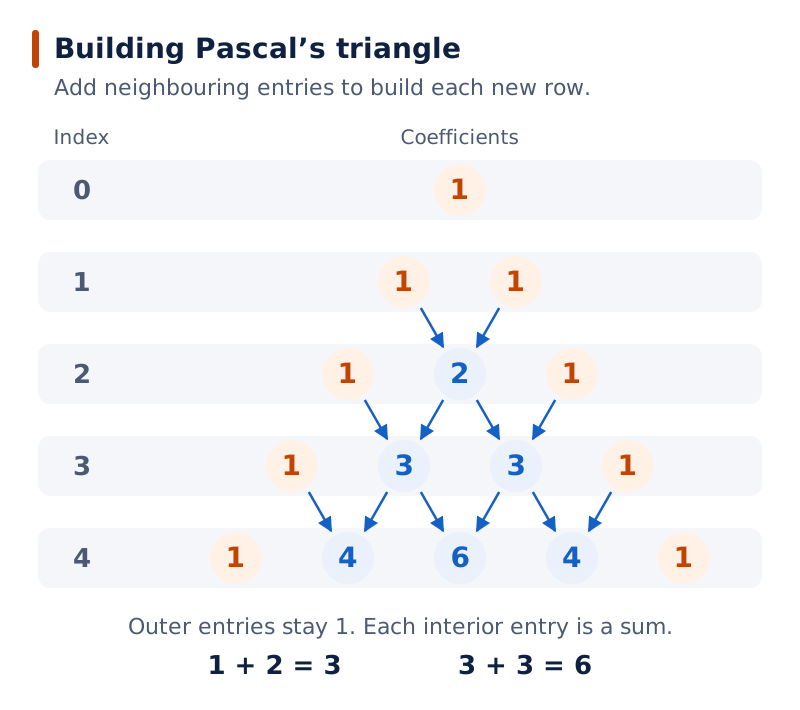
The diagram has columns headed Index and Coefficients. Rows run from zero to four. Small blue downward triangles indicate pairs of neighbouring entries whose sum gives an interior entry below. Ones form the two outer edges.
Drawn by One Young India. See Fig. 7.2 in your NCERT textbook
The row for a particular index gives the coefficients in their required order. Extending the row for the fourth power produces the row for the fifth power. Keep the coefficient pattern separate from the powers of the two quantities until both have been written correctly.
Worked example 1. Expand , where and are algebraic variables, using Pascal’s triangle.
Answer: Treat and as the two complete quantities.
- Read the fifth-power row:
- Insert decreasing and increasing powers:
- Calculate every numerical factor:
- Write the simplified expansion:
This example has six displayed terms. The first variable’s power descends from five to zero, while the second rises from zero to five. The triangle gives the coefficients before substitution; powers of the numerical multipliers must still be included.
How do combinations give the binomial theorem directly?
What does a binomial coefficient mean?
Constructing every earlier row becomes inconvenient when the desired index is large. Combinations give a direct way to calculate a row. Let denote a non-negative integer position index, with . The notation denotes the number of selections of objects from objects.
The symbol denotes a factorial, the product of the positive integers up to its argument, with . The combination formula is . The two endpoint coefficients satisfy .
What the figure shows
Pascal’s triangle in combination notation
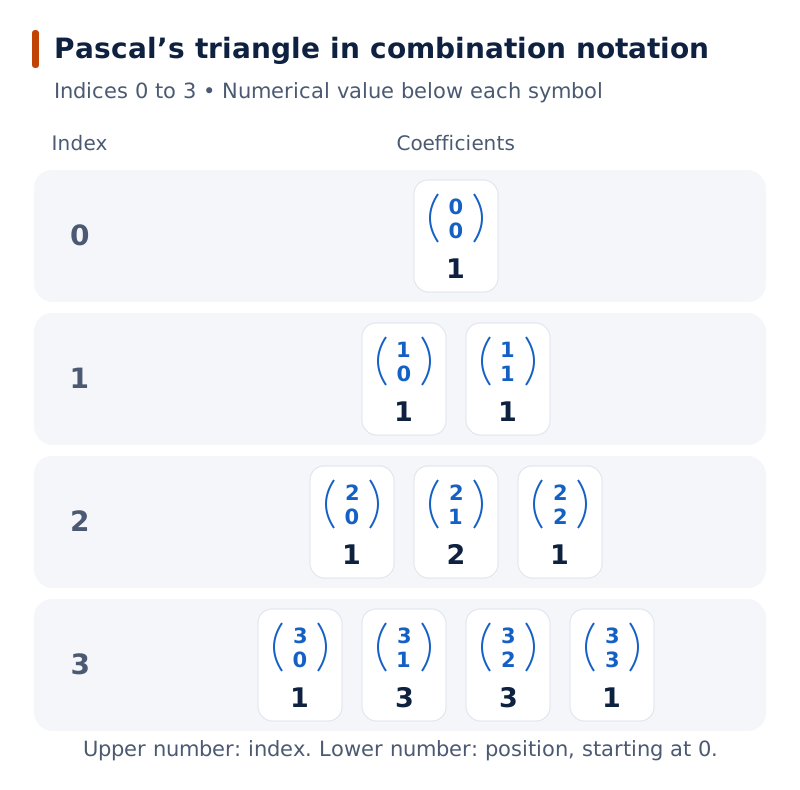
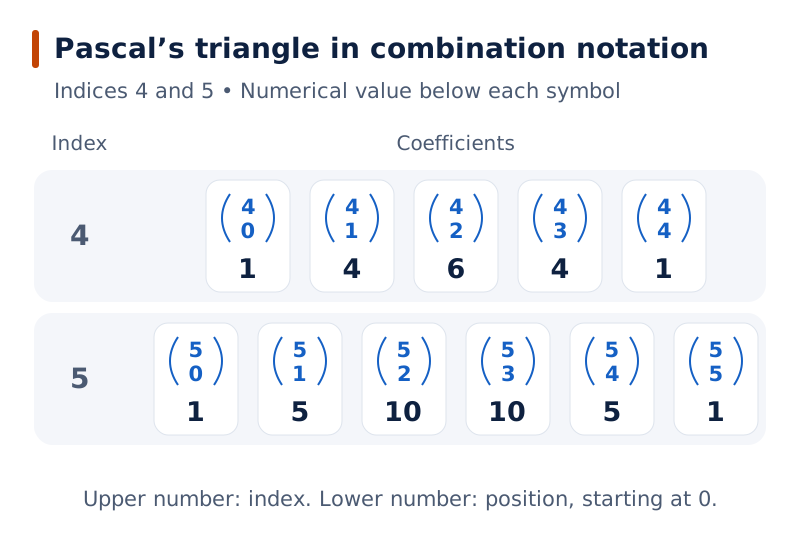
The rows are labelled with indices zero to five. Each entry shows a combination symbol and its numerical value beneath it. The bottom row has the values .
Drawn by One Young India. See Fig. 7.3 in your NCERT textbook
The combination form also explains why the row can be written without building the triangle first. At the chosen index, the upper number stays fixed while the lower number runs from zero to that index. Each value gives the coefficient for the corresponding place in the expansion.
Theorem: Expansion for a positive integral index
For every positive integer , the binomial theorem gives the following finite expansion. The symbol means to add the indicated terms as the integer index runs between the stated limits.
Each coefficient is paired with exactly the corresponding powers. The first contribution uses the first quantity alone; the last uses the second quantity alone. Intermediate contributions contain both quantities. The compact summation and the fully written expansion describe the same calculation.
Worked example 2. Expand .
Answer: Use the sixth-power coefficients and retain the powers of two.
- Calculate the coefficient row:
- Substitute the two quantities into the expansion:
- Evaluate the multipliers:
- Collect the results:
How is the binomial theorem proved by induction?
What must an induction proof establish?
Mathematical induction connects a verified starting case to all subsequent positive integer cases. Let mean the statement of the binomial theorem at index . Let denote an arbitrary positive integer at which the statement is assumed true.
The proof first checks the starting index. It then multiplies the assumed expansion by one more copy of the binomial. Terms with matching powers combine, and their coefficients become entries in the next row of Pascal’s triangle.
Derivation: Induction from one index to the next
- Verify the base case. Thus holds.
- State the induction assumption. Suppose holds:
- Multiply by the binomial. Distribute its two quantities separately:
- Group like terms. An interior term receives one contribution from each sum:
- Combine neighbouring coefficients. Use the identity to obtain
- Complete the induction. The last equality establishes from . Together with the verified starting case, it proves the theorem for every positive integer .
The key coefficient identity expresses algebraically the same addition rule used to construct Pascal’s triangle. The first and last terms remain separate during grouping because each has only one contribution. Their coefficients are one, matching the endpoints of the next row.
The induction assumption is a statement about an arbitrary positive integer, rather than a calculation at one chosen large power. This distinction explains why the argument proves the theorem throughout the stated range of indices.
How does the expansion change for a difference?
Result: Alternating signs for a difference
A subtraction can be handled by taking the second quantity to be negative. The negative sign belongs inside the powered quantity. Even powers of that quantity are positive; odd powers are negative. Consequently the signs of the standard expansion alternate, beginning with a positive term.
Derivation: Replacing the second quantity by its negative
- Rewrite the difference as a sum:
- Apply the binomial theorem with the negative second quantity:
- Separate the sign from the variable power:
The last sign depends on whether the original index is even or odd. Alternation applies to the written coefficients of the polynomial; the value of a term after substituting a negative variable also depends on that substitution.
Worked example 3. Expand .
Answer: Take the second quantity to be , including its sign.
- Write all six terms:
- Calculate the signed powers:
- Multiply the coefficients:
- Assemble the result:
Check the signs and powers independently. A correct alternating pattern does not guarantee correct numerical coefficients, because the powers of two still need multiplication by the binomial coefficients. The exponent of the last term equals the original index.
How do special substitutions produce coefficient identities?
What happens when the first quantity is one?
Setting the first quantity equal to one removes its visible powers. The expansion then lists the binomial coefficients beside successive powers of the second quantity. Choosing a negative second quantity produces the corresponding alternating expansion.
| Substitution | Resulting expansion |
|---|---|
| First quantity one, second quantity positive | |
| First quantity one, second quantity negative |
Identity: Sum of binomial coefficients
- Start from the expansion with the first quantity equal to one:
- Set the variable equal to one:
- Simplify the powers:
This sum identity adds the numerical entries of a complete Pascal row. It is about the binomial coefficients themselves. When expanding two other quantities, their powers supply additional factors, so the final numerical multipliers need not be those unchanged entries.
Identity: Alternating sum of binomial coefficients
- Begin with the negative-variable expansion:
- Substitute one for the variable:
- Since the index is positive, the left side is zero:
In both derivations the theorem stays the same; only the substituted value changes. Reading the requested coefficient sum before substituting helps identify whether the signs should all be positive or alternate. The positive-index condition matters when the left side becomes a power of zero.
How are binomials containing fractions expanded?
Why must the complete quantities be retained?
The binomial theorem applies to two quantities even when one contains a fraction or an existing power. First identify those complete quantities. Then apply the coefficient and exponent pattern. Simplify their internal powers afterwards, preserving any restriction on the variable.
A denominator must be non-zero. In the following example, the denominator in is , so is excluded. Expanding the expression does not remove this original restriction. Powers in numerators and denominators must be combined carefully, because some simplified terms may still contain the variable in a denominator.
Worked example 4. Expand , with .
Answer: The complete quantities are and .
- Use the fourth-power coefficient row:
- Write the expansion before simplifying:
- Calculate each powered quantity and numerical multiplier:
- Cancel common variable factors where permitted:
The expansion has five terms, but their simplified variable powers do not decrease by one. That decrease applies to the first complete quantity before substitution. Here the first quantity contributes double its assigned exponent, while the second contributes a denominator power.
The third term illustrates both calculations: its binomial coefficient is six, its numerical factor from the fraction is nine, and the remaining variable power comes from cancelling the denominator against the numerator. Separating these tasks reduces errors.
How can binomial expansions simplify numerical calculations?
How should the base be split?
A useful numerical split expresses a number as a sum or difference whose individual powers are easy to calculate. A number near a power of ten is particularly convenient. The expansion remains an exact calculation when every term is retained.
For a difference, write the alternating signs before evaluating the large products. Grouping positive contributions separately from negative contributions can make the final arithmetic easier to inspect. The binomial coefficients and the powers of the small adjustment are both necessary.
Worked example 5. Compute using the binomial theorem.
Answer: Use the nearby base one hundred.
- Split the number:
- Write all contributions:
- Evaluate the products:
- Group positive and negative parts:
- Subtract to obtain the exact answer:
The largest contribution comes from the nearby base raised to the required power. The following contributions correct it using successive powers of the difference. Even though the adjustment is small, every correction must be retained when the question requests an exact numerical answer.
How does the same method work for a cube?
Worked example 6. Evaluate using the binomial theorem.
Answer: Express the number as a difference from one hundred.
- Rewrite the power:
- Apply the cube expansion:
- Evaluate the four terms:
- Carry out the arithmetic:
Both calculations use the same structure, although their coefficient rows differ. The small adjustment is raised to successive powers; it is not merely multiplied repeatedly by its first power. Writing every contribution makes the final answer traceable to the original expansion.
How can an expansion compare large numbers without evaluating them?
When is a partial expansion sufficient?
Sometimes the question asks which number is larger, rather than asking for an exact value. Then the first few terms may already establish a strict inequality. The reason is the sign of the remaining terms, not an assumption that they are numerically unimportant.
When the two substituted quantities are positive, every binomial term is positive. Therefore, dropping later terms gives a smaller sum. If this smaller sum already exceeds the comparison value, the whole expansion must exceed that value as well.
Worked example 7. Which is larger, or ?
Answer: The first two terms already settle the comparison.
- Split the base into positive quantities:
- Separate the first two terms from the rest:
- Evaluate the linear term and note that the remaining sum is positive:
- State the requested comparison:
No approximation to the complete power is needed. The argument proves a lower bound that is already strong enough. This use of positive remaining terms differs from truncating an expansion to estimate a value, where the discarded terms affect the accuracy of the result.
Note: Check the signs before dropping terms. A difference expansion has alternating signs, so the same positivity argument cannot be applied to its entire omitted part without further reasoning.
How does the theorem establish a remainder or divisibility?
What form shows a remainder directly?
To show that a number has a specified remainder, express it as an integer multiple of the divisor plus that remainder. A binomial expansion can separate the first few terms and expose a common factor in all the remaining terms.
The useful split is guided by the divisor. In the following problem, writing six as one plus five produces successive powers of five. From the quadratic contribution onwards, every term contains a factor of twenty-five. Removing the linear contribution leaves a constant and those multiples.
Worked example 8. Prove that leaves remainder on division by , for every positive integer .
Answer: Here means five multiplied by the index. Let denote the integer quotient after division by twenty-five.
- Check the smallest allowed index separately:
- For , expand after splitting the base:
- Subtract the linear term and factor out the divisor:
- Define the quotient and establish that it is an integer: Each coefficient and each non-negative integral power of five is an integer.
- Read off the remainder: Thus division by twenty-five leaves remainder one, including the separately checked first case.
The constant term is crucial: after the linear term is removed, that constant is the only part outside the extracted multiple of the divisor. Keeping it visible throughout the calculation makes the remainder clear and prevents it from being accidentally included inside the quotient.
The proof needs the integer quotient, not its exact value. Factoring the common divisor from a complete sum is enough. Checking the first index separately also avoids writing a displayed tail of terms that is absent in that case.
Do not confuse the linear expression being subtracted with a power of five. The cancellation works because the second term of the expansion is five times the index. Replacing that expression by a power would change the problem and invalidate the argument.
How do cancellation and truncation simplify further problems?
Which terms survive when related expansions are subtracted?
Expansions of a sum and a difference have matching coefficients but different signs on terms involving odd powers of the second quantity. Subtracting them removes the matching even-power contributions. This cancellation can shorten calculations with square roots.
Worked example 9. Find . Hence evaluate .
Answer: Expand first, subtract term by term, then substitute the given roots.
- Write the sum expansion:
- Write the difference expansion:
- Subtract, cancelling the matching terms:
- Insert and :
How is an approximation distinguished from an exact expansion?
An approximation uses a specified part of the expansion. Retaining the first three terms does not mean that all later terms are zero. Keep the distinction visible with an approximation sign when reporting the truncated value.
Worked example 10. Approximate using the first three terms of its binomial expansion.
Answer: The small adjustment is one hundredth.
- Rewrite the base:
- Display the complete finite expansion:
- Retain and evaluate the requested three terms:
- State the approximation with the appropriate sign:
Cancellation removes terms through exact algebra, whereas truncation leaves terms out to produce an estimate. These operations may both shorten a calculation, but the status of the answer differs. The first example gives an exact expression; the second gives the requested approximation.
Glossary
- Binomial — An algebraic expression containing two terms, such as a sum or difference of two quantities.
- Index — The exponent indicating the power to which a quantity or expression is raised.
- Positive integral index — An exponent that is a positive whole number, the range considered in this theorem.
- Expansion — An expression obtained by writing a power as the sum of its resulting terms.
- Binomial coefficient — A combination number multiplying the corresponding powers of the two quantities in a binomial expansion.
- Pascal’s triangle — A triangular arrangement of binomial coefficients, with interior entries formed by adding neighbouring entries above.
- Factorial — The product of the positive integers up to a specified integer, with zero factorial defined as one.
- Combination — A selection of a specified number of objects from a collection, without regard to their order.
- Mathematical induction — A proof method establishing a starting case and showing that each case implies the next.
- Like terms — Terms with matching variable factors and powers, whose numerical coefficients can be combined.
- Remainder — The amount left after taking an integer multiple of a divisor from the number divided.
- Approximation — An estimated value obtained here by retaining a specified initial part of a binomial expansion.
Common errors and misconceptions
- Misconception: An expansion at index contains terms. Correct: Its standard binomial form contains terms, including both endpoint terms.
- Misconception: The coefficients from Pascal’s triangle are the final multipliers after every substitution. Correct: Powers of numerical factors inside the two quantities must also be included.
- Misconception: Every term in a difference expansion is negative. Correct: Signs alternate because even powers of the negative second quantity are positive.
- Misconception: Fractional substitutions allow the variable to be zero after expansion. Correct: A denominator containing the variable preserves the original non-zero restriction.
- Misconception: The remainder example subtracts . Correct: It subtracts , meaning five times the index, which cancels the linear binomial contribution.
- Misconception: The first two terms give the exact value in the large-power comparison. Correct: Further positive terms remain, so those first terms establish a lower bound.
- Misconception: Keeping three terms gives an exact value for . Correct: The requested result is ; later terms have been omitted.
- Misconception: The positive-integer proof establishes the same finite formula for every exponent. Correct: The theorem and induction argument here apply to positive integral indices.
Exam-style questions with model answers
Q1. How many terms occur in the standard expansion of , where and are the two quantities and is a positive integer? State the sum of their indices in each term. [2 marks]
- The standard expansion contains terms, one more than the original index, before any simplification caused by substitution.
- The indices of the two quantities add to in every term; one decreases while the other increases.
Q2. Expand , where and are algebraic variables, showing coefficients and signs. [3 marks]
- Take the two quantities as and . Use the fifth-power coefficient row , keeping the negative sign inside each powered second quantity.
- Substitute to obtain Even powers give positive contributions and odd powers give negative contributions.
- Evaluate the numerical powers and multiply each by its binomial coefficient: There are six terms, with total variable degree five in each.
Q3. Use the binomial theorem to evaluate . [3 marks]
- Choose a convenient difference from one hundred: This makes each power of the first quantity easy to calculate and leaves a small second quantity.
- Apply the cubic coefficient pattern, including alternating signs:
- Subtract the first negative contribution and combine the last two contributions: Hence the exact result is
Q4. Using the binomial theorem, compare with , without calculating the whole power. [3 marks]
- Express the base as a sum of positive numbers: The binomial theorem therefore gives positive contributions throughout the expansion.
- The first two contributions are There are further positive terms because the positive integral index is greater than one.
- The whole sum is strictly larger than these first two terms: Thus the given power is larger, and calculating its exact value is unnecessary for this comparison.
Q5. Prove that leaves remainder when divided by , for every positive integer , where denotes multiplication. [5 marks]
- Handle the first allowed index directly: It has the required remainder, so the remaining proof may assume .
- Write six as one plus five and expand: Here is the integer summation index and is a binomial coefficient.
- Subtract the linear contribution. Every remaining term after the constant contains at least two factors of five:
- Let denote the sum after removing the factor twenty-five: It is an integer because all coefficients and the displayed non-negative integral powers are integers.
- Therefore , an integer multiple of twenty-five plus one. Its remainder is one, and the direct first-case check completes the proof for every stated index.
Q6. Derive , where and are real quantities. Hence evaluate . [5 marks]
- Expand the sum with the fourth-power coefficient row: Both complete endpoint terms must be included.
- Expand the difference using the same coefficients and alternating signs: The signs differ precisely in the terms with odd powers of the second quantity.
- Subtract the second full expansion from the first. The first, third and fifth terms cancel, leaving
- Factor the common product from the surviving contributions: This compact identity can now be used for the requested numerical substitution.
- Set and . Then and , giving This is the exact value of the stated difference.
Key takeaways
- The binomial theorem gives finite expansions for positive integral indices, replacing lengthy repeated multiplication with a coefficient and power pattern.
- Pascal’s triangle begins and ends each row with one, while neighbouring entries above generate each interior entry.
- Combination numbers calculate binomial coefficients directly, without requiring every earlier row of Pascal’s triangle.
- The standard expansion contains one more term than its index, with opposite progressions in the two quantities’ powers.
- For a difference, include the negative sign inside the second quantity before evaluating its successive powers.
- Positive omitted terms can establish a strict lower bound, allowing comparison without evaluation of the complete power.
- Divisibility arguments isolate initial terms and factor a common divisor from the remaining complete sum.
- Exact cancellation preserves equality, while retaining only specified initial terms generally produces an approximation.
Test yourself
How many terms are in the standard expansion of ?
There are five terms, one more than the index of four.
How is an interior entry of Pascal’s triangle formed?
Add the two neighbouring entries immediately above its position in the next row.
What is the sum of the binomial coefficients for positive integer index ?
The sum is , obtained by setting both quantities equal to one in the theorem.
What is the alternating sum of the coefficients at positive integer index ?
It is zero, obtained by substituting one for the variable in the difference expansion.
Why is excluded from ?
The second quantity contains division by the variable, so zero is outside the original expression’s domain.
Why can the first two terms settle the comparison of and ?
The first two terms already total , and every remaining contribution is positive.
What does the subtracted expression mean in the remainder problem?
It means five multiplied by the index, matching the linear contribution in the expansion.
Is the three-term result for exact?
No. It is the requested approximation because the remaining three terms have been omitted.