
Classification of Elements and Periodicity in Properties | CBSE Class 11 Chemistry Notes
On this page
Watch & explore
Start with a few high-quality watches, then dive into the notes below.
This note covers the development of periodic classification, the modern periodic law, element nomenclature, electronic configurations, the four blocks, atomic and ionic sizes, ionisation enthalpy, electron gain enthalpy, electronegativity, valence, anomalous behaviour and chemical reactivity.
How did the classification of elements develop?
Why were early patterns useful?
Periodic classification organises elements so that related properties can be studied together. It reduces the need to learn each element and its compounds separately. A useful classification also helps predict properties of elements that have not yet been investigated.
Dobereiner's triads were groups of three elements with similar properties. The middle member had an atomic weight approximately midway between those of the other two. Lithium, sodium and potassium formed one such triad. However, the pattern worked for only a few elements.
Newlands' law of octaves arranged elements by increasing atomic weight. Every eighth element resembled the first, like the repetition of notes in music. This pattern seemed valid only up to calcium, so it did not provide a general classification.
Lothar Meyer showed that physical properties, including atomic volume, varied periodically with atomic weight. His work also recognised that the length of the repeating pattern could change. Periodicity therefore involved recurring properties without requiring every interval to contain the same number of elements.
What made Mendeleev's arrangement successful?
Definition: Mendeleev's periodic law linked the periodic repetition of elemental properties to atomic weights.
Mendeleev considered both physical and chemical properties, including the formulas of compounds. He placed elements with similar behaviour in the same group. When strict atomic-weight order conflicted with chemical similarity, he gave priority to the latter.
For example, iodine was grouped with fluorine, chlorine and bromine despite its atomic weight being lower than that of tellurium. Mendeleev also left gaps for undiscovered elements and predicted their properties.
| Predicted element | Position of gap | Element discovered later | Matching oxide pattern |
|---|---|---|---|
| Eka-aluminium | Below aluminium | Gallium | Ga₂O₃ |
| Eka-silicon | Below silicon | Germanium | GeO₂ |
The success of these predictions showed that the table expressed a real relationship among properties. It was more than a convenient list: the positions of known elements could guide the search for missing members.
Why does the modern periodic law use atomic number?
What changed after Moseley's work?
Moseley's investigation of characteristic X-ray spectra showed that atomic number was more fundamental than atomic mass for arranging elements. This finding changed the basis of the periodic law from atomic weight to atomic number.
Definition: The modern periodic law states that the physical and chemical properties of elements recur periodically when elements are arranged by atomic number.
The symbol denotes atomic number, the number of protons in the nucleus. A neutral atom has the same number of electrons as protons. Increasing atomic number therefore changes the electronic configuration, which governs much of an element's behaviour.
Periodicity arises because similar arrangements of outer electrons recur. Elements with similar valence-shell configurations tend to show related chemical properties even though their total electron counts and atomic sizes differ.
How are periods and groups identified?
The long form has seven horizontal periods and eighteen vertical groups. Groups contain elements with similar outer electronic configurations. The principal quantum number, written , identifies a main electron shell; the highest occupied shell determines the period.
For instance, the group 1 elements have one outer s electron. Lithium has the configuration , while sodium has . Square brackets represent the filled inner configuration of the named noble gas.
Their shared outer pattern explains their family resemblance. Their different outer shells explain why properties such as radius and ease of electron removal still change down the group. Similarity within a group does not mean that every measurable property is identical.
How are systematic names assigned to elements with high atomic numbers?
How does the digit-root method work?
Before an element's discovery and permanent name receive official recognition, a systematic temporary name can be formed directly from its atomic number. This avoids depending on competing proposed names and identifies the element through a definite number.
Each digit has a numerical root and an abbreviation. The roots are combined in the order of the digits, followed by the ending ium. The temporary symbol uses the initial letters of the roots, with its first letter capitalised.
| Digit | Root | Abbreviation |
|---|---|---|
| 0 | nil | n |
| 1 | un | u |
| 2 | bi | b |
| 3 | tri | t |
| 4 | quad | q |
| 5 | pent | p |
| 6 | hex | h |
| 7 | sept | s |
| 8 | oct | o |
| 9 | enn | e |
How is the method applied?
Worked example 1. Find the systematic temporary name and symbol for the element whose atomic number is .
- Read the digits in order: one, two and zero.
- Select their roots: un, bi and nil.
- Combine the roots and the ending to obtain unbinilium.
- Use the three initial letters to obtain Ubn.
Answer: The temporary name is unbinilium and its symbol is Ubn. Atomic number is a count and has no physical unit.
A temporary systematic designation must be distinguished from a permanent name and symbol. For example, the temporary designation unnilhexium, Unh, corresponds to the permanent name seaborgium, Sg. Learning the digit roots is useful for constructing a provisional designation without memorising a separate name for every possible number.
How do electronic configurations explain the lengths of periods?
Which subshells are filled?
The length of a period depends on the orbitals filled during that period. An orbital accommodates at most two electrons. The s, p, d and f subshells contain one, three, five and seven orbitals respectively.
The first period fills the 1s orbital and contains two elements. The second fills 2s and 2p, while the third fills 3s and 3p. Each of these latter periods contains eight elements.
In the fourth period, 4s fills before 3d and then 4p. Thus, the period includes a transition series and contains eighteen elements. The fifth follows the corresponding 5s, 4d and 5p pattern. Period length cannot be obtained simply by counting the orbitals of the outer shell alone.
Derivation: Why does the fifth period contain eighteen elements?
Let be the number of orbitals filled during the period and the number of electrons they accommodate. Both quantities are dimensionless counts.
- The subshell filling sequence is . These contribute one, five and three orbitals.
- Add their orbital counts:
- Allow two electrons per orbital: Successive elements add one electron, giving eighteen elements.
Result: The fifth period contains eighteen elements, from rubidium to xenon. The d subshell belongs to the shell immediately inside the outer shell.
Derivation: Why does the sixth period contain thirty-two elements?
The same counting method applies when f orbitals also enter the filling sequence.
- The relevant subshell sequence is , contributing one, seven, five and three orbitals.
- The total orbital count is
- The total electron capacity is This gives thirty-two successive elements.
Result: The sixth period includes an inner-transition series as well as s-, d- and p-block elements. The lanthanoids and actinoids are displayed separately below the main table to preserve a compact arrangement while retaining chemical families.
How do the four blocks relate to metallic and non-metallic character?
What defines each block?
The block identifies the kind of subshell being filled. In the configurations below, superscript ranges indicate possible electron occupancies, while identifies the outer principal shell.
| Block | General configuration | Position or series | Characteristic behaviour |
|---|---|---|---|
| s-block | Groups 1 and 2 | Reactive metals with low ionisation enthalpies | |
| p-block | Groups 13 to 18, with helium an electronic exception | Includes non-metals, metals and metalloids | |
| d-block | Groups 3 to 12 | Metals, often showing variable oxidation states | |
| f-block | Lanthanoids and actinoids | Inner-transition metals with similar properties within each series |
s-block metals readily lose their outer electrons. Their compounds are predominantly ionic, with lithium and beryllium being important exceptions. The s- and p-block elements together form the main-group or representative elements.
Within the p-block, group 17 contains halogens and group 16 contains chalcogens. Noble gases have filled valence shells and very low chemical reactivity. Removing or adding an electron disturbs their stable outer arrangement.
d-block elements commonly form coloured ions, exhibit variable oxidation states and show paramagnetism; many are useful catalysts. Zinc, cadmium and mercury have filled d subshells and do not show most typical transition-element properties.
Actinoids are radioactive. Their early members show more complicated chemistry than corresponding lanthanoids because several oxidation states are possible. Elements beyond uranium are called transuranium elements.
Why do hydrogen and helium need special treatment?
Helium has the configuration , so its electrons occupy an s subshell. Its complete outer shell and noble-gas behaviour justify placement in group 18. Position in the table and the identity of the occupied subshell must both be considered.
Hydrogen has one s electron, resembling group 1, but can also gain an electron to reach a filled shell, resembling the halogens. Its distinctive behaviour prevents either comparison from describing it completely.
What the figure shows
Blocks and broad classes of elements
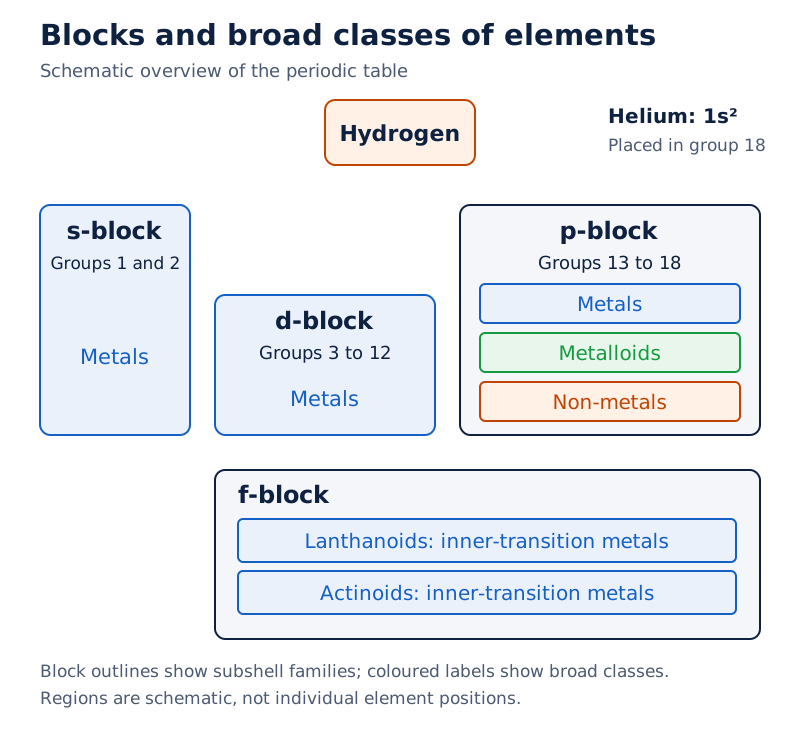
Separate outlined regions identify the s-, p-, d- and f-blocks. Hydrogen appears in a separate box above the main arrangement. The two f-block rows are below it, and different colours distinguish broad classes of elements.
Drawn by One Young India. See Fig. 3.3 in your NCERT textbook
How do metals differ from non-metals?
Metals are usually solid, conduct heat and electricity well, and are malleable and ductile. Mercury is a familiar exception to their usual solid state. Non-metallic solids are generally brittle, and non-metals are generally poor conductors.
Metalloids, such as silicon, germanium, arsenic, antimony and tellurium, show characteristics of both classes. Metallic character generally increases down a group and decreases across a period. These trends help relate position to behaviour without making every member of a class identical.
How do atomic and ionic radii vary through the periodic table?
How can an atom's size be estimated?
An electron cloud has no sharp boundary, so atomic radius is an estimate based on distances between atoms. Covalent radius is half the internuclear separation of identical atoms joined by a single covalent bond. Metallic radius is half the separation of adjacent metal cores in a crystal.
Let denote the appropriate radius and the measured internuclear separation. Both are lengths, expressed here in picometres, abbreviated pm. For these definitions,
Worked example 2. The bond distance in Cl₂ is . Find the covalent radius of chlorine.
- Use half the separation between the two identical bonded atoms: .
- Substitute the measured length: .
- Calculate the radius: .
Answer: Chlorine has a covalent radius of .
Worked example 3. Adjacent copper atoms in solid copper are separated by . Find the metallic radius.
- Use the metallic-radius definition: .
- Substitute the internuclear separation: .
- Calculate the radius: .
Answer: Copper has a metallic radius of .
Why does size decrease across a period but increase down a group?
Across a period, added electrons enter the same valence shell while nuclear charge increases. The increased effective nuclear attraction pulls the outer electrons closer. Down a group, added shells and greater shielding place the outer electrons farther from the nucleus.
What the figure shows
Variation of atomic radius
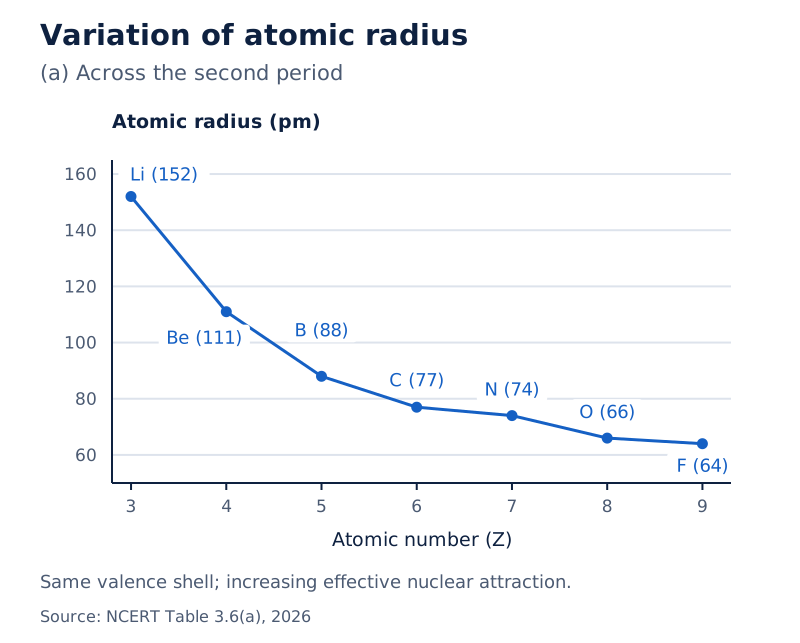
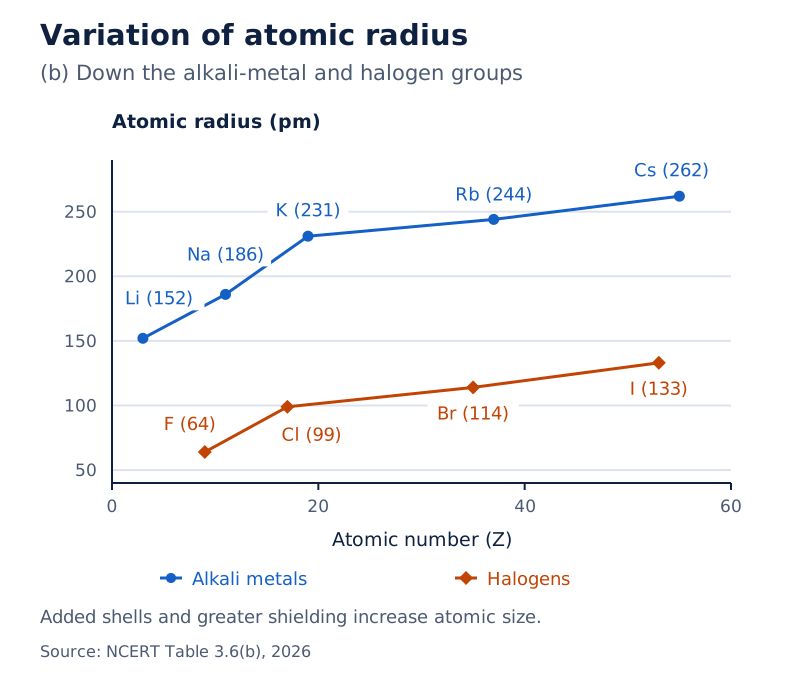
Panel (a) plots atomic radius against atomic number and shows a descending curve from lithium to fluorine. Panel (b) shows rising curves for the alkali metals and halogens as atomic number increases down their groups.
Drawn by One Young India. See Fig. 3.4 in your NCERT textbook
Note: Compare radii defined in the same way. Noble-gas non-bonded radii should be compared with van der Waals radii, rather than directly with covalent radii.
What changes when ions form?
A cation is smaller than its parent atom: fewer electrons experience the same nuclear charge. An anion is larger because adding electrons increases repulsion and reduces the effective attraction per electron. During either change, the number of protons remains the same.
Isoelectronic species have the same number of electrons. The ions , , and each contain ten electrons. Among them, increasing nuclear charge draws the same electron population closer, so their radii decrease in that order.
Do not compare ionic charges alone when the electron populations differ. First identify whether the comparison concerns a parent atom and its ion, an isoelectronic set, or a periodic trend. The relevant explanation follows from that distinction.
What controls ionisation enthalpy and its important exceptions?
What process does the definition describe?
First ionisation enthalpy is the energy required to remove an electron from an isolated gaseous atom in its ground state. The symbol denotes this first molar enthalpy change; it is commonly expressed in kilojoules per mole, .
Let represent an element, indicate the gaseous state and represent an electron. The first and second removal processes are:
The second process has enthalpy change . Both values are positive because removing an electron requires energy. Successive removal becomes harder as the positive charge increases, giving .
The conditions isolated, gaseous and ground state matter when comparing values. They specify the initial species and avoid mixing an atomic electron-removal process with changes involving bonding or an excited electron arrangement.
How do shielding and distance explain the trend?
Core electrons shield outer electrons from the full nuclear attraction. Across a period, this shielding does not increase enough to offset the growing nuclear charge. Outer electrons are held more tightly, so first ionisation enthalpy generally increases.
Down a group, the outer electron occupies a more distant shell and experiences stronger shielding. These effects outweigh the increase in nuclear charge. Electron removal becomes easier and first ionisation enthalpy generally decreases.
What the figure shows
First ionisation enthalpy trends
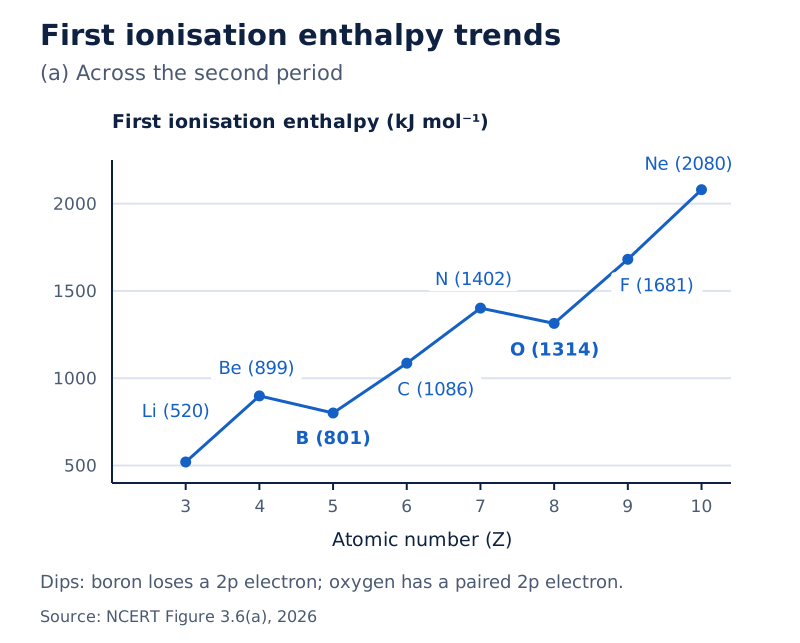
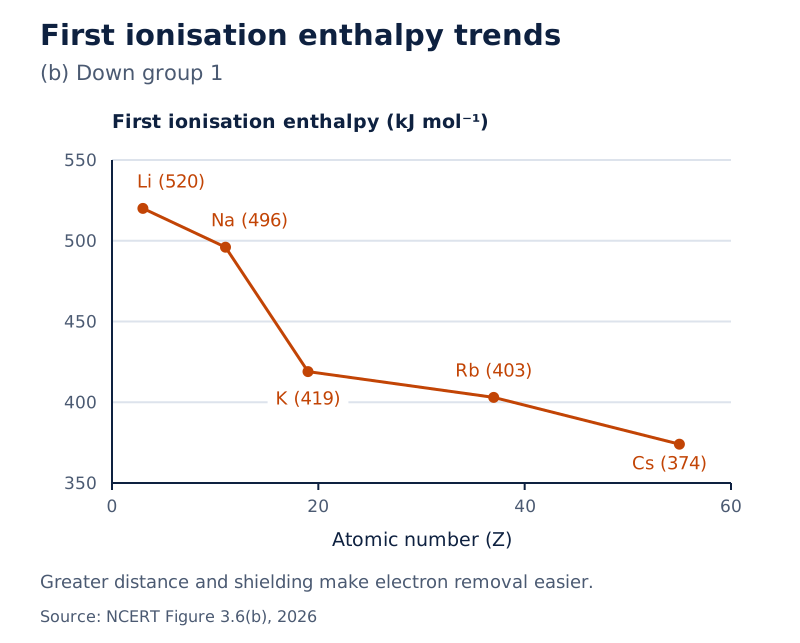
Panel (a) rises overall from lithium to neon, with dips at boron and oxygen. Panel (b) descends from lithium through sodium, potassium and rubidium to caesium. Both use atomic number along the horizontal axis.
Drawn by One Young India. See Fig. 3.6 in your NCERT textbook
Why are beryllium and nitrogen exceptions to a smooth increase?
Beryllium and boron: removing an electron from beryllium involves a 2s electron; boron loses a 2p electron. The 2s electron penetrates closer to the nucleus. The more shielded 2p electron is easier to remove, so boron has the lower first ionisation enthalpy.
Nitrogen and oxygen: nitrogen has three 2p electrons in separate orbitals. Oxygen has a paired set in one 2p orbital. Repulsion within that pair makes removal easier, so oxygen has a lower first ionisation enthalpy than nitrogen.
Worked example 4. Sodium, magnesium and silicon have first ionisation enthalpies of , and , respectively. Is aluminium's value closer to or ?
Answer: It is closer to . Aluminium loses a 3p electron, which is more shielded than magnesium's 3s electron. This is a configuration-based prediction, rather than a numerical interpolation between neighbouring values.
How does electron gain enthalpy differ from ionisation enthalpy?
What does its sign tell us?
Electron gain enthalpy, written , is the enthalpy change when a neutral gaseous atom gains an electron to form an anion. It concerns electron addition, whereas ionisation enthalpy concerns electron removal.
Energy release gives a negative electron gain enthalpy; energy absorption gives a positive value. Unlike ionisation enthalpy, electron gain enthalpy is therefore not necessarily positive. Its molar values are commonly expressed in .
Halogens have strongly negative values because adding an electron completes their valence shell. Noble gases have positive values because the added electron must enter a higher principal shell, disturbing the advantage of the filled-shell arrangement.
Why are fluorine and oxygen important exceptions?
Electron gain enthalpy generally becomes more negative across a period and less negative down a group. However, this trend is less systematic than that of ionisation enthalpy. Electron-electron repulsion must be considered alongside nuclear attraction.
| Element | Electron gain enthalpy | Comparison |
|---|---|---|
| Oxygen | Less negative than sulphur | |
| Sulphur | More negative than oxygen | |
| Fluorine | Less negative than chlorine | |
| Chlorine | More negative than fluorine |
The added electron enters a compact second-shell orbital in oxygen or fluorine and experiences considerable repulsion. In sulphur or chlorine, the larger third-shell region reduces this crowding. Consequently, electron addition releases more energy for sulphur than oxygen, and for chlorine than fluorine.
The phrase more negative must retain its sign meaning. A more negative value represents greater energy release during electron addition. It does not mean that the numerical value is greater on the number line.
Note: Fluorine's very high electronegativity does not imply that its electron gain enthalpy is the most negative. These properties describe different processes.
What is electronegativity and how does it connect the trends?
Why does bonding matter in its definition?
Electronegativity describes an atom's ability, within a chemical compound, to attract shared electrons towards itself. It refers to a bonded atom. Electron gain enthalpy instead describes an enthalpy change for electron addition to a gaseous atom.
Electronegativity is a qualitative concept represented through numerical scales. On the Pauling scale, fluorine is assigned 4.0. The value for an element can vary with the atom to which it is bonded; it is not a fixed energy measurement.
Across a period, decreasing atomic radius brings the nucleus closer to valence electrons. Attraction for shared electrons generally strengthens. Down a group, larger size weakens that attraction, so electronegativity generally decreases.
How can related properties be compared?
| Property | Across a period, left to right | Down a main group |
|---|---|---|
| Atomic radius | Generally decreases | Generally increases |
| First ionisation enthalpy | Generally increases | Generally decreases |
| Electron gain enthalpy | Generally becomes more negative | Generally becomes less negative, with exceptions |
| Electronegativity | Generally increases | Generally decreases |
| Metallic character | Generally decreases | Generally increases |
Non-metallic character is associated with a stronger tendency to attract or gain electrons. Thus, increasing electronegativity across a period accompanies increasing non-metallic character. Decreasing electronegativity down a group accompanies increasing metallic character.
These connections explain why trends often move together, but they do not make the properties interchangeable. A sound explanation identifies the actual process, the relevant shell, shielding and any pairing effect before applying the overall direction.
How do valence and oxidation state help predict compounds?
What can outer electrons tell us?
Valence describes combining capacity and is closely related to outer electronic configuration. For representative elements, it is often the number of outer electrons or the number needed to complete an octet. This is a useful pattern, not an exception-free rule.
Let denote valence and the number of valence electrons. Both are dimensionless counts. The common relationships are or , depending on the element and compound.
Worked example 5. Silicon has valence four and bromine has valence one. Aluminium has valence three and sulphur has valence two. Predict the formulas of their respective binary compounds.
- One silicon atom combines with four bromine atoms, giving SiBr₄.
- For aluminium and sulphur, balance the combining capacities: .
- The required aluminium-to-sulphur atom ratio is , giving Al₂S₃.
Answer: The predicted compounds are SiBr₄ and Al₂S₃. These calculations use atom ratios and valencies, so no physical units apply.
Why is oxidation state different from covalency?
Oxidation state assigns charge according to the relative electronegativities of the bonded atoms. Oxygen has oxidation state positive two in OF₂ because fluorine attracts electrons more strongly. In Na₂O, oxygen has oxidation state negative two and sodium positive one.
Let denote oxygen's oxidation state. For these neutral compounds, the sums of assigned oxidation states are:
- For OF₂, , hence .
- For Na₂O, , hence .
Oxidation state and the number of bonds need not coincide. In , aluminium has oxidation state positive three but covalency six. Variable valence is particularly characteristic of transition elements and actinoids.
Why do second-period elements differ from heavier members of their groups?
Which atomic features cause the differences?
The first members of groups 1, 2 and 13 to 17 often show anomalous behaviour. Lithium and beryllium, for example, form compounds with substantial covalent character, whereas the heavier members of their groups predominantly form ionic compounds.
Their unusual behaviour is associated with small atomic size, a large charge-to-radius ratio and relatively high electronegativity. These features change how strongly an atom attracts electrons and how its compounds compare with those of larger members.
Second-period atoms have only the 2s and 2p valence orbitals available for bonding. Their maximum covalency is four. The contrast is illustrated by and , in which boron and aluminium have covalencies four and six respectively.
What are diagonal relationships and multiple-bond tendencies?
A diagonal relationship is a resemblance between an element and the next period's element one group to its right. Lithium resembles magnesium in some respects, while beryllium resembles aluminium. These similarities supplement the usual comparison down a group.
First members of the p-block also show a greater tendency to form multiple bonds with themselves and with other second-period elements. Examples include , , and .
This helps explain why a group's first member cannot always serve as a complete model for the remaining members. The outer-electron pattern establishes a family relationship, but atomic size and the available valence orbitals influence the detailed chemistry.
How do periodic trends explain chemical reactivity and oxide character?
Why can both ends of a period be reactive?
Alkali metals readily lose an electron because their first ionisation enthalpies are low. Halogens readily gain an electron, with strongly negative electron gain enthalpies. Both families are highly reactive, but their electron-transfer tendencies are opposite.
Within the representative metals, reactivity generally increases down a group as electron removal becomes easier. Among halogens, reactivity decreases down the group. The broad pattern therefore depends on whether reactivity involves losing or gaining electrons.
The noble gases are an essential exception to any statement that reactivity is greatest at the right edge. Their filled valence shells make them much less reactive. The highly reactive non-metal family in this comparison is the halogens.
How does oxide character change?
Across a period, declining metallic character is accompanied by a change from strongly basic towards acidic oxides. Intermediate elements can form amphoteric or neutral oxides. Amphoteric oxides react as bases with acids and as acids with bases.
| Oxide character | Examples | Meaning |
|---|---|---|
| Basic | Na₂O | Forms a strong base with water |
| Acidic | Cl₂O₇ | Forms a strong acid with water |
| Amphoteric | Al₂O₃, As₂O₃ | Shows acidic and basic behaviour |
| Neutral | CO, NO, N₂O | Shows neither acidic nor basic properties |
The reactions of sodium oxide and dichlorine heptoxide with water illustrate the contrast:
The products are sodium hydroxide, a strong base, and perchloric acid, a strong acid. Their basic or acidic nature can be tested qualitatively with litmus. The equations connect the broad periodic trend to observable chemical behaviour.
Transition and inner-transition elements show smaller changes in atomic radii across their series than representative elements. Their behaviour requires attention to electronic configuration, so the simplest main-group trends should not be treated as universal rules for every block.
Glossary
- Periodicity — Recurrence of related physical and chemical properties as elements are arranged by increasing atomic number.
- Period — A horizontal row of elements associated with the highest occupied principal electron shell.
- Group — A vertical family whose members have similar outer electronic configurations and related chemical properties.
- Electronic configuration — The distribution of an atom's electrons among its available orbitals.
- Covalent radius — Half the internuclear separation between identical atoms joined by a single covalent bond.
- Metallic radius — Half the separation between adjacent metal cores within a metallic crystal.
- Isoelectronic species — Atoms or ions containing equal numbers of electrons, although their nuclear charges may differ.
- Shielding — Reduction of the nuclear attraction experienced by an outer electron because of intervening core electrons.
- Ionisation enthalpy — Energy required to remove an electron from an isolated gaseous atom in its ground state.
- Electron gain enthalpy — Enthalpy change accompanying electron addition to a neutral gaseous atom to produce an anion.
- Electronegativity — Ability of an atom within a compound to attract shared electrons towards itself.
- Diagonal relationship — Similarity between an element and the following period's element located one group to its right.
- Amphoteric oxide — An oxide that behaves as a base towards acids and as an acid towards bases.
Common errors and misconceptions
- Misconception: The modern periodic table is arranged by atomic mass. Correct: Its organising variable is atomic number; similar outer configurations explain recurring properties.
- Misconception: Helium must be placed with alkaline earth metals because it has two s electrons. Correct: Its filled shell and noble-gas behaviour justify group 18.
- Misconception: Atomic radius measures a sharp outer boundary. Correct: Electron clouds have no sharp boundary; radii are estimated from specified interatomic distances.
- Misconception: Ionisation enthalpy rises without interruption across a period. Correct: Subshell penetration and electron pairing explain exceptions such as beryllium versus boron and nitrogen versus oxygen.
- Misconception: Fluorine has the most negative electron gain enthalpy. Correct: Chlorine's value is more negative because its larger electron shell reduces repulsion for the incoming electron.
- Misconception: Electronegativity and electron gain enthalpy describe the same process. Correct: The former concerns shared electrons in compounds; the latter concerns electron addition to gaseous atoms.
- Misconception: Oxidation state and covalency are necessarily equal. Correct: Aluminium in has oxidation state positive three and covalency six.
Exam-style questions with model answers
Q1. State the modern periodic law and explain why elements of the same group show similar chemical properties. [2 marks]
- Physical and chemical properties recur periodically when elements are arranged in increasing atomic number.
- Members of a group have similar outer electronic configurations, which produce similarities in their chemical behaviour.
Q2. The internuclear distance in a singly bonded chlorine molecule is . Calculate chlorine's covalent radius and state what this radius represents. [2 marks]
- Let be the internuclear distance and the covalent radius, both in picometres. The radius is half the separation between identical singly bonded atoms.
- Thus . It estimates atomic size without implying a sharp electron-cloud boundary.
Q3. Explain why the first ionisation enthalpy of boron is lower than beryllium's, and oxygen's is lower than nitrogen's. Beryllium and boron lose 2s and 2p electrons respectively; nitrogen has three singly occupied 2p orbitals, while oxygen has one paired 2p orbital. [3 marks]
- Beryllium loses a 2s electron, whereas boron loses a 2p electron. The 2s electron penetrates closer to the nucleus and experiences stronger attraction.
- Boron's 2p electron is more shielded and is easier to remove, despite boron's higher nuclear charge.
- Oxygen has two electrons paired in one 2p orbital. Their repulsion makes electron removal easier than from nitrogen's arrangement of three singly occupied 2p orbitals. Thus both comparisons depart from a smooth increase across the period.
Q4. The ions , , and each contain ten electrons. Their nuclear charges correspond to 8, 9, 11 and 12 protons respectively. Arrange them in increasing radius and explain. [3 marks]
- These ions are isoelectronic because each contains ten electrons. Their electron populations are therefore the same, but their nuclear charges differ.
- A larger nuclear charge attracts that electron population more strongly and contracts the ion. Magnesium has the largest nuclear charge in the set and oxygen the smallest.
- The increasing-radius order is . The comparison depends on nuclear charge within an isoelectronic series, rather than ionic charge considered without electron count.
Q5. Compare atomic radius, first ionisation enthalpy, electron gain enthalpy and electronegativity across a period. Explain the physical basis and include one exception to each enthalpy trend. [5 marks]
- Atomic radius generally decreases from left to right. Electrons enter the same main shell while increasing nuclear charge strengthens the attraction for the outer electron cloud.
- First ionisation enthalpy generally increases because the outer electrons are held more strongly. However, boron's value is lower than beryllium's because removing its more shielded 2p electron is easier than removing a 2s electron.
- Electron gain enthalpy generally becomes more negative as attraction for an incoming electron increases. Noble gases depart from this trend: an added electron must enter a higher principal shell, giving a positive value.
- Electronegativity generally increases as atomic size decreases and attraction for shared electrons becomes stronger. This accompanies increasing non-metallic character.
- These are general trends. Shielding, subshell penetration, pairing and filled-shell arrangements must be considered before predicting individual comparisons.
Q6. Explain the fifth and sixth period lengths. Use the filling sequences 5s, 4d, 5p and 6s, 4f, 5d, 6p; s, p, d and f subshells contain 1, 3, 5 and 7 orbitals respectively, with two electrons per orbital. [4 marks]
- Let denote the number of orbitals being filled and their electron capacity. Both are dimensionless counts.
- For the fifth period, and . There are therefore eighteen elements.
- For the sixth period, and . There are therefore thirty-two elements.
- Each successive neutral element adds one electron. The inclusion of the f subshell makes the sixth period longer, while the d subshell contributes to both period lengths.
Q7. Electron gain enthalpies of fluorine and chlorine are and , respectively. Which addition releases more energy, why does this occur, and how does electron gain enthalpy differ from electronegativity? [3 marks]
- Electron addition to chlorine releases more energy because its electron gain enthalpy is more negative.
- The incoming electron enters a larger third-shell region in chlorine. In fluorine, the compact second-shell region produces greater repulsion between the added electron and existing electrons.
- Electron gain enthalpy is an enthalpy change for electron addition to a gaseous atom. Electronegativity describes attraction for shared electrons by an atom in a compound, so it is a different property.
Q8. Classify Na₂O, Cl₂O₇, Al₂O₃ and CO by oxide character. Write the reactions of Na₂O and Cl₂O₇ with water, forming NaOH and HClO₄ respectively, and explain amphoteric behaviour. [3 marks]
- Na₂O is basic, Cl₂O₇ is acidic, Al₂O₃ is amphoteric and CO is neutral. This illustrates the broad variation from basic to acidic character across a period.
- Sodium oxide forms the strong base sodium hydroxide: .
- Dichlorine heptoxide forms the strong acid perchloric acid: .
- An amphoteric oxide behaves as a base towards acids and as an acid towards bases. A neutral oxide shows neither acidic nor basic properties.
Key takeaways
- Modern classification uses atomic number; the recurrence of similar outer electronic configurations explains periodic similarities in chemical behaviour.
- Period lengths reflect the subshells filled in sequence, including inner d and f subshells when they become relevant.
- Atomic radius generally decreases across a period and increases down a group because nuclear attraction competes with shell size and shielding.
- Cations are smaller than their parent atoms, anions are larger, and greater nuclear charge contracts an isoelectronic electron population.
- Ionisation enthalpy generally rises across a period, but subshell penetration and electron pairing explain important exceptions.
- Electron gain enthalpy concerns gaseous electron addition; electronegativity concerns shared electrons in compounds and must be treated separately.
- Second-period anomalies arise from small size, high charge-to-radius ratio, electronegativity and limitations of the available valence orbitals.
- Periodic reactivity connects easy electron loss in metals with easy electron gain in halogens and changing oxide character.
Test yourself
Why did Mendeleev leave gaps in his table?
He predicted undiscovered elements whose properties would fit the patterns of the groups containing the gaps.
What does the highest occupied principal quantum number identify?
It identifies the element's period by specifying its outermost occupied main electron shell.
Why is helium placed among the noble gases?
Its filled outer shell gives it the characteristic low reactivity of the noble gases.
Why should noble-gas radii not be directly compared with covalent radii?
Noble-gas radii are non-bonded radii and require comparison with corresponding van der Waals radii.
Why is second ionisation enthalpy higher than first ionisation enthalpy?
The second electron must be removed from a positively charged ion rather than a neutral atom.
What causes chlorine's electron gain enthalpy to be more negative than fluorine's?
The incoming electron experiences less repulsion in chlorine's larger third-shell region than in fluorine's compact second shell.
Which diagonal similarities involve lithium and beryllium?
Lithium resembles magnesium in some respects, while beryllium shows a diagonal resemblance to aluminium.
How does an amphoteric oxide behave towards acids and bases?
It behaves as a base towards acids and as an acid towards bases.