
Chemical Bonding and Molecular Structure | CBSE Class 11 Chemistry Notes
On this page
Watch & explore
Start with a few high-quality watches, then dive into the notes below.

This note covers chemical bonds, Lewis structures, formal charge, the octet rule, ionic bonding, lattice enthalpy, bond parameters, resonance, molecular polarity, VSEPR theory, orbital overlap, hybridisation, molecular orbital theory and hydrogen bonding.
Why do atoms form chemical bonds?
Bond formation and stability
A chemical bond is the attractive force that holds atoms, ions or other constituents together in a chemical species. Bonding lowers the energy of the system and produces a more stable arrangement. Different models explain electron sharing, ion formation, molecular shape and molecular properties.
The Kössel-Lewis approach relates bonding to stable noble-gas electronic arrangements. Atoms can lose, gain or share valence electrons. The noble gases other than helium have eight outer-shell electrons; helium has a stable arrangement of two electrons.
Definition: The octet rule describes the tendency of atoms to attain eight electrons in their valence shells through electron transfer or sharing during chemical combination.
Valence electrons are the outer-shell electrons involved in chemical combination. Inner-shell electrons are generally protected and do not participate. A Lewis symbol places dots around an element symbol, with each dot representing one valence electron.
Ionic and covalent descriptions
In NaCl formation, sodium loses one electron and chlorine gains one. The resulting oppositely charged ions attract one another. In Cl₂, each chlorine atom contributes an electron to a shared pair, so both atoms attain an octet.
The symbol denotes an electron. Superscript signs on ions indicate their charges in units of the elementary charge. Electron transfer in sodium chloride formation is represented by:
A single covalent bond consists of one shared electron pair. A double bond involves two shared pairs, and a triple bond involves three. Examples include Cl₂, the carbon-oxygen double bonds in CO₂, and the nitrogen-nitrogen triple bond in N₂.
Hydrogen is an important exception to octet language: it attains a duplet, corresponding to the helium arrangement. Electron counting must therefore distinguish hydrogen from atoms such as carbon, nitrogen and oxygen.
How are Lewis structures and formal charges worked out?
A systematic electron-counting procedure
A Lewis structure shows shared electron pairs and nonbonding electron pairs. It is useful for keeping track of valence electrons, but it does not generally represent the actual three-dimensional shape of a molecule.
- Add the valence electrons contributed by every atom in the species.
- Add one electron for each negative charge; subtract one for each positive charge.
- Arrange the skeletal structure. In general, the least electronegative atom occupies the central position.
- Insert single bonds, distribute the remaining electrons as lone pairs, and check the electron total.
- Where necessary, form multiple bonds to complete octets, while giving hydrogen a duplet.
Worked example 1. Construct the Lewis structure of CO, using four valence electrons from carbon and six from oxygen.
Answer: Electron numbers are dimensionless counts.
- Count the available electrons:
- A single bond and completed oxygen octet leave a lone pair on carbon, whose octet is incomplete.
- Form a triple bond: The triple bond contains six electrons; one lone pair on each atom supplies the remaining four.
For the nitrite ion, NO₂⁻, nitrogen contributes five valence electrons, each oxygen contributes six, and the negative charge contributes one additional electron. Thus its available electron count is:
Place nitrogen between the oxygen atoms. A structure with one nitrogen-oxygen double bond, one single bond and a lone pair on nitrogen completes all octets. The double bond can be placed to either oxygen, giving two resonance forms.
Formal charge as electron bookkeeping
Let denote formal charge, expressed in elementary-charge units; the free atom's valence-electron count; its nonbonding-electron count; and its bonding-electron count. These electron counts are dimensionless. Each atom is assigned all its lone-pair electrons and half its bonding electrons:
Worked example 2. Find formal charges in one ozone structure. Each oxygen has six valence electrons. The central oxygen has two nonbonding and six bonding electrons; the double-bonded terminal oxygen has four of each; the single-bonded terminal oxygen has six nonbonding and two bonding electrons.
Answer: All formal charges below are in elementary-charge units.
- Central oxygen:
- Double-bonded terminal oxygen:
- Single-bonded terminal oxygen:
Formal charge is not the real charge separation in the molecule. It is based on equal sharing of bonding electrons. Comparing formal charges helps select plausible Lewis structures; generally, smaller formal charges are associated with the lower-energy structure.
Where does the octet rule fail?
Three important classes of exceptions
The octet rule is useful, particularly for many compounds of second-period elements, but it is not universal. It must not be used to reject a species simply because its central atom has fewer or more than eight surrounding electrons.
| Exception | Electron arrangement | Examples |
|---|---|---|
| Incomplete octet | The central atom has fewer than eight surrounding electrons. | BeH₂, BCl₃ and BF₃ |
| Odd-electron molecule | An odd total electron count prevents all atoms from satisfying octets. | NO and NO₂ |
| Expanded octet | The central atom has more than eight surrounding valence electrons. | PF₅ and SF₆ |
In electron-deficient compounds such as BCl₃, forcing an octet onto the central atom would misrepresent the simple Lewis description. In odd-electron molecules, pairing every electron is impossible because the total number is odd.
Expanded-octet examples involve elements in the third period and beyond. However, an element that forms expanded-octet compounds can also form compounds obeying the octet rule. Sulphur, for example, has an octet in sulphur dichloride.
What the rule does not explain
The octet approach does not explain molecular shape or the relative stability of molecules in terms of energy. A Lewis diagram indicates electron allocation, but further ideas are required to explain bond angles and bond strengths.
The presumed complete inertness of noble gases is also limited: xenon and krypton form compounds with highly electronegative elements. The octet rule is therefore a useful guide to electron arrangement, rather than a complete theory of chemical bonding.
What makes an ionic compound stable?
Ion formation and the crystal lattice
Ionic bonding involves electrostatic attraction between oppositely charged ions. Its formation depends both on the ease of producing ions from neutral atoms and on the arrangement of those ions in the crystalline solid.
Removing an electron requires ionisation enthalpy and is endothermic. Electron gain can be exothermic or endothermic. Relatively low ionisation enthalpy and a highly negative electron gain enthalpy favour the formation of ionic compounds.
Most ionic compounds contain metal-derived cations and non-metal-derived anions. The ammonium ion, NH₄⁺, is an important exception to the first pattern because its constituent elements are non-metals.
An ionic crystal is an ordered three-dimensional lattice of cations and anions. Its stability cannot be judged merely by checking whether isolated gaseous ions have attained noble-gas configurations. Energy released during lattice formation is crucial.
Lattice enthalpy and its sign
Lattice enthalpy is the energy required to separate one mole of an ionic solid completely into its gaseous constituent ions. For NaCl, this separation requires ; the reverse process releases the same magnitude of energy. Here kJ means kilojoule, a unit of energy, and mol means mole, a unit of amount of substance. Thus means kilojoules per mole.
In the following equation, means the enthalpy change per mole of the stated process; and label solid and gaseous states:
Worked example 3. Gaseous sodium ionisation requires , while electron gain by gaseous chlorine has enthalpy change . Find their combined enthalpy change.
Answer: Let denote the combined enthalpy change for producing gaseous ions from gaseous atoms.
- Add the two signed contributions:
- Evaluate:
The subsequent lattice formation releases , more than compensating for this positive subtotal.
Note: Lattice separation is endothermic; lattice formation is exothermic. State the process before assigning the sign. The gaseous-ion subtotal above is not the enthalpy of formation from elements in their standard states.
How do bond parameters describe bond length and strength?
Length, radius and angle
Bond length is the equilibrium distance between the nuclei of two bonded atoms. Let denote bond length, and and the covalent radii of bonded atoms A and B. Lengths here are measured in picometres, abbreviated pm. Their contributions are represented by:
The covalent radius is approximately half the internuclear distance between identical covalently bonded atoms. The van der Waals radius describes a nonbonded situation and includes the outer extent of the atom.
What the figure shows
Bond length and covalent radii
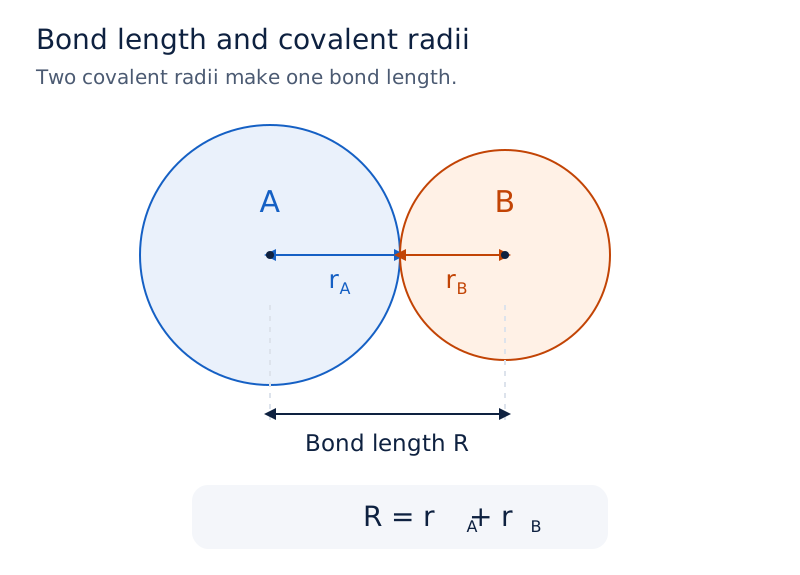
Two touching circles represent atoms A and B. Arrows mark the contributions and from their centres to the contact region; their sum is the bond length .
Drawn by One Young India. See Fig. 4.1 in your NCERT textbook
Bond angle is the angle between the orbitals containing bonding electron pairs around a central atom. It helps describe their spatial distribution and the molecular shape. Water has an angle of between its two oxygen-hydrogen bonds.
Bond enthalpy and average values
Bond enthalpy is the energy required to break one mole of a specified type of bond between atoms in the gaseous state. It is expressed in . Greater bond dissociation enthalpy indicates a stronger bond.
| Gaseous molecule | Bond broken | Bond dissociation enthalpy |
|---|---|---|
| H₂ | Hydrogen-hydrogen single bond | |
| O₂ | Oxygen-oxygen double bond | |
| N₂ | Nitrogen-nitrogen triple bond | |
| HCl | Hydrogen-chlorine single bond |
In a polyatomic molecule, successive bond-breaking steps can require different energies because the chemical environment changes. The mean bond enthalpy is obtained by dividing the total bond dissociation enthalpy by the number of bonds broken.
Worked example 4. Successive oxygen-hydrogen bond dissociation enthalpies in gaseous water are and . Find the average oxygen-hydrogen bond enthalpy.
Answer: Let denote average bond enthalpy. The divisor two is the dimensionless count of bonds broken per water molecule.
- Add the two dissociation enthalpies:
- Divide by the bond count:
Bond order in the Lewis description is the number of bonds between two atoms. H₂, O₂ and N₂ have bond orders one, two and three respectively. Generally, increasing bond order is associated with increased bond enthalpy and decreased bond length.
Why are resonance structures needed?
One molecule, several electron arrangements
Resonance is needed when one Lewis structure cannot describe a species adequately. The contributing structures retain the same arrangement of nuclei but differ in their electron distribution. Together they represent a resonance hybrid.
Ozone illustrates the problem. Each simple Lewis structure contains one single and one double oxygen-oxygen bond, yet the two measured bonds in ozone have the same length, . This lies between the typical single- and double-bond lengths.
Neither individual drawing therefore describes the complete molecule. The resonance hybrid represents equivalent bonds with intermediate character. Its energy is lower than that of either individual canonical form, so resonance stabilises the molecule.
What the figure shows
Resonance in ozone
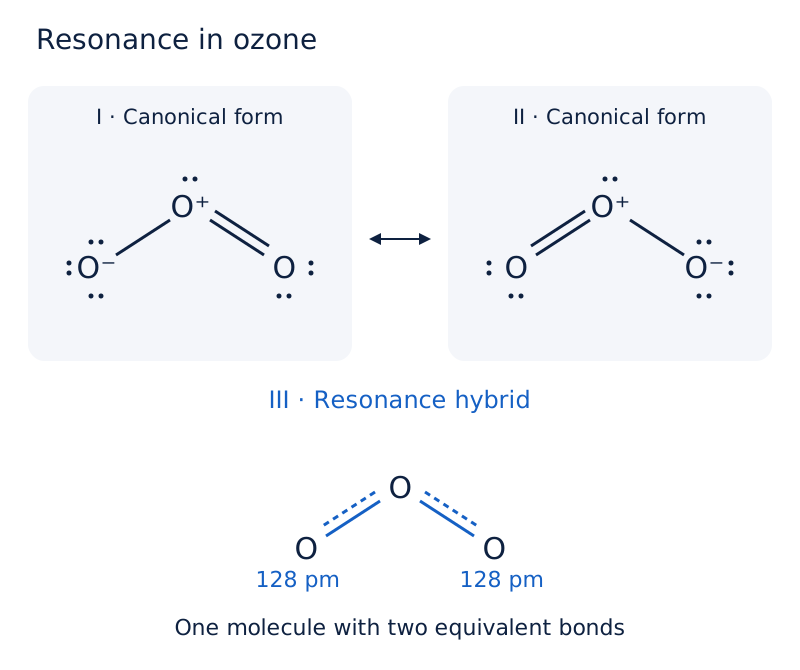
Structures I and II interchange the single and double oxygen-oxygen bonds. Structure III shows the hybrid with both bond lengths labelled , instead of the unequal lengths in either canonical form.
Drawn by One Young India. See Fig. 4.3 in your NCERT textbook
Carbonate and resonance misconceptions
The carbonate ion, CO₃²⁻, has three canonical structures. Each places the carbon-oxygen double bond at a different oxygen, while the nuclear framework remains the same. The actual ion has three equivalent carbon-oxygen bonds.
Canonical forms are not separate molecules. The molecule does not spend one fraction of its time in one form and another fraction in a different form. Nor are the forms in chemical equilibrium with one another.
Resonance therefore averages bond characteristics within a single species. When drawing the forms, change the electron arrangement while keeping the atom positions fixed. Moving a nucleus would describe a different structural arrangement rather than another canonical form of the same resonance hybrid.
How do polarity and dipole moment depend on molecular shape?
From bond polarity to molecular polarity
In a nonpolar covalent bond between identical atoms, the shared electron pair is equally attracted by both nuclei. In a heteronuclear bond such as HF, the more electronegative atom attracts the shared pair more strongly, producing a polar bond.
Let denote dipole moment, the magnitude of the separated charge, and the distance between the positive and negative charge centres. Then:
The SI unit of dipole moment is coulomb metre, written , where C means coulomb and m means metre. The commonly used unit debye is denoted D:
Worked example 5. Convert water's dipole moment, , into coulomb metre using .
Answer:
- Multiply by the conversion factor:
- Cancel the debye units and round:
The molecular dipole moment is a vector sum, so bond directions matter. Bent H₂O has a nonzero resultant. In linear BeF₂ the two equal, opposite bond moments cancel; in trigonal-planar BF₃ the three bond moments also cancel.
NH₃ has a greater dipole moment than NF₃ despite fluorine's greater electronegativity. In NH₃, the lone-pair contribution reinforces the resultant bond moment. In NF₃, it opposes the resultant of the three nitrogen-fluorine bond moments.
Note: The chemistry crossed arrow points towards the negative end, with its cross at the positive end. This is opposite to the conventional physical dipole-vector direction.
Fajans' rules and partial covalent character
An ionic bond can have partial covalent character when the cation distorts the anion's electron cloud. A smaller cation, a larger anion and a greater cation charge favour stronger polarisation and greater covalent character.
For cations of comparable size and charge, electronic configuration also affects polarising power. Transition-metal-type configurations can be more polarising than noble-gas configurations. Thus ionic and covalent descriptions are limiting models, rather than a complete separation of all bonds into perfectly pure categories.
How does VSEPR theory predict molecular shapes?
Count electron regions before naming the shape
Valence shell electron pair repulsion, or VSEPR, theory predicts molecular geometry by placing electron pairs as far apart as possible. Both bonding pairs and lone pairs around the central atom contribute to repulsion.
A multiple bond is treated as one electron region for this geometrical purpose. The two or three shared pairs remain important for bond order, but they do not count as two or three separate directions around the central atom.
A lone pair is localised on one atom and occupies more space than a bonding pair shared between atoms. Let mean lone pair and mean bond pair. The repulsion order is:
| Bonding regions with no lone pairs | Geometry | Example |
|---|---|---|
| Two | Linear | BeCl₂ |
| Three | Trigonal planar | BCl₃ |
| Four | Tetrahedral | CH₄ |
| Five | Trigonal bipyramidal | PCl₅ |
| Six | Octahedral | SF₆ |
Why lone pairs change the observed shape
The electron-pair arrangement includes lone pairs, whereas molecular shape describes the positions of atoms. Four electron regions can therefore correspond to different molecular shapes depending on how many are lone pairs.
| Molecule | Bonding regions | Central lone pairs | Molecular shape |
|---|---|---|---|
| NH₃ | Three | One | Trigonal pyramidal |
| H₂O | Two | Two | Bent |
| SF₄ | Four | One | See-saw |
| ClF₃ | Three | Two | T-shaped |
| BrF₅ | Five | One | Square pyramidal |
| XeF₄ | Four | Two | Square planar |
CH₄ has the tetrahedral bond angle . In NH₃, one lone pair compresses the bond angle to about . Water has two lone pairs, and its bond angle is further reduced to .
In a trigonal-bipyramidal arrangement, a lone pair favours an equatorial position. This gives fewer close repulsive interactions than an axial position. The placement explains the see-saw shape of SF₄ and the T-shaped geometry of ClF₃.
VSEPR gives a practical account of many molecular shapes, especially for compounds of p-block elements. It does not supply a full energetic explanation of bonding, so orbital-based theories are needed alongside it.
How does orbital overlap explain covalent bonding?
Valence bond theory and hydrogen
Valence bond theory describes covalent bond formation through overlap of atomic orbitals and pairing of electrons with opposite spins. For hydrogen, two singly occupied orbitals overlap as the atoms approach.
Here, denotes an s orbital in the first principal shell. More generally, s and p name atomic-orbital types; their preceding numeral gives the principal shell. Subscripts x, y and z indicate spatial orientation.
Attractive interactions occur between nuclei and electrons; repulsive interactions occur between the two nuclei and between the two electrons. Initially, increasing attraction lowers the potential energy. At equilibrium separation, attraction and repulsion balance and the energy is minimum.
Bringing the nuclei still closer increases repulsion and raises the energy sharply. The stable bond length in H₂ is , and separating one mole of gaseous H₂ into atoms requires .
What the figure shows
Hydrogen potential-energy curve
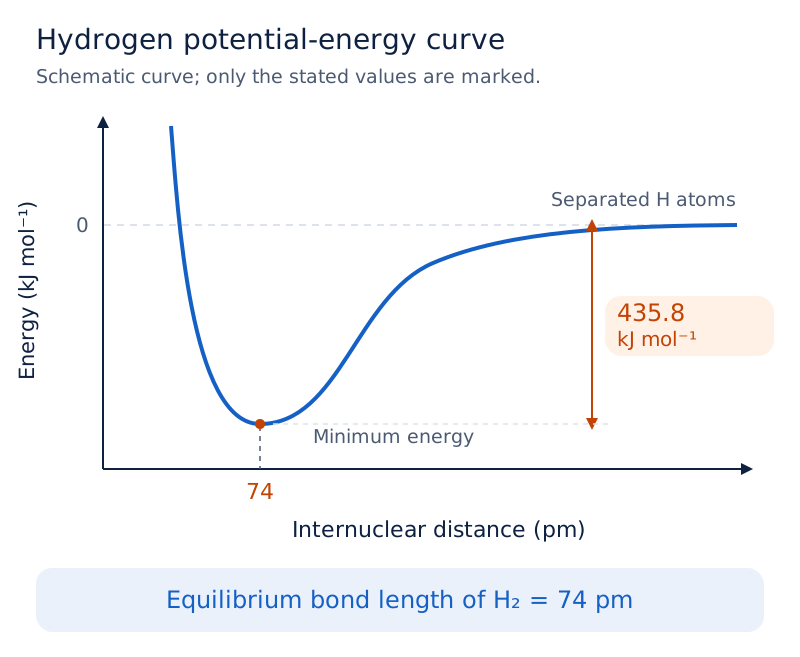
The vertical axis represents energy and the horizontal axis internuclear distance. The curve has a minimum at , with a bond-energy depth of ; it rises sharply at shorter separations.
Drawn by One Young India. See Fig. 4.8 in your NCERT textbook
How do sigma and pi bonds differ?
Positive overlap requires suitable orbital orientation and matching wave-function phases. Plus and minus signs on orbital lobes indicate phase, not positive and negative electric charges. In general, a larger effective overlap produces a stronger bond.
| Feature | Sigma bond | Pi bond |
|---|---|---|
| Symbol | ||
| Overlap | Head-on, along the internuclear axis | Sideways, between parallel orbitals |
| Electron-cloud arrangement | Along the internuclear axis | On either side of the internuclear axis |
| Relative overlap | Greater overlap and stronger bonding | Smaller overlap and weaker bonding |
The Greek symbols and name sigma and pi bonds respectively. A localised carbon-carbon double bond contains one sigma and one pi bond; the corresponding triple bond contains one sigma and two pi bonds.
Simple overlap of unchanged atomic orbitals does not explain the observed tetrahedral arrangement of methane. Hybridisation introduces directed combinations of atomic orbitals to account for such geometries.
How does hybridisation account for molecular geometry?
Combining atomic orbitals
Hybridisation is the mixing of atomic orbitals of nearly equal energies to form a new set of hybrid orbitals. The number of hybrid orbitals formed equals the number of atomic orbitals mixed.
The notation specifies the contributing orbitals: uses one s and one p orbital, uses one s and two p orbitals, and uses one s and three p orbitals. The superscripts count orbitals, not electrons.
Electron promotion is not an essential prerequisite for hybridisation. Filled orbitals can participate as well as half-filled orbitals. The resulting directed orbitals help describe bond formation and the arrangement of electron pairs.
| Hybridisation | Number of hybrids | Arrangement | Example |
|---|---|---|---|
| Two | Linear, | BeCl₂ | |
| Three | Trigonal planar, | BCl₃ | |
| Four | Tetrahedral, ideally | CH₄ | |
| Five | Trigonal bipyramidal | PCl₅ | |
| Six | Octahedral | SF₆ |
In the last two schemes, d denotes the d-orbital type. NH₃ and H₂O also use the description, but lone pairs occupy one and two hybrid orbitals respectively. Their molecular shapes are therefore pyramidal and bent.
Ethane, ethene and ethyne
In ethane, each carbon uses hybrids. One hybrid on each carbon forms the carbon-carbon sigma bond; the remaining hybrids form sigma bonds with hydrogen atoms.
In ethene, each carbon uses hybrids and retains one unhybridised p orbital. The hybrids make the sigma framework, while sideways overlap of the remaining p orbitals forms the pi bond.
What the figure shows
Sigma and pi bonding in ethene
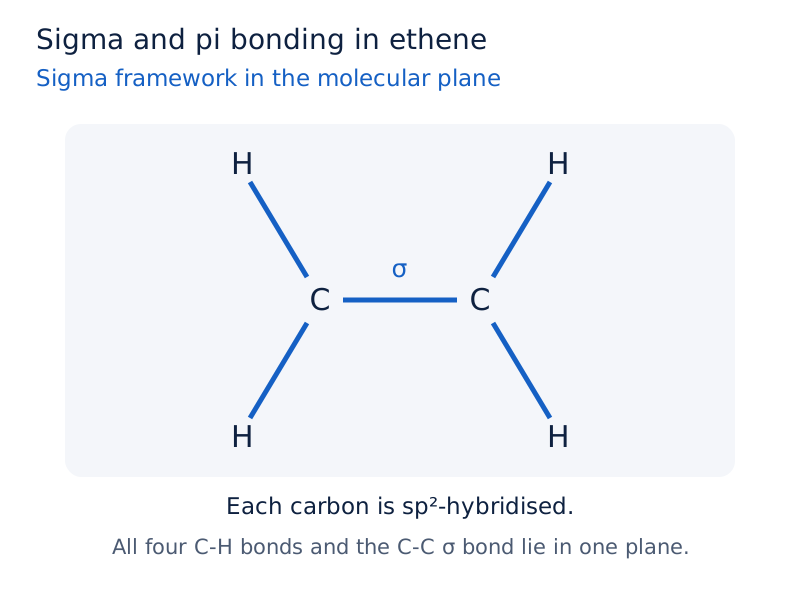
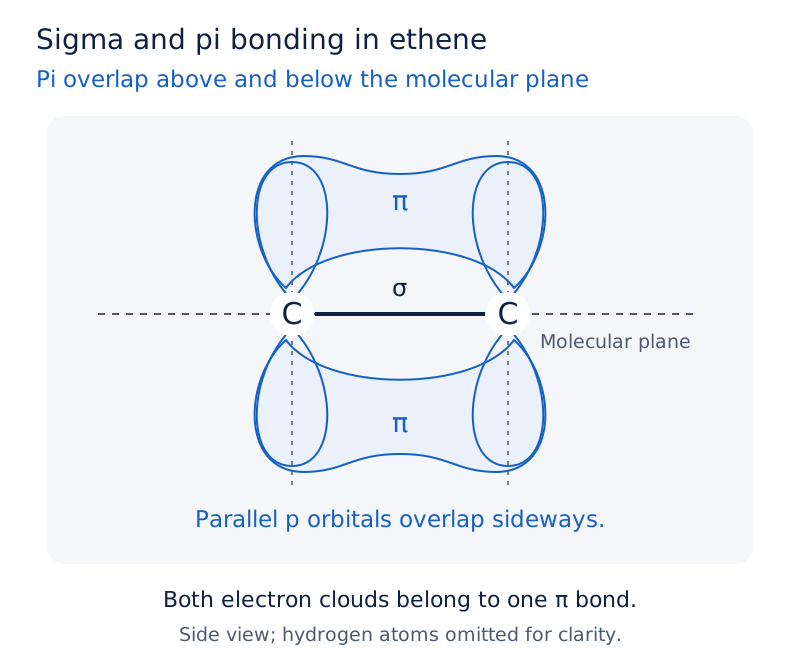
The panels show the sigma framework in the molecular plane and parallel p orbitals on the two carbon atoms. Their sideways overlap produces pi-electron clouds above and below that plane.
Drawn by One Young India. See Fig. 4.15 in your NCERT textbook
In ethyne, each carbon uses hybrids and retains two unhybridised p orbitals. One carbon-carbon sigma bond and two pi bonds form the triple bond. The remaining hybrid on each carbon forms a sigma bond with hydrogen.
Five and six bonding directions
PCl₅ has three equatorial bonds in one plane at to one another. Two axial bonds are perpendicular to that plane. The axial bonds experience greater repulsion, making them slightly longer and weaker than the equatorial bonds.
SF₆ has six bonding directions towards the corners of an octahedron. Its description combines one s, three p and two d orbitals. This differs from the five-direction trigonal-bipyramidal arrangement of PCl₅.
How does molecular orbital theory explain bond order and magnetism?
Orbitals belonging to the whole molecule
In molecular orbital theory, electrons occupy orbitals associated with the molecule as a whole. Combining two atomic orbitals produces two molecular orbitals: a lower-energy bonding orbital and a higher-energy antibonding orbital.
Let and represent atomic-orbital wave functions centred on atoms A and B. Let and represent the corresponding molecular-orbital combinations. The qualitative linear-combination description is:
The proportionality sign indicates the form of the combination. Constructive interference increases electron density between the nuclei. Destructive interference produces a node between them and an antibonding orbital. An asterisk on an orbital label denotes antibonding character.
- Combining atomic orbitals must have the same or nearly the same energy.
- They must have suitable matching symmetry about the molecular axis.
- They must overlap effectively; greater overlap increases electron density between nuclei in a bonding orbital.
- Fill the molecular orbitals according to the aufbau principle, Pauli exclusion principle and Hund's rule.
Take z as the internuclear axis. For B₂, C₂ and N₂, the bonding and orbitals lie below . For O₂ and F₂, the bonding orbital lies below that pair.
For O₂ and F₂, the full sequence in increasing orbital energy is:
Here equality means equal orbital energies, not identical orbitals. For B₂, C₂ and N₂, interchange the bonding sigma level derived from the p orbitals with the pair of bonding pi levels; the rest of this ordering is unchanged.
Counting bonding and antibonding electrons
Let be the number of electrons in bonding molecular orbitals, the number in antibonding orbitals, and the bond order. All three are dimensionless quantities:
A positive bond order indicates net bonding in this model. Equal bonding and antibonding populations give zero bond order. Greater bond order generally corresponds to a shorter bond. Magnetism requires a separate check for unpaired electrons.
Worked example 6. Oxygen has ten electrons in bonding orbitals and six in antibonding orbitals. Two electrons occupy separate, degenerate antibonding pi orbitals. Determine its bond order and magnetic nature.
Answer: Electron counts and bond order are dimensionless.
- Subtract the antibonding population:
- Calculate bond order:
- The two unpaired electrons make O₂ paramagnetic, so it is attracted by a magnetic field.
| Species | Bonding electrons | Antibonding electrons | Bond order | Result |
|---|---|---|---|---|
| H₂ | Two | Zero | Stable, diamagnetic | |
| He₂ | Two | Two | No stable bond in this model | |
| Li₂ | Four | Two | Stable, diamagnetic | |
| C₂ | Eight | Four | Diamagnetic | |
| O₂ | Ten | Six | Paramagnetic |
To show the electron population explicitly, let denote the filled inner-shell combination . Superscripts outside parentheses now indicate electron populations. Oxygen's configuration is:
The final two orbitals have equal energy. Hund's rule places one electron in each before pairing, giving oxygen its two unpaired electrons.
Diamagnetic species have paired electrons and are repelled by a magnetic field. Paramagnetic species have unpaired electrons. Thus identical bond orders do not imply identical magnetic behaviour: C₂ and O₂ both have bond order two but differ magnetically.
In this molecular-orbital description, C₂ has its net double bonding in the two occupied bonding pi orbitals. This differs from the localised sigma-plus-pi description of the double bond in ethene.
How does hydrogen bonding occur within and between molecules?
Origin of the attraction
Hydrogen bonding occurs when hydrogen bonded to a strongly electronegative atom interacts with another electronegative atom, commonly nitrogen, oxygen or fluorine. The electron pair in the original covalent bond is displaced towards the electronegative atom.
Hydrogen consequently acquires a partial positive charge, while the electronegative atom acquires a partial negative charge. This charge separation allows an additional attractive interaction. A hydrogen bond is weaker than the covalent bond that attaches hydrogen to its original atom.
In hydrogen fluoride, hydrogen of one molecule interacts with fluorine of another. A dotted line represents the hydrogen bond, while a solid bond line represents the covalent bond. These two links must be distinguished when describing the structure.
Two types of hydrogen bonding
| Type | Location | Examples |
|---|---|---|
| Intermolecular | Between different molecules of the same or different compounds | HF, water and alcohol molecules |
| Intramolecular | Between suitable groups within one molecule | o-Nitrophenol |
Intermolecular hydrogen bonding connects separate molecules. Intramolecular hydrogen bonding occurs within a molecule when the arrangement brings hydrogen between suitable electronegative atoms. In o-nitrophenol, the hydrogen lies between two oxygen atoms.
What the figure shows
Intramolecular hydrogen bonding
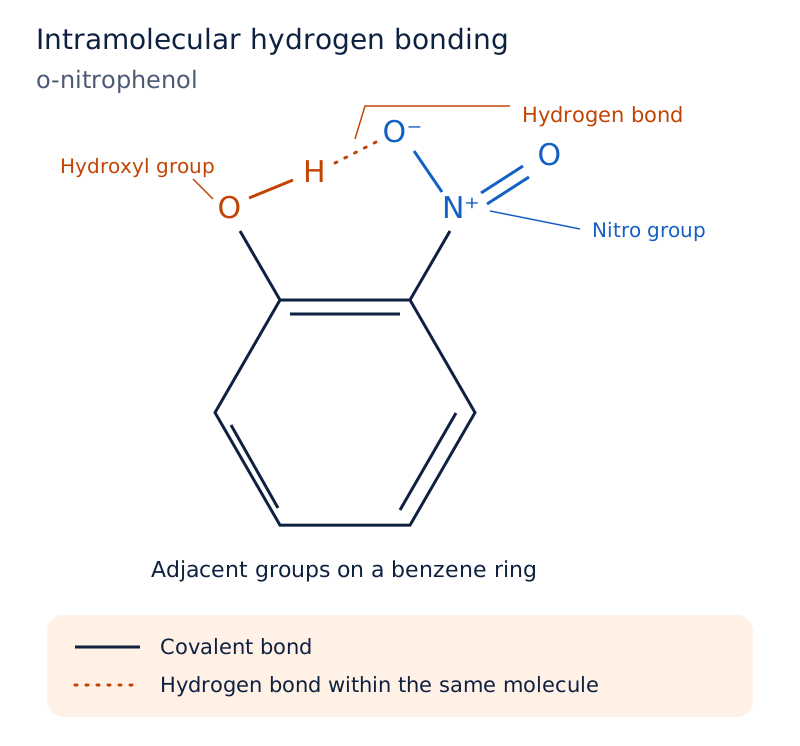
The o-nitrophenol structure has adjacent hydroxyl and nitro groups on a benzene ring. A dotted connection links the hydroxyl hydrogen to an oxygen of the neighbouring nitro group.
Drawn by One Young India. See Fig. 4.22 in your NCERT textbook
Hydrogen bonding influences the structure and properties of compounds, and its extent depends on physical state. It is greatest in the solid state and least in the gaseous state. Both the availability of electronegative atoms and their arrangement matter.
Glossary
- Chemical bond — Attractive force holding atoms, ions or other constituents together in a chemical species.
- Valence electrons — Outer-shell electrons that participate in chemical combination and are represented in Lewis symbols.
- Octet rule — Tendency of atoms to achieve eight outer-shell electrons through electron transfer or sharing.
- Lewis structure — Representation of valence electrons as shared bonding pairs and nonbonding pairs around atoms.
- Formal charge — Bookkeeping charge obtained by assigning lone-pair electrons and half the bonding electrons to an atom.
- Lattice enthalpy — Energy required to separate one mole of an ionic solid completely into gaseous constituent ions.
- Bond length — Equilibrium distance between the nuclei of two atoms joined by a chemical bond.
- Bond enthalpy — Energy required to break one mole of a specified type of bond in gaseous species.
- Resonance hybrid — Single actual structure represented collectively by canonical forms that differ in electron arrangement.
- Dipole moment — Product of charge magnitude and the separation between positive and negative charge centres.
- Hybridisation — Mixing of atomic orbitals of nearly equal energies to produce directed hybrid orbitals.
- Antibonding orbital — Molecular orbital whose occupation opposes bonding and which has higher energy than the contributing atomic orbitals.
- Bond order — Half the difference between bonding and antibonding electron populations in molecular orbital theory.
- Paramagnetism — Attraction towards a magnetic field associated with one or more unpaired electrons in a species.
- Hydrogen bond — Attraction involving hydrogen attached to an electronegative atom and another suitable electronegative atom.
Common errors and misconceptions
- Misconception: Every stable molecule must obey the octet rule. Correct: Incomplete octets, odd-electron molecules and expanded octets provide important exceptions.
- Misconception: Formal charges show the exact physical charges on atoms. Correct: They are electron-bookkeeping quantities based on equal sharing of bonding electrons.
- Misconception: A molecule alternates between resonance forms. Correct: It has one resonance-hybrid structure; canonical forms do not exist as alternating species.
- Misconception: Polar bonds guarantee a polar molecule. Correct: Bond moments can cancel because of molecular symmetry, as in BeF₂ and BF₃.
- Misconception: Four electron regions guarantee a tetrahedral molecular shape. Correct: Lone pairs change the positions of atoms, producing pyramidal NH₃ or bent H₂O.
- Misconception: Plus and minus signs on orbital lobes denote electric charges. Correct: These signs describe wave-function phases, which affect orbital overlap.
- Misconception: A positive bond order means all electrons are paired. Correct: Oxygen has bond order two and two unpaired electrons, making it paramagnetic.
- Misconception: Lattice separation releases energy. Correct: Separating an ionic solid into gaseous ions requires energy; the reverse lattice-formation process releases it.
Exam-style questions with model answers
Q1. State the octet rule and give two types of exceptions, with one example each. [2 marks]
- The octet rule describes attainment of eight valence-shell electrons through electron transfer or sharing.
- BCl₃ illustrates an incomplete octet, while SF₆ illustrates an expanded octet around its central atom.
Q2. An ozone Lewis structure has a central oxygen with two nonbonding and six bonding electrons. Each oxygen has six valence electrons. Calculate the central atom's formal charge and explain its meaning. [3 marks]
- Let denote formal charge in elementary-charge units. Assign the central atom all its nonbonding electrons and half its bonding electrons.
- The calculation is Electron counts are dimensionless, and the result is a positive formal charge of one elementary-charge unit.
- This is a bookkeeping assignment, not a claim that the central oxygen carries precisely that real physical charge within the molecule.
Q3. Successive oxygen-hydrogen bond dissociation enthalpies in gaseous water are and . Calculate the average bond enthalpy and explain why an average is used. [3 marks]
- Add the energy requirements:
- Let denote average oxygen-hydrogen bond enthalpy. Divide by the dimensionless count of two bonds:
- The second bond is broken in a changed chemical environment after the first hydrogen has been removed. Consequently, successive dissociation enthalpies differ, and one average value summarises the two bonds.
Q4. Explain why H₂O is polar whereas BeF₂ is nonpolar. Use their bent and linear geometries respectively. [3 marks]
- Molecular dipole moment is the vector resultant of the individual bond moments, so spatial arrangement matters as well as bond polarity.
- In bent H₂O, the two oxygen-hydrogen bond moments do not point in opposite directions. Their effects therefore do not cancel, leaving a nonzero resultant.
- In linear BeF₂, the two identical bond moments point in opposite directions and cancel exactly. The molecule consequently has zero dipole moment despite its polar bonds.
Q5. CH₄ has four bonding pairs and no central lone pairs; NH₃ has three bonding pairs and one lone pair; H₂O has two of each. Use VSEPR theory to explain their shapes and relative bond angles. [5 marks]
- Each molecule has four electron-pair regions around its central atom. Their basic electron-pair arrangement is tetrahedral because this separates the regions in space and limits repulsion.
- In CH₄, all four regions are bonding pairs. The four hydrogen atoms therefore occupy a tetrahedral arrangement with the ideal tetrahedral bond angle.
- In NH₃, one region is a lone pair. The three hydrogen atoms define a trigonal pyramid, and stronger lone-pair repulsion compresses the bond angles below the tetrahedral value.
- In H₂O, two regions are lone pairs. The two hydrogen atoms define a bent shape, and the additional lone-pair repulsion produces still smaller bond angles.
- Thus the bond angle decreases from methane to ammonia to water. Electron-pair arrangement and molecular shape describe different aspects of the same structure.
Q6. Compare carbon-carbon bonding in ethene and ethyne using hybridisation and orbital overlap. [4 marks]
- Each carbon in ethene is -hybridised, meaning one s and two p orbitals form three hybrids. Axial hybrid overlap forms the carbon-carbon sigma bond; one remaining p orbital on each carbon overlaps sideways to form a pi bond.
- Each carbon in ethyne is -hybridised, using one s and one p orbital. Head-on overlap of one sp hybrid from each carbon forms the carbon-carbon sigma bond. The two unhybridised p orbitals on each carbon overlap sideways with the corresponding parallel p orbitals on the other carbon, forming two pi bonds in mutually perpendicular planes.
- Ethyne therefore has one carbon-carbon sigma bond and two pi bonds, whereas ethene has one sigma and one pi bond between its carbon atoms.
Q7. O₂ has ten bonding and six antibonding electrons, including two unpaired electrons in separate antibonding pi orbitals. He₂ would have two bonding and two antibonding electrons. Calculate both bond orders, compare their stability, and explain oxygen's magnetic behaviour. [5 marks]
- Let denote dimensionless bond order, the bonding-electron count and the antibonding-electron count. Use
- For oxygen, The greater bonding population gives net bonding, so the model predicts a stable oxygen molecule.
- For helium, The bonding and antibonding contributions cancel. This configuration therefore gives no stable helium-helium bond in this model.
- Oxygen has two unpaired electrons, so it is paramagnetic and is attracted by a magnetic field. A positive bond order does not require complete electron pairing.
- Bond order describes net bonding, while the presence or absence of unpaired electrons determines the magnetic classification. Both must be read from the molecular-orbital population.
Q8. Distinguish intermolecular and intramolecular hydrogen bonding, giving one example of each. [2 marks]
- Intermolecular hydrogen bonding connects separate molecules, as between HF molecules.
- Intramolecular hydrogen bonding occurs within one molecule, as between the hydroxyl hydrogen and a nitro-group oxygen in o-nitrophenol.
Key takeaways
- Lewis structures track valence electrons, but they need additional theories to explain molecular geometry, energetics and magnetic behaviour.
- The octet rule has incomplete-octet, odd-electron and expanded-octet exceptions, so it is a useful guide rather than a universal requirement.
- Ionic stability depends strongly on lattice formation, which can compensate for energy absorbed while producing gaseous ions.
- Resonance describes one hybrid structure with delocalised electron distribution; canonical forms are not separate molecules in equilibrium.
- Dipole moments depend on bond polarity and molecular geometry because individual bond moments combine as vectors.
- Lone pairs repel more strongly than bonding pairs, changing molecular shapes and compressing bond angles from ideal arrangements.
- Hybridisation describes directed orbitals, while unhybridised p orbitals account for pi bonds in ethene and ethyne.
- Molecular orbital populations determine bond order and magnetism; oxygen's unpaired electrons explain its paramagnetic behaviour.
- Hydrogen bonding can connect different molecules or operate within one molecule, depending on the positions of suitable electronegative atoms.
Test yourself
Why does hydrogen not need eight outer-shell electrons?
Hydrogen attains a stable duplet corresponding to helium's electronic arrangement, rather than an octet.
How does a negative ionic charge affect the Lewis electron count?
Add one electron to the neutral-atom total for each negative charge carried by the ion.
What remains fixed when drawing resonance structures?
The positions of the nuclei remain fixed; the contributing forms differ in electron arrangement.
Why is a multiple bond counted as one region in VSEPR?
Its shared electron pairs occupy one bonding direction and are treated together as a single region.
Why are axial bonds in PCl₅ longer than equatorial bonds?
Axial bond pairs experience greater repulsive interactions from the equatorial pairs, making axial bonds slightly longer and weaker.
What does an asterisk in a molecular-orbital label indicate?
It identifies an antibonding molecular orbital, whose electron occupation opposes the stabilising effect of bonding orbitals.
Does bond order alone determine whether a molecule is paramagnetic?
No. Paramagnetism depends on unpaired electrons, so the electron distribution must also be inspected.
What is the difference between the solid and dotted links in a hydrogen-bonding drawing?
The solid link represents a covalent bond, while the dotted link represents a hydrogen bond.