
Complex Numbers and Quadratic Equations | CBSE Class 11 Maths Notes
On this page
Watch & explore
Start with a few high-quality watches, then dive into the notes below.
Complex Numbers and Quadratic Equations in Class 11 Mathematics covers the imaginary unit, real and imaginary parts, equality, arithmetic operations, powers of the imaginary unit, square roots of negative numbers, algebraic identities, modulus, conjugates, multiplicative inverses and the geometric representation of complex numbers in the Argand plane.
Why are complex numbers needed, and how are they written?
A square of a real number is non-negative. Therefore, an equation that requires a real number to have a negative square cannot be solved within the real number system. Complex numbers extend that system and allow such equations to have solutions.
Let denote an unknown number. The equation requires . Introduce , called the imaginary unit, with the defining property . The symbol denotes .
Definition: A complex number has the form , where denotes the number and and are real numbers. Its real part is , and its imaginary part is .
How do we identify the two parts?
The imaginary part is the real coefficient multiplying the imaginary unit. It is not the whole imaginary term. For , the real part is and the imaginary part is . Both parts are real numbers even though the whole number is complex.
The forms and mean the same thing. Writing a number in this standard form makes its two parts clear. A real number fits this form with a zero imaginary part; a number on the imaginary axis has a zero real part.
| Complex number | Real part | Imaginary part |
|---|---|---|
How does this connect with quadratic equations?
For a quadratic equation , the letters , and denote real coefficients, with . Let denote its discriminant, defined by . A negative discriminant is the motivating case for extending the real number system.
The equation illustrates that need directly. Its solutions are and , since both have square . Distinguish the single value represented by the radical symbol from the two numbers that solve a squared equation.
When are two complex numbers equal?
Equality requires agreement in both components. Let and denote two complex numbers, where , , and are their real components. The subscripts simply distinguish the first number from the second.
Result: equality of real and imaginary parts
The equality holds precisely when and . Thus one complex equation can give two real equations. First put each side into standard form, then compare real parts with real parts and imaginary parts with imaginary parts.
Worked example 1. Find the real numbers and , representing the two unknowns, if .
Answer: Compare the two components separately before solving the resulting simultaneous equations.
- Equate real parts:
- Divide the real equation by four:
- Equate imaginary parts:
- Substitute the value of the first unknown:
- Rearrange and combine the fractions:
- Check both components in the original expression:
The check confirms the entire complex equality: both the real component and the coefficient of the imaginary unit match the given right-hand side. Checking just the first equation would leave the second unknown unverified.
What should be compared?
In this example, the expression inside the imaginary bracket is a real number because the unknowns are real. The coefficient comparison therefore gives a real simultaneous system. Keep the minus sign attached to the imaginary part on the right-hand side.
Note: Equal real parts alone do not establish equality of complex numbers. The imaginary parts must also be equal. Standard form keeps these two requirements visible throughout the calculation.
How are complex numbers added and subtracted?
Addition combines corresponding parts. Using the two complex numbers already defined, the sum is . Since sums of real numbers are real, this expression is another complex number. This is the closure law for addition.
Subtraction means adding the additive inverse. The additive inverse of is . Both component signs change. Consequently, , with each part of the second number subtracted from the corresponding first part.
Worked example 2. Add and , then evaluate the difference .
Answer: Group corresponding terms in the sum, and distribute the subtraction sign in the difference.
- Separate the components of the sum:
- Complete the two real calculations:
- Replace subtraction by addition of the negative:
- Collect corresponding parts:
Property: laws of addition
Let denote a third arbitrary complex number. The following laws allow terms to be reordered and regrouped during addition. The zero complex number is , written simply as .
| Law | Statement | Meaning |
|---|---|---|
| Commutative | Changing the order leaves the sum unchanged. | |
| Associative | Changing the grouping leaves the sum unchanged. | |
| Additive identity | Adding zero leaves the number unchanged. | |
| Additive inverse | A number and its negative sum to zero. |
The order of subtraction matters. For the same two numbers used above, reversing the subtraction gives . The result is the negative of the original difference. Do not transfer the commutative law of addition to subtraction.
How are complex numbers multiplied?
To multiply complex numbers, expand brackets using the distributive law, replace the square of the imaginary unit by negative one, and collect real and imaginary terms. The reduction of the squared imaginary unit is what distinguishes this calculation from an ordinary expansion in an unspecified variable.
Derivation: the multiplication rule
For and , the letters denote the real components defined earlier.
- Expand the product into four terms:
- Apply the defining relation of the imaginary unit:
- Collect the real terms and the imaginary terms:
Result: The product is again in standard complex form. Its real part includes the negative product of the two imaginary coefficients.
Worked example 3. Express in standard form.
Answer: Show the expansion before collecting the terms.
- Multiply each term in the first bracket by each in the second:
- Replace the squared imaginary unit:
- Combine the real terms and imaginary coefficients:
Property: laws of multiplication
Multiplication obeys closure, commutativity and associativity. In symbols, and . Its identity is , written as , so .
Multiplication distributes over addition: . The corresponding right-hand version is . These laws justify the expansions used in products and identities.
A multiplicative inverse exists for every non-zero complex number. It produces the multiplicative identity when multiplied by the original number. Its explicit formula is developed using the conjugate; the non-zero condition must be retained whenever that formula is used.
How can powers of the imaginary unit be simplified?
The powers of the imaginary unit repeat in a cycle. Starting with , multiplication by another imaginary unit gives , and one further multiplication gives . A group of four factors therefore contributes a factor of one.
Result: the four-power cycle
Let denote any integer. The following table describes the four possible forms of an integer exponent. Choose the form that matches the exponent, including its sign, before replacing the power by its value.
| Exponent form | Value of the power |
|---|---|
Negative powers represent reciprocals. They follow the same cycle, but converting them to reciprocals first can make the signs easier to track. In particular, the reciprocal of the imaginary unit is its negative, not the imaginary unit itself.
Derivation: the first reciprocal power
- Write the negative power as a reciprocal:
- Multiply numerator and denominator by the imaginary unit:
- Use its square to simplify:
Check: Multiplying the proposed reciprocal by the original number gives .
Worked example 4. Express in standard form.
Answer: Reduce the positive power in the denominator, then simplify its reciprocal.
- Apply the meaning of a negative exponent:
- Separate the even part of the exponent:
- Evaluate the reciprocal:
- State the standard form explicitly:
The cycle avoids repeatedly multiplying long strings of factors. It also gives a second way to check signs after using a reciprocal. Both methods must produce the same complex number.
How do square roots of negative real numbers work?
Let now denote a positive real number. The radical represents . However, the equation , where is the unknown, has both and as solutions.
Derivation: the two square roots
- Square the positive choice of imaginary coefficient:
- Square the negative choice as well:
- Record both solutions of the equation:
Two roots: The symbol means that both the plus and minus choices are included. For the negative number , the two square roots are and , while denotes .
Why can the square-root product rule fail?
For positive real numbers and , the rule holds. It also holds when one is negative and the other positive, with the radical convention above. It cannot be applied unchanged when both are negative.
- Evaluate the separate negative radicals:
- Use the defining square:
- Compare with the radical of the product:
The two outcomes differ, which exposes the invalid use of the rule. If either factor is zero, both sides of the product rule are zero. The signs of the radicands must therefore be considered before combining radicals.
Worked example 5. Express in standard form.
Answer: Replace the negative radical before expanding.
- Convert the negative square root:
- Expand all four products:
- Use the defining square and collect terms:
- Factor the imaginary coefficient to obtain:
Which algebraic identities hold for complex numbers?
The familiar square and cube identities also apply to complex numbers. Their proofs depend on distributivity, commutativity and associativity, which complex addition and multiplication satisfy. Thus identities can organise calculations before the imaginary powers are reduced.
Identity: the square of a sum
For arbitrary complex numbers and , expand the square without assuming that either number is real.
- Write the square as a product:
- Distribute over the second bracket:
- Expand both products:
- Use commutativity and combine the middle terms:
The same laws support the following identities. When substituting a term that already contains a minus sign, preserve its brackets until its square or cube has been evaluated.
| Identity | Formula |
|---|---|
| Square of a difference | |
| Cube of a sum | |
| Cube of a difference | |
| Difference of squares |
Worked example 6. Express in standard form.
Answer: Use the cube of a difference, treating the whole imaginary term as the second quantity.
- Substitute into the identity:
- Evaluate the powers of the imaginary term:
- Insert these values:
- Combine corresponding parts:
The final term becomes positive before the imaginary terms are combined because the cube identity subtracts a negative imaginary quantity. This sign change is separate from the negative real contribution made by the squared imaginary term.
What are the modulus and conjugate of a complex number?
For , the modulus, written , is the non-negative real number . The vertical bars denote modulus. The conjugate, written , is . The bar therefore changes the sign of the imaginary component.
Modulus and conjugation are different operations. Modulus produces a non-negative real value, while conjugation produces a complex number. Neither operation means changing both signs: changing both signs gives the additive inverse instead.
Worked example 7. Find the modulus and conjugate of .
Answer: Identify the signed imaginary coefficient before squaring it.
- Read the components:
- Apply the modulus definition:
- Change only the imaginary sign for the conjugate:
Derivation: the product with the conjugate
- Write the original number and its conjugate as factors:
- Apply the difference of squares:
- Reduce the imaginary square and use the modulus definition:
Key connection: Multiplying conjugate factors produces a real sum of squares. This is the algebraic reason conjugates help remove the imaginary part from a denominator.
Which rules connect products, quotients and conjugates?
For complex numbers and , the following relations are useful. In every quotient, the denominator number must be non-zero. Apply that restriction before simplifying, even if a later algebraic expression appears to cancel.
| Operation | Relation |
|---|---|
| Modulus of a product | |
| Modulus of a quotient | |
| Conjugate of a product | |
| Conjugate of a sum or difference | |
| Conjugate of a quotient |
How do conjugates simplify division and multiplicative inverses?
Division by a non-zero complex number means multiplication by its multiplicative inverse. A denominator can be made real by multiplying both numerator and denominator by the conjugate of that denominator. This multiplies the fraction by one and preserves its value.
Derivation: the multiplicative inverse
Let . The real components are not both zero, so their sum of squares is positive.
- Multiply numerator and denominator by the conjugate:
- Use the conjugate product:
- Separate the real and imaginary parts:
Condition: The notation means the multiplicative inverse. It is different from the additive inverse , and it is undefined when .
Worked example 8. Find the multiplicative inverse of .
Answer: Use its conjugate and squared modulus.
- Find the conjugate:
- Calculate the squared modulus:
- Divide the conjugate by that real value:
- Verify the defining product:
Worked example 9. Express in standard form.
Answer: Rationalise with the conjugate of the denominator.
- Multiply both parts of the fraction by the same conjugate:
- Expand the numerator:
- Evaluate the denominator:
- Divide both terms of the numerator:
The conjugate in the multiplier belongs to the denominator. Changing only the numerator, or multiplying numerator and denominator by different expressions, would not preserve the original quotient.
How does the Argand plane represent complex numbers?
Let and denote the real and imaginary components of a complex number . The ordered pair locates a unique point in a coordinate plane. Conversely, that point determines the complex number.
This Argand plane has a horizontal real axis and a vertical imaginary axis. The first coordinate records the real part; the second records the imaginary part. The imaginary coordinate is a real number, just as the imaginary part in standard form is a real coefficient.
The letters , , , , and name the plotted points in the following diagram.
What the figure shows
complex numbers as points
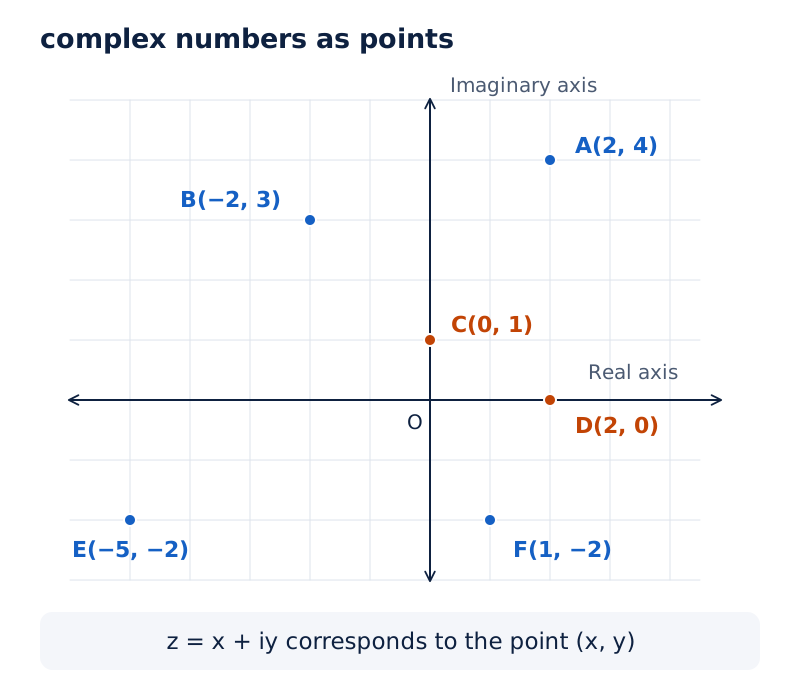
The horizontal and vertical axes cross at the origin. The labelled points are , , , , and , representing the corresponding complex numbers.
Drawn by One Young India. See Fig. 4.1 in your NCERT textbook
The point labelled is unrelated to the earlier discriminant symbol. The point represents , while represents .
What does modulus mean geometrically?
Let name the origin . The modulus is the distance from the origin to the point representing the complex number. Its geometric meaning agrees with its definition as a non-negative real number.
What the figure shows
modulus as distance from the origin
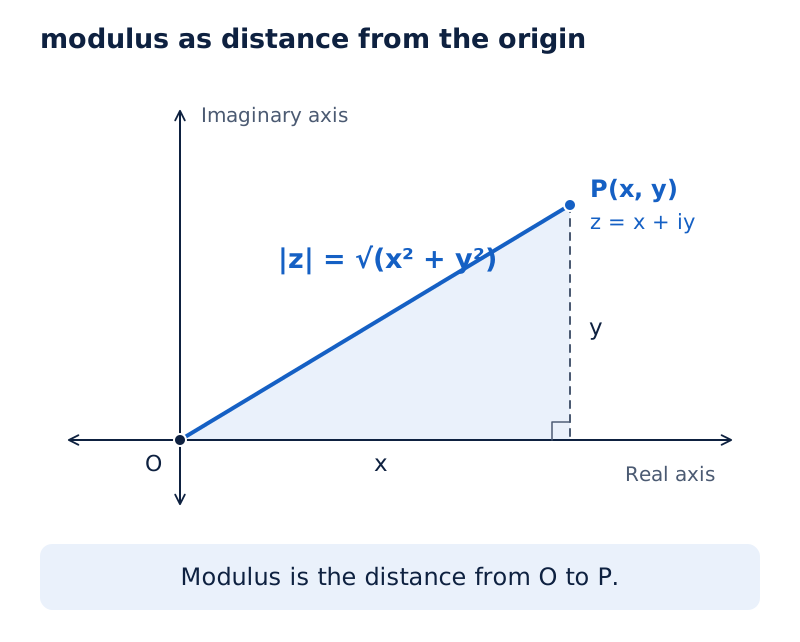
The point lies above and to the right of the origin . A segment joins the origin to the point and is labelled .
Drawn by One Young India. See Fig. 4.2 in your NCERT textbook
Where is the conjugate plotted?
The conjugate corresponds to the point , where names the conjugate point. The real coordinate stays fixed, and the imaginary coordinate changes sign. Thus conjugation is represented by reflection in the real axis.
What the figure shows
conjugate points
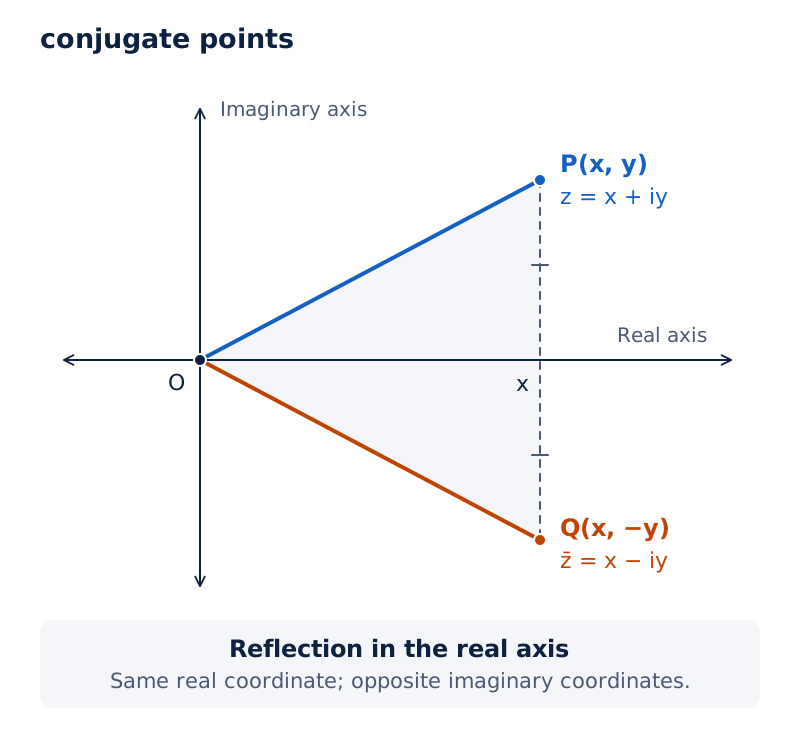
The labelled points and lie on the same vertical line on opposite sides of the horizontal axis. Segments join each point to the origin, showing the reflected positions.
Drawn by One Young India. See Fig. 4.3 in your NCERT textbook
Numbers of the form lie on the real axis, and those of the form lie on the imaginary axis. Reading the axes correctly connects the algebraic components with their geometric positions.
How can complex-number rules be combined in longer problems?
A longer expression may require several operations in sequence. Expand individual products first, simplify the quotient next, and take a conjugate at the end if that is what the question requests. Keeping these stages separate makes the required final operation clear.
Worked example 10. Find the conjugate of .
Answer: Simplify the entire fraction before changing its imaginary sign.
- Expand and simplify the numerator:
- Expand and simplify the denominator:
- Multiply by the denominator's conjugate:
- Expand the new numerator:
- Calculate the denominator and separate the parts:
- Take the conjugate of the simplified result:
Derivation: a quotient with unit modulus
Let and be real numbers that are not both zero. Define the real numbers and by . We can prove a relation between these two components using conjugates and an algebraic identity.
- Multiply by the conjugate of the denominator:
- Expand numerator and denominator:
- Compare the components:
- Square the components and add:
- Expand and regroup the numerator:
- Cancel the equal non-zero quantities:
Result: The components satisfy the required relation. The original condition on the real numbers ensures that the quotient is defined and that the final cancellation is valid. This condition belongs at the beginning of the proof.
Glossary
- Complex number — A number written as , with real components and and imaginary unit .
- Imaginary unit — The number denoted by , whose defining square is .
- Real part — The real component in , denoted by .
- Imaginary part — The real coefficient of the imaginary unit in .
- Additive identity — The zero complex number, whose addition leaves every complex number unchanged.
- Additive inverse — The negative of a complex number, which adds to it to give zero.
- Multiplicative identity — The complex number , whose multiplication leaves every complex number unchanged.
- Multiplicative inverse — The reciprocal of a non-zero complex number, giving one when multiplied by that number.
- Modulus — The non-negative number , measuring distance from the origin in the Argand plane.
- Conjugate — The number associated with , formed by reversing the imaginary component's sign.
- Argand plane — A coordinate plane representing each complex number by its real and imaginary components.
- Real axis — The horizontal axis of the Argand plane, containing points with zero imaginary component.
- Imaginary axis — The vertical axis of the Argand plane, containing points with zero real component.
Common errors and misconceptions
- Misconception: The imaginary part of is . Correct: The imaginary part is , the real coefficient of the imaginary unit; is the imaginary term.
- Misconception: Two complex numbers are equal when their real parts agree. Correct: Both corresponding real and imaginary parts must agree. Each comparison supplies a separate requirement.
- Misconception: The square of the imaginary unit can remain an unspecified squared variable in the final answer. Correct: Replace it using , then collect the real and imaginary parts.
- Misconception: The radical itself represents both solutions of . Correct: The radical denotes ; the equation has the two solutions and .
- Misconception: Square roots of two negative real numbers can be combined with the ordinary product rule. Correct: Convert each negative radical using the imaginary unit first; , while .
- Misconception: Taking a conjugate changes both component signs. Correct: It changes the imaginary sign only. Changing both signs gives the additive inverse, which is a different operation.
- Misconception: Every complex number can be used as a divisor. Correct: Division requires a non-zero denominator. In , zero would make the real denominator zero.
- Misconception: Conjugate points are reflections in the imaginary axis. Correct: They are reflections in the real axis: the real coordinate stays fixed while the imaginary coordinate changes sign.
Exam-style questions with model answers
Q1. For the complex number , state its real part and its imaginary part. [2 marks]
- The real part is , the component written without the imaginary unit.
- The imaginary part is , the real coefficient of the imaginary unit, rather than the entire imaginary term.
Q2. Find the real numbers and if . [3 marks]
- Equality of complex numbers requires equality of their corresponding parts. Comparing the real parts gives , so division by four gives .
- Comparing the imaginary coefficients gives the second real equation . Substituting the value already found gives .
- Rearrange the second equation to obtain . Both values are real and satisfy the two component equations.
Q3. Find the multiplicative inverse of , and verify it by multiplication. [4 marks]
- The given number is non-zero, so it has a multiplicative inverse. Its conjugate is .
- The squared modulus is , which will form the real denominator of the reciprocal.
- Divide the conjugate by the squared modulus: .
- Check the required product: . Thus the computed number is the multiplicative inverse.
Q4. Express in standard form, showing the cube expansion and the simplification of imaginary powers. [5 marks]
- Use the cube of a difference, with the whole term as the second quantity. The expansion is .
- Evaluate the first two terms, retaining the sign of the imaginary term: and .
- Use the defining square of the imaginary unit in the third term: , so .
- Use the third power in the final term: . The minus sign in the cube expansion therefore gives .
- Collect real terms separately from imaginary terms: . This is the required standard form, with the real contribution and the coefficient of the imaginary unit clearly separated.
Q5. Find the conjugate of , showing the simplification of the fraction. [6 marks]
- Expand the numerator and reduce the squared imaginary unit: . This gives its real and imaginary parts.
- Similarly expand the denominator: . The denominator is non-zero, so division is defined.
- Multiply numerator and denominator by the conjugate of this denominator: . The value of the fraction is preserved.
- Expand the new numerator fully: , using the defining square again.
- The denominator is . Hence the original fraction is .
- The simplified fraction is not yet the requested conjugate. To obtain that answer, retain the real part and reverse only the imaginary sign: .
Q6. Let and be real numbers, not both zero, and let real numbers and satisfy . Prove that . [5 marks]
- The condition on the given real numbers makes the denominator non-zero. Multiply by its conjugate to write .
- Expand the numerator and use the conjugate product in the denominator. This gives , with a positive real denominator.
- Compare the corresponding real and imaginary components: and . These are real because all their components are real.
- Square these two expressions and add over the common denominator: .
- Expand the numerator as . The sum of squares is positive because the given real numbers are not both zero. Cancelling the equal non-zero numerator and denominator proves the required result .
Key takeaways
- A complex number separates into real and imaginary components, and the imaginary part is the real coefficient multiplying the imaginary unit.
- Equality of complex numbers requires both component equations to hold, so compare corresponding parts before solving for real unknowns.
- Add and subtract corresponding components; for multiplication, expand all products and reduce every squared imaginary unit before collecting terms.
- Integer powers of the imaginary unit follow a four-value cycle, and negative powers can be simplified by first writing reciprocals.
- A negative real number has two imaginary square roots, but its radical symbol denotes the specified single value.
- The modulus is non-negative, whereas the conjugate preserves the real part and reverses the sign of the imaginary component.
- Division requires a non-zero denominator; multiplying both parts of a fraction by the denominator's conjugate makes that denominator real.
- In the Argand plane, modulus measures distance from the origin, and conjugation reflects the point in the real axis.
Test yourself
What does the relation allow us to do?
It introduces the imaginary unit, allowing numbers outside the real system to solve equations requiring a negative square.
What is the imaginary part of ?
It is , the real coefficient of the imaginary unit, rather than the whole term .
What must be checked before dividing by a complex number?
The denominator must be non-zero, since division uses its multiplicative inverse and zero has no such inverse.
What are the two square roots of ?
They are and ; squaring either number gives the same negative real number.
What does equal for ?
It equals , a non-negative real value obtained by multiplying the number by its conjugate.
How does the conjugate differ from the additive inverse?
The conjugate changes only the imaginary sign, while the additive inverse changes the signs of both components.
What do the axes in an Argand diagram represent?
The horizontal axis records real components, and the vertical axis records imaginary components. Together they locate the complex number.
Where is the conjugate of a plotted complex number located?
It is the reflection of the original point in the real axis, with unchanged real coordinate and reversed imaginary coordinate.