
Equilibrium | CBSE Class 11 Chemistry Notes
On this page
Watch & explore
Start with a few high-quality watches, then dive into the notes below.

This note covers dynamic equilibrium, physical and chemical equilibria, equilibrium constants, reaction quotients, Gibbs energy, Le Chatelier’s principle, acid-base theories, ionic equilibrium, pH, weak acids and bases, salt hydrolysis, buffers, common ions and solubility products.
What makes equilibrium a dynamic state?
A system reaches dynamic equilibrium when its opposing processes continue at equal rates. Its measurable properties remain constant even though molecules keep moving or reacting. Constancy of composition therefore does not mean that all molecular activity has stopped.
For a reversible reaction, the forward reaction converts reactants into products, while the reverse reaction converts products back into reactants. The double half-arrow represents these simultaneous directions. Here A and B denote reactants, and C and D denote products:
Starting with reactants, product concentrations rise while reactant concentrations fall. The forward rate decreases and the reverse rate increases until they become equal. Thereafter the concentrations remain constant, but reactant and product concentrations need not be equal.
Definition: An equilibrium mixture contains reactants and products whose concentrations remain constant because the forward and reverse reactions proceed at equal rates under the given conditions.
How can equilibrium be reached from either direction?
Hydrogen and iodine can form hydrogen iodide, while hydrogen iodide can also decompose:
With the same total numbers of hydrogen and iodine atoms in the same volume, the same equilibrium mixture can be obtained from reactants or product under the same conditions. Equilibrium describes the final balance, rather than a particular starting composition.
The isotope experiment in ammonia synthesis supports this interpretation. Mixing equilibrated ordinary and deuterated reaction mixtures produces ammonia molecules containing both hydrogen isotopes. Continued atom exchange is evidence that forward and reverse reactions persist after the overall composition becomes constant.
What the figure shows
Attainment of chemical equilibrium
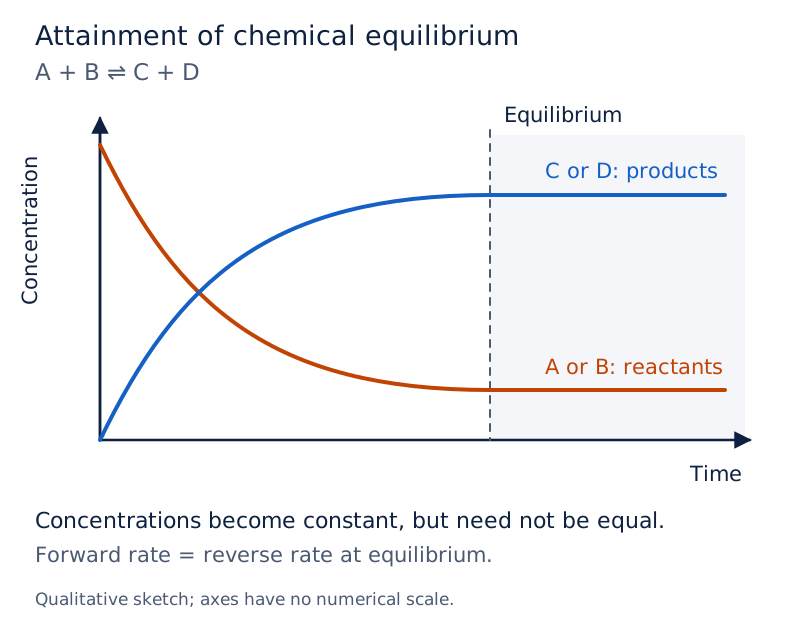
Concentration is plotted vertically against time. The curve labelled A or B falls, while the curve labelled C or D rises. Both flatten at different heights beyond the dashed line labelled equilibrium.
Drawn by One Young India. See Fig. 6.2 in your NCERT textbook
How do physical processes establish equilibrium?
Physical equilibrium involves opposing physical changes without changing the chemical identity of the substance. The examples include melting and freezing, evaporation and condensation, sublimation and deposition, and dissolution and crystallisation. For these equilibria, a closed system and suitable fixed conditions are essential.
What remains constant in each type?
| System | Opposing processes | Equilibrium feature |
|---|---|---|
| Ice and water | Melting and freezing | At atmospheric pressure and , their masses remain constant in an insulated system. |
| Water and water vapour | Evaporation and condensation | Vapour pressure remains constant at a given temperature. |
| Solid iodine and iodine vapour | Sublimation and deposition | The violet vapour eventually has constant colour intensity in a closed vessel. |
| Sugar and saturated sugar solution | Dissolution and crystallisation | Dissolved sugar concentration remains constant at a given temperature. |
| Carbon dioxide above and within water | Dissolution and escape of gas | Dissolved gas concentration depends on its pressure above the liquid. |
At liquid-vapour equilibrium, molecules escape from the liquid and return from the vapour at equal rates. The resulting equilibrium vapour pressure increases with temperature. At the same temperature, a liquid with higher vapour pressure is more volatile and has a lower boiling point.
What the figure shows
Measuring equilibrium vapour pressure
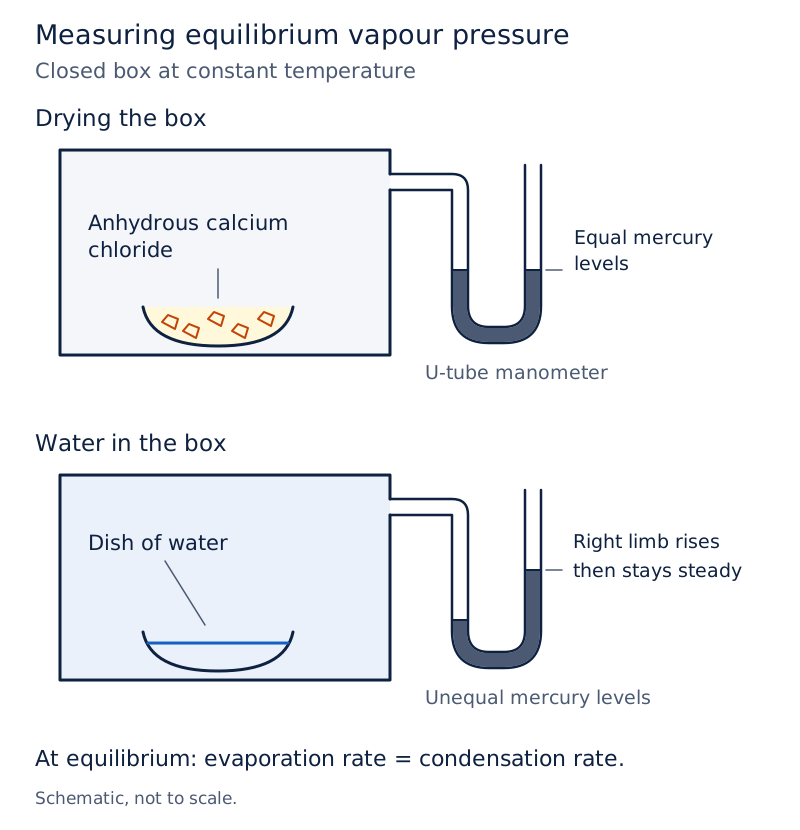
Two closed-box arrangements are shown with connected U-tube manometers. The first contains material labelled anhydrous calcium chloride. The second contains a dish of water and shows unequal liquid levels in the manometer.
Drawn by One Young India. See Fig. 6.1 in your NCERT textbook
A saturated solution cannot dissolve additional solute at that temperature. Sugar crystals in contact with such a solution continue exchanging molecules with it. Radioactive sugar added to non-radioactive saturated sugar solution eventually appears in both the solid and solution, demonstrating this exchange.
Why does soda water release gas when opened?
Henry’s law states that, at constant temperature, the mass of gas dissolved in a given mass of solvent is proportional to the gas pressure above it. Opening the bottle lowers that pressure, so dissolved carbon dioxide escapes towards the new equilibrium condition.
The temperature condition matters: the amount of gas dissolved decreases as temperature increases. Similarly, a liquid’s normal boiling point refers to the temperature at which liquid and vapour coexist at atmospheric pressure, rather than a temperature independent of pressure.
How is the equilibrium constant written correctly?
The law of chemical equilibrium specifies a constant ratio of equilibrium concentrations at a given temperature. Each concentration is raised to the corresponding coefficient in the balanced chemical equation. Square brackets denote molar concentration, expressed in moles per litre.
Let be the stoichiometric coefficients of species A, B, C and D. The concentration equilibrium constant is denoted by :
All concentrations in this expression must be equilibrium concentrations. Initial concentrations are not substitutes unless the mixture is already at equilibrium. For a specified balanced equation, the constant has one value at a particular temperature and is independent of initial composition.
How does changing the equation change the constant?
Let denote an equilibrium constant, the reverse-reaction constant, and the constant after multiplying every coefficient by a factor . Then:
When reactions are added, the constant of the net reaction is the product of their constants. Thus the balanced equation must accompany a quoted constant. Reversing or scaling an equation without changing its constant gives an incorrect equilibrium relation.
Which substances are omitted?
In homogeneous equilibrium, all reactants and products occupy the same phase. A heterogeneous equilibrium contains more than one phase. Pure solids and pure liquids have constant concentrations, so their contributions are absorbed into the equilibrium constant.
For example, calcium carbonate decomposes according to:
Both solids must still be present for this heterogeneous equilibrium, although they are absent from the expression. Dissolved substances and gases are not omitted merely because their amounts seem small.
Worked example 1. At , ammonia synthesis has equilibrium concentrations , and . Find for .
Formula:
Substitute:
Answer:
The value applies at 500 K to the equation as written. The units shown use the direct concentration convention.
How are pressure and concentration equilibrium constants related?
For gaseous equilibria, the pressure equilibrium constant, , uses partial pressures instead of molar concentrations. A gas’s partial pressure is related to its concentration through the ideal gas equation. The derivation assumes ideal-gas behaviour and a common temperature for all gases.
Let be pressure, volume, amount of gas, the gas constant and absolute temperature. The SI unit of pressure is the pascal. The SI unit of volume is the cubic metre.
The SI unit of amount of substance is the mole. The SI unit of thermodynamic temperature is the kelvin. With pressure in bar and volume in litres, use , keeping all units consistent.
Derivation: Relating the two gaseous equilibrium constants
For the general gaseous reaction above, denotes the partial pressure of species , its amount in moles, and is the sum of gaseous product coefficients minus the sum of gaseous reactant coefficients.
- Step 1. Apply the ideal gas equation and express amount per volume as concentration:
- Step 2. Write the pressure expression:
- Step 3. Substitute the concentration-pressure relations:
- Step 4. Identify the concentration constant and gaseous mole change:
Result: The two constants are numerically equal when the gaseous mole change is zero, using the stated consistent pressure and concentration conventions.
For ammonia formation, . For hydrogen iodide formation, . Pure solids and liquids do not enter this gaseous coefficient count.
Do equilibrium constants have units?
Direct concentration and pressure expressions can have units determined by their net powers. Alternatively, dividing each quantity by its standard-state value gives dimensionless ratios. The reference pressure is , and the reference solute concentration is .
Note: Numerical calculations below show direct concentration or pressure units where appropriate. Constants used inside logarithms are dimensionless standard-state values. A pressure or concentration must not be placed inside a logarithm with its units attached.
How do the reaction quotient and Gibbs energy predict change?
The reaction quotient, , has the same concentration expression as , but uses concentrations at the time being examined. It need not describe an equilibrium mixture. Comparing it with the constant predicts the direction of net reaction at that temperature.
| Comparison | Net change | Interpretation |
|---|---|---|
| Forward reaction | More products form until equilibrium is restored. | |
| Reverse reaction | More reactants form until equilibrium is restored. | |
| No net reaction | Forward and reverse reactions continue at equal rates. |
A very large constant generally indicates a product-favoured equilibrium, while a very small constant indicates a reactant-favoured equilibrium. Values between and indicate appreciable reactant and product concentrations. These comparisons do not predict how quickly equilibrium is reached.
What is the thermodynamic connection?
Let denote the reaction Gibbs energy change under the conditions considered, its standard value, and the dimensionless reaction quotient. The SI unit of molar Gibbs energy change is the joule per mole.
Here means natural logarithm; use with energies in joules per mole. A negative reaction Gibbs energy favours forward change; a positive value favours reverse change.
At equilibrium, and , where is the dimensionless equilibrium constant. Therefore:
How are unknown equilibrium concentrations found?
Use a balanced equation, record initial concentrations, express changes with stoichiometric coefficients, and substitute final concentrations into the equilibrium expression. Reject roots that imply negative concentrations or consumption exceeding the initial amount. Finally substitute the answer back into the constant expression.
Worked example 2. For , at . Initially, CO and water vapour each have concentration ; neither product is present.
Let be either initial reactant concentration, the concentration of either product formed and the dimensionless positive square root of the constant. Formula:
The concentration relation is
Substitute:
Answer:
Each product therefore has concentration 0.06731 mol per litre. Check:
How does Le Chatelier’s principle explain equilibrium shifts?
Le Chatelier’s principle predicts that a disturbed equilibrium changes in a direction that reduces the effect of the disturbance. Apply it only after identifying what changes and what remains constant. Concentration, volume and temperature changes do not all act in the same way.
What happens when concentration or pressure changes?
Adding a reactant or product favours its consumption; removing one favours its replacement. Adding hydrogen to the hydrogen iodide equilibrium promotes further HI formation. Removing ammonia from an ammonia-synthesis mixture encourages further formation of ammonia.
At constant temperature, compressing a gaseous equilibrium favours the side with fewer gaseous moles when the two sides differ. Expanding the volume favours the side with more gaseous moles. Count gas coefficients in the balanced equation, excluding pure solids and liquids.
Adding an inert gas at constant volume leaves the reacting gases’ partial pressures and concentrations unchanged. The equilibrium therefore remains undisturbed under that condition. Total pressure alone is insufficient to predict the shift.
Why are temperature and catalysts different?
Raising temperature lowers the constant of an exothermic reaction and increases that of an endothermic reaction. Let denote reaction enthalpy change. Ammonia synthesis is exothermic, with ; lower temperature favours its equilibrium yield.
A catalyst provides a lower-energy pathway for both directions and speeds attainment of equilibrium. It does not change the equilibrium constant or final composition. Ammonia manufacture balances favourable equilibrium at lower temperature against the need for a satisfactory reaction rate.
What the figure shows
Ammonia concentrations approaching equilibrium
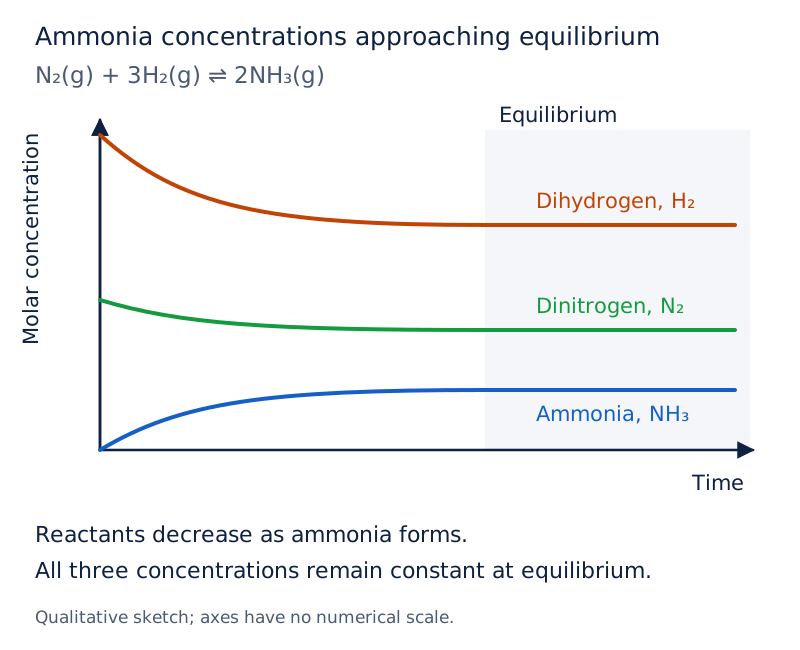
The vertical axis is molar concentration and the horizontal axis is time. Dihydrogen and dinitrogen curves fall towards plateaux; the ammonia curve rises towards a plateau. The three final concentrations are different.
Drawn by One Young India. See Fig. 6.4 in your NCERT textbook
Worked example 3. A vessel contains of N₂O₄ at . For , total equilibrium pressure is . Use molar mass and . Find both partial pressures and constants.
Here is initial mass, initial pressure, and the decrease in N₂O₄ partial pressure. Formula:
Substitute:
Answer:
Since ,
The partial pressures sum to the given total pressure in the 1 L vessel.
How do the three acid-base theories differ?
Electrolytes conduct electricity in aqueous solution because they provide mobile ions. Strong electrolytes ionise almost completely, while weak electrolytes ionise only partially. In a weak electrolyte solution, ions and unionised molecules participate in an ionic equilibrium.
Sodium chloride solution contains sodium and chloride ions, whereas acetic acid solution mainly contains unionised acid along with some acetate and hydronium ions. Sugar solution is a non-electrolyte. Electrical conduction depends on the presence of ions, not simply on dissolution.
| Theory | Acid | Base | Illustration or scope |
|---|---|---|---|
| Arrhenius | Produces hydrogen ions in water | Produces hydroxide ions in water | Describes aqueous acidic and basic solutions. |
| Brønsted-Lowry | Donates a proton | Accepts a proton | Explains proton transfer between ammonia and water. |
| Lewis | Accepts an electron pair | Donates an electron pair | Explains boron trifluoride accepting a lone pair from ammonia. |
What are conjugate acid-base pairs?
A conjugate pair differs by one proton. An acid loses a proton to form its conjugate base; a base gains a proton to form its conjugate acid. Consider:
Ammonia accepts a proton and acts as the base. Water donates that proton and acts as the acid. Ammonium is the conjugate acid of ammonia, while hydroxide is the conjugate base of water.
Water shows a dual role: it accepts a proton from hydrochloric acid but donates one to ammonia. A bare hydrogen ion does not exist freely in aqueous solution; it is hydrated. The symbols H⁺ and H₃O⁺ represent hydrated hydrogen ions in these aqueous discussions.
Why does the Lewis concept include more acids?
BF₃ contains no proton to donate, yet its electron-deficient boron accepts the lone pair supplied by ammonia. Hence BF₃ is a Lewis acid and ammonia is a Lewis base. Hydroxide and fluoride ions also act as Lewis bases by donating lone pairs.
Stronger acids have weaker conjugate bases. Proton-transfer equilibria favour formation of the weaker acid and weaker base. Strength describes the tendency to ionise or transfer a proton, whereas concentration describes the amount of dissolved substance per unit volume.
How do water ionisation and pH describe acidity?
Water can transfer a proton between two of its molecules. One acts as an acid and the other as a base:
The ionic product of water, , incorporates the constant contribution of liquid water. In concentration form:
At , . Pure water has equal hydronium and hydroxide concentrations, each . This equality defines neutrality; the equilibrium constant itself depends on temperature.
Why is a logarithmic scale useful?
pH is the negative base-ten logarithm of hydrogen-ion activity. Let denote that dimensionless activity and the standard concentration. In sufficiently dilute solution, activity is approximated by the concentration divided by this reference:
Likewise, is the negative logarithm of the dimensionless hydroxide concentration ratio, and is the negative logarithm of the dimensionless water constant. At :
An acidic solution has more hydronium than hydroxide; a basic solution has more hydroxide. At this temperature, their pH values are respectively below and above seven. A one-unit pH change corresponds to a tenfold change in hydrogen-ion activity.
Worked example 4. A soft drink has hydrogen-ion concentration . Calculate its pH using the dilute-solution approximation.
Formula:
Substitute:
Answer:
The concentration is 0.0038 mol per litre. The pH is dimensionless, and the drink is acidic.
Very dilute acids require care: hydrogen ions supplied by water cannot be ignored when their contribution is comparable with that of the acid. Using the acid concentration alone can give an unphysical basic pH for a dilute strong acid.
How are weak-acid and weak-base equilibria calculated?
A weak acid ionises only partly. Let HA represent a monoprotic acid, A⁻ its conjugate base, and its acid ionisation constant. Omitting the constant contribution of water gives:
At a fixed temperature, a larger acid ionisation constant indicates greater acid strength. For a weak base B, whose conjugate acid is BH⁺, the base ionisation constant is :
Derivation: Ionisation constant and degree of ionisation
Let be the initial acid concentration and the dimensionless fraction ionised. Assume there are initially no added common ions and that water’s hydronium contribution is negligible compared with the acid’s.
- Step 1. Express the undissociated acid concentration:
- Step 2. Use the one-to-one ionisation stoichiometry:
- Step 3. Substitute the concentrations:
- Step 4. If the ionised fraction is sufficiently small, approximate the denominator:
Result: Dilution increases the fraction ionised in this weak-electrolyte approximation. Check the calculated fraction before assuming it is negligible. The corresponding treatment of a weak base replaces the acid constant with the base constant.
How are conjugate constants related?
For a conjugate acid-base pair, multiplication of the acid and base expressions cancels the shared species:
Define and , using dimensionless standard-state constants. At , . These relations concern a conjugate pair, not an arbitrary acid and base.
Worked example 5. Find the approximate degree of ionisation, pH and conjugate-acid constant for ammonia at . Use and in concentration form.
Let be hydroxide concentration and hydronium concentration. Formula:
Substitute:
Answer:
The fraction ionised is about 0.0188, or 1.88 per cent. The small fraction supports the approximation; an exact calculation gives a slightly lower hydroxide concentration.
What controls acid strength and the common ion effect?
Polybasic acids have more than one ionisable proton per molecule. They dissociate in successive steps, each with its own ionisation constant. Oxalic acid, sulphuric acid and phosphoric acid are examples of acids with more than one ionisable proton.
For a dibasic acid H₂X, let and denote its first and second ionisation constants:
Successive ionisation constants decrease. Removing a positively charged proton from an already negative ion is more difficult than removing it from the neutral acid. The first dissociation generally supplies most of the hydronium ions in such a solution.
How do bond strength and polarity matter?
The extent of acid dissociation depends broadly on the strength and polarity of the hydrogen-to-atom bond. Down a group, declining bond strength is the more important factor. Across a row, increasing bond polarity becomes the deciding factor in the examples considered.
The acid-strength trends are:
These trends refer to comparable chemical behaviour, rather than different concentrations of solutions. A concentrated weak acid and a dilute strong acid cannot be ranked simply by the words “concentrated” and “dilute”.
Why does adding a common ion suppress ionisation?
The common ion effect is the shift produced by adding a substance that supplies an ion already involved in an equilibrium. Acetic acid ionisation provides a useful example:
Adding acetate ions shifts the equilibrium towards unionised acid, lowering hydrogen-ion concentration. Adding hydrogen ions also suppresses acetic acid ionisation. In each case the response follows Le Chatelier’s principle, while the acid constant remains unchanged at constant temperature.
This distinction is central: a lower degree of ionisation after addition of a common ion does not mean that the intrinsic ionisation constant has decreased. Composition changes to restore the same constant under the same temperature conditions.
How do salt hydrolysis and buffers control pH?
Salt hydrolysis occurs when an ion produced by a dissolved salt reacts with water. It can increase hydronium or hydroxide concentration. Dissolving a salt therefore does not necessarily produce a neutral solution, even though the salt was formed by an acid-base reaction.
| Parent acid and base | Example | Behaviour in water at |
|---|---|---|
| Strong acid and strong base | Sodium chloride | Ions do not hydrolyse appreciably; solution is neutral. |
| Weak acid and strong base | Sodium acetate | Acetate hydrolysis produces hydroxide; solution is basic. |
| Strong acid and weak base | Ammonium chloride | Ammonium acts as an acid; solution is acidic. |
| Weak acid and weak base | Ammonium acetate | Both ions hydrolyse; pH depends on the acid and base constants. |
Acetate hydrolysis is represented by:
For a salt of a weak acid and weak base, the usual expression at is:
Here the acid and base constants belong to the parent weak acid and weak base. The relative values determine whether the solution is acidic, basic or approximately neutral.
What makes a solution a buffer?
A buffer solution resists pH change on dilution or addition of small amounts of acid or alkali. An acidic buffer contains a weak acid and its salt with a strong base. A basic buffer contains a weak base and its conjugate-acid salt.
Acetic acid with sodium acetate and ammonia with ammonium chloride are examples. Their common ions suppress further ionisation of the weak component. Their useful behaviour concerns small additions, not an unlimited capacity to consume acid or base.
How is buffer pH calculated?
The Henderson-Hasselbalch equation relates an acidic buffer’s pH to the acid constant and the ratio of conjugate-base concentration to acid concentration:
When ionisation changes are small, these equilibrium concentrations can be approximated by the salt and acid concentrations used to prepare the buffer. Equal concentrations make the ratio unity, so the pH is approximately the acid’s negative logarithmic ionisation constant.
For a basic buffer, use:
Convert to pH using the water relation at the stated temperature. Dilution changes both component concentrations in the same proportion, leaving the ratio approximately unchanged. Choosing an acid with a negative logarithmic ionisation constant close to the desired pH helps design an acidic buffer.
How do solubility products predict dissolution and precipitation?
A sparingly soluble salt establishes equilibrium between undissolved solid and ions in its saturated solution. The solid’s constant contribution is incorporated into the solubility product constant, . Ion concentrations enter with powers equal to their coefficients in the dissolution equation.
For barium sulphate:
Let denote molar solubility, the amount of salt dissolved per litre of saturated solution. In pure water, with no significant secondary ion reactions, each ion concentration in this example equals the molar solubility. Hence .
Why must dissolution stoichiometry be used?
For a general salt MₓXᵧ, let and be the numbers of cations and anions produced per formula unit; let and denote their positive charge magnitudes. Electrical neutrality requires . In pure water:
The relation between solubility and solubility product changes with the salt’s stoichiometry. Consequently, comparing constants alone is insufficient when salts release different numbers of ions. First convert each constant to molar solubility using its own balanced dissolution equation.
When does precipitation occur?
The ionic product, , uses current ion concentrations, whether or not equilibrium has been reached. A value above the solubility product favours precipitation. A lower value permits further dissolution if solid is available. Equality describes a saturated equilibrium solution.
Adding a common ion generally reduces solubility by shifting the dissolution equilibrium towards the solid. Conversely, removing an ion encourages more solid to dissolve. Lower pH can increase the solubility of salts of weak acids by protonating their anions.
Worked example 6. Calculate the molar solubility of Ni(OH)₂ in NaOH. Use the concentration-form solubility product .
The dissolution equation is
Formula:
The hydroxide concentration includes both the NaOH contribution and the hydroxide released by the salt. Since solubility is very small, neglect the latter contribution initially.
Substitute:
Answer:
The solution therefore contains approximately this concentration of nickel ions. Check:
The neglected hydroxide contribution is indeed tiny compared with that supplied by the 0.10 mol per litre NaOH solution.
Solubility is temperature-dependent. Use the constant at the temperature of the problem and distinguish a saturated solution’s equilibrium product from the product calculated immediately after solutions are mixed.
Glossary
- Dynamic equilibrium — A state in which opposing processes continue at equal rates while measurable properties remain constant.
- Equilibrium mixture — A mixture containing reactants and products at constant concentrations under the specified equilibrium conditions.
- Saturated solution — A solution that cannot dissolve further solute at the specified temperature.
- Equilibrium constant — The constant ratio of equilibrium product and reactant terms for a specified reaction at a given temperature.
- Reaction quotient — The corresponding product-to-reactant expression evaluated using current concentrations or pressures, which need not be equilibrium values.
- Heterogeneous equilibrium — An equilibrium involving reactants and products distributed across more than one physical phase.
- Electrolyte — A substance whose aqueous solution conducts electricity because mobile ions are present.
- Conjugate acid-base pair — Two species related by the gain or loss of exactly one proton.
- Lewis acid — A species capable of accepting an electron pair from a Lewis base.
- Degree of ionisation — The fraction of the initially dissolved electrolyte that has ionised under the specified conditions.
- Common ion effect — An equilibrium shift caused by adding a substance supplying an ionic species already present.
- Hydrolysis — Reaction of a salt’s cation, anion or both with water, affecting the solution’s acidity or basicity.
- Buffer solution — A solution resisting pH changes on dilution or addition of small amounts of acid or alkali.
- Solubility product — The equilibrium product of dissolved-ion concentrations, each raised to its dissolution coefficient, for a sparingly soluble salt.
- Molar solubility — The amount of dissolved salt in moles per litre of its saturated solution.
Common errors and misconceptions
- Misconception: Equilibrium means reactions have stopped. Correct: Opposing reactions continue at equal rates, leaving the macroscopic composition unchanged.
- Misconception: Reactants and products must have equal concentrations. Correct: Their concentrations remain constant at equilibrium but need not be equal to each other.
- Misconception: Every substance in the equation belongs in the constant expression. Correct: Pure solids and pure liquids are omitted because their contributions are constant.
- Misconception: A large equilibrium constant implies a fast reaction. Correct: The constant describes equilibrium extent, not the speed of attaining it.
- Misconception: A catalyst increases the equilibrium yield. Correct: It speeds both directions and attainment of equilibrium without altering the equilibrium composition.
- Misconception: Neutral pH is seven at every temperature. Correct: Neutrality means equal hydronium and hydroxide concentrations; the water constant depends on temperature.
- Misconception: Any acid and base constants multiply to the water constant. Correct: This relation applies to a conjugate acid-base pair at the same temperature.
- Misconception: Every salt has solubility equal to the square root of its solubility product. Correct: Derive the relationship from the dissolution stoichiometry and account for common ions.
Exam-style questions with model answers
Q1. Explain why chemical equilibrium is dynamic, and state what happens to concentrations at equilibrium. [2 marks]
- Forward and reverse reactions continue simultaneously at equal rates; the molecular processes do not stop.
- Reactant and product concentrations remain constant with time under unchanged conditions, although their concentrations need not be equal.
Q2. For , write the concentration equilibrium expression and explain the treatment of the solids. [3 marks]
- The concentration equilibrium constant is , where the brackets mean the equilibrium molar concentration of carbon dioxide gas.
- Pure calcium carbonate and calcium oxide have constant concentrations, so their contributions are incorporated into the equilibrium constant rather than written as variable terms.
- Both solids must nevertheless be present for this heterogeneous equilibrium to exist. Omitting them from the expression does not mean that the solid phases are absent.
Q3. For , at . A mixture has , and . Calculate the reaction quotient and predict the direction of change. [3 marks]
- The reaction quotient uses the current concentrations: . Unlike an equilibrium constant calculation, the supplied composition need not already be at equilibrium.
- Substitution gives . The concentration units cancel, so this quotient is dimensionless.
- Since , net reaction proceeds forward. More hydrogen and iodine react to form hydrogen iodide until the quotient equals the equilibrium constant at the stated temperature.
Q4. Consider the exothermic equilibrium . Explain the effects of adding hydrogen, removing ammonia, compression at constant temperature, lowering temperature, and adding a catalyst. [5 marks]
- Adding hydrogen disturbs the concentration balance. The equilibrium shifts towards ammonia formation, consuming some of the added hydrogen along with nitrogen as a new equilibrium is established.
- Removing ammonia favours the forward reaction because the system responds by replacing some of the removed product. Continuous removal can therefore encourage continued ammonia formation.
- Compression at constant temperature favours ammonia formation. The balanced equation has four gaseous reactant moles for every two gaseous product moles, so this direction reduces the gaseous mole count.
- Lowering temperature favours the exothermic forward reaction and increases the equilibrium constant. However, a lower temperature also slows the reaction, so favourable equilibrium does not guarantee a satisfactory rate.
- A catalyst speeds attainment of equilibrium by providing a lower-energy pathway for both reaction directions. It changes neither the equilibrium constant nor the final equilibrium composition under the same conditions.
Q5. In , identify the forward acid and base, and both conjugate pairs. [4 marks]
- Water is the Brønsted-Lowry acid in the forward reaction because it donates a proton to ammonia.
- Ammonia is the Brønsted-Lowry base because it accepts that proton through its available electron pair.
- NH₄⁺ and NH₃ form one conjugate pair. Ammonium is the conjugate acid obtained when ammonia gains one proton.
- H₂O and OH⁻ form the other conjugate pair. Hydroxide is the conjugate base obtained when water loses one proton.
Q6. At , a solution has . Given , calculate hydronium concentration and pH using the dilute-solution approximation, and classify the solution. [3 marks]
- The water relation gives . Both ion concentrations must satisfy the water equilibrium at the stated temperature.
- Using the standard concentration to make the logarithm dimensionless, . The resulting pH itself has no unit.
- The solution is basic because its hydroxide concentration exceeds its hydronium concentration. Equivalently, the calculated pH is greater than seven at this temperature.
Q7. Explain how an acetic acid-sodium acetate buffer resists pH change, and write the equation used to estimate its pH. [5 marks]
- The mixture contains a weak acid, acetic acid, and acetate ions supplied mainly by the salt. These provide the acid and conjugate-base components needed for an acidic buffer.
- The added acetate is a common ion and suppresses further acetic acid ionisation. The equilibrium therefore contains a substantial weak-acid component together with its conjugate base.
- Small additions of hydrogen ions favour formation of unionised acetic acid from acetate. This equilibrium response consumes much of the added acid and limits the resulting pH change.
- Small additions of hydroxide remove hydrogen ions. Further acid ionisation helps replace them, limiting the change in acidity. The buffering description applies to small additions rather than unlimited added alkali.
- The estimate is , where is the negative logarithm of the dimensionless acid constant. Equal component concentrations give approximately .
Q8. A salt A₂X₃ dissolves as . Its concentration-form solubility product is . Calculate its molar solubility in pure water, assuming neither ion reacts with water. [4 marks]
- Let represent molar solubility. The balanced dissolution equation gives and , with each concentration measured in moles per litre.
- The solubility product is . The solid is omitted because its contribution is constant.
- Thus . This expression retains the correct fifth power of concentration units.
- Taking the positive fifth root gives , approximately . The positive value describes the physical amount of dissolved salt.
Key takeaways
- Equilibrium is dynamic: opposing processes continue at equal rates while observable properties and concentrations remain constant.
- Write equilibrium expressions from balanced equations, use equilibrium values, and omit contributions from pure solids and pure liquids.
- Pressure and concentration constants are related through ideal-gas behaviour and the difference in gaseous stoichiometric coefficients.
- The reaction quotient predicts direction, while the equilibrium constant describes extent and does not determine reaction speed.
- Temperature changes equilibrium constants; catalysts speed attainment of equilibrium without changing the final equilibrium composition.
- Acid-base theories describe aqueous ions, proton transfer or electron-pair transfer, with conjugate pairs differing by one proton.
- Water’s ionic product connects hydronium and hydroxide concentrations; numerical neutrality at pH seven requires the stated temperature.
- Weak-electrolyte calculations require a balanced ionisation equation, concentration bookkeeping and a check of any small-ionisation approximation.
- Common ions suppress ionisation or solubility, while suitable weak-acid or weak-base mixtures can resist small pH changes.
- Solubility calculations must use dissolution stoichiometry and account for pre-existing ions before applying the solubility product.
Test yourself
Why does a constant vapour pressure not imply that evaporation has stopped?
Evaporation continues, but condensation returns molecules to the liquid at the same rate, producing no net change.
What happens to an equilibrium constant when the reaction equation is reversed?
The reverse reaction has the reciprocal constant at the same temperature; the balanced equation must therefore be specified.
Under what gaseous stoichiometric condition are pressure and concentration constants numerically equal?
They are equal when the total gaseous product and reactant coefficients are equal, using consistent pressure and concentration conventions.
Why does adding inert gas at constant volume leave equilibrium unchanged?
The reacting gases’ partial pressures and molar concentrations remain unchanged, so their reaction quotient does not change.
How does water act in its reaction with ammonia?
Water donates a proton to ammonia, acting as an acid and forming hydroxide as its conjugate base.
Why does the second ionisation of a polyprotic acid have a smaller constant?
Removing a positively charged proton from an already negative ion is more difficult because of electrostatic attraction.
Why does dilution leave buffer pH approximately unchanged?
Both buffer components are diluted in the same proportion, leaving the concentration ratio in the logarithmic expression approximately unchanged.
What does an ionic product exceeding the solubility product predict?
Precipitation is favoured, reducing dissolved-ion concentrations until the ionic product again matches the equilibrium solubility product.
Write about it
Turn a question from this chapter into a paper.
The Writing Studio has a structure guide, a rubric and citation tools for 15 formats, from essays to research papers. Drafting is free with an account. Learnacy Essential adds feedback from an AI writing coach and submission to The OYI Review.
Learnacy Essential is ₹1,499 for the year. Publication depends on review and is not guaranteed.