
Thermodynamics | CBSE Class 11 Chemistry Notes
On this page
Watch & explore
Start with a few high-quality watches, then dive into the notes below.
This note covers thermodynamic systems, state functions, internal energy, heat and work, the first law, pressure-volume work, enthalpy, heat capacities, calorimetry, thermochemical equations, Hess’s law, different reaction enthalpies, entropy, spontaneity, Gibbs energy and chemical equilibrium.
What do thermodynamics, systems and surroundings describe?
Thermodynamics studies energy transformations in macroscopic systems containing large numbers of molecules. Chemical energy can appear as heat when a fuel burns, as mechanical work in an engine or as electrical energy in a galvanic cell.
It compares initial and final equilibrium states. It does not describe the detailed mechanism or rate of an energy transformation. In an equilibrium state, macroscopic properties such as pressure and temperature do not change with time.
How is a system chosen?
The system is the part of the universe selected for observation. Everything else constitutes the surroundings. In practice, attention is directed to the nearby surroundings that can interact with the system.
A boundary separates the two. It may be real, such as a vessel wall, or imaginary, such as a surface enclosing a chosen region. Defining the boundary makes it possible to track transfers of matter and energy.
| System type | Matter exchange | Energy exchange | Example |
|---|---|---|---|
| Open | Possible | Possible | Reactants in an open beaker |
| Closed | Absent | Possible | Reactants in a closed conducting vessel |
| Isolated | Absent | Absent | Reactants in a closed insulated vessel |
What the figure shows
Open, closed and isolated systems
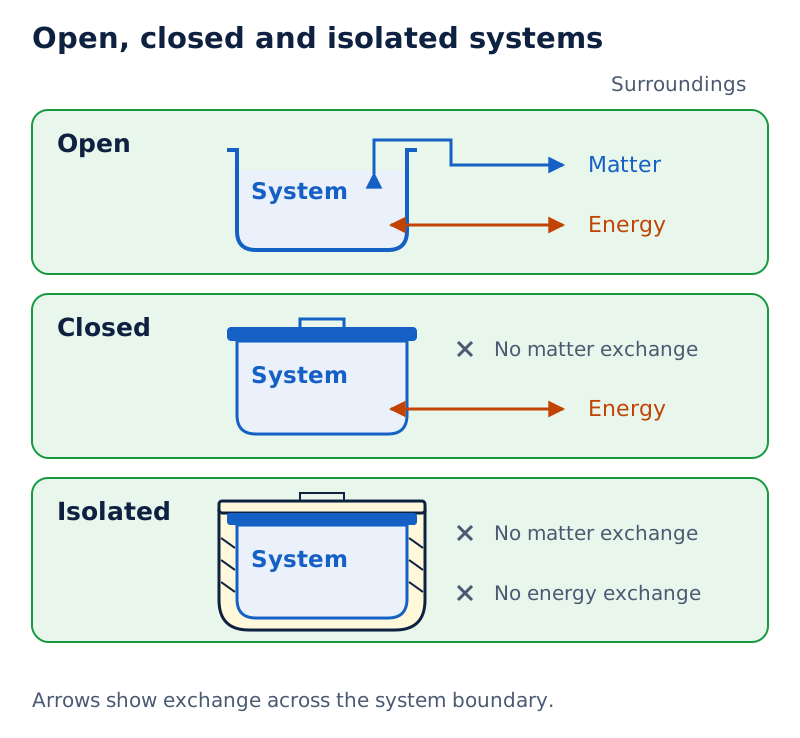
Three blue vessels are surrounded by green regions labelled surroundings. The open system shows matter and energy crossing its boundary. The closed system permits energy exchange, while the isolated system depicts both exchanges as blocked.
Drawn by One Young India. See Fig. 5.2 in your NCERT textbook
An adiabatic boundary prevents heat transfer. This condition does not by itself prevent work being done. Churning water in an insulated vessel can change its internal energy even though heat cannot cross the wall.
How do state functions and the first law account for energy?
A thermodynamic state is specified through measurable bulk properties. Let denote pressure, volume, absolute temperature and amount of substance. Their values describe the state without requiring the position and velocity of every particle.
A state function depends on the current state rather than the route used to reach it. Internal energy, denoted by , is a state function. The symbol denotes a final value minus its initial value.
What signs are used for heat and work?
Let be heat transferred to the system and be work done on it, each with its algebraic sign. Heat is energy transferred because of a temperature difference. Work and heat describe transfers, not separate stores of energy inside a system.
| Transfer | Sign | Meaning for the system |
|---|---|---|
| Heat absorbed | Energy enters as heat | |
| Heat released | Energy leaves as heat | |
| Work done on the system | Energy enters as work | |
| Work done by the system | Energy leaves as work |
Definition: The first law of thermodynamics states that the energy of an isolated system is constant. Energy can neither be created nor destroyed.
For a closed system, its mathematical expression is Although heat and work separately depend on the path, their sum for fixed initial and final states is the same. Changes in internal energy can be measured without knowing its absolute value.
The SI unit of internal energy is the joule. The SI unit of heat is the joule. The SI unit of work is the joule. These common units allow heat and work to be added in the energy balance.
Worked example 1. A system absorbs of heat and does of work. Find its internal-energy change.
Formula: . Substitute and answer:
- Assign the heat sign: .
- Assign the work sign: .
- Calculate .
Answer: , an increase in internal energy.
How is pressure-volume work calculated?
Gas in a cylinder can move a frictionless piston and transfer energy as pressure-volume work. Let denote external pressure, initial volume and final volume. The subscripts identify the initial and final states.
For a constant external pressure, Expansion gives a positive volume change and negative work. Compression gives a negative volume change and positive work. The external pressure, rather than an arbitrary internal pressure, belongs in this expression.
How do reversible and irreversible paths differ?
A reversible process can be reversed at any stage by an infinitesimal change. It proceeds infinitely slowly through a series of equilibrium states, with system and surroundings nearly in equilibrium. Other processes are irreversible.
When external pressure varies, the work is obtained by summing the small contributions. In integral form, Here denotes an infinitesimal volume change and the integral represents their continuous sum.
What the figure shows
Compression along different paths
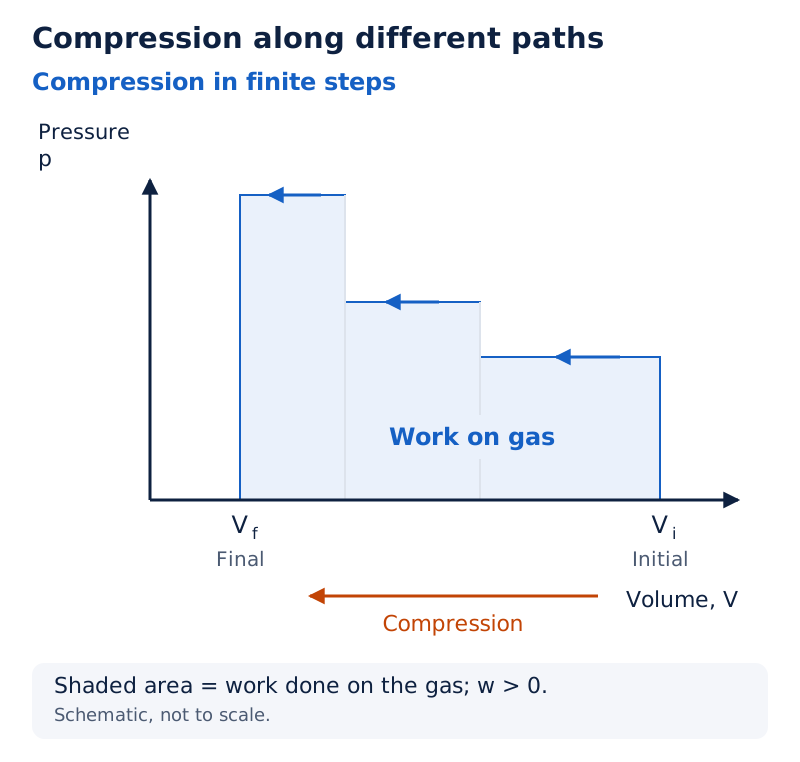
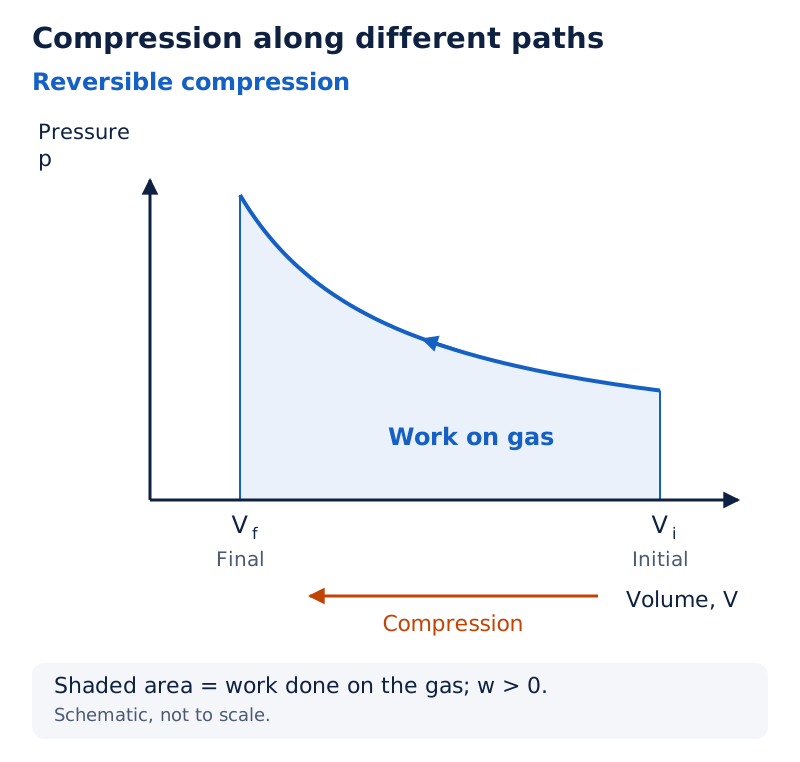
Both plots place pressure on the vertical axis and volume on the horizontal axis. Initial volume is to the right of final volume. One plot has shaded rectangular steps; the other has a shaded area beneath a smooth curve.
Drawn by One Young India. See Figs. 5.5(b) and 5.5(c) in your NCERT textbook
For an ideal gas, denotes the gas constant and . Let denote reversible work. During reversible isothermal expansion, The symbol means natural logarithm. The formula requires constant temperature and ideal-gas behaviour.
In free expansion, the gas expands into a vacuum, so external pressure and work are zero. For an isothermal ideal-gas change, internal energy does not change and heat is the negative of work.
Worked example 2. An ideal gas expands isothermally at from to , against constant external pressure . Find work and heat.
Formula: , . Substitute:
- .
- .
- .
Answer: work is and heat absorbed is . The negative work sign identifies expansion work done by the gas.
Why is enthalpy useful at constant pressure?
Many chemical reactions occur under constant atmospheric pressure, while the volume can change. Enthalpy, denoted by , combines internal energy with the pressure-volume term: Since its components are state functions, enthalpy is also a state function.
The SI unit of enthalpy is the joule. At constant pressure, This relation shows why heat measured at constant pressure and heat measured at constant volume need not be identical.
Derivation: Why does constant-pressure heat equal enthalpy change?
Assume a closed system at constant pressure, with pressure-volume work as the only work. Let denote heat transferred at constant pressure; subscripts 1 and 2 denote initial and final states.
- Apply the first law with expansion work:
- Rearrange to collect the two state quantities:
- Use the enthalpy definition for each state:
Result: Constant-pressure heat equals enthalpy change under these conditions. At constant volume, with no other work, heat instead equals the internal-energy change.
Let denote heat transferred at constant volume. Then . An exothermic reaction releases heat and has negative enthalpy change; an endothermic reaction absorbs heat and has positive enthalpy change.
For reactions involving ideal gases at the same temperature and pressure, let denote moles of gaseous products minus moles of gaseous reactants. Then Count gaseous substances only. Solids and liquids are not included in this mole difference.
The difference between enthalpy and internal-energy changes is usually insignificant for systems containing only solids or liquids because their volume changes are small. It can be significant when gases take part.
Worked example 3. At , taken as , vaporising of water at requires . Treat the vapour as ideal and use .
Formula: . Substitute:
- The gas amount increases by .
- .
- .
Answer: approximately for the stated amount of water.
How do heat capacities and extensive properties differ?
An extensive property depends on the quantity or size of matter present. Mass, volume, internal energy, enthalpy and heat capacity are examples. An intensive property, such as temperature, density or pressure, does not depend on the amount of matter.
Dividing a uniform gas sample into two equal parts halves its volume but leaves its temperature unchanged. A molar property is an extensive property divided by amount of substance, making it independent of sample size.
How is heat related to temperature change?
Let denote heat capacity, specific heat capacity and mass. For the temperature interval considered, A larger heat capacity means a smaller temperature increase for the same heat input.
Let denote molar heat capacity. Then . Specific heat capacity refers to unit mass; molar heat capacity refers to one mole. The SI unit of heat capacity is joule per kelvin; molar heat capacity is expressed in joules per mole per kelvin.
Derivation: How are ideal-gas molar heat capacities related?
Let and denote molar heat capacities at constant pressure and constant volume. Consider a fixed amount of an ideal gas heated through a small temperature interval.
- Use the ideal-gas equation in the enthalpy definition:
- Take the change for fixed amount:
- Express the two energy changes using molar heat capacities:
- Divide by amount and the non-zero temperature change:
Result: For an ideal gas, the constant-pressure molar heat capacity exceeds the constant-volume molar heat capacity by the gas constant. The molar qualification matters: the corresponding difference for the whole sample depends on its amount.
Note: Adiabatic means no heat transfer; isothermal means constant temperature. These describe different conditions. Neither word should be substituted for the other when selecting an energy equation.
How does calorimetry measure internal energy and enthalpy?
Calorimetry determines energy changes through measured temperature changes. The process occurs in a calorimeter, and the heat capacity of the absorbing arrangement must be known. Heat lost by the reaction is gained by the calorimeter in the ideal heat balance.
What does a bomb calorimeter measure?
A combustible substance burns in excess oxygen inside a sealed steel bomb immersed in water. The reaction transfers heat to the surrounding water and apparatus. Because the bomb is rigid, its volume does not change and pressure-volume work is zero.
What the figure shows
Bomb calorimeter
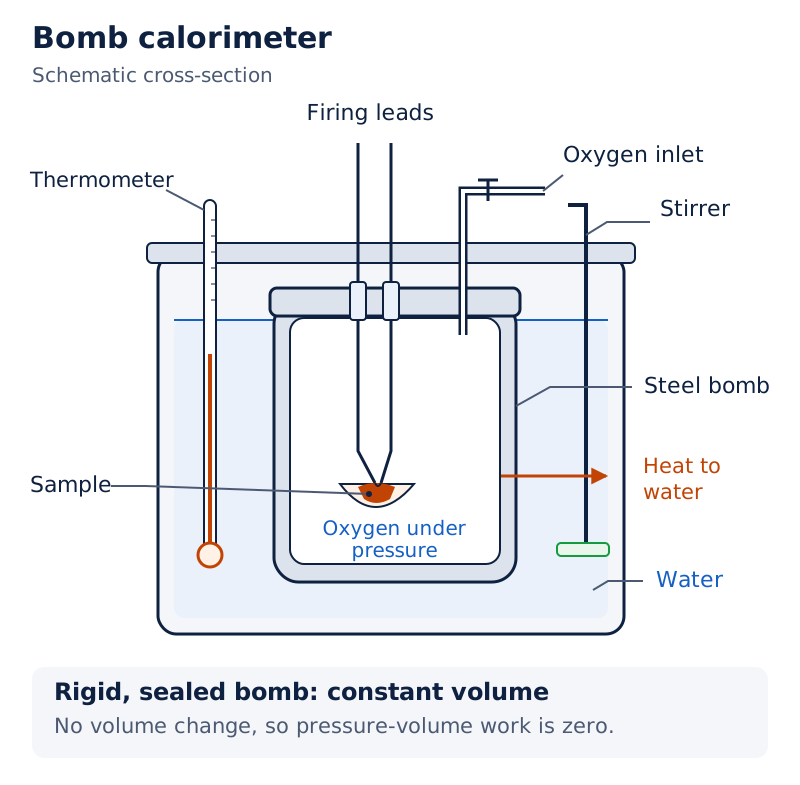
A labelled bomb containing a sample and oxygen under pressure stands in water. Firing leads enter from above. The drawing also labels an oxygen inlet, a thermometer and a stirrer beside the bomb.
Drawn by One Young India. See Fig. 5.7 in your NCERT textbook
Let denote the calorimeter heat capacity and the heat it absorbs. Then . The reaction heat, denoted by , is . At constant volume, this reaction heat gives its internal-energy change.
At constant pressure, calorimetry gives enthalpy change when pressure-volume work is the only work. The temperature rise belongs to the calorimeter, so a positive rise corresponds to a negative reaction heat for an exothermic reaction.
Worked example 4. Burning of graphite in oxygen raises a bomb calorimeter from to . Its heat capacity is . Use graphite’s molar mass . Find the molar energy changes for .
Formula: ; divide sample heat by the amount burnt.
- .
- .
- Molar internal-energy change is
- Gas mole numbers are unchanged, so molar enthalpy change is also .
Answer: both changes are approximately per mole of graphite. The reaction is exothermic.
What are standard enthalpies and phase-change enthalpies?
Reaction enthalpy, denoted by , is the enthalpy change accompanying a chemical reaction. The subscript identifies reaction. Calculate it as the enthalpy of products minus that of reactants, with the amounts fixed by the balanced equation.
A substance’s standard state at a specified temperature is its pure form at . The superscript denotes standard-state quantities. Temperature must still be specified; standard conditions do not automatically mean one particular temperature. Data are usually reported at .
How do phase changes exchange heat?
| Quantity | Symbol | Process for one mole |
|---|---|---|
| Standard enthalpy of fusion | Melting a solid in the standard state | |
| Standard enthalpy of vaporisation | Converting liquid to vapour at constant temperature and standard pressure | |
| Standard enthalpy of sublimation | Converting solid directly to vapour at constant temperature and standard pressure |
Melting and vaporisation absorb heat. During melting or vaporisation at the transition temperature and constant pressure, energy is absorbed without a temperature rise. The heat changes intermolecular organisation instead of simply raising temperature.
At , the molar enthalpy of fusion of ice is . Reversing the process reverses the enthalpy sign: freezing releases the corresponding heat. The magnitude depends on intermolecular interactions, which are stronger between water molecules than between acetone molecules.
Worked example 5. A swimmer carries about of water at . Calculate the heat and internal-energy change for evaporation. Use molar mass , molar vaporisation enthalpy and . Treat vapour as ideal.
Formula: , . Substitute:
- .
- .
- .
- .
Answer: heat absorbed is ; internal energy increases by approximately .
How do formation enthalpies and Hess’s law give reaction enthalpies?
Standard molar enthalpy of formation, denoted by , is the enthalpy change when one mole of a compound forms in its standard state from its elements in their reference states. The subscript identifies formation. Reference states are the elements’ most stable states under the specified standard conditions.
Graphite is the reference state of carbon; dihydrogen and dioxygen are the reference forms of hydrogen and oxygen. By convention, an element’s standard formation enthalpy in its reference state is zero. This does not mean its absolute enthalpy is zero.
Let and denote product and reactant stoichiometric coefficients, with identifying each substance. The summation sign means add the indicated terms. Then
How should thermochemical equations be handled?
A thermochemical equation contains a balanced reaction, physical states and the associated enthalpy change. Symbols , and identify solid, liquid and gas. The amounts in the equation define one mole of reaction.
- Specify physical and allotropic states because they affect enthalpy.
- Interpret coefficients as the molar amounts associated with the stated heat change.
- Multiply the enthalpy change by the same factor when multiplying the equation.
- Reverse the enthalpy sign when reversing the chemical reaction.
Hess’s law of constant heat summation states that a reaction’s enthalpy change equals the sum of the enthalpy changes of its component steps at the same temperature. This follows from enthalpy being a state function.
Worked example 6. Calculate the standard reaction enthalpy for . Formation enthalpies of CaO, CO₂ and CaCO₃ are respectively , and .
Formula: use the coefficient-weighted formation enthalpies of products minus reactants.
- Product total: .
- Subtract reactants: .
Answer: per mole of reaction. The positive sign identifies an endothermic decomposition.
Worked example 7. Graphite combustion to CO₂ has enthalpy , while CO combustion to CO₂ has enthalpy . Find the enthalpy of forming CO from graphite and oxygen.
- Keep , with .
- Reverse the other reaction: , with .
- Add and cancel CO₂: .
- .
Answer: per mole of reaction.
How are combustion, bond, lattice and solution enthalpies distinguished?
Standard enthalpy of combustion, denoted by , is the enthalpy change per mole of substance undergoing combustion with reactants and products in their standard states. The subscript identifies combustion. Combustion reactions are exothermic.
Atomisation produces gaseous atoms. In diatomic molecules, atomisation and bond dissociation describe the same bond-breaking process. For methane, complete atomisation forms one gaseous carbon atom and four gaseous hydrogen atoms per molecule.
Why are mean bond enthalpies needed?
Bond dissociation enthalpy is the enthalpy change when one mole of covalent bonds in gaseous species is broken to form gaseous products. Bond breaking requires energy; bond formation releases energy.
In polyatomic molecules, successive bond-breaking steps have different enthalpy changes. Although methane’s four bonds are initially equivalent, removing hydrogen atoms successively changes the species being broken. A mean bond enthalpy averages the relevant values.
For gaseous reactants and products, reaction enthalpy can be estimated by The approximation matters because mean bond enthalpies differ slightly between compounds.
How do ionic compounds dissolve?
Lattice enthalpy is defined here for dissociating one mole of an ionic solid into gaseous ions. For sodium chloride, This requires energy. The reverse formation of the lattice has the opposite enthalpy sign.
A Born-Haber cycle applies Hess’s law through atomisation, ionisation, electron gain and lattice formation steps. It permits an indirect determination of lattice enthalpy rather than requiring the solid to be separated experimentally into gaseous ions.
Enthalpy of solution refers to dissolving one mole in a specified amount of solvent. Let , and denote solution, lattice dissociation and hydration enthalpies. For dissolution in water,
Separating the ions and hydrating them make opposing contributions. At infinite dilution, interactions between solute particles become negligible. Enthalpy of dilution is the change on adding further solvent; it depends on the original concentration and the amount added.
How does entropy explain the direction of spontaneous change?
A spontaneous process has the potential to proceed without assistance from an external agency. Spontaneity does not imply rapid change. Hydrogen and oxygen can remain mixed for a long time without a perceptible reaction even though water formation is thermodynamically favoured.
The first law accounts for energy but does not determine the direction of change. Heat flows spontaneously from a hotter body to a colder one. A gas spreads through available space, but does not spontaneously gather into one corner.
Why is enthalpy alone insufficient?
A decrease in enthalpy can contribute to spontaneity, but cannot explain every spontaneous change. Diffusion of two gases in an isolated container illustrates a change towards greater mixing without requiring an enthalpy decrease.
Entropy, denoted by , is a state function associated with randomness or disorder and the distribution of energy. A crystalline solid is more ordered than the gaseous state of the same substance. Melting, gas formation and heating commonly increase disorder in the examples considered.
Let denote heat transferred along a reversible path. At constant temperature, Even when the actual change is irreversible, entropy change is evaluated using a reversible route between the same states. Actual irreversible heat cannot simply replace reversible heat.
The SI unit of entropy is joule per kelvin. Molar entropy changes are given in joules per mole per kelvin. Absolute temperature must be used when dividing heat by temperature.
Whose entropy determines spontaneity?
Let , and denote entropy changes of the system, surroundings and their combination. The criterion is
The second law identifies increasing entropy as the spontaneous direction for an isolated system. Its entropy reaches a maximum at equilibrium. A system’s own entropy can decrease while the combined entropy increases because the surroundings gain more entropy.
The third law states that the entropy of a pure crystalline substance approaches zero as temperature approaches absolute zero. The restriction to pure crystalline substances matters. This law permits absolute entropy values to be calculated from thermal data.
How does Gibbs energy combine enthalpy and entropy?
Gibbs energy, denoted by , is defined by . It is an extensive property and a state function. For a change at constant temperature, Enthalpy and the temperature-weighted entropy term must be in compatible energy units.
Derivation: Why does negative Gibbs energy change indicate spontaneity?
Consider constant pressure and temperature, with system and surroundings at the same temperature and pressure-volume work only. The surroundings receive the heat lost by the system.
- Write the surroundings’ entropy change:
- Add system and surroundings contributions:
- Multiply by negative absolute temperature:
- For a spontaneous change, total entropy increases, giving
Result: At constant temperature and pressure, negative Gibbs energy change favours the stated direction. Positive Gibbs energy change means that direction is non-spontaneous. At equilibrium, the reaction Gibbs energy change is zero.
| Enthalpy change | Entropy change | Temperature dependence of spontaneity |
|---|---|---|
| Negative | Positive | Favoured at all temperatures for these signs |
| Positive | Negative | Not favoured at any temperature for these signs |
| Negative | Negative | Favoured at sufficiently low temperature |
| Positive | Positive | Favoured at sufficiently high temperature |
“High” and “low” are relative to the particular reaction. Where both changes are positive, the entropy contribution must outweigh the enthalpy requirement. If enthalpy and entropy are treated as constant, the boundary occurs when .
Note: Convert joules and kilojoules before subtracting the entropy contribution from enthalpy. A correct sign rule cannot rescue a calculation that mixes incompatible units.
How is Gibbs energy related to chemical equilibrium?
At chemical equilibrium, the system’s Gibbs energy is minimum under constant temperature and pressure. The reaction Gibbs energy change, denoted by , is zero. Forward and reverse reactions can continue while the overall composition remains constant.
The standard reaction Gibbs energy change, denoted by , refers to reactants and products in their standard states. It must be distinguished from the reaction Gibbs energy change at the actual equilibrium composition.
What does the equilibrium constant reveal?
Let denote the equilibrium constant. Its relation to standard reaction Gibbs energy is A negative standard Gibbs energy change corresponds to ; a positive value corresponds to . When , the equilibrium constant equals one.
A large equilibrium constant indicates an equilibrium strongly favouring products. Enthalpy alone cannot establish its value because the entropy contribution also affects Gibbs energy. Nor does the equilibrium constant describe how quickly equilibrium is reached.
Worked example 8. A reaction has equilibrium constant at . Use to find its standard reaction Gibbs energy change.
Formula: . Substitute:
- .
- .
- .
Answer: approximately per mole of reaction. The negative standard value agrees with an equilibrium constant greater than one.
Glossary
- System — The selected part of the universe on which thermodynamic observations and calculations are focused.
- Surroundings — Everything outside the system, with practical attention directed to the region able to interact with it.
- State function — A property determined by the system’s state rather than the path used to reach that state.
- Internal energy — The energy of a system, whose changes can result from heat transfer, work or matter exchange.
- Adiabatic process — A process in which no heat is transferred between the system and its surroundings.
- Enthalpy — A state function combining internal energy and the pressure-volume term, useful for constant-pressure heat measurements.
- Extensive property — A property whose value depends on the amount or size of matter in the system.
- Intensive property — A property whose value does not depend on the amount or size of the system.
- Heat capacity — The heat needed to raise the temperature of the specified system by one degree.
- Standard state — The pure form of a substance at one bar pressure and a specified temperature.
- Hess’s law — The principle that overall reaction enthalpy equals the sum of component reaction enthalpies at the same temperature.
- Lattice enthalpy — The enthalpy change when one mole of an ionic solid dissociates into gaseous ions.
- Entropy — A state function associated with randomness or disorder, used with surroundings’ entropy to assess spontaneous change.
- Spontaneous process — A process with the potential to proceed without external assistance, irrespective of how rapidly it occurs.
- Gibbs energy — A state function combining enthalpy and entropy whose change determines spontaneity at constant temperature and pressure.
Common errors and misconceptions
- Misconception: Expansion work is positive in chemistry. Correct: Work done by the system is negative; compression work done on it is positive.
- Misconception: An adiabatic system cannot change its internal energy. Correct: Work can change internal energy even without heat transfer.
- Misconception: Heat and work are state functions. Correct: They depend on the path; their sum equals the state-function change in internal energy.
- Misconception: Standard state always fixes temperature at . Correct: Standard pressure is ; temperature must also be specified.
- Misconception: All elements have zero absolute enthalpy. Correct: The convention sets their standard formation enthalpies in reference states to zero.
- Misconception: A spontaneous reaction must be fast or exothermic. Correct: Spontaneity says nothing about speed, and entropy can favour an endothermic change.
- Misconception: Only the system’s entropy must increase. Correct: Spontaneity depends on the combined entropy change of system and surroundings.
- Misconception: Standard reaction Gibbs energy is always zero at equilibrium. Correct: Actual reaction Gibbs energy is zero; its standard value depends on the equilibrium constant.
Exam-style questions with model answers
Q1. Distinguish a closed system from an isolated system. [2 marks]
- A closed system does not exchange matter with its surroundings, but energy transfer across its boundary is possible.
- An isolated system exchanges neither matter nor energy with its surroundings; both kinds of transfer are prevented.
Q2. A system absorbs of heat and performs of work. Calculate its internal-energy change using the chemistry sign convention. [3 marks]
- Heat enters the system, so . Work is done by the system, so . The signs describe the direction of energy transfer.
- The first law gives , with both contributions expressed in the same energy unit.
- The positive result means the system gains of internal energy because the heat entering exceeds the energy transferred out as work.
Q3. Derive the relation between constant-pressure heat and enthalpy change for a closed system doing only pressure-volume work at constant pressure. Define the quantities used. [5 marks]
- Let be internal energy, heat transferred at constant pressure, pressure and volume. Subscripts 1 and 2 identify initial and final states; denotes final minus initial.
- Pressure-volume work is , where is work done on the system. Expansion therefore contributes negative work under the chemistry convention.
- Substitute into the first law: . This step uses the specified restriction that no other kind of work is involved.
- Rearrange the energy balance to obtain . The constant pressure can be used for both the initial and final terms.
- Define enthalpy by . Hence . Thus constant-pressure heat measures the enthalpy change under the stated conditions.
Q4. For , standard formation enthalpies of CaCO₃, CaO and CO₂ are respectively , and . Calculate and interpret the standard reaction enthalpy. [3 marks]
- Each coefficient in the balanced equation is one. Therefore, the product formation-enthalpy total is .
- Subtract the reactant total: . Subtracting a negative quantity is essential here.
- The reaction is endothermic. Decomposing one mole of calcium carbonate according to this equation absorbs under the stated standard-state conditions.
Q5. State Hess’s law and explain four rules or conditions needed when applying it to thermochemical equations. [5 marks]
- Hess’s law states that the enthalpy change of an overall reaction equals the sum of the enthalpy changes of the component reactions into which it can be divided.
- All component reaction enthalpies must refer to the same temperature. This allows the starting and ending states of the alternative routes to be compared consistently.
- Reverse a component reaction when necessary to put a substance on the required side. Reverse the sign of its enthalpy change at the same time.
- When multiplying a reaction by a factor, multiply its enthalpy change by that factor. Its coefficients specify the molar quantities to which the enthalpy value refers.
- Retain physical states and cancel matching intermediate species to recover the required overall equation. The method works because enthalpy is a state function and its change is independent of path.
Q6. A reaction has and . Treat these as constant. At constant pressure, above what temperature is it spontaneous? [3 marks]
- At constant temperature and pressure, spontaneity requires . Here both enthalpy and entropy changes are positive, so sufficiently high temperature is needed.
- At the boundary, . The units cancel to give an absolute temperature.
- The reaction is spontaneous above under the constant-value assumption. At , Gibbs energy change is zero; below it, the stated direction is non-spontaneous.
Q7. A reaction has equilibrium constant at . Calculate its standard reaction Gibbs energy change using , and explain its sign. [3 marks]
- Use , where the standard reaction Gibbs energy change is related to the equilibrium constant at the same absolute temperature.
- Substitute: .
- The negative standard value corresponds to an equilibrium constant greater than one, so equilibrium favours products. It does not specify how quickly the reaction reaches that equilibrium.
Q8. Explain why decreasing entropy of a reacting system does not necessarily make the reaction non-spontaneous. [2 marks]
- Spontaneity depends on the combined entropy change of the system and its surroundings, rather than on the system alone.
- The surroundings may gain more entropy than the system loses, leaving a positive total entropy change and a spontaneous process.
Key takeaways
- Define the system and boundary first, then identify which transfers of matter, heat and work are possible.
- The chemistry convention assigns positive signs to heat absorbed and work done on the system.
- Internal energy and enthalpy are state functions, while heat and work separately depend on the path.
- Constant-volume calorimetry measures internal-energy change; constant-pressure calorimetry measures enthalpy change under the appropriate work conditions.
- Thermochemical equations require physical states, balanced coefficients and consistent changes of enthalpy when equations are reversed or scaled.
- Hess’s law connects alternative reaction routes because the overall enthalpy change depends on initial and final states.
- Spontaneity concerns direction rather than speed and depends on the total entropy change of system and surroundings.
- At constant temperature and pressure, Gibbs energy combines enthalpy and entropy to predict spontaneity and connect with equilibrium.
Test yourself
Can work change the internal energy of an adiabatic system?
Yes. Adiabatic conditions prevent heat transfer, but work can still increase or decrease internal energy.
Why is expansion work negative in the chemistry convention?
The system transfers energy to its surroundings by doing work during expansion.
What must be counted in the gas-mole correction to enthalpy?
Count moles of gaseous products minus gaseous reactants, excluding solids and liquids.
Why does reversing a thermochemical equation reverse its enthalpy sign?
The initial and final states interchange, so the enthalpy difference changes sign.
Why are mean bond enthalpy calculations approximate?
Mean bond enthalpies differ slightly between compounds and average different bond-breaking environments.
Does positive system entropy change alone prove spontaneity?
No. The surroundings’ entropy change must also be included in the total.
What conditions are needed for the Gibbs energy spontaneity criterion?
Temperature and pressure must be constant when using the sign of Gibbs energy change.
Must standard reaction Gibbs energy change vanish at equilibrium?
No. Actual reaction Gibbs energy change vanishes; its standard value depends on the equilibrium constant.
Write about it
Turn a question from this chapter into a paper.
The Writing Studio has a structure guide, a rubric and citation tools for 15 formats, from essays to research papers. Drafting is free with an account. Learnacy Essential adds feedback from an AI writing coach and submission to The OYI Review.
Learnacy Essential is ₹1,499 for the year. Publication depends on review and is not guaranteed.