
Hydrocarbons | CBSE Class 11 Chemistry Notes
On this page
Watch & explore
Start with a few high-quality watches, then dive into the notes below.
This note covers hydrocarbon classification, nomenclature and isomerism, preparation and reactions of alkanes, ethane conformations, alkene and alkyne bonding, addition mechanisms, benzene structure and aromaticity, electrophilic substitution, directive effects and carcinogenicity.
How are hydrocarbons classified and named?
Definition: Hydrocarbons are compounds containing carbon and hydrogen only. Their classification depends on the carbon skeleton and the types of carbon-carbon bonds present.
Saturated hydrocarbons contain carbon-carbon and carbon-hydrogen single bonds. Open-chain saturated hydrocarbons are alkanes; saturated closed-chain hydrocarbons are cycloalkanes. Unsaturated hydrocarbons contain double bonds, triple bonds or both. Aromatic hydrocarbons form a special class of cyclic compounds.
Petroleum and natural gas are important sources of hydrocarbons. Their uses extend beyond fuels to starting materials for polymers, dyes and drugs. Higher hydrocarbons also serve as solvents for paints. Bonding and structure help explain the different chemical behaviour of these compounds.
General formulas and carbon skeletons
In the following formulas, denotes the number of carbon atoms in a molecule. The alkene and alkyne formulas shown apply to open-chain members containing one double or one triple bond, respectively.
| Family | General formula | Characteristic bonding | Example |
|---|---|---|---|
| Alkanes | Carbon-carbon single bonds | Methane, CH₄ | |
| Alkenes | One carbon-carbon double bond in this series | Ethene, C₂H₄ | |
| Alkynes | One carbon-carbon triple bond in this series | Ethyne, C₂H₂ | |
| Arenes | Benzene: C₆H₆ | Aromatic cyclic electron system | Benzene, C₆H₆ |
An alkyl group is obtained by removing one hydrogen atom from an alkane. Its general formula is . A primary carbon is attached to no other carbon (as in methane) or to one other carbon; a secondary carbon is attached to two, a tertiary carbon to three and a quaternary carbon to four.
Alkane carbon has hybridisation, in which one s and three p orbitals form four hybrid orbitals. Methane has tetrahedral geometry, with carbon at the centre and hydrogen atoms at the corners. Its hydrogen-carbon-hydrogen bond angles are .
What the figure shows
Methane geometry
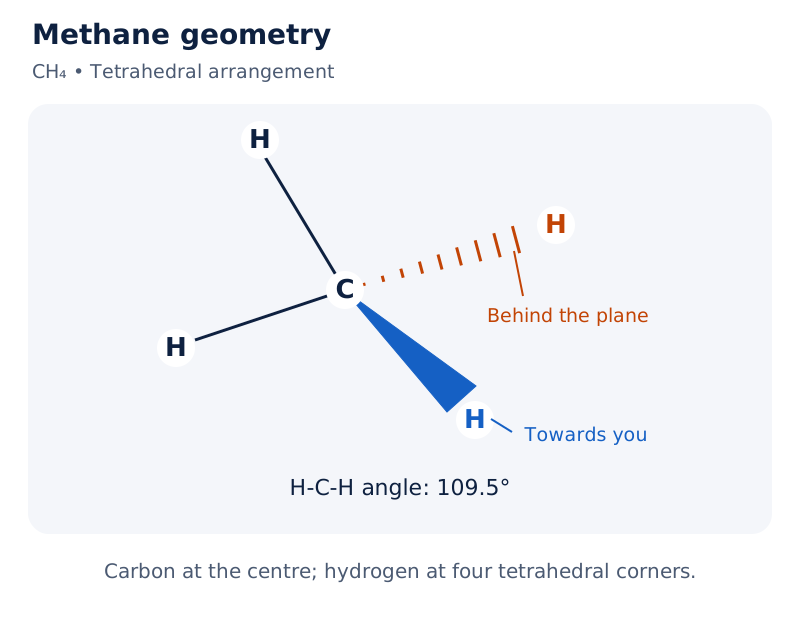
The drawing places a carbon atom inside a tetrahedral arrangement of four labelled hydrogen atoms, showing the three-dimensional orientation of its four bonds.
Drawn by One Young India. See Fig. 9.1 in your NCERT textbook
Naming and chain isomerism
Chain isomers have the same molecular formula but different carbon skeletons. Butane has two chain isomers: butane and 2-methylpropane. Pentane has three: pentane, 2-methylbutane and 2,2-dimethylpropane. Their different structures give them different physical properties.
- To construct a structure from its name, first draw the carbon chain corresponding to the parent hydrocarbon.
- Number the chain so that the substituents can be placed at their specified positions.
- Attach each substituent to the appropriate carbon atom.
- Add hydrogen atoms to satisfy the tetravalence of every carbon atom.
Worked example 1. Why is the name 2-ethylpentane incorrect? Answer: Drawing the indicated structure reveals a continuous chain of six carbon atoms. The correct parent is hexane, and the remaining methyl substituent is at carbon three. The correct name is 3-methylhexane.
How are alkanes prepared and how do their physical properties vary?
Alkanes are almost non-polar because the electronegativity difference between carbon and hydrogen is small. They have weak van der Waals attractions. They are colourless and odourless, and their non-polar nature explains their association with non-polar solvents rather than water.
At , the first four members are gases, members with five to seventeen carbon atoms are liquids, and those with eighteen or more carbon atoms are solids. Here K denotes kelvin, the unit of thermodynamic temperature.
Boiling point generally increases with molecular mass because molecular size and intermolecular attractions increase. Branching reduces contact between molecules and lowers boiling point among isomers. Pentane therefore boils at a higher temperature than the more compact 2,2-dimethylpropane.
Hydrogenation and coupling
Hydrogenation adds dihydrogen to unsaturated hydrocarbons using finely divided platinum, palladium or nickel. Platinum and palladium work at room temperature; nickel requires relatively higher temperature and pressure. An alkene needs one molecule of hydrogen to saturate its double bond.
Alkyl halides, except fluorides, can be reduced with zinc and dilute hydrochloric acid. In the Wurtz reaction, sodium couples alkyl halides in dry ether. Using the same alkyl halide gives a higher alkane with an even number of carbon atoms.
Removing the carboxyl carbon
Decarboxylation of a sodium carboxylate with soda lime gives an alkane containing one carbon atom fewer than the parent acid. Soda lime is a mixture of sodium hydroxide and calcium oxide; heating is required.
Worked example 2. Which sodium carboxylate gives propane on heating with soda lime? Answer: Sodium butanoate is required. Butanoic acid has four carbon atoms, while propane has three, consistent with loss of the carboxyl carbon in decarboxylation.
In Kolbe electrolysis, an aqueous sodium or potassium carboxylate gives an even-carbon alkane at the anode. Carboxylate-derived radicals lose carbon dioxide, and the resulting alkyl radicals combine. Sodium ethanoate gives ethane. Methane cannot be prepared by this method.
How do alkanes undergo substitution, combustion and other reactions?
Alkanes are generally inert towards acids, bases, oxidising agents and reducing agents under ordinary conditions. Their chemical reactions require appropriate conditions. Halogenation replaces hydrogen atoms with halogen atoms and can proceed in diffused sunlight, ultraviolet light or at high temperature.
Free radical chlorination of methane
The chlorination mechanism is described as a free radical chain reaction. A dot denotes an unpaired electron on a radical. The following numbered stages distinguish radical production, chain continuation and radical removal.
- Initiation: Light causes homolytic cleavage of chlorine. Each chlorine atom receives one electron from the bond.
- Propagation, first reaction: A chlorine radical removes hydrogen from methane, producing hydrogen chloride and a methyl radical.
- Propagation, second reaction: The methyl radical attacks another chlorine molecule. Chloromethane forms and a chlorine radical is regenerated.
- Termination: Two radicals combine without generating another radical. The chain can terminate through chlorine formation, ethane formation or chloromethane formation.
Further substitution can produce dichloromethane, trichloromethane and tetrachloromethane. The rate of reaction with halogens decreases from fluorine to chlorine to bromine to iodine. Fluorination is too violent to control easily, while iodination is very slow and reversible.
Combustion and controlled reactions
Complete combustion produces carbon dioxide and water with considerable heat release. For an alkane with carbon atoms, the balanced equation is:
Insufficient oxygen can produce carbon black during incomplete combustion. Controlled oxidation with a regulated oxygen supply and suitable catalysts gives other products. Methane, for example, forms methanol using copper at and , where atm denotes atmosphere, a pressure unit.
| Reaction | Conditions | Change |
|---|---|---|
| Isomerisation | Heat, anhydrous aluminium chloride and hydrogen chloride | Normal alkanes give branched-chain isomers |
| Aromatisation | Six or more carbons; , , suitable metal oxides on alumina | Dehydrogenation and cyclisation give benzene or its homologues |
| Reaction with steam | Methane, nickel catalyst and | Carbon monoxide and dihydrogen form |
| Pyrolysis | High temperature | Higher alkanes split into smaller alkanes, alkenes and other products |
Why does ethane have different conformations?
A sigma bond, represented by , forms by head-on orbital overlap. Its electron distribution is symmetrical around the internuclear axis. Rotation about the carbon-carbon sigma bond produces different spatial arrangements without changing which atoms are bonded to one another.
Definition: Conformations, also called conformers or rotamers, are spatial arrangements interconverted by rotation about a carbon-carbon single bond.
Ethane has infinitely many conformations. Its two extreme arrangements are eclipsed and staggered. In the eclipsed arrangement, hydrogens on neighbouring carbons are as close together as possible. In the staggered arrangement, they are as far apart as possible. Intermediate arrangements are called skew conformations.
Representing the molecule
What the figure shows
Ethane projections
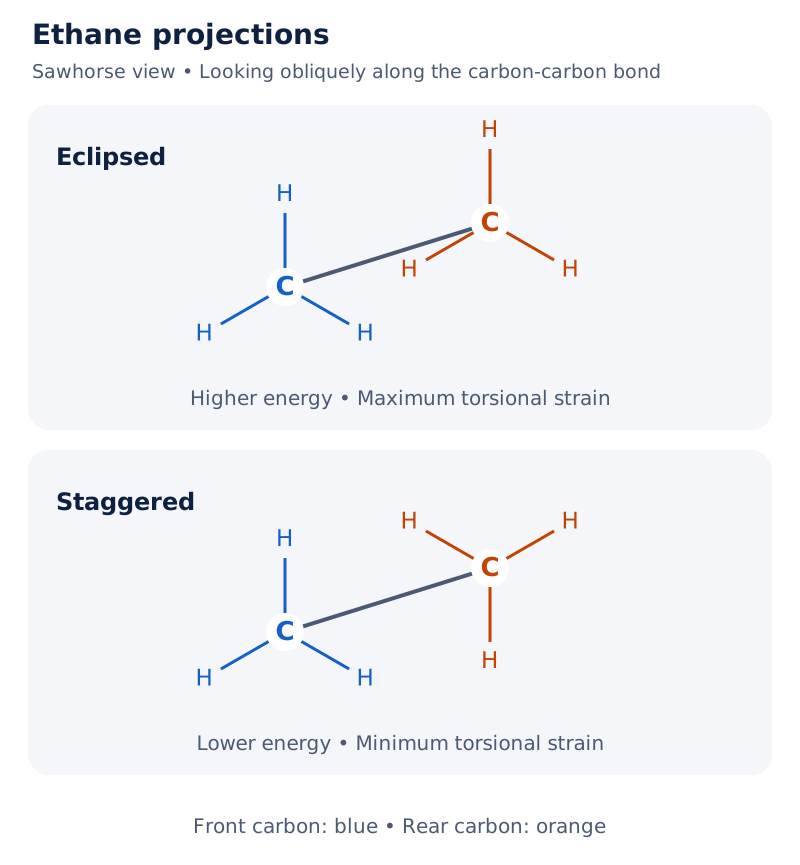
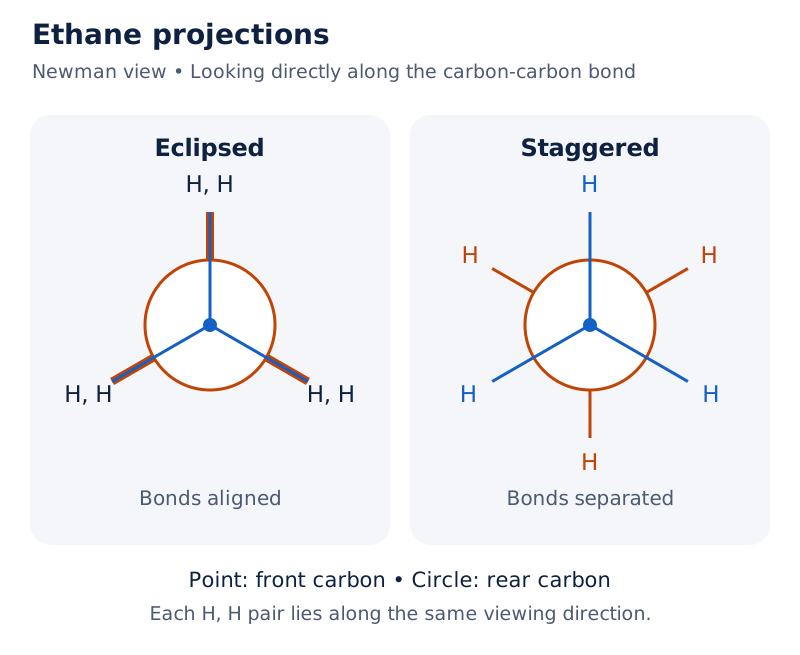
The sawhorse drawings show an oblique carbon-carbon bond with three carbon-hydrogen bonds at each end. The Newman drawings show a central point and a circle, with carbon-hydrogen bonds aligned in the eclipsed view and separated in the staggered view.
Drawn by One Young India. See Figs. 9.2 and 9.3 in your NCERT textbook
In a Newman projection, the molecule is viewed along the carbon-carbon bond. The front carbon is a point and the rear carbon a circle. Three lines represent the covalent carbon-hydrogen bonds from each carbon. A sawhorse projection shows both carbons along an inclined bond.
Comparing stability
| Feature | Staggered ethane | Eclipsed ethane |
|---|---|---|
| Adjacent bond electron clouds | Farther apart | Closer together |
| Torsional strain | Minimum | Maximum |
| Energy and stability | Lower energy, greater stability | Higher energy, lower stability |
Torsional strain is the repulsive interaction between adjacent bond electron clouds. Its magnitude depends on the dihedral or torsional angle. Bond lengths and bond angles remain unchanged between conformations; their relative spatial arrangement changes.
The energy difference between eclipsed and staggered ethane is of the order of , meaning kilojoules per mole. Ordinary thermal motion can overcome this small barrier. Rotation is therefore almost free for practical purposes, but it is not completely barrier-free.
How do alkene bonding and isomerism differ from those of alkanes?
The carbon-carbon double bond contains one sigma bond and one pi bond, represented by . In ethene, each carbon has hybridisation: one s orbital and two p orbitals combine to form three hybrid orbitals. The remaining unhybridised p orbital forms the pi bond.
Head-on overlap of hybrid orbitals produces the carbon-carbon sigma bond. Sideways overlap of the remaining p orbitals produces the weaker pi bond. Loosely held pi electrons make alkenes susceptible to attack by electrophiles, reagents seeking electrons.
What the figure shows
Orbital overlap in ethene
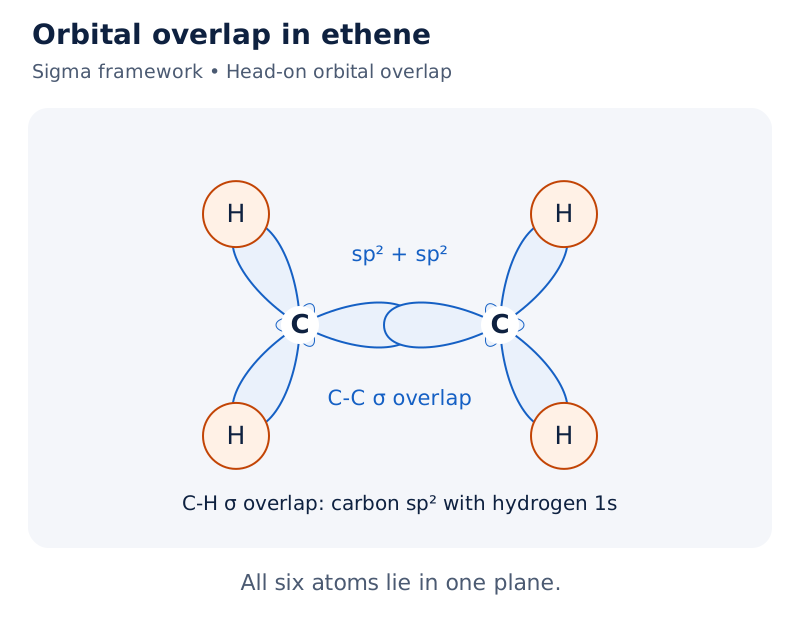
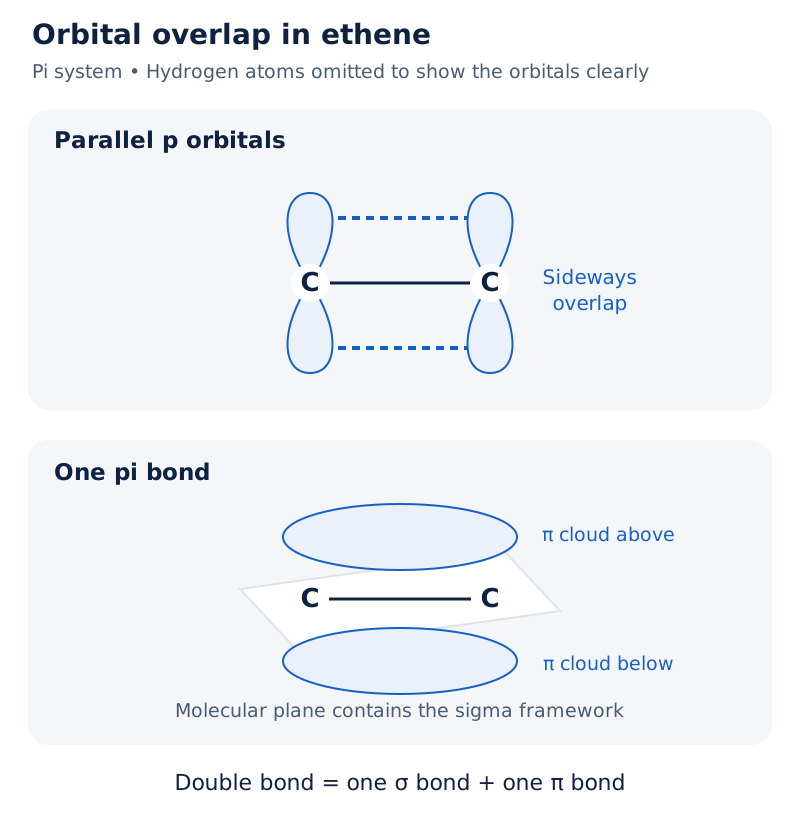
The sigma-bond picture shows carbon hybrid orbitals overlapping with each other and with hydrogen orbitals. The next picture shows parallel p orbitals, sideways overlap and a pi cloud above and below the molecular plane.
Drawn by One Young India. See Figs. 9.4 and 9.5 in your NCERT textbook
Naming and structural isomers
Select the longest chain containing the double bond, number from the nearer end and replace the alkane suffix with -ene. Structural isomers may differ in carbon skeleton or in the position of the double bond.
| Condensed structure | Name | Relationship |
|---|---|---|
| But-1-ene | Position isomer of but-2-ene | |
| But-2-ene | Double bond at the second carbon | |
| 2-Methylprop-1-ene | Chain isomer of the unbranched butenes |
Geometrical isomerism
Geometrical isomerism results from restricted rotation about a double bond. Each doubly bonded carbon must carry two different atoms or groups. In cis-but-2-ene the methyl groups lie on the same side; in trans-but-2-ene they lie on opposite sides.
The two isomers have the same connectivity but different spatial configurations. They can differ in melting point, boiling point, dipole moment and solubility. In trans-but-2-ene, opposing bond dipoles cancel, making its dipole moment almost zero.
Worked example 3. Does show cis-trans isomerism? Answer: No. One double-bonded carbon has two identical hydrogen atoms, while the other has two identical bromine atoms. The requirement for two different groups on each carbon is not satisfied.
How are alkenes prepared?
Alkenes can be obtained by partial reduction of alkynes or by elimination from suitable saturated compounds. The method and conditions determine whether a double bond is formed, whether reduction continues, and which geometrical arrangement is obtained where geometrical isomerism is possible.
Partial reduction of alkynes
Lindlar’s catalyst is palladised charcoal partially deactivated with a poison such as a sulphur compound or quinoline. A calculated amount of hydrogen gives an alkene. Where cis-trans alternatives exist, this reduction gives the cis alkene.
Reduction of an alkyne with sodium in liquid ammonia gives the trans alkene. These stereochemical descriptions do not apply to every product: propene cannot have cis and trans forms because its terminal double-bonded carbon carries two hydrogen atoms.
Eliminating small molecules
| Starting material | Reagent or condition | Reaction |
|---|---|---|
| Alkyl halide | Heat with alcoholic potassium hydroxide | Dehydrohalogenation removes hydrogen halide |
| Vicinal dihalide | Zinc metal | Dehalogenation removes halogens from neighbouring carbons |
| Alcohol | Heat with concentrated sulphuric acid | Dehydration removes water |
In dehydrohalogenation, hydrogen is removed from a beta carbon, the carbon adjacent to the carbon bearing the halogen. The elimination produces a double bond. The rate depends on both the halogen and the alkyl group.
A vicinal dihalide has its halogen atoms on neighbouring carbon atoms. Zinc treatment of 1,2-dibromoethane forms ethene:
Acidic dehydration of an alcohol removes water and forms an alkene. This is also a beta-elimination: the hydroxyl group and a hydrogen on the neighbouring carbon are removed. Dehydration, dehydrohalogenation and dehalogenation should be distinguished by what leaves the starting material.
Alkenes broadly resemble alkanes in physical properties. They are insoluble in water but fairly soluble in non-polar solvents. Their boiling points rise with increasing molecular size, and straight-chain members have higher boiling points than their branched-chain isomers.
How do Markovnikov addition and the peroxide effect work?
Addition reactions use the electron-rich double bond to form new sigma bonds. Hydrogen adds with platinum, palladium or nickel. Bromine and chlorine form vicinal dihalides. Bromine solution in carbon tetrachloride loses its reddish orange colour when it adds across an unsaturated bond.
Hydrogen chloride, hydrogen bromide and hydrogen iodide add to alkenes to give alkyl halides. Their reactivity decreases in the order hydrogen iodide, hydrogen bromide, hydrogen chloride. With an unsymmetrical alkene, the orientation of addition becomes important.
Markovnikov addition to propene
Markovnikov’s rule states that the negative part of the adding molecule attaches to the double-bonded carbon with fewer hydrogen atoms. Thus, ordinary addition of HBr to propene gives 2-bromopropane as the principal product.
- Hydrogen bromide supplies the electrophile , a proton, which attacks the electron-rich double bond.
- Attachment of the proton to the terminal carbon produces the secondary carbocation .
- This secondary carbocation forms faster than the alternative, less stable primary carbocation and therefore predominates.
- The bromide ion, , attacks the carbocation to give 2-bromopropane as the major product.
HBr in the presence of peroxide
The peroxide effect, also called the Kharash effect, reverses the orientation of HBr addition to an unsymmetrical alkene. The pathway is a free radical chain mechanism, and propene gives 1-bromopropane as the major product.
- Peroxide undergoes homolytic cleavage, initiating radical formation. Benzoyl peroxide can produce radicals that subsequently generate bromine radicals from HBr.
- A bromine radical adds to the terminal carbon of propene, leaving the more stable secondary carbon radical.
- That radical abstracts hydrogen from HBr, producing 1-bromopropane and regenerating a bromine radical.
- The regenerated bromine radical continues the chain. Formation of the more stable secondary radical explains the major product.
Note: The peroxide effect is observed with HBr, not with HCl or HI. Do not reverse Markovnikov orientation for every hydrogen halide simply because peroxide is present.
Worked example 4. Predict HBr addition products of , hex-1-ene. Answer: Without peroxide, the major product is 2-bromohexane. With peroxide, it is 1-bromohexane. The change in conditions changes the reaction mechanism and hence the orientation.
How do oxidation, ozonolysis and polymerisation transform alkenes?
Alkenes undergo more than hydrogen and halogen addition. Their double bonds also react with sulphuric acid and water, undergo oxidation, or link monomer molecules into polymers. Keeping the reagent and conditions with each transformation is essential because similar starting materials can give different products.
Addition of sulphuric acid and water
Cold concentrated sulphuric acid adds according to Markovnikov’s rule to form alkyl hydrogen sulphates. Water adds in the presence of a few drops of concentrated sulphuric acid to form alcohols, again following Markovnikov orientation.
For example, hydration of 2-methylpropene gives 2-methylpropan-2-ol. The acid provides the conditions for addition; simply mixing an alkene with water is not the same procedure.
Mild oxidation and cleavage
Baeyer’s reagent is cold, dilute aqueous potassium permanganate solution. It oxidises alkenes to vicinal glycols, compounds with hydroxyl groups on neighbouring carbons. Decolourisation of the permanganate solution provides a test for unsaturation.
More vigorous oxidation using acidic potassium permanganate or acidic potassium dichromate gives ketones and/or acids, depending on the alkene and experimental conditions. But-2-ene yields ethanoic acid on oxidation with acidic potassium permanganate.
Ozonolysis first adds ozone to an alkene to form an ozonide. Treatment with zinc and water then cleaves the ozonide to smaller molecules. Identifying these products helps locate the original double bond.
- Identify the two carbons of the starting double bond.
- Follow ozone addition to the ozonide intermediate.
- Apply zinc-water cleavage to obtain carbonyl products.
- Compare the products with the groups originally attached to the double-bonded carbons.
Propene, , yields ethanal and methanal. In contrast, 2-methylpropene, , gives propan-2-one and methanal. These products distinguish the different arrangements around their double bonds.
Building polymers
In polymerisation, many small monomer molecules combine to form a large polymer. Ethene forms polythene at high temperature and pressure in the presence of a catalyst. In this equation, denotes the number of ethene units incorporated into the polymer chain.
Propene similarly forms polypropene. Polythene is used in articles such as bags, bottles and pipes. Polypropene is used for milk crates, buckets and other moulded articles. Excessive use of these plastics is a matter of concern.
How do the structure and reactions of alkynes explain their behaviour?
Alkynes contain at least one carbon-carbon triple bond. Their names use the suffix -yne and identify the first carbon of the triple bond. But-1-yne and but-2-yne are position isomers. Pent-1-yne and 3-methylbut-1-yne differ in their carbon skeletons.
Triple-bond structure and preparation
In ethyne, carbon is hybridised, meaning one s orbital and one p orbital combine. The triple bond contains one sigma and two pi bonds. The molecule is linear, with a hydrogen-carbon-carbon angle of .
What the figure shows
Bonding in ethyne
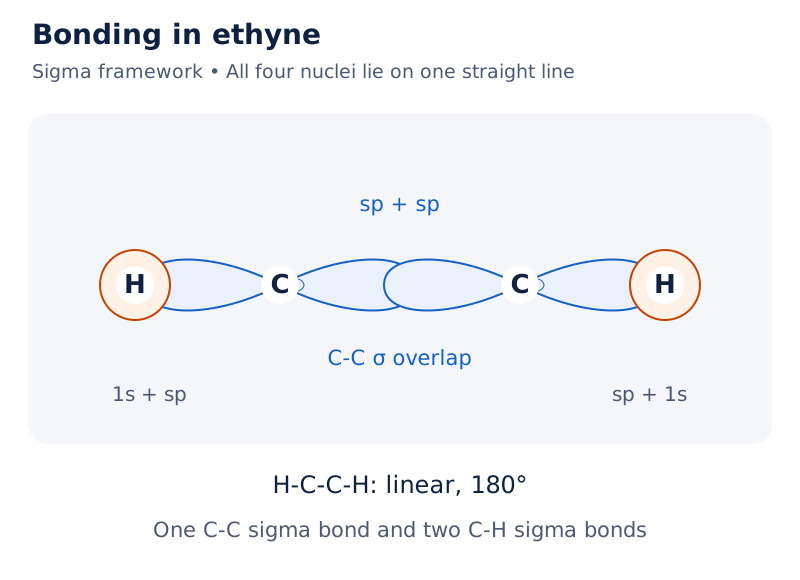
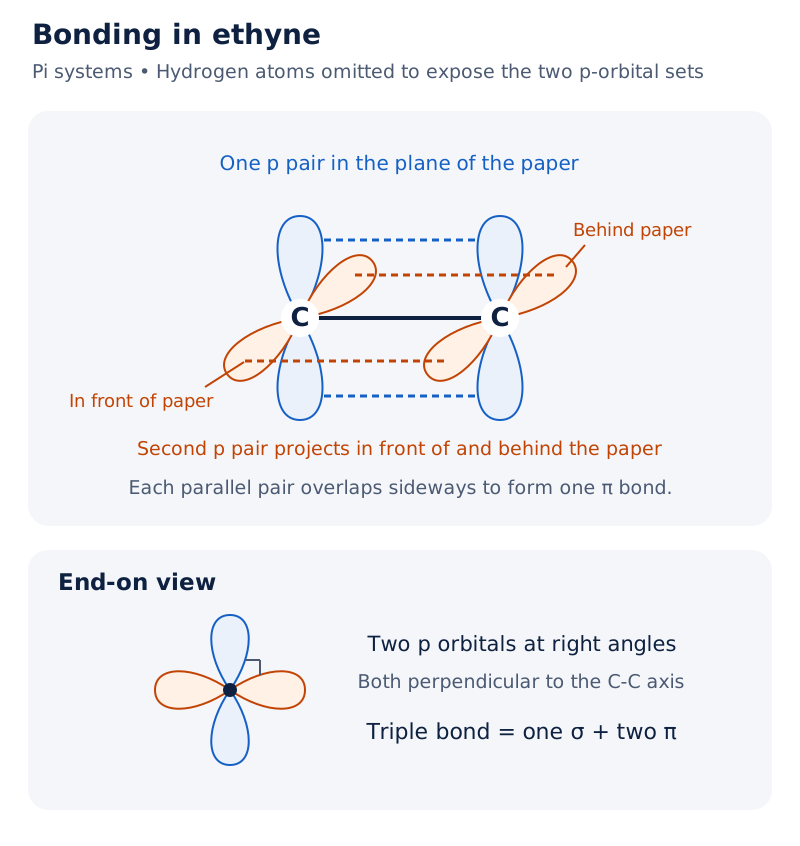
The upper drawing shows head-on sigma overlaps along the hydrogen-carbon-carbon-hydrogen line. The lower drawing shows two sets of p orbitals and pi overlaps in perpendicular orientations, with positions relative to the paper labelled.
Drawn by One Young India. See Fig. 9.6 in your NCERT textbook
Ethyne is prepared by reacting calcium carbide with water. Calcium carbide is obtained by heating quicklime with coke. Another route uses successive dehydrohalogenation of a vicinal dihalide: alcoholic potassium hydroxide first gives an alkenyl halide, then sodamide gives an alkyne.
Why terminal hydrogen is acidic
Terminal alkynes have hydrogen directly attached to a triply bonded carbon. An orbital has s character, making that carbon more electronegative than an alkene or alkane carbon. It attracts the shared electron pair more strongly, allowing proton loss more readily.
The acidity applies to hydrogen attached directly to the triply bonded carbon, not to every hydrogen in an alkyne. Propyne reacts with sodamide to form sodium propynide and ammonia. But-2-yne has no terminal alkyne hydrogen for this reaction.
Addition and polymerisation
Alkynes can add two molecules of hydrogen, halogen or hydrogen halide across a triple bond. Two hydrogen halide molecules give geminal dihalides, in which both halogens occupy the same carbon. Addition to unsymmetrical alkynes follows Markovnikov’s rule.
Warming ethyne with water, mercuric sulphate and dilute sulphuric acid at gives ethanal; propyne gives propanone. These conditions matter because alkynes do not react with water alone.
Ethyne undergoes linear polymerisation to polyacetylene, which conducts electricity under special conditions. Passing ethyne through a red-hot iron tube at causes cyclic polymerisation to benzene.
Why is benzene aromatic and unusually stable?
Arenes are aromatic hydrocarbons. Compounds containing benzene rings are benzenoid; aromatic compounds without benzene rings are non-benzenoid. Benzene has the formula C₆H₆, yet its behaviour differs from that expected for an ordinary compound with three localised double bonds.
Evidence and resonance
All six hydrogen atoms in benzene are equivalent, so benzene forms one type of monosubstituted derivative. Disubstitution gives three positional patterns: ortho at positions 1,2, meta at 1,3 and para at 1,4.
Kekulé structures represent a six-carbon ring with alternating single and double bonds. They do not individually explain benzene’s unusual stability or its preference for substitution. The actual molecule is a resonance hybrid, with the two Kekulé structures as major contributors.
Each carbon has hybridisation and contributes an unhybridised p orbital perpendicular to the ring. These p orbitals overlap around the ring. The six pi electrons are delocalised over all six carbon atoms instead of being confined to three separate carbon pairs.
What the figure shows
Delocalisation in benzene
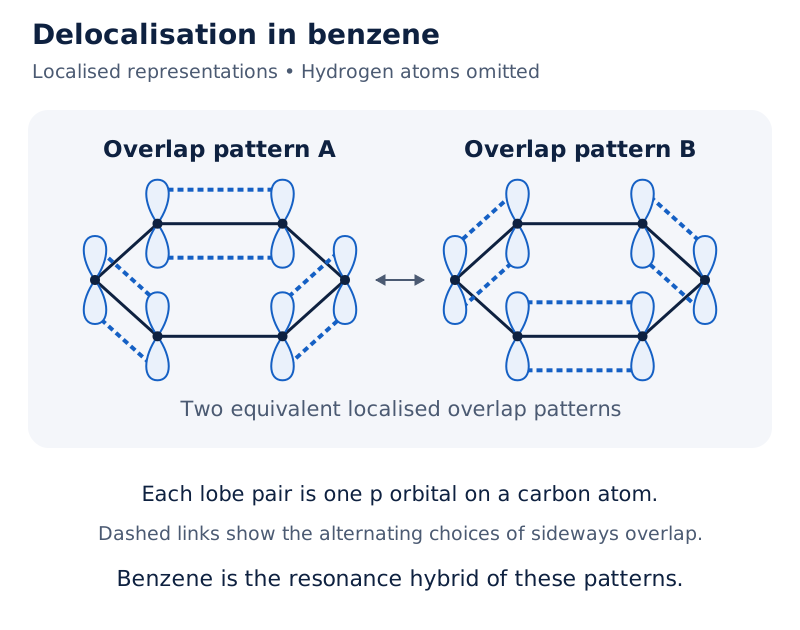
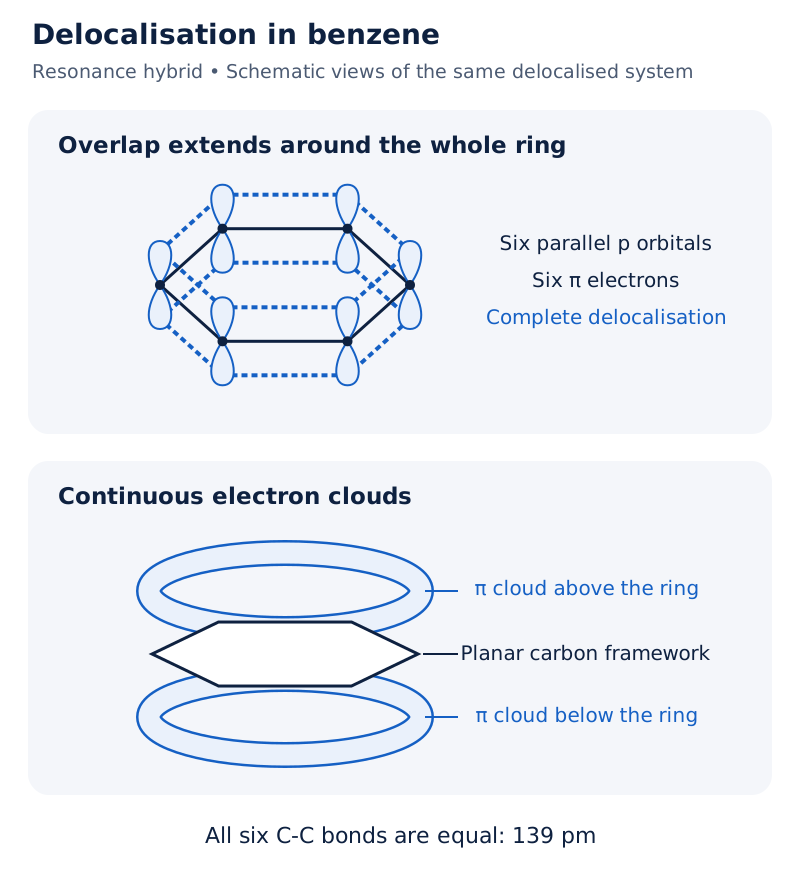
Parts (a) and (b) show two alternating patterns of p-orbital overlap. Part (c) shows overlap around the ring, and part (d) represents electron clouds as rings above and below the hexagonal framework.
Drawn by One Young India. See Fig. 9.7 in your NCERT textbook
Benzene is planar. All six carbon-carbon bond lengths are , where pm denotes picometres. Their equal intermediate length supports delocalisation. The delocalised electron cloud stabilises benzene and explains its reluctance to undergo addition under normal conditions.
Conditions for aromaticity
Hückel’s rule is applied together with planarity and complete cyclic delocalisation. The pi-electron count must fit , where is a non-negative integer: . Electron counting alone is insufficient if the other conditions are absent.
Benzene has six pi electrons, satisfying . Naphthalene has ten, satisfying . These are dimensionless electron counts. A benzene ring is not a compulsory feature of every aromatic system.
Benzene preparation includes cyclic polymerisation of ethyne, heating sodium benzoate with soda lime, and passing phenol vapour over heated zinc dust. Commercially, benzene is isolated from coal tar.
How does benzene undergo electrophilic substitution?
Aromatic hydrocarbons are non-polar, usually colourless liquids or solids, and immiscible with water. They mix readily with organic solvents and burn with a sooty flame. Their characteristic chemical reactions are electrophilic substitutions, although addition and oxidation occur under special conditions.
Reagents and products
| Reaction | Reagents and conditions | Product from benzene |
|---|---|---|
| Nitration | Concentrated nitric and sulphuric acids, heat | Nitrobenzene |
| Halogenation | Chlorine and anhydrous aluminium chloride | Chlorobenzene |
| Sulphonation | Fuming sulphuric acid, heat | Benzenesulphonic acid |
| Friedel-Crafts alkylation | Chloromethane and anhydrous aluminium chloride | Toluene |
| Friedel-Crafts acylation | Acetyl chloride and anhydrous aluminium chloride | Acetophenone |
Nitration introduces a nitro group; alkylation introduces an alkyl group. Acylation introduces an acyl group containing a carbonyl. The following equations distinguish these transformations and include the necessary catalyst or acid conditions.
The three-stage mechanism
Let denote the attacking electrophile, a species seeking electrons. Electrophilic substitution is described through generation of this electrophile, formation of a carbocation intermediate and loss of a proton.
- Generate the electrophile. In nitration, sulphuric acid protonates nitric acid; loss of water then gives the nitronium ion, .
- Form the arenium ion. The ring attacks the electrophile, producing a resonance-stabilised carbocation called a sigma complex. One carbon becomes hybridised, interrupting cyclic delocalisation, so the intermediate is not aromatic.
- Remove a proton. A base removes the proton from that carbon, restoring the aromatic system. In nitration, hydrogen sulphate ion accepts the proton. The overall outcome replaces ring hydrogen while restoring aromaticity.
Under vigorous conditions with nickel, benzene adds hydrogen to give cyclohexane. Under ultraviolet light, chlorine adds to form benzene hexachloride. These addition conditions differ from halogenation with a Lewis acid catalyst, which gives substitution.
How do substituents direct reactions, and what toxicity is associated with hydrocarbons?
When a monosubstituted benzene undergoes further substitution, the three positional products generally do not form equally. The group already attached controls the directive influence, determining whether ortho and para products or the meta product predominate.
Activation and orientation
The hydroxyl group in phenol increases electron density at ortho and para positions through resonance. Although its electron-withdrawing inductive effect also operates, the overall result activates these positions towards electrophilic attack. Phenol is therefore ortho- and para-directing.
An inductive effect withdraws or donates electron density through bonds. The symbol denotes an electron-withdrawing inductive effect. Resonance effects redistribute electron density through the conjugated system and must be considered alongside induction.
| Group or example | Effect on further substitution | Preferred positions |
|---|---|---|
| Hydroxyl group in phenol | Activating overall | Ortho and para |
| Methyl group in toluene | Activating | Ortho and para |
| Halogen in an aryl halide | Moderately deactivating | Ortho and para |
| Nitro group in nitrobenzene | Deactivating | Meta |
Halogens are an important exception to the association between activation and ortho/para direction. Their strong negative inductive effect lowers overall ring electron density. Nevertheless, resonance makes ortho and para positions relatively richer in electrons than the meta position.
The nitro group strongly withdraws electron density. In nitrobenzene, ortho and para positions are comparatively less electron-rich than meta positions, so further electrophilic substitution is difficult and occurs predominantly at a meta position.
Carcinogenicity
Benzene and polynuclear hydrocarbons containing more than two fused benzene rings are toxic and are described as possessing cancer-producing properties. Such polynuclear compounds arise during incomplete combustion of organic materials such as tobacco, coal and petroleum.
After entering the body, these compounds undergo biochemical reactions that can damage DNA and cause cancer. The term carcinogenic refers to cancer-producing ability. This toxicity is a separate property from whether a substance is aromatic or useful as a fuel or industrial starting material.
Glossary
- Hydrocarbon — A compound containing carbon and hydrogen only, classified by its carbon skeleton and bonding.
- Alkane — A saturated open-chain hydrocarbon containing carbon-carbon single bonds and carbon-hydrogen bonds.
- Chain isomerism — Structural isomerism in which compounds share a molecular formula but have different carbon skeletons.
- Conformation — A spatial arrangement that can interconvert with another through rotation about a single bond.
- Torsional strain — Repulsion between adjacent bond electron clouds that affects the relative stability of conformations.
- Geometrical isomerism — Different spatial configurations arising from restricted rotation around a suitably substituted carbon-carbon double bond.
- Electrophile — An electron-seeking reagent that attacks an electron-rich region during a chemical reaction.
- Homolysis — Bond cleavage in which each bonded atom receives one electron, giving free radicals.
- Vicinal dihalide — A compound having two halogen atoms attached to two adjacent carbon atoms.
- Geminal dihalide — A compound having two halogen atoms attached to the same carbon atom.
- Ozonolysis — Addition of ozone followed by ozonide cleavage to identify products related to the original double bond.
- Arenium ion — The carbocation intermediate in aromatic electrophilic substitution, containing one carbon with interrupted cyclic delocalisation.
- Directive influence — The effect of an existing ring substituent on the preferred position of further substitution.
- Carcinogenicity — The cancer-producing property associated with benzene and certain fused-ring polynuclear hydrocarbons.
Common errors and misconceptions
- Misconception: Rotation about ethane’s carbon-carbon bond is completely free. Correct: A small torsional energy barrier separates conformations, though ordinary thermal energy permits ready interconversion.
- Misconception: Every alkene shows cis-trans isomerism. Correct: Each double-bonded carbon must have two different atoms or groups attached.
- Misconception: Peroxide reverses addition of every hydrogen halide. Correct: The peroxide effect applies to HBr, not HCl or HI.
- Misconception: Every hydrogen atom in an alkyne is acidic. Correct: The relevant acidic hydrogens are attached directly to triply bonded carbon atoms.
- Misconception: Benzene has three permanently localised double bonds. Correct: Its six pi electrons are delocalised and all six carbon-carbon bond lengths are equal.
- Misconception: Every ortho/para director activates benzene. Correct: Halogens direct ortho/para while deactivating the ring overall.
- Misconception: Dehydration and dehydrohalogenation remove the same substance. Correct: Dehydration removes water; dehydrohalogenation removes hydrogen halide.
Exam-style questions with model answers
Q1. Define chain isomerism and name both chain isomers of C₄H₁₀. [2 marks]
- Chain isomerism occurs when compounds have the same molecular formula but different arrangements of their carbon skeleton.
- The two chain isomers of C₄H₁₀ are butane and 2-methylpropane, which have straight and branched carbon chains respectively.
Q2. Explain the formation of ethane during chlorination of methane under light. [3 marks]
- Light causes homolytic cleavage of chlorine molecules, producing chlorine radicals that initiate a free radical chain reaction.
- A chlorine radical abstracts hydrogen from methane to produce a methyl radical and hydrogen chloride: .
- Two methyl radicals can combine during termination: . This consumes radicals without regenerating them and explains ethane as a byproduct.
Q3. Give three reasons why staggered ethane is more stable than eclipsed ethane. [3 marks]
- In staggered ethane, the hydrogen atoms attached to adjacent carbon atoms are as far apart as possible, unlike the closer arrangement in eclipsed ethane.
- This arrangement keeps neighbouring carbon-hydrogen bond electron clouds farther apart, reducing electron-cloud repulsion and giving minimum torsional strain.
- Reduced repulsion gives the staggered conformation lower energy and greater stability. The eclipsed conformation has maximum torsional strain and correspondingly higher energy.
Q4. Explain the major products when propene reacts with HBr without peroxide and with peroxide. Include the intermediates responsible for orientation. [5 marks]
- Without peroxide, propene undergoes electrophilic addition of HBr and gives 2-bromopropane as its major product, following Markovnikov’s rule.
- The proton adds preferentially so that a secondary carbocation forms. This intermediate is more stable than the alternative primary carbocation and is formed faster.
- Bromide attacks the secondary carbocation, completing formation of 2-bromopropane, with bromine attached to the middle carbon atom.
- With peroxide, addition follows a free radical chain mechanism. Bromine radical addition at the terminal carbon produces the more stable secondary carbon radical.
- This radical abstracts hydrogen from HBr, giving 1-bromopropane and regenerating a bromine radical. The peroxide effect is specific to HBr among these hydrogen halides.
Q5. Explain why propyne reacts with sodamide whereas but-2-yne lacks the corresponding terminal-hydrogen reaction. Write the propyne equation. [3 marks]
- Propyne contains hydrogen directly attached to an -hybridised carbon. The high s character makes this carbon attract the shared electron pair strongly, allowing proton removal more readily.
- Sodamide removes this hydrogen, forming sodium propynide and ammonia: .
- But-2-yne has carbon groups attached to both triply bonded carbons. It has no terminal alkyne hydrogen, so it cannot undergo this corresponding proton-removal reaction.
Q6. Explain benzene’s stability using hybridisation, delocalisation and bond lengths, and state all three aromaticity conditions. [5 marks]
- Each carbon in benzene is hybridised, forming a planar sigma framework and retaining one unhybridised p orbital perpendicular to the ring.
- These p orbitals overlap around the ring, delocalising six pi electrons over the six carbon atoms and stabilising the molecule.
- All six carbon-carbon bond lengths are equal at , intermediate between typical single and double bonds, consistent with the resonance hybrid.
- An aromatic system must be planar and allow complete delocalisation of pi electrons around the ring. Both structural conditions must be satisfied.
- It must also contain pi electrons, where is a non-negative integer. Benzene satisfies this count with and six pi electrons.
Q7. Describe the three main stages in electrophilic nitration of benzene using concentrated nitric and sulphuric acids. [3 marks]
- Sulphuric acid protonates nitric acid. The protonated nitric acid loses water, generating the attacking electrophile, the nitronium ion, .
- Benzene attacks the electrophile to produce a resonance-stabilised arenium ion. One carbon becomes hybridised, so cyclic delocalisation is interrupted and the intermediate loses aromaticity.
- Hydrogen sulphate ion removes the proton from this carbon. Aromaticity is restored, giving nitrobenzene as the substitution product.
Q8. Explain why chlorine is deactivating but ortho/para-directing in chlorobenzene. [2 marks]
- Chlorine’s strong electron-withdrawing inductive effect lowers the overall electron density of the ring, making further electrophilic substitution more difficult.
- Resonance nevertheless makes ortho and para positions relatively more electron-rich than meta positions, so substitution is directed mainly to ortho and para.
Key takeaways
- Hydrocarbon classification connects the carbon skeleton and bond types with the reactions expected from each family.
- Alkanes mainly undergo substitution under suitable conditions, and methane chlorination illustrates initiation, propagation and termination.
- Staggered ethane is more stable because adjacent bond electron clouds experience less repulsion and torsional strain.
- Alkene geometrical isomerism requires restricted rotation and two different substituents on each double-bonded carbon.
- HBr normally follows Markovnikov orientation, but peroxide introduces a radical pathway giving the opposite major orientation.
- Terminal alkyne acidity concerns hydrogen directly bonded to an -hybridised carbon, rather than every hydrogen present.
- Benzene’s planar delocalised electron system explains equal bond lengths, unusual stability and preference for electrophilic substitution.
- Substituent activation and positional direction are distinct: halogens deactivate benzene while directing further substitution ortho and para.
Test yourself
What does heating sodium butanoate with soda lime produce?
It produces propane, an alkane with one fewer carbon atom than the parent carboxylic acid.
What is the difference between a vicinal and a geminal dihalide?
A vicinal dihalide has halogens on neighbouring carbons; a geminal dihalide has both on the same carbon.
Why does propene lack cis-trans isomerism?
Its terminal double-bonded carbon has two identical hydrogen atoms, so the required substituent difference is absent.
Which alkene geometry is obtained using sodium in liquid ammonia to reduce a suitable alkyne?
The reduction gives a trans alkene when the product can exhibit geometrical isomerism.
Which products result from propene ozonolysis followed by zinc and water?
Ethanal and methanal form when the ozonide is cleaved by zinc and water.
Why is the arenium intermediate not aromatic?
One carbon is hybridised, interrupting complete cyclic delocalisation of the ring’s pi electrons.
How can ethyne be converted directly into benzene?
Pass ethyne through a red-hot iron tube at ; three molecules undergo cyclic polymerisation.
Why is nitrobenzene mainly meta-directing?
The nitro group withdraws electrons, leaving ortho and para positions comparatively less electron-rich than meta positions.