
Redox Reactions | CBSE Class 11 Chemistry Notes
On this page
Watch & explore
Start with a few high-quality watches, then dive into the notes below.
This note covers classical oxidation and reduction, electron transfer, competitive reactions, oxidation numbers and their exceptions, types of redox reactions, balancing by oxidation number and half-reaction methods, redox titrations, redox couples and electrode processes.
What do oxidation and reduction mean in the classical approach?
Definition: A redox reaction involves oxidation and reduction occurring simultaneously. The classical approach recognises these changes through the addition or removal of oxygen, hydrogen, electronegative elements or electropositive elements.
How did the definitions develop?
Oxidation originally meant addition of oxygen. Burning magnesium and sulphur illustrate this meaning. In equations, the state symbols , , and mean solid, liquid, gas and aqueous solution respectively.
The meaning widened to include removal of hydrogen. Hydrogen sulphide loses hydrogen when it reacts with oxygen to form sulphur and water. Magnesium reacting with chlorine shows why addition of an electronegative element also counts as oxidation, even without oxygen.
| Change being considered | Oxidation | Reduction |
|---|---|---|
| Oxygen | Addition to a substance | Removal from a substance |
| Hydrogen | Removal from a substance | Addition to a substance |
| Electronegative element | Addition to a substance | Removal from a substance |
| Electropositive element | Removal from a substance | Addition to a substance |
How can both changes be identified together?
Reduction is illustrated by removal of oxygen from iron oxide during its reaction with aluminium. The aluminium gains that oxygen, so it undergoes oxidation in the same reaction. One description therefore complements the other.
In the reaction between hydrogen sulphide and chlorine, hydrogen sulphide is oxidised through removal of hydrogen, while chlorine is reduced through addition of hydrogen. Identifying the change in each reactant prevents treating oxidation as an isolated event.
Redox processes include fuel combustion, corrosion, extraction of highly reactive elements and the operation of batteries. Their common feature is the paired chemical change, although the materials, conditions and practical purposes differ.
How does electron transfer explain redox reactions?
The electron-transfer approach gives a common explanation for reactions involving different elements. Oxidation is loss of electrons by a species; reduction is gain of electrons. An electron is represented by , with the superscript indicating its negative charge.
What is a half-reaction?
A half-reaction records one part of a redox process and explicitly includes electrons. Sodium chloride formation can be separated into sodium losing electrons and chlorine gaining them. These are complementary parts of the overall chemical change.
- Sodium supplies electrons through oxidation:
- Chlorine accepts those electrons through reduction:
- The overall formation of solid sodium chloride is:
An oxidising agent, or oxidant, accepts electrons and undergoes reduction. A reducing agent, or reductant, donates electrons and undergoes oxidation. The agent is named for the change it causes in the other species.
| Species behaviour | Own change | Role in the reaction |
|---|---|---|
| Donates electrons | Oxidation | Reducing agent |
| Accepts electrons | Reduction | Oxidising agent |
Why is sodium hydride formation a useful test?
Worked example 1. Explain the redox change when sodium reacts with hydrogen to form sodium hydride.
Answer: Sodium hydride contains sodium ions and hydride ions. Electron counts in the following steps are dimensionless.
- Sodium is oxidised:
- Hydrogen is reduced:
- Combining the changes gives:
Sodium is the reducing agent and hydrogen is the oxidising agent. Hydrogen gains electrons in this reaction.
Note: Addition of hydrogen is not a sufficient shortcut for identifying which reactant is reduced. In sodium hydride formation, electronegativity and electron transfer show that hydrogen itself is reduced.
What do competitive electron-transfer experiments show?
Metals differ in their tendency to release electrons. Competitive electron transfer compares this tendency by placing one metal in a solution containing ions of another. The observations reveal which direction of reaction is favoured.
What happens when zinc meets copper ions?
A zinc strip in aqueous copper nitrate may become coated with reddish copper after about one hour, while the solution's blue colour disappears. Zinc loses electrons and copper ions gain them. The net ionic equation excludes nitrate ions.
What the figure shows
Zinc in copper nitrate solution
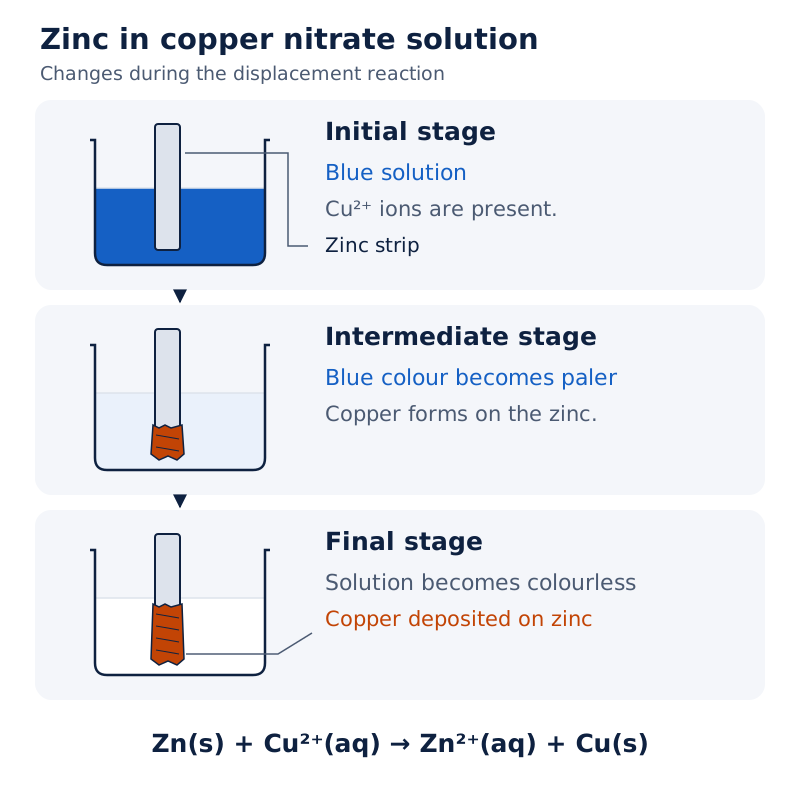
Three beakers show initial, intermediate and final stages. The blue solution becomes paler, and the final zinc rod carries a copper deposit labelled as copper deposited on zinc.
Drawn by One Young India. See Fig. 7.1 in your NCERT textbook
The reverse experiment, copper placed in zinc sulphate solution, shows no visible reaction. A sensitive hydrogen sulphide test does not detect copper ions. This supports the conclusion that equilibrium greatly favours zinc ions and copper metal over zinc metal and copper ions.
How do copper, silver, cobalt and nickel compare?
Copper placed in aqueous silver nitrate is oxidised, while silver ions are reduced. The solution develops a blue colour because copper ions form. Here too, equilibrium greatly favours the products.
What the figure shows
Copper in silver nitrate solution
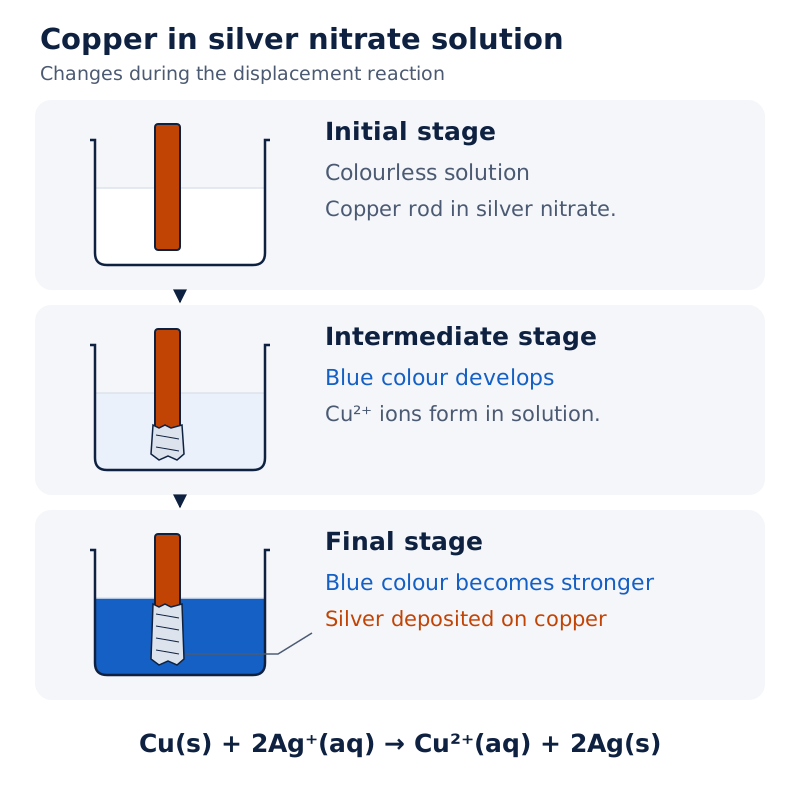
The initial beaker contains a copper rod in a colourless solution. Blue colour develops and increases in intensity through the next two stages; the final rod has a labelled silver deposit.
Drawn by One Young India. See Fig. 7.2 in your NCERT textbook
Together, the zinc and copper experiments give the electron-releasing tendency , where the greater-than sign means a greater tendency to release electrons. This comparison is also a comparison of reducing activity.
Cobalt and nickel provide a less one-sided case: . The double arrow denotes a reversible reaction. At equilibrium, both metal ions occur at moderate concentrations; neither reactants nor products are greatly favoured.
What rules determine oxidation numbers?
An oxidation number assigns an oxidation state by treating the electron pair in a covalent bond as belonging entirely to the more electronegative atom. It is a bookkeeping device for tracking electron shifts, including reactions where electron transfer is incomplete.
For example, water formation involves covalent bonding. The electron shift towards oxygen can be tracked by assigning hydrogen a positive oxidation number and oxygen a negative one. These assignments do not require complete ionic charge separation in the water molecule.
Which rules should be applied first?
| Situation | Oxidation-number rule | Example or qualification |
|---|---|---|
| Free element | Each atom has oxidation number | H₂, O₂, O₃, P₄ and elemental metals |
| Monatomic ion | Equals the signed ionic charge | : ; : |
| Alkali and alkaline earth metals in compounds | and , respectively | Aluminium is assigned in its compounds |
| Oxygen in most compounds | Check peroxides, superoxides and oxygen fluorides separately | |
| Hydrogen | Usually | in binary compounds with metals, such as NaH |
| Fluorine in compounds | Other halogens are as halide ions | |
| Neutral compound | Sum for all atoms is | Include the number of atoms of each element |
| Polyatomic ion | Sum equals the ion's signed charge | For , the sum is |
Which oxygen exceptions are essential?
In peroxides, such as H₂O₂ and Na₂O₂, oxygen is assigned . In superoxides, such as KO₂ and RbO₂, its value is . In OF₂ and O₂F₂, oxygen has positive values of and , respectively.
Chlorine, bromine and iodine can have positive oxidation numbers when combined with oxygen in oxoacids and oxoanions. Their halide value must therefore not be transferred mechanically to every compound containing them.
Note: Oxidation numbers are dimensionless signed numbers, not measured charges with physical units. The word “most” in oxygen's usual rule matters: applying to every oxygen compound gives incorrect answers.
How are oxidation numbers calculated and interpreted?
Use the formula and total charge before solving for an unknown oxidation number. Let mean the unknown oxidation number of the named element in each worked example. All values of , atom counts and sums below are dimensionless.
How does the algebraic method work?
Worked example 2. Find the oxidation number of gold in HAuCl₄, taking hydrogen as and chlorine as .
Answer: The compound is neutral, so the signed contributions add to zero.
Formula: Let and be the oxidation numbers of hydrogen and chlorine. Charge balance gives , hence .
Substitute: Use and .
- Write the dimensionless charge-sum equation:
- Collect the known contributions:
- Solve for gold:
Gold is in oxidation state III in this compound.
Worked example 3. Calculate the oxidation number of manganese in MnO₂, with oxygen assigned .
Answer: Both the atom count and the oxidation numbers are dimensionless.
Formula: Let be oxygen’s oxidation number. Charge balance gives , hence .
Substitute: Use .
- Use the neutral formula:
- Simplify the oxygen contribution:
- Solve for manganese:
This is manganese(IV) oxide.
Stock notation expresses an element's oxidation state using a Roman numeral in parentheses. It distinguishes iron(II) in FeO from iron(III) in Fe₂O₃, and copper(I) in CuI from copper(II) in CuO.
What does a fractional answer mean?
Worked example 4. Calculate and interpret the average carbon oxidation number in carbon suboxide, C₃O₂, with oxygen assigned .
Answer: Here is the dimensionless average over the three carbon atoms.
- Write the sum:
- Isolate the carbon contribution:
- Find the average:
- Check against the structural assignments:
The two terminal carbon atoms have oxidation number , while the middle carbon has oxidation number .
The average does not describe every atom separately. In the tetrathionate ion, the two outer sulphur atoms have oxidation number and the two middle ones have . Their average is , although their individual environments differ.
Fractional oxidation numbers require care. Mixed oxides such as Fe₃O₄ also give averages, but fractional values occur for oxygen in and . It is therefore too broad to say that every fractional result must represent distinct whole-number states.
How do combination and decomposition redox reactions differ?
The classification of redox reactions describes the pattern of reactants and products. Combination, decomposition, displacement and disproportionation are the four categories. Classification must still be supported by oxidation-number changes; a familiar reaction pattern alone does not prove that a reaction is redox.
What changes in a combination reaction?
A combination reaction forms a compound from reacting substances. Elemental carbon combines with dioxygen to give carbon dioxide. Carbon changes from to , while oxygen changes from to .
Nitrogen and oxygen combining to form nitric oxide provide another example. Nitrogen is oxidised from to , and oxygen is reduced from to . Both elements enter the same product.
Combustion using elemental dioxygen is also redox. In methane combustion, carbon's oxidation number changes, but hydrogen remains at . A redox reaction does not require every element present to change its oxidation state.
When is decomposition a redox process?
A decomposition reaction breaks a compound into two or more components. Water decomposition produces hydrogen and oxygen in their elemental states. Potassium chlorate decomposition produces potassium chloride and oxygen, with changes in chlorine and oxygen oxidation numbers.
Potassium remains at in the second equation. Chlorine changes from to , while oxygen changes from to . This identifies the simultaneous reduction and oxidation.
Note: Calcium carbonate decomposition is not redox: . Calcium remains at , carbon at , and oxygen at ; no element changes oxidation number.
What distinguishes displacement from disproportionation?
How do displacement reactions compare?
In a displacement reaction, an atom or ion belonging to one element replaces an atom or ion of another element in a compound. Metal displacement includes zinc reducing copper ions. Such reactions are useful in extracting metals from their compounds.
Hydrogen displacement is a non-metal displacement process. Alkali metals and some alkaline earth metals, including calcium, displace hydrogen from cold water. Many metals also release hydrogen from acids; magnesium, zinc and iron react with hydrochloric acid.
Halogen displacement reflects differences in oxidising power. Chlorine displaces bromide and iodide ions in aqueous solution; bromine displaces iodide ions. Fluorine attacks water, so its displacement reactions with halides are not generally performed in aqueous solution.
Why is disproportionation a special case?
In disproportionation, the same element in one initial oxidation state is simultaneously oxidised and reduced. The reacting substance contains that element in an intermediate state, and the products contain both higher and lower states.
Oxygen starts at in hydrogen peroxide. It is reduced to in water and oxidised to in dioxygen. This reaction is both decomposition and disproportionation; the two descriptions emphasise different features.
Chlorine disproportionates in alkaline solution to chloride and hypochlorite. Chlorine's initial value of becomes and , respectively. Hypochlorite oxidises colour-bearing stains to colourless compounds and is involved in household bleaching.
Worked example 5. Explain why perchlorate does not disproportionate, while hypochlorite can.
Answer: Let be chlorine's dimensionless oxidation number.
- For perchlorate:
- For hypochlorite:
- Hypochlorite forms both a lower and a higher chlorine state:
Perchlorate already contains chlorine in its highest oxidation state, , so further oxidation needed for disproportionation is unavailable.
Fluorine does not show disproportionation because it cannot acquire a positive oxidation state. Its behaviour must not be inferred by simply extending chlorine's reaction pattern to every halogen.
How does the oxidation-number method balance an equation?
The oxidation-number method equalises the total increase and decrease in oxidation numbers. Begin with correct reactant and product formulas, identify the changing atoms, and account for how many of those atoms each formula contains.
After matching the changes, balance charge using hydrogen ions in acidic solution or hydroxide ions in basic solution. Add water to balance hydrogen and then check oxygen. Correct coefficients must satisfy both atomic composition and total ionic charge.
Derivation: Dichromate and sulphite in acidic solution
Potassium dichromate reacts with sodium sulphite in acid to give chromium(III) and sulphate ions. Oxidation numbers, coefficients and charge counts in the following steps are dimensionless; denotes hydrogen ions.
- Write the skeletal ionic equation:
- Determine the changes per atom. Chromium is reduced and sulphur is oxidised: Here and mean final minus initial oxidation number for chromium and sulphur.
- Two chromium atoms require a total decrease of six. Three sulphur atoms provide a total increase of six: Hence:
- The left charge is , while the right charge is . Add eight hydrogen ions to the left:
- Add four water molecules to the right to balance hydrogen:
- Check the dimensionless counts. Oxygen: . Charge on the left: ; charge on the right: . Chromium, sulphur and hydrogen also match.
Result: Dichromate is the oxidising agent because chromium is reduced. Sulphite is the reducing agent because sulphur is oxidised. The acid supplies the hydrogen ions required by the balanced ionic equation.
What changes when the medium is basic?
For permanganate reacting with bromide to give manganese dioxide and bromate, manganese changes from to , while bromine changes from to . Two manganese atoms balance the change of one bromine atom.
The hydroxide ions reflect the basic medium. The total ionic charge is on each side, and the equation contains nine oxygen atoms and two hydrogen atoms on each side.
How are half-reactions balanced in acidic solution?
The half-reaction method, also called the ion-electron method, balances oxidation and reduction separately. It makes electron conservation explicit. After equalising the electrons released and accepted, add the two half-reactions and cancel the electrons.
Balance atoms other than oxygen and hydrogen first. In acid, use water for oxygen, hydrogen ions for hydrogen, and electrons for charge. An equation that balances atoms but leaves unequal charges is incomplete.
Derivation: Iron(II) oxidation by dichromate
In acidic solution, dichromate oxidises iron(II) ions to iron(III), while chromium is reduced to chromium(III). All coefficients and charge counts below are dimensionless.
- Separate the skeletal equation into its two changes:
- Balance chromium atoms in the reduction half:
- Balance oxygen with water, then hydrogen with hydrogen ions:
- Balance charge using electrons. Iron releases one electron; dichromate accepts six:
- Multiply the iron half-reaction by six:
- Add the half-reactions and cancel the six electrons:
- Verify the total charge: There are six iron atoms, two chromium atoms, seven oxygen atoms and fourteen hydrogen atoms on each side.
Result: Six iron(II) ions supply the electrons accepted by one dichromate ion. Iron(II) is the reductant and dichromate is the oxidant; no free electrons remain in the overall equation.
Why must the final check include charge?
The coefficients count particles, while superscripts identify ionic charges. Changing a superscript to balance charge would change the chemical species. Add electrons within a half-reaction and adjust coefficients; preserve the formulas of the specified reactants and products.
Note: Electrons appear on the product side of an oxidation half-reaction and on the reactant side of a reduction half-reaction. Their equal cancellation is a check that the two complementary changes have been combined correctly.
How is the half-reaction method adapted to basic solution?
For a basic solution, first balance oxygen and hydrogen as for an acidic solution. Then add as many hydroxide ions to both sides as there are hydrogen ions. Combine hydrogen and hydroxide ions into water and cancel water common to both sides.
Adding hydroxide to just one side during this conversion would destroy the established balance. The same quantity must be added to both sides before simplification. The final equation should represent the stated basic medium.
Worked example: Permanganate oxidising iodide
Worked example 6. Balance the reaction of permanganate with iodide in basic solution, forming manganese dioxide and iodine.
Answer: Permanganate is reduced and iodide is oxidised. Coefficients, oxidation numbers and charge counts below are dimensionless.
- Balance iodine atoms and charge in the oxidation half:
- Balance manganese, oxygen and hydrogen in the reduction half using the acidic form temporarily:
- Add four hydroxide ions to each side:
- Combine hydrogen and hydroxide ions into water, cancel two waters, and balance charge with three electrons:
- Multiply oxidation by three and reduction by two:
- Add and cancel electrons:
- Verify charge and oxygen: Both sides also have six iodine atoms, two manganese atoms and eight hydrogen atoms.
What does the medium tell us?
In this reaction manganese changes from to , so each manganese atom accepts three electrons. Iodine changes from to , so two iodide ions release two electrons. Equalising these amounts requires six electrons in each half.
The products must be specified before balancing. The basic permanganate reactions here produce manganese dioxide. The iodide example produces iodine, while the bromide example produces bromate; replacing one product with another would represent a different chemical change.
How are redox reactions used in titrations?
A redox titration determines the strength of an oxidant or reductant through its reaction with another solution. The equivalence point corresponds to the quantities required by the reaction's mole stoichiometry. An observable colour change identifies the end point.
When can the reagent act as its own indicator?
Permanganate is intensely coloured and can act as a self-indicator. After the last of a reductant, such as iron(II) or oxalate, has been oxidised, the first lasting pink tinge signals the end point.
Dichromate is not a self-indicator. Diphenylamine is oxidised just after the equivalence point, producing an intense blue colour. The indicator's oxidation therefore supplies the visible signal when the reagent itself does not give a suitable automatic colour change.
| Titration situation | Indicator arrangement | Observed end-point signal |
|---|---|---|
| Permanganate oxidising a reductant | Permanganate acts as self-indicator | First lasting pink tinge |
| Dichromate titration | Diphenylamine indicator | Intense blue colour appears |
| Liberated iodine titrated with thiosulphate | Starch added after iodine liberation | Blue colour disappears when iodine is consumed |
How does the iodine method work?
A reagent able to oxidise iodide can first liberate iodine. Copper(II) ions provide an example, forming copper(I) iodide and iodine. The iodine then reacts specifically with thiosulphate, forming iodide and tetrathionate ions.
Iodine gives an intense blue colour with starch. This colour disappears once thiosulphate has consumed the iodine. Iodine, although insoluble in water, remains in potassium iodide solution as KI₃.
The balanced equation establishes that one iodine molecule reacts with two thiosulphate ions. It is this chemical proportion that connects the titration measurement to the quantity being determined. Equal volumes alone would not establish the required stoichiometric relationship.
How do electrode processes produce current in a Daniell cell?
When zinc directly contacts copper sulphate solution, zinc is oxidised, copper ions are reduced and heat is evolved. Separating the two half-reactions allows electrons to travel through an external wire. The arrangement converts the same chemical change into an electrical process.
What are the parts and functions of the cell?
The Daniell cell contains a zinc rod in zinc sulphate solution and a copper rod in copper sulphate solution. A metallic wire connects the rods, with a switch and provision for an ammeter. A salt bridge connects the solutions.
The salt bridge is a U-tube containing potassium chloride or ammonium nitrate solution, usually set with agar agar. It provides electrical contact between the solutions without allowing them to mix. Ions moving through it complete the internal circuit.
What the figure shows
Daniell cell
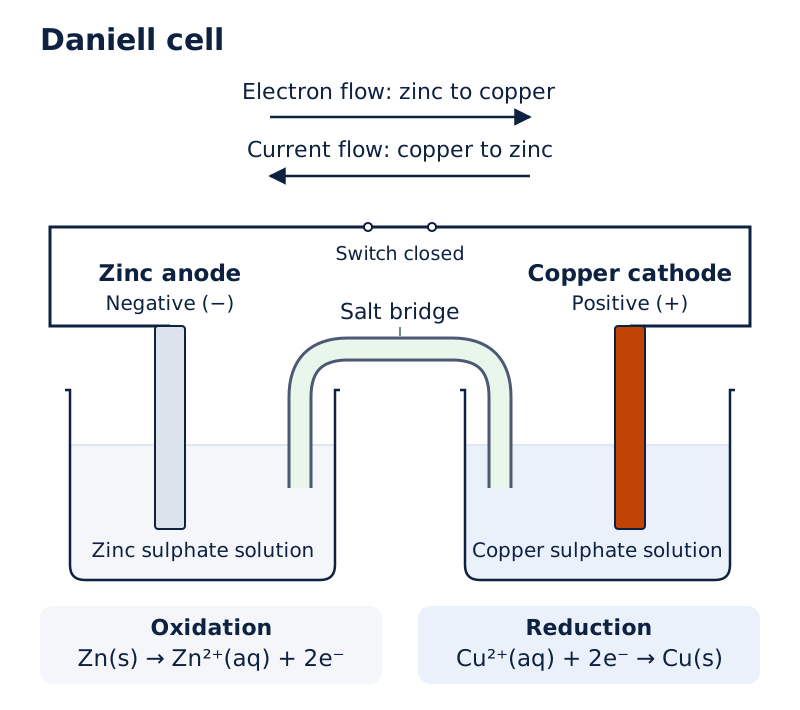
Two beakers contain electrodes labelled anode, negative, on the left and cathode, positive, on the right. A U-shaped salt bridge joins the liquids. Above them, a wire and switch carry opposite arrows for current flow and electron flow.
Drawn by One Young India. See Fig. 7.3 in your NCERT textbook
With the switch off, current does not flow. With it on, electrons travel through the wire from zinc to copper. Oxidation occurs at the zinc anode; copper ions gain electrons at the copper cathode. Conventional current runs opposite to electron flow.
What do redox couples and electrode potentials mean?
A redox couple contains the oxidised and reduced forms of a substance taking part in a half-reaction. Write the oxidised form first, as in and . The slash represents their interface.
Electrode potential is the potential associated with an electrode. Standard conditions here use unit concentration for participating species, gas pressure of when a gas is involved, and temperature . The symbols atm and K denote atmosphere and kelvin.
Let denote standard electrode potential, measured in volts, symbol . By convention the standard hydrogen electrode has . The listed electrode processes are written as reductions.
| Redox couple | Standard electrode potential | Reducing tendency relative to hydrogen |
|---|---|---|
| Zinc is the stronger reducing agent | ||
| Reference couple | ||
| Copper is the weaker reducing agent | ||
| Silver is the weaker reducing agent |
A negative standard potential indicates a stronger reducing couple than the hydrogen couple; a positive value indicates a weaker one. Oxidation-number language remains useful, while an electron-density description views oxidation as a decrease and reduction as an increase in electron density around the reacting atoms.
How can electrode potentials predict reactions?
Compare standard reduction potentials under standard conditions. The couple with the more positive potential has the stronger oxidising member. Combine electron gain by that member with electron loss by the reducing member of the other couple.
Worked example 7. Predict whether reacts with under standard conditions.
Answer: The standard reduction potentials are 0.77 V for and 0.54 V for .
- Iron(III) ions are the stronger oxidising species and accept electrons: .
- Iodide supplies electrons: .
- Multiply the iron half-reaction by two and combine: The reaction is feasible. Both sides have total charge .
Worked example 8. Predict whether reacts with under standard conditions.
Answer: The standard reduction potentials are 0.80 V for and 0.34 V for .
- Silver ions accept electrons: .
- Copper supplies electrons: .
- Multiply the silver half-reaction by two: The reaction is feasible. Both sides have total charge .
Worked example 9. Predict whether reacts with under standard conditions.
Answer: The standard reduction potentials are 0.77 V for and 0.34 V for .
- Iron(III) ions accept electrons: .
- Copper releases two electrons: .
- Double the iron half-reaction and combine: The reaction is feasible. Both sides have total charge .
Worked example 10. Predict whether reacts with under standard conditions.
Answer: The standard reduction potentials are 0.80 V for and 0.77 V for .
- The proposed change would require silver oxidation, , alongside iron(III) reduction, .
- Silver ions are the stronger oxidising species. The potential ordering therefore favours the reverse pairing: silver ions accepting electrons from iron(II) ions.
- The proposed reaction between silver metal and iron(III) ions is not feasible under standard conditions.
Worked example 11. Predict whether reacts with under standard conditions.
Answer: The standard reduction potentials are 1.09 V for and 0.77 V for .
- Bromine accepts electrons: .
- Iron(II) ions release electrons: .
- Double the iron half-reaction and combine: The reaction is feasible. Both sides have total charge .
Worked example 12. Arrange potassium, silver, mercury, magnesium and chromium in increasing order of reducing power using their standard reduction potentials.
Answer: The given potentials are −2.93 V for , 0.80 V for , 0.79 V for , −2.37 V for and −0.74 V for .
- A metal with a more negative standard reduction potential is a stronger reducing agent.
- Order the potentials from most positive to most negative: 0.80 V, 0.79 V, −0.74 V, −2.37 V, −2.93 V.
- The increasing order of reducing power is
Glossary
- Oxidation — Loss of electrons by a species, also identified through an increase in an element's oxidation number.
- Reduction — Gain of electrons by a species, also identified through a decrease in an element's oxidation number.
- Redox reaction — A chemical reaction in which complementary oxidation and reduction changes occur simultaneously.
- Oxidising agent — An electron acceptor that brings about oxidation of another species and itself undergoes reduction.
- Reducing agent — An electron donor that brings about reduction of another species and itself undergoes oxidation.
- Oxidation number — An assigned oxidation state based on giving shared bonding electrons entirely to the more electronegative atom.
- Half-reaction — One oxidation or reduction part of a redox process, explicitly showing electrons released or accepted.
- Stock notation — Representation of oxidation state by a Roman numeral in parentheses associated with the relevant element.
- Displacement reaction — A reaction in which an atom or ion of one element replaces that of another element.
- Disproportionation — Simultaneous oxidation and reduction of the same element from one initial oxidation state to higher and lower states.
- Equivalence point — The point at which the oxidant and reductant have reacted in the proportions required by mole stoichiometry.
- Redox couple — The oxidised and reduced forms of a substance together participating in an oxidation or reduction half-reaction.
- Salt bridge — A connection containing an electrolyte that permits ionic conduction between the separated solutions of a cell.
- Standard electrode potential — The electrode potential under specified standard conditions, compared with the conventional zero potential of the standard hydrogen electrode.
Common errors and misconceptions
- Misconception: The oxidising agent is oxidised. Correct: It accepts electrons and is reduced. Its name describes the oxidation it brings about in the other species.
- Misconception: Oxygen has oxidation number in every compound. Correct: Peroxides, superoxides and oxygen fluorides are exceptions; identify the type of compound before applying the usual rule.
- Misconception: Hydrogen has oxidation number in every compound. Correct: Hydrogen is assigned in binary metal hydrides. In NaH formation, hydrogen gains electrons and sodium loses them.
- Misconception: Every decomposition reaction is redox. Correct: Calcium carbonate decomposition leaves the oxidation numbers of calcium, carbon and oxygen unchanged and is therefore not redox.
- Misconception: An average oxidation number must describe every atom of that element. Correct: Carbon suboxide contains terminal carbon atoms at and a central carbon at , despite its fractional average.
- Misconception: Equal atom counts prove that an ionic equation is balanced. Correct: The total charge must also agree. Balance electrons in the half-reactions and verify charge again after combining them.
- Misconception: A basic-medium equation can be obtained by adding hydroxide to just one side. Correct: During conversion of a balanced acidic half-reaction, add equal hydroxide quantities to both sides before forming and cancelling water.
- Misconception: Electrons travel through the salt bridge. Correct: Electrons travel through the external wire; ion migration through the salt bridge completes the internal circuit.
Exam-style questions with model answers
Q1. Define oxidation and reduction in terms of electron transfer. [2 marks]
- Oxidation is loss of one or more electrons by a chemical species during a reaction.
- Reduction is gain of one or more electrons by a chemical species; it accompanies oxidation in a redox reaction.
Q2. In , identify the species oxidised, the species reduced, and the two agents. Explain your assignments. [3 marks]
- Zinc is oxidised because each zinc atom loses two electrons to form a zinc ion. The oxidation half-reaction is , where denotes an electron.
- Copper(II) ions are reduced because they accept electrons and form copper metal: . The electrons accepted equal those released by zinc.
- Zinc is the reducing agent because it donates electrons. Copper(II) ions are the oxidising agent because they accept those electrons and bring about zinc's oxidation.
Q3. Calculate manganese's oxidation number in neutral MnO₂, using oxygen's oxidation number of , and give its Stock designation. [3 marks]
- Let be manganese's unknown oxidation number. Oxidation numbers and atom counts are dimensionless. Since MnO₂ is neutral, its one manganese atom and two oxygen atoms must contribute a total of zero: .
- The two oxygen contributions sum to . Rearranging the dimensionless equation gives , hence for manganese.
- The oxidation state is written as the Roman numeral IV in Stock notation. The compound is therefore designated manganese(IV) oxide.
Q4. Classify as a redox reaction. Oxygen is in H₂O₂, in H₂O and in O₂. Explain why the same classification does not apply to , where calcium, carbon and oxygen retain , and , respectively. [4 marks]
- Hydrogen peroxide undergoes disproportionation. One element, oxygen, begins in a single intermediate oxidation state and forms products containing both lower and higher oxidation states.
- Oxygen is reduced when its oxidation number decreases from in hydrogen peroxide to in water.
- Oxygen is also oxidised when its oxidation number increases from to in dioxygen. The same reaction is a decomposition because one compound forms multiple products.
- Calcium carbonate decomposition is not redox. All three elements retain the stated oxidation numbers, so neither oxidation nor reduction occurs.
Q5. Balance in acidic aqueous solution by the half-reaction method. Show electron balance and verify total charge. [5 marks]
- Separate oxidation of iron from reduction of dichromate. Balance iron's charge by releasing one electron: , where denotes an electron. All coefficients and charge counts are dimensionless.
- Balance the two chromium atoms, seven oxygen atoms and fourteen hydrogen atoms in the reduction half: . Water balances oxygen, while hydrogen ions represent the acidic medium.
- Add six electrons on the left to balance reduction-half charge: . Multiply the iron oxidation half by six to supply those electrons.
- Add the halves and cancel electrons:
- The dimensionless charge checks are and . Both sides also contain six iron atoms, two chromium atoms, seven oxygen atoms and fourteen hydrogen atoms.
Q6. Balance in basic aqueous solution. Show the balanced half-reactions and check atoms and charge. [5 marks]
- Iodide is oxidised to iodine. Balance iodine atoms and release electrons: , where denotes an electron. Coefficients and charge counts are dimensionless.
- Balance the reduction half using water and hydrogen ions: . Add four hydroxide ions to both sides, combine them with hydrogen ions, and cancel water common to both sides.
- Add three electrons to balance charge. The basic reduction half is . Multiply this half by two and the iodide half by three.
- Add the scaled half-reactions and cancel six electrons:
- Both sides contain two manganese, six iodine, twelve oxygen and eight hydrogen atoms. The dimensionless charge sums are on the left and on the right.
Q7. Describe the electrode reactions, electron path, current direction and salt-bridge function in a Daniell cell containing zinc in zinc sulphate and copper in copper sulphate, connected by a wire and salt bridge. [5 marks]
- At the zinc anode, oxidation releases electrons: , where denotes an electron. The zinc electrode is the negative electrode of this cell.
- At the copper cathode, copper(II) ions gain electrons and form copper metal: . The copper electrode is the positive electrode.
- When the external circuit is closed, electrons released at zinc travel through the connecting metallic wire to the copper electrode, where reduction consumes them.
- Conventional current in that external circuit flows in the direction opposite to the electrons. Thus the current arrow and electron-flow arrow point in opposite directions.
- The salt bridge provides electrical contact between the solutions without allowing them to mix. Migration of ions through the bridge completes the circuit within the cell.
Q8. State how the end point is detected in a permanganate titration, a dichromate titration using diphenylamine, and a titration of liberated iodine with thiosulphate using starch. [3 marks]
- Permanganate acts as a self-indicator. After the reductant has been consumed, the first lasting pink tinge indicates that a little permanganate remains and signals the end point.
- Dichromate is not a self-indicator. It oxidises diphenylamine just after the equivalence point, producing an intense blue colour that supplies the visible signal.
- Iodine gives a blue colour with starch. As thiosulphate consumes the liberated iodine, that blue colour disappears, indicating the end point of this titration.
Key takeaways
- Oxidation and reduction occur together; electron loss by one species is paired with electron gain by another.
- The oxidising agent accepts electrons and is reduced, while the reducing agent donates electrons and is oxidised.
- Oxidation-number rules require attention to exceptions, especially oxygen in peroxides, superoxides and fluorides, and hydrogen in binary metal hydrides.
- A fractional average oxidation number need not describe every atom individually; structural information can reveal different atomic oxidation states.
- Check oxidation-number changes before classifying a reaction as redox, because decomposition alone does not establish oxidation and reduction.
- Both balancing methods must conserve atoms and total charge; half-reactions must also release and accept equal numbers of electrons.
- The reaction medium determines whether hydrogen ions or hydroxide ions appear in the final balanced aqueous equation.
- Redox titration end points depend on appropriate colour changes, while the quantitative relationship depends on the balanced reaction's stoichiometry.
- In a Daniell cell, electrons move through the external wire and ions migrate through the salt bridge to complete the circuit.
Test yourself
Which change in oxidation number identifies oxidation?
An increase in oxidation number identifies oxidation; a decrease identifies reduction of the element concerned.
What is hydrogen's oxidation number in sodium hydride?
Hydrogen has oxidation number in NaH, a binary compound of hydrogen with a metal.
Why does the blue colour develop when copper enters silver nitrate solution?
Copper is oxidised to copper(II) ions, whose formation gives the solution its blue colour.
What distinguishes disproportionation from an ordinary paired redox change?
The same element in one initial oxidation state is both oxidised and reduced, producing higher and lower oxidation states.
Why cannot calcium carbonate decomposition be identified as redox?
Calcium, carbon and oxygen keep their oxidation numbers, so the decomposition contains no oxidation-number change.
How is a balanced acidic half-reaction converted for basic solution?
Add equal hydroxide quantities to both sides to neutralise the hydrogen ions, then combine and cancel water as appropriate.
Which form is written first in a redox couple?
The oxidised form is written first, followed by the reduced form, as in .
What causes the blue starch colour to disappear during iodine titration?
Thiosulphate consumes the iodine, so the intense blue colour associated with iodine and starch disappears.