
Organic Chemistry: Some Basic Principles and Techniques | CBSE Class 11 Chemistry Notes
On this page
Watch & explore
Start with a few high-quality watches, then dive into the notes below.
This note covers carbon bonding and molecular shapes, structural representations, classification, nomenclature, isomerism, reaction intermediates, electron displacement effects, purification techniques, qualitative tests and quantitative elemental analysis.
How do carbon bonding and structural representations explain organic molecules?
Catenation is carbon's ability to form covalent bonds with other carbon atoms. Carbon also bonds with hydrogen, oxygen, nitrogen, sulphur, phosphorus and halogens. Its tetravalence, or capacity to form four covalent bonds, helps explain the structures of organic compounds.
Hybridisation and molecular shape
Hybridisation describes the mixing of atomic orbitals. The symbols and denote types of atomic orbitals; , and describe the hybrid orbitals used by carbon in methane, ethene and ethyne respectively.
| Compound | Carbon hybridisation | Shape |
|---|---|---|
| Methane, CH₄ | Tetrahedral | |
| Ethene, C₂H₄ | Planar | |
| Ethyne, C₂H₂ | Linear |
Greater character brings bonding electrons closer to the nucleus. Compared with carbon, carbon forms shorter, stronger bonds and is more electronegative. The case is intermediate. These differences connect orbital description with molecular properties.
A sigma bond, denoted , can form through overlap of a carbon hybrid orbital with a hydrogen orbital. A pi bond, denoted , involves sideways overlap of parallel orbitals. Rotation about an ethene double bond disrupts this overlap and is restricted. In general, pi bonds provide the most reactive centres in molecules containing multiple bonds.
Reading different representations
A complete structural formula shows bonds explicitly. A condensed formula groups atoms together, as in . A bond-line formula uses lines for carbon bonds; ends and junctions represent carbon atoms, with enough implied hydrogen atoms to satisfy carbon's valence. Heteroatoms are written explicitly.
What the figure shows
Methane in three dimensions
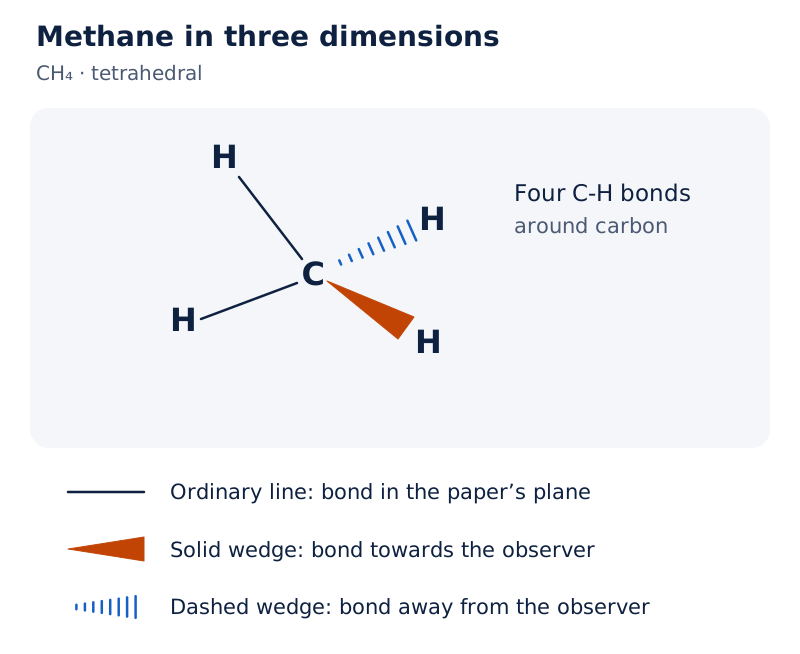
The central carbon is joined to four hydrogen atoms. Ordinary lines show bonds in the paper's plane, a solid wedge shows a bond towards the observer, and a dashed wedge shows a bond away from the observer.
Drawn by One Young India. See Fig. 8.1 in your NCERT textbook
Molecular models convey different information. Framework models emphasise bonds, ball-and-stick models show atoms and bonds, and space-filling models emphasise the relative space occupied by atoms. The representation chosen changes what is highlighted, while the underlying molecule remains the same.
How are organic compounds classified into families?
Acyclic compounds have open carbon chains, which may be straight or branched. Ethane and isobutane are examples. Cyclic compounds contain rings. Classification by the carbon skeleton is separate from classification by the functional group, so both descriptions may apply to one compound.
Distinguishing ring systems
| Category | Structural feature | Examples |
|---|---|---|
| Alicyclic, homocyclic | Non-aromatic ring containing carbon atoms | Cyclopropane, cyclohexane, cyclohexene |
| Alicyclic, heterocyclic | Non-aromatic ring containing another element | Tetrahydrofuran |
| Benzenoid aromatic | Benzene or related aromatic ring system | Benzene, aniline, naphthalene |
| Heterocyclic aromatic | Aromatic ring containing a heteroatom | Furan, thiophene, pyridine |
| Non-benzenoid | Aromatic classification without a benzene ring | Tropone |
Definition: A functional group is an atom or group of atoms joined to a carbon chain that is responsible for the characteristic chemical properties of an organic compound.
The hydroxyl, aldehyde and carboxylic acid groups distinguish alcohols, aldehydes and carboxylic acids. Compounds containing the same functional group undergo similar reactions. For example, methanol, ethanol and propan-2-ol all liberate hydrogen when they react with sodium.
A homologous series is a family with a characteristic functional group and a general molecular formula. Successive members differ by a methylene unit, . Alkanes, alkenes, alkynes, alcohols and carboxylic acids form such series. A compound with two or more identical or different functional groups is polyfunctional.
Hydrocarbons contain carbon and hydrogen only. Saturated hydrocarbons contain only carbon-carbon single bonds. Unsaturated hydrocarbons contain at least one carbon-carbon double or triple bond. A ring alone does not establish aromatic character: cyclohexane and benzene belong to different categories.
How are systematic names constructed and interpreted?
IUPAC nomenclature connects a compound's name with its structure. The parent hydrocarbon supplies the main name; prefixes identify substituents and suffixes identify the principal functional group or unsaturation. Common names such as toluene, aniline and anisole remain widely used.
Naming a branched alkane
- Identify the longest continuous carbon chain. If chains of equal length are possible, select the one with more side chains.
- Number the parent chain so that substituents receive the lowest possible numbers. The chain may bend within the displayed structure.
- Name each alkyl substituent and give its position. Alkyl names are obtained by replacing the alkane ending with -yl.
- List different substituents alphabetically. Use di-, tri- or tetra- for repeated groups, but ignore these multiplying prefixes when alphabetising.
- Separate numbers by commas and numbers from words by hyphens. When equivalent positions remain, give the lower number to the substituent cited first alphabetically.
These rules give names such as 2,4-dimethylpentane and 3-ethyl-6-methyloctane. In alphabetising common alkyl names, iso- and neo- count as parts of the name; sec- and tert- do not. A saturated monocyclic parent receives the prefix cyclo-.
Functional groups and priority
| Class | Group | Suffix when principal |
|---|---|---|
| Alcohol | -ol | |
| Aldehyde | -al | |
| Ketone | -one | |
| Carboxylic acid | -oic acid | |
| Nitrile | -nitrile | |
| Amine | -amine | |
| Amide | -amide |
Choose a parent chain containing the principal functional group and give that group the lowest possible position. Other functional groups become prefixes. The decreasing priority includes carboxylic acid, sulphonic acid, ester, acyl chloride, amide, nitrile, aldehyde, ketone, alcohol, amine, double bond and triple bond.
Thus, is 7-hydroxyheptan-2-one: the ketone supplies the suffix and hydroxyl becomes hydroxy-. Two hydroxyl groups give ethane-1,2-diol. Two double bonds give buta-1,3-diene, with the parent ending adjusted accordingly.
Benzene names and reverse interpretation
For disubstituted benzene, ortho, meta and para denote positions 1,2; 1,3; and 1,4 respectively. Use numbered positions for three or more substituents. A benzene ring treated as a substituent is phenyl.
To interpret pent-4-en-2-ol, first draw a five-carbon chain, then place the hydroxyl group on carbon 2 and the double bond between carbons 4 and 5. Its condensed structure is . Check both the suffix position and carbon valences.
How do structural isomerism and stereoisomerism differ?
Isomers share a molecular formula but differ in properties. Structural isomers differ in the way their atoms are connected. Stereoisomers retain the same constitution and sequence of covalent bonds but differ in the relative positions of atoms or groups in space.
Four types of structural isomerism
| Type | What differs? | Example |
|---|---|---|
| Chain isomerism | Carbon skeleton | Pentane, 2-methylbutane and 2,2-dimethylpropane, all C₅H₁₂ |
| Position isomerism | Position of a substituent or functional group | Propan-1-ol and propan-2-ol, both C₃H₈O |
| Functional group isomerism | Functional group | Propanal and propanone, both C₃H₆O |
| Metamerism | Alkyl chains on either side of the functional group | Methoxypropane and ethoxyethane, both C₄H₁₀O |
The position-isomer pair retains the alcohol group but places it on a different carbon. The functional-isomer pair instead changes an aldehyde into a ketone. Metamerism concerns how carbon groups are distributed around the linking functional group, rather than simply moving that group along one skeleton.
Stereoisomerism includes geometrical and optical isomerism. Its defining feature is spatial difference without a change in connectivity. A molecular formula alone cannot establish which structure is present; the bonding arrangement and, where relevant, the three-dimensional arrangement must also be specified.
Note: Resonance contributors are not separate isomers. They are alternative electron arrangements used to describe one actual molecule or ion, with the positions of nuclei unchanged.
How do bond cleavage, intermediates and attacking reagents work?
A reaction mechanism gives a sequential account of electron movement, bond breaking, bond formation, energetics and rates during a reaction. The carbon-containing molecule under attention is the substrate; the attacking species is the reagent. If both reactants supply carbon to a new bond, this naming choice is arbitrary.
Comparing homolysis and heterolysis
| Feature | Homolytic cleavage | Heterolytic cleavage |
|---|---|---|
| Electron distribution | One bonding electron goes to each fragment | Both bonding electrons go to one fragment |
| Typical products | Neutral free radicals with unpaired electrons | Oppositely charged species |
| Electron-flow arrow | Half-headed, or fish-hook, arrow | Full-headed curved arrow for an electron pair |
| Reaction description | Free-radical or nonpolar | Ionic or polar |
A carbocation has a positively charged carbon with six valence-shell electrons. Alkyl carbocations are highly reactive; the positively charged carbon is trigonal planar and hybridised. A carbanion carries negative charge on carbon, which is generally hybridised with a distorted tetrahedral arrangement.
A free radical contains an unpaired electron. Alkyl radical stability increases from methyl through primary and secondary to tertiary. For the simple alkyl carbocations, methyl is also less stable than primary, secondary and tertiary carbocations.
What the figure shows
Methyl carbocation and carbanion
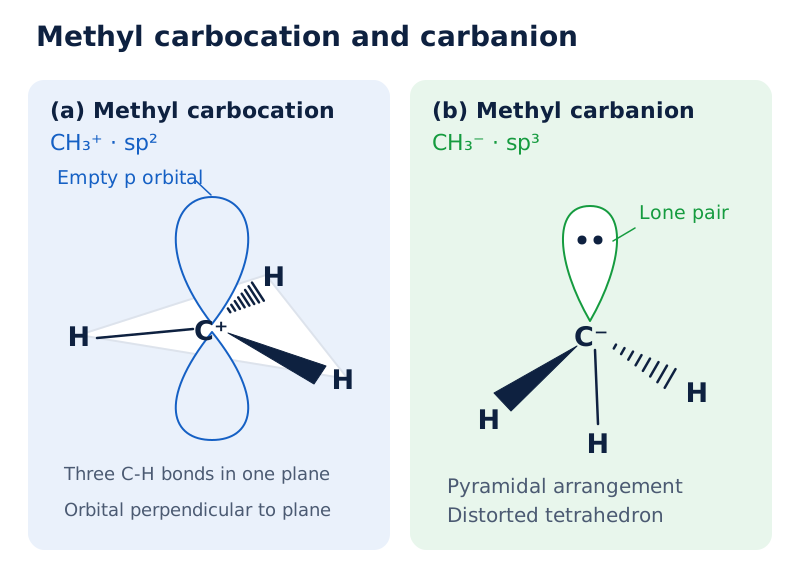
Panel (a) shows the methyl carbocation with three hydrogen atoms around carbon and an orbital extending above and below their plane. Panel (b) shows the methyl carbanion with a lone pair represented above carbon and three carbon-hydrogen bonds directed below it.
Drawn by One Young India. See Fig. 8.3 in your NCERT textbook
Electron donors and acceptors
A nucleophile donates an electron pair to an electron-deficient centre. Hydroxide, cyanide and carbanions are examples. Neutral species with lone pairs can also act as nucleophiles. An electrophile accepts an electron pair; carbocations and boron trifluoride are examples.
In an alkyl halide, bond polarity makes carbon an electrophilic centre. Curved arrows begin at the electron source and end at the accepting atom or bond position. Organic reactions are broadly classified as substitution, addition, elimination and rearrangement, according to the overall structural change.
How do electron displacement effects influence stability and reactivity?
Inductive and resonance effects involve electron displacement under the influence of atoms or substituents already present. The electromeric effect occurs when an attacking reagent approaches. Distinguishing the electrons involved and whether the effect is permanent helps prevent confusion between these explanations.
Inductive effect
The inductive effect is the polarisation of a sigma bond caused by polarisation of an adjacent sigma bond. In chloroethane, chlorine draws electron density towards itself. The directly bonded carbon becomes partially positive and draws electron density from the next carbon-carbon bond.
The effect decreases rapidly with intervening bonds and becomes vanishingly small after three bonds. Halogens, nitro, cyano and carboxyl groups withdraw electron density relative to hydrogen. Alkyl groups such as methyl and ethyl are usually regarded as electron donating.
Resonance structures and resonance effect
A single Lewis structure cannot adequately describe benzene. Its carbon-carbon bond lengths are uniformly 139 pm, intermediate between typical single and double bond lengths of 154 pm and 134 pm. The actual molecule is a resonance hybrid, not a molecule alternating between separate structures.
Contributors retain the same nuclear positions and number of unpaired electrons. More covalent bonds, complete octets where applicable, less charge separation and appropriate placement of charges favour stability. The hybrid has lower energy than any contributor; the difference from the lowest-energy contributor is resonance energy.
The resonance effect involves interaction between two pi bonds, or between a pi bond and an adjacent lone pair. Positive resonance effect, , means electron donation from a substituent towards the conjugated system. Negative resonance effect, , means electron withdrawal towards the substituent.
Hydroxyl and amino groups show positive resonance effects; nitro, cyano and carbonyl-containing groups show negative effects. The letter in these signed labels denotes resonance effect. Conjugated systems permit electron delocalisation and can develop regions of increased or decreased electron density.
Electromeric effect and hyperconjugation
The electromeric effect is complete transfer of a shared pi-electron pair to one atom of a multiple bond in response to an attacking reagent. It disappears when the reagent is removed. The symbol denotes this effect.
In the positive electromeric effect, , the pair shifts towards the atom receiving the reagent. In the negative effect, , it shifts towards the other atom. When inductive and electromeric effects oppose one another, the electromeric effect predominates.
Hyperconjugation delocalises electrons of an adjacent carbon-hydrogen sigma bond into an unsaturated system or an available orbital. In the ethyl cation, an adjacent bond overlaps with the empty carbon orbital and disperses positive charge. This is a permanent stabilising effect, also possible in alkenes and alkylarenes.
In general, more attached alkyl groups provide greater hyperconjugative stabilisation of an alkyl carbocation. The tert-butyl cation has nine adjacent carbon-hydrogen bonds available for this interaction. The methyl cation lacks the corresponding hyperconjugative stabilisation because its bonds cannot overlap with its perpendicular empty orbital.
How is a suitable purification method selected?
Purification depends on the nature of the compound and its impurities. Relevant differences include volatility, solubility and adsorption. Most pure compounds have sharp melting and boiling points, which help assess purity. Chromatographic and spectroscopic techniques also provide ways of checking purity.
Sublimation and crystallisation
Sublimation separates a sublimable solid from non-sublimable impurities by direct conversion of the solid to vapour. Crystallisation instead exploits differences in solubility. A suitable solvent dissolves the compound sparingly at room temperature but appreciably at higher temperature.
- Dissolve the impure solid in the suitable solvent at higher temperature.
- Concentrate the solution until it is nearly saturated.
- Cool it so that the purer compound crystallises out.
- Separate crystals by filtration; the mother liquor retains impurities and some dissolved compound.
Activated charcoal can remove coloured impurities by adsorption. A solvent mixture may help when the compound is highly soluble in one solvent but poorly soluble in another. Repeated crystallisation may be necessary when impurities have comparable solubilities.
Comparing distillation methods
| Method | Suitable separation | Key principle or example |
|---|---|---|
| Simple distillation | Volatile liquid from nonvolatile impurities, or liquids with sufficiently different boiling points | Chloroform, 334 K, and aniline, 457 K |
| Fractional distillation | Liquids with close boiling points | Repeated condensation and vaporisation in a fractionating column |
| Reduced-pressure distillation | High-boiling liquids or liquids decomposing at or below their boiling points | Glycerol from spent-lye |
| Steam distillation | Steam-volatile substances immiscible with water | Aniline from aniline-water mixture |
What the figure shows
Simple distillation apparatus
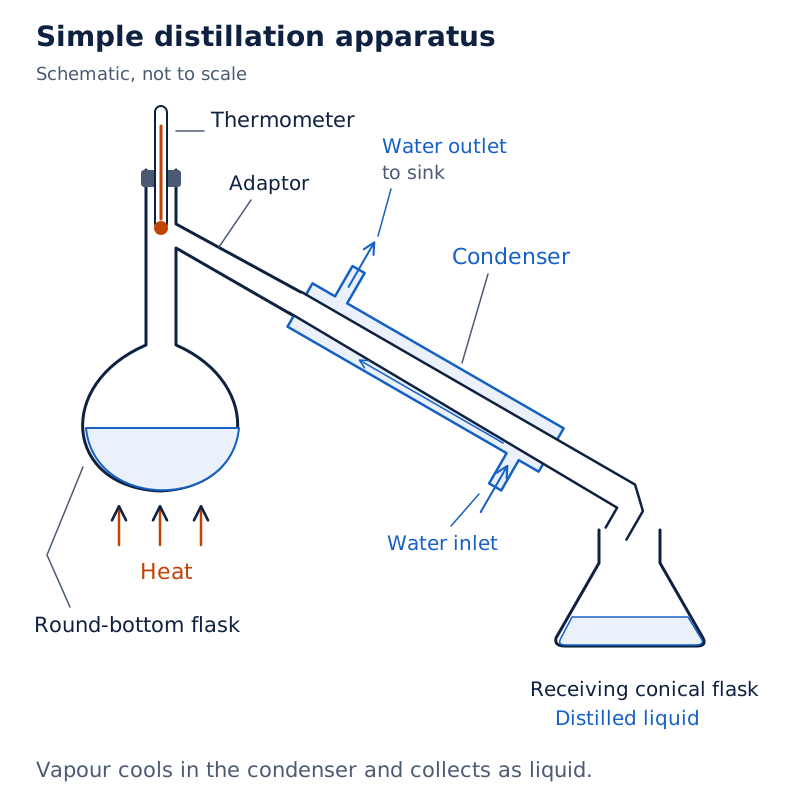
A heated round-bottom flask connects through an adaptor to a sloping condenser and a receiving conical flask. A thermometer is fitted above the distillation flask. The condenser is labelled with a water inlet and an outlet leading to the sink.
Drawn by One Young India. See Fig. 8.5 in your NCERT textbook
In fractional distillation, rising vapours become richer in the more volatile component. Descending liquid and ascending vapour exchange heat at successive surfaces. Each successive condensation-vaporisation unit is a theoretical plate. Lowering external pressure lowers the temperature at which a liquid boils.
For steam distillation, let be atmospheric pressure, the organic liquid's vapour pressure and water's vapour pressure, all in the same pressure unit. Boiling occurs when The organic liquid therefore vaporises below its own normal boiling point.
Differential extraction uses an organic solvent immiscible with water in which the compound is more soluble. Shake the aqueous solution with this solvent, separate the layers in a separating funnel, then remove the organic solvent. Continuous extraction repeatedly uses the same solvent when extraction would otherwise require a large quantity.
How do chromatography and the retardation factor describe separation?
Chromatography separates mixture components between a stationary phase and a moving mobile phase. Differences in adsorption or partition cause different rates of movement. The technique can separate mixtures, purify compounds and test purity; it is not restricted to naturally coloured substances.
Adsorption chromatography
In column chromatography, a glass tube contains a stationary adsorbent such as silica gel or alumina. The mixture is placed near the top and an eluant flows downwards. More strongly adsorbed components are retained nearer the top, while other components travel further.
Thin-layer chromatography, or TLC, uses a thin adsorbent layer on glass. A small mixture spot is placed near one end and the plate stands in eluant in a closed jar. Components rise different distances as the solvent moves through the adsorbent.
The retardation factor, , is the distance moved by a substance from the baseline divided by the distance moved by the solvent front from the same baseline: Both distances use the same unit, so the ratio is dimensionless.
What the figure shows
Developing and reading a TLC plate
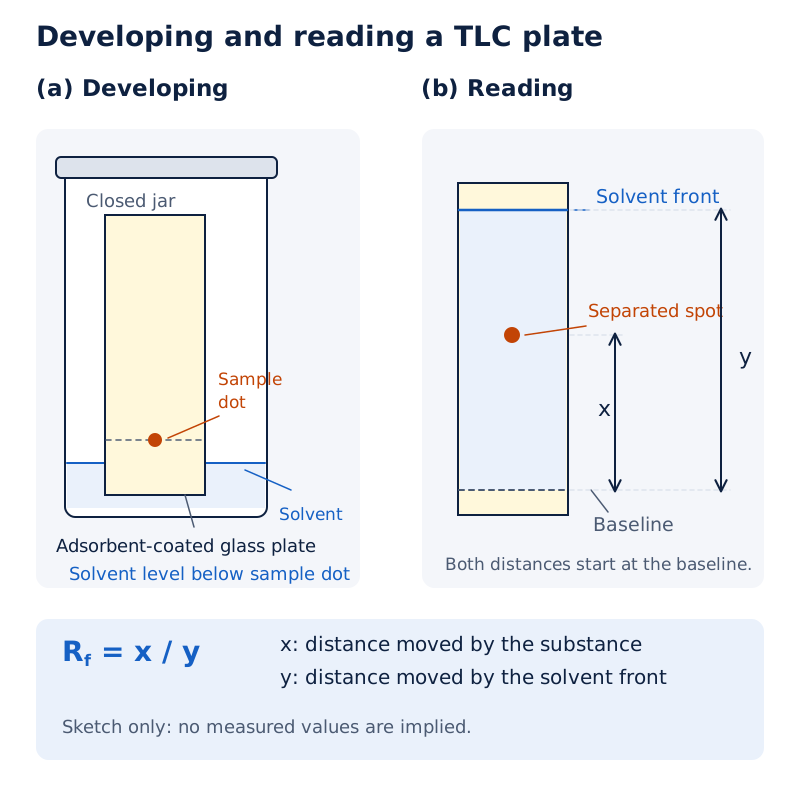
Panel (a) shows an adsorbent-coated glass plate inside a jar, with the sample dot above the solvent level. Panel (b) labels the baseline, separated spot and solvent front; the two distances are measured upwards from the same baseline.
Drawn by One Young India. See Fig. 8.12 in your NCERT textbook
Partition and spot detection
Paper chromatography is partition chromatography. Water trapped in the paper is the stationary phase, while a moving solvent rises by capillary action. Components partition differently between these phases and appear at different positions on the developed chromatogram.
Coloured substances can be seen directly. Some colourless substances fluoresce under ultraviolet light; iodine-adsorbing substances appear as brown spots after exposure to iodine vapour. Appropriate spray reagents may also reveal spots, such as ninhydrin solution for amino acids.
How are the elements in an organic compound detected?
Qualitative analysis identifies elements present. Heating an organic compound with copper(II) oxide converts its carbon to carbon dioxide and hydrogen to water. Carbon dioxide makes lime-water turbid, while water turns white anhydrous copper sulphate blue.
The corresponding confirmation reactions are and The downward arrow denotes formation of a precipitate. These observations detect the combustion products rather than directly observing carbon or hydrogen atoms.
Sodium fusion and nitrogen
Lassaigne's test converts covalently bound elements into water-soluble ionic substances by fusion with sodium. Boiling the fused mass with distilled water produces the sodium fusion extract. Carbon and nitrogen yield cyanide; sulphur yields sulphide; halogens yield halides.
Here denotes chlorine, bromine or iodine:
For nitrogen, boil the extract with iron(II) sulphate and acidify with concentrated sulphuric acid. Cyanide forms hexacyanidoferrate(II). Some iron(II) is oxidised to iron(III), producing the Prussian blue iron(III) hexacyanidoferrate(II) product.
For sulphur, acidify the extract with acetic acid and add lead acetate. Black lead sulphide confirms sulphur: Alternatively, sodium nitroprusside gives a violet colour with sulphide.
When nitrogen and sulphur occur together, thiocyanate can form and give a blood-red colour with iron(III), rather than Prussian blue. With excess sodium, thiocyanate decomposes into cyanide and sulphide, allowing their usual tests:
Halogens and phosphorus
Acidify the extract with nitric acid, then add silver nitrate. The precipitation reaction is Identify the halogen using both the precipitate's colour and its behaviour with ammonium hydroxide.
| Halogen | Silver halide | Behaviour in ammonium hydroxide |
|---|---|---|
| Chlorine | White silver chloride | Soluble |
| Bromine | Yellowish silver bromide | Sparingly soluble |
| Iodine | Yellow silver iodide | Insoluble |
Note: If nitrogen or sulphur is present, first boil the sodium fusion extract with concentrated nitric acid. This destroys cyanide or sulphide, which would otherwise interfere with the silver nitrate test for halogens.
For phosphorus, heat the compound with sodium peroxide to convert phosphorus into phosphate. Boil the solution with nitric acid and add ammonium molybdate. Yellow colouration or a yellow precipitate indicates phosphorus. Keep the preparation and observation for each test distinct.
How are carbon and hydrogen percentages derived from combustion?
Quantitative analysis measures elemental composition. Burn a known sample mass in excess oxygen with copper(II) oxide. Pass the products through weighed absorption tubes: anhydrous calcium chloride absorbs water, while potassium hydroxide solution absorbs carbon dioxide. Their mass increases give the product masses.
Derivation: Carbon percentage
Let be sample mass, carbon dioxide mass and carbon mass, all in grams. Let denote carbon percentage by mass.
- The carbon mass fraction in carbon dioxide is .
- Therefore, carbon mass is , in grams when is in grams.
- Dividing by sample mass gives .
Result: Convert carbon dioxide to its carbon content before comparing with the original sample mass.
Derivation: Hydrogen percentage
Let be water mass and hydrogen mass, both in grams. Let denote hydrogen percentage by mass; remains the sample mass.
- The hydrogen mass fraction in water is .
- Therefore, hydrogen mass is , in grams when is in grams.
- The percentage is .
Result: Use water mass for hydrogen and carbon dioxide mass for carbon; these measurements are not interchangeable.
Worked example 1. Complete combustion of 0.246 g of a compound gives 0.198 g of carbon dioxide and 0.1014 g of water. Find the carbon and hydrogen percentages using the mass fractions derived above.
Formula: , , , .
Substitute: Use the measured masses in grams throughout.
- Carbon mass: .
- Carbon percentage: .
- Hydrogen mass: .
- Hydrogen percentage: .
Answer: The 0.246 g sample contains carbon and hydrogen by mass.
How does Dumas' method estimate nitrogen?
In Dumas' method, heat the nitrogen-containing compound with copper(II) oxide in carbon dioxide. Nitrogen is liberated along with carbon dioxide and water. Heated copper gauze reduces traces of nitrogen oxides to nitrogen. Potassium hydroxide absorbs carbon dioxide, and the nitrogen volume is measured.
Correct the measured pressure for aqueous tension, the water-vapour pressure. Let be atmospheric pressure, aqueous tension and dry nitrogen pressure, all in millimetres of mercury:
Let be measured gas volume in millilitres, temperature in kelvin and nitrogen volume at the stated standard conditions. Using 273 K and 760 mm Hg, At these conditions, 22400 mL nitrogen has mass 28 g.
Worked example 2. A 0.3 g sample gives 50 mL nitrogen at 300 K and 715 mm Hg. Aqueous tension is 15 mm Hg. Calculate nitrogen percentage using the standard-volume relation above.
Formula: ; nitrogen mass is gas volume at standard conditions multiplied by .
- Dry pressure: .
- Corrected volume: .
- Nitrogen mass: .
- Percentage: .
Answer: The 0.3 g sample contains nitrogen.
How does Kjeldahl's method use acid consumption to measure nitrogen?
Kjeldahl's method converts nitrogen to ammonium sulphate by heating the compound with concentrated sulphuric acid. Excess sodium hydroxide then liberates ammonia. Absorb this ammonia in a known excess of standard sulphuric acid and determine the acid remaining by titration with standard alkali.
The relevant reactions are and Thus, one mole of sulphuric acid neutralises two moles of ammonia, each containing one mole of nitrogen atoms.
The method is not applicable to nitrogen in nitro groups, azo groups or rings such as pyridine. These forms of nitrogen do not become ammonium sulphate under the stated conditions. Choosing the correct analytical method therefore depends on nitrogen's chemical form.
Direct acid consumption and back titration
Let denote acid molarity in moles per litre, the volume of acid actually consumed in litres, the amount of ammonia in moles, and the mass of nitrogen in grams. Then and .
Worked example 3. Ammonia from 0.5 g of compound neutralises 10 mL of sulphuric acid of molarity 1 mol L⁻¹. Calculate nitrogen percentage, using a nitrogen molar mass of 14 g mol⁻¹.
Formula: ; .
Substitute: Express the consumed acid volume in litres.
- Acid volume: .
- Ammonia amount: .
- Nitrogen mass: .
- Percentage: .
Answer: The 0.5 g sample contains nitrogen.
Worked example 4. Ammonia from 0.50 g of compound is absorbed in 50 mL of 0.5 mol L⁻¹ sulphuric acid. The remaining acid needs 60 mL of 0.5 mol L⁻¹ sodium hydroxide. Find nitrogen percentage using 14 g mol⁻¹ for nitrogen.
- Initial acid: .
- Alkali used: . Since two moles of alkali neutralise one mole of acid, residual acid is .
- Acid consumed by ammonia: ; ammonia amount is .
- Nitrogen mass: .
- Percentage: .
Answer: The 0.50 g sample contains nitrogen; only the acid consumed by ammonia enters the calculation.
How do precipitate masses reveal halogen and sulphur percentages?
In the Carius method for halogens, heat a known sample with fuming nitric acid and silver nitrate in a hard glass tube. Carbon and hydrogen become carbon dioxide and water. The halogen forms silver halide, which is filtered, washed, dried and weighed.
The silver halide contains one halogen atom per formula unit. Convert its measured mass to halogen mass using the ratio of their molar masses. Then divide by the original sample mass. The whole precipitate mass cannot be treated as halogen mass because it includes silver.
Worked example 5. A 0.15 g compound gives 0.12 g silver bromide. Find bromine percentage. Use silver and bromine molar masses of 108 g mol⁻¹ and 80 g mol⁻¹ respectively.
- Silver bromide molar mass: .
- Bromine mass: .
- Percentage: .
Answer: The 0.15 g sample contains bromine.
Sulphur as barium sulphate
For sulphur estimation, heat the sample in a Carius tube with sodium peroxide or fuming nitric acid. Sulphur is oxidised to sulphuric acid. Add excess barium chloride solution and filter, wash, dry and weigh the barium sulphate precipitate.
Worked example 6. A 0.157 g compound gives 0.4813 g barium sulphate. Calculate sulphur percentage using molar masses of 233 g mol⁻¹ for barium sulphate and 32 g mol⁻¹ for sulphur.
- Sulphur mass fraction in the precipitate: .
- Sulphur mass: .
- Percentage: .
Answer: The 0.157 g sample contains sulphur.
How are phosphorus and oxygen estimated?
For phosphorus estimation, fuming nitric acid oxidises phosphorus to phosphoric acid. Ammonia and ammonium molybdate precipitate ammonium phosphomolybdate. Alternatively, magnesia mixture precipitates magnesium ammonium phosphate, which yields magnesium pyrophosphate on ignition.
Let be the mass of ammonium phosphomolybdate and the sample mass, in grams. Its molar mass is 1877 g mol⁻¹ and it contains 31 g of phosphorus per mole. Phosphorus percentage, denoted , is
If is instead the mass of magnesium pyrophosphate in grams, its 222 g mol⁻¹ molar mass includes 62 g of phosphorus per mole. The corresponding relation is Choose the expression matching the precipitate actually weighed.
Oxygen by difference or direct estimation
Oxygen percentage is usually obtained by subtracting the sum of all other elemental percentages from the total. If denotes oxygen percentage and denotes the sum of the other percentages,
For direct estimation, decompose a known sample in nitrogen and pass its oxygen-containing gaseous products over red-hot coke. Oxygen becomes carbon monoxide, which warm iodine pentoxide oxidises to carbon dioxide while liberating iodine.
The reactions are If is the resulting carbon dioxide mass in grams, the oxygen percentage is The factor reflects the relation between oxygen from the sample and the carbon dioxide finally produced.
Glossary
- Catenation — The ability of carbon atoms to form covalent bonds with one another, producing chains and rings.
- Functional group — An atom or group attached to a carbon chain that gives an organic compound its characteristic chemical properties.
- Homologous series — A family with a characteristic functional group whose successive members differ by a methylene unit.
- Structural isomers — Compounds sharing a molecular formula but differing in the manner in which their atoms are connected.
- Heterolysis — Bond cleavage in which both electrons of the shared pair remain with one of the fragments.
- Homolysis — Bond cleavage in which each bonded atom receives one electron from the shared electron pair.
- Nucleophile — An electron-rich species that supplies an electron pair to an electron-deficient reactive centre during bonding.
- Electrophile — An electron-deficient species that accepts an electron pair from a nucleophile during formation of a bond.
- Inductive effect — Polarisation transmitted through sigma bonds because a neighbouring bond is polarised by an atom or substituent.
- Resonance hybrid — The actual molecular structure described collectively by contributing structures, with lower energy than any individual contributor.
- Hyperconjugation — Stabilising delocalisation of electrons from an adjacent carbon-hydrogen sigma bond into an unsaturated system or available orbital.
- Chromatography — A separation technique in which mixture components move differently between stationary and mobile phases.
- Sodium fusion extract — The aqueous extract obtained by boiling a sodium-fused organic sample with distilled water for elemental tests.
- Aqueous tension — The pressure contributed by water vapour that is subtracted when calculating the pressure of collected dry nitrogen.
Common errors and misconceptions
- Misconception: The longest horizontal line must be the parent chain. Correct: Follow the longest continuous carbon chain, even when it bends through branches in the drawing.
- Misconception: Every cyclic compound is aromatic. Correct: Alicyclic compounds such as cyclohexane are a separate category from aromatic compounds such as benzene.
- Misconception: A nucleophile must be negatively charged. Correct: Neutral species with an available lone pair can also donate that pair and act as nucleophiles.
- Misconception: Benzene switches between two actual structures. Correct: The contributors are hypothetical representations of one resonance hybrid with uniform carbon-carbon bond lengths.
- Misconception: Inductive and electromeric effects are both permanent. Correct: The electromeric effect requires an attacking reagent and disappears when that reagent is removed.
- Misconception: Kjeldahl's method measures every form of organic nitrogen. Correct: It is unsuitable for nitro, azo and ring nitrogen such as that in pyridine.
- Misconception: The mass of silver bromide is the mass of bromine. Correct: Convert using the bromine-to-silver-bromide molar-mass ratio before calculating the sample's percentage.
- Misconception: All initially added acid reacts with ammonia in back titration. Correct: Subtract the residual acid found by alkali titration to obtain acid actually consumed.
Exam-style questions with model answers
Q1. Distinguish homolytic and heterolytic bond cleavage by electron distribution and products. [2 marks]
- Homolytic cleavage gives one bonding electron to each fragment, producing free radicals with unpaired electrons.
- Heterolytic cleavage transfers both bonding electrons to one fragment, producing oppositely charged species, which may include a carbocation or carbanion.
Q2. Explain how to derive the structure of pent-4-en-2-ol from its systematic name. [3 marks]
- The parent term pent- specifies a continuous chain containing five carbon atoms. Start with this skeleton before placing its functional group and multiple bond.
- The suffix -2-ol places the hydroxyl group on the second carbon. The term -4-en- places a double bond between the fourth and fifth carbons.
- Complete carbon valences with hydrogen atoms to obtain , retaining the numbering that gives the alcohol group its lower position.
Q3. Benzene has uniform carbon-carbon bond lengths of 139 pm; typical single and double bond lengths are 154 pm and 134 pm respectively. Give three reasons for describing benzene as a resonance hybrid rather than as one structure with alternating single and double bonds. [3 marks]
- Benzene has uniform carbon-carbon bond lengths of 139 pm, rather than separate typical single and double bond lengths of 154 pm and 134 pm.
- The alternative contributing structures keep the nuclei in the same positions but distribute electrons differently. Neither contributor individually represents the actual molecule.
- The resonance hybrid is lower in energy than either individual contributor. Its stabilisation therefore belongs to the actual delocalised structure, not to switching between two separate molecules.
Q4. Describe five steps or observations in testing a sodium fusion extract for halogens when nitrogen or sulphur may also be present. [5 marks]
- Begin with the sodium fusion extract, in which fusion has converted covalently bound halogen into an ionic sodium halide that can enter the aqueous extract.
- Boil the extract with concentrated nitric acid to decompose cyanide or sulphide. These ions would otherwise interfere with the silver nitrate test.
- Add silver nitrate to the acidified extract. A white precipitate of silver chloride that dissolves in ammonium hydroxide identifies chlorine.
- A yellowish precipitate of silver bromide that is only sparingly soluble in ammonium hydroxide identifies bromine; use the solubility observation together with colour.
- A yellow precipitate of silver iodide that is insoluble in ammonium hydroxide identifies iodine. Distinguish these observations from the colours produced in nitrogen and sulphur tests.
Q5. A 0.15 g compound gives 0.12 g AgBr in Carius estimation. Using molar masses of 108 g mol⁻¹ for silver and 80 g mol⁻¹ for bromine, calculate bromine percentage. [3 marks]
- The precipitate contains both silver and bromine. Its molar mass is , so bromine accounts for the fraction obtained from their molar-mass ratio.
- Convert the measured precipitate mass into bromine mass: . The remaining precipitate mass belongs to silver.
- Divide bromine mass by original sample mass: . The denominator is the sample mass, not the silver bromide mass.
Q6. Ammonia from 0.50 g of compound is absorbed in 50 mL of 0.5 mol L⁻¹ H₂SO₄. Residual acid needs 60 mL of 0.5 mol L⁻¹ NaOH. One mole of H₂SO₄ reacts with two moles of either NH₃ or NaOH; nitrogen has molar mass 14 g mol⁻¹. Calculate nitrogen percentage. [5 marks]
- Convert the initial acid volume to litres and calculate its amount: . This includes both acid later consumed and acid left over.
- The alkali amount is . From the supplied stoichiometry, the remaining sulphuric acid is .
- Subtract residual acid from initial acid: . This is the amount consumed specifically by ammonia during absorption.
- Ammonia amount is . Each ammonia molecule contains one nitrogen atom, giving nitrogen mass .
- Use the original compound mass to obtain nitrogen. This calculation excludes the acid that remained unreacted with ammonia.
Q7. Explain the principle, stationary phase, mobile phase and separation process of paper chromatography. [4 marks]
- Paper chromatography is partition chromatography: components distribute differently between stationary and mobile phases rather than simply moving together with the solvent.
- The stationary phase is water trapped in the chromatography paper. The paper supports this water while the mixture is initially spotted near its base.
- A suitable solvent or solvent mixture is the mobile phase. It rises through the paper by capillary action and passes over the original spot.
- Different partitioning retains components to different extents, producing spots at different heights. Coloured spots are visible; suitable detection methods reveal colourless components.
Q8. Explain why steam distillation can separate a steam-volatile organic liquid immiscible with water below its normal boiling point. [2 marks]
- The mixture boils when the combined vapour pressures of water and the organic liquid equal atmospheric pressure.
- The organic liquid therefore need not supply the entire atmospheric pressure by itself and vaporises at a lower temperature.
Key takeaways
- Carbon hybridisation explains molecular shape, while orbital overlap explains sigma and pi bonding and restricted rotation about double bonds.
- Identify the parent chain and principal functional group before numbering substituents and assembling a systematic organic name.
- Structural isomerism changes atomic connectivity; stereoisomerism changes spatial arrangement while preserving the sequence of covalent bonds.
- Homolysis produces radicals, whereas heterolysis produces charged species; nucleophiles donate electron pairs and electrophiles accept them.
- Induction, resonance, electromeric displacement and hyperconjugation differ in the electrons involved and their dependence on an approaching reagent.
- Choose purification methods by differences in volatility, solubility or adsorption, and match each technique to the compound's properties.
- Sodium fusion converts covalently bound elements into ionic forms, allowing characteristic aqueous tests for nitrogen, sulphur and halogens.
- Elemental percentages require stoichiometric conversion of measured products, correct units and the original sample mass as denominator.
Test yourself
Why is rotation about a carbon-carbon double bond restricted?
Rotation disrupts the sideways overlap of parallel orbitals that forms the pi bond.
What distinguishes a homologous series from a set of isomers?
Successive homologues differ by a methylene unit; isomers share a molecular formula but differ in structure or spatial arrangement.
What do ortho, meta and para mean for disubstituted benzene?
They specify relative substituent positions 1,2; 1,3; and 1,4 respectively on the benzene ring.
Why can a neutral species act as a nucleophile?
An available lone pair can be donated to an electron-deficient centre even without an overall negative charge.
Why does reduced pressure help distil a heat-sensitive liquid?
The liquid reaches the external pressure with its vapour pressure at a lower temperature, reducing the temperature required for boiling.
Which two distances determine the retardation factor in TLC?
The substance's travel distance and the solvent front's travel distance, both measured from the same baseline.
Why subtract aqueous tension in Dumas' method?
The measured pressure includes water vapour; subtraction gives the pressure attributable to dry nitrogen.
Which forms of nitrogen cannot be estimated by Kjeldahl's method?
Nitrogen in nitro groups, azo groups and rings such as pyridine does not become ammonium sulphate under the method's conditions.
Write about it
Turn a question from this chapter into a paper.
The Writing Studio has a structure guide, a rubric and citation tools for 15 formats, from essays to research papers. Drafting is free with an account. Learnacy Essential adds feedback from an AI writing coach and submission to The OYI Review.
Learnacy Essential is ₹1,499 for the year. Publication depends on review and is not guaranteed.