
Essay-writing | CBSE Class 11 English Notes
On this page
This note covers the meaning of an essay, generating ideas, selecting points, building paragraphs, organising an argument, reviewing a draft, and practising the Hobbies, Games and girl-child education writing tasks.
What is an essay, and what makes it effective?
An essay is a composition about a particular subject that contains more than one paragraph. A paragraph is a group of connected sentences developing a part of that subject. Writing an essay involves choosing ideas and arranging them so that a reader can follow their development.
Definition: An essay develops a particular subject through connected paragraphs. Its main qualities are unity, coherence, relevance and proportion.
How do the four qualities differ?
| Quality | Meaning | Question for checking a draft |
|---|---|---|
| Unity | Every part is clearly connected to the main subject. | Does this paragraph belong in this essay? |
| Coherence | Ideas, sentences and paragraphs have a logical relationship and sequence. | Can the reader follow the movement from this idea to the next? |
| Relevance | Unimportant information is left out. | Does this detail help develop the subject? |
| Proportion | Important ideas receive more space. | Have the central points received enough explanation? |
These qualities work together, but they describe different decisions. Unity concerns connection with the subject. Coherence concerns the order and relationship of ideas. Relevance helps decide what to include. Proportion helps decide how fully to develop the material that remains.
For an essay on Hobbies, free-time activities, personal choice and refreshment of the mind belong to the subject. Placing related points together helps create coherence. Selecting useful details maintains relevance, while giving the important ideas room to develop maintains proportion.
What is the difference between collecting and composing?
A collection of words such as music, creativity and friendship supplies material. It does not yet show how the ideas connect. A completed essay turns selected material into sentences and paragraphs that develop the subject in an intelligible order.
Do not treat the qualities as decorations to add after writing. They guide the selection of points, the arrangement of paragraphs and the review of the finished piece. The same subject can produce an unclear list or a connected essay, depending on these choices.
How can brainstorming help you begin writing?
Most of us find beginning difficult. One way to make it easier is brainstorming, which means collecting ideas as they occur. Several people can offer ideas in a group, or a writer can record thoughts individually on a sheet of paper.
At this stage, ideas can appear in a random order. You are gathering material before choosing its final arrangement. An idea does not need to arrive as a polished sentence to be useful. A word or short phrase can preserve it for later development.
How does the Hobbies example begin?
- Write the topic, Hobbies, inside a circle to keep the subject in view.
- Record thoughts as they occur, without first arranging them into paragraphs.
- Look across the collected ideas and select the points to develop.
- Expand the selected points into sentences before building the essay.
What the figure shows
Hobbies idea collection
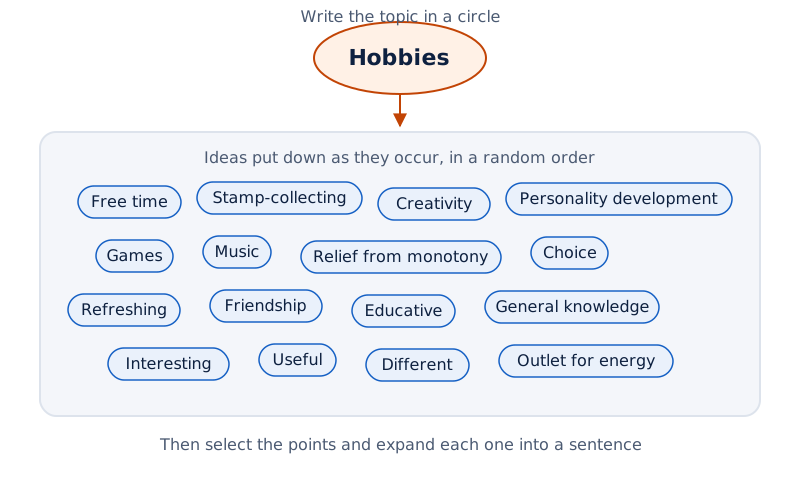
A small circle contains the topic Hobbies. Below it, a jagged outline is surrounded by words and phrases, including Free time, Stamp-collecting, Creativity, Personality development, Games, Music, Relief from monotony, Choice, Refreshing, Friendship, Educative, General knowledge, Interesting, Useful, Different and Outlet for energy.
Drawn by One Young India. Reference: NCERT Class 11, printed page 84
The arrangement records associations rather than a finished sequence. Monotony means dull repetition; relief from monotony can become a point about variety. Creativity means expressing imaginative ideas. Educative means contributing to learning. Personality development concerns the growth of a person’s overall qualities and ways of expressing themselves.
Worked example 1: moving beyond the idea collection
Task: Use the collected ideas Free time, Choice and Refreshing to prepare sentences for an essay on Hobbies.
Answer: Hobbies occupy our free time. We choose them because they interest us. They refresh the mind by giving us a different kind of activity.
The answer develops the supplied ideas without introducing a new topic. The next decision is how to connect these sentences: begin by identifying hobbies, then explain their voluntary nature and their refreshing effect.
How do you select points and expand them into sentences?
Selection means choosing from the ideas collected. Expansion means expressing a short point as a complete sentence that communicates its meaning. The Hobbies material shows how a brief association can become a statement suitable for further development.
Which ideas are available in the Hobbies material?
| Idea group | Points available for development |
|---|---|
| Meaning and choice | Hobbies occupy free time, are personally chosen and are not forced. |
| Interest and refreshment | They give pleasure, refresh the mind through different activities and relieve monotony. |
| Energy and usefulness | They help direct energy and can be useful or give pleasure to others. |
| Learning and development | They are educative, widen general knowledge, develop personality and express creativity. |
| Relationships | Common interests bring people together and help friendships develop. |
The points about learning and personal development can be connected, while still receiving distinct explanations. Explain how a selected activity contributes to learning, or how pursuing an interest provides a means of expressing creativity.
The available examples include stamp-collecting and painting. The material also mentions reading aloud to visually impaired people, visiting art exhibitions and attending music concerts. Visually impaired describes people whose sight is reduced or absent. Use examples to explain a selected point rather than adding them without a purpose.
Worked example 2: explaining an abstract point
Task: Expand the ideas general knowledge and friendship, using stamp-collecting and shared interests.
Answer: Stamp-collecting can extend our knowledge of different countries. Shared interests also bring us into contact with other people, creating opportunities for friendship.
The first sentence connects an activity with learning; the second connects common interests with relationships. Each sentence makes the underlying relationship clear. Neither needs a made-up incident, named collector or numerical claim.
Channelising energy means directing energy towards an activity. To develop that point, explain how a chosen hobby provides an outlet for energy. Avoid merely repeating the phrase in several sentences: expansion should clarify what the idea contributes to the subject.
How should you write the opening of an essay?
An introduction is the opening part that establishes the subject. We usually begin a topic with a definition or short description. Usually matters: it describes a common approach, not an instruction that every essay must begin in exactly the same way.
How does a definition introduce Hobbies?
A definition identifies hobbies as activities pursued in free time. Examples then make that meaning concrete. The available activities include needlework, drawing and painting, music, stamp-collecting, clay-modelling and solving crossword puzzles.
Needlework means work done using a needle and thread. Clay-modelling means shaping objects from clay. The examples show what the definition includes; they do not require separate stories about people practising each activity.
The next point is personal choice. Hobbies can involve work, yet people take them up willingly because they are interested in them. This distinction develops the opening beyond a list of activities and explains why hobbies give pleasure.
Worked example 3: preparing a brief opening
Task: Introduce Hobbies using free time, painting or music, personal choice and pleasure.
Answer: A hobby is an activity we choose for our free time, such as painting or music. Although it may involve work, our interest in it makes the activity a source of pleasure.
This opening identifies the subject, supplies examples and adds a connected explanation. It leaves room for later paragraphs about refreshment, learning and friendship. An introduction establishes direction; the remaining paragraphs develop the ideas selected for the essay.
How can a different opening still work?
The Games essay begins with words attributed to the Duke of Wellington, then moves towards the importance of games. Attribution means crediting words to someone. When discussing this opening, retain the qualification that the words have been attributed to him; do not turn that into certain authorship.
How can the Hobbies points become connected paragraphs?
Development is the explanation of the ideas introduced or selected for an essay. The Hobbies example moves from meaning and personal choice to interest, refreshment, variety and usefulness. Its paragraphs develop relationships between points instead of leaving each point as an isolated item.
How do pleasure and variety connect?
A freely chosen activity interests us and gives pleasure. Doing something different after work refreshes the mind. This change also provides variety, which helps explain the point about relief from monotony. The ideas connect because each develops a related aspect of the experience.
Keep their meanings distinct. Refreshment concerns renewed mental energy, while variety concerns a change of activity. Simply repeating that hobbies are interesting would not explain either point fully. A paragraph becomes more useful when its sentences develop the relationship between the ideas.
Worked example 4: developing a paragraph
Task: Connect these supplied points: hobbies offer different activities; they refresh the mind after work; they relieve monotony; they renew enthusiasm.
Answer: Hobbies give us a change from routine work. A different activity refreshes the mind and brings variety into daily life. By breaking monotony, a hobby renews our enthusiasm for work.
The paragraph moves from change of activity to its effects. It has a clear focus and does not jump into unrelated material. The sentences are connected by their meaning, so the reader can understand why they belong together.
How can usefulness lead towards learning and friendship?
The material also develops hobbies as useful activities. Quite a few hobbies, including stamp-collecting, broaden general knowledge about countries. Sharing interests can lead to correspondence with people in other countries. Correspondence means exchanging letters or other written messages.
That sequence connects usefulness, learning and contact with others. Preserve the limited claim quite a few: it does not say that every hobby teaches information about countries. Similarly, examples should illustrate the point they support, rather than becoming claims about every possible hobby.
A further paragraph can develop creativity or friendship from the selected points. Decide its place by asking what idea it extends and how it connects with the main subject. This applies coherence and unity while the essay is being written.
How is The Importance of Games organised?
The Importance of Games demonstrates a plan in which benefits are considered alongside dangers. A benefit is a useful or favourable effect; a disadvantage is an unfavourable aspect. The writer uses five paragraphs, each with a distinct place in the development.
| Paragraph | Purpose | Contribution to the essay |
|---|---|---|
| 1 | Introduction | Introduces games and makes a general statement about their importance. |
| 2 | Health benefits | Explains the value of regular physical exercise. |
| 3 | Moral benefits | Explains sportsmanship, participation and doing one's best. |
| 4 | Disadvantages and dangers | Considers other ways to exercise and the danger of excessive interest in games. |
| 5 | Conclusion | Draws together the discussion into a qualified final opinion. |
Moral benefits concern attitudes and conduct. Sportsmanship is the attitude towards participation, winning and losing developed through games. A conclusion is the ending that brings the discussion together into a final view.
What does the plan show?
What the figure shows
Plan of the Games essay
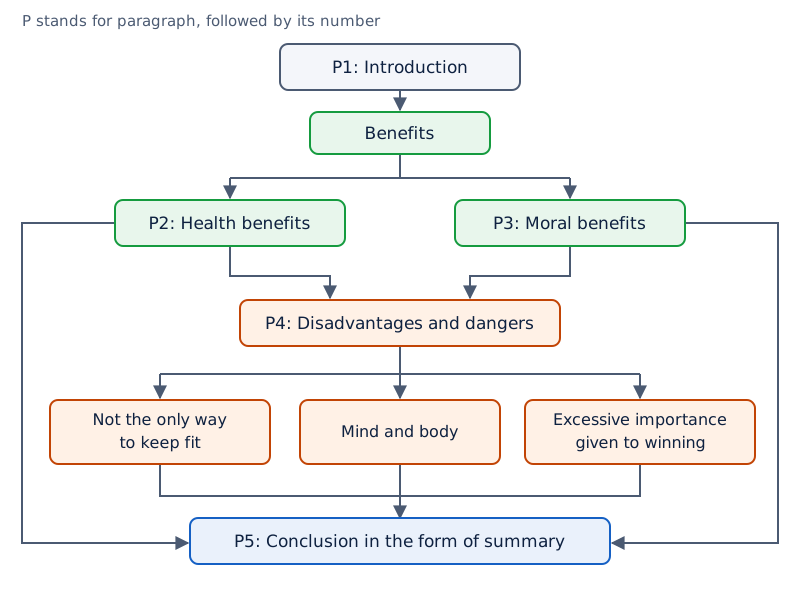
Boxes lead from the introduction to benefits, divided into health and moral benefits. A disadvantages box branches towards other ways of keeping fit, mind and body, and excessive importance given to winning. Arrows carry the discussion towards a concluding summary.
Drawn by One Young India. Reference: NCERT Class 11, printed page 87
The printed diagram abbreviates paragraph as P, followed by its number. The health and moral branches separate different kinds of benefit, while the final box gathers the discussion. The structure helps a writer see the relationship between paragraph functions.
The five-paragraph arrangement belongs to this worked example. The definition of an essay requires more than one paragraph, not exactly five. Use the plan to understand introduction, development and conclusion without treating one example's paragraph count as a universal rule.
Notice also that the conclusion follows the consideration of disadvantages. It therefore responds to the discussion as a whole. Its position helps the reader understand how the favourable judgement can coexist with the cautions already explained.
How does the Games essay develop its supporting argument?
An argument is a connected set of reasons supporting a view. The Games essay supports the importance of games through physical and moral benefits. These are developed separately so that the reader can follow what each contributes.
How is the health point explained?
The health paragraph connects fitness with fulfilling the duties society expects of a person. Intelligence is of limited use if poor health prevents someone from using it. The writer then compares the body with a machine that works badly when it is not used.
A comparison explains something by relating it to something else. The body is compared with a machine in some ways. Keep that limitation: the comparison is a way of explaining the need for activity, not a statement that bodies and machines are identical.
The paragraph makes the usefulness of a game conditional on its providing an opportunity for regular physical exercise, meaning bodily activity undertaken repeatedly. The word provided introduces that condition. Removing it would make the claim broader than the argument allows.
How is the moral point explained?
The next paragraph turns to experiencing both winning and losing. This encourages sportsmanship and helps a person respond wisely and naturally to life's problems. The participation principle used in the essay values taking part, together with doing the best one can.
The movement from health to conduct gives the essay a second line of support. Supporting details are explanations that develop a main point. Here, winning, losing, participation and effort explain what the moral benefit involves.
Worked example 5: preserving a condition
Task: Explain the usefulness of games from this supplied point: a game is useful provided it gives the body regular physical exercise.
Answer: A game's usefulness for this health argument depends on the regular physical exercise it provides. The claim concerns the opportunity for exercise; it does not make the name or competitive result of the game the source of the benefit.
How do cautions lead to a balanced conclusion?
A caution identifies a limitation or danger that needs consideration. The Games essay recognises that exercise, rather than games themselves, matters for health. Games are therefore one route to exercise, while other routes are possible; yoga is the example mentioned.
What dangers does the discussion identify?
The writer also considers excessive interest in games. The phrase mens sana in corpore sano means a healthy mind in a healthy body. The discussion draws attention to the mind as well as the body, rather than treating physical activity as the whole of life.
If games become the most important thing in our lives, we may be in danger of treating winning as the central purpose. Keep both the condition and the possibility. The argument does not say that everybody who plays games inevitably becomes obsessed with winning.
Balance in this discussion means weighing benefits together with limitations. Recognising a danger does not erase the earlier advantages. It helps determine the conditions under which the final favourable judgement is reasonable.
Worked example 6: drafting the conclusion
Task: Conclude from these supplied points: games provide physical and moral benefits; other exercise is possible; excessive interest can make winning too important; wise participation matters.
Answer: Games can offer worthwhile physical and moral benefits, although they are not the only way to exercise. Their value should be understood alongside the danger of excessive concern with winning. Taking part wisely allows us to gain from them.
This ending brings the earlier points together. It neither ignores the dangers nor concludes that games are therefore worthless. The qualification about wise participation connects the favourable view to the cautions.
When checking an ending, compare it with the main discussion. A conclusion that promises benefits without any qualification would weaken this particular argument because its development has already explained why the way people participate matters.
How can you review a draft using the four qualities?
Reviewing means reading a draft again to decide what needs improvement. A draft is a version of the writing that can still be revised. Apply unity, coherence, relevance and proportion to the actual sentences and paragraphs, rather than simply naming the qualities.
What should you check?
- Check unity: connect each paragraph with the main subject. In Hobbies, identify whether it develops meaning, choice, refreshment, usefulness, creativity or relationships.
- Check coherence: examine the relationship between successive ideas. In Games, distinguish the introduction, physical benefits, moral benefits, dangers and conclusion.
- Check relevance: decide whether each detail helps the discussion. Remove unimportant material rather than retaining it merely because it occurred during brainstorming.
- Check proportion: give the important ideas more space. Develop reasons and explanations instead of allowing a list of examples to replace the main discussion.
Then check the strength of your wording. A qualification limits a claim or states a condition. Words such as usually, can, provided and may affect meaning. Changing them can turn a careful statement into an unsupported generalisation.
Worked example 7: reviewing an overstatement
Task: Review the claim that hobbies involve no work, using these supplied facts: hobbies can entail work; they are personally chosen; they give pleasure because they interest us.
Answer: Replace the claim with the explanation that hobbies may involve work but are chosen willingly. Their connection with pleasure comes from personal interest, not from an absence of effort.
The revision corrects the meaning while keeping the paragraph focused on hobbies. It also preserves the useful contrast between a freely chosen activity and something forced upon a person. Reviewing is therefore a matter of reasoning as well as expression.
Finally, reread the opening and ending together. Check that they concern the same subject and that the ending follows from the points actually developed. This connects the overall organisation with the sentence-level checks already completed.
How can you answer the essay-writing practice tasks?
The practice tasks require you to use the same process with a chosen topic: generate ideas, select points, expand them into sentences and arrange them into connected paragraphs. A theme in a writing task is the central topic or concern to develop.
Which topics can you practise?
- Himalayan quake 2005.
- Those who can bear all can dare all.
- Fascinating facts about water.
- Public health in transition.
- Human population grows up.
- Success begins in the mind.
- Think before you shop.
Begin with the topic as given. Select ideas that explain that subject, organise them coherently and give the important ones enough space. A factual topic requires accurate supporting information; a title by itself does not supply event details or statistics.
What information supports the girl-child activity?
Child Sex Ratio (CSR) means the number of girls per 1000 boys in the age group from 0 to 6 years. The activity connects concern about a declining CSR with Beti Bachao, Beti Padhao, a programme supporting the girl child.
The programme concerns survival, protection and empowerment, meaning greater ability to make choices and participate. Gender-biased sex selection means selecting against a child because of sex. The activity's objectives concern preventing this discrimination, ensuring girls' survival and protection, and ensuring their education and participation.
The writing task asks for themes based on these objectives and a discussion of how the writer can contribute. Treat the objectives as the supplied material for planning. Keep a proposed contribution distinct from a claim that a programme has already achieved a particular result.
An outline is a brief plan showing the main parts of a piece of writing.
Worked example 8: making an outline from supplied objectives
Task: Plan the girl-child essay using prevention of gender-biased sex selection, survival and protection, education and participation, and your own possible contribution.
Answer: Introduce the need to support the girl child. Plan paragraphs on preventing gender-biased sex selection, ensuring survival and protection, and ensuring education and participation. For the personal contribution, propose helping younger girls with their studies, if this reflects your own intention. Conclude by linking this intended action with the education objective.
This outline organises the supplied material; the personal contribution must express the writer's own considered intention.
Glossary
- Essay — A composition on a particular subject, developed in more than one connected paragraph.
- Brainstorming — Generating and collecting ideas as they occur, individually or through contributions from a group.
- Unity — The quality of keeping every part of an essay clearly linked to its main subject.
- Coherence — A logical relationship and sequence connecting the ideas, sentences and paragraphs in an essay.
- Relevance — The quality maintained by selecting useful material and excluding unimportant information from the discussion.
- Proportion — The allocation of more space to important ideas when developing an essay.
- Introduction — The opening part that establishes the subject and begins the direction of the discussion.
- Conclusion — The ending that draws together the preceding discussion into a final view.
- Monotony — Dull repetition or lack of variety, from which hobbies can provide relief.
- Sportsmanship — The attitude to participation, winning and losing that games help a person develop.
- Qualification — Wording that limits the strength of a claim or states when it applies.
- Outline — A brief plan indicating the main parts and arrangement of a piece of writing.
- Child Sex Ratio — The number of girls per 1000 boys in the age group from 0 to 6 years.
Common errors and misconceptions
- Misconception: Brainstorming ideas must arrive in paragraph order. Correct: Ideas can be recorded randomly before points are selected and organised.
- Misconception: A list of words is already an essay. Correct: Selected points need expansion into sentences and development across connected paragraphs.
- Misconception: Every essay must contain exactly five paragraphs. Correct: The Games example uses five; the definition requires more than one paragraph.
- Misconception: Coherence and proportion mean the same thing. Correct: Coherence concerns logical connections; proportion concerns the space given to important ideas.
- Misconception: A hobby cannot involve work. Correct: A hobby may involve work, but it is taken up by personal choice and gives pleasure through interest.
- Misconception: The Games argument promises health benefits without conditions. Correct: Its claim depends on games providing regular physical exercise.
- Misconception: Discussing dangers means rejecting games. Correct: The conclusion remains favourable while making wise participation central to gaining benefits.
- Misconception: CSR counts girls out of the total number of children. Correct: It counts girls per 1000 boys in the specified age group of 0 to 6 years.
Exam-style questions with model answers
Q1. A writing task calls an essay a composition on one subject in more than one paragraph. Identify its subject requirement and paragraph requirement. [2 marks]
- The composition must develop a particular subject, keeping its discussion focused on that subject.
- It must contain more than one paragraph, allowing the subject to develop across connected parts.
Q2. A writer has recorded these Hobbies ideas randomly: free time, personal choice and refreshment through different activities. Explain three steps for turning this material into the start of an essay. [3 marks]
- Select the supplied points that establish what hobbies are and why people take them up, keeping the discussion focused on Hobbies.
- Expand them into sentences: hobbies occupy free time, are personally chosen and refresh the mind through a change of activity.
- Arrange the sentences logically, beginning with the meaning of hobbies and then developing personal choice and refreshment in connected writing.
Q3. Review a draft using these criteria: every part should connect with the subject; ideas should follow logically; unimportant information should be excluded; important ideas should receive more space. Name and explain each criterion. [4 marks]
- Unity: Check that every part of the draft clearly connects with the main subject rather than moving into unrelated discussion.
- Coherence: Check that ideas, sentences and paragraphs have logical relationships and follow an order the reader can understand.
- Relevance: Remove information that is unimportant to the discussion instead of keeping every idea collected during preparation.
- Proportion: Give important ideas more space, allowing enough explanation for them to receive appropriate attention in the essay.
Q4. Plan five paragraphs for The Importance of Games using these supplied points: introduce their importance; explain regular exercise and health; discuss sportsmanship and participation; recognise other forms of exercise and excessive concern with winning; conclude that wise participation can bring benefits. Explain each paragraph's role. [5 marks]
- Introduction: Establish games as the subject and introduce their importance. This gives the reader the general direction before the detailed reasons appear.
- Health: Develop the physical benefit by explaining the connection between games and regular exercise. Keep this paragraph focused on the health argument.
- Conduct: Develop the moral benefit through sportsmanship and participation. This adds a distinct reason for valuing games alongside the physical benefit.
- Cautions: Acknowledge other ways of exercising and the danger of excessive concern with winning. These points qualify the earlier favourable discussion.
- Conclusion: Bring the benefits and cautions together. End with the judgement that games can be valuable when participation is guided wisely.
Q5. The supplied claims say that we usually begin with a definition or description; a game is useful provided it offers regular exercise; and making games life's chief concern may create excessive emphasis on winning. Explain why usually, provided and may must be retained. [3 marks]
- Usually describes a common opening method. Removing it could wrongly turn the definition or description into a compulsory beginning for every essay.
- Provided states a condition. The usefulness claimed here depends on the game offering regular exercise, so that condition must remain attached.
- May expresses a possible danger. It does not say that excessive emphasis on winning is an inevitable result for every person.
Q6. Use only these Hobbies points: personal choice rather than compulsion; pleasure through interest; variety after routine work; relief from monotony; wider knowledge through stamp-collecting; friendship through common interests. Give six developed points for an essay. [6 marks]
- Choice: People take up hobbies willingly. This personal choice distinguishes the activity from something they undertake merely because it is forced upon them.
- Pleasure: Interest in the chosen activity makes it enjoyable. Explain that connection instead of simply listing hobbies without showing why people value them.
- Variety: A hobby provides a different activity after routine work. This change gives the discussion a clear point about variety in daily life.
- Monotony: Hobbies relieve the dull repetition of routine. Develop this as an explanation of why changing activities can make daily life more interesting.
- Knowledge: Stamp-collecting supplies an example of a hobby through which general knowledge can widen. Use the example to support the learning point.
- Friendship: Common interests connect people with one another. Explain this link to show how a hobby can contribute to relationships as well as personal enjoyment.
Q7. For this activity, CSR means girls per 1000 boys aged 0 to 6. The supplied programme objectives are preventing gender-biased sex selection, ensuring girls' survival and protection, and ensuring their education and participation. The task also asks how the writer can contribute. Give a five-point essay plan without adding statistics or claiming outcomes. [5 marks]
- Opening: Introduce support for the girl child and define CSR accurately as girls per 1000 boys in the age group from 0 to 6 years.
- Prevention: Develop the objective of preventing gender-biased sex selection. Keep the discussion focused on the objective supplied instead of introducing unsupported numerical claims.
- Protection: Give survival and protection their own explanation within the plan. This preserves the distinct concern of safeguarding the girl child.
- Education: Develop education and participation as another central objective. Connect this paragraph with the broader purpose already established in the opening.
- Contribution and ending: Propose helping younger girls with their studies as a possible personal contribution, adapting this intention to what you can undertake. Conclude by connecting this proposed action with the objective of education and participation.
Key takeaways
- An essay develops a particular subject through more than one paragraph, with clear connections between its parts.
- Brainstorming collects ideas as they occur; selection and arrangement turn that material into a developing essay.
- Unity connects parts with the subject, while coherence connects ideas, sentences and paragraphs logically.
- Relevance excludes unimportant information, and proportion gives important ideas more space for explanation and development.
- The Hobbies example connects personal choice and pleasure with refreshment, variety, learning, creativity and friendship.
- The Games example moves through introduction, physical benefits, moral benefits, dangers and a qualified conclusion.
- Preserve words such as usually, provided and may because they control the strength and conditions of claims.
- Use supplied activity objectives to plan the girl-child essay, then express your own intended contribution honestly.
Test yourself
How can one person brainstorm without a group?
Write ideas on a sheet of paper as they occur, then select and arrange them.
What turns a collected phrase into a usable essay point?
Expand it into a complete sentence that explains its meaning and connection with the subject.
Which quality concerns giving important ideas more space?
Proportion concerns allocating more space to important ideas within the essay.
Why can a hobby involve work and still give pleasure?
It is personally chosen because it interests us, rather than being forced upon us.
What condition accompanies the usefulness of games in the health argument?
The game must give the body an opportunity for regular physical exercise.
What does the fourth paragraph of the Games essay contribute?
It introduces disadvantages and dangers, including excessive interest and making winning too important.
Why is exactly five paragraphs not a rule for every essay?
Five paragraphs structure the Games example; an essay is defined as having more than one paragraph.
What does Child Sex Ratio count in the writing activity?
It counts girls per 1000 boys in the age group from 0 to 6 years.
Write about it
Turn a question from this chapter into a paper.
The Writing Studio has a structure guide, a rubric and citation tools for 15 formats, from essays to research papers. Drafting is free with an account. Learnacy Essential adds feedback from an AI writing coach and submission to The OYI Review.
Learnacy Essential is ₹1,499 for the year. Publication depends on review and is not guaranteed.