
Financial Management | CBSE Class 12 Business Studies Notes
On this page
This note covers business finance, financial management and wealth maximisation, investment, financing and dividend decisions, financial planning, capital structure, financial leverage, trading on equity, and the meaning and determinants of fixed and working capital.
What is financial management, and why is shareholders’ wealth its objective?
Definition: Business finance is the money needed to carry out business activities. Financial management concerns the optimal procurement and use of that finance.
Finance supports establishment, daily operations, modernisation, expansion and diversification. It purchases tangible assets such as buildings and machinery, and intangible assets such as patents and technical expertise. It also pays for materials, salaries and bills.
How does financial management affect a business?
Good financial management compares sources by cost and risk, seeks returns exceeding the cost of funds, and ensures that finance is available when needed. It also avoids unnecessarily idle funds. Its decisions shape the financial statements and the business’s financial health.
- Fixed assets: Capital budgeting determines their size and composition. An investment of ₹100 crores in fixed assets increases that asset block by this amount.
- Current assets: Credit and inventory decisions influence receivables and stocks, while expansion also increases working capital requirements.
- Funding period: Decisions determine the proportion of long-term and short-term finance, with implications for liquidity and profitability.
- Long-term funding mix: Financing decisions determine the amounts of debt, equity and preference share capital.
- Profit and loss items: More debt increases interest expense; expansion is likely to affect virtually all items in the profit and loss account.
Why is wealth maximisation the primary aim?
Wealth maximisation means maximising the current market price of the company’s equity shares. A financial decision should add value: the benefit from it should exceed its cost. Such value additions tend to increase share prices and benefit shareholders.
The objective connects investment, financing and working capital choices. A new machine should create benefits exceeding its cost; procuring funds at a lower cost can increase that value addition. Efficient decision-making selects the best available alternative.
Tata Steel’s acquisition of Corus illustrates the scale of these choices. The 2007 deal was worth US$12 billion, and Tata Steel raised over US$8 billion in debt. Financing the acquisition affected its capital structure and had implications for shareholders and employees.
How do investment decisions allocate a firm’s scarce funds?
An investment decision determines how funds are invested in different assets. Since resources are scarce relative to their possible uses, the firm must select investments carefully. The decision can concern long-term assets or the current assets supporting everyday operations.
What the figure shows
Financial Decisions
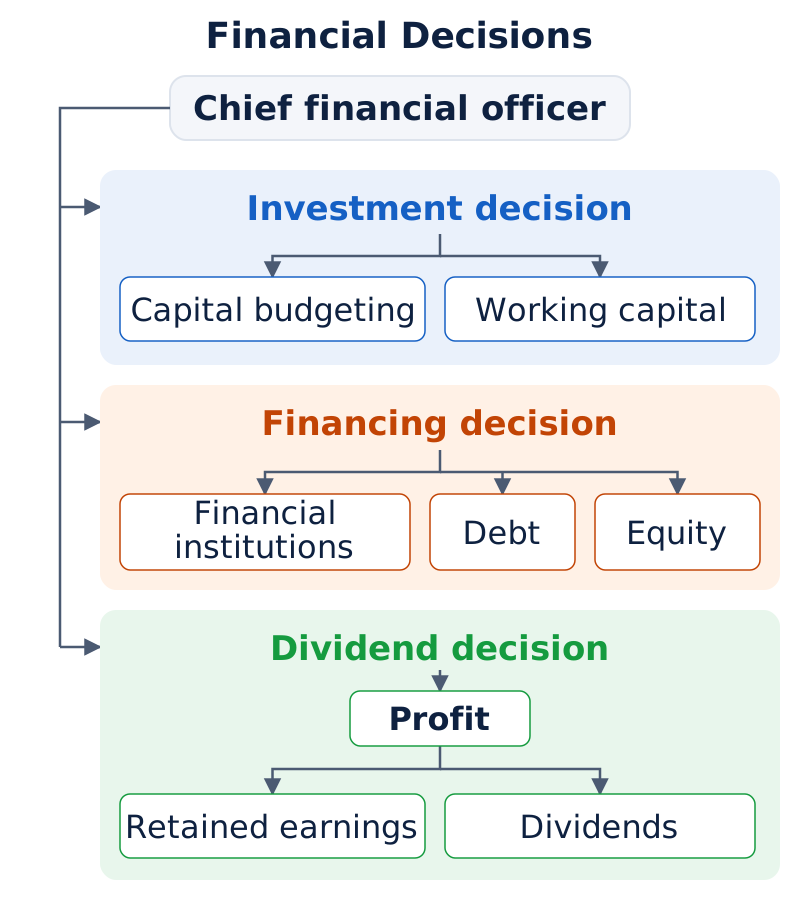
A chief financial officer appears at the centre. The investment branch leads to capital budgeting and working capital. The financing branch shows financial institutions, debt and equity. The dividend branch shows profit divided into retained earnings and dividends.
Drawn by One Young India. Reference: NCERT Class 12, p. 221
How do long-term and short-term investment decisions differ?
| Basis | Capital budgeting | Working capital decisions |
|---|---|---|
| Time orientation | Commits funds on a long-term basis | Supports day-to-day working |
| Examples | Replacing a machine, acquiring a fixed asset or opening a branch | Deciding cash, inventory and receivables levels |
| Main effects | Long-term earning capacity, asset size and competitiveness | Liquidity and profitability of daily operations |
| Decision difficulty | Normally involves large sums and is reversible only at a huge cost | Requires efficient cash, inventory and receivables management |
Which factors govern capital budgeting?
- Cash flows of the project: Analyse the amounts of expected cash receipts and payments over the investment’s life.
- Rate of return: Compare expected returns while assessing the risk involved. Return is the most important criterion in evaluating the proposal.
- Investment criteria: Apply capital budgeting techniques using investment amounts, interest rates, cash flows and returns before choosing a project.
Worked example 1. Projects A and B involve the same risk. A offers a return of 10%, while B offers 12%. Which project should be selected under normal circumstances?
Answer: Choose project B because its 12% return exceeds A’s 10% return at the same risk. The equal-risk condition matters: a higher return cannot be assessed without considering the risk attached to it.
A poor capital budgeting decision can severely damage a business’s financial position. Large commitments and costly reversal make careful evaluation essential before funds are committed, rather than after the investment has been made.
What determines a financing decision?
The financing decision concerns how much finance to raise from different long-term sources. It identifies available sources and chooses their proportions. Short-term sources are considered under working capital management.
Shareholders’ funds include equity capital and retained earnings. Borrowed funds include debentures and other debt. The broader financing mix may also include preference share capital. Choosing this mix determines the overall cost of capital and the enterprise’s financial risk.
What are the advantages and limitations of debt?
The main advantage of debt is its relatively low cost. Interest is deductible in calculating taxable profit, making debt still cheaper. Debt financing also avoids the dilution of management control that may accompany a fresh equity issue.
Its main limitation is the obligation to pay interest and repay principal at the specified time. Interest remains payable even without profit. Equity carries no comparable compulsion to pay dividends or repay capital, so debt creates greater financial risk for the business.
Which seven factors influence the choice?
| Factor | Effect on the financing decision |
|---|---|
| Cost | A prudent manager normally prefers a cheaper source, while also considering its other characteristics. |
| Risk | Different sources carry different risks; debt brings fixed payment obligations. |
| Floatation costs | Higher expenses of raising funds make a source less attractive. |
| Cash flow position | Stronger cash flows may make debt financing more viable. |
| Fixed operating costs | High rent, insurance and salary commitments favour lower fixed financing costs and therefore less debt. |
| Control considerations | Additional equity may dilute management control; debt financing has no such implication. |
| Capital market conditions | A rising market attracts equity investment; a depressed market may make share issues difficult. |
Note: A financing decision selects the sources of funds. An investment decision selects the assets in which those funds are placed. One acquisition or expansion can require both decisions.
How is the dividend decision made?
A dividend is the portion of profit distributed to shareholders. The dividend decision divides profit after tax between distribution and retention. Dividends provide current income, while retained earnings finance reinvestment and increase future earning capacity.
Retention also affects the financing decision: funds supplied internally reduce the amount needed from outside. The division must therefore serve shareholders’ wealth maximisation, rather than treating dividend payment as an isolated choice.
How do earnings, growth and cash affect dividends?
- Amount of earnings: Dividends come from current and past earnings, making earnings a major determinant.
- Stability of earnings: Other things remaining the same, stable earnings place a company in a better position to declare higher dividends.
- Stability of dividends: Companies generally stabilise dividend per share. Small or temporary earnings changes do not normally lead to changes in that dividend.
- Growth opportunities: Companies with good growth opportunities retain more earnings for investment and consequently pay smaller dividends.
- Cash flow position: Dividend payment requires cash. A profitable company may still lack the cash needed for distribution.
What other factors affect the payout?
- Shareholders’ preferences: Management considers shareholders’ desire for dividend income, including the needs of those depending on regular investment income.
- Taxation policy: Differences in the tax treatment of dividends and capital gains affect the choice. Higher dividend taxation favours lower payouts; relatively lower rates may favour higher payouts.
- Stock market reaction: Investors generally view a dividend increase positively. A decrease may negatively affect the share price.
- Access to the capital market: Large, reputed companies generally have easier access, depend less on retained earnings and tend to pay higher dividends.
- Legal constraints: Restrictions under the Companies Act must be observed when declaring dividends.
- Contractual constraints: Lenders may restrict future dividends through loan agreements, and the company must respect those terms.
Note: Stable earnings and stable dividends are different considerations. The first concerns consistency of profits; the second concerns the policy of maintaining dividend per share despite small or temporary earnings changes.
How does financial planning ensure funds are available at the right time?
Definition: Financial planning estimates a business’s fund requirements and specifies their sources. It prepares a financial blueprint of future operations, matching the amount and timing of funds with expected needs.
Its twin objectives are to ensure availability of funds whenever required and to avoid raising resources unnecessarily. Too little funding prevents commitments and plans being fulfilled. Excess funding adds cost and may encourage wasteful spending.
How does planning differ from financial management?
Financial management selects the best investment and financing alternatives by comparing costs and benefits to maximise shareholders’ wealth. Financial planning supports smooth operations by estimating fund requirements and availability in the light of those decisions.
Planning includes long-term growth and capital expenditure as well as short-term budgets. It is typically undertaken for three to five years. A budget gives a more detailed action plan for one year or less.
How is a financial plan developed?
- Usually begin with a sales forecast for the planning period.
- Prepare projected financial statements, considering fixed capital and working capital requirements.
- Estimate profits and the retained earnings available after dividend payouts to identify internal funding.
- Estimate the remaining requirement for external funds and identify possible sources.
- Prepare cash budgets incorporating these estimates and sources.
Why is financial planning important?
- It prepares the firm for different possible future business situations.
- It helps avoid shocks and surprises by preparing for future requirements.
- Clear policies and procedures coordinate functions such as sales and production.
- Detailed action plans reduce waste, duplicated effort and gaps in planning.
- It links present actions with future needs.
- It continuously connects investment decisions with financing decisions.
- Specific objectives for business segments make actual performance easier to evaluate.
For example, predicted sales growth of 20% may turn out to be 10% or 30%. Preparing alternatives for these situations helps management anticipate differing expenses and decide how to respond.
In the Aval Ltd. case, the exporter of canvas goods and bags plans to enter leather goods requiring specialised machinery. Finance Manager Prabhu estimates fund amounts and timing, examines future profits for internal finance, and explores external sources for the balance. These are financial planning activities.
What is capital structure, and how does it affect risk and return?
Capital structure is the mix of owners’ funds and borrowed funds. Owners’ funds include equity share capital, preference share capital, reserves and surpluses or retained earnings. Borrowed funds include loans, debentures and public deposits.
In expressing this mix as equity and debt, D represents debt and E represents equity. Financial leverage can be expressed as D/E, the debt-equity ratio, or D/(D + E), debt as a proportion of total capital.
Why does cheaper debt increase financial risk?
| Basis | Debt | Equity |
|---|---|---|
| Return to provider | The lender receives an assured return | The shareholder bears greater uncertainty |
| Cost to business | Lower required return and deductible interest reduce cost | Greater investor risk makes equity more costly |
| Payment commitment | Interest and principal repayment are obligatory | No comparable compulsion to pay dividends or repay capital |
| Risk to business | Fixed charges increase financial risk | Absence of those compulsory payments reduces this financial risk |
Increased debt is likely to reduce the overall cost of capital provided the cost of equity remains unaffected. However, more debt also means greater fixed financial charges. Failure to meet these commitments may force the business into liquidation.
Financial risk is the chance that the firm will fail to meet its payment obligations. This is different from the risk borne by the investor: debt may be less risky for the lender while creating compulsory payments for the borrowing firm.
What makes a capital structure optimal?
An optimal capital structure combines debt and equity so as to increase the value of equity shares. Its purpose is to maximise shareholders’ wealth through an appropriate risk-return combination. Merely adding cheaper debt does not guarantee that this objective will be achieved.
When does trading on equity increase earnings per share?
Definition: Trading on equity is the increase in profit earned by equity shareholders because of fixed financial charges such as interest. It is favourable when the return on investment exceeds the cost of debt.
RoI = (EBIT / Total investment) × 100. EBIT means earnings before interest and taxes. To obtain earnings per share, deduct interest from EBIT, deduct tax from the resulting earnings before tax, and divide earnings after tax by the number of equity shares.
What happens when RoI exceeds the interest rate?
Worked example 2. Company X Ltd. uses ₹30 lakh, earns EBIT of ₹4 lakh, pays 10% annual interest on debt and faces 30% tax. Situations I, II and III have debt of nil, ₹10 lakh and ₹20 lakh, with 3,00,000, 2,00,000 and 1,00,000 equity shares respectively, each of ₹10.
Answer: RoI = (₹4 lakh / ₹30 lakh) × 100 = 13.33%, exceeding the 10% debt cost. EPS rises from ₹0.93 to ₹1.05 and ₹1.40 as debt increases. This supports favourable trading on equity, but the financing decision must also consider increased financial risk.
| Company X item | Situation I | Situation II | Situation III |
|---|---|---|---|
| EBIT | ₹4,00,000 | ₹4,00,000 | ₹4,00,000 |
| Interest | Nil | ₹1,00,000 | ₹2,00,000 |
| Earnings before tax | ₹4,00,000 | ₹3,00,000 | ₹2,00,000 |
| Tax | ₹1,20,000 | ₹90,000 | ₹60,000 |
| Earnings after tax | ₹2,80,000 | ₹2,10,000 | ₹1,40,000 |
| Number of equity shares | 3,00,000 | 2,00,000 | 1,00,000 |
| EPS | ₹0.93 | ₹1.05 | ₹1.40 |
What happens when RoI falls below the interest rate?
Worked example 3. Company Y Ltd. also uses ₹30 lakh, pays 10% annual interest and faces 30% tax, but earns EBIT of ₹2 lakh. Debt in situations I, II and III is nil, ₹10 lakh and ₹20 lakh. The corresponding numbers of ₹10 equity shares are 3,00,000, 2,00,000 and 1,00,000.
Answer: RoI = (₹2 lakh / ₹30 lakh) × 100 = 6.67%, below the 10% debt cost. EPS falls from ₹0.47 to ₹0.35 and then nil. The company should not use trading on equity in this unfavourable situation.
| Company Y item | Situation I | Situation II | Situation III |
|---|---|---|---|
| EBIT | ₹2,00,000 | ₹2,00,000 | ₹2,00,000 |
| Interest | Nil | ₹1,00,000 | ₹2,00,000 |
| Earnings before tax | ₹2,00,000 | ₹1,00,000 | Nil |
| Tax | ₹60,000 | ₹30,000 | Nil |
| Earnings after tax | ₹1,40,000 | ₹70,000 | Nil |
| Number of equity shares | 3,00,000 | 2,00,000 | 1,00,000 |
| EPS | ₹0.47 | ₹0.35 | Nil |
Worked example 4. Sunrises Ltd. needs ₹80,00,000 for modern machinery and proposes debentures costing 10%. Its previous-year EBIT was ₹8,00,000 and total capital investment was ₹1,00,00,000. Is this financing decision rational on the stated return-cost comparison?
Answer: RoI = (₹8,00,000 / ₹1,00,00,000) × 100 = 8%. The 10% debt cost exceeds the 8% RoI, so issuing debentures is not rational on this comparison. Borrowing would create an unfavourable trading-on-equity situation.
Even Company X should avoid reckless use of debt. Higher EPS can accompany higher financial risk. The best debt-equity mix maximises shareholders’ wealth, rather than EPS considered in isolation.
How do cash flows, coverage ratios and costs affect capital structure?
Before borrowing, a company must consider whether its projected cash flows can cover payment obligations with a sufficient buffer. Cash is needed for ordinary operations, investment in fixed assets, interest payments and repayment of principal.
What do ICR and DSCR show?
Interest coverage ratio (ICR) = EBIT / Interest. It measures how many times earnings before interest and taxes cover interest obligations. A higher ratio indicates a lower risk of failing to meet interest payments.
However, high EBIT may coexist with a low cash balance, and ICR does not adequately address repayment obligations. The debt service coverage ratio compares cash profits with cash commitments for debt and preference share capital.
DSCR = (Profit after tax + Depreciation + Interest + Non-cash expenses) / (Preference dividend + Interest + Repayment obligation).
A higher DSCR indicates a better ability to meet cash commitments and consequently greater potential to increase debt. It considers a wider range of commitments than interest coverage alone.
How do return and financing costs influence borrowing?
- Return on investment: RoI above the debt cost makes trading on equity favourable. RoI below that cost means additional debt reduces EPS, as in Company Y.
- Cost of debt: Borrowing at a lower rate increases a firm’s capacity to employ debt.
- Tax rate: Deductibility of interest makes debt relatively cheaper at higher tax rates. With a 10% borrowing rate and 30% tax rate, the after-tax cost of debt is 7%.
- Cost of equity: Additional debt increases the financial risk borne by shareholders. Their required return may therefore rise. Beyond a point, the cost of equity may rise sharply and the share price may fall despite higher EPS.
- Floatation costs: Public issues of shares and debentures involve considerable expenditure. A financial institution’s loan may cost less to arrange, influencing the financing mix.
Note: Coverage ratios support a borrowing decision; they do not replace cash flow analysis. Interest coverage may look satisfactory even when cash available for interest and principal is insufficient.
Which other factors influence the choice of capital structure?
Capital structure depends on more than return and borrowing cost. Managers must also consider business risk, financial flexibility, control, regulation and market conditions. Together with cash flows and financing costs, these determine how much debt the business can reasonably use.
How do risk, flexibility and control matter?
- Risk consideration: Total risk combines operating or business risk with financial risk. Higher fixed operating costs increase business risk. A firm with lower business risk has greater capacity to use debt, and vice versa.
- Flexibility: Using all available borrowing capacity leaves no scope for additional debt when unforeseen needs arise. Some borrowing power should be preserved.
- Control: Debt normally does not dilute control. A public equity issue may reduce management’s holding and make the company vulnerable to takeover, especially where that holding is already low.
How do regulation, markets and industry practice matter?
- Regulatory framework: Public issues of shares and debentures must comply with SEBI guidelines. Borrowing from banks and financial institutions involves other norms. The ease of meeting these requirements influences source selection.
- Stock market conditions: In a bullish market, shares are more easily sold, even at higher prices, and companies often prefer equity. In a bearish phase, raising equity may be harder and debt may be chosen.
- Other companies’ capital structures: Debt-equity ratios within the same industry offer useful guidance, but should not be followed blindly. A firm with greater business risk cannot afford the same financial risk and should use lower debt.
The relationship between the factors matters. Low debt cost may attract borrowing, but high operating risk and weak cash flows constrain it. Similarly, preserving control is relevant, but a company must still be able to service its debt.
The choice is therefore an optimisation of risk and return. Management should know industry norms and be able to justify following or departing from them in the light of its own circumstances.
Why does fixed capital matter, and what determines its requirement?
Fixed capital is investment in long-term assets. These assets remain in the business for more than one year, usually much longer. Examples include land, buildings, machinery, furniture and vehicles.
Managing fixed capital allocates funds among projects with long-term implications. It includes acquisition, replacement, expansion and modernisation. Major advertising campaigns and research and development programmes with long-term effects also involve capital budgeting decisions.
Why must fixed capital decisions be taken carefully?
- Long-term growth: Funds invested in long-term assets are likely to yield returns in future. These investments influence the business’s prospects.
- Large funds: Substantial capital is tied up in long-term projects, requiring detailed analysis of funding and investment.
- Risk: Large commitments affect the firm’s overall returns and business risk over a long period.
- Costly reversal: Abandoning a heavily funded project can waste substantial resources and cause heavy losses.
Fixed assets should be financed from long-term sources, including equity, preference shares, debentures, long-term loans and retained earnings. They should never be financed through short-term sources.
Which eight factors affect fixed capital requirements?
| Factor | Effect and example |
|---|---|
| Nature of business | Trading requires less fixed investment than manufacturing because it does not require manufacturing plant and machinery. |
| Scale of operations | A larger scale requires bigger plants and more space, increasing fixed capital requirements. |
| Choice of technique | Capital-intensive operations require more machinery investment than labour-intensive operations. |
| Technology upgradation | Rapid obsolescence increases replacement needs. Computers become obsolete sooner than furniture. |
| Growth prospects | Expected growth may lead a firm to create capacity in advance, generally increasing fixed investment. |
| Diversification | A textile company starting a cement manufacturing plant requires greater fixed investment. |
| Financing alternatives | Leasing allows use of an asset through rental payments and may reduce the funds needed for outright purchase. |
| Level of collaboration | Banks using one another’s ATMs or jointly establishing facilities can reduce each participant’s fixed investment. |
Leasing may be especially suitable in high-risk lines of business. Collaboration is feasible where each participant’s individual scale is insufficient to use a facility fully. Both affect the funds that must be committed to fixed assets.
What is working capital, and how does it balance liquidity and profitability?
A business needs investment in current assets to support smooth daily operations. These are assets normally converted into cash or cash equivalents within one year. They are usually more liquid than fixed assets but contribute less to profits.
Which assets and liabilities are current?
Current assets include cash in hand or at bank, marketable securities, bills receivable, debtors, finished goods, work in progress, raw materials and prepaid expenses. These are listed in their order of liquidity, beginning with cash.
Current liabilities are payment obligations due within one year. They include bills payable, creditors, outstanding expenses and advances received from customers. Some current assets are usually financed through these short-term sources.
Net working capital = Current assets − Current liabilities. Net working capital is the excess of current assets over current liabilities, representing the part financed through long-term sources.
Why is neither maximum liquidity nor minimum stock sufficient?
Liquidity refers to the ability to convert an asset into cash quickly without reducing its value. Too little investment in current assets can make payment obligations difficult to meet. Yet these assets provide little or low return, so liquidity must be balanced with profitability.
In the Ramnath case, television components are purchased on three months’ credit while assembled televisions are sold for cash. Supplier credit reduces the working capital requirement, while cash sales avoid tying funds up in customer credit.
Note: Credit allowed to customers and credit availed from suppliers have opposite effects. More customer credit increases debtors and working capital needs; supplier credit reduces the working capital requirement.
Which factors increase or reduce working capital requirements?
Working capital requirements depend on the nature and scale of operations, the time funds remain tied up, trading conditions and operating efficiency. The factors should be considered together because production, inventories, receivables and supplier credit are connected.
How do business activity and timing affect the requirement?
- Nature of business: Other things remaining the same, trading usually requires less working capital than manufacturing because goods need no processing. Service businesses usually maintain no inventory and therefore require less working capital.
- Scale of operations: A higher scale generally requires larger inventories and debtors, raising working capital needs.
- Business cycle: A boom is likely to raise production and sales, increasing requirements. A depression reduces activity and the funds needed.
- Seasonal factors: Peak seasons require more working capital because activity is higher; lean seasons require less.
- Production cycle: A longer interval between receipt of raw materials and their conversion into finished goods ties up funds for longer and increases requirements.
How do credit, efficiency and supplies affect the requirement?
- Credit allowed: Liberal credit to customers increases debtors and therefore working capital requirements.
- Credit availed: Credit received from suppliers reduces the working capital requirement to that extent.
- Operating efficiency: Efficient raw material use, faster debtor collection and better sales efforts may reduce stocks and receivables, releasing funds otherwise tied up.
- Availability of raw materials: Reliable, continuous supplies allow lower stocks. Uncertain availability or longer lead time requires greater stocks and more working capital. Lead time is the interval between placing an order and receiving materials.
How do growth, competition and inflation affect the requirement?
- Growth prospects: Higher expected growth requires more working capital to meet higher production and sales targets.
- Level of competition: Strong competition may require larger finished-goods stocks for urgent orders and more liberal customer credit, both increasing requirements.
- Inflation: Rising prices increase the amount needed even for unchanged production and sales. The effect depends on individual price changes and each component’s share in total requirements.
An inflation rate of 5% does not mean every working capital component rises by 5%. Raw materials, labour and finished goods may experience different price changes, so a uniform increase should not simply be assumed.
In the ‘S’ Limited steel case, setting up a new plant requires about ₹5,000 crores and starting its operations requires about ₹500 crores of working capital. The case distinguishes the long-term asset commitment from funds needed to begin daily operations.
Glossary
- Business finance — Money required to establish, operate, modernise, expand or diversify a business and carry out its activities.
- Financial management — Optimal procurement and use of finance, considering costs, risks, returns and the availability of funds.
- Wealth maximisation — Maximising shareholders’ wealth by increasing the current market price of the company’s equity shares.
- Investment decision — A decision about allocating the firm’s funds among different long-term and short-term assets.
- Capital budgeting — Long-term investment decisions that commit funds to projects or assets affecting future growth, profitability and risk.
- Financing decision — A decision determining how much finance should be raised from each available long-term source.
- Dividend decision — Deciding how much profit after tax to distribute to shareholders and how much to retain.
- Financial planning — Estimating fund requirements and specifying sources so that adequate funds are available when needed.
- Capital structure — The mix of owners’ funds and borrowed funds used to finance a business.
- Financial risk — The chance that a business will fail to meet its financial payment obligations.
- Trading on equity — An increase in profit earned by equity shareholders due to fixed financial charges such as interest.
- Fixed capital — Investment in long-term assets that remain in the business for more than one year.
- Net working capital — The excess of current assets over current liabilities, financed through long-term sources.
- Floatation costs — Expenses incurred in raising funds, which affect the relative attractiveness of financing sources.
- Lead time — The interval between placing an order for materials and actually receiving those materials.
Common errors and misconceptions
- Misconception: The financial objective is simply to raise EPS. Correct: The primary objective is shareholders’ wealth maximisation. Excessive debt may increase EPS while increasing risk and reducing the share price.
- Misconception: More debt improves shareholder returns in every situation. Correct: Trading on equity is favourable when RoI exceeds debt cost. Company Y’s lower RoI causes EPS to fall as debt rises.
- Misconception: A high interest coverage ratio proves that every debt commitment can be met. Correct: EBIT may be high while cash is low. Principal repayments also matter, making cash analysis and DSCR relevant.
- Misconception: Profit automatically provides cash for dividends. Correct: A company may earn profit but lack cash. Dividend decisions must consider cash availability as well as earnings.
- Misconception: Financial planning and financial management mean the same thing. Correct: Management chooses investment and financing alternatives; planning estimates fund requirements, their timing and available sources.
- Misconception: All forms of credit increase working capital requirements. Correct: Credit allowed to customers increases debtors and requirements, whereas credit availed from suppliers reduces the working capital requirement.
- Misconception: Current assets and net working capital are identical. Correct: Net working capital is current assets minus current liabilities, rather than the entire investment in current assets.
- Misconception: A 5% inflation rate raises each working capital component by 5%. Correct: Actual requirements depend on the price changes of individual components and their proportions in the total.
Exam-style questions with model answers
Q1. State the two objectives of financial planning. [2 marks]
- Ensure availability: Estimate the amount and timing of funds required, and identify sources so that funds are available whenever needed.
- Avoid unnecessary funding: Do not raise excess resources that remain idle, add cost or encourage wasteful expenditure.
Q2. Explain the three factors affecting capital budgeting decisions. [3 marks]
- Cash flows: Examine the expected amounts of cash receipts and payments throughout the project’s life before committing funds.
- Rate of return: Compare the expected return from each proposal while assessing its risk. With equal risk, the higher-return project is normally preferred.
- Investment criteria: Apply suitable capital budgeting techniques using investment amounts, interest rates, cash flows and returns to evaluate proposals before selection.
Q3. Company X Ltd. has EBIT of ₹4,00,000, debt of ₹10,00,000 at 10% annual interest, a 30% tax rate and 2,00,000 equity shares. Calculate interest, earnings before tax, earnings after tax and EPS. [4 marks]
- Interest: Annual interest equals debt multiplied by the interest rate: ₹10,00,000 × 10% = ₹1,00,000.
- Earnings before tax: Deduct interest from EBIT: ₹4,00,000 − ₹1,00,000 = ₹3,00,000.
- Earnings after tax: Tax is ₹3,00,000 × 30% = ₹90,000. Earnings after tax are ₹3,00,000 − ₹90,000 = ₹2,10,000.
- EPS: Divide earnings after tax by the equity shares: ₹2,10,000 / 2,00,000 = ₹1.05 per share.
Q4. Company Y Ltd. has EBIT of ₹2,00,000, debt of ₹20,00,000 at 10% annual interest, a 30% tax rate and 1,00,000 equity shares. Calculate interest, earnings before tax, earnings after tax and EPS. [4 marks]
- Interest: Debt of ₹20,00,000 at 10% creates an annual interest obligation of ₹2,00,000.
- Earnings before tax: Subtract that interest from EBIT: ₹2,00,000 − ₹2,00,000 = nil. Interest absorbs the whole operating earning.
- Earnings after tax: With nil earnings before tax, tax at 30% is nil, leaving earnings after tax of nil.
- EPS: Nil earnings divided among 1,00,000 equity shares produce nil earnings per share.
Q5. Sunrises Ltd. proposes raising ₹80,00,000 through debentures costing 10% to replace machinery. Previous-year EBIT was ₹8,00,000 and total capital investment was ₹1,00,00,000. Calculate RoI, compare it with debt cost and advise on the proposal using this comparison. [3 marks]
- Calculate RoI: RoI = EBIT / Total investment × 100 = ₹8,00,000 / ₹1,00,00,000 × 100 = 8%.
- Compare: The proposed debt costs 10%, which exceeds the 8% return earned on the company’s investment.
- Advise: Issuing debentures is not rational on this return-cost comparison. Debt would cost more than the return being earned, making trading on equity unfavourable.
Q6. Explain any six factors affecting the fixed capital requirement of a business. [6 marks]
- Nature of business: Manufacturing generally needs greater fixed investment than trading because plant and machinery are required to produce goods.
- Scale of operations: A larger organisation needs bigger plants and more space, so it requires greater investment in fixed assets.
- Choice of technique: Capital-intensive production uses more plant and machinery than labour-intensive production and therefore requires more fixed capital.
- Technology upgradation: Assets subject to rapid obsolescence need earlier replacement, increasing fixed capital requirements compared with assets that remain useful longer.
- Growth prospects: Higher anticipated growth may require additional capacity in advance, increasing investment in assets needed to meet future demand.
- Diversification: Entering another line of business increases fixed investment, as when a textile company starts a cement manufacturing plant.
Q7. Explain how earnings stability, growth opportunities, cash availability, shareholder preferences and contractual constraints affect dividend decisions. [5 marks]
- Earnings stability: Other things remaining the same, stable earnings put a company in a better position to declare higher dividends.
- Growth opportunities: Good investment opportunities encourage retention of earnings to finance growth, leaving a smaller amount available for dividends.
- Cash availability: Dividend payments require cash. Even a profitable company must consider whether it has sufficient cash for distribution.
- Shareholder preferences: Management considers the desire for regular dividend income, particularly among shareholders depending on income from their investment.
- Contractual constraints: Loan agreements may restrict dividend payments. The company must ensure its dividend decision does not violate these conditions.
Q8. Explain how the production cycle, credit allowed, credit availed, operating efficiency, raw material availability and inflation affect working capital requirements. [6 marks]
- Production cycle: A longer period from receiving raw materials to completing finished goods ties up funds for longer, increasing working capital requirements.
- Credit allowed: Liberal credit to customers increases the amount held in debtors, so the business needs more working capital.
- Credit availed: Credit obtained from suppliers reduces the working capital requirement to the extent that purchases are financed by them.
- Operating efficiency: Better stock management, debtor collection and sales efforts may reduce funds tied up in raw materials, receivables and finished goods.
- Raw material availability: Continuous, reliable supplies permit lower stocks. Uncertain supplies or longer lead times require greater inventories and working capital.
- Inflation: Rising prices increase funding needs even at unchanged output. The actual increase depends on component prices and their relative proportions.
Key takeaways
- Financial management aims to maximise shareholders’ wealth by making decisions that increase the current market price of equity shares.
- Investment decisions allocate funds to assets; financing decisions select sources; dividend decisions divide profit between distribution and retention.
- Financial planning matches the amount and timing of fund requirements with sources while avoiding unnecessary excess funding.
- Debt is relatively cheap but creates fixed obligations, so capital structure must balance expected returns with financial risk.
- Trading on equity is favourable when RoI exceeds debt cost; a higher EPS alone does not establish the best capital structure.
- Fixed capital decisions commit substantial funds, affect long-term growth and risk, and are costly to reverse.
- Working capital supports daily operations; net working capital equals current assets minus current liabilities and is financed through long-term sources.
- Customer credit raises working capital needs, supplier credit reduces them, and operating efficiency may reduce funds tied up in assets.
Test yourself
What is the primary objective of financial management?
It is to maximise shareholders’ wealth by maximising the current market price of the company’s equity shares.
Which condition made trading on equity favourable for Company X?
Company X earned RoI of 13.33%, exceeding its 10% debt cost, so increased debt raised its earnings per share.
Why does a high ICR not settle the borrowing decision?
A company may have high EBIT but little cash, while principal repayments also require funds beyond those needed for interest.
Why can leasing reduce fixed capital requirements?
Leasing allows a firm to use an asset through rental payments without committing the large sum needed to purchase it.
How are financial planning and a budget related?
A budget is a detailed short-term financial plan for one year or less, forming part of financial planning.
What is the difference between business risk and financial risk?
Business risk depends on fixed operating costs; financial risk concerns the possibility of failing to meet financial payment obligations.
Why may a profitable company pay a smaller dividend?
It may need to retain earnings for growth, lack sufficient cash, or face legal and contractual restrictions on dividend payments.
How does a longer lead time affect working capital?
More material must be kept in stock while awaiting deliveries, increasing the amount of funds required for working capital.
Write about it
Turn a question from this chapter into a paper.
The Writing Studio has a structure guide, a rubric and citation tools for 15 formats, from essays to research papers. Drafting is free with an account. Learnacy Essential adds feedback from an AI writing coach and submission to The OYI Review.
Learnacy Essential is ₹1,499 for the year. Publication depends on review and is not guaranteed.