
Consumer Protection | CBSE Class 12 Business Studies Notes
On this page
Watch & explore
Start with a few high-quality watches, then dive into the notes below.
This note covers the meaning and importance of consumer protection, the Consumer Protection Act, 2019, consumer rights and responsibilities, ways of protecting consumers, redressal commissions, mediation, available reliefs, consumer organisations and cases involving banking and dry-cleaning services.
What is consumer protection and why do consumers need it?
Definition: Consumer protection safeguards consumers' interests through measures against unethical business practices, education about rights and responsibilities, and speedy redressal of grievances.
Consumers purchase, use and consume goods and services. Manufacturers, sellers and service providers seeking higher sales and market share may be tempted to adopt unfair practices. These can expose consumers to unsafe products, health problems, misleading claims and excessive prices.
Which malpractices harm consumers?
| Malpractice | How it affects the consumer |
|---|---|
| Adulterated goods | Inferior substances are added to the product being sold. |
| Counterfeit and duplicate goods | A lesser-value product may be passed off as the real product, or duplicate goods may be sold. |
| Substandard or defective goods | Goods fail to meet prescribed quality standards or contain defects. |
| Faulty weights and measures | Malfunctioning measures lead to consumers receiving underweight products. |
| Hoarding and black marketing | These practices lead to scarcity and a rise in prices. |
| Overcharging | The seller charges more than the Maximum Retail Price. |
| Misleading advertisements | False claims present goods or services as having superior quality, grade or standards. |
| Inferior services | The quality of service falls below the conditions agreed upon. |
Why is protection important from the consumer's viewpoint?
- Consumer ignorance: Widespread lack of knowledge about rights and available reliefs makes consumer education necessary. Awareness enables consumers to recognise that they can challenge exploitation.
- Unorganised consumers: Consumers need organisations that protect and promote their interests. Existing consumer organisations in India need to become powerful enough to provide adequate protection.
- Widespread exploitation: Defective products, adulteration, misleading advertising, hoarding and black marketing create a need for protection against unscrupulous sellers.
Protection has a wide scope. It includes education, grievance redressal, judicial machinery and consumer associations. Its purposes include physical safety, access to information, fair prices, appropriate quality and quantity, consumer satisfaction, social justice, trusteeship, and business survival and growth.
Note: Caveat emptor means “Let the buyer beware”; caveat venditor means “Let the seller beware”. The shift towards a consumer market places greater emphasis on protecting the buyer's interests.
Why should a business protect consumers?
Consumer protection matters to business as well as to buyers. Consumers are an important stakeholder group because businesses earn money by selling goods and providing services to them. Protecting their interests supports customer satisfaction and responsible business conduct.
What are the advantages of protecting consumers?
- Long-term interest of business: Satisfied customers make repeat purchases and give favourable feedback to prospective customers. This can expand the customer base. Enlightened businesses therefore aim at long-term profit maximisation through customer satisfaction.
- Use of society's resources: Businesses use resources belonging to society. They consequently have a responsibility to supply goods and services that serve the public interest and do not impair public confidence.
- Social responsibility: Consumers form an important group among business stakeholders. Their interests deserve attention just as the interests of other stakeholder groups do.
- Moral justification: A business has a moral duty to protect consumers and avoid exploiting them. Defective goods, adulteration, misleading advertisements, hoarding and black marketing conflict with this duty.
- Avoiding government intervention: Exploitative practices invite government action, which can tarnish a company's image. Businesses should voluntarily adopt practices that take care of customers' needs and interests.
What limitations arise when consumers remain unaware or unorganised?
Legal rights alone do not make consumers well informed. Widespread ignorance about rights and reliefs creates a need for education. Similarly, individual consumers need organisations that can promote their interests and help them seek protection against exploitation.
Businesses contribute through self-regulation, ethical conduct and grievance cells. Consumer awareness, associations and government measures also contribute. Protection therefore involves both responsible conduct by sellers and informed action by consumers, rather than merely the existence of rights.
The connection between satisfaction and business interest is practical: repeat sales and favourable feedback can support growth. The moral and social reasons remain distinct, because businesses also owe duties to consumers and to the society whose resources they use.
Who is a consumer under the Consumer Protection Act, 2019?
The Consumer Protection Act, 2019 replaced the 1986 Act and seeks to widen the scope of protection. It aims to protect and promote consumers' interests through speedy and inexpensive redressal of grievances. It extends throughout India and includes e-commerce firms.
Which purchases and services are covered?
A consumer buys goods or avails services for consideration. Payment may already have been made, may be promised, may be partly paid and partly promised, or may fall under a deferred-payment scheme.
The definition includes a user of goods or a beneficiary of services when that use has the buyer's approval. It covers offline and online transactions, electronic means, teleshopping, direct selling and multilevel marketing.
A person obtaining goods or services for resale or a commercial purpose is outside the consumer definition given here. The Act applies to manufacturers and traders, and to businesses supplying goods or providing services.
How do important complaint terms differ?
| Term | Meaning |
|---|---|
| Complaint | A written allegation seeking relief for matters such as restrictive practices, defective goods, deficient services, overcharging or unsafe goods and services. |
| Defect | A fault, imperfection, shortcoming or inadequacy relating to goods or a product. |
| Deficiency | A shortcoming in a service, including negligence or withholding relevant information that causes loss or injury. |
| Spurious goods | Goods falsely claimed to be genuine. |
| Restrictive trade practice | A practice manipulating prices or supplies in a way that imposes an unjustified cost on consumers. |
| Product liability | The responsibility to compensate consumers for harm caused by defective products or deficient services. |
Who can be a complainant?
A complainant may be one or more consumers, a voluntary consumer association, the Central or a State Government, the central authority, a legal heir or legal representative, or a parent or legal representative in the case of a minor.
Which other Acts form part of the legal background?
Other named laws concerning consumer interests include the Indian Contract Act, 1872, the Sale of Goods Act, 1930, the Trade Marks Act, 1999 and the Competition Act, 2002. Consumer protection thus forms part of a wider legal framework.
What are the six consumer rights?
The six consumer rights empower buyers to obtain protection, information, choice, a hearing, relief and education. They concern the purchase and use of goods and services, as well as action when a consumer is dissatisfied.
How do safety, information and choice protect a buyer?
- Right to safety: Consumers have a right to protection against goods and services hazardous to life, health and property. Electrical appliances made with substandard products or without conformity to safety norms might cause serious injury. ISI-marked appliances provide assurance of meeting quality specifications.
- Right to be informed: A consumer should have complete information about the intended purchase, including ingredients, manufacturing date, price, quantity and directions for use. Providing information on packaging and labels helps consumers exercise this right.
- Right to be assured: Consumers should have access to a variety of products at competitive prices. Marketers should offer alternatives in quality, brand, price and size so that consumers can make a choice.
How do hearing, redressal and education help consumers?
- Right to be heard: A dissatisfied consumer has a right to complain and receive a hearing. Consumer service and grievance cells established by businesses help provide this opportunity. Consumer organisations also assist with grievances.
- Right to seek redressal: Consumers can seek relief against unfair or restrictive practices and unscrupulous exploitation. Relief may include removing a defect, replacing a product or compensating a consumer for loss or injury.
- Right to consumer education: Consumers have a right to acquire knowledge and remain informed throughout life. They should know their rights and the reliefs available when goods or services fall short of expectations.
How does information differ from education?
The right to be informed concerns information about a product the consumer intends to buy. The right to consumer education concerns the continuing acquisition of knowledge about consumer rights and available reliefs. Both contribute to awareness, but their focus differs.
Consider the proposal by FSSAI for hotels and other food outlets to disclose the oil or fat used in cooking each menu item. This illustrates the right to be informed: knowledge about ingredients helps consumers understand what they are buying.
Note: The right to be heard concerns making a complaint and receiving a hearing. The right to seek redressal concerns obtaining relief. Identifying a grievance cell does not, by itself, establish that compensation has been awarded.
Diagram
Consumer rights
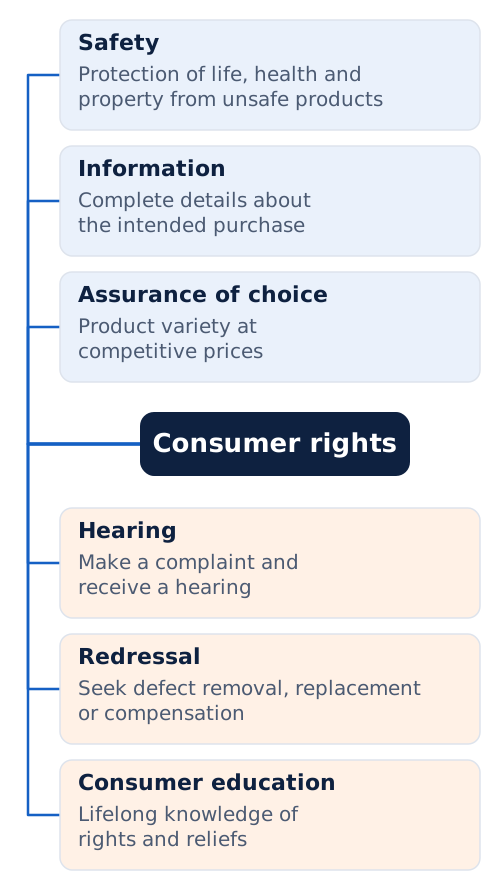
Put “Consumer rights” in a central box. Draw six branches labelled safety, information, assurance of choice, hearing, redressal and consumer education. Add one short phrase explaining each right.
Drawn by One Young India.
What responsibilities should consumers fulfil?
Consumer responsibilities complement rights. Protection becomes effective when consumers understand their duties while purchasing, using and consuming goods and services. Awareness should lead to careful choices, safe use, honest dealings and action against shortcomings.
What should consumers do before and during purchase?
- Know the available alternatives: Be aware of different goods and services in the market so that the choice is intelligent and informed.
- Choose standardised goods: Look for quality assurance marks, such as ISI on electrical goods, FPO on food products and Hallmark on jewellery.
- Understand risks: Learn the risks associated with goods and services. Follow the manufacturer's instructions and use products safely.
- Read labels: Check information about price, net weight, manufacturing date and expiry date instead of overlooking the details supplied.
- Assert your interests: Ensure that you receive a fair deal in the transaction.
- Deal honestly: Choose legal goods and services and discourage practices such as black marketing and hoarding.
What duties concern evidence, complaints and collective welfare?
- Ask for a cash memo: Obtain proof of purchase when buying goods or services. It serves as evidence that the purchase was made.
- File a complaint: Approach the appropriate consumer forum when goods or services have shortcomings. Do not neglect action merely because the amount involved is small.
- Form consumer societies: Support organisations that educate consumers and safeguard their interests.
- Respect the environment: Avoid waste, littering and contributions to pollution.
The label and the cash memo serve different purposes. A label supplies product information, whereas the cash memo proves the purchase. Reading a label helps with choice and safe use; asking for a cash memo preserves evidence of the transaction.
What the figure shows
Marks indicating quality in different products
The illustration shows the FPO letters within an oval with ribbon-like shapes below, the Bureau of Indian Standards mark, a circular Agmark emblem, the triangular BIS Hallmark and a pot-shaped Eco-mark symbol.
Reference: NCERT Class 12, page 298
These quality marks connect consumer awareness with purchase decisions. Recognising a mark is useful alongside reading product details and following instructions. A consumer should also be prepared to complain when the purchased goods or services have a shortcoming.
What are the ways and means of consumer protection?
Consumer awareness is one means of protection. Business conduct, trade associations, consumer organisations and government measures also help protect consumers. These approaches support education, fair dealings and redressal instead of leaving the consumer to act without assistance.
How do businesses and their associations contribute?
Self-regulation by business means following ethical standards and practices in dealings with customers. Socially responsible firms recognise that serving customers properly is in their long-term interest. Many firms have customer service and grievance cells to address complaints.
Business associations such as FICCI and CII prescribe codes of conduct for members. These codes provide guidelines for dealings with customers. The association's role complements the ethical practices adopted by an individual business.
How do awareness, organisations and government help?
- Consumer awareness: Knowledge of rights and reliefs enables consumers to raise their voice against unfair practices. Understanding responsibilities also helps safeguard their interests. The Department of Consumer Affairs has undertaken the Jago Grahak Jago campaign to generate awareness.
- Consumer organisations: These bodies educate consumers about rights and provide protection. They can press businesses to avoid malpractices and exploitation.
- Government: Government measures include legislation and institutions for protecting consumers. The Consumer Protection Act, 2019 provides a central authority and a three-tier grievance-redressal machinery.
What is the role of the central authority?
The Central Consumer Protection Authority (CCPA) regulates matters involving violations of consumer rights, unfair trade practices, and false or misleading advertisements that harm consumers' interests. The District, State and National Commissions provide the three levels of grievance redressal.
| Means of protection | Main contribution |
|---|---|
| Business self-regulation | Ethical dealings and grievance cells. |
| Business associations | Codes of conduct guiding members' dealings with customers. |
| Consumer awareness | Knowledge of rights, reliefs and responsibilities. |
| Consumer organisations | Education, protection and action against exploitation. |
| Government | Legal measures, the central authority and redressal machinery. |
How do the District, State and National Commissions differ?
The three-tier redressal machinery operates at district, state and national levels. Under the jurisdiction limits associated with the Consumer Protection Rules, 2021, the relevant amount is the value of goods or services paid as consideration.
What are the jurisdiction limits?
| Commission | Value paid as consideration | Appeal route and period |
|---|---|---|
| District Commission | Does not exceed ₹50 lakh. | Appeal to the State Commission within 45 days from the order, on grounds of fact or law. |
| State Commission | Exceeds ₹50 lakh but does not exceed ₹2 crore. | Appeal to the National Commission within 30 days of the order. |
| National Commission | Exceeds ₹2 crore. | Appeal to the Supreme Court of India within 30 days of the order. |
The respective State Government establishes the State Commission, which ordinarily functions at the state capital. The National Commission has territorial jurisdiction over the whole country. Jurisdiction for complaints and the route for appeals are separate features of this machinery.
How should the boundary amounts be applied?
Worked example 1. Apply the jurisdiction rule to its lower boundary: the value paid as consideration is exactly ₹50 lakh. Which commission should be chosen for the complaint?
Answer: Choose the District Commission. Its limit does not exceed ₹50 lakh, so ₹50 lakh falls within it. State Commission jurisdiction begins when consideration exceeds ₹50 lakh.
Worked example 2. Apply the jurisdiction rule to the next boundary: consideration paid is exactly ₹2 crore. Which commission should be chosen?
Answer: Choose the State Commission. Its jurisdiction extends above ₹50 lakh up to ₹2 crore. The National Commission entertains complaints where consideration exceeds ₹2 crore.
Both examples turn on the difference between “does not exceed” and “exceeds”. An amount equal to an upper limit remains within that limit. Crossing it moves the complaint into the next value category.
Note: Use consideration paid to identify the value category. Do not substitute the compensation demanded. Also distinguish the District Commission's 45-day appeal period from the 30-day periods stated for the higher commissions.
An order of a District, State or National Commission is deemed final if neither party makes an appeal against it. A dissatisfied party should therefore distinguish the original complaint from a challenge to an order already issued.
How are mediation and evidence used in redressal?
The District Commission can consider mediation when, at the first hearing or a later stage, it appears that a settlement acceptable to the parties may be possible. Referral depends on consent; settlement is not presumed merely because a complaint has been filed.
What happens when mediation is considered?
- The commission identifies elements of a possible settlement that may be acceptable to the parties.
- It may direct the parties to give their consent for settlement through mediation within five days.
- If the parties agree and give written consent, the commission refers the matter for mediation.
- If settlement through mediation fails, the commission proceeds with the complaint.
How does evidence differ for goods and services?
When an alleged defect in goods cannot be determined without proper testing or analysis, the commission obtains a sample, seals it and refers it to the appropriate authority for analysis. Testing is linked to the nature of the alleged defect.
For a service dispute, settlement is based on evidence brought forward by the complainant. The commission can ask the service provider for necessary information, documents or records. Proof helps establish the circumstances of the complaint.
The banking case involving failed ATM transactions illustrates the use of evidence. The complainant presented photographs and video recordings of attempts when cash was unavailable. The forum considered that evidence and rejected the bank's argument against treating the failure as a service deficiency.
Diagram
Mediation route
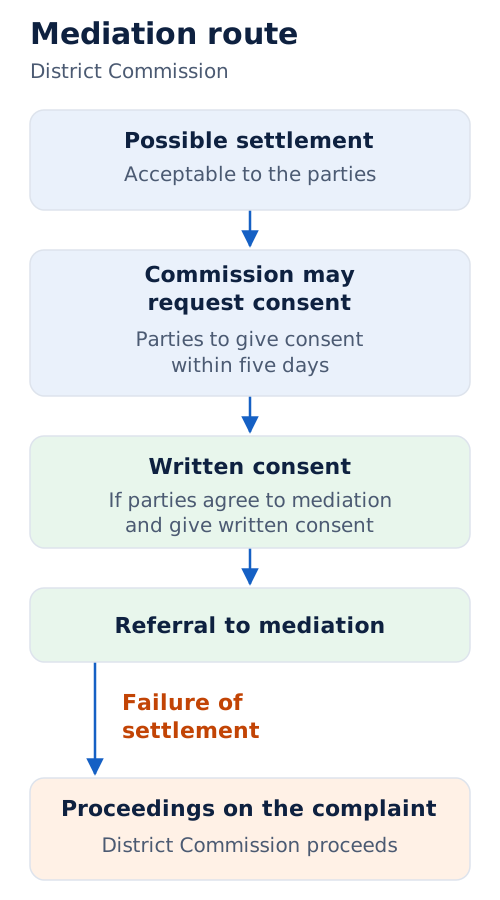
Draw boxes for possible settlement, consent sought within five days, written consent and referral to mediation. Add a branch showing that failure of settlement leads back to proceedings on the complaint.
Drawn by One Young India.
What relief can consumers obtain, and how do the cases illustrate it?
A commission satisfied about defective goods, deficient services, unfair trade practices or a claim under product liability may order relief. The remedy can address the consumer's loss, require correction of the problem or stop harmful business practices.
Which reliefs are available?
- Removal: Remove the defect in goods or the deficiency in service.
- Replacement: Replace a defective product with a new one free from defects.
- Refund: Return the price paid for the product or the charges paid for the service.
- Compensation: Pay a reasonable amount for loss or injury caused by the opposite party's negligence.
- Punitive damages: Pay punitive damages in appropriate circumstances.
- Ending unfair practices: Discontinue unfair or restrictive trade practices and do not repeat them.
- Stopping hazardous sales: Do not offer hazardous goods for sale.
- Withdrawal: Withdraw hazardous goods from sale.
- Stopping hazardous production or services: Cease manufacturing hazardous goods and desist from offering hazardous services.
- Product liability relief: Compensate for consumer loss or injury under product liability action and withdraw hazardous products from being offered for sale.
What happened in the ATM case?
Worked example 3. A petition filed in Raipur on 4 May 2017 concerned three failed ATM transactions caused by unavailable cash. Photographs and video recordings were submitted. The forum awarded ₹1,500 for mental harassment and ₹1,000 for legal expenses. What was the decision and total amount?
Answer: The forum treated the non-availability of cash as a deficiency in banking service and rejected the bank's argument. The total imposed was ₹1,500 + ₹1,000 = ₹2,500.
The bank argued that an ATM operates through internet connectivity and that the user was not directly its client at that time. The forum rejected this reasoning. The decision shows how a service complaint, supported by evidence, can lead to relief.
What happened in Mrs Mathur's dry-cleaning case?
Worked example 4. Mrs Mathur sent a jacket costing ₹4,500 for dry cleaning in January 2018. Shine Dry Cleaners had previously cleaned it well. This time it had white discolouration marks, confirmed by the cleaner in a letter. After unsuccessful compensation requests, consumer court intervention secured agreement to pay ₹2,500. Identify the rights exercised.
Answer: Her initial complaint exercised the right to be heard. Seeking and obtaining ₹2,500 compensation exercised the right to seek redressal. She also fulfilled her responsibility to complain about a deficient service.
The compensation agreed in this case was ₹2,500, while the purchase price of the jacket was ₹4,500. Keep the two figures distinct: the case illustrates compensation for the discoloured jacket, not a full refund of its purchase price.
How do consumer organisations and NGOs protect consumers?
Consumer organisations and non-governmental organisations (NGOs) work to protect and promote consumers' interests. NGOs are non-profit organisations concerned with people's welfare. They have their own constitutions and are free from government interference.
How do they educate consumers and test products?
- Public education: Training programmes, seminars and workshops explain consumer rights and help people become aware of available protection.
- Publications: Periodicals and other publications share knowledge about consumer problems, legal reporting, available reliefs and related matters.
- Comparative testing: Organisations arrange testing of competing consumer products in accredited laboratories. Publishing the results helps consumers understand their relative qualities.
How do they support complaints and collective action?
- Encouraging protest: They encourage consumers to act against unscrupulous, exploitative and unfair trade practices.
- Legal assistance: They provide aid and legal advice to consumers seeking a remedy.
- Complaints for consumers: They file complaints in appropriate consumer courts on consumers' behalf.
- Cases in the public interest: They initiate cases for the general public's interest rather than for an individual consumer alone.
These functions combine education with support for action. Product testing helps consumers compare competing brands, while legal assistance helps when a grievance already exists. Organisations can therefore contribute both to informed purchasing and to obtaining a remedy after exploitation.
Consumer Unity and Trust Society (CUTS), Jaipur, is an example of a consumer organisation. Consumer societies also provide a way for individuals to organise collectively, educate other consumers and safeguard shared interests.
Consumers themselves have a responsibility to form such societies. Collective organisation addresses the problem of unorganised consumers, while training and publications address ignorance. Legal advice and the filing of complaints support the effort to obtain redressal.
Glossary
- Consumer protection — Measures safeguarding consumers against exploitation, educating them and helping secure redressal of grievances.
- Consumer — A person buying goods or obtaining services for consideration, including approved users or beneficiaries.
- Consideration — Payment for goods or services, whether paid, promised, partly paid or deferred.
- Complaint — A written allegation seeking relief against specified problems involving goods, services or trade practices.
- Complainant — A consumer or another eligible person, association or authority making a complaint for relief.
- Spurious goods — Goods that are falsely claimed to be genuine products.
- Defect — A fault, imperfection, shortcoming or inadequacy relating to goods or a product.
- Deficiency — A fault or shortcoming in a service, including negligence causing consumer loss or injury.
- Restrictive trade practice — Manipulation of prices or supplies that imposes an unjustified cost on the consumer.
- Product liability — Responsibility to compensate for consumer harm caused by defective products or deficient services.
- Mediation — A means of settling a dispute to which parties give written consent before referral.
- Consumer education — Acquiring knowledge of consumer rights and available reliefs to remain an informed consumer.
- Cash memo — A document obtained on purchase that serves as proof of the transaction.
- NGO — A non-profit organisation promoting people's welfare, with its own constitution and freedom from government interference.
Common errors and misconceptions
- Misconception: Consumer protection concerns goods alone. Correct: It covers goods and services, including transactions involving e-commerce firms.
- Misconception: A consumer must have paid the entire price immediately. Correct: Consideration may be paid, promised, partly paid and partly promised, or arranged under deferred payment.
- Misconception: The right to be heard and the right to seek redressal mean the same thing. Correct: A hearing concerns the complaint; redressal concerns relief, such as replacement or compensation.
- Misconception: A complaint involving exactly ₹50 lakh belongs to the State Commission. Correct: Consideration paid of exactly ₹50 lakh falls within District Commission jurisdiction.
- Misconception: Exactly ₹2 crore belongs to the National Commission. Correct: The State Commission includes consideration up to ₹2 crore; National Commission jurisdiction begins above that amount.
- Misconception: Mediation automatically replaces proceedings after every complaint. Correct: Referral requires agreement and written consent; if settlement fails, the commission proceeds with the complaint.
- Misconception: Small amounts do not justify consumer action. Correct: Consumers should complain about shortcomings even when the amount involved is small.
- Misconception: Mrs Mathur obtained the entire ₹4,500 jacket price as compensation. Correct: The cleaner agreed to pay ₹2,500 after consumer court intervention.
Exam-style questions with model answers
Q1. FSSAI proposed that hotels and other food outlets declare the oil or fat used in cooking each menu item. Identify and explain the consumer right reinforced by this proposal. [2 marks]
- The proposal reinforces the right to be informed.
- Consumers are entitled to complete product information, including ingredients. Declaring the oil or fat used informs them about the food they intend to buy.
Q2. Explain three reasons why consumer protection is important from the consumer's point of view. [3 marks]
- Consumer ignorance: Consumers may not know their rights or the reliefs available. Education is necessary to create awareness and help them recognise opportunities for protection.
- Unorganised consumers: Consumers need effective organisations to protect and promote their interests. Until organisations become sufficiently powerful, consumers require adequate protection.
- Widespread exploitation: Unsafe products, adulteration, misleading advertisements, hoarding and black marketing expose consumers to harm and unfair treatment, making protection necessary.
Q3. Mrs Mathur sent her ₹4,500 jacket to Shine Dry Cleaners in January 2018. It returned with white discolouration marks, which the cleaner confirmed in a letter. She complained and repeatedly requested compensation without success. After consumer court intervention, the cleaner agreed to pay ₹2,500. Identify the right exercised initially, the right enabling compensation, the responsibility she fulfilled, and one other consumer responsibility. [4 marks]
- Right to be heard: Her initial complaint sought a hearing about the unsatisfactory dry-cleaning service.
- Right to seek redressal: Seeking relief through consumer court intervention led to the agreed ₹2,500 compensation for the discoloured jacket.
- Responsibility to complain: She took action about a shortcoming in the service instead of leaving the grievance unchallenged.
- Another responsibility: A consumer should ask for a cash memo when purchasing goods or services because it provides proof of purchase.
Q4. Under the Consumer Protection Rules, 2021, District Commission jurisdiction covers consideration paid up to ₹50 lakh, State Commission jurisdiction covers more than ₹50 lakh up to ₹2 crore, and National Commission jurisdiction covers more than ₹2 crore. Identify the appropriate commission at exactly ₹50 lakh and exactly ₹2 crore consideration paid. Then state the appeal destination and period for a District Commission order. [3 marks]
- Exactly ₹50 lakh belongs to the District Commission because its jurisdiction includes consideration paid that does not exceed ₹50 lakh.
- Exactly ₹2 crore belongs to the State Commission because it covers amounts above ₹50 lakh that do not exceed ₹2 crore.
- An appeal against a District Commission order lies to the State Commission within 45 days from the order, on grounds of fact or law.
Q5. Explain five reasons why consumer protection is important from a business's point of view. [5 marks]
- Long-term business interest: Satisfied consumers make repeat purchases and recommend the business to prospective customers. This supports expansion of the customer base and long-term profits.
- Society's resources: Businesses use resources belonging to society. They therefore have a responsibility to provide goods and services in the public interest.
- Social responsibility: Consumers are important stakeholders because businesses earn revenue by serving them. Their interests must be cared for alongside those of other groups.
- Moral justification: Businesses have a moral duty to avoid exploitation, including unsafe goods, adulteration, misleading advertisements, hoarding and black marketing.
- Government intervention: Exploitative practices invite government action and can damage the business's image. Voluntarily protecting consumers helps businesses avoid this consequence.
Q6. Explain all six consumer rights under the Consumer Protection Act, 2019. [6 marks]
- Right to safety: Consumers should be protected from goods and services hazardous to life, health and property, including unsafe electrical appliances.
- Right to be informed: Consumers should receive complete product information, such as ingredients, manufacturing date, price, quantity and directions for use.
- Right to be assured: Consumers should have access to a variety of products at competitive prices, allowing choice among quality, brand, price and size alternatives.
- Right to be heard: Consumers can complain and receive a hearing when dissatisfied with goods or services. Grievance cells support this right.
- Right to seek redressal: Consumers may obtain relief against unfair or restrictive practices and exploitation through remedies such as replacement, defect removal or compensation.
- Right to consumer education: Consumers can acquire knowledge throughout life about their rights and available reliefs, helping them remain informed.
Q7. A Raipur petition filed on 4 May 2017 concerned three failed ATM transactions due to unavailable cash. The complainant supplied photographs and video recordings. The bank argued that internet-based ATM use meant the user was not directly its client then; the forum rejected this argument. The award comprised ₹1,500 for mental harassment and ₹1,000 for legal expenses. Identify the service issue and calculate the total award. [2 marks]
- The forum treated unavailable cash during the failed ATM transactions as a deficiency in banking service.
- The total award was ₹1,500 for mental harassment + ₹1,000 for legal expenses = ₹2,500.
Q8. Explain five functions of consumer organisations and NGOs in protecting consumers. [5 marks]
- Education: They organise training programmes, seminars and workshops to teach the public about consumer rights and improve awareness of the protection available.
- Publications: They publish periodicals and other material explaining consumer problems, legal reporting, available reliefs and other matters relevant to consumers.
- Comparative testing: They test competing products in accredited laboratories and publish results, allowing consumers to learn about the relative qualities of different brands.
- Legal assistance: They provide aid and legal advice to consumers seeking a legal remedy, helping them pursue protection against exploitation.
- Filing complaints: They approach appropriate consumer courts on behalf of consumers, supporting action against sellers when a consumer grievance calls for redressal.
Key takeaways
- Consumer protection combines education, safeguards against exploitation, grievance redressal and collective organisation to promote consumers' interests.
- Businesses benefit from consumer satisfaction through repeat purchases and favourable feedback, while also fulfilling social and moral responsibilities.
- The Consumer Protection Act, 2019 covers goods and services, including e-commerce and approved users or beneficiaries.
- The six rights concern safety, information, assurance of choice, a hearing, redressal and continuing consumer education.
- Consumers should read labels, choose standardised goods, use products safely, obtain cash memos and complain about shortcomings.
- Jurisdiction uses consideration paid: District up to ₹50 lakh, State above ₹50 lakh through ₹2 crore, and National above ₹2 crore.
- Mediation requires agreement and written consent; failed settlement leads back to proceedings on the consumer complaint.
- Reliefs include defect removal, replacement, refunds, compensation and orders stopping hazardous goods, hazardous services and unfair practices.
- Consumer organisations educate the public, test products, provide legal support and pursue complaints for consumers or the public interest.
Test yourself
What does caveat venditor mean?
It means “Let the seller beware”, reflecting the emphasis on consumer interests in a consumer market.
Can promised payment fall within the consumer definition?
Yes. Consideration may be paid, promised, partly paid and partly promised, or covered by deferred payment.
Why should a consumer obtain a cash memo?
A cash memo serves as proof that the purchase of goods or services was made.
Which right is served by a business grievance cell?
The right to be heard, because dissatisfied consumers can complain and receive a hearing.
What distinguishes a defect from a deficiency?
A defect concerns a fault or shortcoming in goods; a deficiency concerns a fault or shortcoming in services.
What happens if mediation does not produce a settlement?
The District Commission proceeds with the complaint when settlement through mediation fails.
What distinguishes information about ingredients from consumer education?
Ingredient information concerns a particular purchase. Consumer education develops continuing knowledge of rights and available reliefs.
How do consumer organisations use product testing?
They compare competing products in accredited laboratories and publish results to inform consumers about relative quality.
Write about it
Turn a question from this chapter into a paper.
The Writing Studio has a structure guide, a rubric and citation tools for 15 formats, from essays to research papers. Drafting is free with an account. Learnacy Essential adds feedback from an AI writing coach and submission to The OYI Review.
Learnacy Essential is ₹1,499 for the year. Publication depends on review and is not guaranteed.