
Organising | CBSE Class 12 Business Studies Notes
On this page
Watch & explore
Start with a few high-quality watches, then dive into the notes below.

This note covers the meaning, process and importance of organising, organisation structure, functional and divisional structures, formal and informal organisation, delegation, authority, responsibility, accountability, centralisation and decentralisation.
What is organising, and how does it translate plans into action?
Definition: Organising is the process of putting plans into operation by clarifying jobs, establishing working relationships and deploying resources to achieve identified goals.
Planning specifies objectives. Organising brings together the people and resources required to accomplish them. It coordinates human effort and integrates resources so that employees can work collectively and effectively towards a common purpose.
Organising includes designing roles, selecting suitably skilled people for those roles and defining relationships between them. It clarifies the authority attached to a position and the responsibility for results, reducing uncertainty about the performance of duties.
How does a school fete illustrate organising?
A school fete involves groups such as the food, decoration and ticketing committees. Each handles a particular area under the overall supervision of the official in charge. Coordinating relationships allow these groups to interact smoothly and understand their contributions.
The fete therefore requires more than a collection of willing people. Division of work and clear relationships enable their separate efforts to contribute to the same event. Resources and human effort must be brought together through an organised arrangement.
What does the Wipro case illustrate?
In the Wipro case, improved customer orientation guided restructuring. Wipro separated activities into subsidiaries by product line, including telecommunications, engineering and financial services. The subsidiaries had their own accounting, personnel and administrative functions.
Wipro moved from centralised towards decentralised management, placed growth responsibility with the management of each entity and removed a management layer. The case shows how grouping activities and changing managerial relationships can support an organisation's chosen objectives.
What are the steps in the organising process?
The organising process moves from identifying work to establishing relationships between those who perform it. These steps connect the activities required by a plan with the people, departments and authority needed to complete them.
- Identification and division of work: Identify the work required by existing plans and divide it into manageable activities. This shares the workload and avoids duplication rather than leaving everyone to perform the same tasks independently.
- Departmentalisation: Group activities of a similar nature. Grouping supports specialisation. Departments may be formed using criteria such as territory, including north, south and west, or products, including appliances, clothes and cosmetics.
- Assignment of duties: Define the work of each position and allocate jobs according to employees' skills and competencies. Place each department under an individual and match the nature of each job with the ability of its performer.
- Establishing authority and reporting relationships: Clarify who gives orders and to whom each person is accountable. These relationships create a hierarchy and support coordination between departments.
How should the library task be organised?
Worked example 1. Twelve students working in the school library must unload new books, stock the shelves and dispose of packaging and other waste. How should their work be organised to avoid confusion?
Answer: Use the 4 organising steps. Identify and divide the library tasks, group similar activities, assign each group its work and establish supervision and reporting relationships. One student can supervise the groups so that separate efforts contribute to completing the whole job.
Assignment and reporting relationships answer different questions. Assignment establishes what a person must do. Reporting relationships establish from whom that person takes instructions and to whom the person must answer. Allocating work without clarifying these relationships leaves organising incomplete.
Why is organising important for an enterprise?
Organising supports the survival and growth of an enterprise by creating an arrangement in which people can perform tasks and meet objectives. Its value extends from efficient daily work to adaptation, employee development and business expansion.
How does it improve current performance?
- Benefits of specialisation: Systematic allocation allows workers to perform particular tasks regularly. Repetition develops experience and specialisation, reduces workload and improves productivity.
- Clarity in working relationships: Employees know the channels of communication and who reports to whom. This clarifies the transfer of instructions, fixes responsibility and specifies the extent of authority.
- Optimum utilisation of resources: Proper assignment makes better use of material, financial and human resources. Avoiding overlapping duties and duplicated effort reduces confusion and waste.
- Effective administration: Clear jobs, duties and relationships support proper execution of work. Managing the enterprise becomes easier because uncertainty and duplication are reduced.
How does it support change and development?
- Adaptation to change: Structure and relationships between managerial levels can be modified to accommodate changes in the business environment. This supports continuity and stability during transition.
- Development of personnel: Delegating routine work gives managers time to explore new methods and growth opportunities. Subordinates also learn to handle challenges and develop their abilities.
- Expansion and growth: Organising permits additional jobs and departments, new product lines and entry into new geographical territories. These changes can enlarge the customer base, sales and profit.
These benefits are connected. Clear duties reduce wasted effort, while delegation releases managerial time and prepares employees for additional responsibilities. An enterprise can therefore pursue new activities without relying entirely on the work capacity of its existing managers.
Note: Repeated performance of the same job can also cause monotony, stress, boredom and absenteeism. Recognising the benefits of specialisation does not mean overlooking these possible difficulties.
What is organisation structure, and why must it suit the business?
Definition: Organisation structure is the framework within which managerial and operating tasks are performed. It establishes relationships between people, work and resources.
Structure is an outcome of organising. It coordinates human, physical and financial resources and allows the enterprise to function as an integrated unit. An organisation chart presents this arrangement of positions and relationships.
Growth introduces new functions and additional levels, making coordination more difficult. Structure therefore needs attention as size and complexity increase. Management should review it alongside plans and objectives to decide whether modification is needed.
What is span of management?
Span of management means the number of subordinates a superior can manage effectively. It influences the shape of the structure and the levels of management. A suitable structure supports communication, coordination and control over business operations.
How does Sunita organise her travel agency?
Sunita divides the agency's work into operations, sales and administration. Operations cover travel counselling, reservation and ticketing, and customer care. Sales include the accounts executive, while administration includes the bookkeeper, cashier and utility personnel.
This functional grouping specifies authority and responsibility in support of harmonious relationships between customers and employees. It illustrates how an overall business objective can be supported by clearly defined areas of work.
What can structural change resolve?
In the ONGC case, functional arrangements created delays, disputes over shared responsibilities and group loyalties that often took precedence over task requirements. An asset-based approach with clearly defined responsibilities was recommended.
Asset managers received first control over service personnel working with their teams, and procurement powers were devolved. The resulting arrangement comprised 14 assets and 11 centralised services. The case connects responsibility for performance with control over the people and resources needed to deliver it.
When is a functional structure suitable, and what are its advantages and limitations?
A functional structure groups similar or related jobs into departments. In a manufacturing concern these may include production, purchase, marketing, accounts and personnel. Departments report to a coordinating head and may be divided further into sections.
What the figure shows
Functional structure
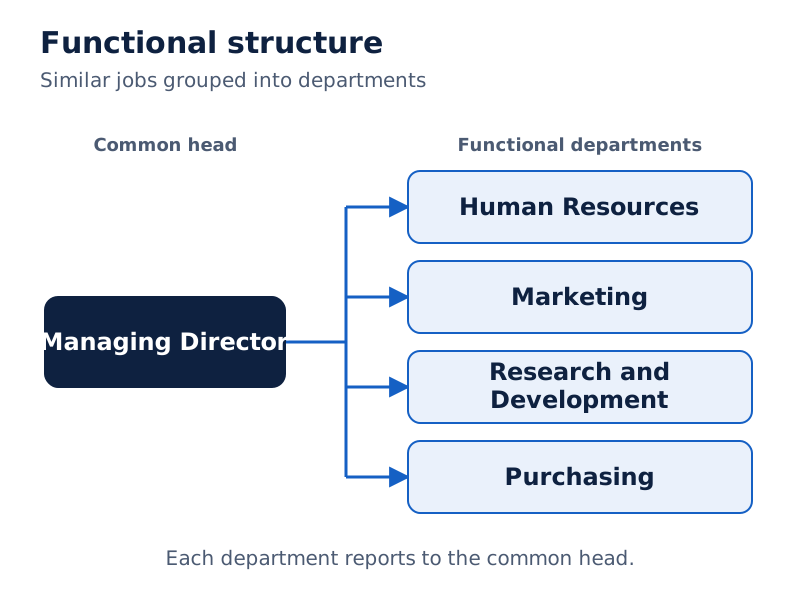
A Managing Director box appears above four connected boxes labelled Human Resources, Marketing, Research and Development, and Purchasing. The chart groups work by function under a common head.
Drawn by One Young India. Reference: NCERT Class 12, p. 115
What are its advantages?
- Occupational specialisation: Employees performing similar tasks develop expertise, improving the use of manpower and their performance.
- Departmental control and coordination: Similarity of tasks makes coordination and control within the department easier.
- Managerial and operational efficiency: Greater efficiency contributes to increased profit.
- Economies of scale: Minimal duplication of effort lowers cost.
- Easier training: Training can concentrate on a limited range of skills.
- Attention to functions: The arrangement ensures that the different functions receive due attention.
What are its limitations?
Functional heads may give departmental objectives greater importance than enterprise objectives. Such functional empires can weaken interaction between departments. Coordination across different functions may also become difficult because information must move between specialised departments.
Conflicting interests may arise. A sales department's demand for a customer-friendly design, for example, may cause production difficulties. Unclear separation of responsibility can also encourage interdepartmental conflict.
People with similar skills may develop a narrow outlook and find it difficult to appreciate other perspectives. Functional managers gain less experience across diverse areas, limiting their preparation for top management positions.
When should it be chosen?
The structure is most suitable when an organisation is large, its activities are diversified and its operations require a high degree of specialisation. Its strengths within departments must be considered alongside possible difficulties in coordinating across functions.
How does a divisional structure work, and how does it differ from a functional structure?
A divisional structure consists of separate business units, generally grouped by products. A divisional manager has authority over the unit and responsibility for its performance. Each division brings together functions such as production, marketing, finance and purchase.
Each division is multifunctional and develops expertise relating to its product line. A functional structure tends to operate within the division. The division acts as a profit centre, with its head responsible for profit or loss.
What the figure shows
Divisional and functional structure
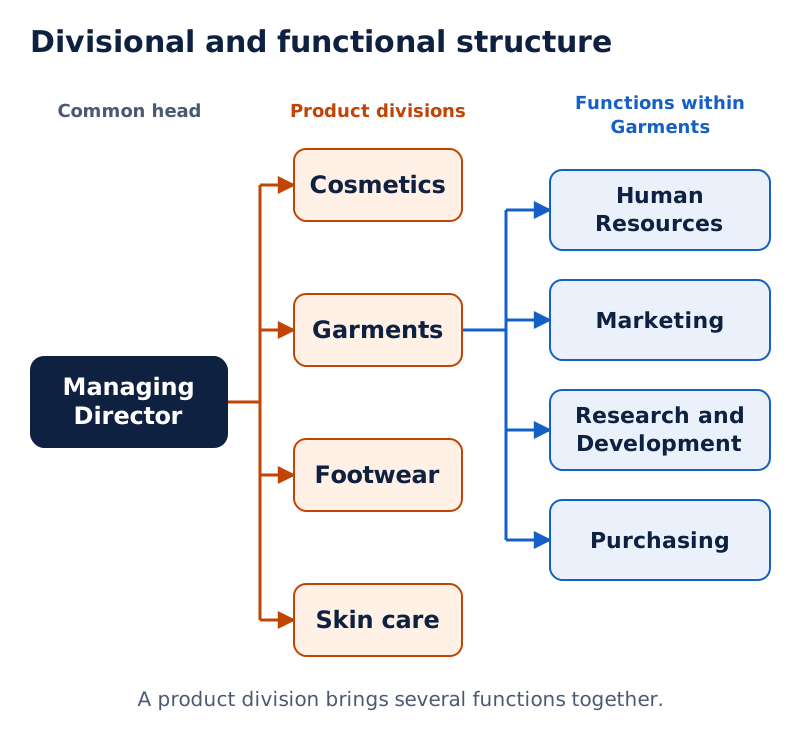
The Managing Director connects to Cosmetics, Garments, Footwear and Skin care. Beneath Garments are Human Resources, Marketing, Research and Development, and Purchasing, showing functional departments within a product division.
Drawn by One Young India. Reference: NCERT Class 12, p. 118
What are its advantages?
Product specialisation gives divisional heads experience in several functions and prepares them for higher positions. Identifiable revenues and costs help measure performance, fix responsibility for poor results and take remedial action.
Divisional autonomy encourages initiative, flexibility and faster decisions. Expansion becomes easier because a new division, head and staff can be added for a new product line without interrupting existing operations.
What are its limitations?
Divisions may dispute the allocation of funds or maximise their own profits at the expense of others. Repeating similar functions across product divisions increases expenditure. Powerful divisional managers may also assert independence in ways that neglect organisational interests.
How do the two structures compare?
| Basis | Functional structure | Divisional structure |
|---|---|---|
| Formation | Based on functions | Based on product lines supported by functions |
| Specialisation | Functional specialisation | Product specialisation |
| Responsibility for performance | Difficult to fix on a department | Easier to fix on the division |
| Managerial development | Limited exposure to diverse functions | Autonomy and experience across functions |
| Cost | More economical because functions are not duplicated | Costlier because resources are duplicated |
| Coordination | Difficult in a multi-product company | Easier within an integrated product division |
Worked example 2. Neha manufactures shoes and plans to diversify into leather bags and western formal wear as a complete provider of corporate wear for working women. Which structure should she choose?
Answer: Recommend a divisional structure for the 3 product lines: shoes, leather bags and western formal wear. Product-based units can coordinate their own functions, fix responsibility for performance and support expansion without disrupting the existing product operation.
What is formal organisation, and what benefits and limitations does it have?
Formal organisation is the structure deliberately designed by management to accomplish tasks. It specifies authority, responsibility and relationships between positions. Its structure may be functional or divisional, so these terms describe different aspects of organisational arrangements.
What are its main features?
Formal organisation defines who reports to whom and lays down rules and procedures for achieving planned objectives. It coordinates, interlinks and integrates departmental efforts. Top management deliberately creates it to support smooth functioning.
The emphasis is on the work to be performed rather than employees' interpersonal relationships. Job descriptions and work procedures guide behaviour and explain the roles required for organisational objectives.
What are its advantages?
- Fixed responsibility: Defined relationships make it easier to establish who is responsible.
- Clear roles: Specified duties reduce ambiguity and help avoid duplicated effort.
- Unity of command: An established chain of command maintains clear reporting relationships.
- Achievement of goals: The framework identifies the operations required and each employee's contribution.
- Stability: Rules make employee behaviour fairly predictable and give continuity to the organisation.
What are its limitations?
Following established communication channels may cause procedural delays and slower decisions. Poor organisational practices may give inadequate recognition to creativity when rigid policies prevent deviations.
Formal structure also provides an incomplete account of human relationships at work. Its emphasis on jobs and structure cannot fully explain the personal interactions that influence how an organisation actually functions.
These limitations do not remove the need for clearly defined jobs and authority. They explain why the formal framework should be understood alongside the informal relationships that develop among its members.
How does informal organisation support or hinder formal organisation?
Informal organisation is the network of social relationships that develops through interaction at work. It emerges within formal organisation when people interact beyond their officially assigned roles. Friendship and common interests help such groups form.
Examples include employees who play cricket on Sundays, meet for coffee in the cafeteria or share an interest in dramatics. These groups are not deliberately created by management and have no fixed structure or written rules.
How does it differ from formal organisation?
| Basis | Formal organisation | Informal organisation |
|---|---|---|
| Origin | Management rules and policies | Personal and social interaction |
| Authority | Attached to a management position | Based on personal qualities |
| Behaviour | Directed by official rules | Influenced by group norms |
| Communication | Follows the scalar chain | May flow in any direction |
| Nature | Rigid structure | Flexible network |
| Leadership | Managers act as leaders | Group chooses leaders who may not be managers |
What are its advantages and disadvantages?
Informal communication spreads information and feedback quickly because prescribed routes are not followed. The network meets social needs, creates belonging and improves job satisfaction. It can also compensate for gaps in formal organisation, for example by revealing employees' reactions to plans and policies.
However, rumours can make the network destructive. Informal groups may resist changes and delay growth. Pressure to conform can harm the enterprise when group norms conflict with organisational interests.
Worked example 3. A sewing-machine company follows formal organisation completely. Decisions are delayed, employees can express grievances only through formal channels and motivation is poor. What should management do?
Answer: Recognise and use informal organisation alongside the formal structure. This offers 3 relevant benefits: quicker communication and feedback, satisfaction of employees' social needs, and a way to discover reactions to policies. Management should seek group support rather than confront informal groups.
Informal organisation cannot be eliminated altogether. Recognising its members and their roles allows management to use its communication channels constructively while continuing to rely on formal duties and reporting relationships.
What is delegation, and how are authority, responsibility and accountability related?
Delegation is the downward transfer of authority from a superior to a subordinate. A manager cannot personally perform every task. Delegation extends the manager's area of operations and makes time available for high-priority activities.
Delegation does not mean abdication. A manager remains accountable for assigned work even after granting authority. Delegated authority can be withdrawn and transferred to another person, but the manager's own accountability does not disappear.
What are the three elements?
Authority is the right to command subordinates and take action within the scope of a position. In formal organisation it comes from position and flows downwards. Its scope is restricted by laws and organisational rules, although it increases at higher levels.
Responsibility is the subordinate's obligation to perform an assigned duty properly. It arises in a superior-subordinate relationship and flows upwards because the subordinate is responsible to the superior.
Accountability means answerability for the final outcome. It flows upwards and cannot be delegated. Regular feedback generally helps enforce it, and a subordinate must explain the consequences of actions or omissions.
| Basis | Authority | Responsibility | Accountability |
|---|---|---|---|
| Origin | Formal position | Delegated authority | Responsibility |
| Flow | Downwards | Upwards | Upwards |
| Delegation | Can be delegated | Cannot be entirely delegated | Cannot be delegated at all |
Why must authority match responsibility?
Authority must be commensurate with responsibility. Excess authority may be misused, whereas insufficient authority may make a person ineffective. Authority is delegated, responsibility is assumed and accountability is imposed.
Worked example 4. A production manager requires a foreman to produce 200 units per day but gives no authority to requisition tools and materials from stores. Can the manager fairly blame the foreman for missing the target?
Answer: The manager should not blame the foreman for failing to achieve 200 units when necessary authority has been withheld. Responsibility must be accompanied by sufficient authority to obtain the tools and materials required. The manager remains accountable for the outcome.
Cartoon: No delegation leads to delays in decision-making (NCERT Class 12, p. 126). People wait outside a manager's office, and a large pile of files stands on the desk. The manager says, “All files must be approved by me”.
Why is delegation essential for effective organising?
Delegation combines work-sharing with the authority needed to act. It benefits both managers and subordinates while clarifying relationships throughout the organisation. Its importance is therefore wider than simply reducing the number of tasks on a manager's desk.
How does it improve people and performance?
- Effective management: Managers gain time for important matters when subordinates undertake routine work. This allows managers to function more efficiently and explore areas in which they can make additional contributions.
- Employee development: Opportunities to use skills and handle more complex tasks can reveal latent abilities. Experience in exercising authority develops decision-making and leadership skills and prepares employees for higher positions.
- Employee motivation: Entrusting work expresses a superior's trust and calls for the subordinate's commitment. Responsibility builds self-esteem and confidence, encouraging the employee to improve performance.
- Facilitation of growth: Trained and experienced employees provide a pool of people able to lead new ventures. They can carry the working practices learned in existing units into newly established branches.
- Basis of management hierarchy: Delegation creates superior-subordinate relationships. The extent and flow of authority define reporting lines and the power attached to each position.
- Better coordination: Authority, responsibility and accountability clarify powers, duties and answerability. This reduces overlapping duties and duplicated effort, supporting coordination across departments and management levels.
Why is trust accompanied by answerability?
Delegation gives employees scope to exercise initiative, but their work still contributes to organisational objectives. Clear powers and duties allow them to act, while accountability keeps attention on the outcome. The superior must ensure that subordinates discharge their duties properly.
The employee's opportunity to develop and the manager's continuing accountability therefore coexist. Delegation creates a working relationship; it does not remove the superior from responsibility for managing the assigned work.
What is decentralisation, and why must it be balanced with centralisation?
Centralisation retains decision-making authority at higher management levels. Decentralisation shares that authority with lower levels throughout the organisation, placing decisions nearer the points of action. It describes how decision-making responsibilities are distributed through the hierarchy.
The number and importance of decisions made below the top level indicate the extent of decentralisation. It is a policy of selectively dispersing authority, based on confidence that employees can make and implement decisions effectively.
Why are the two relative terms?
Complete centralisation would concentrate every decision at the top and remove the need for a management hierarchy. Complete decentralisation would pass every decision downwards and remove the need for higher managerial positions. Both situations are unrealistic.
Every organisation combines the two. As size and complexity grow, decision-making tends to become more decentralised because employees directly involved in operations may know more about them than senior managers who are only indirectly associated with those operations.
What are the benefits of decentralisation?
- Initiative: Independent decisions develop confidence and self-reliance. Regularly solving problems also helps identify potential leaders.
- Managerial talent: Handling assignments independently supplements formal training and creates a pool of people suited to more demanding positions.
- Quick decisions: Decisions near the point of action require fewer approvals and shorter communication routes, with less chance of information distortion.
- Relief to top management: Lower levels act within prescribed limits, leaving senior managers more time for major policy matters.
- Growth: Greater autonomy encourages departments to improve performance. Higher returns can provide resources for expansion.
- Better control: Performance can be evaluated at each level. Departmental accountability and feedback help identify deviations and improve operations.
Control remains necessary even when direct supervision diminishes. Performance measures and management information systems help assess results. Decentralisation can cause disintegration if departments follow their own guidelines against organisational interests, so major policy decisions require an appropriate balance with centralisation.
How do delegation and decentralisation differ?
Delegation and decentralisation both involve passing authority downwards, but their scope and purpose differ. Delegation concerns a superior and an immediate subordinate. Decentralisation extends the sharing of decision-making authority throughout the organisation.
What distinctions should be kept clear?
| Basis | Delegation | Decentralisation |
|---|---|---|
| Nature | Compulsory because one person cannot perform all tasks | Optional policy chosen by top management |
| Freedom of action | Greater superior control and less freedom | Less control over executives and greater freedom of action |
| Status | A process used to share tasks | The result of a management policy decision |
| Scope | Narrow, between a superior and immediate subordinate | Wide, extending delegation to the lowest management level |
| Purpose | Reduce the manager's burden | Increase subordinates' role through greater autonomy |
The distinction between a compulsory process and an optional policy is important. Managers need help to complete work and therefore delegate. Top management separately decides how extensively authority should be dispersed throughout the organisation.
How does autonomy relate to organisational control?
Decentralisation gives lower levels more freedom, but it does not imply unlimited independence. Management selects which decisions should move downwards and which should remain at higher levels. Subordinates exercise authority within the limits established for them.
Similarly, delegation cannot be used to pass away a superior's accountability. Whether authority is shared with one subordinate or dispersed widely, clarity about duties and answerability remains essential to coordinated organisational performance.
Note: Delegation is a process; decentralisation is a broader policy governing its extent. A decision to decentralise does not mean abandoning central control over major policy matters.
Glossary
- Organising — The process of clarifying work, relationships and resource deployment to implement plans and achieve objectives.
- Departmentalisation — Grouping similar activities into departments after dividing the total work into manageable tasks.
- Organisation structure — The framework connecting people, work and resources within which managerial and operating tasks are performed.
- Span of management — The number of subordinates that a superior can manage effectively within an organisation.
- Functional structure — An arrangement that groups similar or related jobs into departments based on functions.
- Divisional structure — An arrangement of separate product-based units, each bringing together functions needed for its product line.
- Formal organisation — A structure deliberately designed by management, specifying duties, authority and relationships for achieving objectives.
- Informal organisation — A network of social relationships that emerges spontaneously through personal interaction among employees.
- Delegation — The downward transfer of authority from a superior to a subordinate within prescribed limits.
- Authority — The right to command subordinates and take action within the scope of a position.
- Responsibility — The obligation of a subordinate to perform properly the duty assigned by a superior.
- Accountability — Answerability to a superior for the final outcome of assigned work, which cannot be delegated.
- Centralisation — Retention of decision-making authority at higher management levels rather than sharing it with lower levels.
- Decentralisation — Delegation of authority throughout organisational levels, bringing decision-making closer to the points of action.
Common errors and misconceptions
- Misconception: Organising ends when tasks have been divided. Correct: Similar activities must also be grouped, duties assigned and authority and reporting relationships established.
- Misconception: Functional coordination is equally easy everywhere. Correct: Similar tasks aid coordination within a department, while coordination across specialised departments may be difficult.
- Misconception: Divisional structure eliminates functional departments. Correct: Each division brings together several functions, and functional arrangements tend to exist within product divisions.
- Misconception: Formal organisation and functional structure mean the same thing. Correct: A formal organisation can use either a functional or a divisional structure.
- Misconception: Informal groups are necessarily harmful. Correct: They can meet social needs and speed communication, although rumours, resistance and conflicting group norms can cause harm.
- Misconception: Delegating authority removes the manager's accountability. Correct: The manager remains accountable for the outcome; accountability cannot be delegated.
- Misconception: Responsibility can exceed authority without affecting performance. Correct: Insufficient authority may make a person ineffective, so authority must match the responsibility assigned.
- Misconception: Decentralisation means all decisions move to lower levels. Correct: Authority is dispersed selectively, with centralisation retained for major policy decisions.
Exam-style questions with model answers
Q1. Define span of management and state one aspect of organisation structure that it influences. [2 marks]
- Span of management is the number of subordinates that a superior can manage effectively.
- It influences the shape of organisation structure by determining levels of management within that structure.
Q2. Twelve students must unload new library books, stock the shelves and dispose of packaging waste. Explain the four organising steps needed to complete the work systematically. [4 marks]
- Identify and divide the work into manageable activities covering unloading, shelving and disposal of waste, so that effort is not duplicated.
- Group similar activities and the students undertaking them, creating organised task groups instead of leaving everyone to work independently.
- Assign duties to the groups and their members, matching work with their abilities and making each contribution clear.
- Establish supervision and reporting relationships so that students know whose instructions to follow and to whom they must report progress.
Q3. Neha manufactures shoes and plans to add leather bags and western formal wear. Recommend a structure and explain two benefits relevant to her expansion. [3 marks]
- Recommend a divisional structure because the expanded business will contain different product lines, each requiring coordinated attention to its own functions.
- Each division can bring together functions related to its product. This supports product specialisation and gives its head experience across several functional areas.
- Expansion is facilitated because new product divisions, heads and staff can be added without interrupting the existing shoe business.
Q4. A manager gives a foreman a production target of 200 units per day but no authority to requisition tools and materials. Explain the defect in delegation, its effect and the manager's accountability. [3 marks]
- The authority granted is not commensurate with the responsibility assigned. The foreman has a production obligation without the corresponding power to obtain necessary inputs.
- Insufficient authority may prevent the foreman from achieving the target, so the manager should not blame him for failure caused by this restriction.
- The manager remains accountable for the final outcome. Assigning the task does not transfer away the manager's own answerability for its performance.
Q5. Explain six advantages of a functional organisation structure. [6 marks]
- Occupational specialisation develops because employees repeatedly perform similar tasks within a department, improving their expertise and the efficient use of manpower.
- Control and coordination within a department improve because the tasks performed by its members are similar and can be managed together.
- Managerial and operational efficiency increase when work is organised around specialised functions, and this greater efficiency contributes to improved profit.
- Duplication of effort is minimised, allowing economies of scale and lowering the costs incurred in carrying out the organisation's activities.
- Employee training becomes easier because each functional area requires attention to a limited range of relevant skills rather than many unrelated skills.
- Different functions receive due attention because they are recognised as distinct departments within the structure instead of being left without clear organisational focus.
Q6. Distinguish between delegation and decentralisation on nature, freedom of action, status, scope and purpose. [5 marks]
- Nature: Delegation is compulsory because one manager cannot perform all tasks personally. Decentralisation is an optional policy adopted at the discretion of top management.
- Freedom of action: Delegation involves greater control by the superior and less subordinate freedom. Decentralisation provides executives with greater freedom through reduced control.
- Status: Delegation is a process followed to share tasks. Decentralisation is the result of a policy decision about the distribution of authority.
- Scope: Delegation concerns a superior and an immediate subordinate. Decentralisation has wider scope because it extends delegation to the lowest management level.
- Purpose: Delegation reduces the manager's burden. Decentralisation increases the role of subordinates by giving them greater autonomy in making and implementing decisions.
Q7. A sewing-machine company relies entirely on formal channels, suffers delayed decisions and has poorly motivated employees who cannot freely express grievances. Recommend one organisational change and explain three benefits. [4 marks]
- Management should recognise and use informal organisation alongside its formal structure, gaining the support of employee groups rather than attempting to suppress them.
- Informal communication can spread information and feedback faster because it does not have to follow every prescribed step in the formal chain.
- Social relationships can satisfy employees' need for belonging and contact with like-minded people, helping to improve their job satisfaction.
- The informal network can reveal reactions to plans and policies, compensating for gaps in formal communication and helping management understand employee concerns.
Q8. Explain six reasons why an organisation may choose decentralisation. [6 marks]
- It develops initiative by allowing lower-level managers to exercise judgement, solve problems and become more confident and self-reliant in their decisions.
- It develops future managerial talent because independently handled assignments give practical experience and reveal employees capable of taking on more challenging responsibilities.
- It speeds decisions by placing authority near the point of action, reducing the need for repeated approvals through a long management chain.
- It relieves top management of routine operational decisions and direct supervision, releasing time for important policy matters while lower levels act within prescribed limits.
- It supports growth by giving departments greater autonomy to improve performance, generating returns that the organisation can use to finance expansion.
- It improves control by making departmental results assessable and using feedback from different levels to identify deviations and improve the organisation's operations.
Key takeaways
- Organising implements plans by dividing work, grouping activities, assigning duties and establishing clear authority and reporting relationships.
- Organisation structure connects people, work and resources, and should be reviewed as business objectives and operating conditions change.
- Functional structure supports occupational specialisation, while divisional structure integrates several functions around each product line.
- Formal organisation provides defined roles and rules; informal organisation develops through social interaction and can support or disrupt work.
- Authority flows downwards, while responsibility and accountability flow upwards; delegated authority must match the responsibility assigned.
- Delegation develops employees and releases managerial time, but the superior remains accountable for the outcome of assigned work.
- Decentralisation extends authority throughout organisational levels, encouraging initiative, quicker decisions, managerial development and assessment of departmental performance.
- Decentralisation is selective and must coexist with centralisation, particularly where decisions concern major organisational policies.
Test yourself
Which step follows identification and division of work?
Departmentalisation follows: similar activities are grouped into departments to support specialisation.
Why is allocating duties alone insufficient?
Employees also need to know who gives them orders and to whom they are accountable.
Which kind of specialisation is associated with divisional structure?
Product specialisation, with several functions brought together within each product-based division.
Where does authority in formal organisation originate?
Authority originates in an individual's formal position within the management hierarchy.
Can accountability be delegated along with authority?
No. Accountability cannot be delegated, and the superior remains answerable for the final outcome.
What happens when assigned responsibility exceeds authority?
The employee may become ineffective because the powers needed to perform the duty are insufficient.
How can informal organisation assist management before implementing policies?
Its network can reveal employees' reactions to plans and policies, providing useful feedback.
What shows that an organisation is greatly decentralised?
Lower levels take decisions that are both numerous and important within the organisation.
Write about it
Turn a question from this chapter into a paper.
The Writing Studio has a structure guide, a rubric and citation tools for 15 formats, from essays to research papers. Drafting is free with an account. Learnacy Essential adds feedback from an AI writing coach and submission to The OYI Review.
Publication depends on review and is not guaranteed.