
Staffing | CBSE Class 12 Business Studies Notes
On this page

This note covers the meaning and importance of staffing, its relationship with human resource management, manpower estimation, the staffing process, recruitment sources, selection procedures and tests, performance appraisal, compensation, and the meaning, benefits and methods of training and development.
What is staffing and why is it important?
Definition: Staffing is the managerial function of filling and keeping filled the positions in an organisation structure. It involves obtaining, utilising and maintaining a satisfactory and satisfied workforce.
In simple terms, staffing means putting people to jobs. It begins with workforce planning and extends to recruitment, selection, placement, training, development, appraisal, promotion and compensation. Employees may include daily wagers, consultants and contract employees.
In a new enterprise, staffing follows planning and organising. Managers first decide the work and create positions. In an existing enterprise, it is a continuous process because new jobs arise and existing employees may leave.
What benefits does proper staffing provide?
- Competent personnel: Staffing helps discover and obtain people capable of performing the various jobs in an organisation.
- Higher performance: Matching the right person with the right job improves the contribution made by employees.
- Survival and growth: Succession planning for managers helps maintain the continuity of the enterprise and supports its future growth.
- Optimum utilisation: Avoiding overmanning prevents under-utilisation and high labour costs. Identifying shortages beforehand helps prevent disruption of work.
- Job satisfaction and morale: Objective assessment and fair rewards recognise employees' contributions and improve their attitude towards work.
Rapid technological advances, increasing organisational size and complex human behaviour make staffing especially important. Unsuitable employees can waste materials, time, effort and energy. Adequate training and suitable incentives help improve productivity and product quality.
How does the Infosys example illustrate human resources?
The Infosys case presents employees' expertise, innovation, leadership and managerial skills as valuable human assets. As a knowledge-intensive company, it faces the challenge of attracting, retaining and developing people whose talents are also sought by competitors in India and abroad.
How is staffing related to human resource management?
Human Resource Management, or HRM, is the specialised area concerned with managing people. Staffing is an inherent part of HRM because it involves finding, evaluating and establishing working relationships with people for an organisational purpose.
Every manager has staffing responsibilities. These include placing suitable people in jobs, introducing new employees, improving performance, developing abilities, maintaining morale and protecting employees' health and physical working conditions.
Who performs the staffing function?
In small organisations, managers may handle salaries, welfare and working conditions themselves. As organisations grow, a separate human resource department develops. In very large companies, this department may contain specialists for its different functions.
Staffing is both a line activity, performed by managers as an essential management function, and a staff activity, involving the advisory role of the human resource department. Having specialists does not remove the manager's responsibility for people.
| HRM activity | Work involved |
|---|---|
| Recruitment and job analysis | Search for qualified people and collect job information to prepare job descriptions. |
| Compensation | Develop compensation and incentive plans for employees. |
| Training and development | Improve efficient performance and support employees' career growth. |
| Employee relations | Maintain labour and union-management relations and handle grievances and complaints. |
| Welfare and legal matters | Provide social security and welfare, defend the company in lawsuits and avoid legal complications. |
How did HRM evolve?
The trade union movement created a need for a labour welfare officer linking owners and workers. The factory system expanded hiring responsibilities, leading to personnel officers and later personnel managers responsible for recruitment, selection and placement.
The human relations approach recognised the importance of people. Technological change required new skills and training. As people came to be regarded as resources capable of development, the wider role of the human resource manager emerged.
How are manpower requirements estimated?
Manpower estimation determines both the number and the type of employees required. Counting vacancies alone is insufficient: each position requires particular qualifications, skills, experience and other characteristics. Managers must relate staffing needs to the work and organisational objectives.
| Analysis | What it examines | Purpose |
|---|---|---|
| Workload analysis | The number and types of people necessary to perform jobs and achieve objectives. | Establishes human resource requirements. |
| Workforce analysis | The number and types of people already available. | Establishes the existing supply of employees. |
How does the comparison guide action?
Comparing requirements with availability reveals understaffing, overstaffing or adequate staffing. Overstaffing may require removal or transfer of employees elsewhere. Understaffing requires recruitment. Neither excess employees nor insufficient employees is desirable.
Requirements must then become a job description and a desirable candidate profile. The profile identifies qualifications, experience and personality characteristics. This information provides the basis for searching for suitable employees and preparing vacancy advertisements.
Workforce diversity also matters. Organisations need to encourage women, people from backward communities and people with disabilities to occupy responsible positions. Where necessary, requirements need to be understood and redefined with this participation in mind.
Worked example 1. A steel manufacturing company employs 800 persons and plans expansion that may require another 200 persons for different additional requirements. Its HR manager, Ms. Jayshree, must prepare for this expansion. What should she examine?
Answer: The possible need for another 200 employees calls for workload analysis alongside workforce analysis of the existing 800 employees. She should identify the types of additional jobs and required qualifications before recruiting. The figures alone do not establish the skills needed for each position.
Note: Workload analysis concerns people required; workforce analysis concerns people available. Both number and type must be considered in each analysis.
What are the steps in the staffing process?
The staffing process aims to meet manpower requirements at the right time. Needs arise when a business starts or expands, and when employees quit, retire, transfer, receive promotion or are removed from their jobs.
How does staffing move from estimation to compensation?
- Estimating manpower requirements: Compare workload with the existing workforce and specify the number and type of people needed.
- Recruitment: Locate prospective candidates and encourage them to apply, creating a pool of applicants from appropriate sources.
- Selection: Choose suitable people from this pool through assessment, including tests and interviews.
- Placement and orientation: Assign the selected person to the post and introduce the workplace, colleagues, rules and policies.
- Training and development: Facilitate learning, improve competencies and prepare employees for career advancement and higher responsibilities.
- Performance appraisal: Compare current or past performance with predetermined standards and provide feedback to the employee.
- Promotion and career planning: Support long-term growth and movement into positions carrying greater responsibility.
- Compensation: Establish wages, salaries and other rewards appropriate to jobs and employees' contributions.
Placement means occupying the position for which a person was selected. Orientation means becoming familiar with colleagues and organisational rules and policies. These early experiences may have a lasting influence on performance and the decision to remain with the organisation.
How are performance and rewards managed?
Appraisal involves defining the job, assessing performance and giving feedback. Employees should know the expected standards. Promotions usually mean more pay, responsibility and job satisfaction, while career planning considers employees' long-term interests and potential.
Compensation includes direct payments such as wages, salaries, commissions, incentives and bonuses, and indirect payments such as employer-paid insurance and vacations. Direct pay may be time-based or performance-based; some plans combine time-based pay with incentives.
Pay plans are influenced by labour laws, unions, company policy and equity. Recruitment, selection and training are also influenced by skills availability, labour market conditions, the company's image, costs, technology and the general economic environment.
Worked example 2. Xylo Limited is setting up an auto-components plant in India. It plans to capture about 40% of the Indian market and export at least ₹50 crores in about 2 years of planned operations. It needs a highly trained and motivated workforce. What staffing approach should it follow?
Answer: Xylo should start by estimating the people and skills required for its production plans. Its 40% market-share and ₹50-crore export targets do not themselves specify employee numbers. Recruitment, selection, placement, training, appraisal, career planning and compensation should support the required workforce.
How does recruitment differ from selection?
Definition: Recruitment is the process of searching for prospective employees and stimulating them to apply for jobs in an organisation.
The purpose of recruitment is to attract an adequate number of applicants with suitable characteristics and qualifications. It connects available people with job opportunities and precedes selection. A job description and candidate profile help communicate what the vacancy requires.
What activities are involved in recruitment?
- Identify different sources from which suitable labour may be available.
- Assess the validity of these sources for the organisation's requirements.
- Choose the most suitable source or combination of sources.
- Invite prospective candidates to apply for the available vacancies.
| Basis | Recruitment | Selection |
|---|---|---|
| Purpose | Find possible candidates and encourage applications. | Identify and choose the best available person for a job. |
| Sequence | Builds the pool of prospective candidates. | Works with the pool developed through recruitment. |
| Main activity | Locate sources and communicate vacancies. | Assess applicants through screening, tests, interviews and checks. |
Selection involves judgement about a candidate's likely performance. Its effectiveness is ultimately tested by performance on the job. Rigorous selection also conveys the seriousness of the organisation and enhances the prestige and self-esteem of those selected.
What the figure shows
Aspects of Staffing
Boxes for Applicant (Person) and Organisation (Job) appear at the top. Connecting arrows lead to Recruitment, labelled identification and attraction; Selection, labelled assessment, evaluation and final match; and Training, labelled acquainting and skill development.
Reference: NCERT Class 12, page 149, unnumbered
What are the merits and limitations of internal recruitment?
Internal recruitment fills vacancies from within the enterprise. Its two important sources are transfers and promotions. These draw on employees already known to the organisation, but they involve different kinds of movement.
| Basis | Transfer | Promotion |
|---|---|---|
| Movement | Horizontal movement between jobs, departments or shifts. | Vertical movement to a higher position. |
| Responsibility and status | No substantive change in responsibility and status. | Higher responsibilities, facilities and status. |
| Pay | Salary does not necessarily change. | The higher position carries higher pay. |
| Use | Can move suitable employees from surplus departments to departments with shortages. | Provides advancement and can improve motivation, loyalty and satisfaction. |
What are the merits of internal sources?
- Motivation: Promotion opportunities encourage learning, commitment and loyalty. A promotion higher up may create a chain of promotions below.
- Simpler evaluation: Known employees can be assessed more accurately and economically, making selection and placement easier.
- Training: Transfers help employees learn different jobs and prepare for higher positions. Internally recruited employees do not need induction training.
- Balanced staffing: Transfers shift suitable employees from departments with a surplus to departments with a shortage.
- Lower cost: Filling jobs internally is cheaper than obtaining candidates from outside the enterprise.
What are the limitations of internal sources?
- Restricted fresh talent: Complete reliance on internal promotion reduces the entry of new people and ideas.
- Possible lethargy: Employees may become less active if they feel assured of time-bound promotions.
- Limited availability: A new enterprise cannot use internal recruitment, and an organisation cannot fill every vacancy internally.
- Reduced competition: The competitive spirit among employees may be weakened.
- Productivity effects: Frequent transfers may often reduce organisational productivity.
A transfer should be made only after ensuring that the employee can perform the new job. It can also help avoid termination or address individual grievances. Promotion provides advancement, while transfer can redistribute and develop the existing workforce.
Which external sources of recruitment can an enterprise use?
External recruitment brings candidates from outside the organisation. It becomes necessary when existing employees are insufficient or do not meet the requirements of available jobs. Different sources serve different kinds of vacancies and offer different degrees of reach and screening.
How do the main external sources work?
| Source | Method and main use |
|---|---|
| Direct recruitment | A notice at the enterprise gives vacancy details. Job-seekers assemble on a specified date and selection occurs on the spot, usually for casual unskilled or semi-skilled work. |
| Casual callers | Organisations maintain unsolicited applications and screen these applicants when vacancies arise. This can reduce recruitment costs compared with other sources. |
| Advertisement | Newspapers and trade or professional journals provide a wider choice and space for job information. Advertisements may also attract many unsuitable applicants. |
| Employment exchange | Government exchanges link employers and job-seekers, particularly for skilled and unskilled operative jobs. Their records are often not up to date, and referred candidates may be unsuitable. |
| Placement agencies and management consultants | Agencies maintain candidate information and charge fees for recommending suitable people. Consultants help recruit technical, professional and managerial personnel, specialising in middle and top executive positions. |
| Campus recruitment | Organisations recruit through colleges, universities, vocational schools and management or technology institutes, especially for technical, professional and managerial jobs. |
| Recommendations of employees | Present employees introduce applicants, including friends or relatives. Knowledge of both the company and the candidate provides a form of preliminary screening. |
| Labour contractors | Contractors maintain contact with labourers and provide unskilled workers at short notice. Dependence on a contractor creates the risk of losing the workers recruited through that contractor. |
| Advertising on television | Vacant posts, job requirements, required qualities and the organisation's profile are publicised through television. |
| Web publishing | Dedicated websites provide information about job-seekers and vacancies, connecting prospective employees with organisations seeking people. |
When is direct recruitment useful?
Direct recruitment is inexpensive because it avoids vacancy-advertising costs. Casual or badli workers receive daily wages. This method suits a rush of work or temporary vacancies caused by absent permanent workers.
Worked example 3. A company makes 1,00,000 paper plates and bowls each day. A local festival brings an urgent order for an extra 50,000 plates and bowls. Which recruitment method should it choose for this rush of work?
Answer: Direct recruitment is suitable for the temporary rush created by the extra 50,000 items. The company should display vacancy details and select suitable casual workers on the spot. This recommendation applies to the casual unskilled or semi-skilled jobs for which direct recruitment is usually used.
The method chosen must fit the vacancy. For example, extensive screening can make a placement agency useful, whereas campus recruitment connects employers with people qualifying from educational institutions. No single source meets every staffing requirement.
What are the merits and limitations of external recruitment?
External recruitment broadens the field of candidates, but it can affect costs, time and the expectations of existing employees. Its usefulness depends on whether the organisation needs qualifications, numbers or fresh talent that its current workforce cannot provide.
What are its merits?
- Qualified personnel: Management can attract people who already possess the qualifications and training required for vacant jobs.
- Wider choice: Wide publicity brings applications from outside and gives management more candidates from whom to select.
- Fresh talent: New entrants can meet requirements that current staff are unable to fulfil and bring fresh talent into the organisation.
- Competitive spirit: Competition with outside candidates encourages existing employees to work harder and demonstrate better performance.
What are its limitations?
Employee dissatisfaction may arise when existing staff believe their promotion prospects have declined. External recruitment is also a lengthy process: vacancies must be publicised and applications received before selection begins. Advertising and processing applications make it costly.
How do employee referrals illustrate an external source?
In a 2016 referral example, Lenovo India asked employees to recommend candidates and rewarded successful recommendations of more women for the same roles. Infosys used a portal through which employees could submit candidate profiles and track their referrals.
The same dated example reported that companies including Genpact, Dabur and Jubilant obtained over 40% of their hires through referrals. These are illustrations from that period, rather than measures of present hiring patterns.
Worked example 4. In the 2016 referral example, Lenovo India asked existing employees to recommend candidates and rewarded successful recommendations of more women. Should this be classified as internal recruitment because current employees make the recommendations?
Answer: The 2016 example illustrates recommendations of employees, an external source. The recommended candidates come from outside the workforce. Internal recruitment would involve moving existing employees through transfers or promotions. The identity of the person recommending a candidate does not change the source.
How does the selection procedure identify suitable employees?
Selection identifies and chooses the best person from prospective candidates. Applicants pass through assessment stages; many are eliminated while others proceed. The process may continue beyond the offer and joining because actual job performance tests the quality of the selection decision.
What are the eight main steps?
- Preliminary screening: Application forms help eliminate unqualified or unsuitable applicants. Preliminary interviews can reveal reasons for rejection that did not appear in the forms.
- Selection tests: Paper-and-pencil tests or practical exercises attempt to measure characteristics such as intelligence, aptitude, personality and existing skills.
- Employment interview: A formal, in-depth conversation assesses suitability for the job. Applicants may also seek information from the interviewer.
- Reference and background checks: Employers verify information and obtain further details through references such as former employers, teachers and other known persons.
- Selection decision: A final choice is made among candidates passing the earlier stages. The concerned manager's views are generally considered because that manager will be responsible for the employee's performance.
- Medical examination: After selection and before the job offer, the candidate undergoes a medical fitness test. The offer follows a declaration of fitness.
- Job offer: An appointment letter communicates the offer and generally specifies the reporting date. The selected person should receive reasonable time to report.
- Contract of employment: After acceptance, documents such as an attestation form and the employment contract are completed.
What does the employment contract cover?
Typical contract headings include job title, duties, responsibilities, starting date, calculation of service, pay, allowances, working hours, leave, sickness, grievance and disciplinary procedures, work rules and termination. The precise information varies with the level of the job.
What the figure shows
Selection process
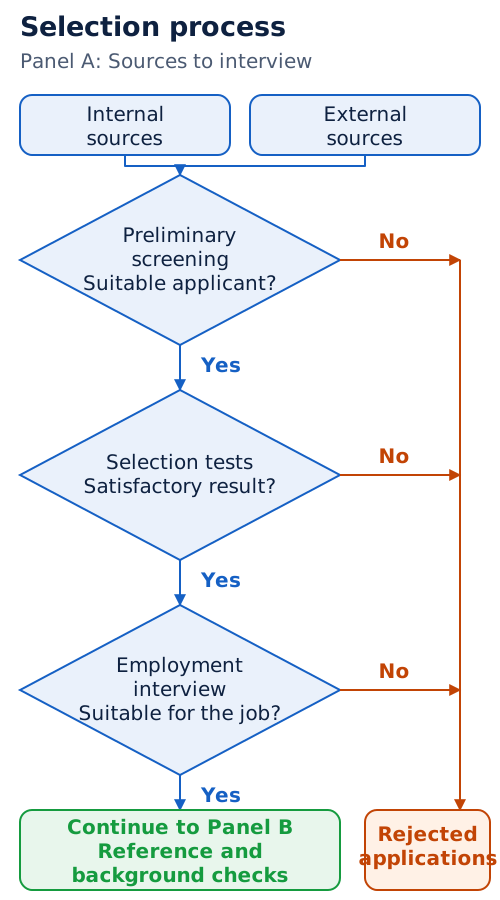
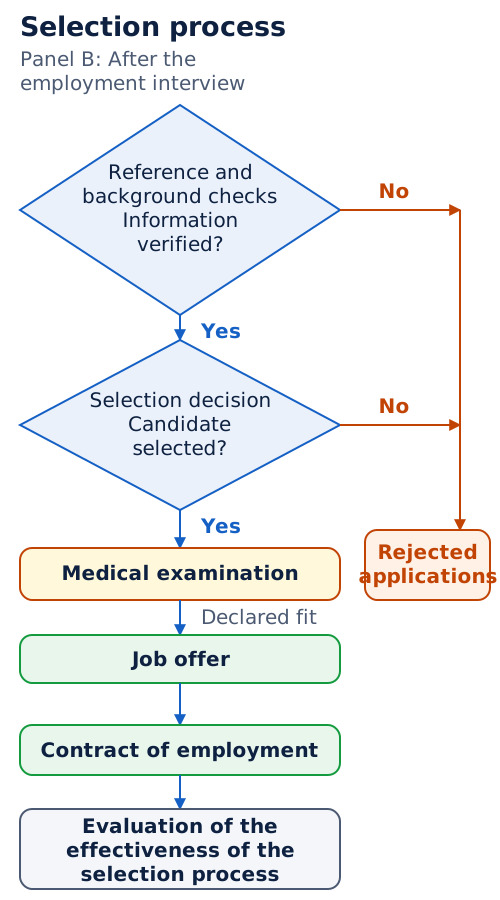
Internal and external sources feed preliminary screening. Decision diamonds accompany screening, tests, interview, reference checks and selection. Negative branches lead to rejected applications; positive branches lead towards the job offer, employment contract and evaluation of the selection process.
Drawn by One Young India. Reference: NCERT Class 12, page 158, unnumbered
Note: Medical examination belongs after the selection decision and before the job offer. An appointment offer and an employment contract are distinct stages.
A reject error occurs when a candidate who would perform successfully is rejected. An accept error occurs when a selected candidate performs poorly. Both explain why careful assessment matters even when a vacancy attracts many applicants.
What do the different selection tests measure?
Employment tests attempt to measure individual characteristics relevant to selection. A test may take the form of written questions or an exercise. The characteristics assessed range from manual dexterity to intelligence and personality, so different tests serve different purposes.
| Test | Characteristic measured | Meaning for selection |
|---|---|---|
| Intelligence test | Level of intelligence quotient. | Indicates learning ability and the ability to make decisions and judgements. |
| Aptitude test | Potential for learning new skills. | Indicates the person's capacity to develop. |
| Personality test | Emotions, reactions, maturity and value system. | Provides clues about overall personality; these tests are difficult to design and implement. |
| Trade test | Existing knowledge, proficiency and skills. | Assesses what the individual already knows or can do in a professional or technical area. |
| Interest test | Pattern of interests or involvement. | Identifies the kinds of work that attract the individual. |
How do aptitude and trade tests differ?
An aptitude test concerns the potential to acquire skills. A trade test concerns skills already possessed. A person can have the capacity to learn without yet possessing the proficiency required to carry out a particular job.
Personality tests probe a broad set of qualities, whereas interest tests examine preferences and involvement. Intelligence tests concern learning and judgement. Keeping these purposes separate helps identify which characteristic a selection exercise is intended to assess.
Tests form one part of the selection procedure. Interviews allow a more detailed conversation, while references verify and supplement information. The final decision draws on the applicants who have passed the tests, interviews and reference checks.
Why are training and development needed, and how do they differ?
Training and development seek to improve current or future performance through learning, usually by changing attitudes or increasing skills and knowledge. As technology changes and jobs become more complex, employees need to upgrade or alter their skills.
Organisations also need to adapt their products, services and methods of work. Continuing learning helps employees perform current duties and prepare for higher responsibilities. Opportunities for career advancement can help attract and retain talented employees.
How do training, development and education differ?
| Basis | Training | Development |
|---|---|---|
| Meaning | Increases knowledge, aptitudes, skills and abilities for specific jobs. | Provides learning opportunities for overall growth. |
| Purpose | Enables an employee to perform a job better. | Helps the employee grow and realise potential. |
| Orientation | Job-oriented. | Career-oriented. |
| Duration and scope | A short-term process focused on specific work. | An ongoing process that includes training and wider personal growth. |
Education increases knowledge and understanding. It develops a logical, rational mind, the understanding of basic principles, and capacities for analysis, synthesis and objectivity. It is broader than training, which is more closely tied to organisational goals.
What benefits does the organisation receive?
- Systematic learning: Planned training avoids the waste of effort and money associated with trial-and-error learning.
- Higher productivity: Better quantity and quality of work contribute to higher profits.
- Future managers: Training prepares people who can take over managerial responsibilities in an emergency.
- Improved morale: Training increases morale and reduces absenteeism and employee turnover.
- Adaptability: Learning helps the organisation respond to technological and economic changes.
What benefits does the employee receive?
- Career improvement: Greater skills and knowledge strengthen the individual's career prospects.
- Higher earnings: Improved performance helps the employee earn more.
- Safer working: More efficient handling of machines makes the employee less prone to accidents.
- Satisfaction: Training increases employee satisfaction and morale.
A person recruited by a BPO unit for being outgoing and well-versed in spoken English may still need training in business processes, telephone etiquette and diction adaptation. Entry qualifications and learning potential do not remove the need for job-specific preparation.
How do on-the-job and off-the-job training methods work?
On-the-job training occurs at the workplace while the employee is working: learning while doing. Off-the-job training takes place away from the workplace: learning before doing. Both aim to develop the knowledge and abilities employees need.
Which methods provide on-the-job training?
- Apprenticeship programmes: A trainee learns under a master worker to acquire a higher level of skill. Plumbers, electricians and iron-workers often undergo this training. Trainees spend a prescribed period with an experienced guide; slow learners may require additional training.
- Coaching: A superior guides the trainee, agrees goals, suggests ways to achieve them, reviews progress and recommends changes in behaviour and performance. The senior manager takes responsibility for coaching and may prepare the trainee to assume some managerial duties.
- Internship training: Educational institutions and business firms cooperate. Selected candidates continue their regular studies for a prescribed period and also work in a factory or office to acquire practical knowledge and skills.
- Job rotation: Trainees move between jobs or departments. They gain a broader understanding of the business, test their aptitudes and interact with employees across departments. This helps future cooperation and makes promotions, replacements and transfers easier.
Which methods provide off-the-job training?
| Method | How learning takes place |
|---|---|
| Classroom lectures or conferences | Specific rules, procedures or methods are explained. Audio-visual aids and demonstrations can often increase interest, retention and clarity. |
| Films | Information and skills that are difficult to represent through other techniques are demonstrated. Films can be effective in certain cases when combined with conference discussions. |
| Case study | Trainees examine real organisational problems, identify causes, develop alternatives, choose what they consider the best solution and implement it. |
| Computer modelling | A computer simulates aspects of the work environment, enabling learning without the risks or high costs of mistakes in real situations. |
| Vestibule training | The work environment is recreated away from the actual work floor. Employees practise using the materials, files and equipment they will use on the job. |
| Programmed instruction | Information is divided into meaningful units arranged logically from simple to complex. Trainees progress by answering questions or filling blanks. |
How can the method be matched to the problem?
Vestibule training is usually used where employees must handle sophisticated machinery and equipment. Workers who remain idle because they lack knowledge of hi-tech machines can learn in a recreated setting using the relevant equipment.
Coaching centres on the superior's guidance, whereas job rotation broadens exposure across work areas. An internship combines institutional study with practical work. Apprenticeship provides extended guidance by a master worker for skilled occupations. These distinctions help identify the method from its actual features.
Glossary
- Staffing — The management function of filling and keeping filled the positions in an organisation structure.
- Human Resource Management — The specialised management area concerned with people, including recruitment, development, compensation, welfare and employee relations.
- Workload analysis — Assessment of the number and types of employees required to perform jobs and achieve organisational objectives.
- Workforce analysis — Assessment of the number and types of employees already available within the organisation.
- Recruitment — Searching for prospective employees and encouraging them to apply for jobs in an organisation.
- Selection — Identifying and choosing the best person for a job from a pool of prospective candidates.
- Placement — The selected employee occupying the position or post for which that person was chosen.
- Orientation — Introducing selected employees to colleagues and familiarising them with the organisation's rules and policies.
- Performance appraisal — Evaluation of an employee's current or past performance against predetermined standards, followed by feedback.
- Compensation — All forms of pay or rewards provided to employees, including direct financial payments and indirect benefits.
- Aptitude test — An assessment of an individual's potential to learn new skills and capacity to develop.
- Trade test — A test of existing skills, knowledge and proficiency in a professional or technical area.
- Training — A learning process that increases employees' aptitudes, skills and abilities to perform specific jobs.
- Development — Learning opportunities that support overall growth, including performance, personality, maturity and the realisation of potential.
- Vestibule training — Training away from the actual work floor, using the equipment and materials required for the job.
Common errors and misconceptions
- Misconception: Staffing ends when someone is appointed. Correct: Staffing also includes training, appraisal, career planning and compensation. Existing enterprises need continuing staffing as jobs and employees change.
- Misconception: The HR department alone is responsible for staffing. Correct: All managers perform staffing duties; the specialised HR department also provides support and advice.
- Misconception: Workload analysis counts the employees already available. Correct: Workload analysis estimates requirements; workforce analysis assesses the number and types already available.
- Misconception: Transfer and promotion both mean movement to a higher position. Correct: Transfer is horizontal movement without substantive change in status; promotion is movement to a higher position with greater responsibility.
- Misconception: Employee recommendations are an internal source because employees make them. Correct: They are an external source when recommended candidates come from outside; internal sources are transfers and promotions.
- Misconception: Aptitude tests measure existing technical proficiency. Correct: Aptitude tests assess the potential to learn, while trade tests assess skills already possessed.
- Misconception: Training and development mean exactly the same thing. Correct: Training focuses on specific jobs; development concerns wider, ongoing growth and includes training.
- Misconception: Vestibule training is on-the-job training because actual equipment is used. Correct: It is off-the-job training because learning takes place away from the actual work floor.
Exam-style questions with model answers
Q1. Define staffing and explain why it is continuous in an existing enterprise. [2 marks]
- Staffing is the managerial function of filling and keeping filled the positions in an organisation structure with suitable people.
- It is continuous because new jobs may be created and existing employees may leave, requiring further staffing action.
Q2. Distinguish between recruitment and selection on the basis of purpose, sequence and main activities. [3 marks]
- Purpose: Recruitment searches for prospective employees and encourages applications. Selection identifies and chooses the best available person for a job from those candidates.
- Sequence: Recruitment creates the pool of applicants first. Selection follows recruitment and assesses the people within that pool for available positions.
- Activities: Recruitment identifies sources and invites applications. Selection uses screening, tests, interviews and checks to evaluate suitability and make a choice.
Q3. A company produces 1,00,000 paper plates and bowls daily. A local festival brings an urgent order for an extra 50,000 items. Recommend a recruitment method for this temporary rush and explain three features that make it suitable. [4 marks]
- Recommendation: Direct recruitment is suitable for filling casual vacancies during the temporary rush caused by the extra 50,000 items, particularly in unskilled or semi-skilled jobs.
- Procedure: The company can display a notice describing vacancies; applicants assemble on the specified date and selection takes place on the spot.
- Economy: Direct recruitment is inexpensive because the company does not incur the cost of advertising vacancies through other media.
- Employment arrangement: Selected casual or badli workers receive daily wages, fitting the need for workers during a rush of work.
Q4. Explain five benefits of proper staffing to an organisation. [5 marks]
- Competent personnel: Staffing helps the organisation discover and obtain capable employees for its various jobs, giving it the people needed to perform its work.
- Higher performance: It places the right person in the right job, improving the match between job requirements and an employee's abilities.
- Continuity and growth: Succession planning for managers helps the enterprise maintain continuity and supports its survival and future growth.
- Optimum utilisation: It avoids overmanning and associated high costs, while identifying shortages in advance so that work need not be disrupted.
- Morale and satisfaction: Objective assessment and fair rewards for employees' contributions improve their job satisfaction and morale within the organisation.
Q5. Explain the first six steps of selection, from preliminary screening through medical examination, in their correct order. [6 marks]
- Preliminary screening: Application forms help eliminate unsuitable applicants. Preliminary interviews can reveal disqualifying information that was not apparent from the application forms.
- Selection tests: Written tests or exercises attempt to assess characteristics such as intelligence, aptitude, personality, interests and existing professional or technical skills.
- Employment interview: A formal, detailed conversation evaluates suitability for the job. The candidate can also seek relevant information from the interviewer.
- Reference and background checks: Employers verify supplied information and obtain additional details from references such as former employers, teachers and known persons.
- Selection decision: The final choice is made among candidates passing earlier stages. The concerned manager's views are generally considered when deciding.
- Medical examination: After selection and before the job offer, the candidate undergoes a medical fitness test; the offer follows a declaration of fitness.
Q6. Distinguish between training and development on four bases: meaning, purpose, orientation and duration. [4 marks]
- Meaning: Training increases knowledge and skills for specific jobs. Development involves learning and growth across a wider range of individual capacities.
- Purpose: Training enables an employee to perform a job better. Development aims at the employee's overall growth and realisation of potential.
- Orientation: Training is job-oriented, relating closely to particular work. Development is career-oriented and supports broader progress beyond the immediate job.
- Duration: Training is a short-term process. Development is an ongoing process and includes training as part of its wider scope.
Q7. Factory workers remain idle because they lack knowledge of hi-tech machines, and frequent engineer visits cause high overhead charges. Identify the appropriate training method and describe how it works. [2 marks]
- Vestibule training is appropriate: workers learn to handle the sophisticated equipment they need for their jobs.
- Training takes place away from the actual work floor, in a recreated environment using the relevant equipment and materials.
Q8. Explain any three benefits of training to an organisation and any three benefits to an employee. [6 marks]
- Organisation, systematic learning: Planned training reduces the waste of effort and money associated with employees learning through trial-and-error methods at work.
- Organisation, productivity: Training improves both the quantity and quality of employees' output, helping the organisation achieve higher productivity and profits.
- Organisation, adaptability: Better knowledge and skills help employees and the organisation respond effectively to a changing technological and economic environment.
- Employee, career: Improved skills and knowledge strengthen the individual's career prospects and ability to perform work, supporting progress within working life.
- Employee, earnings: Training can help the individual earn more through increased performance, linking the improvement in work with an earning benefit.
- Employee, safety: Training makes employees more efficient in handling machines, so they are less prone to accidents while carrying out their work.
Key takeaways
- Staffing fills and keeps organisational positions filled, connecting suitable employees with jobs and continuing throughout the life of an enterprise.
- All managers perform staffing duties, while specialist human resource departments support recruitment, development, compensation, employee relations and welfare.
- Workload analysis identifies people required; workforce analysis identifies people available, allowing managers to recognise shortages and surpluses.
- Recruitment attracts applicants, selection evaluates them, placement assigns the post, and orientation introduces the workplace and its policies.
- Transfers and promotions are internal sources; external sources provide wider choice and fresh talent but can increase cost and delay.
- The selection sequence includes medical examination after the selection decision and before the job offer is made.
- Training improves job-related abilities, while development supports broader growth; both can benefit the organisation and the employee.
- On-the-job methods involve learning while working, while off-the-job methods include classroom lectures, films, case studies, modelling, vestibule training and programmed instruction.
Test yourself
Why does staffing continue after the organisation has first filled its positions?
New jobs may be created, and employees may leave, retire, transfer or receive promotion. These changes create further requirements for suitable people.
Which analysis identifies the workforce already available?
Workforce analysis identifies the number and types of employees already available, which can then be compared with requirements established by workload analysis.
Why is transfer described as horizontal movement?
It shifts an employee between jobs, departments or shifts without a substantive change in responsibility and status; salary does not necessarily change.
How are casual callers different from direct recruitment?
Casual callers provide unsolicited applications kept for future vacancies. Direct recruitment uses a vacancy notice and on-the-spot selection when applicants assemble on the specified date.
Which test distinguishes existing skills from learning potential?
A trade test measures existing knowledge and skills. An aptitude test measures the potential to learn new skills and the capacity to develop.
How does coaching differ from job rotation?
Coaching involves guidance, goals and progress reviews by a superior. Job rotation shifts trainees between jobs or departments to broaden their understanding and experience.
What makes internship training a joint programme?
Educational institutions and business firms cooperate so that selected candidates combine regular studies with practical work in an office or factory.
How does programmed instruction organise learning?
It divides information into meaningful units arranged logically from simple to complex. Trainees work through the units by answering questions or filling blanks.
Write about it
Turn a question from this chapter into a paper.
The Writing Studio has a structure guide, a rubric and citation tools for 15 formats, from essays to research papers. Drafting is free with an account. Learnacy Essential adds feedback from an AI writing coach and submission to The OYI Review.
Learnacy Essential is ₹1,499 for the year. Publication depends on review and is not guaranteed.