
Directing | CBSE Class 12 Business Studies Notes
On this page
Watch & explore
Start with a few high-quality watches, then dive into the notes below.

This note covers the meaning, importance and principles of directing, supervision, motivation, Maslow’s need hierarchy, financial and non-financial incentives, leadership styles, the communication process, formal and informal networks, communication barriers and measures for effective communication.
What is directing, and why is it important?
Definition: Directing is the process of instructing, guiding, counselling, motivating and leading people in an organisation to achieve its objectives.
Directing turns preparations into action. Planning, organising and staffing create the setting in which people work; directing gets that work started. It involves helping employees understand their tasks, encouraging effort and seeing that instructions are properly implemented.
What are its main characteristics?
- It initiates action: managers use direction to move from arrangements and plans to the performance of work.
- It operates at every management level: top executives as well as supervisors direct wherever superior-subordinate relationships exist.
- It is continuous: direction continues throughout an organisation’s life even when managers change. Infosys, Tata, BHEL and HLL illustrate organisations where this process continues despite changes in managerial personnel.
- It flows downwards: direction begins at the top and moves through the hierarchy. A manager directs immediate subordinates and receives instructions from the immediate superior.
How does directing help an organisation?
- Initiating action: a supervisor’s guidance and clarification of doubts help workers perform tasks and achieve assigned targets.
- Integrating efforts: leadership links individual contributions with team effort so that employees work towards common organisational goals.
- Developing potential: motivation and effective leadership help employees use their capabilities more fully.
- Introducing change: communication, motivation and leadership reduce resistance and develop cooperation when changes are needed.
- Providing stability: cooperation and commitment help maintain balance among groups, activities and departments.
Worked example 1. A manager wants to introduce a new accounting system, but accounting staff initially resist. What should the manager do?
Answer: Explain the purpose, provide training and motivate staff with additional rewards. These measures may help employees accept the change and cooperate. The situation illustrates directing’s role in introducing needed changes.
Which principles make directing effective?
Employees differ in their backgrounds, expectations, needs and attitudes. Effective direction therefore requires more than issuing identical instructions to everyone. The following eight principles guide managers in securing contributions while maintaining understanding and cooperation.
- Maximum individual contribution: directing techniques should bring out each employee’s full potential for organisational objectives. Suitable monetary and non-monetary rewards can encourage employees to use energies and abilities that otherwise remain untapped.
- Harmony of objectives: employees may seek attractive salaries while the organisation seeks productivity and profits. Managers should show how employee rewards and work efficiency complement one another, bringing personal and organisational objectives into harmony.
- Unity of command: an employee should receive instructions from one superior only. Instructions from several superiors create confusion, conflict and disorder, weakening effective direction.
- Appropriateness of direction technique: motivational and leadership techniques should suit employees’ needs, capabilities, attitudes and the situation. Money may strongly motivate one person, while promotion may motivate another.
- Managerial communication: instructions should create clear understanding across organisational levels. Managers should use feedback to establish whether subordinates have understood what is required.
- Use of informal organisation: informal groups exist within formal organisations. Managers should recognise these groups and use them constructively when directing people.
- Leadership: managers should exercise leadership that influences subordinates positively without creating dissatisfaction. Personal influence supports the formal authority to give instructions.
- Follow through: managers should review whether orders are being implemented and identify difficulties. They should modify directions when necessary, rather than regard the issue of an order as the end of their responsibility.
Note: Unity of command concerns the superior from whom an employee receives instructions. Managerial communication concerns clear understanding, while follow through checks what happens when instructions are implemented.
What is supervision, and how does a supervisor help workers?
The four elements of directing are supervision, motivation, leadership and communication. Supervision has two related meanings: a process performed by managers and the work of a supervisor occupying a particular position in the hierarchy.
As a process, supervision guides employees’ efforts and other resources towards objectives. It involves overseeing work and giving instructions so that resources are used optimally and targets are achieved. Every manager supervises subordinates in this sense.
As a position, a supervisor works at the operative level immediately above workers. This direct contact makes the supervisor particularly important in translating managerial intentions into everyday work.
What are the seven important roles of a supervisor?
- Maintaining contact: day-to-day interaction and friendly relations allow the supervisor to guide and support workers.
- Linking workers and management: the supervisor conveys managerial ideas to workers and workers’ problems to management, helping prevent misunderstandings and conflicts.
- Maintaining group unity: internal differences are addressed so that workers can cooperate harmoniously.
- Achieving targets: the supervisor takes responsibility for task achievement and motivates workers to meet the performance expected of them.
- Providing training: skilled supervision supplies on-the-job training and helps develop an efficient team.
- Building morale: supervisory leadership influences workers and strengthens their willingness to contribute.
- Giving feedback: the supervisor analyses completed work and suggests ways to improve work skills.
For example, a supervisor explaining operations on a lathe machine guides a worker in performing the job. This shows how directing includes practical assistance with work, rather than merely announcing a target.
How does motivation move a person towards action?
Motivation stimulates people to act towards desired goals. Within an organisation, it encourages subordinates to act in ways that achieve organisational objectives. Formal authority by itself does not necessarily secure the best work from employees who have the ability to perform.
| Term | Meaning | Example |
|---|---|---|
| Motive | An inner state that energises and directs behaviour towards a goal. | Hunger arising from the need for food. |
| Motivation | The process of stimulating people to act towards desired goals. | Encouraging improved performance by satisfying an employee’s needs. |
| Motivator | A technique used to encourage people to contribute their best. | Pay, bonus, promotion, praise or responsibility. |
What are the features of motivation?
Motivation is an internal feeling: needs, aspirations and desires influence behaviour. It produces goal-directed behaviour, such as improved performance by an employee interested in promotion. It is also complex because people differ in expectations, perceptions and reactions.
Motivation may be positive or negative. Positive methods include pay increases, promotion and recognition. Negative methods include punishment, stopping increments and threats, which may also induce action. A particular method need not have the same effect on every employee.
What is the sequence in the motivation process?
- An unsatisfied need arises.
- The need creates tension.
- Tension stimulates drives to satisfy the need.
- These drives produce search behaviour.
- The action results in a satisfied need.
- Satisfaction produces a reduction of tension.
What the figure shows
Motivation process
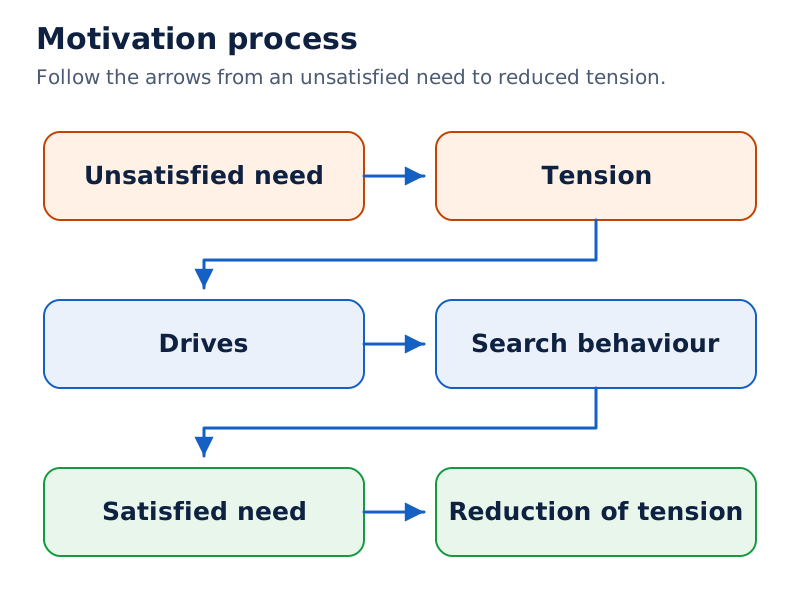
Six boxes form a vertical chain joined by downward arrows: Unsatisfied Need, Tension, Drives, Search Behaviour, Satisfied Need and Reduction of Tension.
Drawn by One Young India. Reference: NCERT Class 12, p. 178
Ramu misses breakfast and becomes hungry and restless. He searches for a hotel, eats a meal and feels his energy return. His hunger is the need, the search is goal-directed behaviour, and the meal satisfies that need.
Why does motivation matter for organisational performance?
Motivation connects employees’ needs with their willingness to work towards organisational goals. It helps managers understand why capable employees may still perform below their potential. Five important benefits explain why organisations develop motivational programmes.
- Improved performance: satisfying needs encourages employees to devote their energies to work and contribute more fully to organisational goals.
- Positive attitudes: suitable rewards, encouragement and praise may gradually change a negative or indifferent attitude towards work.
- Lower employee turnover: identifying needs and providing appropriate incentives help retain employees, saving the money, time and effort required for recruitment and training.
- Reduced absenteeism: motivation addresses problems such as inadequate rewards, lack of recognition and poor working relationships, encouraging more regular attendance.
- Smoother change: explaining how a proposed change can bring additional rewards may make employees more willing to accept it.
What does the Tata Steel case illustrate?
The Tata Steel case brings together officer participation in decisions, personal development programmes, talent review, job rotation, performance-linked compensation and formal recognition. Leadership opportunities in quality circles support employee involvement in improvement.
Communication methods in the case include video conferencing, MD Online and dialogues with senior management. These initiatives helped build a focused team and encouraged employees to take ownership of processes while working towards targets.
Worked example 2. Rashmi Joshi’s performance deteriorates after she is not selected for promotion. Decisions slow down and sales reports become late. What directing issue should the new marketing manager address?
Answer: The manager needs to motivate and inspire Rashmi to regain her former performance. Her case shows why formal authority alone may not secure employees’ best efforts when their aspirations remain unfulfilled.
How does Maslow’s hierarchy explain employee needs?
Abraham Maslow presented a theory of motivation based on human needs in a paper published in 1943. The theory arranges needs in a hierarchy, helping managers identify the need level relevant to an employee.
| Level, from lower to higher | Meaning | Illustration |
|---|---|---|
| Basic physiological needs | Primary needs such as hunger, thirst, shelter and sleep. | Basic salary helps satisfy these needs. |
| Safety and security needs | Protection from physical and emotional harm. | Job security, stable income and pension plans. |
| Affiliation and belonging needs | Affection, acceptance, friendship and belonging. | Cordial relations with colleagues. |
| Esteem needs | Self-respect, autonomy, status, recognition and attention. | A job title indicates status. |
| Self-actualisation needs | The drive to become what one is capable of becoming. | Growth, self-fulfilment and achievement of goals. |
What assumptions underlie the theory?
- People’s behaviour is based on their needs, and satisfaction of those needs influences behaviour.
- Needs are arranged hierarchically, beginning with basic needs and moving to higher ones.
- A satisfied need no longer motivates the person; the next higher need becomes the motivator.
- A person moves to the next higher level only after the lower need is satisfied.
What the figure shows
Maslow’s need hierarchy
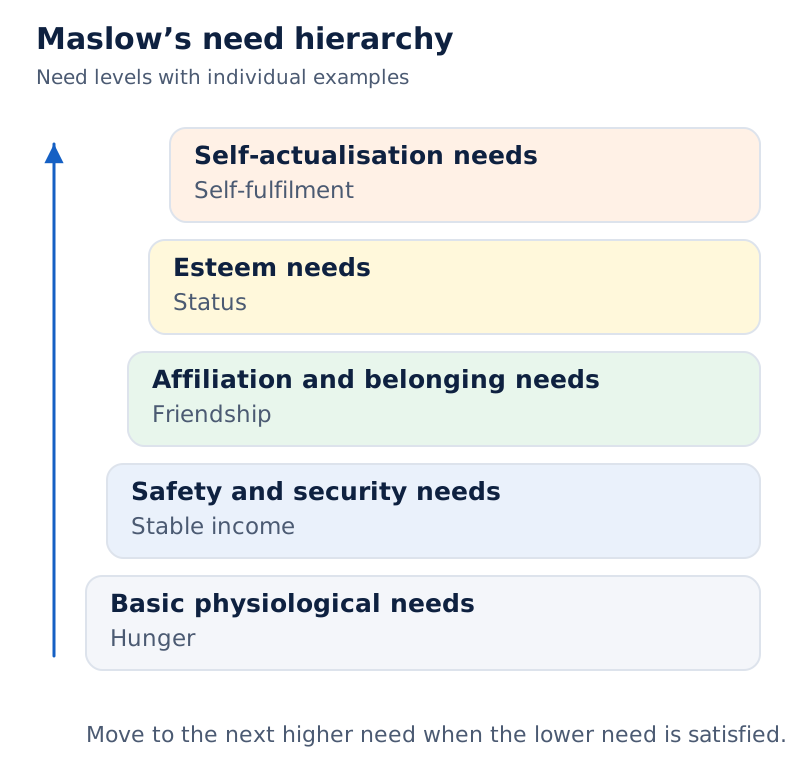
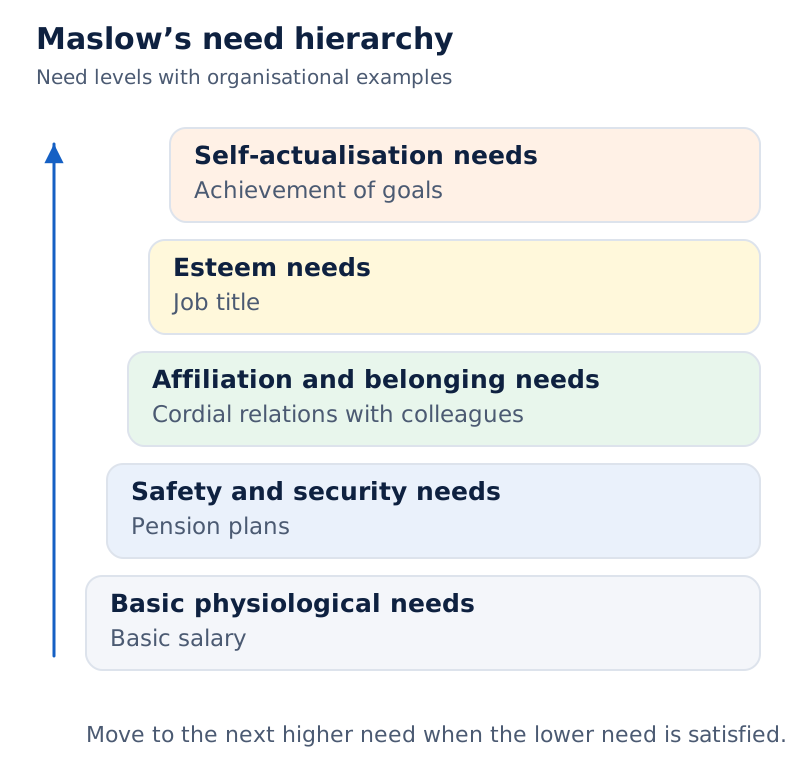
A pyramid places basic physiological needs at its base, followed by safety/security, affiliation/belongingness, esteem and self-actualisation. Panels on either side give individual and organisational examples, including hunger and basic salary at the bottom.
Drawn by One Young India. Reference: NCERT Class 12, p. 180
What are the theory’s usefulness and limitations?
The theory directs attention to needs as a basis of motivation. However, its classification and hierarchy of needs have been questioned. The assumptions should be presented as features of the theory. Its continuing usefulness lies in helping managers identify employee needs before choosing motivators.
How do financial and non-financial incentives motivate employees?
An incentive is a measure used to motivate people to improve performance. Financial incentives are directly monetary or measurable in money. Non-financial incentives emphasise psychological, social and emotional satisfaction, although they may also involve money.
What are the seven financial incentives?
| Incentive | How it works |
|---|---|
| Pay and allowances | Basic pay, dearness allowance, other allowances and increments provide monetary rewards. Some organisations link increases to performance. |
| Productivity-linked wage incentives | Wage payments are linked with increases in individual or group productivity. |
| Bonus | An additional incentive is paid over and above wages or salary. |
| Profit sharing | Employees receive a share of organisational profits, encouraging contributions to improved performance and profits. |
| Co-partnership or stock option | Employees are offered shares at a set price below market price, creating a feeling of ownership. |
| Retirement benefits | Provident fund, pension and gratuity provide financial security after retirement and motivate employees during service. |
| Perquisites | Benefits such as car allowance, housing, medical aid and children’s education are provided in addition to salary. |
The Infosys stock-option example shows shares being used as part of managerial compensation. The motivating link is the feeling of ownership and the resulting interest in organisational growth, rather than merely receiving an immediate cash payment.
What are the eight non-financial incentives?
- Status: rank, authority, responsibility, recognition and prestige attached to a job can satisfy psychological, social and esteem needs.
- Organisational climate: characteristics such as autonomy, reward orientation, consideration for employees and risk-taking influence behaviour. Positive managerial measures can improve this climate.
- Career advancement opportunity: skill development and a sound promotion policy help employees grow into higher-level jobs and encourage better performance.
- Job enrichment: jobs offer greater variety, higher skill requirements, autonomy, responsibility, personal growth and meaningful work experience. An interesting job itself becomes motivating.
- Employee recognition: appreciation acknowledges good work. Examples include congratulations, displaying achievements on notice boards, certificates and rewards for useful suggestions.
- Job security: stability of future income and employment reduces worry and can encourage greater zeal. However, feeling unlikely to lose a job may also make some employees complacent.
- Employee participation: employees join decisions affecting them through arrangements such as joint management, work or canteen committees.
- Employee empowerment: greater autonomy and powers make employees feel their work matters, encouraging the use of skills and talents.
Note: Promotion can involve extra pay yet remain a non-financial incentive when the main satisfaction comes from increased status, authority, responsibility and challenge. Classification depends on the emphasis of the incentive.
Worked example 3. GyanPradan provides medical aid and free education to employees’ children. Identify the incentive and its category.
Answer: These benefits are perquisites, a financial incentive. They are benefits beyond salary and are measurable in monetary terms. Their form does not make them non-financial incentives.
What is leadership, and why are followers important?
Definition: Leadership influences people’s behaviour so that they strive voluntarily towards organisational goals. It relies on interpersonal relations and motivates followers to contribute to common objectives.
The main features of leadership are influence, change in behaviour, leader-follower relationships, pursuit of common organisational goals and continuity. Leadership is an ongoing process, rather than a single instruction or decision.
How does leadership benefit an organisation?
- Positive influence: leaders encourage people to contribute their energies towards organisational objectives.
- Personal support: confidence, encouragement and attention to followers’ needs help create a congenial working environment.
- Acceptance of change: persuasion, clarification and inspiration help overcome resistance with minimum discontent.
- Conflict handling: leaders allow followers to express feelings and disagreements and provide suitable explanations to resolve differences.
- Training and succession: leaders develop subordinates and prepare successors, supporting a smooth succession process.
What makes the leader-follower relationship effective?
Followers contribute skills, knowledge, commitment, cooperation and team spirit. Their acceptance of leadership helps make a leader effective. Organisational success should therefore recognise the contribution of followers as well as the leader’s personal influence.
Business illustrations of leadership include Reliance Industries and the Ambanis, Infosys and Narayana Murthy, Tata and J.R.D. Tata, and Wipro and Azim Premji. These examples connect organisational achievement with leadership, while the follower relationship explains how that influence operates.
Qualities associated with good leadership include courage, willpower, judgement, knowledge, integrity, physical energy, faith, moral qualities, fairness, vitality, decisiveness and social skills. No individual can possess every quality, and possessing qualities does not invariably ensure success. Training and conscious effort can help managers develop them.
How do autocratic, democratic and free-rein leadership differ?
Leadership styles can be classified by the use of authority. The three basic styles differ in who makes decisions, how followers participate and how much independence they receive. Their suitability depends on the situation.
| Style | Decision-making and communication | Role of followers |
|---|---|---|
| Autocratic or authoritarian | The leader gives orders and expects obedience. Communication is one-way in this style. | Followers act according to the leader’s commands. |
| Democratic or participative | The leader consults subordinates when developing plans and making decisions. | Followers participate, express opinions and contribute to setting objectives. |
| Laissez-faire or free-rein | The leader uses power only when essential and supplies support and information. | Followers have substantial independence to set objectives, choose methods and accept responsibility. |
What advantages and qualifications should be remembered?
Autocratic leadership facilitates quick decisions and can support productivity where a factory supervisor must ensure timely production. Some autocratic leaders hear subordinates’ opinions and concerns, although the final decision remains their own.
Democratic leadership encourages participation because people perform best when involved in setting their objectives. The leader respects opinions, supports duties and uses forces within the group to exercise control.
Free-rein leadership gives followers responsibility for their tasks and for resolving issues. The manager remains available to support them and provide required information.
Note: Styles may be combined as circumstances require. A free-rein leader can still prescribe rules, while a democratic leader may need to decide independently during an emergency.
How does communication create understanding and support management?
Communication exchanges ideas, views, facts and feelings between or among people to create common understanding. A manager’s professional knowledge is insufficient if instructions fail to produce understanding in subordinates.
What are the eight elements of the process?
- Sender: the person who conveys thoughts or ideas and acts as the source.
- Message: the ideas, suggestions, feelings or orders intended for communication.
- Encoding: converting the message into symbols such as words, pictures or gestures.
- Media: the channel carrying the message, such as writing, conversation, a telephone call or the Internet.
- Decoding: interpreting the symbols used by the sender to understand the message.
- Receiver: the person who receives the sender’s communication.
- Feedback: the receiver’s actions indicating that the message has been received and understood.
- Noise: any hindrance to communication affecting the sender, message or receiver.
Noise includes a poor telephone connection, ambiguous symbols, inattention, faulty decoding, prejudices and misleading gestures. It is broader than an unwanted sound: any of these obstructions may interfere with common understanding.
What the figure shows
Communication process
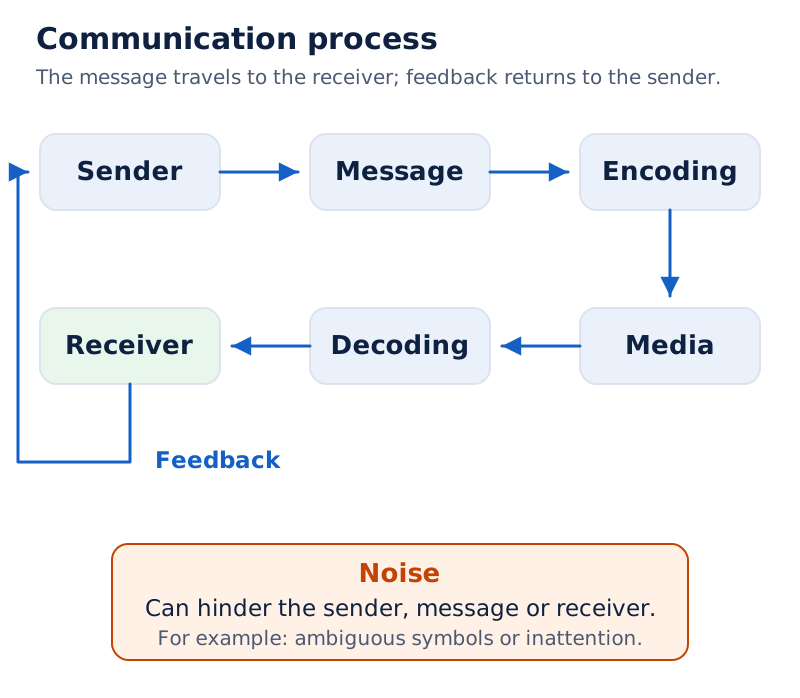
Boxes show Sender, Message, Media and Receiver across the page, with Encoding and Decoding above. A feedback route returns from Receiver to Sender. Noise is shown below the message route.
Drawn by One Young India. Reference: NCERT Class 12, p. 189
Why is communication important?
- Coordination: explaining goals, methods and working relationships connects activities, people and departments.
- Smooth working: communication connects human and physical elements into a functioning organisation.
- Decision-making: relevant information provides the basis for meaningful managerial decisions.
- Managerial efficiency: communication carries targets, instructions, job allocations and information about performance.
- Cooperation and industrial peace: two-way communication promotes mutual understanding between workers and management.
- Effective leadership: managers need communication skills to influence subordinates.
- Morale and motivation: communication helps employees adjust to work, improves human relations and supports participation.
Thus, communication supports the other elements of directing. Supervisory guidance must be understood, motivational measures must reach employees, and leadership depends on expressing ideas in ways that influence followers.
How does formal communication flow through an organisation?
Formal communication follows the official channels established by the organisation chart. It may occur between superiors and subordinates or between employees and managers at the same level. It may be oral or written, but is generally recorded and filed.
| Direction | Flow | Example |
|---|---|---|
| Upward | Subordinate to superior. | A leave application or progress report. |
| Downward | Superior to subordinate. | An instruction to complete assigned work or attend a meeting. |
| Horizontal or lateral | Between divisions or employees at the same level. | A production manager discussing delivery schedules or product quality with the marketing manager. |
What are the five formal communication networks?
- Single chain: communication moves through successive superior-subordinate relationships along the organisational hierarchy.
- Wheel: subordinates communicate through one superior, who acts as the hub. They are not permitted to communicate among themselves within this network.
- Circular: each person communicates with the two adjoining people. Communication moves slowly around the circle.
- Free flow: each person can communicate freely with others, making the flow fast.
- Inverted V: a subordinate may communicate with the immediate superior and the superior’s superior. Communication with the latter is limited to prescribed matters.
What the figure shows
Communication networks
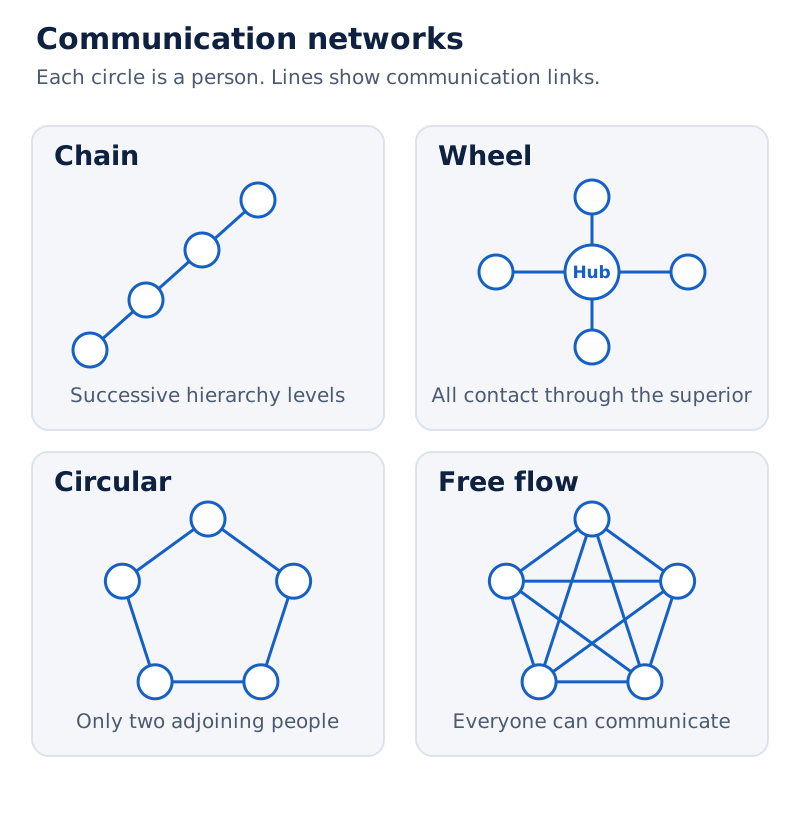
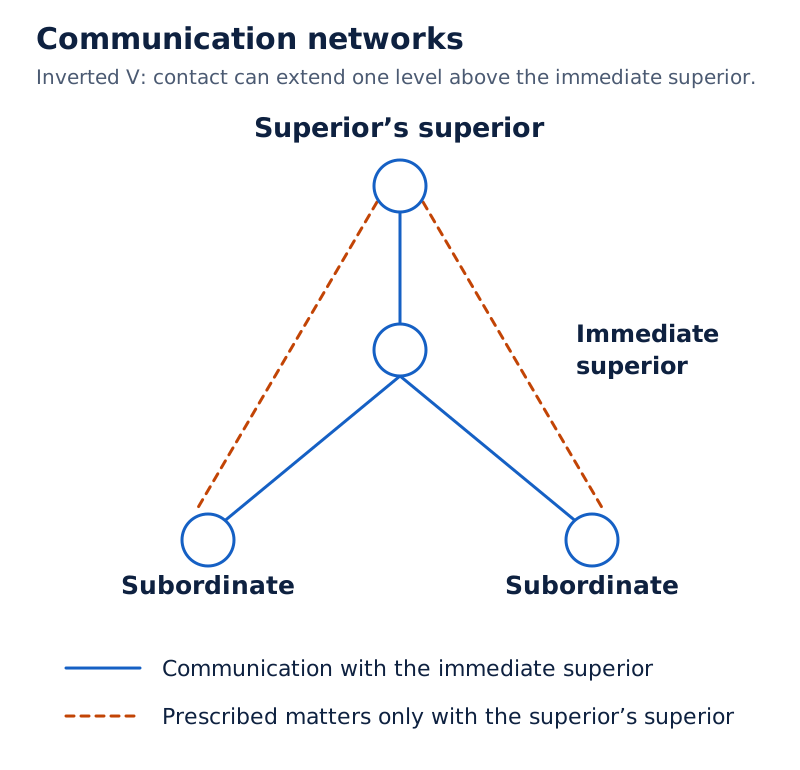
Five labelled drawings show Chain, Wheel, Circular, Free Flow and Inverted V. The chain joins circles vertically; the circular network forms a ring; the free-flow drawing includes connections across the group.
Drawn by One Young India. Reference: NCERT Class 12, p. 192
Direction and network describe different aspects of communication. Upward or downward identifies the relationship between sender and receiver. A network identifies the pattern through which messages pass among members.
What are the merits and limitations of informal communication?
Informal communication takes place without following formal lines of authority. It is called the grapevine because it spreads through the organisation in many directions, disregarding official levels. It arises from employees’ need to exchange views outside formal channels.
Examples include workers discussing a superior’s behaviour in the canteen or talking about rumours of transfers. Such exchanges show how social interaction creates communication alongside the official system.
What are its merits and limitations?
A merit is rapid transmission: grapevine channels may convey information quickly and help managers discover employees’ reactions. Managers can use these positive aspects to understand what people are thinking.
Limitations include distortion, unauthenticated rumours and difficulty tracing the source. Informal discussions can influence behaviour and may harm the working environment. Managers should use helpful aspects while reducing harmful effects.
Which networks can the grapevine follow?
| Network | Pattern |
|---|---|
| Single strand | Each person communicates with another in sequence. |
| Gossip | A person communicates with all on a non-selective basis. |
| Probability | Individuals communicate randomly with other individuals. |
| Cluster | An individual communicates with selected people whom they trust. |
The cluster network is the most popular of these grapevine networks in organisations. Trust guides the selection of recipients, unlike random selection in the probability network or non-selective communication in gossip.
Which barriers prevent effective communication?
Communication barriers can stop a message, filter parts of it or alter its meaning. They are grouped as semantic, psychological, organisational and personal barriers. Recognising the type helps a manager understand why common understanding has failed.
What are semantic barriers?
Semantic barriers concern meanings and difficulties in encoding or decoding messages.
- Badly expressed messages: inadequate vocabulary, wrong words or missing words fail to convey the intended meaning.
- Symbols with different meanings: receivers interpret a word differently from the sender. “Value” can refer to a ring’s worth, the importance of friendship or the usefulness of computer skills.
- Faulty translations: an inaccurate translation between languages changes the message.
- Unclarified assumptions: unstated expectations allow sender and receiver to understand instructions differently.
- Technical jargon: specialists’ terms may be unfamiliar to people outside the field.
- Body language and gesture decoding: a mismatch between spoken words and movements may cause misunderstanding.
Worked example 4. A boss asks a subordinate to take care of a guest. The boss means transport, food and accommodation until departure; the subordinate understands only taking the guest carefully to a hotel. Identify the barrier.
Answer: Unclarified assumptions create a semantic barrier. The instruction leaves the intended scope unstated, so the boss and subordinate attach different meanings to it.
What are psychological barriers?
- Premature evaluation: judging a message before the sender finishes. This may be due to prejudices or preconceived ideas.
- Lack of attention: preoccupation prevents proper listening. A boss absorbed in a file may fail to understand an employee’s problem.
- Loss by transmission and poor retention: successive relaying may lose or distort information, particularly in oral communication. Inattention or lack of interest also weakens retention.
- Distrust: lack of belief between sender and receiver obstructs understanding of the original meaning.
What are organisational barriers?
- Organisational policy: policies unsupportive of free communication can restrict the flow of information.
- Rules and regulations: rigid procedures and prescribed routes may delay communication.
- Status: a superior’s status may create psychological distance and discourage subordinates from expressing feelings.
- Complexity of structure: numerous managerial levels add filtering points, causing delay and distortion.
- Organisational facilities: lack of meetings, suggestion or complaint boxes, social gatherings and transparency may hinder communication.
What are personal barriers?
- Fear of challenge to authority: a superior may suppress information perceived as threatening authority.
- Lack of confidence in subordinates: a superior may avoid seeking their advice or opinions.
- Unwillingness to communicate: subordinates may withhold messages they believe could harm their interests.
- Lack of proper incentives: without recognition or rewards for useful suggestions, employees may not initiate communication.
How can managers improve communication effectiveness?
Communication barriers exist to a greater or lesser degree in organisations. Managers should address the message, its delivery and the receiver’s response. Effective communication requires both clear expression and patient, attentive listening.
- Clarify ideas before communicating: study and analyse the issue so that the intended meaning is clear to the sender before it is expressed to others.
- Consider the receiver’s needs: adjust the message to the receiver’s education and level of understanding.
- Consult others: involve relevant people in planning communication. Participation can improve acceptance and willing cooperation.
- Choose language, tone and content carefully: use understandable language and a manner that respects listeners’ feelings and encourages a response.
- Convey helpful and valuable information: connect the message with listeners’ interests and needs, making it meaningful to them.
- Ensure feedback: ask questions about the message and encourage the receiver to respond. Use the response to improve communication.
- Communicate for present and future: meet existing commitments while maintaining consistency with the enterprise’s future goals.
- Follow up: regularly review instructions and their implementation so that obstacles can be identified and removed.
- Be a good listener: listen patiently and attentively, showing interest when subordinates speak.
Feedback and follow-up serve related purposes. Feedback helps establish whether a message has been understood. Follow-up examines what happens after instructions are given and whether practical difficulties obstruct implementation. Both help a manager make communication more effective.
In the guest-care situation, clear expression requires the boss to specify the intended arrangements. Checking the subordinate’s understanding addresses the gap between the two interpretations. The remedy follows directly from clarifying ideas and ensuring feedback.
Glossary
- Directing — Instructing, guiding, counselling, motivating and leading people towards the achievement of organisational objectives.
- Supervision — Overseeing and guiding employees’ work to use resources optimally and achieve work targets.
- Motive — An internal state that energises and directs behaviour towards the satisfaction of needs.
- Motivation — The process of stimulating people to act towards desired organisational goals.
- Motivator — A technique, such as praise or promotion, used to encourage employees’ contributions.
- Incentive — A measure used to motivate people to improve their performance at work.
- Self-actualisation — The drive to become what one is capable of becoming through growth and fulfilment.
- Job enrichment — Designing work with greater variety, skill, autonomy, responsibility and opportunities for personal growth.
- Empowerment — Giving subordinates greater autonomy and powers so that their work feels important.
- Leadership — Influencing people’s behaviour so they strive voluntarily towards common organisational objectives.
- Encoding — Converting an intended message into communication symbols such as words, pictures or gestures.
- Decoding — Interpreting the sender’s encoded symbols to understand the message being communicated.
- Feedback — Actions by the receiver indicating receipt and understanding of the sender’s message.
- Noise — An obstruction or hindrance affecting the sender, message or receiver during communication.
- Grapevine — Informal communication that spreads through an organisation without following official lines of authority.
Common errors and misconceptions
- Misconception: Directing is simply giving orders. Correct: It includes supervision, motivation, leadership and communication, helping people act towards organisational objectives.
- Misconception: Only the person called a supervisor supervises. Correct: Every manager supervises subordinates; supervisor also names a particular operative-level position.
- Misconception: The same incentive motivates everyone equally. Correct: People differ in their needs, expectations, perceptions and responses, making motivation complex.
- Misconception: Any incentive involving money must be financial. Correct: Promotion may involve higher pay but is treated as non-financial when psychological satisfaction is its main emphasis.
- Misconception: A successful leader must possess every desirable quality. Correct: No individual possesses all the qualities, and followers’ cooperation also contributes to effective leadership.
- Misconception: Free-rein leadership means the manager provides no support or rules. Correct: The manager supplies information and support, and may still prescribe rules.
- Misconception: Formal communication is necessarily written. Correct: It may be oral or written; its defining feature is the use of official channels.
- Misconception: Noise means sound alone. Correct: Ambiguous symbols, inattention, prejudices and faulty decoding can also obstruct communication.
Exam-style questions with model answers
Q1. Distinguish a motive from a motivator, giving one example of each. [2 marks]
- A motive is an internal state that directs behaviour towards a goal, such as hunger arising from the need for food.
- A motivator is a technique used to encourage action, such as a bonus or promotion offered to employees.
Q2. Explain any three principles of directing: unity of command, harmony of objectives and follow through. [3 marks]
- Unity of command: each employee should receive instructions from one superior only. This prevents the confusion, conflict and disorder that can arise from multiple sources of command.
- Harmony of objectives: direction should reconcile personal and organisational goals by showing that employee rewards and work efficiency can complement each other.
- Follow through: managers should review implementation, identify difficulties and modify directions where needed. Giving an order alone does not complete the directing task.
Q3. GyanPradan provides medical aid and free education to employees’ children. Identify the incentive, state its category and explain two other incentives in that category. [4 marks]
- The benefits are perquisites. They provide employees with additional benefits beyond their salary, including medical assistance and education for their children.
- They belong to financial incentives because the benefits can be measured in monetary terms even though they are not simply a salary payment.
- Bonus is another financial incentive. It provides an additional payment over and above an employee’s wages or salary.
- Profit sharing gives employees a share of organisational profits, encouraging them to improve performance and contribute towards higher profits.
Q4. Explain the five levels of Maslow’s need hierarchy in ascending order, with an illustration of each. [5 marks]
- Basic physiological needs are primary requirements such as food, shelter and sleep. In an organisation, basic salary helps employees satisfy these needs.
- Safety and security needs concern protection from physical and emotional harm. Stable income, job security and pension plans help meet these requirements.
- Affiliation and belonging needs involve affection, acceptance and friendship. Cordial relationships with colleagues illustrate their satisfaction in an organisational setting.
- Esteem needs include self-respect, autonomy, status and recognition. A job title can indicate status and contribute to the satisfaction of these needs.
- Self-actualisation needs concern becoming what one is capable of becoming. Personal growth, self-fulfilment and achievement of goals illustrate this highest level.
Q5. Explain three leadership styles based on authority and state one qualification about choosing a style. [4 marks]
- Autocratic leadership gives orders and expects obedience. The leader makes decisions and communicates instructions to subordinates, who act according to those commands.
- Democratic leadership involves consultation and participation. The leader encourages subordinates to contribute to decisions, plans and the setting of objectives.
- Free-rein leadership gives followers considerable independence and responsibility. The manager supports them with necessary information and uses power only when essential.
- Choice is situational: styles may be combined. A democratic leader may decide independently during an emergency, while a free-rein leader may still require rules.
Q6. A boss instructs a subordinate to take care of a guest, intending transport, food and accommodation until departure. The subordinate understands only taking the guest carefully to a hotel. Identify and explain the communication barrier. [2 marks]
- The barrier is unclarified assumptions, which belongs to the semantic category of communication barriers.
- The boss leaves the scope of care unstated. Consequently, the subordinate interprets the instruction more narrowly, leaving a gap between intended and understood meaning.
Q7. Explain six measures for improving communication: clarity, receiver needs, consultation, language and tone, feedback, and listening. [6 marks]
- Clarify ideas: the sender should study and analyse the issue before expressing it, ensuring that the intended message is clear.
- Consider receiver needs: adjust communication to the receiver’s education and understanding so that its meaning can be grasped properly.
- Consult others: involve relevant people in planning communication. Their participation can encourage ready acceptance and willing cooperation when the message is delivered.
- Use suitable language and tone: choose understandable words and a respectful manner that does not offend listeners and encourages a response.
- Ensure feedback: ask questions and encourage the receiver to respond. The response helps check understanding and improve the communication process.
- Listen attentively: give patient attention to subordinates and show interest in what they say, helping overcome misunderstanding and communication difficulties.
Q8. Rashmi Joshi seeks a higher managerial position but takes credit for sales representatives’ good work and denies responsibility for problems. Management appoints an outsider, fearing difficulties with her future peers. Rashmi then becomes despondent, decisions slow down and her reports become late. Explain the directing issue and two reasons why issuing orders alone may be inadequate. [3 marks]
- The issue is motivation: the new manager needs to inspire Rashmi to regain her former performance after the disappointment of not receiving the promotion.
- Her desire for advancement concerns an internal aspiration. Formal authority alone does not address the dissatisfaction associated with that unfulfilled aspiration.
- Her deteriorating performance shows that ability and a managerial position do not by themselves ensure effective work. The manager must understand what stimulates her willingness to perform.
Key takeaways
- Directing initiates action, integrates individual effort, develops employee potential, supports change and strengthens organisational stability.
- Effective direction combines supervision, motivation, leadership and communication throughout the hierarchy and the organisation’s continuing life.
- Supervisors connect workers and management through daily guidance, training, feedback, group unity and responsibility for targets.
- Motivation begins with unsatisfied needs and connects employee satisfaction with goal-directed behaviour and organisational performance.
- Maslow’s hierarchy moves from physiological needs to self-actualisation, while its classification and ordering remain subject to criticism.
- Financial incentives provide monetary benefits; non-financial incentives primarily address psychological, social and emotional needs at work.
- Leadership depends on influence and followers’ cooperation, with the appropriate use of authority varying across situations.
- Clear messages, suitable channels, feedback, follow-up and attentive listening help overcome barriers to common understanding.
Test yourself
Which four elements make up directing?
The four elements are supervision, motivation, leadership and communication.
Why is directing described as continuous?
It operates throughout an organisation’s life even when the people occupying managerial positions change.
What follows search behaviour in the motivation process?
A satisfied need follows search behaviour, leading to a reduction of tension.
Which need is at the top of Maslow’s hierarchy?
Self-actualisation is the highest need: becoming what one is capable of becoming through growth and fulfilment.
How does empowerment motivate employees?
Greater autonomy and powers make employees feel their jobs are important and encourage the use of skills and talents.
How does a wheel network operate?
All subordinates communicate through one superior, the hub, rather than communicating among themselves within that network.
Which grapevine network is most popular in organisations?
The cluster network is most popular, with individuals communicating selectively to people they trust.
How does premature evaluation obstruct communication?
The receiver judges the message before the sender finishes. This may be due to preconceived notions or prejudices.
Write about it
Turn a question from this chapter into a paper.
The Writing Studio has a structure guide, a rubric and citation tools for 15 formats, from essays to research papers. Drafting is free with an account. Learnacy Essential adds feedback from an AI writing coach and submission to The OYI Review.
Learnacy Essential is ₹1,499 for the year. Publication depends on review and is not guaranteed.