
Planning | CBSE Class 12 Business Studies Notes
On this page
Watch & explore
Start with a few high-quality watches, then dive into the notes below.

This note covers the meaning, importance, features and limitations of planning, the steps in the planning process, single-use and standing plans, objectives, strategies, policies, procedures, methods, rules, programmes and budgets.
What is planning, and how does it connect objectives with action?
Definition: Planning involves setting objectives for a specified period, developing alternative ways of achieving them and selecting the best available course of action.
Planning means deciding beforehand what to do and how to do it. It connects the present position of an organisation with the position it wants to reach. Managers first establish a destination, then consider the actions needed to reach it.
What are the ends and means of planning?
The ends are the objectives or targets to be achieved. The means are the courses of action through which those targets will be pursued. Planning deals with both, so announcing a desirable result alone does not complete the task.
Objectives guide managerial decisions and provide targets against which actual performance can be measured. Planning gives managers a rational basis for choosing between alternatives, while also allowing creativity and innovation in developing possible courses of action.
Why do time and implementation matter?
A plan needs a time frame. Time is limited, and environmental conditions may change while managers are still preparing their plans. A plan that is not implemented cannot turn an intention into an organisational result.
Planning is therefore connected with action even though its preparation is an intellectual activity. Managers must think ahead, make predictions and establish targets before arranging how work will be done. This responsibility exists at every level of management.
Diagram
Objectives and action
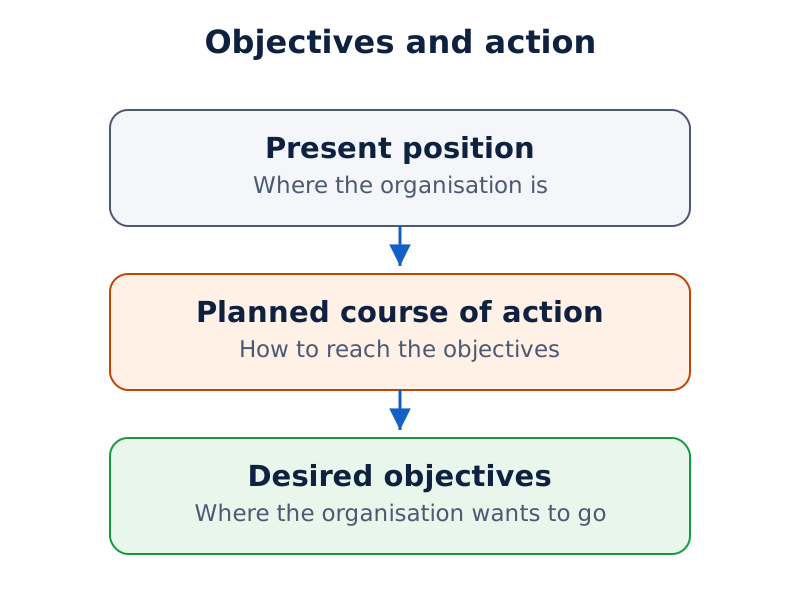
Draw boxes labelled present position, planned course of action and desired objectives. Connect them with arrows to show how planning bridges the gap between where an organisation is and where it wants to go.
Drawn by One Young India.
What advantages make planning important for management?
The importance of planning lies in the guidance it gives to organisational activity. It helps managers prepare for uncertainty, coordinate work and make reasoned choices. These benefits explain why planning supports the other functions of management.
- Provides directions: Clearly stated goals show employees what the organisation intends to achieve and what they must do. Departments and individuals can coordinate their efforts instead of working towards different destinations.
- Reduces the risks of uncertainty: Looking ahead helps managers anticipate changes and prepare responses. Planning cannot eliminate uncertain events, but it can identify tasks and possible ways of dealing with changed conditions.
- Reduces overlapping and wasteful activities: Planning coordinates the work of divisions, departments and individuals. Clarity reduces confusion and misunderstanding, helps minimise redundant work and makes inefficiencies easier to identify and correct.
- Promotes innovative ideas: As the first managerial function, planning provides an opportunity to turn new ideas into concrete courses of action. These ideas can guide future activities and contribute to business growth.
- Facilitates decision making: Managers compare alternative courses in the light of targets and expected future conditions. Evaluating those alternatives helps them select a viable course through reasoned judgement.
- Establishes standards for controlling: Planned goals become standards against which actual performance is compared. Differences reveal deviations, and managers can decide what corrective action is required.
How are planning and controlling connected?
Planning establishes the expected result; controlling checks performance against it. Without goals and standards, managers would lack the basis for identifying deviations. The extent of a deviation influences the corrective action required.
This relationship does not mean that preparing a plan completes control. Actual performance still has to be measured and compared with the standard. Planning supplies the reference point, while subsequent monitoring shows whether the organisation is moving towards its objectives.
Note: Reducing uncertainty is different from removing it. Plans help managers anticipate change and prepare responses, but uncertain events can still affect results.
What are the main features of planning?
The features of planning describe its nature and scope. They explain why planning is purposeful, why it supports other managerial functions and why it continues throughout the life of an organisation.
| Feature | Meaning |
|---|---|
| Focuses on objectives | Plans specify goals and activities that contribute to predetermined organisational purposes. |
| Primary function | Planning establishes the framework within which other management functions operate. |
| Pervasive | Planning is needed at every management level and in every department. |
| Continuous | One plan is prepared and implemented, then another follows as requirements and conditions change. |
| Futuristic | Planning anticipates future events and prepares the organisation to deal with them. |
| Involves decision making | Managers examine alternatives and choose an appropriate course of action. |
| Mental exercise | Planning requires foresight, imagination, judgement and systematic analysis of facts and forecasts. |
Does every manager prepare the same kind of plan?
Pervasiveness does not mean identical scope. Top management plans for the whole organisation, middle management prepares departmental plans, and supervisors undertake day-to-day operational planning. The need is common, but the area covered differs.
The primacy of planning means that it provides the basis for organising, staffing, directing and controlling. These functions remain interrelated and equally important. Planning comes first because managers need a purpose and course of action before organising work around them.
How do continuity, forecasting and choice fit together?
Plans cover specified periods, such as a month, quarter or year. New requirements and future conditions create the need for another plan. Sales forecasts, for example, help a business prepare its annual production and sales plan.
Decision making is necessary because alternative courses are available. If there is only one possible goal or course, there is no choice to make. Planning evaluates alternatives through logical thinking, rather than relying on guesses or wishes.
Its character as a mental exercise distinguishes thinking through an intended action from carrying it out. Foresight and intelligent imagination are useful, but they must be supported by orderly examination of facts and forecasts.
What limitations can prevent planning from achieving its purpose?
Planning is essential, but business conditions do not always develop as expected. Changes in costs, prices, government intervention and legal requirements can affect plans. The following limitations explain why managers need caution and flexibility.
- Leads to rigidity: A detailed plan fixes goals and a course of action for a period. Managers may find it difficult to change direction, even when circumstances make the original plan unsuitable for the organisation.
- May not work in a dynamic environment: Economic, political, physical, legal and social conditions change. Policy changes, political instability, natural calamities and competition may upset forecasts, sales targets and financial plans.
- Reduces creativity: When top management prepares plans and others usually implement them, lower-level decision makers may have little freedom to propose alternatives. Initiative may decline when employees merely carry out orders.
- Involves huge costs: Collecting and checking facts, making calculations, consulting experts, holding meetings and investigating feasibility consume resources. Sometimes the benefits of a plan may not justify these costs.
- Is time-consuming: Preparing a plan can take so long that little time remains for implementation. The time devoted to planning must therefore be understood alongside the need to act.
- Does not guarantee success: Plans must be properly prepared and implemented. A previously successful plan may fail under new conditions, and reliance on past success can create complacency and a false sense of security.
Can planning both encourage and reduce creativity?
Yes. During plan preparation, innovative ideas can become practical courses of action. However, if employees are expected merely to follow decisions made above them, their own initiative may be restricted. These describe different aspects of how planning operates.
The criticism of reduced creativity does not cancel the feature of pervasiveness. Planning is required throughout an organisation, but participation and freedom may be restricted when plans are imposed by top management.
What happens when competition changes sales expectations?
Competition may require revised sales targets. Cash budgets based on those sales figures may also need modification. This connection shows why a change in the environment can affect several related plans.
Note: Planning remains useful despite its limitations. It provides a basis for examining future courses of action, but it is not a solution to every managerial problem.
How does the planning process begin with objectives and premises?
The planning process follows a logical sequence. Managers first establish what they want to achieve, then develop assumptions about future conditions. These initial steps provide the basis for identifying and evaluating possible actions.
Step 1: Setting objectives
Objectives specify desired results for the organisation and its departments or units. They should be clear to employees at every level. Departmental objectives must fit within the wider organisational framework, so separate activities contribute to a common purpose.
An organisation may aim to increase sales by 20%. Its departments then need to determine how their activities will contribute to that goal. Managers should participate in setting objectives and understand the contribution expected from their own work.
Clarity at this stage makes the remaining planning task easier. If the desired result is understood, managers can judge whether a possible course of action will help achieve it. Unclear objectives weaken the basis for choosing between alternatives.
Step 2: Developing premises
Definition: Planning premises are assumptions about future conditions that provide the basis on which plans are prepared.
Managers cannot know the future with certainty. Their premises may draw on forecasts, existing plans and past policy information. All managers involved should understand and agree on the same assumptions so that their plans share a common basis.
Forecasting helps gather information for developing premises. Forecasts may concern product demand, changes in policy, interest rates, capital-goods prices or tax rates. Accurate forecasts are therefore important to sound planning, though the future remains uncertain.
An objective and a premise answer different questions. The objective states the result sought; a premise states an assumption about conditions under which the organisation will pursue that result. Treating an assumption as a guaranteed outcome overlooks uncertainty.
How are alternatives identified, selected and put into action?
After setting objectives and developing premises, managers consider possible ways forward. The remaining stages move from generating choices to evaluating them, making a decision, implementing it and checking progress.
- Identifying alternative courses of action: Managers identify the available ways of achieving the objectives. Alternatives may be routine or innovative. Involving more people can bring additional ideas, especially when an important project needs thorough discussion.
- Evaluating alternative courses: Managers weigh advantages and disadvantages against the objective. Each proposal is assessed for feasibility and consequences. Financial evaluation may consider earnings, interest, taxes and dividends, as well as the relationship between risk and likely return.
- Selecting an alternative: This is the actual decision stage. The preferred plan should be feasible, profitable and have the least negative consequences. Experience, judgement and sometimes intuition matter where mathematical analysis is unsuitable. Sometimes a combination of plans is selected.
- Implementing the plan: The chosen course is put into action. Other management functions become involved. For example, a plan to increase production may require more labour and machinery, which must be organised and acquired.
- Follow-up action: Managers monitor whether implementation is taking place and activities follow the schedule. Checking progress helps ensure that the intended objectives are achieved.
Why is identifying an alternative different from selecting one?
Identification creates the available choices; evaluation compares their consequences; selection commits to the preferred course. A report listing options therefore does not, by itself, establish that a final decision has been made.
Worked example 1. A company wants market share to rise from 10% to 25% by the end of the next financial year. Rajni lists entering new markets, expanding the product range, offering rebates or discounts, and increasing advertising. Which planning step has she completed?
Answer: Rajni has identified alternative courses of action for the 25% market-share objective. Her report supplies possible ways forward; it does not show that she has evaluated them or chosen the final course.
Diagram
Planning process
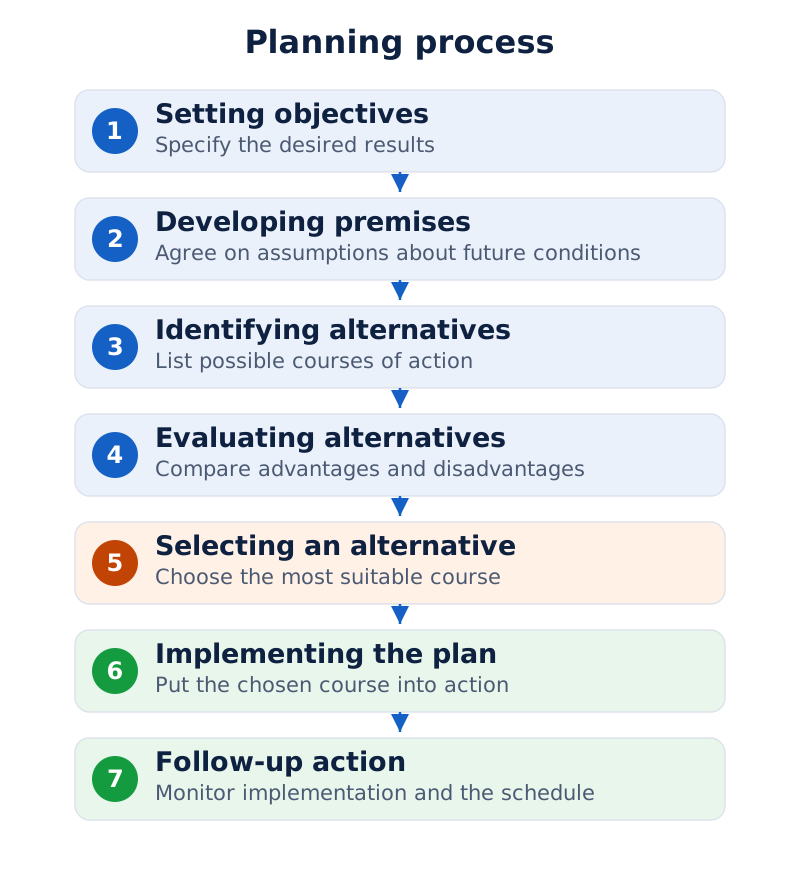
Connect seven boxes in this order: setting objectives, developing premises, identifying alternatives, evaluating alternatives, selecting an alternative, implementing the plan and follow-up action.
Drawn by One Young India.
How do single-use plans differ from standing plans?
Plans can be classified by their use and planning period. Single-use plans and standing plans belong to operational planning. The key distinction is whether the situation is non-recurring or occurs regularly.
| Basis | Single-use plan | Standing plan |
|---|---|---|
| Purpose | Prepared for a one-time event or project. | Prepared for activities that recur over time. |
| Use | The same course is not likely to be repeated in future. | Provides continuing guidance for routine operations. |
| Duration and revision | Duration depends on the project, which may last a day, week or month. | Usually developed once and modified as business needs change. |
| Examples | Budgets, programmes and projects. | Policies, procedures, methods and rules. |
What details do these plans contain?
A single-use plan may identify the employees responsible for particular work. Organising a seminar or conference is a one-time activity. A programme for opening a department may specify the steps and procedures needed to carry out the work.
Projects resemble programmes but differ in scope and complexity. Their duration depends on the work involved, so single-use does not mean that every such plan must last for exactly the same period.
A standing plan makes recurring decisions more efficient and helps internal operations run smoothly. An educational institution's admission policy and a procedure for reporting production progress illustrate recurring guidance.
Objectives and strategies are usually not placed in this single-use or standing classification. Objectives guide overall planning, while strategy belongs to strategic planning and considers resource allocation, priorities, competition and the business environment.
How do objectives and strategies guide an organisation?
What makes an objective clear?
An objective is the desired future position or result that management seeks through organisational operations. Objectives are the end points of planning, and other managerial activities also work towards their achievement.
Objectives are usually established by top management and guide overall business planning. Departments may have their own objectives within the organisation's broader goals. They should be specific, measurable in quantitative terms and expressed as written results to be achieved within a given period.
Worked example 2. Polaris plans to expand capacity to employ 800 more professionals within six months, with a current-year objective of adding capacity for 1500 to 2000 more professionals. What planning features should this decision illustrate?
Answer: The target of capacity for 800 additional professionals identifies a definite objective, while six months provides a time frame. The stated expansion targets show planning's focus on objectives; establishing them before arranging expansion also illustrates its primary role.
What does a strategy contain?
A strategy is a comprehensive plan for accomplishing organisational objectives. It sets broad direction and scope over the long run. Its dimensions are determining long-term objectives, adopting a course of action and allocating the resources needed.
Economic, political, social, legal and technological conditions affect strategy. Strategic choices include remaining in the same business, combining existing activities with new lines or seeking a dominant position in the existing market.
A marketing strategy addresses customers, product demand, distribution channels, pricing and advertising. These connected decisions establish the broad approach through which the organisation intends to compete and achieve its objectives.
Worked example 3. In 2018, Bharti Airtel responded to Reliance Jio by changing its ₹149 prepaid plan to provide 2 GB of 3G/4G data daily, twice its earlier allowance. How should this competitive decision be classified?
Answer: The response to competition illustrates strategy. The revised ₹149 offer, with 2 GB daily data, forms part of a broad competitive course of action. Strategy connects long-term objectives, the chosen course and the resources required to pursue it.
How do policies and procedures differ?
Policies and procedures both support implementation, but they give different kinds of guidance. A policy establishes broad boundaries for decisions; a procedure states the sequence of steps to follow in particular circumstances.
How does a policy guide judgement?
A policy is a general statement that directs thinking and action. It helps interpret a broadly stated strategy and provides a general response to recurring situations. Recruitment and pricing policies make it easier to resolve issues within an established framework.
Policies exist at different levels and in different departments. Major company policies may be known to customers, clients and competitors, while minor policies contain details for people within the organisation.
The manager has discretion in interpreting and applying a policy. A purchase policy may address whether to make or buy required items, how to select vendors and how many suppliers to use. It sets the boundaries within which those decisions are made.
How does a procedure put guidance into a sequence?
A procedure sets out routine steps in chronological order. It describes how work is to be carried out, usually by people within the organisation. Requisitioning supplies before production is an example of an activity for which a procedure may be specified.
| Basis | Policy | Procedure |
|---|---|---|
| Form | A general statement guiding thinking and decisions. | A sequence of steps for carrying out an activity. |
| Main emphasis | The broad parameters within which managers act. | The chronological order in which actions occur. |
| Relationship | Provides the framework for action. | Operates within that policy framework. |
The two plans are therefore interlinked. Procedures help enforce policies and achieve objectives. Confusing them loses the difference between a general guide to decisions and the ordered actions used to carry those decisions into effect.
How do methods and rules regulate everyday work?
What does a method prescribe?
A method states the prescribed way of performing a task with its objective in view. It deals with a task forming one step of a procedure and explains how that step should be carried out.
Methods may differ across tasks. Selecting a suitable method saves time, money and effort and improves efficiency. For higher-level management training, orientation programmes, lectures and seminars may be used; supervisory training may use on-the-job and work-oriented methods.
The distinction is one of focus. A procedure gives the sequence of steps, while a method gives the manner of performing a particular task within that sequence. Both help guide work, but they are not interchangeable terms.
Why does a rule leave no discretion?
A rule is a specific statement requiring or prohibiting an action. It leaves no flexibility or discretion in its application. Rules are usually the simplest plans because no compromise or change is allowed unless a policy decision is taken.
Rules count as plans because they specify beforehand what must or must not be done. They embody managerial decisions that guide future behaviour, even though they do not present employees with alternative courses.
Rama Stationery Mart requires all payments to be made by e-transfer only. This is a rule: the required payment mode is fixed. It differs from a broad policy under which a manager can exercise judgement within stated boundaries.
What do programmes and budgets contribute to planning?
How does a programme bring details together?
A programme is a detailed statement about a project. It brings together objectives, policies, procedures, rules, tasks, human and physical resources, and the budget needed to implement a course of action.
Its scope includes the activities involved and their contribution to the overall business plan. Detailed arrangements are worked out within the broad policy framework. This makes a programme more comprehensive than a statement of the project's desired result alone.
Why is a budget both a plan and a control device?
A budget expresses expected results numerically. A sales budget may forecast sales of different products in each area for a particular month. A budget may also show how many workers a factory needs at peak production times.
Budgets are therefore not restricted to monetary amounts. Their numerical form makes comparison between expected and actual results easier. Managers can identify deviations and take corrective action, so budgets support control as well as planning.
How does a cash budget work?
A cash budget estimates cash inflows and outflows over a period. Inflows generally arise from cash sales, while outflows generally reflect costs and expenses connected with business operations. It helps management plan and control cash use.
Definition: Net cash position is determined by cash inflows minus cash outflows, giving a surplus or deficiency.
The business needs adequate cash for its purposes but should avoid excessive balances, which earn little or no return. Forecasting cash requirements therefore requires caution. Preparing the budget belongs to planning because it estimates future results before they occur.
| Plan | Distinguishing focus |
|---|---|
| Programme | The detailed activities, resources and arrangements required for a project. |
| Budget | Expected results expressed numerically for a specified period. |
| Cash budget | Estimated cash inflows, outflows and the resulting surplus or deficiency. |
How do the business cases illustrate planning in practice?
How does IOCL link a future target to planned action?
Worked example 4. Indian Oil plans to achieve net zero operational emissions by 2046 and envisages an investment of ₹2 lakh crore towards that vision. What planning elements should be identified?
Answer: Net zero operational emissions is the intended objective, 2046 specifies the time horizon, and the planned ₹2 lakh crore investment identifies a resource commitment towards the vision. The target concerns operational emissions; it should not be broadened to every possible category of emissions.
IOCL's plans include diversification into alternative energy and a renewable, green-energy ecosystem. Its waste-management efforts include stronger recycling, reducing environmental footprints, waste stewardship and biodiversity conservation. Broad intentions need to be translated into steps for implementation.
What does Mitticool show about innovation and policy?
Following losses in the January 2001 earthquake, Mansukhbhai distributed undamaged stock among affected people in Kutch. A February 2001 newspaper photograph showed a broken water filter that he had made.
With support from the Gujarat Grass-roots Innovation Augmentation Network in Ahmedabad, he continued experimenting with soil and fridge designs. The Mitticool fridge emerged in 2005. The company's policy is to keep products affordable for poor people.
The case's future plans include a factory with support from the National Innovation Foundation at IIM Ahmedabad and a clay, eco-friendly MittiCool house. These are proposed developments, rather than completed achievements.
Which features appear in C Ltd.'s competitive response?
C Ltd. faces declining market share as competitors offer cheaper cars to price-sensitive customers. It plans new models with additional features and technological improvements for quality-conscious buyers. A team representing every management level will brainstorm implementation steps.
Representation across levels illustrates pervasiveness; improving future market standing illustrates the futuristic nature of planning; brainstorming illustrates a mental exercise. The case connects each feature to a distinct part of the situation.
Glossary
- Planning — Setting objectives for a period, developing alternative courses and choosing the best available way to achieve them.
- Objective — A desired future result or position that management seeks to achieve through organisational operations.
- Planning premises — Assumptions about future conditions that form the basis for preparing organisational plans.
- Forecasting — Anticipating future events and conditions to provide information on which plans can be based.
- Primacy of planning — Planning precedes other management functions and provides the framework within which they operate.
- Pervasiveness — The requirement for planning across all management levels and departments, although its scope differs.
- Single-use plan — A plan prepared for a one-time event or project that is not likely to recur.
- Standing plan — A plan guiding regularly recurring activities, usually developed once and modified as business needs change.
- Strategy — A comprehensive plan connecting long-term objectives, a course of action and the resources required.
- Policy — A general statement guiding thinking and managerial decisions within broad parameters for action.
- Procedure — A chronological sequence of routine steps specifying how an activity is to be carried out.
- Method — The prescribed manner of performing a task that forms one step of a procedure.
- Rule — A specific instruction requiring or prohibiting an action without allowing flexibility or discretion.
- Programme — A detailed project plan combining objectives, policies, procedures, rules, tasks, resources and the required budget.
- Budget — A statement of expected results expressed numerically, used for planning and for comparing actual performance.
Common errors and misconceptions
- Misconception: Planning belongs only to top management. Correct: It is required at every level and in every department, although its scope differs.
- Misconception: Planning removes uncertainty. Correct: It anticipates possible changes and prepares responses; uncertain events cannot be eliminated.
- Misconception: A successful past plan guarantees future success. Correct: Changed circumstances and unknown factors may make that plan unsuitable.
- Misconception: Innovative ideas and reduced creativity cannot both be associated with planning. Correct: Planning can develop new ideas while rigid implementation may restrict employees' initiative.
- Misconception: Listing alternatives means that the best plan has been selected. Correct: Identification is followed by evaluation and then selection.
- Misconception: A policy, procedure and method mean the same thing. Correct: They respectively provide broad guidance, an ordered sequence and a prescribed way of performing a task.
- Misconception: Every budget must be expressed in money. Correct: Budgets express expected results numerically and may show worker requirements as well as financial amounts.
- Misconception: A standing plan can never change. Correct: It is usually developed once but modified from time to time to meet business needs.
Exam-style questions with model answers
Q1. Explain the two main aspects of planning: ends and means. [2 marks]
- Ends: Planning sets objectives or targets that state what the organisation intends to achieve within a specified period.
- Means: Planning develops alternative courses of action and selects the best available way of achieving those objectives.
Q2. A company wants its market share to rise from 10% to 25% by the end of the next financial year. Rajni lists entering new markets, expanding the product range, offering rebates or discounts, and increasing advertising expenditure. Identify the planning step and explain any two alternatives she listed. [3 marks]
- Identifying alternative courses of action: Rajni has listed possible ways of reaching the market-share objective. The situation does not show a final selection.
- Entering new markets: The company could sell its products in geographical areas or customer groups it does not currently serve. Reaching additional buyers could increase sales and help it raise its market share.
- Expanding the product range: Offering customers a broader range is another alternative presented for achieving the same objective.
Q3. In 2018, Bharti Airtel responded to Reliance Jio by revising its ₹149 prepaid offer to provide 2 GB of 3G/4G data daily, twice its earlier allowance. Identify the type of plan illustrated and explain its three dimensions. [4 marks]
- Strategy: The change in the prepaid offer illustrates a competitive course of action responding to another business in the market.
- Long-term objectives: A strategy determines the longer-term objectives that give the organisation its direction.
- Course of action: It specifies the broad approach adopted to accomplish the organisation's objectives.
- Resource allocation: It includes allocating the resources necessary to carry out the chosen approach and achieve those objectives.
Q4. Explain six ways in which planning is important to management. [6 marks]
- Direction: Clearly stated goals guide employees and departments, helping them understand their responsibilities and coordinate work towards the same organisational objectives.
- Reduced uncertainty: Looking ahead helps managers anticipate changes and prepare responses, although planning cannot eliminate uncertain events or prevent every disturbance.
- Reduced waste: Coordinating activities reduces confusion and overlapping work, makes redundant tasks easier to identify and supports corrective action against inefficiencies.
- Innovation: Planning gives new ideas a concrete form as proposed courses of action, helping management guide future business activities and growth.
- Decision making: Comparing alternatives against targets and expected conditions helps managers select a viable course through a rational assessment of available choices.
- Standards for control: Planned goals provide reference points for measuring actual performance, finding deviations and deciding the corrective action needed.
Q5. Explain six limitations that can prevent planning from producing the intended results. [6 marks]
- Rigidity: Fixed plans can make it difficult for managers to change direction when circumstances alter and the original course becomes unsuitable.
- Dynamic environment: Economic, political, physical, legal and social changes can upset forecasts. Competition may require revised sales targets and cash budgets.
- Reduced creativity: When employees merely implement top-management plans, their freedom to propose different approaches may shrink and their initiative may decline.
- High costs: Fact-checking, calculations, expert advice, meetings and feasibility investigations use resources. Sometimes the costs may not be justified by the benefits.
- Time consumption: Plan preparation sometimes absorbs so much time that managers have little time left to put the completed plan into operation.
- No guarantee of success: Proper preparation and implementation remain necessary. Past success does not ensure that the same plan will work under new conditions.
Q6. After setting objectives and developing premises, what five steps remain in the planning process? Explain them in order. [5 marks]
- Identify alternatives: List the available courses of action for achieving the objectives, considering routine approaches as well as innovative ideas contributed by others.
- Evaluate alternatives: Compare each proposal's positive and negative aspects against the objective, considering its feasibility, consequences and relevant financial or other factors.
- Select an alternative: Choose the most suitable course, using analysis, experience and judgement. Sometimes a combination of plans is appropriate.
- Implement the plan: Put the decision into action by arranging the required work and resources, bringing other managerial functions into operation.
- Follow up: Monitor whether the plan is being implemented and activities follow the schedule, helping ensure that objectives are achieved.
Q7. C Ltd. faces declining market share as competitors introduce cheaper cars for price-sensitive consumers. It plans technologically improved models with added features for quality-conscious buyers. A team representing all management levels will brainstorm implementation steps. Explain three features of planning illustrated here. [3 marks]
- Pervasive: The planning team includes representatives from every management level, showing that planning is not confined to top management.
- Futuristic: Plans for improved models seek a better future market position in response to competition and different consumer preferences.
- Mental exercise: Brainstorming the implementation steps requires thinking, judgement and the examination of possible actions before the company carries them out.
Q8. Rama Stationery Mart requires every payment to be made by e-transfer only. A cash budget estimates cash inflows and outflows over a period. Identify each type of plan and classify each as standing or single-use. [4 marks]
- Rule: The payment instruction specifies what must be done and leaves no discretion to choose another mode of payment.
- Standing plan: The rule guides recurring payment activities, rather than being prepared for a one-time project.
- Budget: The cash statement expresses expected inflows and outflows numerically for the specified period.
- Single-use plan: The budget is prepared for that particular period and is classified among single-use plans.
Key takeaways
- Planning connects objectives with action by considering alternative courses and selecting the best available way forward.
- Planning is primary, pervasive, continuous, futuristic, objective-oriented and a mental exercise involving decisions among alternatives.
- Clear plans provide direction, reduce uncertainty and waste, promote ideas, support decisions and establish control standards.
- Rigidity, environmental change, reduced creativity, high costs and time requirements limit planning; success is not guaranteed.
- The planning process starts with objectives and premises and continues through alternatives, selection, implementation and follow-up.
- Single-use plans serve non-recurring situations, while standing plans guide regular activities and may be modified when needed.
- Strategies connect long-term objectives, a chosen course and resources; policies provide broad guidance for managerial decisions.
- Procedures sequence activities, methods prescribe task performance, rules remove discretion, programmes integrate details and budgets quantify expectations.
Test yourself
Why is planning considered a primary function?
It sets the objectives and framework within which organising, staffing, directing and controlling take place.
How does the scope of planning differ across management levels?
Top management plans for the whole organisation, middle management plans for departments, and supervisors undertake day-to-day operational planning.
What distinguishes a premise from an objective?
A premise is an assumption about future conditions; an objective is the desired result that the organisation seeks to achieve.
Must selection always result in one plan?
No. Sometimes managers select a combination of plans rather than a single course of action.
What is the difference between a method and a procedure?
A procedure specifies a chronological sequence of steps. A method prescribes how a task forming one of those steps is performed.
Why does a budget belong to planning even when it supports control?
Preparing a budget involves forecasting expected numerical results. Comparing those expectations with actual performance also makes it a control device.
What distinguishes IOCL's stated emissions objective from a broader claim about all emissions?
The stated goal concerns net zero operational emissions by 2046. It does not extend that wording to every category of emissions.
What policy guides Mitticool's product pricing?
The company keeps its products at lower prices so that poor people can afford them.
Write about it
Turn a question from this chapter into a paper.
The Writing Studio has a structure guide, a rubric and citation tools for 15 formats, from essays to research papers. Drafting is free with an account. Learnacy Essential adds feedback from an AI writing coach and submission to The OYI Review.
Learnacy Essential is ₹1,499 for the year. Publication depends on review and is not guaranteed.