
Controlling | CBSE Class 12 Business Studies Notes
On this page

This note covers the meaning and importance of controlling, its limitations, its relationship with planning, performance standards, measurement and comparison of performance, analysis of deviations, critical point control, management by exception, corrective action, control techniques and business case situations.
What is controlling and how does it complete the management cycle?
Definition: Controlling means ensuring that actual organisational activities conform to planned activities, using resources effectively and efficiently to achieve predetermined goals.
A manager needs to know whether work is proceeding according to the plan. Controlling provides this check by examining actual performance, identifying departures from standards, investigating their causes and taking corrective action where needed. Its purpose is to help achieve the organisation's objectives.
Why is controlling goal-oriented and pervasive?
Controlling is goal-oriented because it directs attention towards predetermined results. Checking activities has a purpose: resources should be used effectively and efficiently, and the organisation should remain on course towards its goals.
It is also pervasive. Managers at top, middle and lower levels control activities within their respective areas. The function is required in educational institutions, hospitals, the military and clubs as well as in business organisations.
Controlling is not simply the final act after which management stops. Information about deviations helps managers formulate better future plans. It completes one management cycle and feeds into the planning function of the next cycle.
How does the departure control example illustrate monitoring?
A Departure Control System (DCS) automates airline airport operations such as check-in, printing boarding passes, baggage acceptance, boarding load control and aircraft checks. It can capture updated reservations and update passenger status as checked-in, boarded or flown.
The example shows why managers need information about the progress of activities. Such information helps them handle situations intelligently and take corrective action before damage occurs. Control therefore connects monitoring with the achievement of planned results.
Diagram
The management cycle
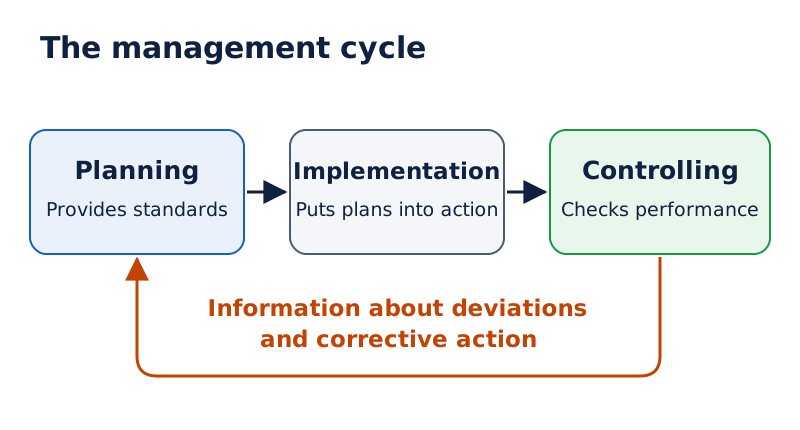
Draw planning, implementation and controlling in sequence. Add a return arrow from controlling to future planning, labelled information about deviations and corrective action.
Drawn by One Young India.
What advantages make controlling important to an organisation?
A good control system helps an organisation translate plans into results. It measures progress, reveals problems and guides corrective action. Its importance extends beyond detecting mistakes: it also concerns resource use, employee motivation, discipline and coordination.
What are the six main benefits?
- Accomplishing organisational goals: Control measures progress towards goals and brings deviations to light. It indicates corrective action and guides the organisation so that its activities remain on the right track towards the desired results.
- Judging accuracy of standards: Control helps management check whether standards are accurate and objective. Changes within the organisation and its environment may require those standards to be reviewed and revised.
- Efficient use of resources: Performing activities according to predetermined standards and norms helps reduce wastage and spoilage. Managers use control to ensure that resources contribute effectively and efficiently to organisational work.
- Improving employee motivation: Employees know in advance what they are expected to do and the performance standards used for their appraisal. This clarity motivates them and helps them improve their performance.
- Ensuring order and discipline: Keeping a close check on activities helps minimise dishonest behaviour. Control creates an atmosphere of order and discipline by making employee activities subject to scrutiny.
- Facilitating coordination in action: Departments and employees work under predetermined standards coordinated with one another. Their separate efforts are directed towards the achievement of overall organisational objectives.
How can monitoring reveal dishonest behaviour?
At a New York City import-export company, managers suspected two employees of theft. Computer monitoring revealed that they were deleting orders from company records after processing them and retaining the revenues. It also exposed their plan to steal electronics from the warehouse.
This case illustrates order and discipline: monitoring helped uncover dishonest activities. It does not mean that every control system must use the same monitoring method. The relevant benefit is the ability to check activities and identify behaviour that harms the organisation.
| Control benefit | Central question for management |
|---|---|
| Goal achievement | Is actual progress consistent with the organisation's objectives? |
| Accuracy of standards | Do the standards remain objective and realistic after changes? |
| Resource efficiency | Are activities reducing wastage and spoilage of resources? |
| Coordination | Are departmental and individual efforts directed towards common goals? |
What limitations can reduce the effectiveness of controlling?
Controlling is important, but it operates within practical limits. Difficulties in measurement, external influences, employee resistance and expenditure can reduce its effectiveness. Recognising these limitations helps explain why an organisation cannot assume that installing a control system will solve every problem.
Which four limitations should managers recognise?
| Limitation | Explanation | Example or implication |
|---|---|---|
| Difficulty in setting quantitative standards | Some aspects of performance cannot easily be expressed numerically, making measurement and comparison difficult. | Employee morale, job satisfaction and human behaviour present this difficulty. |
| Little control over external factors | Generally, an enterprise cannot control influences arising outside it. | Government policies, technological changes and competition may affect results. |
| Resistance from employees | Employees often see control as a restriction on their freedom. | They might object to strict observation through Closed Circuit Televisions, or CCTVs. |
| Costly affair | Installing and operating control systems involves expenditure, time and effort. | A small enterprise may be unable to justify an expensive system. |
How should these limitations be interpreted?
Difficulty in using numbers does not mean qualitative performance is irrelevant. It means that comparison becomes harder and the control system loses some effectiveness. Managers should make qualitative standards measurable as far as possible, rather than ignore areas such as morale or customer satisfaction.
Similarly, external factors may affect performance even when employees follow internal plans. A deviation must therefore be investigated before its cause is attributed to an employee. Changes in competition or technology can make an earlier standard require reconsideration.
The cost of control should not exceed the benefits derived from it. An elaborate arrangement is not justified simply because it can collect more information. The expenditure, time and effort involved must be considered alongside the usefulness of the control system.
Note: Control is often resisted by employees, and employees might object to CCTV monitoring. These are possible difficulties, not claims that every employee rejects every form of control.
How are planning and controlling related?
Planning and controlling are inseparable functions. Planning establishes the desired performance and provides standards. Controlling uses those standards to measure progress, discover deviations and initiate corrective action. Each function supports the other in achieving organisational objectives.
Why does each function need the other?
Without planning, managers have no predetermined understanding of what performance should be. There is no standard against which actual results can be assessed. In this sense, controlling is blind without planning: its basis for evaluation is missing.
Without controlling, management cannot adequately check whether decisions have become the desired action. Even a well-prepared plan may go astray if progress is not monitored and deviations are not addressed. Planning therefore needs control to help secure implementation.
| Basis | Planning | Controlling |
|---|---|---|
| Main role | Prescribes an appropriate course of action for achieving objectives. | Evaluates whether decisions have produced the desired action. |
| Standards | Provides standards of desired performance. | Uses standards to judge actual performance. |
| Future orientation | Uses forecasts to prepare for future conditions. | Initiates corrective action to improve future performance. |
| Use of the past | Draws on past experience when preparing plans. | Examines past activities to identify deviations. |
Are planning and controlling both forward-looking and backward-looking?
It is only partly correct to describe planning as looking ahead and controlling as looking back. Plans concern the future, but past experience guides their preparation. Control examines what has happened, but its corrective action aims to improve what happens next.
Both functions therefore have backward-looking and forward-looking aspects. The difference between prescribing action and evaluating action remains useful, but it should not be turned into a rigid separation of their time orientation.
The relationship also improves the next management cycle. Planning based on facts makes controlling easier and more effective. In return, control provides information from past experience that supports better future planning. Standards and plans can then be reconsidered in light of actual difficulties.
How does the controlling process begin with performance standards?
Controlling is a systematic process. Its steps connect the intended result with actual performance and the action required to address a significant difference. The sequence matters because comparison needs both a standard and a measurement of what actually occurred.
- Set performance standards that specify the criteria for evaluating performance.
- Measure actual performance objectively and reliably.
- Compare actual performance with the standards to reveal deviations.
- Analyse deviations to establish their significance and causes.
- Take corrective action where deviations require intervention.
What makes a useful standard?
Standards are benchmarks against which actual performance is measured. They may concern the cost to be incurred, revenue to be earned, units to be produced or sold, or time allowed for a task. These are quantitative standards.
Qualitative standards concern matters such as goodwill and employee motivation. Managers should try to express standards precisely in quantitative terms where possible, because this makes comparison easier. Where a qualitative standard is necessary, its meaning should still support measurement.
For a self-service fast food chain, customer satisfaction can be related to waiting time for a table, time taken to place an order and time taken to collect it. These measures make an otherwise qualitative objective easier to assess.
Worked example 1. A production standard calls for reducing defects from 10 in every 1,000 pieces to 5 in every 1,000 pieces by the end of the quarter. What should the manager use as the target for comparison?
Answer: The target is 5 defects in every 1,000 pieces by the quarter's end. The earlier level is 10 defects per 1,000 pieces. The manager should compare actual defects on the same production basis and within the stated time frame.
Standards should also be flexible. Changes in the internal or external environment may require modifications so that the benchmark remains realistic. Flexibility does not remove the need for a standard; it keeps that standard appropriate to changed conditions.
How is actual performance measured objectively?
After setting standards, managers measure actual performance. This measurement should be objective and reliable. Personal observation, sample checking and performance reports are among the available methods. As far as possible, actual results should be measured in the same units as the standards.
Must measurement wait until work is finished?
Measurement is generally associated with completed work, but it should take place during performance wherever possible. In assembly work, each part can be checked before assembly. A manufacturing plant could continuously monitor gas particles in the air for safety.
An employee's superior may prepare a performance report. For a company, measurement may involve periodic calculation of gross profit ratio, net profit ratio or return on investment. The appropriate measure depends on what aspect of performance is being evaluated.
Marketing progress may be measured through units sold or increases in market share. Production efficiency may be assessed using the number of pieces produced and the number of defective pieces in a batch. Measurement must connect to the relevant activity.
Which functional areas use which standards?
| Functional area | Standards used to gauge performance |
|---|---|
| Production | Quantity, quality, cost and individual job performance. |
| Marketing | Sales volume, sales expense, advertising expenditure and individual salesperson's performance. |
| Human resource management | Labour relations, labour turnover and labour absenteeism. |
| Finance and accounting | Capital expenditure, inventories, flow of capital and liquidity. |
In a small organisation, it may be possible to check every piece against quality specifications. In a large organisation, this might not be possible. Selected pieces can instead be checked at random, a method known as sample checking.
The difference between complete inspection and sample checking concerns how performance information is obtained. Both are directed towards finding whether the product conforms to the specified quality. Neither removes the need to compare the findings with the relevant standard.
How does comparison reveal deviations from standards?
The third step compares measured performance with the standard. A deviation is the difference between actual and desired performance. The comparison identifies the gap; analysing why that gap arose is a separate step that follows.
Why should measurement and standards use matching units?
Comparison is easier when standards are quantitative. A worker's output in units produced during a week can be compared with the standard output for that week. The standard and actual result then refer to the same kind of performance and period.
Collecting performance information alone is therefore insufficient. A report showing units produced becomes useful for control when it is read alongside the expected output. The standard gives meaning to the result by showing what the organisation intended to achieve.
Does finding a deviation establish its cause?
A difference does not, by itself, show why performance departed from the plan. Causes may include unrealistic standards, a defective process, inadequate resources, structural drawbacks, organisational constraints or environmental influences. Identifying the difference must be followed by appropriate investigation.
Some deviation can be expected in all activities, so managers must establish an acceptable range. They also need to distinguish important areas from less significant ones. The existence of a gap does not mean every gap deserves identical attention.
These distinctions connect comparison with analysis. Comparison answers whether actual and desired performance differ. Analysis asks which differences require managerial attention and what caused them. Corrective action can then address the relevant problem rather than rest on the size of a difference alone.
How do critical point control and management by exception guide analysis?
Keeping a check on every activity is neither easy nor economical. Managers therefore need to direct attention towards important areas and significant deviations. Critical point control and management by exception help them make these choices.
What does critical point control focus on?
Critical point control concentrates on key result areas (KRAs) that are crucial to organisational success. These become critical points because a problem there can affect the entire organisation. The significance of an area matters as well as the percentage size of a deviation.
Worked example 2. In a manufacturing organisation, labour cost increases by 5 per cent while postal charges rise by 15 per cent. Why may the smaller percentage increase be more troublesome?
Answer: Under critical point control, the manager should focus on key result areas. The 5 per cent labour cost increase may be more troublesome than the 15 per cent increase in postal charges because the importance of the area also matters. The percentages alone do not determine priority.
What does management by exception focus on?
Management by exception, also called control by exception, concentrates management's attention on significant deviations beyond permissible limits. It rests on the idea that trying to control everything may result in controlling nothing effectively.
Worked example 3. A manufacturing organisation allows a 2 per cent increase in labour cost as an acceptable deviation. An increase of 5 per cent occurs. What should management do?
Answer: The 5 per cent increase exceeds the permitted 2 per cent range and should be brought to management's notice. As a major deviation, it requires immediate attention on a priority basis. Management should investigate its causes before deciding on appropriate corrective action.
| Approach | Main emphasis | Illustration |
|---|---|---|
| Critical point control | The importance of the area in which a deviation occurs. | Labour cost may deserve more attention than postal charges. |
| Management by exception | Whether the deviation exceeds the permissible limit and is significant. | A labour cost increase beyond the accepted 2 per cent requires reporting. |
What advantages follow from these approaches?
- Saving managerial time: Managers deal with significant deviations, reducing the time and effort spent on routine matters.
- Better use of talent: Attention is directed towards important areas where managerial involvement is most useful.
- Delegation and morale: Routine problems remain with subordinates, facilitating delegation of authority and increasing employee morale.
- Timely action: Critical problems are identified so that management can act to keep the organisation on the right track.
After selecting deviations for attention, management must identify their exact causes. There may be several causes behind a single problem. The deviations and their causes are then reported so that corrective action can be taken at the appropriate level.
How should managers choose corrective action?
Corrective action is the final step in the controlling process. No corrective action is required when deviations remain within acceptable limits. Deviations beyond that range, especially in important areas, require immediate managerial attention so that standards can be achieved and the deviations do not recur.
Why must the response follow the cause?
A production shortfall might call for employee training. A project running behind schedule might need additional workers, more equipment or permission for overtime. These are possible responses, not automatic solutions for every shortfall. The action must follow the diagnosis.
If managerial action cannot correct the deviation, the standards may need revision. This possibility connects corrective action with planning. Control may reveal a problem in actual work, but it can also reveal that the benchmark itself needs reconsideration.
Worked example 4. Writewell Products Ltd. has a priority export order and defined production targets. Bhanu Prasad falls short of his daily target by 10 units for two consecutive days. Arfaaz asks CEO Vasundhara to terminate his services. Which principle should guide her decision?
Answer: Vasundhara should apply management by exception. The 10-unit shortfall needs to be considered against the permissible deviation and its significance. The situation gives neither the daily target nor the acceptable limit, so it does not establish whether the shortfall exceeds that limit. Its causes should be analysed before corrective action is chosen.
What does a considered response involve?
In the Writewell situation, the existence of a shortfall does not establish its cause. The manager needs to determine whether the deviation demands higher-level attention and investigate why it occurred. A request for dismissal is not a substitute for this analysis.
A control decision therefore combines the standard, measured result, acceptable range and explanation of the deviation. This sequence keeps the response connected to performance and organisational goals. It also preserves the distinction between detecting a problem and deciding how to remedy it.
How can control principles be applied to business cases and techniques?
What does the M Limited case illustrate?
M Limited manufactures mobile phones for the domestic Indian market and export. It has enjoyed substantial market share and loyal customers, but its sales and customer satisfaction targets are not being met. New competitors offer better technology and pricing in a growing market.
The case brings together the internal control process and external influences. Competition and technological change can affect results. Management should therefore compare actual sales and customer satisfaction with planned standards and examine the causes of the shortfalls.
A better control system can help the company measure progress, assess whether its standards remain accurate, use resources efficiently and coordinate activity. Linking control information to future planning helps it reconsider plans in light of the difficulties identified.
The company should follow the complete process: set standards, measure actual performance, compare results, analyse deviations and take corrective action.
What does Shantanu's instruction show?
Shantanu, a chief manager in a garment company, asks the production manager to keep a constant check on departmental activities and track employee performance. His instruction connects continuing monitoring with achieving targets effectively and efficiently.
The situation illustrates the continuous and goal-oriented nature of controlling. Its application across management levels also reflects the pervasive character of the function. Control concerns ongoing progress towards plans rather than a check performed once and then abandoned.
Which techniques are classified as traditional or modern?
| Group | Techniques |
|---|---|
| Traditional techniques | Personal observation, statistical reports, breakeven analysis and budgetary control. |
| Modern techniques | Return on investment, ratio analysis, responsibility accounting, management audit, PERT and CPM, and Management Information System. |
These techniques support managerial control, while the controlling process explains the sequence of managerial work. The names of techniques should therefore be distinguished from the five steps that connect standards, measurement, comparison, analysis and corrective action.
Glossary
- Controlling — The management function that ensures actual activities conform to plans and support predetermined organisational goals.
- Performance standard — A criterion or benchmark against which actual performance is measured and evaluated.
- Quantitative standard — A performance benchmark expressed numerically, such as cost, revenue, output or time allowed for a task.
- Qualitative standard — A performance benchmark relating to qualities such as goodwill or employee motivation rather than a direct numerical target.
- Actual performance — The work or results achieved, measured objectively and reliably for comparison with predetermined standards.
- Deviation — The difference revealed when actual performance is compared with the standard or desired performance.
- Acceptable range — The permitted extent of deviation used to judge whether performance requires corrective managerial attention.
- Key result areas — Areas critical to organisational success on which critical point control concentrates managerial attention.
- Critical point control — An approach that focuses control on key result areas essential to the success of the organisation.
- Management by exception — A principle that brings significant deviations beyond permissible limits to management's attention.
- Sample checking — Checking selected pieces at random to assess whether products conform to prescribed quality specifications.
- Corrective action — Managerial action taken to address unacceptable deviations and help actual performance conform to standards.
Common errors and misconceptions
- Misconception: Controlling is performed only by top managers. Correct: It is pervasive, and managers at top, middle and lower levels control activities within their respective areas.
- Misconception: Controlling ends management permanently. Correct: It completes one cycle and supplies information that improves planning in the next cycle.
- Misconception: Planning looks only forward and controlling only backward. Correct: Both draw on past experience and contribute to future performance.
- Misconception: Standards must all be numerical. Correct: Standards can be quantitative or qualitative, although precise quantitative expression makes comparison easier.
- Misconception: Performance can be measured only after work ends. Correct: Wherever possible, measurement should also occur during performance, as with checking parts before assembly.
- Misconception: Every deviation requires corrective action. Correct: No corrective action is required for deviations within acceptable limits; significant deviations beyond them demand attention.
- Misconception: The largest percentage deviation must be the most important. Correct: Critical point control also considers whether the affected area is crucial to organisational success.
- Misconception: A shortfall proves employee fault. Correct: Causes may include unrealistic standards, defective processes, inadequate resources, organisational constraints or external factors and must be investigated.
Exam-style questions with model answers
Q1. Define controlling and explain why it is goal-oriented. [2 marks]
- Controlling ensures that actual organisational activities conform to planned activities through measurement, comparison and appropriate corrective action.
- It is goal-oriented because it directs activities and resource use towards achieving predetermined organisational objectives effectively and efficiently.
Q2. Explain any three limitations of controlling. [3 marks]
- Measurement difficulty: Employee morale, job satisfaction and human behaviour are difficult to express quantitatively, making measurement and comparison with standards less straightforward.
- External factors: Generally, an enterprise cannot control government policies, technological change or competition, although these influences may affect its performance.
- Employee resistance: Employees often regard control as a restriction on freedom and might object to strict monitoring through CCTVs.
Q3. Explain four ways in which planning and controlling are related. [4 marks]
- Planning provides performance standards, giving controlling the benchmarks needed to compare actual results with the results management intended to achieve.
- Controlling checks implementation, discovers deviations and initiates corrective action, helping ensure that organisational events conform to the plans already prepared.
- Planning is prescriptive because it specifies a course of action; controlling is evaluative because it checks whether decisions became desired action.
- Both use past experience and influence future performance: past control information improves planning, while corrective action aims to improve subsequent results.
Q4. A manufacturing organisation permits a 2 per cent increase in labour cost as an acceptable deviation, but the actual increase is 5 per cent. Identify the applicable principle and explain the managerial response in three further points. [4 marks]
- The applicable principle is management by exception, which directs management's attention towards significant deviations beyond the permissible range.
- The actual increase of 5 per cent is beyond the acceptable 2 per cent, so it should be reported to management.
- As a major deviation, it requires immediate managerial attention on a priority basis rather than treatment as a routine permitted variation.
- Management should identify its exact causes before selecting corrective action, since detecting the increase does not establish why it occurred.
Q5. Describe the five steps in the controlling process in their correct order. [5 marks]
- Setting performance standards: Establish the criteria against which actual performance will be measured. Use precise quantitative terms where possible and make qualitative standards easier to assess.
- Measuring actual performance: Obtain objective, reliable information through methods such as observation, sample checking and reports, using the same units as the standards wherever possible.
- Comparing performance with standards: Compare achieved results with the benchmarks to reveal the deviations between actual performance and the desired results.
- Analysing deviations: Determine which differences are significant, consider acceptable limits and key result areas, and investigate the exact causes requiring managerial attention.
- Taking corrective action: Address unacceptable deviations through appropriate action, such as training or additional resources. Standards may need revision where managerial action cannot correct the deviation.
Q6. Explain six points of importance of controlling in an organisation. [6 marks]
- Achieving goals: Controlling measures progress, identifies deviations and indicates corrective action, keeping organisational activities directed towards the achievement of predetermined objectives.
- Checking standards: It helps assess whether standards are accurate and objective and whether internal or environmental changes require their review and revision.
- Using resources efficiently: Activities follow predetermined standards and norms, helping managers reduce wastage and spoilage and make effective use of available resources.
- Motivating employees: Employees know their expected tasks and appraisal standards in advance, which motivates them and supports improvement in their performance.
- Maintaining discipline: A close check on employee activities helps minimise dishonest behaviour and creates an atmosphere of order within the organisation.
- Coordinating action: Coordinated standards guide departments and employees so that their separate efforts contribute together to the organisation's overall objectives.
Q7. Writewell Products Ltd. has a priority export order and defined production targets. Bhanu Prasad falls short of his daily target by 10 units for two consecutive days. Arfaaz asks CEO Vasundhara to terminate his services. The daily target, permissible deviation and cause of the shortfall are not supplied. Identify the relevant control principle and explain two implications for her decision. [3 marks]
- Vasundhara should apply management by exception, which focuses managerial attention on significant deviations exceeding permissible limits rather than every variation in performance.
- The stated shortfall is 10 units on each of two days, but the missing permissible range means the case does not establish whether it exceeds that range.
- The cause must be investigated before corrective action is chosen. The shortfall alone does not establish that dismissal is the appropriate response.
Q8. M Limited manufactures mobile phones for the domestic Indian market and export. Its sales and customer satisfaction targets are not being met, while new competitors offer better technology and pricing. Identify two external influences and explain how the five-step controlling process could address the situation. Give six points in all. [6 marks]
- External influences: Competition and technological change are relevant because new players offer improved technology and pricing. Generally, an enterprise has little control over such external factors.
- Set standards: Establish clear benchmarks for sales and customer satisfaction, making qualitative expectations measurable where possible and reviewing whether standards remain realistic under changed conditions.
- Measure performance: Collect objective and reliable information about actual sales and customer satisfaction, using measures that can be compared with the company's standards.
- Compare results: Identify the differences between the measured performance and the targets to establish where the company is falling short of its plans.
- Analyse deviations: Assess their significance and investigate the causes, considering changes in competition and technology rather than assuming that every shortfall arises internally.
- Take corrective action: Choose action suited to the identified causes. If managerial action cannot correct a deviation, standards may need revision for future planning.
Key takeaways
- Controlling checks whether activities conform to plans and whether resources support organisational goals effectively and efficiently.
- Managers at every level perform controlling, and the function applies to business and non-business organisations.
- Control information improves future planning, while planning supplies the standards that make meaningful control possible.
- The five steps are setting standards, measuring performance, comparing results, analysing deviations and taking corrective action.
- Standards may be quantitative or qualitative and should remain flexible enough to reflect changes in business conditions.
- Critical point control focuses on key result areas; management by exception focuses on significant deviations beyond permissible limits.
- Managers must investigate causes before choosing corrective action, and acceptable deviations do not require corrective intervention.
- Measurement difficulties, external influences, employee resistance and costs can limit the effectiveness of an organisation's control system.
Test yourself
Why is controlling described as pervasive?
Managers at top, middle and lower levels perform it, and both business and non-business organisations need it.
What is the difference between a standard and a deviation?
A standard is the benchmark for judging performance. A deviation is the difference between actual performance and that benchmark.
How can a self-service fast food chain make customer satisfaction easier to measure?
It can set standards for waiting for a table, placing an order and collecting the order.
What does sample checking involve?
Selected pieces are checked at random to assess whether products meet their prescribed quality specifications.
Why may a smaller percentage deviation deserve greater attention?
It may affect a key result area that is more important to organisational success than the area with the larger deviation.
When is corrective action unnecessary?
No corrective action is required when deviations remain within the acceptable limits set for performance.
What can managers do when managerial action cannot correct a deviation?
They may need to revise the performance standards so that the benchmark reflects the situation realistically.
Name the four traditional techniques of managerial control.
The four traditional techniques are personal observation, statistical reports, breakeven analysis and budgetary control.
Write about it
Turn a question from this chapter into a paper.
The Writing Studio has a structure guide, a rubric and citation tools for 15 formats, from essays to research papers. Drafting is free with an account. Learnacy Essential adds feedback from an AI writing coach and submission to The OYI Review.
Learnacy Essential is ₹1,499 for the year. Publication depends on review and is not guaranteed.