
Gravitation | CBSE Class 11 Physics Notes
On this page
Watch & explore
Start with a few high-quality watches, then dive into the notes below.
This note covers universal gravitation, Kepler’s laws, the gravitational constant, spherical shells, acceleration due to gravity, gravitational potential and potential energy, escape speed, satellite motion, orbital energy and weightlessness.
How does universal gravitation connect falling bodies and orbital motion?
Gravitation is the mutual attraction between masses. The attraction that makes a body fall towards Earth also supplies the acceleration that keeps the Moon moving around Earth. Newton’s universal law brings terrestrial motion and celestial motion into one description.
What does Newton’s law state?
Definition: Every body attracts every other body with a force proportional to the product of their masses and inversely proportional to the square of their separation.
Let (F) be the force magnitude, (m_1) and (m_2) the two point masses, (r) their separation and (G) the universal gravitational constant. Then
The SI unit of force is the newton, written . The SI unit of mass is the kilogram, written . The SI unit of distance is the metre, written . Use consistent units before substituting numerical values.
The force is attractive and acts along the line joining the particles. Define as the unit vector from the first mass towards the second, and as the force on the second due to the first:
The minus sign gives the direction towards the first mass. If denotes the reverse interaction, Newton’s third law gives . These equal and opposite forces act on different bodies.
How are several gravitational forces combined?
The principle of superposition says that each gravitational interaction acts independently. Let be the resultant force and the individual contributions. Their vector sum is .
Three equal masses at the vertices of an equilateral triangle exert a zero resultant force on a mass at the centroid. The three attractions have equal magnitudes, and their directions cancel by symmetry. Adding their magnitudes would give the wrong answer.
Note: The inverse-square formula refers directly to point masses. Extended bodies require addition of the forces from their constituent parts. Spherical symmetry permits an important simplification, but an arbitrary rigid body cannot automatically be replaced by a point at its centre.
How small is the Moon’s orbital acceleration?
The Moon keeps falling towards Earth while moving around it. Comparing its acceleration with surface gravity helped connect orbital motion with the decrease of gravitational attraction over distance.
Worked example 1. Estimate the Moon’s centripetal acceleration using orbital radius and period , treating its orbit as circular. These symbols denote the Moon’s radius of orbit and period in this example.
Formula: Let denote the Moon’s centripetal acceleration. Then , where is the circle constant.
Substitute: Convert the orbital period to seconds before calculating acceleration.
Answer: The acceleration is approximately , much smaller than Earth’s surface gravity of .
What do Kepler’s three laws tell us about planetary motion?
Kepler’s laws describe the shape, changing speed and periods of planetary orbits. They connect observations of motion with the gravitational explanation. A circle is a special ellipse in which the two foci coincide.
| Law | Statement | Meaning |
|---|---|---|
| Law of orbits | Planets describe ellipses with the Sun at one focus. | The Sun need not be at the centre of the orbit. |
| Law of areas | The Sun-planet line sweeps equal areas in equal times. | A planet moves faster when nearer the Sun. |
| Law of periods | The square of the period is proportional to the cube of the semi-major axis. | Larger orbits have longer periods around the same central body. |
Define as orbital period and as the semi-major axis, half the longest diameter of the ellipse. The third law is . The quotient remains constant for planets orbiting the same Sun.
What the figure shows
Elliptical orbit
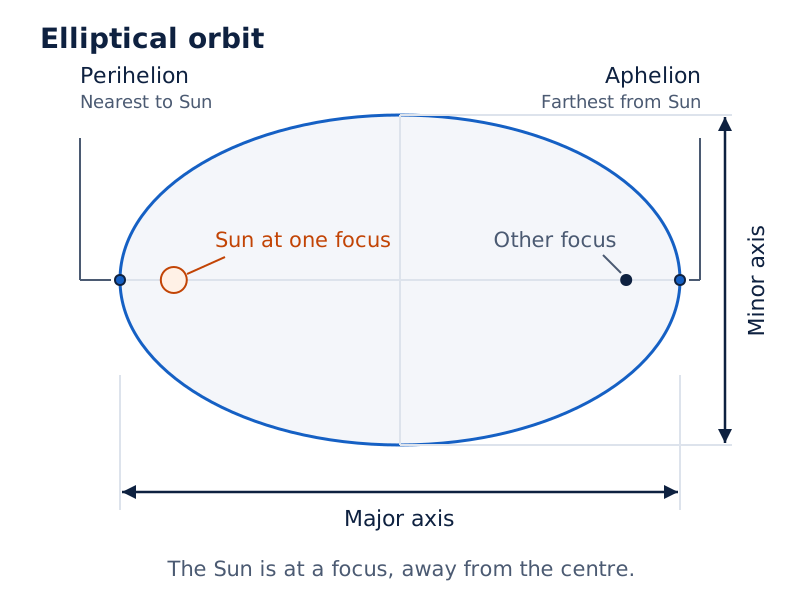
The ellipse shows the Sun at the left focus and another focus to the right. Perihelion is the left end, nearest the Sun; aphelion is the right end, farthest away. Horizontal and vertical arrows indicate the major and minor axes.
Drawn by One Young India. See Fig. 7.1(a) in your NCERT textbook
Derivation: Why does a central force give equal areas in equal times?
Let be the planet’s position vector from the Sun, its velocity, its mass, its momentum, its angular momentum, its torque, swept area and time.
- The momentum and angular momentum are and . The cross-product sign specifies the vector product.
- For the central gravitational force , the force vector is parallel to the position line. Therefore , so angular momentum is conserved.
- During a short interval , where denotes a small change, the swept triangle has area .
- Writing for angular-momentum magnitude gives . Both mass and angular momentum remain constant, so the swept area per unit time is constant.
Result: The law of areas follows from a central force. It does not require the force to have an inverse-square dependence.
What the figure shows
Swept area
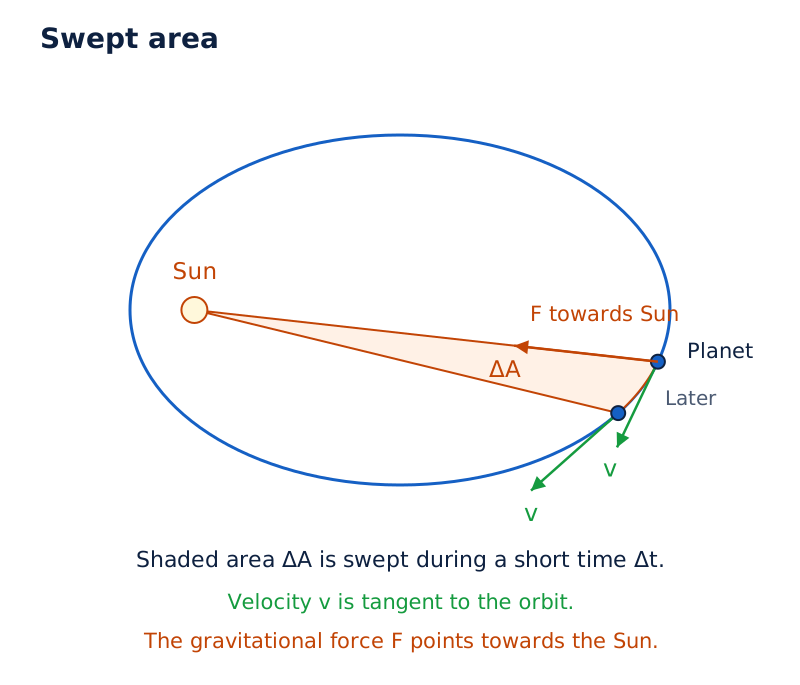
A shaded narrow sector lies between two lines from the Sun to nearby positions of the planet. Velocity arrows are drawn at the planet’s positions, while the force arrow points towards the Sun.
Drawn by One Young India. See Fig. 7.2 in your NCERT textbook
Perihelion means the closest orbital point to the Sun; aphelion means the farthest. Define as the respective distances and as the respective speeds.
- At these two points, velocity is perpendicular to the radius, so conservation of angular momentum gives .
- Cancel the common planet mass and rearrange to obtain .
The greater distance at aphelion therefore corresponds to a smaller speed. Equal areas do not mean equal distances travelled: the shorter Sun-planet radius near perihelion must sweep through a larger angle to enclose the same area.
How do spherical shells and Cavendish’s experiment simplify gravitation?
A uniform spherical shell has two useful properties. Outside it, its attraction is the same as that of a point mass equal to the shell’s mass placed at its centre. Inside it, the shell’s resultant gravitational force is zero.
For an exterior particle, force components perpendicular to the centre-particle line cancel. For an interior particle, the contributions from the shell cancel completely. These statements concern the force exerted by the shell itself.
Note: A hollow shell does not shield a particle from gravitational forces due to other bodies outside the shell. Zero force from the shell and absence of every gravitational force are different claims.
How is the gravitational constant measured?
Cavendish’s experiment uses a suspended bar with small lead spheres at its ends. Large lead spheres attract the small spheres and produce a turning effect. The suspension wire twists until its restoring torque balances the gravitational torque.
What the figure shows
Torsion balance
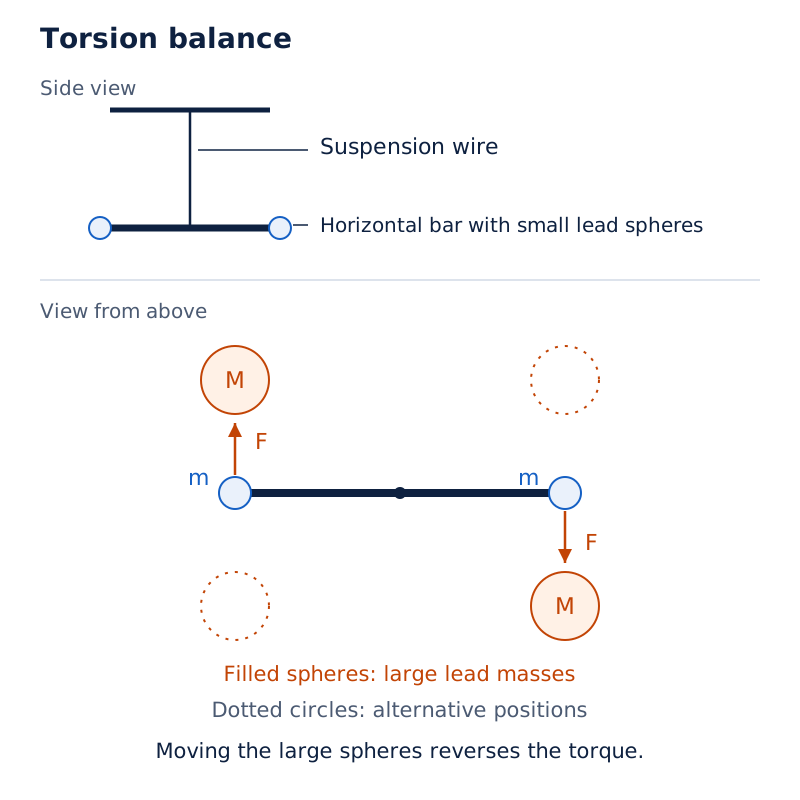
A horizontal bar hangs from a central wire. Shaded large spheres lie on opposite sides of its ends. Dotted circles show the alternative positions of the large spheres, which reverse the torque and turn the bar.
Drawn by One Young India. See Fig. 7.6 in your NCERT textbook
For this apparatus, let and be a large and a small sphere’s masses, their centre-to-centre separation, the bar length, the twist angle and the restoring torque per unit angle.
- The attraction between neighbouring spheres is .
- The equal and opposite forces produce gravitational torque . The restoring torque has magnitude .
- At equilibrium, . Therefore , with the restoring constant measured independently.
The value used here is . The SI unit of the gravitational constant is . This universal constant must be distinguished from local acceleration due to gravity.
How is acceleration due to gravity related to Earth’s mass?
Let denote Earth’s mass, its radius and the acceleration due to gravity at its surface. A spherically symmetric Earth can be imagined as concentric shells. At an exterior point, every shell acts as though its mass were at the common centre.
Derivation: Surface gravity
Let be the mass of a small body on the surface and the magnitude of Earth’s attraction on it. Treat Earth as spherical in this calculation.
- Applying the exterior-sphere result at the surface gives .
- Newton’s second law for the body gives , so .
- Cancelling the body’s mass gives . Rearranging gives Earth’s mass as .
Result: Surface acceleration depends on Earth’s mass and radius, but the falling body’s mass cancels. Equal acceleration does not mean equal force: a more massive body experiences a proportionately larger gravitational force.
The SI unit of acceleration is the metre per second squared, written . Measuring gravity and Earth’s radius, together with the gravitational constant, makes it possible to infer Earth’s mass.
Worked example 2. Find Earth’s mass using surface acceleration , radius and .
Formula: , so .
Substitute: Use to check the resulting mass unit.
- Square the radius:
- Substitute with units:
Answer: Earth’s mass is approximately .
Mass and weight describe different quantities. Mass belongs to the body, while its gravitational weight depends on the attraction at its location. Moving the body to another height changes its weight without changing its mass.
How does gravity change above and below Earth’s surface?
The centre-to-body distance is essential in an inverse-square calculation. Let be height above the surface and depth below it. Write and for the accelerations at those locations, while continues to mean surface acceleration.
Derivation: Gravity at a height
At height , the body is exterior to a spherical Earth, whose radius is and mass is .
- The distance from Earth’s centre is , giving .
- Divide by the surface value : .
- Rewrite as . When , meaning height is much smaller than Earth’s radius, the binomial approximation gives .
Result: Gravity decreases with altitude. The inverse-square expression applies outside the spherical Earth; the linear approximation is restricted to small heights.
What the figure shows
Height above Earth
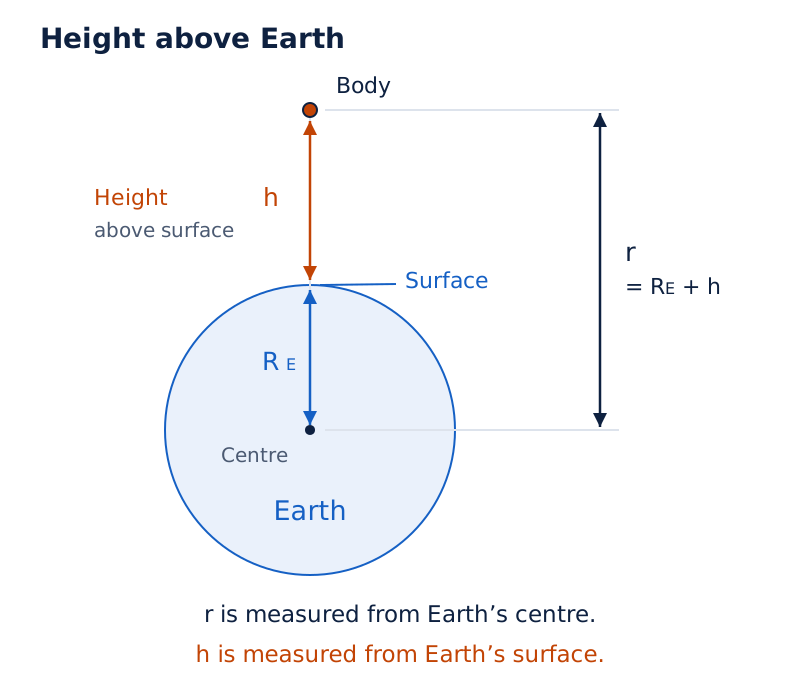
A shaded circular Earth has its radius marked from the centre. A separate vertical segment extends upward from the surface and is labelled as height. The drawing distinguishes height from distance measured from the centre.
Drawn by One Young India. See Fig. 7.8(a) in your NCERT textbook
Derivation: Gravity at a depth
Assume Earth has uniform density. Let be the mass of the smaller sphere inside the body’s position. The surrounding outer shell makes no contribution to the gravitational force there.
- The interior radius is . Equal density makes enclosed mass proportional to volume: .
- The enclosed sphere gives , for a nonzero interior radius.
- Using the surface value gives . Its central limit is zero.
Result: Gravity decreases linearly with depth under the uniform-density assumption. Within this model it reaches its maximum at the surface, decreasing both outwards and inwards.
Worked example 3. A body weighs at Earth’s surface. Find its gravitational weight at a height equal to half Earth’s radius.
Formula: Let be surface weight and weight at height . Then .
Substitute: The given height is , so the squared distance ratio is dimensionless.
Answer: The gravitational weight is . The small-height approximation is unsuitable at this height.
Worked example 4. A body weighs at the surface. Assuming uniform Earth density, find its weight halfway down to the centre.
Formula: Let be weight at depth . Then .
Substitute: Here and .
Answer: The weight is . Using the whole Earth’s mass with the reduced interior radius would incorrectly predict an increase.
What are gravitational potential energy and gravitational potential?
Gravity is conservative: work between two positions is independent of the path. Its potential energy describes position in the gravitational interaction. Let denote potential energy, choosing zero when the interacting masses are infinitely far apart.
For two point masses and separated by , . For a body of mass outside spherical Earth, . The negative sign is tied to the chosen zero at infinity.
Derivation: Work and the change in potential energy
Let and be initial and final distances from Earth’s centre, with . Define as the work done by an external agent during slow lifting, with no change in kinetic energy.
- The agent balances the inward gravitational attraction, requiring outward force magnitude .
- Integrate over the outward displacement: , where denotes an infinitesimal radial displacement.
- Evaluation gives .
- The potential-energy increase is . Gravity’s work has the opposite sign: , where denotes work done by gravity.
Result: Slow outward lifting increases potential energy. Gravitational work during that lift is negative because gravity opposes the displacement.
How does the near-surface expression fit?
For heights and much smaller than Earth’s radius, gravity is practically constant. The potential-energy difference becomes . Choosing the surface as zero then gives the local approximation .
This surface-based zero differs from the zero at infinity used in the general expression. Adding a constant changes the energy’s numerical value but leaves potential-energy differences and gravitational forces unchanged.
Gravitational potential, denoted here by , is potential energy per unit mass: . The SI unit of potential energy is the joule, ; the SI unit of gravitational potential is the joule per kilogram, .
How is the energy of several particles found?
Add the potential energies of every distinct pair, counting each pair once. For four equal masses at the corners of a square of side , there are four side pairs and two diagonal pairs.
- Each side pair contributes , while each diagonal pair contributes .
- The total is .
- Each corner is from the centre. Adding the four potentials gives , where the subscript identifies the square’s centre.
How is escape speed obtained from energy conservation?
Escape speed is the minimum initial speed needed to reach infinity without returning. The ideal calculation considers gravitational motion after projection and neglects atmospheric resistance and other celestial bodies. At the minimum speed, the object’s speed approaches zero at infinity.
Derivation: Escape from Earth
Let be escape speed, initial speed, speed at infinity, launch distance from Earth’s centre and projectile mass. Set potential energy to zero at infinity.
- The initial mechanical energy, denoted , is .
- The final energy, denoted , is . Conservation requires .
- At the escape threshold, , so .
- Cancel the projectile mass to obtain . From the surface, .
Result: Escape speed is independent of projectile mass in this model. It depends on the attracting body and the launch distance from its centre. A greater launch height gives a lower required escape speed.
Worked example 5. Calculate escape speed from Earth’s surface using and .
Formula: .
Substitute: Retain the distance and acceleration units inside the square root.
Answer: The escape speed is . This is a speed magnitude, so “escape velocity” is a loose name for the quantity.
A projectile launched faster than the escape threshold retains kinetic energy far away. Define as that remaining speed. Energy conservation gives , using the escape speed appropriate to the launch point.
Worked example 6. A projectile leaves Earth’s surface at three times its escape speed of . Find its speed far away, ignoring the Sun and other planets.
Formula: and .
Substitute: All speeds can remain in kilometres per second.
Answer: Its speed far away is approximately . The initial speed is larger because part of its kinetic energy supplies the increase in gravitational potential energy.
How are a satellite’s orbital speed and period calculated?
An Earth satellite moves around Earth under gravitational attraction. The Moon is Earth’s natural satellite. Artificial satellites have practical uses in telecommunication, geophysics and meteorology. Their gravitational motion follows the same principles as planetary motion around the Sun.
Derivation: A circular satellite orbit
Let be orbital speed, orbital period, satellite mass and orbital radius at height . Treat the satellite mass as negligible compared with Earth’s mass.
- The required inward centripetal force is . Gravity supplies this force, so .
- Cancel mass and simplify: , hence .
- One revolution covers the circumference, so , where is the circle constant.
- Substituting the speed gives , or .
Result: A higher circular orbit has a lower speed and a longer period. Both results are independent of satellite mass within the stated approximation.
The period expression reproduces Kepler’s third law. For an elliptical orbit, the semi-major axis replaces the circular radius in that period expression. The circular-speed formula must not be treated as a constant-speed formula for an ellipse.
Worked example 7. Estimate the speed and period of an ideal satellite very close to Earth’s surface. Use , and neglect height compared with Earth’s radius.
Formula: and .
Substitute: The radius-to-acceleration ratio has units of time squared.
Answer: Orbital speed is about , and the period is about , or roughly .
The SI unit of time is the second, written . In orbital calculations, convert days, hours and minutes consistently before combining them with the gravitational constant in SI units.
How can orbital observations reveal masses and planetary years?
The gravitational constant connects an observed orbital radius and period to the mass producing the attraction. Thus an orbit can be used to weigh a celestial body without placing it on a balance. Circular-orbit calculations use distance from the central body’s centre.
What mass follows from a moon’s orbit?
Worked example 8. Phobos orbits Mars in , with orbital radius . Find Mars’s mass, using and a circular orbit.
Formula: Let be Mars’s mass, Phobos’s orbital radius and its period. Then and .
Substitute: Convert both measured quantities to SI units.
Answer: Mars’s inferred mass is approximately .
How can periods be compared without finding the Sun’s mass?
For two planets orbiting the same central mass, the proportionality constant in the period law cancels. The comparison therefore uses a ratio of orbital sizes, rather than separate calculations of the gravitational force on each planet.
Worked example 9. Assume circular Earth and Mars orbits. Mars’s orbital radius is times Earth’s, and Earth’s year is days. Find the Martian year.
Formula: Let denote the Mars and Earth periods and their orbital radii. Then , giving .
Substitute: The radius ratio is dimensionless; the answer retains the time unit of the Earth period.
Answer: The Martian year is approximately .
The two problems use the same law in different ways. An absolute orbit measurement determines a central mass; a ratio of orbits about the same centre determines a ratio of periods. Changing the central body changes the proportionality constant.
Why is a bound satellite’s total energy negative?
Let denote kinetic energy, gravitational potential energy and their total. With potential energy zero at infinity, a circular satellite orbit of radius has positive kinetic energy and negative potential energy.
Derivation: Energy in a circular orbit
Use satellite mass , Earth mass and circular speed . The circular force balance already gives .
- Substitute speed into kinetic energy: .
- The potential energy is , so .
- Add both contributions: .
Result: The negative total energy identifies a bound orbit under this zero convention. Energy must be supplied to raise the total to zero and permit escape.
In an elliptical orbit, kinetic and potential energies change as distance changes, while total mechanical energy remains constant and negative. The circular relation between instantaneous kinetic and potential energies should not be applied at every point of an ellipse.
What changes when a satellite moves to a higher circular orbit?
Worked example 10. A satellite of mass moves from circular radius to circular radius . Find changes in total, kinetic and potential energy using and .
Formula: Subscripts and denote initial and final orbits. Use , and .
Substitute: First evaluate the symbolic energy change for the two specified circular radii.
- The initial and final energies are and . Subtraction gives .
- Since for either circular orbit,
- Since for either circular orbit,
Answer: Required energy is approximately . Kinetic energy decreases by that amount, while potential energy increases by approximately .
Supplying energy can therefore produce a slower final orbit. The increase in potential energy is larger than the decrease in kinetic energy, leaving a positive total-energy change. Orbital radius, rather than height above the surface, must be used in each energy formula.
Why do astronauts experience weightlessness?
An astronaut and the surrounding satellite are both in free fall towards Earth. Their shared gravitational motion produces weightlessness inside the satellite. Gravity is still present and provides the acceleration needed for the orbit.
Zero apparent weight must not be confused with zero gravitational force. Likewise, a satellite’s changing velocity is compatible with conservation of its mechanical energy and angular momentum under Earth’s central gravitational attraction.
Glossary
- Gravitation — The mutual attractive interaction between bodies possessing mass, described for particles by Newton’s universal law.
- Central force — A force directed along the line joining a particle to a fixed centre.
- Superposition — The independent action of individual gravitational forces, whose vector sum gives the resultant force.
- Ellipse — A closed curve for which the sum of distances from two fixed foci is constant.
- Semi-major axis — Half the longest diameter of an ellipse, used in Kepler’s law of periods.
- Perihelion — The point on a planet’s elliptical orbit at which it is nearest the Sun.
- Aphelion — The point on a planet’s elliptical orbit at which it is farthest from the Sun.
- Areal speed — The area swept out per unit time by the line joining a planet to the Sun.
- Gravitational constant — The universal proportionality constant relating gravitational force to masses and the inverse square of separation.
- Gravitational potential — Gravitational potential energy per unit mass at a specified point, relative to a chosen zero.
- Escape speed — The minimum initial speed needed to reach infinity without returning under the specified gravitational attraction.
- Orbital period — The time taken by a satellite or planet to complete one revolution around its central body.
- Bound orbit — An orbit with negative total mechanical energy when potential energy is chosen to vanish at infinity.
- Weightlessness — The condition experienced by an astronaut sharing the free fall of an orbiting satellite towards Earth.
Common errors and misconceptions
- Misconception: Equal areas in equal times means constant speed throughout an ellipse. Correct: A planet moves faster near perihelion and slower near aphelion; the area swept per unit time stays constant.
- Misconception: Altitude is the distance used in the inverse-square formula. Correct: Use the distance from Earth’s centre, which is the sum of its radius and the altitude.
- Misconception: Gravity increases below the surface because the centre is closer. Correct: Under the uniform-density assumption, only the enclosed sphere contributes, and gravity decreases linearly with depth.
- Misconception: A hollow spherical shell shields all gravity. Correct: Its own resultant force is zero inside, but external bodies still exert gravitational forces on an interior particle.
- Misconception: The near-surface potential-energy expression works for arbitrary heights. Correct: It assumes almost constant gravity; the general inverse-distance expression is needed when that approximation fails.
- Misconception: A higher circular orbit requires a greater final speed. Correct: Its speed is smaller, while potential energy and total energy increase relative to the lower circular orbit.
- Misconception: An astronaut is weightless because Earth’s gravity has disappeared. Correct: The astronaut and spacecraft share free fall while gravity supplies their orbital acceleration.
Exam-style questions with model answers
Q1. State Kepler’s law of areas and explain what it implies about a planet’s speed near and far from the Sun. [2 marks]
- The line joining a planet to the Sun sweeps out equal areas in equal intervals of time.
- The planet moves faster when nearer the Sun and slower when farther away, so constant areal speed does not imply constant linear speed.
Q2. State the two force results for a uniform spherical shell and explain whether such a shell shields gravity from other bodies. [3 marks]
- At an exterior point, the shell attracts a particle as though all of the shell’s mass were concentrated at its centre.
- At an interior point, the shell’s own gravitational contributions cancel, leaving zero resultant force due to that shell.
- This cancellation does not remove the influence of other masses outside it. A hollow shell therefore does not provide gravitational shielding.
Q3. A body weighs on the surface of spherical Earth of radius . Calculate its weight at height and state why the small-height approximation should not be used. [3 marks]
- Let be weight at the given height and distance from Earth’s centre. The geometry gives .
- Applying inverse-square dependence, .
- The height is half Earth’s radius, rather than much smaller than it. The small-height approximation is therefore inappropriate; the exterior inverse-square expression supplies the required result.
Q4. Treat Earth as a uniform-density sphere of radius , mass and surface gravity . Derive the acceleration at depth , using gravitational constant , and state its central value. [4 marks]
- Let be the distance from Earth’s centre. The outer spherical shell exerts zero force on the body, so only the mass inside this radius contributes.
- Let be that enclosed mass. Uniform density gives .
- Writing for acceleration at depth, . The surface value is .
- Substitution gives . At the centre, , and the acceleration is zero by the limiting result and symmetry.
Q5. Derive escape speed from the surface of spherical Earth using mass , radius and gravitational constant . Explain its independence of projectile mass. Ignore air resistance, Earth’s rotation and other celestial bodies. [5 marks]
- Choose gravitational potential energy to be zero at infinity. Let be projectile mass and the minimum launch speed needed to escape Earth’s gravitational attraction.
- The surface potential energy is , where denotes initial potential energy. The initial kinetic energy is , where denotes initial kinetic energy.
- At the minimum escape speed, the projectile’s speed approaches zero at infinity. Its kinetic and potential energies both approach zero there.
- Conservation of mechanical energy therefore gives , equating the initial energy to the limiting final energy.
- Cancelling mass yields . Projectile mass has disappeared from the result, so the escape speed is independent of that mass in this model.
Q6. A satellite of mass moves in a circular orbit of radius about spherical Earth of mass , with . Using gravitational constant , derive its speed and total energy. Take potential energy as zero at infinity. [5 marks]
- Let be the orbital speed. Gravity provides the required centripetal force, so . Both forces in this equality refer to the same inward force.
- Cancelling the satellite mass and simplifying gives , hence . The speed decreases for larger circular orbital radii.
- Let denote kinetic energy. Substitution gives , which is positive for the orbiting satellite.
- Let denote gravitational potential energy. With the specified zero, , twice the kinetic energy in magnitude and opposite in sign.
- Total energy is their sum: . Its negative sign shows that the satellite is gravitationally bound under the chosen energy convention.
Q7. A projectile leaves Earth at three times the surface escape speed, which is . Find its speed at infinity, neglecting air resistance and all other celestial bodies. [3 marks]
- Let be the given escape speed and the launch speed. Then .
- Let denote speed at infinity. Energy conservation, with potential energy zero there, gives .
- Thus . The remaining speed is nonzero because the launch speed exceeds the minimum required for escape.
Q8. Explain weightlessness in an orbiting satellite. State whether gravitational force, total mechanical energy and angular momentum vanish or remain relevant during the orbit. Treat Earth’s gravity as the only force. [4 marks]
- The astronaut and satellite are both falling freely towards Earth. Their shared free fall accounts for the astronaut’s experience of weightlessness inside the spacecraft.
- Gravitational force does not vanish. It produces the acceleration that continually changes the direction of motion in the orbit.
- Total mechanical energy remains conserved because gravity is conservative. For a bound orbit it is negative when potential energy is zero at infinity.
- Angular momentum about Earth’s centre remains conserved because the gravitational force is central and produces no torque about that centre.
Key takeaways
- Newton’s universal law describes attraction between point masses; forces from several bodies must be added as vectors.
- Kepler’s area law expresses angular-momentum conservation under a central force and allows speed to change around an ellipse.
- Exterior gravity uses distance from Earth’s centre; the small-height approximation requires height to be much smaller than Earth’s radius.
- Gravity decreases linearly with depth only under the uniform-density model, because outer spherical shells contribute no interior force.
- Gravitational potential energy is negative when zero is chosen at infinity; only differences determine the associated work.
- Escape speed follows from energy conservation and does not depend on the projectile’s mass in the ideal gravitational model.
- A higher circular satellite orbit has lower speed and kinetic energy, but greater potential energy and total energy.
- Weightlessness inside an orbiting satellite results from shared free fall, while gravitational attraction continues to provide orbital acceleration.
Test yourself
Why is a planet faster at perihelion than at aphelion?
Angular momentum is conserved. At these two points, a smaller Sun-planet distance requires a larger tangential speed.
Does the area law require an inverse-square force?
No. It follows from angular-momentum conservation under any central force, including gravitational attraction.
Which mass determines gravity inside a uniform solid Earth?
The mass within the sphere extending from the centre to the particle contributes; the surrounding shell contributes zero force.
Why does a negative potential energy not mean a negative kinetic energy?
Potential energy depends on the chosen zero. Kinetic energy depends on mass and squared speed and cannot be negative.
What happens to circular orbital speed when orbital radius increases?
The speed decreases because the circular speed is proportional to the inverse square root of orbital radius.
Why can escape speed be found without specifying projectile mass?
The mass multiplies both kinetic and gravitational potential energy, so it cancels from the escape condition.
How does potential energy change when a satellite moves to a higher circular orbit?
It increases, becoming less negative relative to infinity, even though the final circular-orbit kinetic energy decreases.
Is a freely falling astronaut beyond Earth’s gravitational influence?
No. Earth’s attraction accelerates both astronaut and spacecraft, and their shared free fall produces weightlessness.