
Kinetic Theory | CBSE Class 11 Physics Notes
On this page
Watch & explore
Start with a few high-quality watches, then dive into the notes below.

This note covers the molecular nature of matter, ideal gas behaviour, gas laws, the molecular origin of pressure, the kinetic interpretation of temperature, molecular speeds, degrees of freedom, equipartition of energy, heat capacities and mean free path.
How does the molecular picture explain the behaviour of matter?
Kinetic theory explains gas behaviour through the motion of atoms or molecules. These particles move continually. Their collective motion connects microscopic quantities, such as molecular mass and speed, with measurable properties, such as pressure and temperature.
Particles, spacing and motion
The atomic hypothesis describes matter as particles in perpetual motion. Particles attract one another when separated by a small distance and repel when squeezed very close together. An atom has a size of about .
In solids, atoms are tightly packed, with separations of a few angstroms. In liquids, separations are also small, but atoms can move around more freely. This mobility allows liquids to flow. In gases, typical separations are in tens of angstroms.
Intermolecular forces are important in closely packed solids and liquids. For a dilute gas, molecules are sufficiently far apart that their interactions can be neglected for most of the time. Interactions become important during collisions.
| State | Molecular arrangement | Consequence |
|---|---|---|
| Solid | Closely packed atoms vibrating about mean positions | Interatomic interactions strongly influence behaviour |
| Liquid | Closely spaced particles able to move around | The substance can flow |
| Gas | More widely separated particles in random motion | Particles travel between collisions and gas disperses unless enclosed |
What does equilibrium mean?
A gas may look still even though its molecules move rapidly. Its equilibrium is dynamic: molecules collide and change velocities, while average properties remain constant. A steady pressure therefore does not imply stationary molecules or identical molecular speeds.
Molecules consist of one or more atoms. Atomic theory explains why compounds have definite mass proportions and why related compounds exhibit simple ratios of combining masses. Atoms themselves contain smaller constituents, but molecular motion is the useful level of description for gas behaviour here.
Definition: Dynamic equilibrium is a state in which microscopic motion and collisions continue while the average macroscopic properties remain unchanged.
What quantities connect the molecular and macroscopic descriptions of a gas?
The ideal gas equation connects pressure, volume, temperature and amount of gas. Let be pressure, volume, absolute temperature, the amount in moles, and the universal gas constant.
Let denote the number of molecules and the Avogadro constant. Let be the mass of the sample and its molar mass, meaning mass per mole. The amount of gas is then:
Constants and alternative forms
Useful approximate values are and . Boltzmann's constant, , connects temperature with energy per molecule: .
Define number density, , as the number of molecules per unit volume, and mass density, , as mass per unit volume. Then:
Choose the form that matches the given data. Mole counts fit the molar form; particle counts fit the Boltzmann form. Mass density requires the molar mass in compatible units. Number density and mass density describe different quantities and cannot be interchanged.
Units and temperature
| Quantity | SI unit | Meaning in the equation |
|---|---|---|
| Pressure | Pascal, | Force per unit area |
| Volume | Cubic metre, | Space occupied by the sample |
| Temperature | Kelvin, | Absolute temperature |
| Amount of substance | Mole, | Particle count expressed in moles |
| Number density | Number of molecules per unit volume |
The SI unit of pressure is the pascal. The SI unit of volume is the cubic metre. The SI unit of absolute temperature is the kelvin. The SI unit of energy is the joule. The SI unit of amount of substance is the mole.
Note: Gas equations use absolute temperature. For the rounded conversions used here, corresponds to . A temperature rise of is a rise of .
When do real gases obey ideal gas laws?
An ideal gas satisfies the ideal gas equation exactly at all pressures and temperatures. It is a theoretical model. Real gases approach this behaviour at low pressures and high temperatures, well above their liquefaction temperatures, when molecular interactions become less important.
Gas laws and their conditions
| Law | Conditions | Result |
|---|---|---|
| Boyle's law | Fixed amount at constant temperature | |
| Charles' law | Fixed amount at constant pressure | |
| Avogadro's law | Equal volumes at equal pressure and temperature | Equal numbers of molecules |
| Dalton's law | Mixture of non-interacting ideal gases at a common temperature | Total pressure is the sum of partial pressures |
Boyle's law makes pressure inversely proportional to volume for a fixed sample at constant temperature. Charles' law makes volume proportional to absolute temperature at constant pressure. Omitting the fixed conditions changes the meaning of either statement.
Avogadro's law follows directly because the particle number is determined by pressure, volume and temperature. Equal volumes at identical pressure and temperature contain equal particle numbers, even when their gases have different molecular masses.
What the figure shows
Departure from ideal behaviour
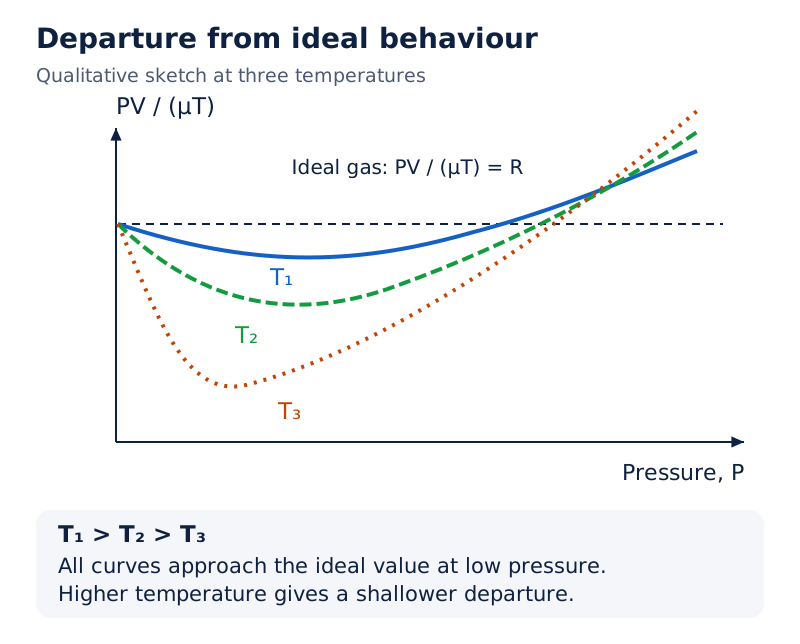
Pressure is on the horizontal axis and on the vertical axis. A horizontal ideal-gas line is compared with three curved real-gas plots. The curves approach the ideal value at low pressure; the higher-temperature curve departs less strongly.
Drawn by One Young India. See Fig. 12.1 in your NCERT textbook
Worked calculation of molar volume
Worked example 1. Find the volume of one mole of ideal gas at and , using .
Formula: .
Substitute:
- Use the given amount: .
- Evaluate .
- Convert volume: .
Answer: The supplied constants give 22.46 L, or to three significant figures. The conventional approximate molar volume at standard conditions is ; the small difference reflects the rounded pressure and gas constant.
How do partial pressure and molecular volume help describe gases?
The partial pressure of a gas is the pressure it would exert if it alone occupied the mixture's volume at the same temperature. This definition keeps both volume and temperature fixed; it does not assign each gas a separate part of the container.
Mixtures of ideal gases
For gases labelled by an index , let be the partial pressure and the amount of that component. Each component satisfies:
At a common volume and temperature, partial-pressure ratios equal mole ratios and molecular-number ratios. They do not generally equal mass ratios, since different gases have different molar masses.
For neon and oxygen with partial pressures in the ratio , the molecular-number ratio is also . Using molar masses and , respectively, gives the following density ratio.
- Let and be the component mass densities. At common volume, , where the two capital mass symbols denote sample masses.
- Replace each sample mass by amount times molar mass: .
- Cancel the common units and evaluate: .
Molecular volume is not container volume
Molecular volume means the volume of the molecules themselves added together. The much larger volume occupied by a gas also includes the space between its particles. Confusing these volumes conceals an important reason the ideal gas approximation works.
Water has density , whereas water vapour at and one atmosphere has density . Treating liquid water as closely packed gives an estimate of the molecular volume fraction.
- For the same mass, volume is inversely proportional to density.
- The estimated fraction is .
- This dimensionless fraction is small, so the actual molecular material occupies only a small portion of the vapour's total volume.
How can molecular size and particle number be estimated?
Bulk density, molar mass and the Avogadro constant connect a visible amount of material with a single molecule. These estimates need assumptions about packing and shape. Their purpose is to establish molecular scales, rather than claim an exact geometrical boundary for a molecule.
Estimating one water molecule
Worked example 2. Estimate the mass and volume of one water molecule. Use molar mass , Avogadro constant , and water density . Approximate molecular density by bulk liquid density.
Formula: ; . Here is one molecule's mass, its estimated volume, and the circle constant.
Substitute:
- Find molecular mass: .
- Find molecular volume: .
- If the molecule is approximated as a sphere of radius , use .
Answer: Using the density of 1000 kg/m³, the estimated mass is , volume is and radius is about . The radius depends on the spherical approximation.
Counting molecules in a room
Worked example 3. Estimate the number of air molecules in a room of volume at and one atmosphere. Take pressure as , temperature as , and . Treat air as an ideal gas mixture.
Formula: .
Substitute:
- Calculate .
- Calculate .
- Divide: .
Answer: Approximately molecules occupy the 25.0 m³ room. The joule units cancel, leaving a particle count.
The room calculation includes all gas constituents in the pressure. It does not require a separate count of oxygen, nitrogen and water vapour. The ideal mixture equation gives their combined number directly.
How do molecular collisions produce gas pressure?
Gas molecules move randomly and collide with container walls. Every collision transfers momentum to a wall. The average rate of momentum transfer is a force, and force per unit area is pressure.
Assumptions of the model
Molecules move freely between collisions, and intermolecular interactions are negligible except during collisions. Collisions between molecules and with stationary walls are elastic. The gas is in a steady state with no preferred direction of molecular motion.
What the figure shows
Collision with a container wall
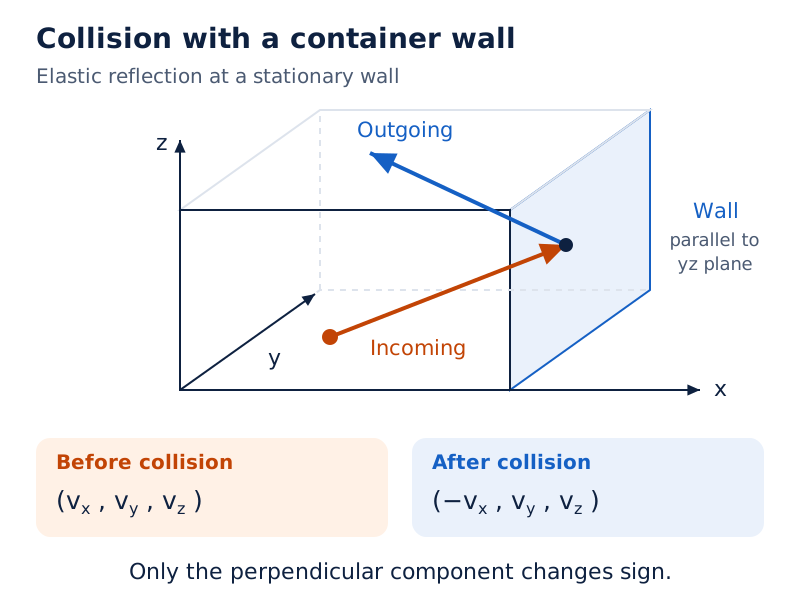
A cube is drawn with three coordinate axes. Two arrows meet at a wall, showing the incoming and outgoing molecular paths. Their labels show reversal of the velocity component perpendicular to the wall, while the other two components remain unchanged.
Drawn by One Young India. See Fig. 12.4 in your NCERT textbook
Derivation: Pressure of an ideal gas
Let be a molecule's velocity components along three perpendicular axes, a wall area, and a short time interval. Let denote the number density of a group with a specified normal speed magnitude.
- On hitting a stationary wall normal to the first axis, the molecule's momentum change is , where is its normal momentum change. The wall receives momentum .
- Molecules within distance can reach the wall. On average, half move towards it. The number striking is .
- Let denote momentum delivered to the wall. Then .
- The group's pressure contribution, , is . Summing over molecular velocity groups gives , where angle brackets denote an average.
- Let denote molecular speed. Isotropy gives .
- Substitution gives . Since , equivalently .
Result: Pressure depends on number density, molecular mass and mean square speed. The factor of one-third comes from equal average contributions along the three perpendicular directions.
The argument initially counts trajectories without intervening collisions. In a steady distribution, collisions remove some molecules from a velocity group and add others. The average result remains valid when collision durations are negligible compared with the intervals between collisions.
Pressure exists throughout the gas, not merely at its walls. An imagined internal layer experiences pressure on both sides. The cube is a convenient construction; the result can also be obtained using a small plane area in a differently shaped vessel.
What do temperature and root mean square speed mean microscopically?
Absolute temperature measures average translational kinetic energy per molecule. Individual molecules have different velocities, so this interpretation concerns an average. Equal temperatures imply equal average translational energies, even for different molecular masses.
Derivation: Kinetic interpretation of temperature
Let be the total translational kinetic energy of the sample. Let be average translational kinetic energy per molecule. The subscript indicates translation.
- Multiply the pressure equation by volume and use : .
- Write translational energy as . Comparing the two expressions gives .
- Combine this with to obtain .
- Divide by particle number: .
- Define root mean square speed, , by . Then .
Result: At a common temperature, lighter molecules have larger root mean square speeds. Temperature determines average translational energy, while molecular mass also affects speed.
Note: Translational energy is not necessarily the whole internal energy. Molecules may also rotate and vibrate. The pressure relation uses translational energy, even when other energy contributions are present.
Worked molecular speed
Worked example 4. Find nitrogen's root mean square speed at , using molecular mass and .
Formula: .
Substitute:
- Evaluate .
- Divide by molecular mass: .
- Take the square root: .
Answer: Approximately 517 m/s. This result follows from taking the square root of the mean square speed, rather than averaging the speeds directly.
For argon and chlorine at the same temperature, average translational energies are equal. Their root mean square speed ratio is , using molecular masses in the same units. Changing their relative amounts does not change this ratio at fixed temperature.
How does equipartition distribute energy among molecular motions?
A degree of freedom describes an independent way a molecule can move. A particle constrained to a line needs one position coordinate; in a plane it needs two; in space it needs three. Unrestricted translation therefore has three degrees of freedom.
Translational, rotational and vibrational contributions
For translation, the kinetic energy is . Each term is quadratic in a velocity component. In thermal equilibrium, each has average energy .
The law of equipartition of energy assigns average energy to each quadratic energy term in thermal equilibrium. Each translational or rotational degree contributes one such term. A vibration contributes both a kinetic and a potential energy term.
A monatomic gas, such as argon, has three translational degrees of freedom. A rigid diatomic molecule has three translational and two rotational degrees. The relevant rotations are about two independent axes perpendicular to the line joining its atoms.
What the figure shows
Rotation of a diatomic molecule
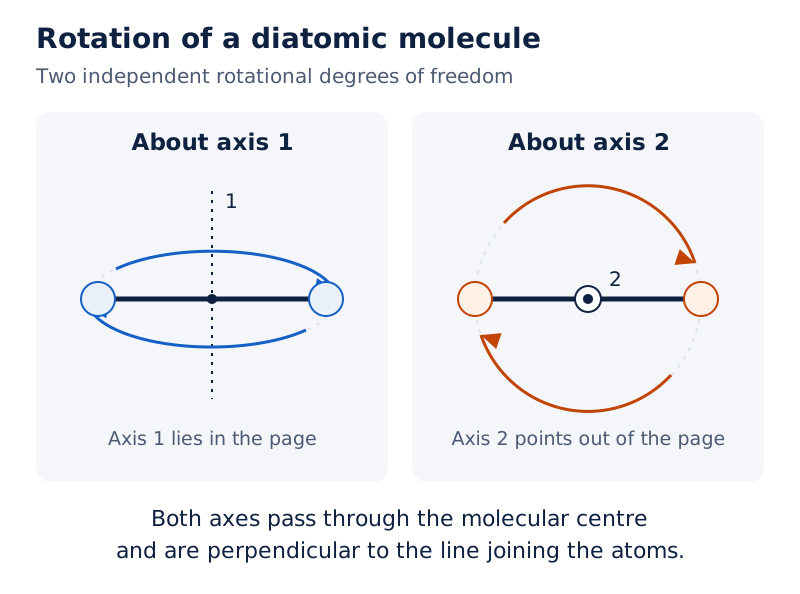
Two sketches show pairs of atoms joined by a line. Dotted axes labelled one and two pass through the molecular centre, and curved paths show rotation about these two different axes.
Drawn by One Young India. See Fig. 12.6 in your NCERT textbook
For angular speeds and , with corresponding moments of inertia and , rotational energy is . Here denotes rotational energy.
Rotation about the line joining the atoms has a very small moment of inertia and does not contribute in this treatment for quantum mechanical reasons. The rigid-rotator approximation also neglects vibration, so its range of applicability matters when predicting heat capacities.
Why does vibration count twice?
Let denote vibrational energy, vibrational displacement, time and the oscillator force constant. A one-dimensional oscillator has:
The first term is kinetic energy and the second is potential energy. Thus one vibrational mode contributes average energy , twice the contribution of a single translational or rotational degree. Counting only its kinetic part underestimates the energy stored.
How does kinetic theory predict heat capacities?
Molar heat capacity measures heat required per mole per unit temperature rise under a specified condition. Let denote its constant-volume value and its constant-pressure value. Their SI unit is .
Derivation: Heat capacities of a monatomic ideal gas
Let be total internal energy and let denote the ratio of the molar heat capacities. Keep the amount fixed while differentiating with respect to temperature.
- Three translational contributions give .
- At fixed volume, heat changes internal energy. Therefore .
- For an ideal gas, . Hence .
- The ratio is .
Result: The monatomic predictions follow from three translational degrees of freedom. Differentiating internal energy removes its temperature factor; heat capacity is not internal energy itself.
Comparing molecular models
| Model | Constant-volume molar heat capacity | Constant-pressure molar heat capacity | Heat-capacity ratio |
|---|---|---|---|
| Monatomic | |||
| Rigid diatomic | |||
| Diatomic with one active vibration | |||
| Polyatomic model with three rotations and vibrational modes |
Here means the number of active vibrational modes in the stated polyatomic model. Its three translational and three rotational contributions together supply energy per molecule; vibrations supply an additional .
These predictions agree with measured values for several gases at ordinary temperatures. Some gases have larger measured heat capacities than predictions that ignore vibration. Including vibrational contributions can improve agreement, so a molecular model should accompany each quoted result.
Worked example 5. A fixed-volume cylinder holds of helium at standard conditions. Using molar volume and , calculate the heat for a temperature rise. Treat helium as a monatomic ideal gas.
Formula: ; . Here is molar volume, heat supplied and temperature rise.
Substitute:
- Find amount: .
- Use .
- Calculate .
Answer: Approximately 374 J. Fixed volume requires the constant-volume heat capacity.
Extension to solids
Atoms in a solid vibrate about mean positions. Three-dimensional vibration gives average energy per atom. For one mole, this leads to energy and molar heat capacity approximately .
The volume change of a solid is usually small enough to neglect the associated pressure-volume work in this estimate. The prediction generally agrees with observations at ordinary temperatures; carbon is an exception. It is not a universal temperature-independent rule for every solid.
Why is diffusion slow when molecules move so quickly?
A gas molecule's large speed does not mean it travels uninterrupted across a room. Collisions repeatedly deflect its path. Gas leaking into a room therefore takes time to spread, even though the molecules themselves move rapidly between successive encounters.
Definition: The mean free path is the average distance travelled by a molecule between two successive collisions.
Derivation: Mean free path
Let denote molecular diameter, average molecular speed, average time between collisions and mean free path. Model molecules as spheres and first imagine that the other molecules are stationary.
- A moving molecule collides when another centre comes within distance . In time , the swept volume is .
- At number density , the expected collision count is , so the collision rate is .
- The mean collision interval in this approximation is .
- Multiplying time by speed gives in the stationary-target approximation.
- Allowing for the motion of all molecules requires relative speeds. The corrected result is .
Result: Mean free path decreases as number density increases and varies inversely with the square of molecular diameter. An evacuated tube can give much longer free paths because it contains fewer collision partners.
What the figure shows
Swept collision volume
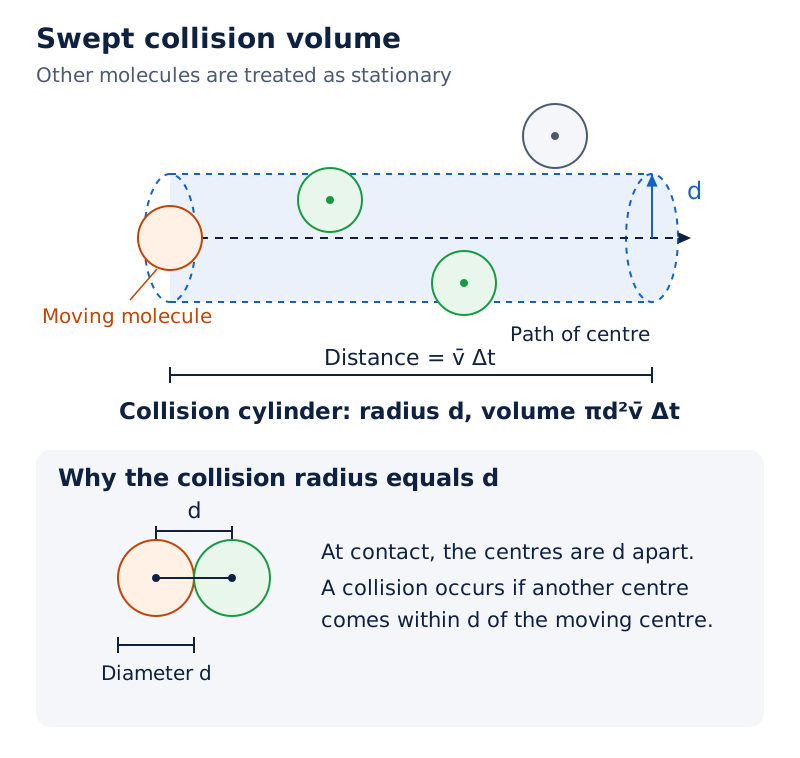
A slanting dashed cylinder surrounds a molecule's path, with spherical molecules drawn inside and beside it. The labelled travel distance is average speed multiplied by the time interval. Diameter labels mark the molecular size and the collision geometry.
Drawn by One Young India. See Fig. 12.7 in your NCERT textbook
Worked mean free path
Worked example 6. Estimate the mean free path of water vapour at , at the same pressure as a gas with number density at . Take molecular diameter .
Formula: ; . Here and are the reference number density and temperature.
Substitute:
- At constant pressure, .
- Calculate .
- Evaluate .
Answer: At 373 K, the mean free path is approximately using the corrected expression and the stated data.
Mean free path and molecular separation are different. Separation concerns neighbouring particles at an instant; mean free path concerns the distance travelled before a collision. A molecule can pass between many neighbours without their centres becoming close enough for a collision.
Glossary
- Kinetic theory — An explanation of gas properties based on the continual random motion and collisions of constituent molecules.
- Ideal gas — A theoretical gas satisfying the ideal gas equation exactly at every pressure and temperature.
- Number density — The number of molecules per unit volume, distinct from mass per unit volume.
- Partial pressure — Pressure a component gas would exert alone at the mixture's volume and temperature.
- Absolute temperature — Temperature measured on the kelvin scale, proportional to average translational kinetic energy in an ideal gas.
- Root mean square speed — The square root of the average of the squared speeds of the molecules.
- Isotropy — Absence of a preferred direction, giving equal average squared velocity components along perpendicular axes.
- Degree of freedom — An independent way of describing molecular motion, such as translation along a particular axis.
- Equipartition of energy — Equal average energy assigned to quadratic energy terms in a system at thermal equilibrium.
- Rigid rotator — A molecular model that includes rotation while neglecting vibration of the separation between its atoms.
- Molar heat capacity — Heat required per mole for unit temperature rise under a stated constraint such as constant volume.
- Mean free path — Average distance travelled by a gas molecule between one collision and the next.
Common errors and misconceptions
- Misconception: Molecules in an equilibrium gas are motionless. Correct: Motion and collisions continue; average macroscopic properties remain steady.
- Misconception: Every real gas obeys the ideal gas equation exactly. Correct: Real gases approach ideal behaviour under suitable low-pressure, high-temperature conditions.
- Misconception: Celsius temperature can be substituted into gas laws. Correct: Their temperature variable is absolute temperature in kelvin.
- Misconception: Equal temperatures imply equal molecular speeds. Correct: They imply equal average translational energies; lighter molecules have larger root mean square speeds.
- Misconception: Mean square speed equals the square of mean speed. Correct: Averaging after squaring and squaring after averaging are different operations.
- Misconception: Each vibration contributes the same energy as one translation. Correct: A vibrational mode has both kinetic and potential terms and contributes twice as much.
- Misconception: Translational energy is the whole internal energy for every ideal gas. Correct: Rotation and vibration may supply additional contributions.
- Misconception: Mean free path is the distance between neighbouring molecules. Correct: It measures a molecule's travel between collisions, which is a different distance.
Exam-style questions with model answers
Q1. State Avogadro's law and explain whether equal volumes of different ideal gases at equal temperature and pressure must have equal masses. [2 marks]
- Equal volumes of ideal gases at the same temperature and pressure contain equal numbers of molecules.
- Their masses need not be equal because the molecules of different gases can have different masses.
Q2. State three assumptions used in the kinetic theory pressure calculation. [3 marks]
- The gas contains many molecules in continual random motion, with no preferred direction in the equilibrium state, so the average squared velocity components are equal.
- Intermolecular interactions are negligible between collisions, and molecules move freely along straight paths during those intervals.
- Molecular collisions with other molecules and stationary container walls are elastic, conserving the total kinetic energy of the colliding system.
Q3. Derive the pressure formula for an ideal gas using a wall-collision argument. Define the symbols introduced. [5 marks]
- Let be molecular mass and velocity towards a wall. Elastic reflection reverses this component, transferring momentum to the wall.
- For wall area , short time , and group number density , the number of impacts is , since half the nearby molecules move towards the wall.
- The transferred momentum is . Dividing by area and elapsed time gives the group's pressure .
- Summing the velocity groups yields , where is total pressure, total number density and brackets denote an average.
- Isotropy gives , where is speed. Thus , connecting pressure with molecular motion.
Q4. Explain why argon and chlorine molecules in thermal equilibrium have equal average translational energies but different root mean square speeds. Use molar masses for argon and for chlorine to find their speed ratio. [3 marks]
- Thermal equilibrium gives a common absolute temperature . Average translational energy per molecule is , where is Boltzmann's constant, so the energies are equal.
- Root mean square speed varies inversely with the square root of molecular mass at fixed temperature. Therefore the lighter argon particles move faster in this sense.
- The ratio is , with the molar-mass units cancelling.
Q5. Derive the constant-volume and constant-pressure molar heat capacities of a rigid diatomic ideal gas. State the equipartition contribution and find the heat-capacity ratio. Use , where is the gas constant. [5 marks]
- A rigid diatomic molecule has three translational and two rotational degrees of freedom, giving five independent quadratic kinetic-energy terms in this model.
- At absolute temperature , equipartition assigns to each term, where is Boltzmann's constant. Average molecular energy is therefore .
- For a fixed amount in moles, internal energy . Differentiation gives constant-volume molar heat capacity .
- Using the given ideal-gas relation, constant-pressure molar heat capacity is .
- The ratio, denoted by , is . This prediction treats the molecule as rigid and therefore excludes a vibrational contribution.
Q6. A rigid cylinder contains of monatomic ideal helium. Calculate the heat needed to raise its temperature by . Use and explain the choice of heat capacity. [3 marks]
- A rigid cylinder maintains constant volume, so use constant-volume molar heat capacity , appropriate to a monatomic ideal gas with three translational degrees of freedom.
- Substitution gives .
- Heat supplied is , where is amount and temperature rise. The mole and kelvin units cancel.
Q7. Define mean free path and explain why a gas can diffuse slowly even though its molecules have large speeds. [2 marks]
- Mean free path is the average distance a molecule travels between successive collisions.
- Repeated collisions change molecular directions, preventing rapid straight-line travel across the room and slowing the overall spreading of gas.
Key takeaways
- Kinetic theory relates gas pressure and temperature to the continual random motion of molecules and their collisions.
- Real gases approximate ideal behaviour at low pressures and high temperatures, when molecular interactions become less important.
- The ideal gas equation can use moles or molecular counts, provided constants and units match the chosen form.
- Gas pressure depends on molecular number density, molecular mass and mean square speed, with isotropy supplying the one-third factor.
- Equal temperatures imply equal average translational kinetic energies; lighter molecules then have greater root mean square speeds.
- Equipartition assigns equal average energy to quadratic terms, so one vibrational mode contributes both kinetic and potential energy.
- Heat-capacity predictions depend on which translational, rotational and vibrational contributions are included in the molecular model.
- Mean free path describes travel between collisions and explains why rapid molecular motion does not produce instantaneous diffusion.
Test yourself
What makes gas equilibrium dynamic?
Molecules keep moving and colliding, while average properties such as pressure and temperature remain constant.
Which two conditions accompany Boyle's law?
The amount of gas is fixed and its temperature remains constant while pressure and volume vary.
How does number density differ from mass density?
Number density counts molecules per unit volume; mass density measures mass per unit volume.
Why does the pressure equation contain a factor of one-third?
In an isotropic gas, the mean squared velocity is shared equally among three perpendicular components.
Does equal temperature give identical individual molecular energies?
No. It determines average translational energy; molecules still have a distribution of velocities and energies.
Why does a vibration contribute twice the energy of one translational degree?
A vibration has two quadratic terms, one kinetic and one potential, whereas one translational degree has one.
Which molar heat capacity is used when heating gas in a rigid cylinder?
Use the constant-volume molar heat capacity because the rigid cylinder prevents a change in volume.
What happens to mean free path when number density decreases at fixed molecular diameter?
Mean free path increases because fewer molecules per unit volume means fewer possible collision partners.
Write about it
Turn a question from this chapter into a paper.
The Writing Studio has a structure guide, a rubric and citation tools for 15 formats, from essays to research papers. Drafting is free with an account. Learnacy Essential adds feedback from an AI writing coach and submission to The OYI Review.
Learnacy Essential is ₹1,499 for the year. Publication depends on review and is not guaranteed.