
Mechanical Properties of Solids | CBSE Class 11 Physics Notes
On this page
Watch & explore
Start with a few high-quality watches, then dive into the notes below.

This note covers elasticity and plasticity, stress and strain, Hooke’s law, stress-strain curves, Young’s modulus, shear modulus, bulk modulus, compressibility, Poisson’s ratio, elastic potential energy, worked calculations, and applications to ropes, beams, columns and mountains.
What are elasticity, plasticity and elastic deformation?
A solid has a definite shape and size, but it is not perfectly rigid. Even a steel bar can stretch, compress or bend when a sufficiently large external force acts on it. The rigid-body description is therefore an approximation.
Definition: Elasticity is the property by which a body tends to regain its original size and shape when the applied force is removed. The associated recoverable change is called elastic deformation.
Gently pulling the ends of a helical spring increases its length slightly. Releasing the ends allows it to regain its original shape and size. This connects elasticity with recovery after unloading, rather than simply with the amount of stretching.
A lump of putty or mud behaves differently. After deformation, it has no gross tendency to regain its earlier shape. The deformation is permanent. Such substances are called plastic, and the property is called plasticity; putty and mud are close to ideal plastics.
Why does the distinction matter in design?
Buildings, bridges, automobiles and ropeways require knowledge of how their materials respond to forces. A useful material must withstand its working load without an unacceptable change in dimensions. Strength and elastic behaviour therefore enter the choice of construction materials.
The deformation may be too small to notice visually, but that does not mean it is absent. Its magnitude depends on both the nature of the material and the magnitude of the deforming force. Measuring small changes makes this response quantitative.
Elasticity also has a precise comparative meaning: under comparable loading, a material that develops less strain has a larger elastic modulus. A material that stretches easily should not automatically be described as more elastic in this sense.
How do stress and the different kinds of strain describe deformation?
When deforming forces act on a body in static equilibrium, internal restoring forces develop. Their magnitude balances the applied force. Stress is the restoring force per unit area, and its form depends on how the forces act on the surface.
Let be the magnitude of the applied force normal to a cross-section, its area, and the longitudinal stress. Then The SI unit of stress is the pascal, written , with .
The dimensional formula is , where , and in dimensional notation represent mass, length and time. Strain compares a change in dimension with the original dimension, so it has no dimensions or units.
Which force produces which strain?
| Loading | Stress | Corresponding strain |
|---|---|---|
| Opposite outward forces normal to end faces | Tensile stress | Increase in length divided by original length |
| Opposite inward forces normal to end faces | Compressive stress | Decrease in length relative to original length |
| Tangential forces parallel to opposite faces | Shearing stress | Relative sideways displacement divided by separation of faces |
| Uniform normal forces over the whole surface | Hydraulic stress | Change in volume divided by original volume |
Let now denote the original length of a body and its change in length. The longitudinal strain, denoted by , is Tensile and compressive stresses are both forms of longitudinal stress.
For shear, let be the relative displacement of opposite faces, separated originally by , and let be the angular displacement from the original vertical direction. Then The final approximation applies to small angles expressed in radians.
Let be the original volume and the change in volume. The volume strain is . Under uniform hydraulic compression, the volume decreases without a change in geometrical shape.
What the figure shows
Types of deformation
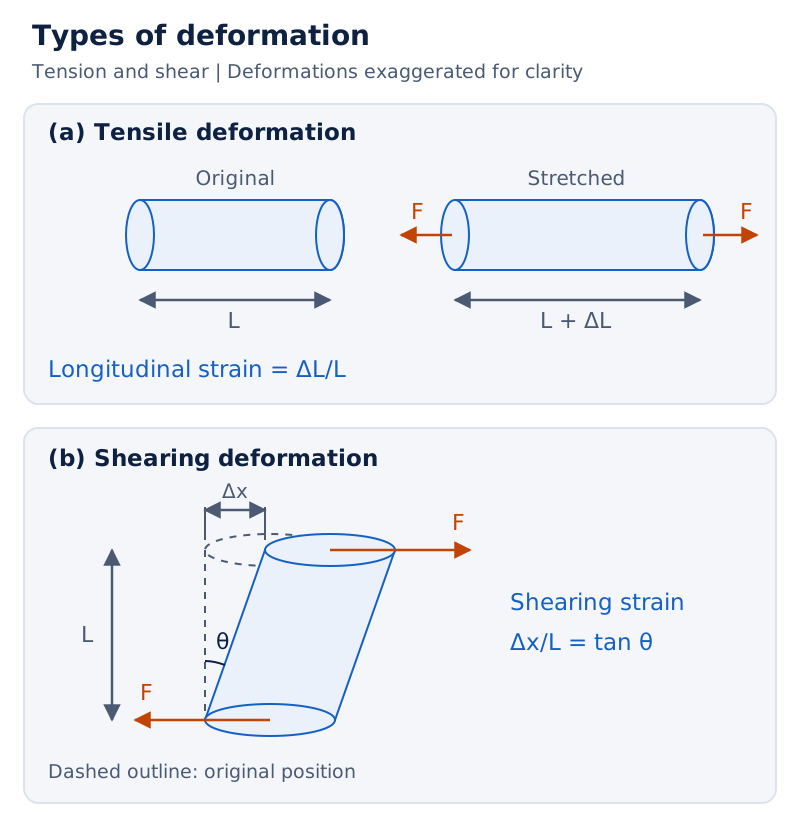
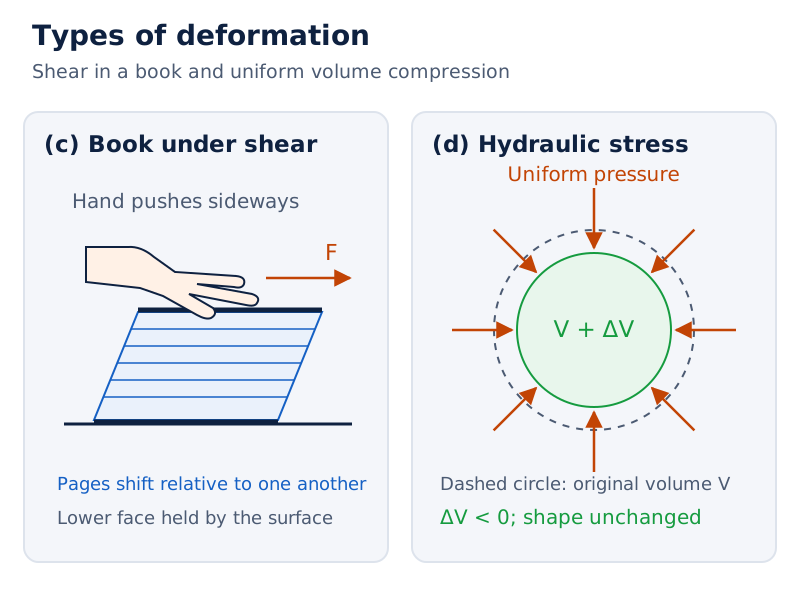
Panel (a) shows a cylinder lengthening under opposite pulls. Panel (b) shows a cylinder sheared sideways. Panel (c) shows a hand pushing a book. Panel (d) shows inward normal arrows around a body under hydraulic stress.
Drawn by One Young India. See Fig. 8.1 in your NCERT textbook
Note: A wire pulled by equal and opposite end forces has tension equal to either force. Its tensile stress is , not . Balancing the external forces does not remove the internal stress.
What does Hooke’s law explain about a stress-strain curve?
For small deformations, stress is directly proportional to strain for most materials. This empirical relation is Hooke’s law. It applies provided the response remains in the linear part of the stress-strain curve.
Writing for the appropriate modulus of elasticity, the relation is The modulus is a characteristic of the material. The particular modulus used depends on whether the deformation is longitudinal, shearing or volumetric.
How is the curve obtained and interpreted?
A test wire or cylinder is stretched by an applied force. The force is increased in steps, and the corresponding extension is recorded. Converting these measurements to stress and strain produces a curve that reveals the material’s response to increasing loads.
What the figure shows
Typical metal stress-strain curve
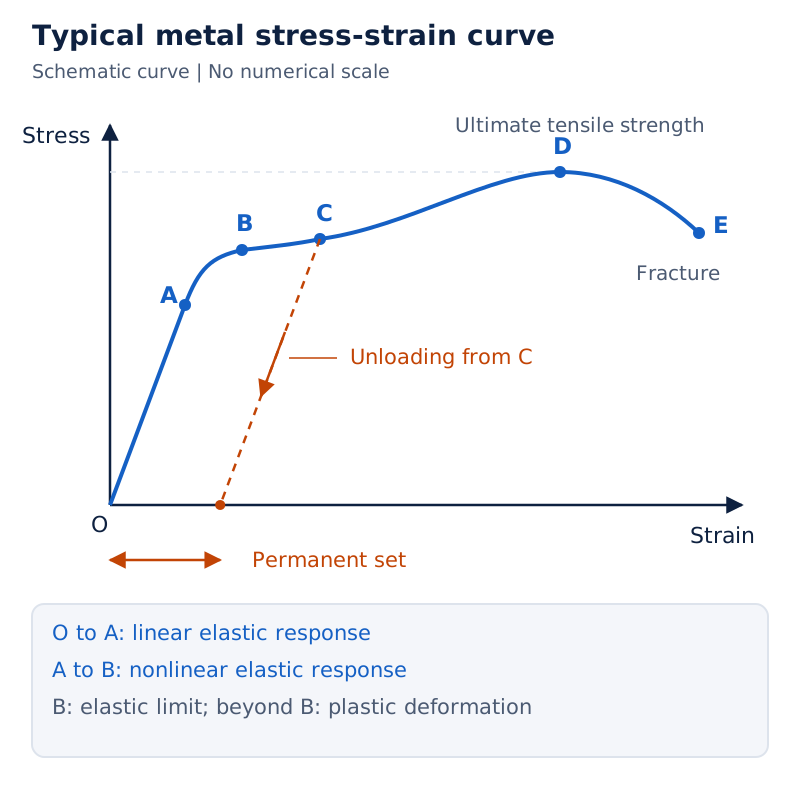
Stress is on the vertical axis and strain on the horizontal axis. The curve passes through labelled points O, A, B, C, D and E. D is its highest point, E marks fracture, and a dashed unloading line indicates permanent set.
Drawn by One Young India. See Fig. 8.2 in your NCERT textbook
| Region or point | Behaviour | Meaning on unloading |
|---|---|---|
| O to A | Stress and strain are proportional | Original dimensions are recovered |
| A to B | Stress and strain are not proportional | Original dimensions are still recovered |
| B | Yield point or elastic limit | Boundary before permanent deformation develops |
| Beyond B, for example C | Plastic deformation occurs | A permanent set remains |
| D and E | Ultimate tensile strength at D; fracture at E | The material ultimately breaks |
The stress at the yield point is the yield strength, denoted by . Beyond it, strain can increase rapidly for a small stress increase. On unloading from the plastic region, a non-zero strain remains even when the stress becomes zero.
The maximum stress at D is the ultimate tensile strength, denoted by . Beyond D, further strain can develop even under a reduced applied force. If D and E are close, the material is brittle; if far apart, it is ductile.
Can a material be elastic without obeying Hooke’s law?
Yes. Elastomers, including rubber and aortic tissue, can undergo large strains and recover. Rubber can be pulled to several times its original length. A large elastic range does not require stress to be proportional to strain throughout that range.
What the figure shows
Elastic tissue of the aorta
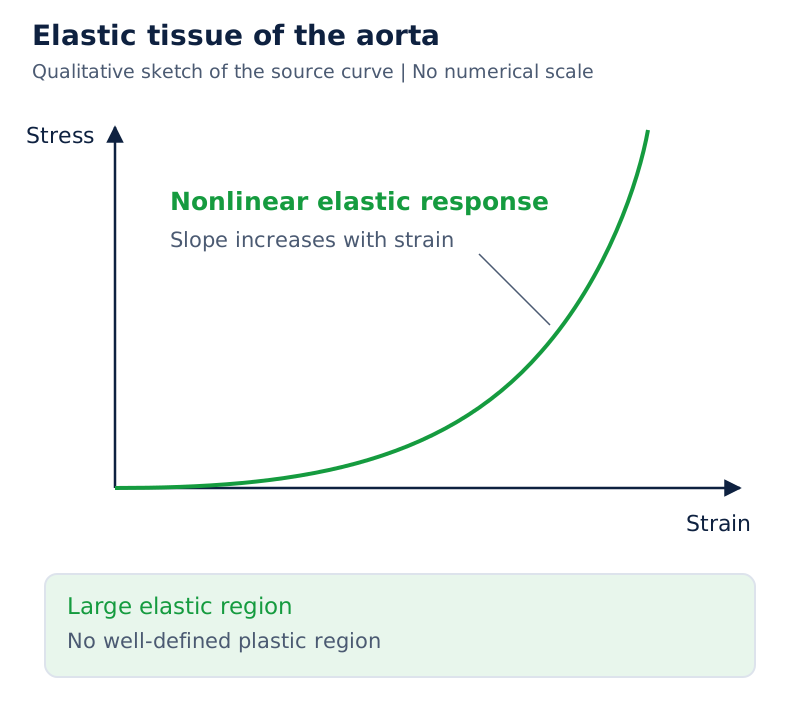
The plotted stress-strain curve bends upwards and becomes steeper as strain increases. It is not a straight line. The tissue has a large elastic region and no well-defined plastic region.
Drawn by One Young India. See Fig. 8.3 in your NCERT textbook
How does Young’s modulus determine the extension of a rod?
Young’s modulus, denoted by , is the ratio of longitudinal stress to longitudinal strain in the proportional elastic region. It describes the resistance of a material to stretching or compression along its length.
The SI unit of Young’s modulus is the pascal. Since strain is dimensionless, Young’s modulus has the same unit as stress. For a given material, the strain magnitudes under corresponding tensile and compressive stresses are the same in the elastic treatment.
Derivation: Extension in terms of Young’s modulus
- Write the defining ratio of longitudinal stress to longitudinal strain:
- Substitute the force per area and the fractional length change:
- Rearrange to isolate the extension:
- Rearrange the same relation to find the required deforming force:
Interpretation: For a fixed force, original length and area, a larger Young’s modulus produces a smaller extension. The dimensions of the specimen affect its extension, while the modulus characterises the material.
What does a large modulus mean?
Metals have large Young’s moduli and therefore require large forces to produce small longitudinal strains. Steel is more elastic than copper, brass and aluminium in this comparative sense. This helps explain its use in heavy-duty machines and structural designs.
Worked example 1. A structural steel rod has radius , length , and Young’s modulus . A longitudinal force of stretches it. Find its stress, extension and strain.
Let denote the circular radius; is the circle constant. Formula:
Substitute: Convert the radius and force before using SI units.
Answer: The extension is approximately , the stress is , and the strain is dimensionless.
How are joined wires and compressed bones analysed?
The Young’s modulus relation applies separately to each elastic member. Before substituting numbers, identify the force carried by each member. Wires joined end to end carry the same tension, while the supported load in the human-pyramid example is shared by two thighbones.
How do two wires joined end to end extend?
For wires with equal cross-sectional area and equal tension, extensions depend on their original lengths and Young’s moduli. Their strains need not be equal. The total extension is the sum of the extensions of the two wires.
Worked example 2. Copper and steel wires of lengths and , each of diameter , are joined end to end. Their total extension is . Find the load using moduli and , respectively.
Subscripts and identify copper and steel. Let be the common tensile load. Formula:
Substitute: Use the extension ratio together with the given total extension.
Answer: The applied load is about . The copper wire contributes the larger extension.
How is the load shared in the human pyramid?
Worked example 3. A balanced human pyramid and its equipment have total mass . The bottom performer has mass . Each thighbone has length , effective radius , and Young’s modulus . Find each bone’s compression, sharing the extra load equally. Take gravitational acceleration .
Formula: Here denotes the magnitude of the shortening.
Substitute: Exclude the bottom performer’s own mass from the extra load.
Answer: Each thighbone shortens by about . The small fractional shortening illustrates why this deformation is not visually obvious.
What is shear modulus and how is sideways displacement calculated?
Shear modulus, denoted by , is the ratio of shearing stress to the corresponding shearing strain. It is also called the modulus of rigidity. It describes a solid’s resistance to relative sideways displacement of its opposite faces.
Let denote shearing stress. In the proportional region, For a small shear angle, The SI unit of shear modulus is the pascal.
The shear modulus is generally less than Young’s modulus. For most materials, the approximate relation is . This is an approximate comparison, rather than an exact identity to substitute for a supplied material value.
Which area should be used for a sheared slab?
The relevant area is the face across which the tangential force acts. It need not be the largest visible face. The displacement is measured parallel to the force, while the separation of the faces is measured perpendicular to that displacement.
Worked example 4. A square lead slab has side and thickness . Its lower edge is fixed, and a shearing force of acts on its narrow upper face. Find the upper edge’s displacement using .
Formula:
Substitute: The face area uses the slab’s side and thickness; the face separation is its side length.
Answer: The upper edge moves approximately . The shear strain is small, consistent with the small-deformation treatment.
How do bulk modulus and compressibility describe volume changes?
A body surrounded by fluid under pressure experiences normal forces over its surface. Under uniform hydraulic compression, its volume decreases without a change of geometrical shape. The hydraulic stress has the same magnitude as the applied pressure.
Let denote the applied pressure increase, and the bulk modulus. Taking volume change with its sign, A positive pressure increase produces a negative volume change, so the bulk modulus is positive for a system in equilibrium.
The SI unit of bulk modulus is the pascal. The SI unit of pressure is also the pascal. Bulk modulus applies to solids, liquids and gases, whereas Young’s modulus and shear modulus describe the length and shape responses of solids.
How is compressibility related to bulk modulus?
Compressibility, denoted by , is the reciprocal of bulk modulus. If denotes the pressure increase, A larger bulk modulus means a smaller fractional volume change for a given pressure increase.
Solids are the least compressible and gases the most compressible. Gases are about a million times more compressible than solids, and their compressibilities vary with pressure and temperature. The neighbouring atoms in solids are tightly coupled; gas molecules are very poorly coupled.
Note: The positive magnitude of fractional compression is . The signed volume strain is negative during compression. State which quantity an answer represents.
Worked example 5. The average depth of the Indian Ocean is about . Find the fractional compression of water at that depth using density , bulk modulus , and .
Let be depth and be water density. Formula:
Substitute: Use the pressure due to the water column.
Answer: The pressure increase is , and the positive fractional compression is approximately , or . The ratio has no unit because the pressure units cancel.
What does Poisson’s ratio tell us about lateral deformation?
Stretching a wire changes more than its length. Its lateral dimensions also undergo a small change. A description using only longitudinal strain therefore does not capture every aspect of its deformation.
The strain perpendicular to the applied force is called lateral strain. Within the elastic limit, it is directly proportional to the longitudinal strain. Their ratio gives another elastic constant, called Poisson’s ratio.
How is the ratio written for a stretched wire?
Let be the original wire diameter, the positive magnitude of its contraction, and Poisson’s ratio. Retaining for original length and for elongation,
This convention compares the magnitude of diameter contraction with the magnitude of longitudinal extension. It avoids confusing a decrease in diameter with an increase. Both strains are ratios of lengths, so Poisson’s ratio is a pure number without dimensions or units.
Its value depends on the nature of the material. For steels it lies between and , while for aluminium alloys it is about . These values describe the coupling between lateral and longitudinal deformation.
The need for Poisson’s ratio illustrates a broader point: a deforming force acting in one direction can produce strains in other directions. In such situations, one elastic constant alone cannot describe all the proportional relationships between stress and strain.
How is elastic potential energy stored in a stretched wire?
Work is done against interatomic forces when a wire is stretched. This work is stored as elastic potential energy. In the proportional elastic region, the force increases with extension, so the final force cannot be treated as constant throughout the stretching process.
Let denote the final extension, the extension at an intermediate stage, and an infinitesimal additional extension. Let now denote the work done and the stored elastic potential energy. The wire has original length , area , and Young’s modulus .
Derivation: Work done and elastic energy density
- At intermediate extension , apply the Young’s modulus relation:
- The small work increment, denoted by , is force multiplied by the additional extension:
- Add the work increments from zero extension to the final extension:
- Identify the work with the stored energy and rewrite it using strain and the wire’s original volume:
- Let denote elastic potential energy per unit volume. Divide by volume and use the linear stress-strain relation:
Result: The elastic energy density is half the product of stress and strain in the proportional elastic region. Use the longitudinal strain corresponding to the same stress, rather than an unrelated lateral or volume strain.
The SI unit of elastic potential energy is the joule, written . Energy per unit volume is measured in . Since strain is dimensionless, the energy-density expression also has the dimensions of stress.
The derivation depends on the linear force-extension relation. It is therefore tied to Hooke’s law and should not be extended unchanged to a nonlinear part of a material’s stress-strain curve.
How do elastic properties guide the design of ropes and beams?
Engineering structures must carry their loads without excessive deformation or failure. A bridge must withstand traffic, wind forces and its own weight. Beams, columns and lifting ropes therefore require knowledge of material strength as well as elastic response.
How thick must a crane rope be?
A lifting rope should remain within its elastic limit. Its cross-sectional area must keep the working stress below the yield strength. Practical ropes also allow a substantial safety margin and use many thin braided wires for flexibility, strength and ease of manufacture.
Worked example 6. A crane lifts tonnes using mild steel with yield strength . Find the minimum rope area and approximate circular radius before allowing a safety margin. Use and .
Let be the lifted mass and the minimum cross-sectional area. Formula:
Substitute: Convert the lifted mass before calculating its weight.
Answer: The minimum radius is about . A load safety factor of about ten leads to a recommended radius of about , rather than using the limiting minimum.
Why are deep beams and I-shaped sections useful?
For a beam supported near its ends and loaded at its centre, let denote the sag, the span length, the breadth, the depth and the central load. Its Young’s modulus is . The sag is
A larger Young’s modulus reduces bending. For fixed material, load and span, increasing depth is more effective than increasing breadth because sag depends on the inverse cube of depth but only the inverse first power of breadth. A shorter span also reduces sag.
What the figure shows
Loaded beam and beam sections
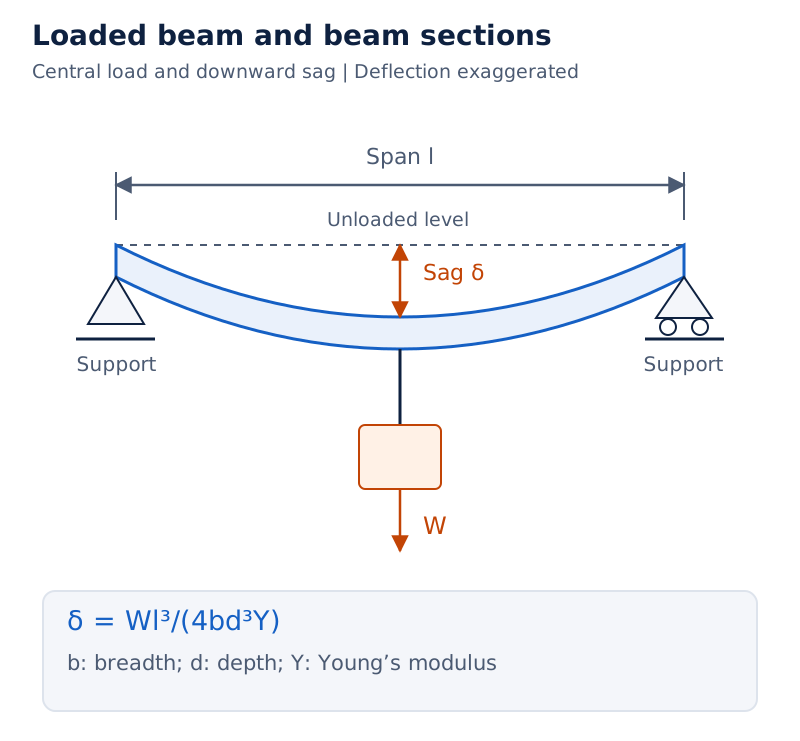
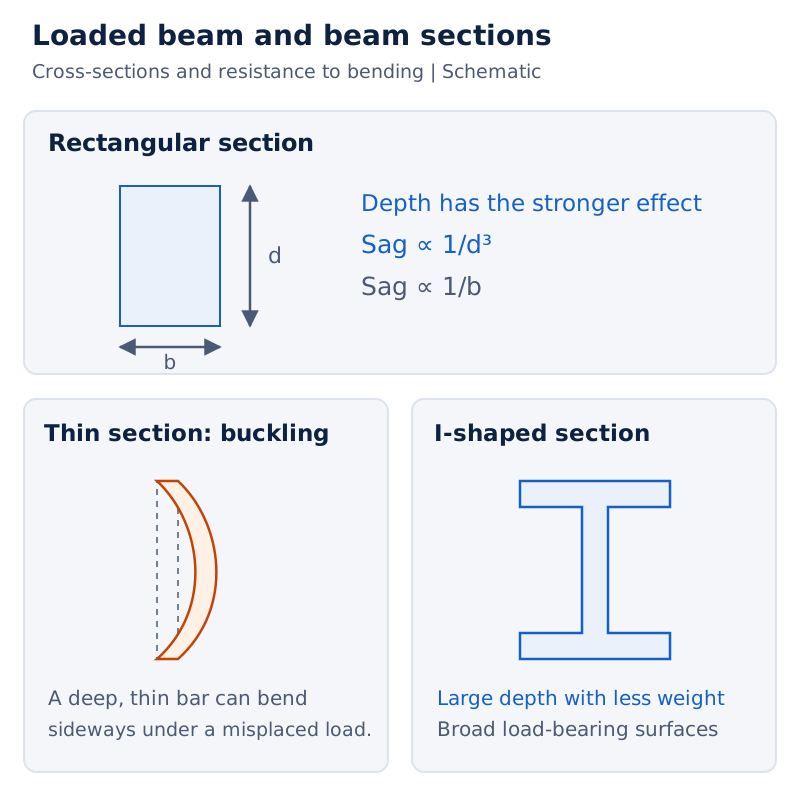
Figure 8.6 shows a beam supported at its ends, a central hanging load and downward sag. Figure 8.7 shows a rectangular section, a thin section bending sideways, and an I-shaped section.
Drawn by One Young India. See Figs. 8.6 and 8.7 in your NCERT textbook
A deep, thin bar can buckle if the load is not correctly placed. An I-shaped section provides a large load-bearing surface and sufficient depth while reducing weight without sacrificing strength. This also reduces the cost of the beam.
Columns also depend on their end design. A pillar with rounded ends supports less load than one with distributed ends. The final design of a building or bridge must account for its working conditions, cost and the long-term reliability of its materials.
What limits mountain height?
A mountain’s base is not uniformly compressed because its sides are free. The weight of overlying rock therefore creates a shear component. If the stress becomes too large, the rock can flow, limiting the height that can be supported.
The approximate shear stress is , where now denotes mountain height and rock density. Using typical rock strength gives a limiting height of about . This is an estimate based on elastic properties, rather than uniform hydraulic compression.
Glossary
- Elasticity — Property by which a body tends to regain its original size and shape after the applied force is removed.
- Plasticity — Property associated with permanent deformation and no gross tendency to recover the previous shape after unloading.
- Stress — Internal restoring force per unit area developed in a body subjected to a deforming force.
- Longitudinal strain — Change in a body’s length divided by its original length under tensile or compressive loading.
- Shearing strain — Relative sideways displacement of opposite faces divided by their original separation within the body.
- Volume strain — Change in a body’s volume divided by its original volume under hydraulic loading.
- Hooke’s law — Empirical relation stating that stress is proportional to strain in the linear region for most materials.
- Yield strength — Stress corresponding to the yield point or elastic limit on the material’s stress-strain curve.
- Permanent set — Residual deformation remaining after the load is removed from a body deformed into its plastic region.
- Young’s modulus — Ratio of longitudinal stress to longitudinal strain in the proportional elastic region of a material.
- Shear modulus — Ratio of shearing stress to the corresponding shearing strain, also called the modulus of rigidity.
- Bulk modulus — Positive ratio of pressure increase to the resulting fractional compression of a body in equilibrium.
- Compressibility — Reciprocal of bulk modulus, describing the fractional decrease in volume per unit increase in pressure.
- Poisson’s ratio — Ratio of lateral contraction strain magnitude to longitudinal extension strain for a wire within its elastic limit.
- Elastomer — Material such as rubber or aortic tissue that can undergo large elastic strains without obeying Hooke’s law throughout.
Common errors and misconceptions
- Misconception: A solid body is perfectly rigid. Correct: Even a steel bar deforms under sufficiently large forces; a rigid body is an idealised description.
- Misconception: Equal opposite pulls give wire stress . Correct: The tension at a cross-section equals either pull, so the tensile stress is .
- Misconception: Hooke’s law holds throughout every elastic region. Correct: It holds in the linear region; elastic recovery may also occur where stress and strain are not proportional.
- Misconception: Strain has the same unit as extension. Correct: Strain is a ratio of like dimensions and therefore has neither dimensions nor units.
- Misconception: Rubber is more elastic than steel because it stretches more easily. Correct: A larger Young’s modulus indicates greater resistance to longitudinal strain under comparable stress.
- Misconception: Compression makes bulk modulus negative. Correct: Signed volume change is negative, and the minus sign in makes the equilibrium bulk modulus positive.
- Misconception: Poisson’s ratio is another stress measured in pascals. Correct: It compares two strains and is a dimensionless pure number.
- Misconception: The full final stretching force acts through the whole extension. Correct: Force increases with extension in the linear region; the stored energy follows from adding the incremental work.
Exam-style questions with model answers
Q1. Distinguish elasticity from plasticity, giving one example of each. [2 marks]
- Elasticity is the tendency to regain original size and shape after removal of the applied force. A gently stretched helical spring illustrates elastic recovery.
- Plasticity is associated with permanent deformation. Putty has no gross tendency to recover its previous shape after it has been deformed.
Q2. Describe longitudinal, shearing and volume strain, including their defining ratios and units. [3 marks]
- Longitudinal strain is , where is the change in length and the original length under tensile or compressive loading.
- Shearing strain is , where is the relative sideways displacement of opposite faces and is their original separation.
- Volume strain is , where is the volume change and the original volume. All three strains are dimensionless ratios and have no units.
Q3. Explain a typical metal stress-strain curve from initial loading to fracture. Distinguish linear elasticity, nonlinear elasticity, yielding, permanent set and failure. [5 marks]
- Initially the curve is linear. Stress is proportional to strain, so Hooke’s law applies. Removal of the load restores the original dimensions of the specimen.
- After the proportional limit, stress and strain cease to be proportional. The body can nevertheless still return to its original dimensions when the load is removed.
- The yield point marks the elastic limit. Its corresponding stress is the yield strength. Beyond this point, strain increases rapidly for relatively small stress changes.
- Unloading from the plastic region leaves residual strain even when stress has become zero. This remaining deformation is the permanent set, showing that recovery is incomplete.
- The curve reaches the ultimate tensile strength, after which further strain can accompany reduced applied force until fracture. Nearby ultimate-strength and fracture points indicate brittle behaviour; widely separated points indicate ductility.
Q4. Derive the extension of a uniform wire in terms of its applied tensile force, original length, cross-sectional area and Young’s modulus. State the condition of validity. [3 marks]
- Let be tensile force, cross-sectional area, original length and extension. The longitudinal stress and strain are
- Young’s modulus is their ratio in the proportional elastic region. Substituting both definitions gives
- Rearrangement gives This assumes the wire remains in the linear elastic range, where stress is proportional to strain.
Q5. Define Poisson’s ratio for a stretched wire and explain why it has no unit. [2 marks]
- Poisson’s ratio compares lateral contraction strain magnitude with longitudinal extension strain within the elastic limit.
- Both strains are dimensionless ratios of lengths. Their ratio is therefore a pure number and has neither dimensions nor units.
Q6. A square lead slab of side and thickness has its lower edge fixed. A tangential force of acts on its narrow upper face. Calculate the face area, shearing stress and displacement using shear modulus . [3 marks]
- The force acts across the narrow face, so its area is The separation of the faces is .
- Shearing stress is force per area. Therefore
- Using shear modulus , the sideways displacement is This is the displacement of the upper edge relative to the fixed lower edge.
Q7. Explain bulk modulus, its sign during compression, and its relationship with compressibility. State the kinds of matter to which it applies. [3 marks]
- Bulk modulus measures resistance to uniform volume compression: where is pressure increase, initial volume and signed volume change.
- During compression, pressure increases while volume decreases. Thus is positive and negative; the minus sign makes the equilibrium bulk modulus positive.
- Compressibility is the reciprocal: . Bulk modulus applies to solids, liquids and gases. A larger value means less fractional compression for the same pressure increase.
Q8. Derive the elastic potential energy per unit volume of a uniform wire stretched within the linear elastic region. Define the symbols used. [5 marks]
- Let be Young’s modulus, cross-sectional area and original length. At intermediate extension , the stretching force follows
- Let be an infinitesimal additional extension and its work increment. Work is force multiplied by displacement:
- For final extension , the total work is obtained by integrating over the increasing force:
- This work is stored as elastic potential energy . With longitudinal strain and original volume , it becomes
- The energy density is energy divided by volume. Using longitudinal stress , the required result is The derivation requires a linear elastic response.
Key takeaways
- Elasticity describes recovery after unloading; plastic deformation leaves a permanent change in shape or size.
- Stress is restoring force per area, whereas strain is a dimensionless fractional change in a dimension.
- Hooke’s law applies in the linear part of the stress-strain curve; elastic recovery can extend beyond that part.
- Young’s modulus, shear modulus and bulk modulus connect the appropriate stress with longitudinal, shearing and volume deformation.
- Greater bulk modulus means lower compressibility; the negative sign accounts for volume decreasing as pressure increases.
- Poisson’s ratio links lateral contraction with longitudinal extension and has no dimensions or units.
- Elastic energy is stored work; its derivation must account for the stretching force increasing with extension.
- Practical design uses elastic limits, safety margins and suitable cross-sections to control deformation and avoid failure.
Test yourself
Why can equal and opposite forces deform a stationary body?
The forces can balance overall while producing internal restoring forces and changes in shape or size.
Does a nonlinear stress-strain curve necessarily mean permanent deformation?
No. A material can recover its original dimensions in a nonlinear elastic region without obeying Hooke’s law there.
Which modulus applies to a solid under uniform pressure from a surrounding fluid?
Bulk modulus applies because the loading changes volume without changing the body’s geometrical shape.
Why is steel described as more elastic than copper under comparable longitudinal loading?
Steel has a larger Young’s modulus, so the same longitudinal stress produces a smaller strain.
What remains when a material is unloaded from its plastic region?
A permanent set remains: the strain does not return to zero when the stress is removed.
Why is increasing beam depth more effective than increasing breadth?
Sag varies inversely with the cube of depth but only inversely with breadth, keeping other quantities fixed.
Why are crane ropes made from many thin braided wires?
Braided thin wires provide flexibility, strength and ease of manufacture; one thick wire would behave like a rigid rod.
Why is mountain-base loading not treated as uniform hydraulic compression?
The sides are free and compression is not uniform, so the loading includes a shear component.