
Oscillations | CBSE Class 11 Physics Notes
On this page
Watch & explore
Start with a few high-quality watches, then dive into the notes below.

Oscillations: periodic and oscillatory motion, time period and frequency, displacement and phase, simple harmonic motion, its connection with uniform circular motion, velocity and acceleration, restoring forces, loaded springs, energy exchange, the simple pendulum, periodic functions and worked numerical problems.
What distinguishes periodic motion from oscillatory motion?
Periodic motion repeats itself at regular intervals of time. Uniform circular motion and the orbital motion of planets are examples. Repetition must involve the motion itself, rather than a single journey that happens to return an object to its starting position.
Oscillatory motion involves movement to and fro about a mean position. A swinging cradle, the pendulum of a wall clock and the piston of a steam engine illustrate this behaviour. The description includes both the repeated movement and the position about which it occurs.
Why does equilibrium matter?
At an equilibrium position, the net external force on a body is zero. If left there at rest, the body remains there. Near a stable equilibrium, a small displacement produces a force tending to bring the body back.
A ball at the bottom of a bowl illustrates stable equilibrium. Displacing it slightly produces motion back towards the bottom. The force tending to restore equilibrium explains why the body returns; its continuing motion carries it through the mean position.
| Motion | Identifying feature | Example |
|---|---|---|
| Periodic | Motion repeats at regular intervals | Uniform circular motion |
| Oscillatory | Repeated to-and-fro movement about a mean position | A swinging pendulum |
| Simple harmonic | Restoring force is proportional to displacement | An ideal loaded spring |
Are oscillations and vibrations different?
There is no significant physical distinction between oscillation and vibration. The word oscillation is often used for lower frequencies, such as a moving tree branch; vibration is often used for higher frequencies, such as a musical string.
Real oscillating bodies eventually come to rest because friction and other dissipative effects remove mechanical energy. An external periodic agency can maintain oscillations. The ideal simple harmonic model describes motion with constant amplitude when these dissipative effects are absent.
Note: Periodicity alone does not establish simple harmonic motion. Uniform circular motion is periodic, but its projection along a diameter, rather than the circular trajectory itself, performs linear simple harmonic motion.
How are period, frequency and displacement measured?
The time period, denoted by , is the smallest time interval after which the motion repeats. The SI unit of time period is the second. A complete oscillation returns the particle to the same position and the same state of motion.
The frequency, denoted by , counts oscillations per unit time. The SI unit of frequency is the hertz. Frequency need not be an integer: it expresses a rate, rather than necessarily a whole number of oscillations completed during one second.
Period and frequency are reciprocals:
Which variable represents displacement?
For a block moving along a straight line, displacement measures position relative to equilibrium. The SI unit of linear displacement is the metre. Displacement can be positive or negative, depending on the chosen positive direction.
For a pendulum, the angular displacement measures the string's angle from the vertical. The SI unit of angular displacement is the radian. More generally, an oscillating variable can be voltage, pressure or an electric or magnetic field.
What the figure shows
Linear and angular displacement
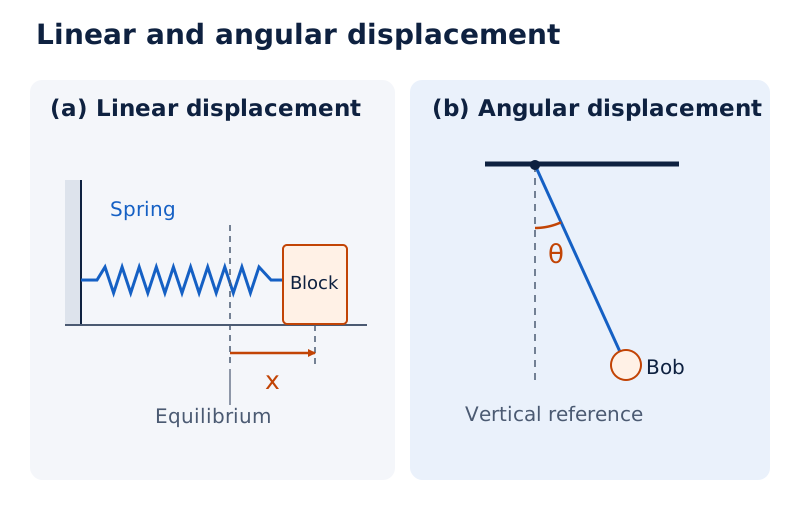
Part (a) shows a block connected to a wall by a spring, with horizontal displacement marked. Part (b) shows a suspended bob, a dashed vertical reference and the angular displacement .
Drawn by One Young India. See Fig. 13.2 in your NCERT textbook
Worked example 1. A heart beats 75 times in one minute. Find its frequency and period.
Let be the number of beats and the elapsed time. Formula: , .
Substitute:
Answer: The frequency is and the period is . This example shows why a physically meaningful frequency can be fractional.
What defines simple harmonic motion and its phase?
Definition: Simple harmonic motion, abbreviated SHM, is oscillatory motion in which displacement from equilibrium varies sinusoidally with time. Equivalently, its restoring force is proportional to displacement and directed towards equilibrium.
Let denote time, the amplitude, the angular frequency and the phase constant. The displacement is
The amplitude is the magnitude of the maximum displacement. It is taken as positive, while displacement ranges between and . Amplitude therefore differs from the total separation between the extreme positions, which is .
What information does phase provide?
The phase is . It specifies the stage of the oscillation. The phase constant is its value at , so changing the instant chosen as the time origin changes the phase constant.
Two oscillators can have the same amplitude and angular frequency but different phase constants. Their displacement curves have the same height and period, but the particles need not occupy the same position at the same instant.
The SI unit of angular frequency is radians per second. The angular frequency measures the rate at which phase advances, whereas ordinary frequency counts complete cycles per second. The mathematical constant is the ratio of a circle's circumference to its diameter.
Derivation: Angular frequency and period
- After one complete period the displacement repeats:
- The phase advances through one full cycle:
- Cancel the common terms and use the frequency definition:
Result: The period is determined by angular frequency, not by the amplitude or phase constant of ideal SHM.
What the figure shows
Amplitude and phase changes
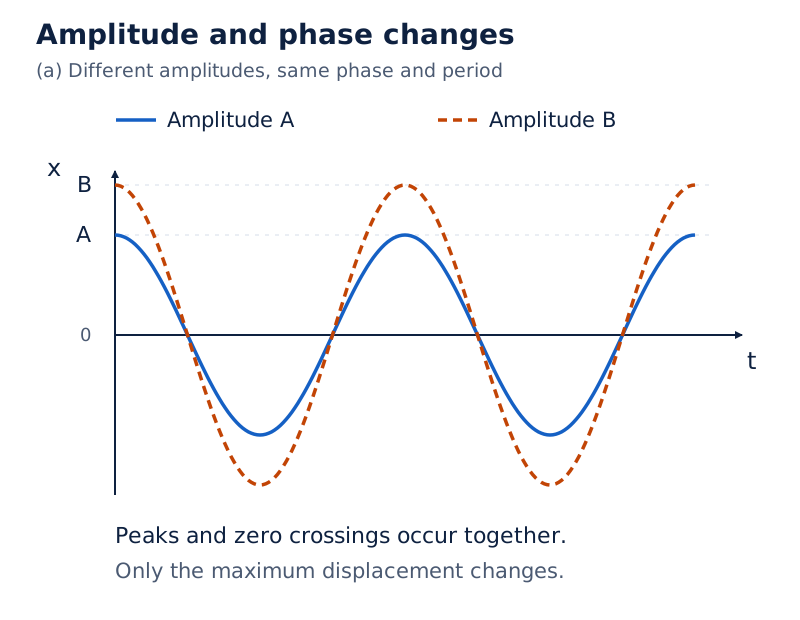
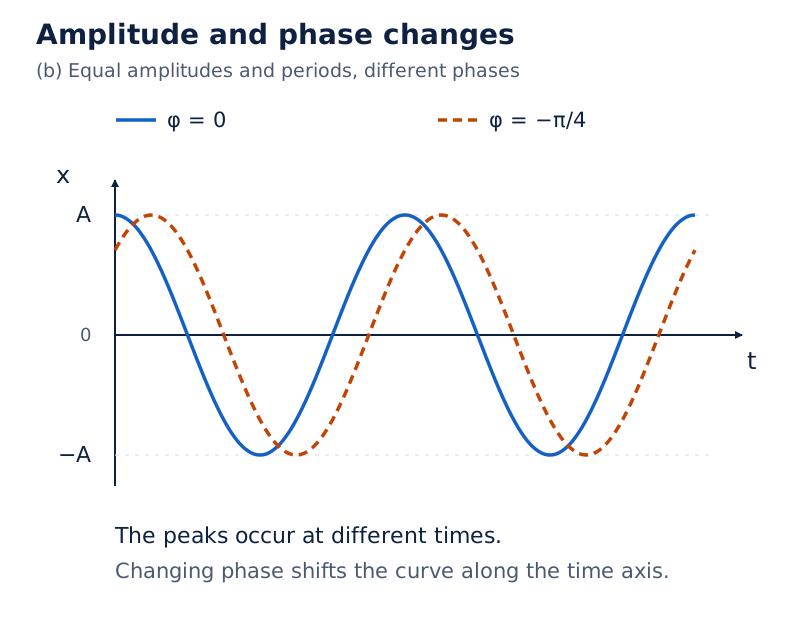
Part (a) shows two displacement curves with different heights but aligned oscillations. Part (b) shows curves of equal amplitude shifted relative to each other along the time axis.
Drawn by One Young India. See Fig. 13.7 in your NCERT textbook
How does uniform circular motion produce an SHM projection?
Consider a reference particle moving uniformly anticlockwise on a circle of radius . Let its initial angle from the positive horizontal axis be , and let its constant angular speed be .
After time , its angular position is . Its horizontal projection lies on a diameter. The projection's coordinate is the radius multiplied by the cosine of this angle:
This has exactly the form required for SHM. The radius supplies the projection's amplitude; one revolution supplies one complete oscillation. The particle on the circle has constant speed, while the projection moves fastest at the centre and momentarily stops at either end.
What changes for a perpendicular projection?
Let denote displacement of the projection on the vertical diameter. Its motion is
The two projections have equal amplitudes and periods, but differ in phase by . Both are simple harmonic. Choosing a different diameter changes the phase description rather than the physical frequency of the reference motion.
What the figure shows
The reference circle
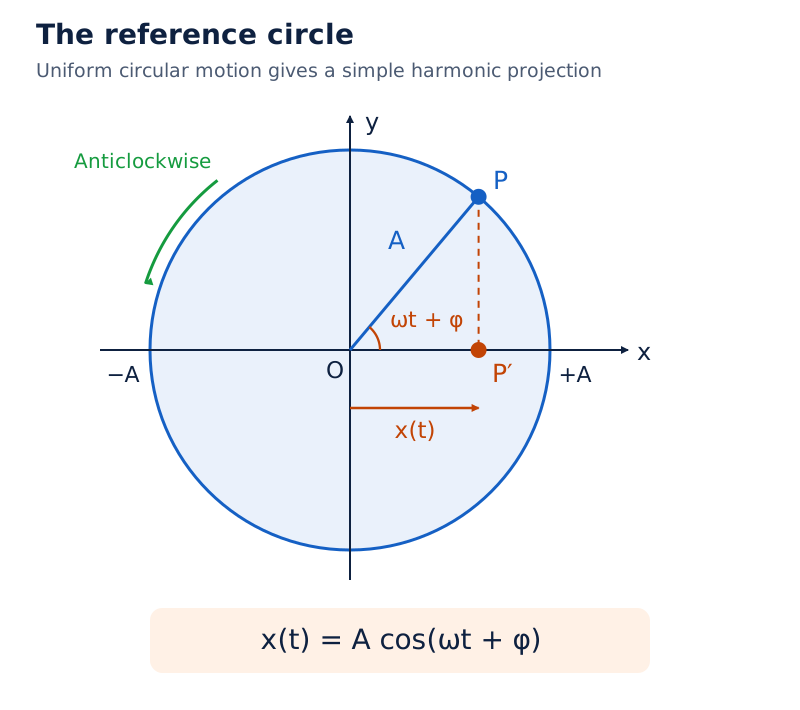
A circle is centred at O with horizontal and vertical axes. A radius joins O to P in the upper-right part of the circle. A dashed perpendicular joins P to its horizontal projection P′.
Drawn by One Young India. See Fig. 13.10 in your NCERT textbook
How should the circular analogy be used?
The reference circle gives a geometrical way to obtain displacement, velocity and acceleration. It does not mean that the actual linearly oscillating particle travels in a circle. Its trajectory remains a straight line between the extreme positions.
The forces also differ. Uniform circular motion requires a centripetal force towards the circle's centre. Linear SHM requires a restoring force along the line of oscillation whose magnitude changes with displacement. The projection connects the mathematical descriptions without making these force systems identical.
How do velocity and acceleration vary during SHM?
Let denote the instantaneous velocity and the instantaneous acceleration. Both quantities vary sinusoidally, but neither generally reaches its maximum at the same time as displacement. Their signs must be interpreted using the chosen positive direction.
Derivation: Velocity and acceleration from displacement
- Write the displacement with constant amplitude, angular frequency and phase constant:
- Differentiate once with respect to time:
- Differentiate velocity once more:
- Replace the cosine expression by displacement:
Result: Acceleration is proportional to displacement and points towards equilibrium whenever displacement is nonzero.
Let denote maximum speed and maximum acceleration magnitude. Their values are and . The SI unit of velocity is metres per second. The SI unit of acceleration is metres per second squared.
| Position | Speed | Acceleration |
|---|---|---|
| Mean position | Maximum, | Zero |
| Positive extreme | Zero | |
| Negative extreme | Zero |
Velocity differs in phase from displacement by ; acceleration differs from displacement by . At equilibrium, zero acceleration does not imply zero velocity. At an extreme, zero instantaneous velocity does not imply zero acceleration.
What the figure shows
Displacement, velocity and acceleration
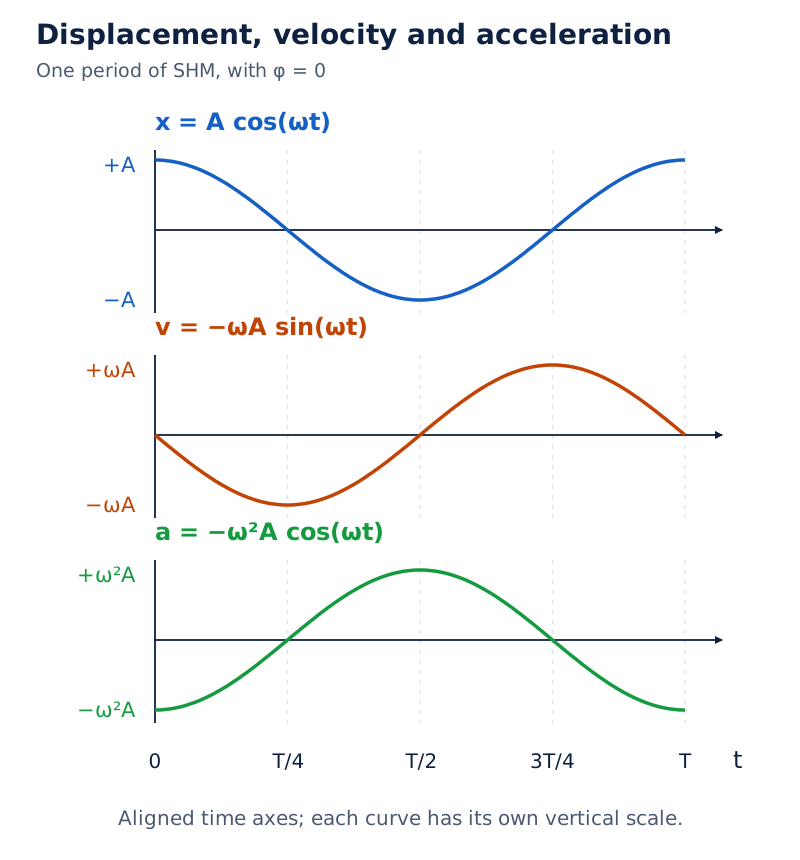
Three curves share a time axis spanning one period. Displacement starts at its positive maximum; velocity starts at zero and becomes negative; acceleration starts at its negative maximum.
Drawn by One Young India. See Fig. 13.13 in your NCERT textbook
Worked example 2. A body obeys . Find displacement, speed and acceleration at .
Formula: , , .
Substitute:
- The phase is
Answer: Displacement is approximately , speed is , and acceleration is . Velocity is positive at this instant, so its magnitude equals the stated speed.
What restoring force makes a loaded spring oscillate?
Let denote the net restoring force, the oscillating mass and the positive force constant. Newton's second law connects the SHM acceleration to its force:
The negative sign represents direction. When displacement is positive, restoring force is negative; when displacement is negative, restoring force is positive. This is why a force proportional to displacement but directed away from equilibrium does not produce SHM.
The SI unit of force is the newton. The SI unit of force constant is newtons per metre. The force constant measures how strongly the system responds to displacement. A larger force constant gives a larger restoring force for the same displacement.
How does the spring period depend on mass?
Provided the spring obeys the linear restoring-force law and dissipative effects are neglected, its angular frequency and period are
A greater mass increases the period, while a greater force constant decreases it. For a fixed mass and force constant, ideal SHM has a period independent of amplitude. Real forces may include additional nonlinear terms, so the linear model has a limited range of applicability.
Derivation: A mass between two identical springs
Attach the mass between two identical springs fixed to opposite supports. Each spring has force constant . Let and denote the forces exerted by the left and right springs respectively.
- Displace the mass a distance to the right of equilibrium. The left spring is extended and the right spring compressed by that displacement.
- Both springs restore the mass towards equilibrium:
- Add the forces and define the effective force constant :
- Use the oscillator period with this effective constant:
Result: The two restoring forces reinforce one another. Using the force constant of just one spring would miss half the restoring force.
How is energy exchanged in simple harmonic motion?
Let denote kinetic energy, potential energy and total mechanical energy. The SI unit of energy is the joule. For an ideal linear oscillator, kinetic and potential energies change throughout the motion while their sum remains constant.
Choose the zero of potential energy at equilibrium. The spring force is conservative, and its potential energy increases with the square of displacement. Kinetic energy depends on the square of speed, so reversing the velocity does not change kinetic energy.
Derivation: Conservation of oscillator energy
- Insert the velocity expression into kinetic energy:
- Use to write
- Insert displacement into the potential-energy expression:
- Add the two energies and apply the trigonometric identity:
Result: Total energy is constant and proportional to the square of amplitude, provided no dissipative force removes energy.
Where are the energies greatest?
At the mean position, potential energy is zero and all mechanical energy is kinetic. At either extreme, the particle stops momentarily, so kinetic energy is zero and all mechanical energy is potential. Between these positions, energy is continuously exchanged.
Both kinetic and potential energies repeat after , although displacement repeats after . Each energy peaks twice during one complete oscillation. Potential energy being nonnegative here follows from the chosen zero; it is not a universal requirement for all potential-energy descriptions.
What the figure shows
Energy during SHM
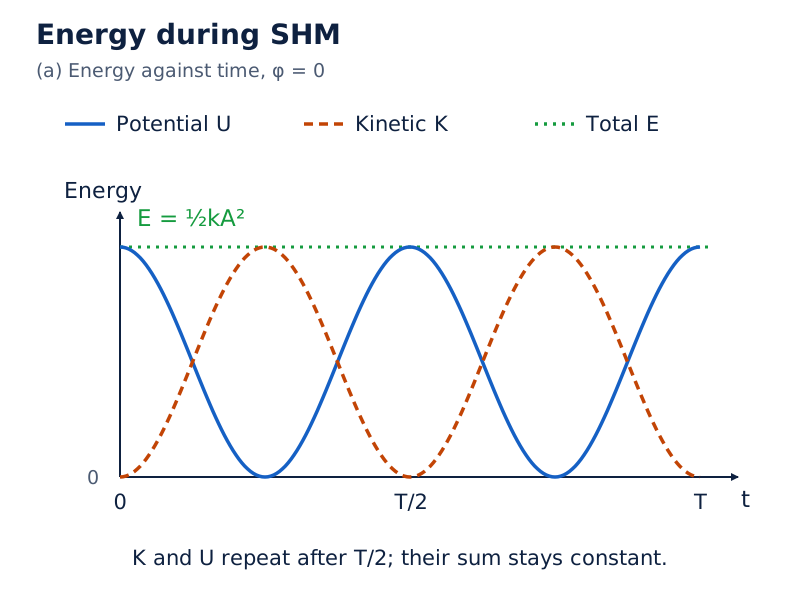
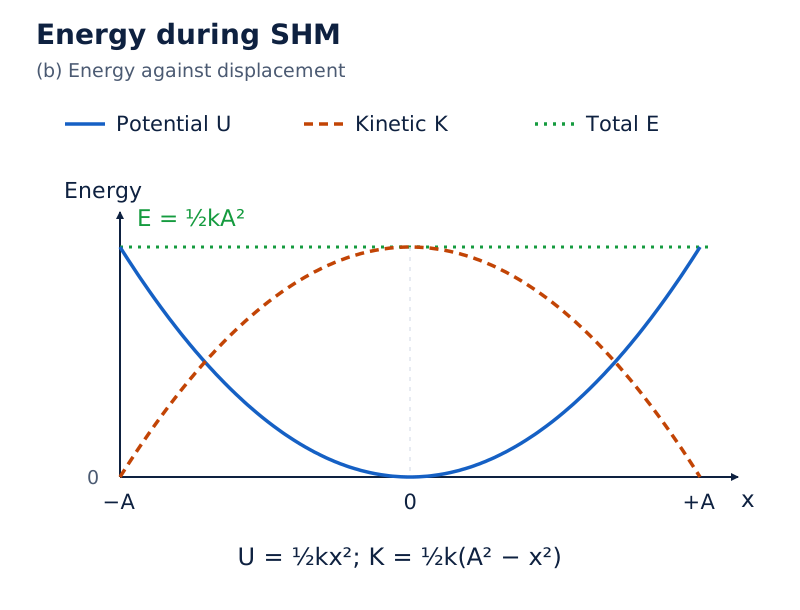
Part (a) plots alternating kinetic- and potential-energy peaks against time beneath a constant total-energy line. Part (b) plots energy against displacement, with potential energy lowest at the centre and kinetic energy lowest at the extremes.
Drawn by One Young India. See Fig. 13.16 in your NCERT textbook
Worked example 3. A block on a frictionless surface is attached to a spring with . It is pulled from equilibrium and released from rest. Find the energies at displacement .
Formula: , , .
Substitute:
Answer: Kinetic energy is , potential energy is , and total energy is . Rounding kinetic energy to two significant figures gives ; retain the unrounded value when adding the energies.
Why is a simple pendulum approximately simple harmonic?
A simple pendulum consists of a small bob of mass suspended by an inextensible, massless string of length from a rigid support. It oscillates in a vertical plane. Let denote the acceleration due to gravity.
The bob experiences gravity vertically downwards and tension along the string. Gravity has a tangential component that restores the bob towards the vertical. Tension acts along the radius and produces no torque about the support.
What the figure shows
Forces on a pendulum
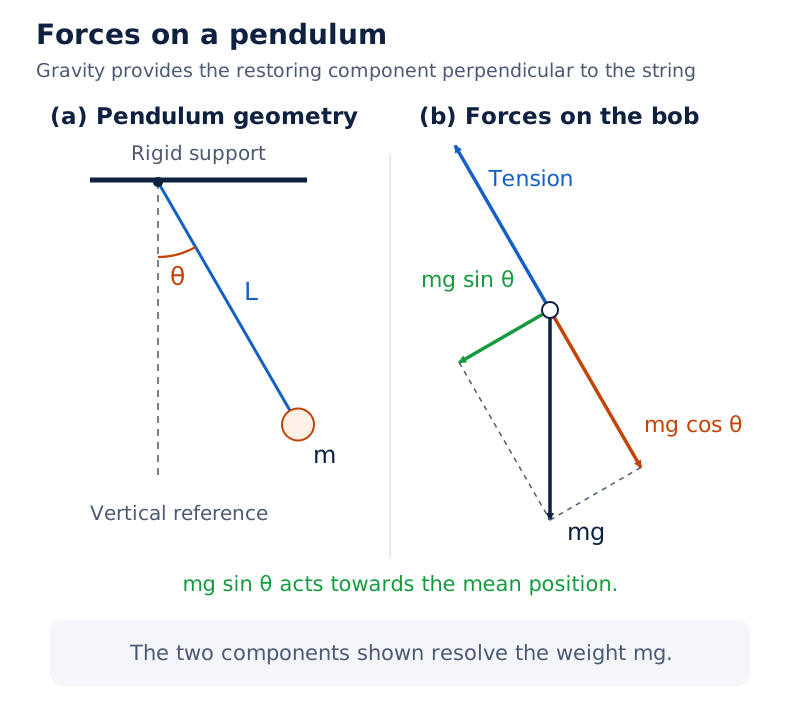
Part (a) shows the string length and a bob displaced from the dashed vertical. Part (b) resolves the downward weight into components along and perpendicular to the string and shows tension directed towards the support.
Drawn by One Young India. See Fig. 13.17 in your NCERT textbook
Derivation: The period of a simple pendulum
Let denote torque about the support, the moment of inertia about it, and angular acceleration. Measure , the displacement from the vertical, in radians.
- The tangential component of gravity produces a restoring torque:
- Apply rotational dynamics:
- For small angular displacement, use :
- The massless string and small bob give , so
- Compare with the angular SHM relation :
Result: The small-angle period depends on pendulum length and gravitational acceleration, and is independent of the bob's mass.
Why is the small-angle condition essential?
The exact restoring torque contains the sine of the angle, rather than the angle itself. Replacing the sine by the angle makes the restoring angular acceleration proportional to displacement. The resulting SHM description and period formula are therefore approximations for small swings.
Worked example 4. Find the length of a seconds pendulum. Its complete period is ; take .
Formula: , hence .
Substitute:
Answer: The required length is approximately , or about one metre. A seconds pendulum takes one second for a half-oscillation and two seconds for a complete oscillation.
How can oscillator formulas be applied to numerical problems?
Begin by identifying the physical system. A loaded spring uses mass and force constant to determine angular frequency. A small-angle pendulum uses length and gravitational acceleration. A stated displacement equation gives amplitude, angular frequency and phase directly.
Next distinguish amplitude from the full distance between extremes, and angular frequency from ordinary frequency. Convert all data to a consistent unit system before substitution. Keep units through the calculation and round only after the required quantity has been obtained.
How are spring frequency and maximum values calculated?
Worked example 5. A mass is attached to a horizontal spring with force constant . It is displaced and released from rest. Neglect friction. Find its frequency, maximum acceleration magnitude and maximum speed.
Formula: , , , .
Substitute:
Answer: Frequency is approximately , maximum acceleration magnitude is , and maximum speed is . These maxima occur at different positions.
How does a change in gravity affect a pendulum?
Worked example 6. A pendulum has period on Earth. Find its period on the Moon, keeping its length unchanged. Take terrestrial gravity as and lunar gravity as . Assume small oscillations.
Subscripts and identify Earth and Moon values. Formula: , . Dividing eliminates the unchanged length.
Substitute:
Answer: The lunar period is approximately . Weaker gravitational acceleration gives a longer period for the same pendulum length.
In the spring example, the given release from rest identifies the initial displacement as the amplitude. In the pendulum example, the length cancels only because the same pendulum is used. These conditions explain which data enter each formula.
How can periodic functions and initial conditions be interpreted?
A sinusoidal expression with one angular frequency describes SHM about its equilibrium value. A combination of sine and cosine terms at that same frequency can also be written as one sinusoid. More complicated periodic expressions need not represent a single SHM.
Which functions repeat?
Let be a positive constant and time. The symbol denotes the base of natural logarithms. Treat the expressions below as dimensionless functions for identifying periodicity. A dimensional displacement would require the appropriate amplitude factor.
| Function | Behaviour | Period |
|---|---|---|
| One sinusoid after combination | ||
| Periodic combination of different frequencies | ||
| Harmonic variation about one-half | ||
| Monotonically decreasing, non-periodic | No period |
The squared sine illustrates the importance of identifying the equilibrium value correctly:
Its oscillation is centred on one-half rather than zero. Its angular frequency is twice that in the original sine argument. The constant offset shifts the mean value without destroying the harmonic variation around that mean.
How is the starting state specified?
For a fixed angular frequency, two initial conditions determine linear SHM. They may be initial position and initial velocity, or amplitude and phase. Let and denote position and velocity respectively at .
The velocity sign distinguishes motion towards one side from motion towards the other. A particle can pass through the same displacement twice in a cycle with opposite velocities. A complete description must therefore retain directional information, not merely the distance from equilibrium.
Changing phase changes the starting state but not the ideal oscillator's period. Changing amplitude changes maximum displacement, maximum speed and total energy. Changing angular frequency changes the period and the rate at which the particle progresses through its cycle.
Glossary
- Periodic motion — Motion that repeats itself after equal intervals of time, completing the same cycle repeatedly.
- Oscillatory motion — Repeated to-and-fro movement of a body about a mean or equilibrium position.
- Equilibrium position — Position at which the net external force vanishes and a body initially at rest remains at rest.
- Time period — Smallest interval of time after which a complete cycle of motion repeats.
- Frequency — Number of complete oscillations per unit time, equal to the reciprocal of the period.
- Amplitude — Magnitude of the greatest displacement from equilibrium reached during an oscillation.
- Simple harmonic motion — Oscillatory motion whose displacement from equilibrium is a sinusoidal function of time.
- Angular frequency — Rate of advance of oscillation phase, equal to ordinary frequency multiplied by twice pi.
- Phase — Quantity specifying the stage of a sinusoidal oscillation at a particular instant.
- Phase constant — Initial value of phase, fixed by the starting state and chosen time origin.
- Restoring force — Force directed towards equilibrium that tends to reduce the displacement of an oscillating body.
- Force constant — Positive proportionality constant relating restoring-force magnitude to displacement magnitude in a linear oscillator.
- Reference circle — Circle used to represent SHM as the diameter projection of uniform circular motion.
- Simple pendulum — Idealised small bob suspended from a rigid support by an inextensible, massless string.
Common errors and misconceptions
- Misconception: Every periodic motion is SHM. Correct: SHM requires sinusoidal displacement from equilibrium or an equivalent linear restoring-force law.
- Misconception: Amplitude is the distance between the extreme positions. Correct: That distance is ; amplitude is measured from equilibrium to either extreme.
- Misconception: Acceleration is greatest at equilibrium because speed is greatest there. Correct: Acceleration is zero at equilibrium and greatest in magnitude at the extremes.
- Misconception: Zero velocity at an extreme means the resultant force is zero. Correct: The restoring force has its greatest magnitude there and reverses the motion.
- Misconception: Kinetic and potential energies each remain constant. Correct: They exchange continuously; their sum remains constant for an ideal conservative oscillator.
- Misconception: Frequency and angular frequency are interchangeable. Correct: ; frequency is measured in hertz and angular frequency in radians per second.
- Misconception: The simple-pendulum period formula is exact for every swing size. Correct: It uses the small-angle approximation and describes approximately harmonic motion.
- Misconception: A seconds pendulum has a one-second complete period. Correct: One second corresponds to a half-oscillation; its complete period is .
Exam-style questions with model answers
Q1. Define the period and frequency of an oscillation, and state their relation. [2 marks]
- The period is the smallest time interval after which the motion repeats, measured in seconds.
- The frequency counts oscillations per unit time, measured in hertz, and satisfies .
Q2. Explain why uniform circular motion and its projection on a diameter have different motion descriptions. [3 marks]
- A particle in uniform circular motion follows a circular path at constant speed. Its trajectory itself is not a to-and-fro motion along a straight line.
- For radius , angular speed , time and initial angle , its diameter projection has displacement , which defines SHM.
- The projection moves between opposite ends of the diameter, with greatest speed at the centre and zero speed at either end, although the reference particle's speed remains constant.
Q3. Starting from , derive velocity and acceleration and state their values at equilibrium. Here is displacement, amplitude, angular frequency, time and phase constant. [4 marks]
- Velocity is the first time derivative of displacement. Differentiating the cosine and its argument gives .
- Acceleration is the time derivative of velocity. Therefore .
- Substituting the original displacement expression gives , so acceleration is directed towards equilibrium for nonzero displacement.
- At equilibrium, and , while speed is greatest: . Zero acceleration at this instant does not mean that the particle is stationary.
Q4. A frictionless spring oscillator has force constant . It is released from rest at displacement . Calculate total, potential and kinetic energies at displacement . Take potential energy as zero at equilibrium. [3 marks]
- The release displacement is the amplitude . With force constant , total energy is , and remains constant because friction is absent.
- At the specified displacement , potential energy is , using the stated equilibrium reference.
- Kinetic energy is the remaining part of the total: . Adding the unrounded energies recovers the same conserved total.
Q5. Derive the period of a simple pendulum of length , with a small bob of mass and a massless, inextensible string. Gravitational acceleration is . State the approximation used. [5 marks]
- Let be angular displacement from the vertical and torque about the support. The tangential gravitational component gives restoring torque ; the negative sign shows its restoring direction.
- Let be moment of inertia about the support and angular acceleration. Rotational dynamics gives , hence .
- For small angular displacement measured in radians, . Consequently, , making angular acceleration proportional to angular displacement and oppositely directed.
- For the small bob and massless string, . Thus . Comparing with SHM defines angular frequency .
- The period is . Mass cancels, and the formula applies to small oscillations under the stated ideal-pendulum assumptions.
Q6. Prove that the total energy of an ideal spring oscillator is constant. Let be mass, force constant, amplitude, angular frequency, time and phase constant. Use , , , and . Neglect friction. [5 marks]
- The kinetic energy, denoted by , is . Squaring velocity removes its directional sign, as required for kinetic energy.
- Substituting the supplied relation between force constant, mass and angular frequency gives , expressing both energies with the same coefficient.
- Potential energy, denoted by , is after substituting displacement into the supplied spring-energy expression.
- Total mechanical energy, denoted by , is . The identity therefore gives .
- This final expression contains no time dependence. Kinetic and potential energies exchange during the motion, but their sum remains constant under the stated absence of friction.
Q7. A heart beats 75 times per minute. Calculate the frequency and the period, taking one minute as 60 seconds. [2 marks]
- The frequency is , the number of beats per second.
- The period is the reciprocal: , the time taken for one beat.
Q8. A mass lies between two identical springs attached to opposite fixed supports. Each spring has force constant and obeys Hooke's law. Neglect friction. Derive the net restoring force and period for displacement from equilibrium. [3 marks]
- Displacement to the right extends the left spring and compresses the right spring by . Each force points back towards equilibrium: and , where the subscripts identify the two springs.
- The net force is . It is proportional to displacement and oppositely directed, establishing SHM with effective force constant .
- The angular frequency is , and the period is . Both springs must be included in the restoring force.
Key takeaways
- Periodic motion repeats regularly; simple harmonic motion additionally requires sinusoidal displacement from equilibrium and a linear restoring force.
- Period and frequency are reciprocals, while angular frequency measures phase advance and equals twice pi times ordinary frequency.
- Amplitude gives maximum displacement from equilibrium; phase specifies the stage of motion relative to the chosen time origin.
- The diameter projection of uniform circular motion performs SHM, even though the reference particle itself follows a circular path.
- Speed is greatest at equilibrium, whereas acceleration and restoring-force magnitudes are greatest at the extreme positions.
- Kinetic and potential energies exchange during ideal SHM, but total mechanical energy remains constant without dissipative forces.
- A loaded spring's period depends on mass and force constant, while its amplitude sets the total oscillation energy.
- A simple pendulum performs approximately SHM for small angles; its period depends on length and gravitational acceleration.
Test yourself
Why does returning to the same position not necessarily complete an oscillation?
The particle may pass that position in the opposite direction. A complete cycle restores both position and the state of motion.
Where is a particle's acceleration zero during ideal SHM?
At equilibrium, displacement is zero, so the relation gives zero acceleration even though speed is greatest.
What is the physical meaning of the negative sign in ?
The force points opposite to displacement, towards equilibrium; the negative sign does not mean that the force constant is negative.
How do the energy periods compare with the displacement period?
Kinetic and potential energies each repeat after half the displacement period because each reaches its maximum twice per complete oscillation.
Why does bob mass disappear from the simple-pendulum period?
Mass appears in both the gravitational restoring torque and the moment of inertia, so it cancels from the angular-acceleration equation.
Which approximation makes the pendulum equation simple harmonic?
For small angles measured in radians, , making angular acceleration proportional to angular displacement and oppositely directed.
What remains unchanged if only the phase constant of an ideal SHM is changed?
Its amplitude, angular frequency and period remain unchanged. The phase constant changes the starting state relative to the chosen time origin.
Why is a constant total-energy line compatible with changing speed?
Kinetic energy rises as potential energy falls, and vice versa, so their sum stays constant while speed varies.
Write about it
Turn a question from this chapter into a paper.
The Writing Studio has a structure guide, a rubric and citation tools for 15 formats, from essays to research papers. Drafting is free with an account. Learnacy Essential adds feedback from an AI writing coach and submission to The OYI Review.
Learnacy Essential is ₹1,499 for the year. Publication depends on review and is not guaranteed.