
Mechanical Properties of Fluids | CBSE Class 11 Physics Notes
On this page
Watch & explore
Start with a few high-quality watches, then dive into the notes below.

This note covers fluids, pressure and density, Pascal’s law, pressure measurement, hydraulic machines, streamline flow, continuity, Bernoulli’s principle, efflux and dynamic lift, viscosity, Stokes’ law, terminal velocity, surface energy, surface tension, contact angle, drops, bubbles and capillary rise.
What makes a fluid different from a solid?
Flow, shape and compressibility
Fluids are liquids and gases that can flow. They have no definite shape of their own and offer very little resistance to shear stress. A small shearing stress can therefore change their shape.
A liquid has a nearly fixed volume under atmospheric pressure, while a gas fills its container. Liquids and solids have much lower compressibility than gases. Describing liquids as incompressible is a useful approximation, rather than a claim that their volume cannot change.
How are pressure and density defined?
Let be the magnitude of the normal force on a surface and its area. The average pressure is The SI unit of pressure is the pascal:
Pressure is scalar. It uses the normal component of force, not a force vector divided by area. A resting fluid exerts force perpendicular to a surface, since a tangential component would cause the fluid to flow.
For pressure at a point, let be the normal force on a small area . Then Pressure exists within a fluid as well as at its container walls.
If is mass and is volume, density is The SI unit of density is . The SI unit of force is the newton, and the SI unit of area is the square metre.
Relative density is the ratio of a substance’s density to water’s density at . It is dimensionless. At that temperature water has density ; aluminium’s relative density is .
Worked example 1. Two femurs, each of cross-sectional area , support a mass of . Take gravitational acceleration . Find the average pressure.
Formula: , , , where is one femur’s area. Substitute:
Answer: the average pressure is .
How does pressure change with depth?
In a fluid at rest, pressure at a point is the same in every direction. In a connected liquid in equilibrium, pressure is also the same at all points in a horizontal plane. Unequal horizontal pressures would produce a net force and cause flow.
Pressure increases downwards because lower layers support the weight of liquid above them. For a liquid of uniform density, the pressure difference depends on vertical separation, density and gravitational acceleration. Container shape and the amount of liquid do not enter this result.
Derivation: pressure difference in a resting liquid
Consider a vertical liquid cylinder of area , height , volume and mass . Let be pressure at its top and pressure at its bottom; is its constant density and gravitational acceleration.
- Vertical equilibrium balances the upward and downward forces:
- Write the mass using the cylinder’s volume:
- Substitute the mass and cancel the common area:
- For a free surface at atmospheric pressure , the absolute pressure at depth is
Result: the gauge pressure , meaning pressure above atmospheric pressure, is This form assumes that the liquid density remains constant with depth.
The hydrostatic paradox illustrates this independence from vessel shape. Differently shaped vessels connected at the bottom have the same liquid level in equilibrium, even though they contain different quantities of liquid. The bottom pressures are equal.
Worked example 2. A swimmer is below a lake surface. Use , and . Find gauge and absolute pressures.
Formula: , . Substitute:
Answer: gauge pressure is ; absolute pressure is , approximately twice atmospheric pressure.
How do barometers and manometers measure pressure?
Atmospheric pressure and the mercury barometer
Atmospheric pressure at a point equals the weight per unit area of the air column above it. At sea level, one atmosphere is . Air density changes substantially with height, so a constant-density atmosphere is an approximation.
A mercury barometer uses a mercury-filled tube, closed at one end and inverted into a mercury trough. The pressure of mercury vapour above the column is sufficiently small to neglect. The column’s hydrostatic pressure balances atmospheric pressure.
For mercury density , column height above the trough and gravitational acceleration , At sea level the mercury height is about .
The open-tube manometer
An open-tube manometer contains liquid in a U-tube. One end connects to the system being measured and the other opens to the atmosphere. For the illustrated arrangement, the system pressure exceeds atmospheric pressure and where is the vertical difference between liquid levels.
Equal pressures at the same level in the connected manometer liquid provide the working principle. A low-density liquid such as oil suits small pressure differences; a high-density liquid such as mercury suits large differences.
What the figure shows
Pressure-measuring devices
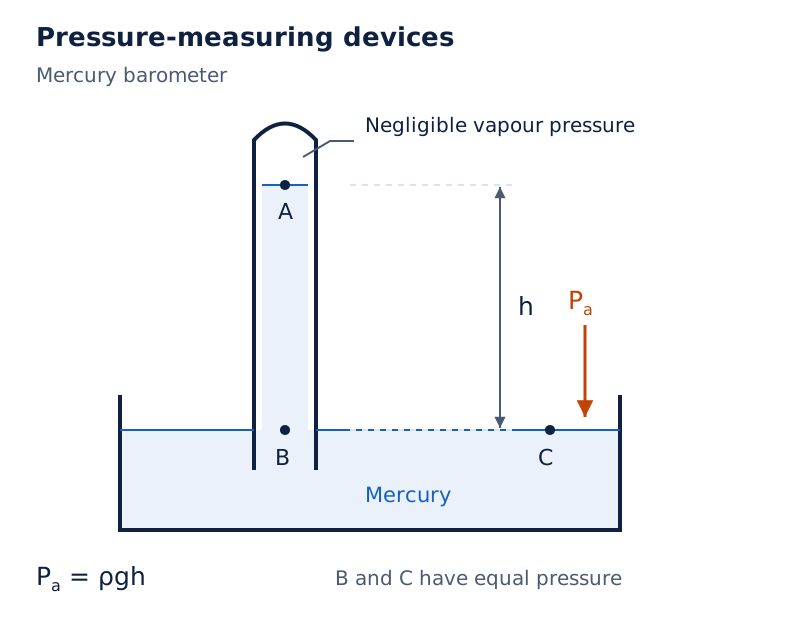
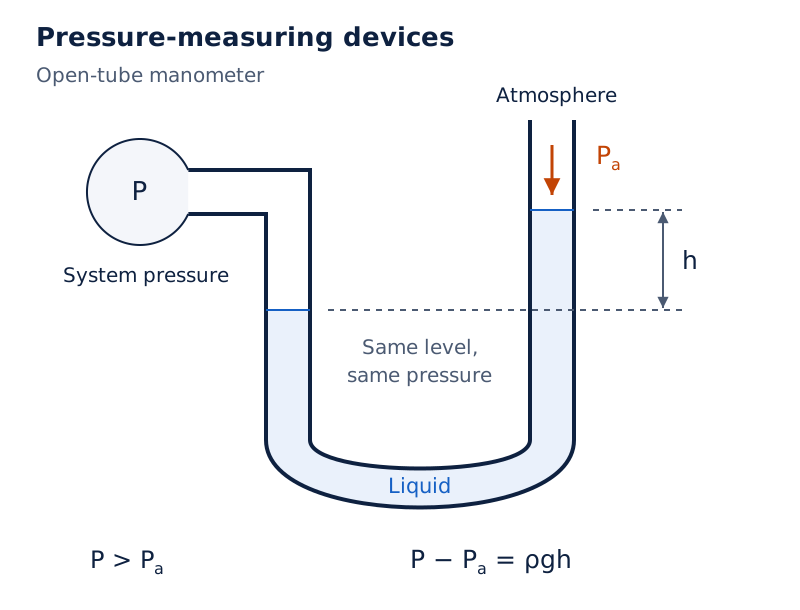
The barometer drawing shows an inverted tube in a mercury trough, column height , and points A, B and C. The manometer shows a U-tube connected to pressure , an atmospheric opening and a level difference .
Drawn by One Young India. See Fig. 9.5 in your NCERT textbook
| Pressure unit | Equivalent | Context |
|---|---|---|
| Atmosphere | Sea-level atmospheric reference | |
| Bar | Meteorology | |
| Torr | Pressure equivalent of one millimetre of mercury |
Note: Absolute pressure includes atmospheric pressure. Gauge pressure measures the difference from it. Tyre-pressure gauges and blood-pressure gauges measure gauge pressure; the two pressure conventions must be distinguished in calculations.
How does Pascal’s law explain hydraulic machines?
Pascal’s law states that an externally applied pressure change in an enclosed fluid is transmitted undiminished throughout the fluid and to the vessel walls. This is a statement about the transmitted change; hydrostatic pressure can still vary with height.
Let and be the small and large piston areas, with applied force and supported force . In the hydraulic arrangement, Common atmospheric pressure on both pistons cancels.
The force increases because the output piston has greater area. The mechanical advantage is the area ratio. If and are the piston displacements, incompressibility gives The larger piston therefore moves a smaller distance.
What the figure shows
Hydraulic lift
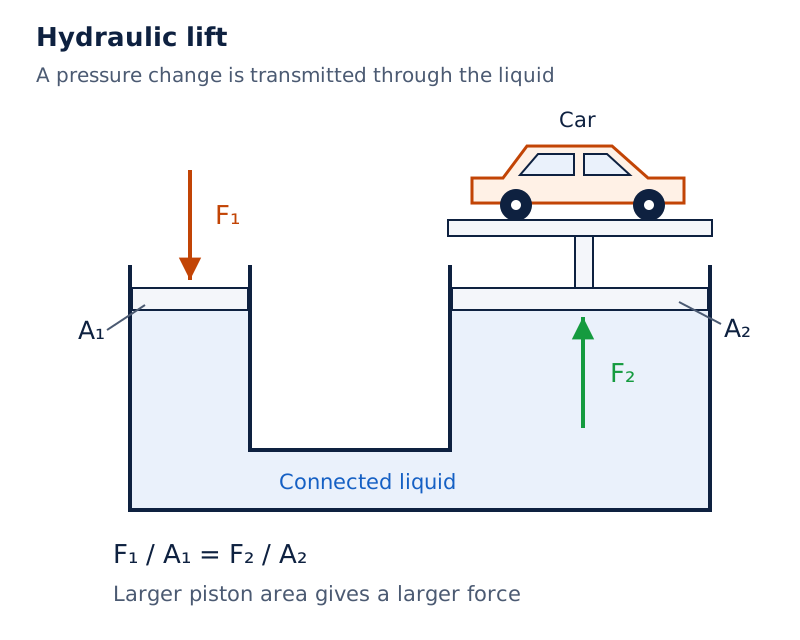
The drawing shows connected liquid beneath two pistons. A downward arrow acts on the smaller piston of area . An upward arrow acts below the larger piston of area , which supports a car.
Drawn by One Young India. See Fig. 9.6b in your NCERT textbook
Worked example 3. Water-filled syringes have piston diameters and . The smaller piston receives and moves . Find the larger piston’s force and displacement.
Formula: , . For circular pistons, the area ratio equals the squared diameter ratio. Substitute:
Answer: the larger piston exerts and moves about .
Why do hydraulic brakes work?
Pressing the pedal moves the master piston. Pressure travels through brake oil to larger pistons, producing forces that press brake shoes against the brake lining. The system transmits the pressure to the cylinders attached to all four wheels.
In both lifts and brakes, distinguish pressure transmission from force multiplication. A common transmitted pressure acts over different piston areas; it does not imply equal forces on differently sized pistons.
What are streamlines and the equation of continuity?
In steady flow, the velocity at a fixed point remains constant with time. Velocities at different positions can still differ. A particular fluid particle can accelerate while travelling through such a flow.
A streamline has a tangent in the direction of the local fluid velocity. In steady flow it traces a particle’s path. Two streamlines cannot intersect, because the intersection would assign two possible velocity directions to the same point.
Derivation: conservation of mass in a flow tube
Take two sections with areas , speeds and densities . Let be a short time interval and the masses passing the respective sections.
- The mass entering during the interval is
- The mass leaving during the same interval is
- Conservation of mass in steady flow gives
- For an incompressible fluid, densities cancel with the time interval:
Result: narrower portions have greater flow speed. The product , where is cross-sectional area and local flow speed, is volume flow rate, whose SI unit is . The continuity equation follows from mass conservation.
How does turbulent flow differ?
At low speeds, flow can remain smooth and steady. Beyond a limiting critical speed, it loses steadiness and becomes turbulent. A fast stream meeting rocks can form whirlpool-like white-water regions.
In laminar flow, layers move smoothly past one another. Their speeds need not be equal. In turbulent flow, velocity and pressure fluctuate with time, so the steady-flow treatment and its simple streamline map no longer apply.
How is Bernoulli’s equation derived and when is it valid?
Bernoulli’s principle relates pressure, speed and height along a streamline. It applies to steady flow of an incompressible, non-viscous fluid. Real fluids have viscosity, so its use for low-viscosity flows is an approximation.
Pressure forces do work that changes kinetic and gravitational potential energies. The equation does not include energy lost through viscous friction or the elastic energy associated with compressibility.
Derivation: pressure work and mechanical energy
At two sections let pressures be , speeds , and heights above a common reference be . A volume , of mass , passes each section. Let denote net pressure work, kinetic-energy change and potential-energy change.
- The net work on the fluid is
- The kinetic-energy change is
- The gravitational potential-energy change is
- Apply conservation of mechanical energy:
- Divide by the transferred volume and rearrange:
Result: along a streamline, where is local speed and is height. The three terms represent pressure, kinetic energy per unit volume and gravitational potential energy per unit volume.
What the figure shows
Flow through a pipe of varying cross-section
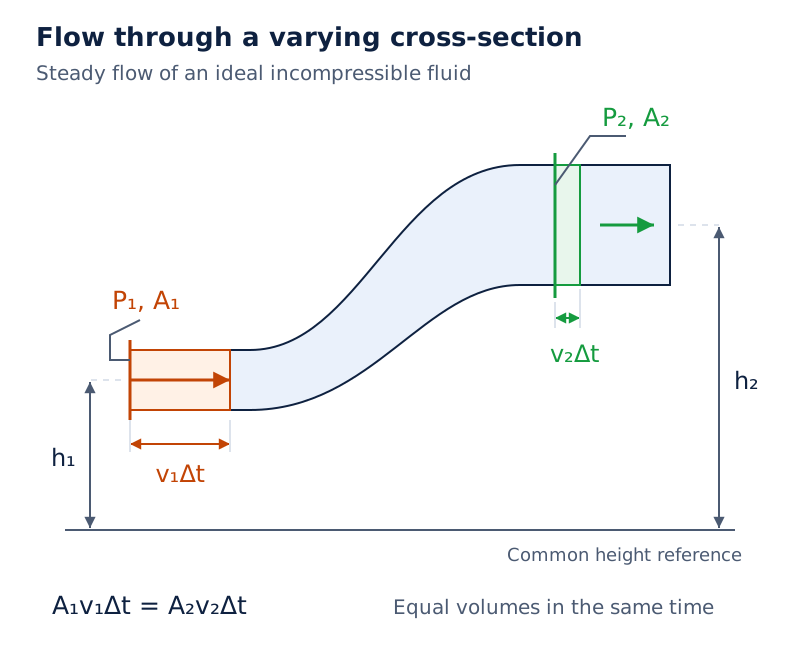
A pipe rises from a narrower lower section to a wider upper section. The drawing labels pressures , areas , heights , and travelled lengths , where is the time interval.
Drawn by One Young India. See Fig. 9.9 in your NCERT textbook
Note: Higher speed implies lower pressure along a horizontal streamline under Bernoulli’s assumptions. When height also changes, the gravitational term must be included. Turbulent or significantly viscous flow cannot be treated using this unmodified equation.
When speed is zero everywhere, Bernoulli’s equation reduces to hydrostatic pressure variation. This connects moving-fluid energy conservation with the force-balance result for a stationary liquid.
How do efflux and dynamic lift follow from Bernoulli’s principle?
Derivation: Torricelli’s law for an open tank
Let be the outflow speed through a small hole, its depth below the liquid surface, and the liquid density. The tank is open to atmospheric pressure , and its cross-sectional area is much larger than the hole’s area.
- Continuity makes the surface speed negligible compared with the exit speed:
- Choose the hole as the height reference and apply Bernoulli’s equation:
- Cancel equal atmospheric pressures and density:
- Take the positive speed:
Torricelli’s law: the ideal efflux speed equals the speed acquired by falling freely through the same vertical distance. The large-tank, small-hole approximation is necessary to neglect motion of the top surface.
If pressure above the liquid differs from atmospheric pressure, the corresponding result is Pressure above the liquid can therefore contribute to the outflow speed.
Spinning balls and aerofoils
Dynamic lift acts on a body moving through a fluid. A spinning ball drags surrounding air, changing the relative speeds on its two sides. The resulting pressure difference produces lift, called the Magnus effect. Bernoulli’s principle partly explains the departure from a parabolic path.
For an aerofoil, the wing’s orientation relative to the flow crowds streamlines above it. Faster air above corresponds to lower pressure, giving an upward force. In level flight this lift balances the aircraft’s weight.
Worked example 4. Air speeds above and below a model wing are and . Its area is and air density is . Neglect the height difference and find the lift.
Formula: , . Here is lower pressure minus upper pressure, and are upper and lower speeds. Substitute:
Answer: the upward lift is approximately .
What is viscosity and how can it be measured?
Viscosity is the internal resistance associated with relative motion between fluid layers. Faster layers pull slower neighbouring layers forward, while slower layers retard faster ones. Maintaining such relative motion requires a force.
For a liquid between parallel plates, the liquid touching a stationary plate is stationary. The layer touching a moving plate shares its velocity. In the illustrated laminar arrangement, layer speeds increase uniformly between the plates.
Coefficient of viscosity
Let be the plate separation, the relative plate speed, the contact area and the required tangential force. The shear stress is , while the strain rate is . The coefficient of viscosity is
The SI unit of coefficient of viscosity is , also called poiseuille. Equivalently, Fluid shear stress depends on the rate of shear strain, unlike the elastic-solid relation involving shear strain itself.
What the figure shows
Velocity distribution in viscous flow
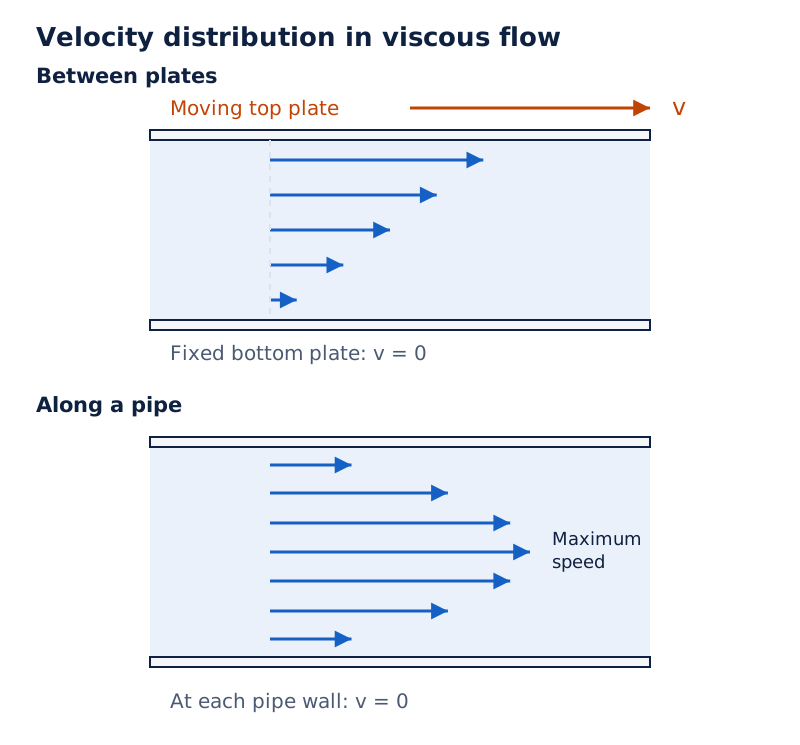
The upper drawing shows a liquid layer between plates, with the top moving right and the bottom fixed. The lower drawings show rightward velocity arrows longest along a pipe’s centre and shortening towards its walls.
Drawn by One Young India. See Fig. 9.12 in your NCERT textbook
Worked example 5. A block of area moves at constant speed over a liquid film thick. A hanging mass of pulls it through an ideal pulley. Use .
Formula: , . Constant speed makes the pulling force balance viscous resistance. Substitute:
Answer: viscosity is approximately .
The viscosity of liquids decreases with temperature, while that of gases increases. Heating makes liquid molecules more mobile; in gases it increases their random motion. Blood is more viscous than water, and honey offers greater resistance than oil in the plate experiment.
How does Stokes’ law lead to terminal velocity?
A sphere moving through a viscous fluid drags the adjacent fluid and experiences an opposing force. Stokes’ law gives the magnitude of this viscous drag as where is drag force, the sphere’s radius, its speed and the fluid’s viscosity. The symbol is the circle constant.
A falling sphere initially accelerates. As its speed increases, viscous resistance increases. Eventually drag plus upward buoyant force balances its weight. Its acceleration then becomes zero, and it falls with constant terminal velocity.
Derivation: terminal speed of a falling sphere
Let be the sphere’s density, the surrounding fluid’s density and the downward terminal speed. Assume the sphere is denser than the fluid and the viscous drag is described by Stokes’ law.
- Write the sphere’s weight :
- The buoyant force equals the weight of displaced fluid:
- At terminal speed, the net force vanishes:
- Rearrange to obtain
Result: for a fixed density difference and viscosity, terminal speed varies as the square of sphere radius. For a fixed sphere and density difference, it decreases as viscosity increases.
Worked example 6. A copper ball of radius falls through oil at with terminal speed . Densities are for copper and for oil. Use .
Formula: . Substitute:
Answer: the oil’s viscosity is approximately .
Why does a liquid surface possess energy and tension?
Molecules within a liquid are surrounded by neighbouring molecules. A surface molecule has fewer liquid neighbours and extra potential energy relative to an interior molecule. Creating additional surface therefore requires energy.
A liquid tends towards the least surface area permitted by external conditions. Surface energy belongs to the interface between materials and depends on the materials on both sides. It is not simply a property of one fluid in isolation.
Derivation: surface tension of a film
Consider a film with a movable bar of length . Let be a small outward displacement, the balancing applied force and the surface energy per unit area. Let denote the total increase in surface area and the increase in surface energy.
- The film has two faces, giving
- The added surface energy is
- Work by the balancing force supplies this energy:
- Cancel the displacement to obtain
Surface tension is thus both force per unit length of interface and surface energy per unit area. The SI unit of surface tension is , equivalent to .
What the figure shows
Stretching a liquid film
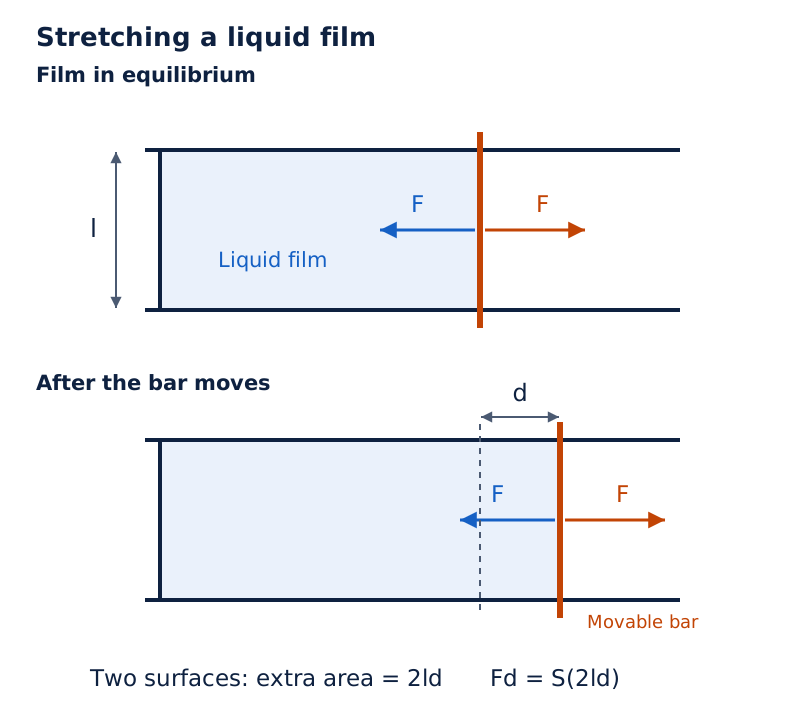
Two drawings show a film between parallel guides and a movable bar of length . Opposite horizontal force arrows are labelled ; the second drawing marks the bar’s extra displacement .
Drawn by One Young India. See Fig. 9.15 in your NCERT textbook
Surface tension acts in the interface, perpendicular to an imaginary line drawn on it. Equal and opposite pulls act across an internal line. At the boundary, the film pulls inward on the movable bar.
Temperature matters: surface tension of a liquid usually falls as temperature rises. At , the listed liquid-air surface tensions are for ethanol and for water.
How can a glass plate measure surface tension?
A vertical glass plate forms one arm of a balance, with its horizontal lower edge just above a liquid. Raising the vessel brings the liquid into contact with the plate. The liquid pulls the plate down, and extra weights restore balance until the plate just clears the liquid.
Let be the extra mass, its weight, the plate-edge length and the liquid-air surface tension. The two sides of the edge contribute, giving The balancing weight measures the surface-tension force.
What does the angle of contact tell us about wetting?
The angle of contact, denoted by , is the angle between the tangent to the liquid surface and the solid surface at their contact, measured inside the liquid. Its value depends on the liquid-solid pair.
Water spreads on clean glass, while mercury on glass tends to form drops. Water can also form droplets on a lotus leaf. These differences arise from the balance of interfacial energies, rather than from a liquid having one fixed wetting behaviour on every surface.
Balance of interfacial tensions
Let , and represent liquid-air, solid-air and solid-liquid interfacial tensions respectively. Equilibrium at the contact line gives This relation connects the angle with all three interfaces.
| Behaviour | Contact angle | Example and implication |
|---|---|---|
| Wetting | Acute angle measured inside liquid | Water on clean glass tends to spread |
| Non-wetting | Obtuse angle measured inside liquid | Mercury on glass tends to form drops |
| Wetting agents | Make the angle small | Soaps and detergents help liquid penetrate |
| Waterproofing agents | Create a large angle | Reduce wetting of fibres by water |
When liquid molecules are strongly attracted to the solid, the solid-liquid interfacial energy is reduced and the angle can decrease. When attraction among liquid molecules dominates over attraction to the solid, the liquid does not wet the surface.
Wetting agents, including soaps, detergents and dyeing substances, reduce the angle of contact so that liquids can penetrate effectively. Waterproofing treatments act in the opposite direction by creating a large contact angle between water and fibres.
Why is pressure higher inside drops and bubbles?
When gravity and other external effects can be neglected, a free liquid drop tends to be spherical. For a given volume, the sphere has the least surface area and therefore the least surface energy.
A curved interface also produces an excess pressure on its concave side. Count the number of interfaces carefully: a liquid drop in air and an air cavity in liquid each have one; a soap bubble has two.
Derivation: excess pressure inside a spherical drop
Let be drop radius, surface tension, internal pressure and external pressure. Let be a very small radius increase, with corresponding volume increase and surface-energy increase .
- To first order in the radius increase,
- The corresponding volume increase is
- Pressure work supplies the extra surface energy:
- Cancel common factors:
Two-interface bubble: a soap bubble has twice the surface-energy increase, so An air bubble inside a liquid still uses the single-interface expression.
What the figure shows
Drop, cavity and bubble
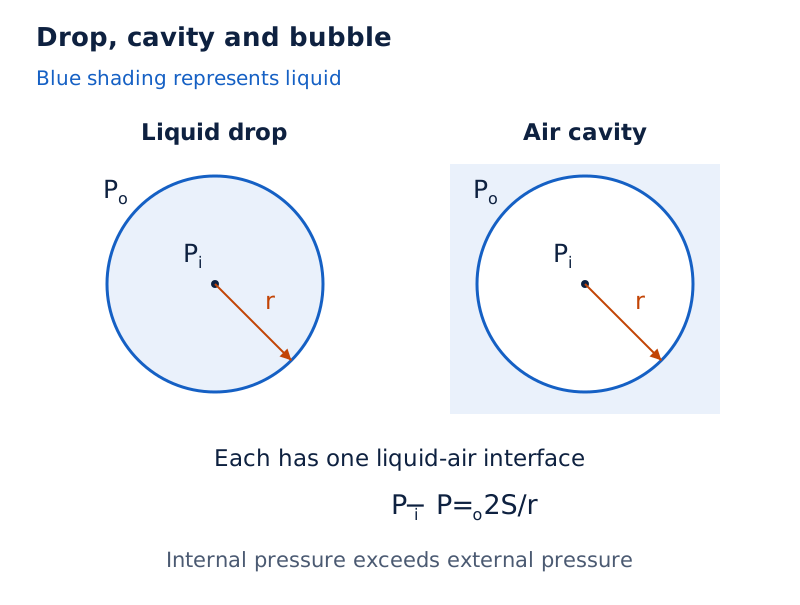
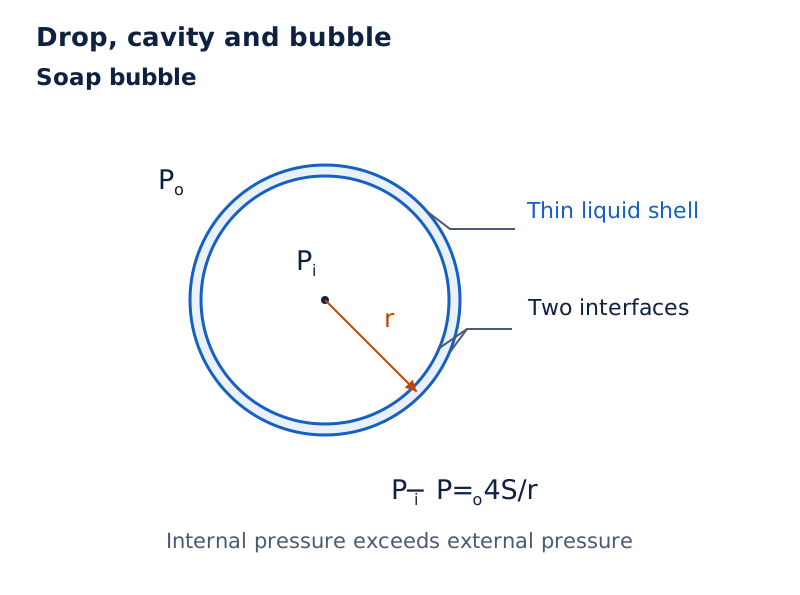
Three circular cross-sections show a shaded liquid drop, an unshaded cavity surrounded by liquid, and a bubble with a thin shaded shell. Radius , internal pressure and external pressure distinguish the configurations.
Drawn by One Young India. See Fig. 9.18 in your NCERT textbook
Worked example 7. A tube of diameter ends below water. Find the pressure needed for a hemispherical air bubble at its end. Use , , and .
Formula: , . Here is the immersion depth. The hemispherical bubble radius equals the tube radius. Substitute:
Answer: absolute internal pressure is approximately ; excess pressure over the surrounding water is .
How does surface tension cause capillary rise?
Water rises in a narrow glass tube because the curved liquid-air interface produces a pressure difference. Its contact angle with glass is acute and its meniscus is concave. Immediately below this meniscus, water pressure is below atmospheric pressure.
The liquid column rises until its hydrostatic pressure difference balances the pressure difference across the curved surface. Capillary rise is therefore a consequence of surface tension acting together with gravity.
Derivation: height of capillary rise
Let be the tube’s internal radius, the meniscus radius of curvature, contact angle, rise above the outside surface, liquid density and surface tension. Let be the pressure difference across the meniscus.
- The meniscus geometry gives
- The single-interface pressure difference is
- Hydrostatic equilibrium requires
- Solve for the rise:
Result: for a given liquid, temperature and contact angle, a narrower tube gives a greater rise. An obtuse contact angle makes the cosine negative, corresponding to capillary depression, as with mercury.
What the figure shows
Capillary rise and meniscus
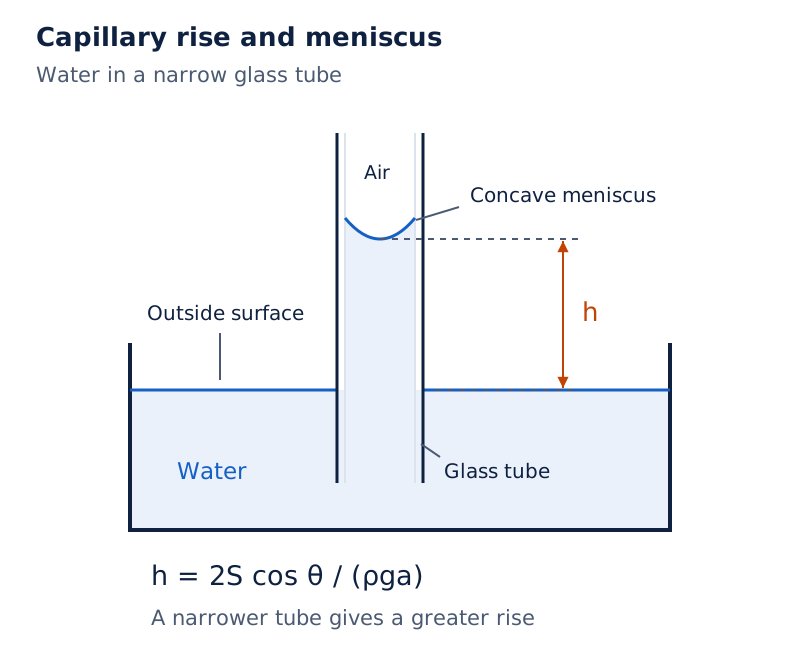
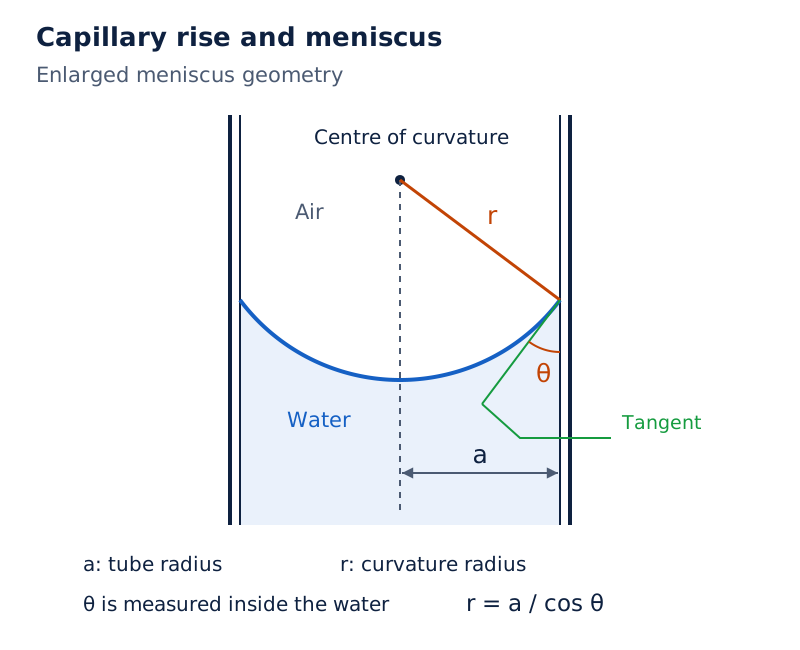
A narrow tube stands in a water vessel with its internal surface raised by . An enlarged meniscus drawing labels tube radius , curvature radius and contact angle .
Drawn by One Young India. See Fig. 9.19 in your NCERT textbook
For water with negligible contact angle, . Using the illustrated values , , and :
Measure relative to the liquid surface outside the tube. Do not confuse the tube radius, which sets the narrowness of the capillary, with the meniscus curvature radius used in the pressure formula.
Glossary
- Fluid — A liquid or gas that can flow and changes shape under very small shear stress.
- Pressure — Normal force per unit area, expressed as a scalar quantity at a point in a fluid.
- Density — Mass per unit volume of a substance, nearly constant for a largely incompressible liquid.
- Relative density — The dimensionless ratio of a substance’s density to the density of water at four degrees Celsius.
- Gauge pressure — The difference between the actual pressure at a point and the surrounding atmospheric pressure.
- Pascal’s law — An applied pressure change in an enclosed fluid is transmitted undiminished throughout the fluid and its containing walls.
- Streamline — A curve whose tangent gives the direction of fluid velocity at each point along it.
- Continuity equation — The mass-conservation relation connecting density, cross-sectional area and speed at different sections of steady flow.
- Viscosity — Internal resistance arising from relative motion between fluid layers, with forces opposing their relative movement.
- Terminal velocity — Constant falling velocity reached when viscous drag and buoyancy together balance the weight of a body.
- Surface tension — Force per unit length in an interface, also equal to its surface energy per unit area.
- Angle of contact — Angle between the liquid-surface tangent and solid surface at contact, measured on the liquid side.
- Capillary rise — Elevation of liquid in a narrow tube caused by surface tension and balanced by hydrostatic pressure.
Common errors and misconceptions
- Misconception: Pressure has the direction of its force. Correct: Pressure is scalar; the force on a resting-fluid boundary is normal to the local surface.
- Misconception: A wider vessel necessarily has greater pressure at the same depth. Correct: For the same uniform liquid and surface pressure, depth determines hydrostatic pressure, not vessel width.
- Misconception: Gauge and absolute pressures are interchangeable. Correct: Gauge pressure excludes atmospheric pressure; absolute pressure includes it. State which one a calculation requires.
- Misconception: Steady flow has the same speed everywhere. Correct: Velocity is constant with time at each fixed point, but may differ between points.
- Misconception: Bernoulli’s equation applies to any flow. Correct: Its stated form requires steady, incompressible, non-viscous flow along a streamline.
- Misconception: Terminal velocity means that no forces act. Correct: Weight, buoyancy and drag remain present; their resultant is zero, giving zero acceleration.
- Misconception: Every bubble uses for excess pressure. Correct: A soap bubble has two interfaces, while an air bubble in liquid has one and uses .
- Misconception: Every liquid rises in a capillary. Correct: An obtuse contact angle gives a negative cosine and capillary depression, as for mercury.
Exam-style questions with model answers
Q1. Define pressure and explain why it is scalar although force is a vector. [2 marks]
- Average pressure is normal force per unit area, , where is normal force and is area.
- Only the magnitude of the normal force component enters this definition. Pressure itself has no assigned direction and is therefore scalar.
Q2. Derive the pressure at depth in a resting liquid of uniform density , open to atmospheric pressure . Take gravitational acceleration as . [3 marks]
- Consider a vertical liquid cylinder of cross-sectional area and height . Its mass is . Let be the pressure at its lower face.
- The upward bottom force balances the downward atmospheric force and the cylinder’s weight. Hence , because the liquid is at rest.
- Dividing by the area gives , so . The term is gauge pressure; adding atmospheric pressure gives absolute pressure.
Q3. A swimmer is below a lake surface. Calculate gauge and absolute pressures using water density , , and atmospheric pressure . [3 marks]
- Let denote gauge pressure, water density and depth. The hydrostatic relation for uniform-density water is , measured relative to atmospheric pressure.
- Substitution gives . This is the additional pressure produced by the water column.
- Absolute pressure includes atmospheric pressure : . The two answers therefore refer to different pressure reference levels.
Q4. State the conditions for Bernoulli’s equation and derive it between two sections of a flow tube. Define the quantities used. [5 marks]
- Assume steady, incompressible, non-viscous flow along a streamline. Denote density by , pressures by , speeds by , heights by , and gravitational acceleration by .
- Let be the common volume passing the two sections in a short interval. Net pressure work on this volume is .
- The transferred mass is . Its kinetic-energy change is .
- Its gravitational potential-energy change is . Conservation of mechanical energy gives , with no viscous energy loss.
- Substitute these expressions, divide by , and rearrange: Thus pressure plus kinetic and gravitational energy per unit volume remains constant along the streamline.
Q5. Explain terminal velocity and derive its expression for a sphere denser than the surrounding fluid, assuming Stokes’ drag. Define all symbols. [5 marks]
- Let be sphere radius, sphere density, fluid density, fluid viscosity and gravitational acceleration. The sphere initially accelerates downwards, and its viscous drag increases with speed.
- The sphere’s weight is , where is the circle constant. Weight acts downward and is determined by the sphere’s volume and density.
- The upward buoyant force equals displaced-fluid weight: . This must be included along with drag when balancing forces.
- At terminal speed , upward Stokes’ drag is , and acceleration vanishes. Force balance gives .
- Rearranging gives . The motion continues at this constant speed because the resultant force, rather than each individual force, is zero.
Q6. Compare excess pressures in a spherical liquid drop, an air bubble within a liquid and a soap bubble. Use radius and surface tension . [3 marks]
- A liquid drop has one liquid-air interface. If and denote internal and external pressure, its excess pressure is .
- An air bubble within liquid also has one interface. Its excess pressure over the surrounding liquid is therefore , even though it is called a bubble.
- A soap bubble has two interfaces, giving . The distinction follows from the surface energy of both faces, so counting interfaces is essential before selecting a formula.
Q7. Derive the capillary-rise formula for a liquid of density , surface tension and contact angle in a circular tube of internal radius . Use gravitational acceleration , and explain capillary depression. [4 marks]
- Let be meniscus curvature radius and the liquid level relative to the outside surface. Geometry gives .
- For the single curved interface, the pressure difference is . This pressure difference drives the change in liquid level.
- Hydrostatic balance requires . Therefore , showing that the rise increases as tube radius decreases.
- For an obtuse contact angle, is negative. The calculated height is then negative, meaning the liquid level lies below the outside surface, as in mercury capillary depression.
Key takeaways
- Pressure is scalar and depends on normal force per unit area; resting fluids exert forces perpendicular to their boundaries.
- Hydrostatic pressure increases with depth in a uniform liquid, while gauge pressure excludes the atmospheric contribution.
- Pascal’s law transmits pressure changes through enclosed fluids, allowing hydraulic machines to multiply force through unequal piston areas.
- Continuity expresses conservation of mass; an incompressible fluid moves faster through a narrower section during steady flow.
- Bernoulli’s equation conserves mechanical energy along a streamline under steady, incompressible and non-viscous flow assumptions.
- Viscosity opposes relative fluid-layer motion; terminal speed occurs when buoyancy and viscous drag balance a falling sphere’s weight.
- Surface tension represents interfacial energy per area and force per length; a soap film has two contributing surfaces.
- Contact angle governs wetting and capillary behaviour, while interface number determines the excess pressure in drops and bubbles.
Test yourself
Why is the force exerted by a resting fluid normal to a surface?
A tangential component would cause the fluid to flow along the surface, contradicting the assumption that it is at rest.
Why can a hydraulic lift produce a larger output force?
The transmitted pressure acts on a larger output piston area, producing greater force while that piston moves a smaller distance.
Can a particle accelerate in steady flow?
Yes. Velocity at a fixed point remains constant with time, but the particle can move into regions with different velocities.
What conservation law gives the continuity equation?
Conservation of mass equates the mass entering and leaving a flow tube during the same time interval.
How does temperature affect liquid and gas viscosity?
Liquid viscosity decreases as temperature rises, whereas gas viscosity increases with temperature.
Why does a soap bubble have a different pressure formula from an air bubble in water?
A soap bubble has two liquid-air interfaces, while an air bubble in water has one interface.
Why does water rise farther in a narrower capillary?
For fixed liquid properties and contact angle, the capillary-rise height is inversely proportional to the tube’s internal radius.
Why is a free small liquid drop approximately spherical?
When gravity and other external effects are negligible, a sphere minimises surface area and surface energy for the given volume.
Write about it
Turn a question from this chapter into a paper.
The Writing Studio has a structure guide, a rubric and citation tools for 15 formats, from essays to research papers. Drafting is free with an account. Learnacy Essential adds feedback from an AI writing coach and submission to The OYI Review.
Learnacy Essential is ₹1,499 for the year. Publication depends on review and is not guaranteed.