
Waves | CBSE Class 11 Physics Notes
On this page
Watch & explore
Start with a few high-quality watches, then dive into the notes below.

This note covers mechanical waves, transverse and longitudinal motion, progressive wave equations, amplitude and phase, wavelength and frequency, wave speed, sound in gases, superposition, reflection, standing waves, normal modes of strings and air columns, and beats.
What travels when a mechanical wave moves through a medium?
Disturbance, energy and local motion
A wave is a pattern of disturbance that propagates without the physical transfer of matter as a whole. When a pebble disturbs still water, circles spread outwards, while cork pieces on the surface move up and down without travelling outwards with those circles.
The distinction is between the movement of the disturbance and the motion of individual constituents. A sound wave travels through air, but it does not require air to flow bodily from the speaker to the listener. Wind, by contrast, involves movement of air as a whole.
Definition: Mechanical waves propagate through a material medium by the coupled oscillations of its constituents. They transfer energy through elastic interactions between neighbouring parts of the medium.
Connected springs illustrate this coupling. Disturbing the first spring stretches or compresses its neighbour, which affects the next spring. The disturbance travels along the collection even though each spring executes small oscillations about its equilibrium position. Elastic forces connect local motions into a travelling disturbance.
How does sound pass through air?
A compressed region of air has greater density and pressure. Its molecules affect the adjoining region, creating compression there while the first region becomes rarefied. A rarefaction is a region of lower density. Successive compressions and rarefactions carry the disturbance through air.
Mechanical waves need a medium and cannot propagate through a vacuum. Sound waves, waves on strings and seismic waves belong to this category. Their behaviour depends on the medium's elastic and inertial properties, which determine how it responds to a disturbance.
Electromagnetic waves, including light, radio waves and X-rays, can travel through a vacuum. Matter waves are associated with constituents such as electrons and atoms. These categories should not be confused with the mechanical oscillations of material particles considered here.
How do transverse and longitudinal waves differ?
Compare particle motion with propagation
In a transverse wave, particles oscillate perpendicular to the direction in which the disturbance propagates. A pulse moving along a stretched string is an example: the pulse advances along the string while its elements move up and down about their equilibrium positions.
In a longitudinal wave, particle oscillations are parallel to the direction of propagation. Moving a piston periodically in an air-filled pipe creates successive compressions and rarefactions. The air elements oscillate along the pipe as the disturbance travels through it.
| Feature | Transverse wave | Longitudinal wave |
|---|---|---|
| Particle displacement | Perpendicular to propagation | Parallel to propagation |
| String or air example | Harmonic wave on a stretched string | Sound travelling through air |
| Elastic response in a bulk medium | Resistance to shearing strain | Resistance to compressional strain |
| Propagation in steel | Possible | Possible |
| Propagation in air | Not supported as a bulk mechanical wave | Supported |
What the figure shows
Pulse on a stretched string
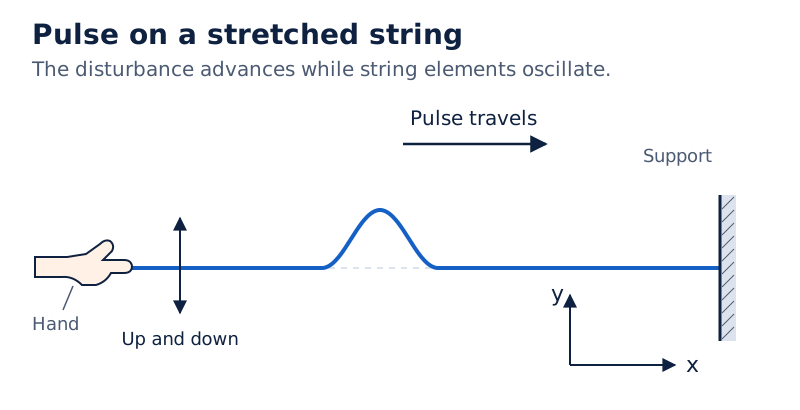
A hand disturbs the left end of a horizontal string attached to a support at the right. A raised pulse and a rightward arrow are shown. The horizontal axis is labelled , and the vertical axis is labelled .
Drawn by One Young India. See Fig. 14.2 in your NCERT textbook
What can the medium support?
Solids can sustain shearing as well as compressional strain, so they can support both types of wave. Fluids can sustain compression but do not support bulk transverse mechanical waves. Transverse and longitudinal waves generally have different speeds even in the same solid.
Water-surface waves require care. Their particles move both vertically and horizontally, so the motion combines transverse and longitudinal features. Short capillary ripples have surface tension as their restoring influence, whereas gravity provides the restoring influence for gravity waves. Surface waves do not contradict the statement about bulk fluids.
A single up-and-down jerk produces a pulse. A continuous sinusoidal disturbance produces a harmonic wave. Both can be progressive disturbances; a wave does not have to repeat indefinitely for its disturbance to travel from one region to another.
How does the progressive wave equation describe a moving disturbance?
Read each symbol before using the equation
Let be transverse displacement from equilibrium at position and time . Let be amplitude, angular wave number, angular frequency and initial phase angle. A sinusoidal wave travelling in the positive horizontal direction is
The phase is . It determines the displacement once the amplitude is known. At the origin at the initial instant, and , the phase is . A suitable choice of origins can make this initial phase zero.
For positive and , the corresponding negative-direction wave is . Follow a point of constant phase to establish direction: in the first equation its position increases as time increases; in the second its position decreases.
Spatial shape and temporal oscillation
At a fixed time, displacement varies sinusoidally with position, giving a snapshot of the wave. At a fixed position, displacement varies sinusoidally with time, describing the simple harmonic motion of one element. These are different ways of examining the same displacement function.
A crest is a point of maximum positive displacement; a trough is a point of maximum negative displacement. A travelling crest advances through the medium. A particular string element instead oscillates about its equilibrium position. Following one does not describe the motion of the other.
For a longitudinal wave, write , where denotes particle displacement parallel to propagation. The mathematical form is similar, but the displacement direction is different. A sinusoidal graph of longitudinal displacement does not mean particles move transversely.
Note: Amplitude is a non-negative maximum displacement, whereas instantaneous displacement can be positive, negative or zero. The sign of displacement identifies a side of equilibrium; it does not represent a negative amplitude.
How are wavelength, period and frequency related?
Spatial and temporal repetition
The wavelength is the shortest spatial separation between points in the same phase at a given instant. Consecutive crests, or consecutive troughs, are separated by one wavelength. Equal displacement alone is insufficient to identify equal phase, because different parts of a sinusoid can share a displacement.
The period is the time taken by one element to complete an oscillation. The frequency counts oscillations per second. Angular quantities describe the corresponding phase changes in radians:
| Quantity | Symbol | Unit statement |
|---|---|---|
| Amplitude | The SI unit of amplitude is metre. | |
| Wavelength | The SI unit of wavelength is metre. | |
| Period | The SI unit of period is second. | |
| Frequency | The SI unit of frequency is hertz. | |
| Angular frequency | The SI unit of angular frequency is radian per second. | |
| Angular wave number | The SI unit of angular wave number is radian per metre. |
A displacement-position graph gives wavelength; a displacement-time graph for one element gives period. Although both may look sinusoidal, their horizontal axes have different meanings and units. Reading the axis is therefore essential before extracting a physical quantity.
Worked example 1. A string wave is . Find its amplitude, wavelength, period, frequency and displacement at , .
Formula: , , , .
Substitute:
- Read the amplitude: .
- Calculate wavelength: .
- Calculate period: . Hence .
- Convert position: . The phase is .
- Evaluate in radians: .
Answer: The amplitude is , wavelength about , period about , frequency about , and displacement about , positive and close to the amplitude.
What determines the speed of a travelling wave?
Derivation: speed from constant phase
- Let denote wave speed. Follow a crest or any other fixed-phase point. For the positive-direction wave, .
- Let be its displacement during time interval . Equating its initial and final phase gives .
- Subtract the common terms: . Rearranging gives .
- Substitute the definitions of angular frequency and angular wave number: .
Result: During one period, the disturbance advances by one wavelength. The SI unit of wave speed is metre per second.
Speed on a stretched string
Let denote string tension, the string's mass, its length and its linear mass density. The tension supplies the restoring influence; the mass per unit length represents inertia. For the stretched-string model,
The symbol keeps tension distinct from period . The SI unit of tension is newton, and the SI unit of linear mass density is kilogram per metre. Greater tension increases speed; greater linear mass density reduces it, with the other quantity unchanged.
Dimensional analysis gives a proportionality to the square root of tension divided by linear density, but cannot fix the dimensionless multiplier. The exact wave calculation supplies a multiplier of unity. Dimensional agreement is a useful check, not a complete determination of the formula.
For a fixed string tension and linear density, the speed remains the same in this model. The source determines frequency; wavelength adjusts through the speed relation. This independence from frequency is not a property of every possible wave or medium.
Worked example 2. A steel wire has length , mass , and tension . Find its transverse wave speed.
Formula: , .
Substitute:
- Calculate linear density: .
- Use the unrounded density: .
Answer: The transverse disturbance travels at approximately .
Worked example 3. A string of mass , length , and tension receives a transverse jerk at one end. Find the travel time to the other end.
Formula: , , , where is the disturbance's travel time.
Substitute:
- Find linear density: .
- Find speed: .
- Find travel time: .
Answer: The disturbance reaches the other end after . This is a propagation time, not the oscillation period of a string element.
How is sound speed related to elasticity and density?
Bulk modulus and the relevant restoring force
Let be bulk modulus, pressure, volume and mass density. A small pressure change produces a small volume change . The bulk modulus measures resistance to compression:
The minus sign makes the modulus positive because increasing pressure reduces volume. The SI unit of bulk modulus is pascal. For longitudinal motion in a solid bar with negligible lateral expansion, use , where is the material's Young's modulus.
Sound generally travels faster in solids and liquids than in gases. Although solids and liquids have higher densities, their elastic moduli are much larger. It is the ratio of the relevant modulus to density, not density alone, that determines the speed.
Why did Newton's estimate need correction?
Newton treated sound-related pressure changes in a gas as isothermal, meaning that temperature remains constant. The ideal-gas relation then gives , leading to . This predicts a speed in air below the measured value.
Laplace's correction recognises that compressions and rarefactions occur too rapidly for heat flow to keep the temperature constant. They are treated as adiabatic. Let , where and are heat capacities at constant pressure and constant volume respectively.
Derivation: the adiabatic sound-speed formula
- For an adiabatic change in an ideal gas, start with .
- For small changes, differentiation gives .
- Divide by and rearrange: . Thus the adiabatic bulk modulus, denoted , is .
- Substitute into the general sound-speed relation: .
Result: The Laplace-corrected expression is , for the ideal-gas, adiabatic treatment of sound propagation. It uses the appropriate elastic response for the rapid pressure variations.
Worked example 4. At standard temperature and pressure, one mole of air has mass and occupies . Use and to compare Newton's and Laplace's estimates.
Formula: , , , where and are Newton's and Laplace's speed estimates.
Substitute:
- Calculate density: .
- Using unrounded density, .
- Apply the adiabatic factor: .
Answer: Newton's estimate is approximately ; the corrected estimate is approximately using the unrounded density. Retaining intermediate digits avoids small rounding discrepancies.
How does superposition produce interference?
Add displacements at the same place and time
The principle of superposition states that when waves overlap, the resultant displacement of an element is the algebraic sum of its individual displacements. Let and denote displacements due to two waves. Then .
The addition is algebraic because displacements can have opposite signs. Equal, oppositely directed displacements can cancel during overlap. This does not mean the pulses cease to exist: after crossing, they continue with their identities. A zero resultant displacement is a statement about their sum.
Equal-frequency waves travelling together
Consider two harmonic waves of equal amplitude, frequency and wavelength travelling in the same direction. In this comparison, denotes their phase difference. Their individual displacements are and .
- Apply superposition: .
- Use the sine-sum identity to obtain .
- Let denote the non-negative resultant amplitude. Reading the magnitude of the coefficient gives .
The resultant remains a travelling harmonic wave with the same frequency and wavelength. Its amplitude depends on phase difference. The absolute-value sign keeps amplitude non-negative; the signed coefficient in the displacement equation also determines phase.
| Condition | Resultant amplitude | Interference |
|---|---|---|
| : waves in phase | Constructive, with the largest possible amplitude | |
| : opposite phases | Destructive, with complete cancellation for equal amplitudes | |
| Other phase differences | Result depends on the phase difference |
Complete cancellation in this comparison requires the equal amplitudes and opposite phases already specified. The condition should accompany the result. Superposition also applies to more than two disturbances, with the resultant found by adding all their displacement contributions.
What happens when a wave meets a boundary?
Rigid and free boundaries
A wave reaching a rigid boundary is reflected. For a string fixed to a wall, the boundary displacement must remain zero. The incident and reflected disturbances must therefore cancel there. A reflected displacement pulse is inverted, corresponding to a phase reversal of radians.
If the boundary absorbs no energy, the reflected pulse retains the incident pulse's shape and amplitude, with the inversion required by the fixed end. Dynamically, the arriving pulse exerts a force on the support, which exerts an opposing force on the string.
What the figure shows
Reflection at a rigid support
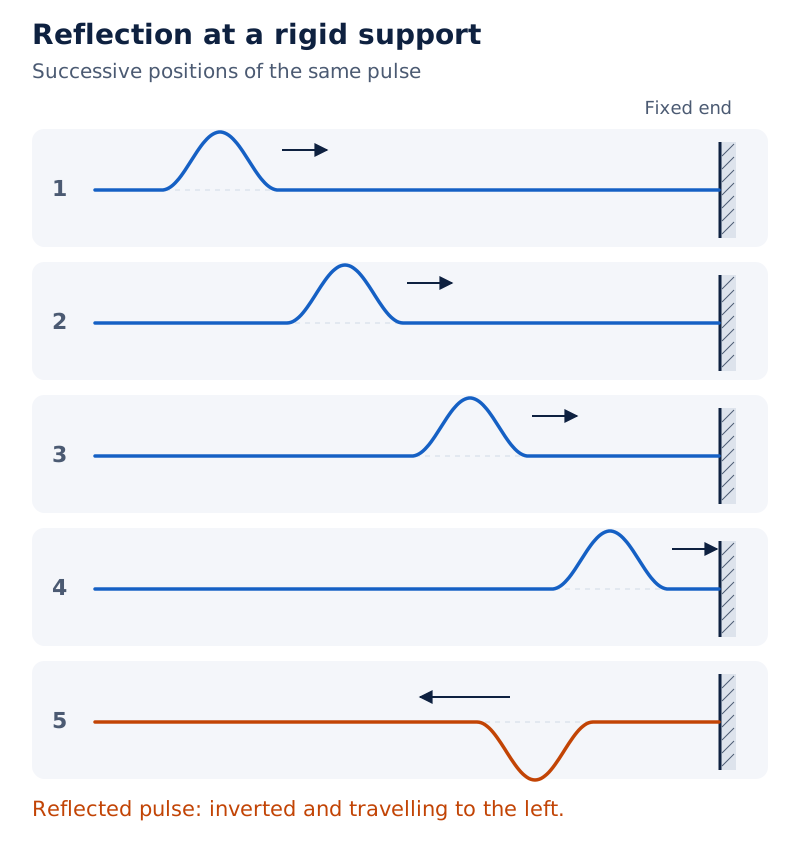
Successive drawings show a raised pulse approaching a vertical support on the right. The first four drawings show successive positions of the raised pulse approaching the support. The final drawing shows a downward pulse with a leftward arrow.
Drawn by One Young India. See Fig. 14.11 in your NCERT textbook
At a completely free boundary, such as a string attached to a freely moving ring on a rod, reflection occurs without displacement phase reversal. With no energy dissipation, the reflected pulse has the same amplitude as the incident one. Their boundary displacements can reinforce.
Boundary conditions control the reflected pattern
The important rule is physical: a fixed end cannot move, whereas a free end can. An open end of an air column corresponds to a non-rigid displacement boundary. State whether displacement or pressure is being discussed before assigning nodes or antinodes.
At an interface between different elastic media, part of the disturbance can be reflected and part transmitted. The ideal fixed-end and free-end cases describe limiting boundary behaviour. Echoes provide a familiar example of sound reflection at a rigid boundary.
Reflection changes the direction of propagation. A full reflected-wave expression must account for this as well as the boundary phase condition. Merely inserting a minus sign into an incident expression does not, by itself, reverse its direction of travel.
How do standing waves create nodes and normal modes on a string?
Derivation: a standing-wave displacement
- Take equal-amplitude waves of equal frequency travelling oppositely: and .
- Add their displacements: .
- Use the sine-sum identity: . Position and time now occur in separate factors.
- The amplitude at position , denoted , is . Its value changes with position, while the time factor has the same angular frequency throughout.
Result: A standing wave has a stationary spatial pattern. Its nodes remain at fixed positions even though the contributing waves travel in opposite directions.
Nodes, antinodes and their separation
A node is a point where amplitude is zero. An antinode is a point where amplitude is greatest. Let be an integer indexing successive positions. For the form above,
Here and are the respective positions measured from the origin node. Consecutive nodes are separated by , as are consecutive antinodes. A node and its neighbouring antinode are separated by .
Particles between two adjacent nodes oscillate in the same phase but generally with different amplitudes. Nodes themselves remain at rest. Unlike a progressive harmonic wave, the standing-wave pattern does not advance through the medium as time passes.
Why are only certain string frequencies allowed?
- For a string fixed at both ends, choose the origin at one end. Both and must be nodes.
- The length must contain an integral number of node-to-node intervals: , where now labels the harmonic.
- The allowed wavelength of harmonic , denoted , is .
- Its frequency is therefore . The fundamental frequency is .
These natural patterns are normal modes. The fundamental is the first harmonic and has the lowest natural frequency. Higher modes have integer multiples of this frequency. A vibrating string can contain a superposition of modes, with some more strongly excited than others.
What the figure shows
String harmonics
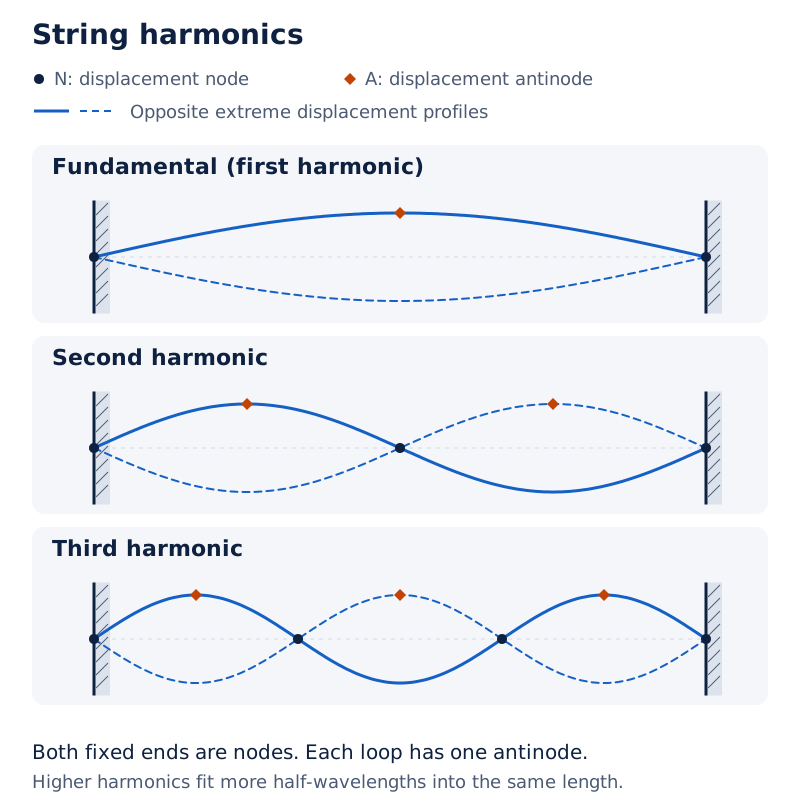
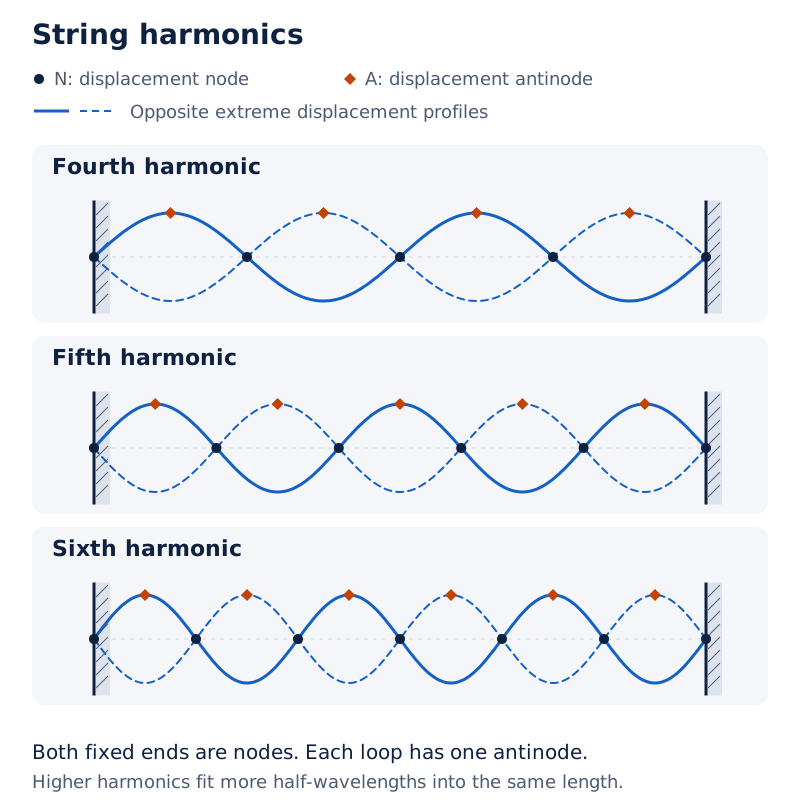
Six drawings show a string held at both ends, labelled from the fundamental to the sixth harmonic. The number of loops increases in successive drawings. Antinodes are labelled A and interior nodes N.
Drawn by One Young India. See Fig. 14.13 in your NCERT textbook
Plucking or bowing position affects which modes are prominent in instruments such as the sitar or violin. The boundaries determine the allowed modes; the way the string is excited influences their relative contributions to the resulting vibration.
Why do open and closed air columns have different harmonics?
Displacement and pressure boundary conditions
At a closed end, air displacement is zero, so there is a displacement node. Pressure changes there are largest. At an open end, displacement has an antinode while pressure change is least. A pressure node and a displacement node therefore describe different positions.
For an air column of length closed at one end and open at the other, the ends must accommodate a displacement node and an antinode. The ideal boundary conditions allow odd quarter-wavelengths, giving
Here the index starts at zero: the lowest mode has frequency . The next allowed frequencies are and . They are the third and fifth harmonics, not the second and third harmonics.
Compare the ideal air columns
| Property | Both ends open | One end closed |
|---|---|---|
| Displacement conditions | Antinode at both ends | Node at closed end, antinode at open end |
| Fundamental wavelength | ||
| Fundamental frequency | ||
| Allowed harmonics | All positive integer harmonics | Odd harmonics |
What the figure shows
Open-pipe harmonics
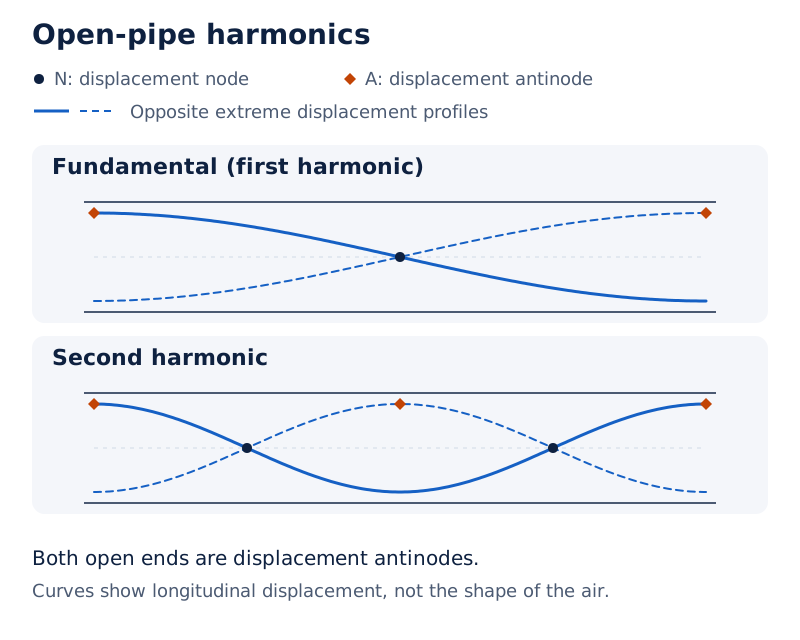
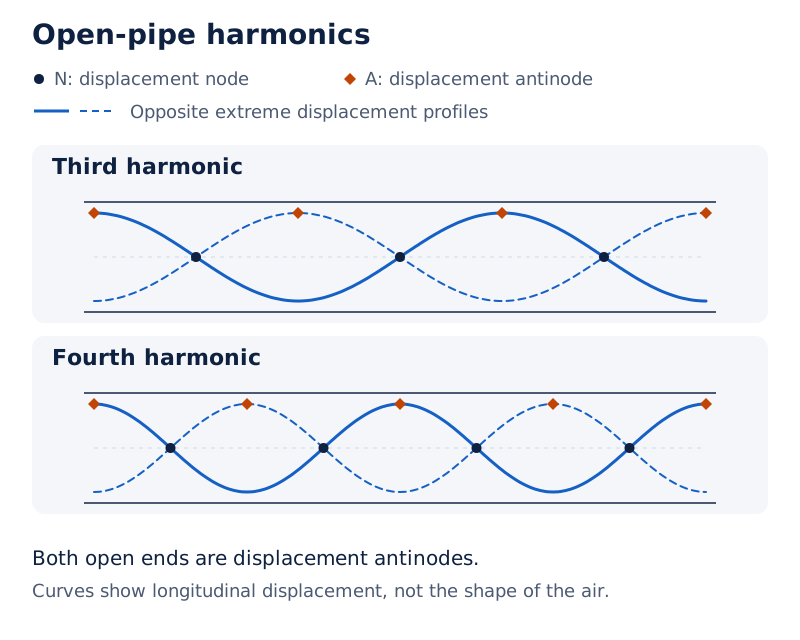
Four patterns are labelled fundamental, second, third and fourth harmonic. Both ends are marked A. Interior points are labelled N and A to identify successive nodes and antinodes.
Drawn by One Young India. See Fig. 14.15 in your NCERT textbook
An open pipe has the same sequence of harmonic frequencies as a string fixed at both ends, for the same length and wave speed, even though their displacement conditions differ. Resonance occurs when an external driving frequency is close to a natural frequency.
Worked example 5. A pipe of length is open at both ends. A source has frequency , and sound speed is . Identify the resonant harmonic and decide whether closing one end preserves resonance in the ideal model.
Formula: , , where and are the open-pipe and closed-pipe fundamental frequencies.
Substitute:
- Convert the data: , and source frequency .
- Open pipe: . The harmonic ratio is .
- Closed pipe: . The ratio becomes .
Answer: The open pipe resonates in its second harmonic, with fundamental frequency . After closure, the source corresponds to an unavailable even harmonic, so resonance is not obtained in the ideal model.
How do beats help identify a small frequency difference?
Slow variation in the resultant amplitude
Beats are periodic waxing and waning of sound intensity when two harmonic sounds with close but unequal frequencies and comparable amplitudes are superposed. The sound has a frequency close to their average, while its loudness changes at their frequency difference.
Let and be the two angular frequencies. At a fixed point, choose phases so that the longitudinal displacements are and , where and are the individual displacements.
- Add the displacements: , where denotes their resultant.
- Apply the cosine-sum identity: .
- For close frequencies, the difference factor varies slowly compared with the average-frequency oscillation. Amplitude magnitude is greatest when the slow cosine factor is either positive unity or negative unity.
- Let and be the ordinary frequencies, and the beat frequency. Counting successive amplitude maxima gives .
The factor of one-half in the slow cosine's argument does not make the beat frequency half the difference. Both signs of the cosine produce maximum amplitude magnitude. Musicians use beats during tuning and adjust the instruments until the audible beats disappear.
Use the direction of a frequency change
A beat count alone gives the magnitude of a difference, leaving two possible frequencies for an unknown source. A controlled change supplies the missing information. For a stretched string with length and linear density unchanged, increasing tension raises its normal-mode frequencies.
Worked example 6. Two sitar strings A and B produce beats. String A has frequency . A slight increase in B's tension reduces the beat frequency to . Find B's original frequency.
Formula: , where and are the frequencies of strings A and B.
Substitute:
- The original possibilities are or .
- Increasing B's tension increases its frequency. Starting above A would increase the difference; the observed decrease instead places B originally below A.
- Select the lower value and check: , and .
Answer: B's original frequency is . The change in beat frequency determines which side of the known frequency the unknown string originally occupied.
Glossary
- Mechanical wave — A disturbance transmitted through a material medium by coupled oscillations of its constituent particles.
- Transverse wave — A wave whose particles oscillate perpendicular to the direction in which the disturbance propagates.
- Longitudinal wave — A wave whose particles oscillate parallel to the direction in which the disturbance propagates.
- Amplitude — The maximum magnitude of a particle's displacement from its equilibrium position during an oscillation.
- Phase — The angular argument that specifies the state of a harmonic oscillation at a position and time.
- Wavelength — The shortest distance between points in the same phase in a progressive wave at a given instant.
- Period — The time taken by an element of the medium to complete one full oscillation.
- Frequency — The number of complete oscillations performed by an element of the medium in unit time.
- Superposition — Addition of individual wave displacements to obtain the resultant displacement where the disturbances overlap.
- Node — A fixed position in a standing-wave pattern where displacement amplitude remains zero at all times.
- Antinode — A position in a standing-wave pattern where the displacement amplitude has its greatest value.
- Fundamental frequency — The lowest natural frequency of oscillation permitted by the boundary conditions of a system.
- Beats — Periodic variation in sound intensity produced by superposition of waves having slightly different frequencies.
Common errors and misconceptions
- Misconception: Air must travel from a speaker to the listener with the sound. Correct: The disturbance propagates through local compressions and rarefactions without bodily transport of the air medium.
- Misconception: A displacement-time graph directly gives wavelength. Correct: It gives the period of an element; wavelength is read from the spatial repetition of a displacement-position graph.
- Misconception: Increasing frequency necessarily increases speed on the same stretched string. Correct: At unchanged tension and linear density, speed remains fixed and wavelength changes.
- Misconception: Dimensional analysis determines the exact numerical constant in the string-speed formula. Correct: It leaves a dimensionless factor undetermined; an exact dynamical calculation supplies it.
- Misconception: Every point of a standing wave has the same amplitude. Correct: Amplitude depends on position, vanishing at nodes and reaching its largest value at antinodes.
- Misconception: A displacement node in an air column is also a pressure node. Correct: Pressure changes are largest at displacement nodes and least at displacement antinodes.
- Misconception: A pipe closed at one end has every harmonic. Correct: Its ideal normal modes contain odd harmonics; a pipe open at both ends allows all positive integer harmonics.
- Misconception: Beat frequency is half the frequency difference. Correct: It equals the full magnitude of the difference because both positive and negative extrema of the slow factor give maximum amplitude magnitude.
Exam-style questions with model answers
Q1. Distinguish transverse and longitudinal waves by particle motion, giving one example of each. [2 marks]
- In a transverse wave, particles oscillate perpendicular to propagation, as in a harmonic wave on a stretched string.
- In a longitudinal wave, particles oscillate parallel to propagation, as in sound travelling through air.
Q2. A wave is , where is position in metres, time in seconds and displacement. Find amplitude, wavelength and period. [3 marks]
- The amplitude is the coefficient outside the sine, so . It is the maximum displacement magnitude, read directly from the given equation, not the displacement at every instant.
- The angular wave number is , giving wavelength .
- The angular frequency is , giving period . This is one element's complete oscillation time.
Q3. A string has mass , length and tension . Calculate its linear mass density, transverse wave speed and end-to-end travel time. Distinguish travel time from period. [4 marks]
- Linear mass density is mass divided by length: .
- With tension , wave speed is .
- The travel time is length divided by speed: .
- This time describes the disturbance travelling along the whole string. Period instead describes one constituent completing an oscillation; the supplied data do not specify a driving frequency.
Q4. Explain Laplace's correction to Newton's sound-speed formula. Use , , and , where is speed, bulk modulus, density, pressure, volume and the heat-capacity ratio. [5 marks]
- Newton assumed isothermal pressure variations, meaning that gas temperature stayed constant during compression and rarefaction. This gives and the estimate .
- Sound produces rapid pressure changes. There is little time for heat transfer to maintain constant temperature, so Laplace treated the variations as adiabatic instead.
- For the ideal gas, differentiate the supplied adiabatic relation for small changes: .
- Divide by and rearrange to obtain . The adiabatic bulk modulus is therefore .
- Substitute this modulus into the wave-speed relation: . The corrected elastic response raises the predicted speed and brings it into agreement with the observed sound speed in air.
Q5. A string of length , fixed at both ends, carries transverse waves of speed . Derive its allowed wavelengths and frequencies using node separation , where is wavelength. Explain the fundamental and higher harmonics. [5 marks]
- A fixed end cannot move, so both ends of the string must be displacement nodes. Allowed standing waves must satisfy these boundary conditions simultaneously.
- The length contains an integral number of intervals between adjacent nodes. Thus , where the harmonic index .
- Rearranging gives the wavelength of the indexed mode, . Boundary conditions therefore restrict the wavelengths instead of allowing an arbitrary spatial pattern.
- Using the progressive-wave speed relation for the component waves, the corresponding frequency is , where denotes that mode's frequency.
- The fundamental is the lowest mode, . Higher harmonics have integer multiples of this frequency, and the string can vibrate as a superposition of these allowed modes.
Q6. A pipe is driven by a source. Sound speed is . Using ideal boundary conditions, identify resonance with both ends open and explain the effect of closing one end. [4 marks]
- Convert length and frequency: and . The open-pipe fundamental is .
- The frequency ratio is , so the open pipe resonates at its second harmonic.
- Closing one end gives fundamental . The source-to-fundamental ratio is now .
- A pipe closed at one end permits odd harmonics only. The required even harmonic is absent, so the same source does not resonate with this ideal closed pipe.
Q7. Sitar string A has frequency . With string B it produces beats. Slightly increasing B's tension reduces the beat frequency to . Find B's original frequency and justify your choice. [3 marks]
- Let be B's original frequency. The initial beat count gives , so the possibilities are and .
- Increasing tension raises B's frequency. If B originally exceeded A, increasing it further would enlarge the frequency difference and increase the beat count. That contradicts the given decrease.
- B was therefore originally below A, giving . The observed direction of change selects the lower of the two initial possibilities.
Key takeaways
- Mechanical waves transfer a disturbance and energy through coupled particle oscillations, without transporting the medium bodily along with the wave.
- Transverse and longitudinal describe particle motion relative to propagation; water-surface waves combine both types of particle motion.
- A harmonic progressive wave is periodic in position and time, with wavelength and period describing these distinct repetitions.
- Wave speed depends on the medium's restoring and inertial properties; source frequency then determines wavelength for that speed.
- Laplace's correction treats rapid sound compressions and rarefactions as adiabatic, using the appropriate bulk modulus of the gas.
- Standing waves have fixed nodes and antinodes, and their permitted frequencies follow from the boundary conditions.
- Open pipes allow all integer harmonics, while ideal pipes closed at one end allow odd harmonics only.
- Beats reveal a small frequency difference; a controlled tension change can identify whether an unknown string frequency is higher or lower.
Test yourself
Why is wind different from a sound wave in air?
Wind involves bodily movement of air; sound propagates through local compressions and rarefactions without such bulk transport.
What does fixing time in a wave equation allow you to examine?
It gives displacement as a function of position, describing the spatial shape of the wave at that instant.
How far does a progressive wave travel during one oscillation period?
It travels one wavelength while an element of the medium completes one oscillation.
What happens to wavelength if frequency increases at unchanged wave speed?
Wavelength decreases because the product of wavelength and frequency must remain equal to the unchanged wave speed.
Why does reflection at a fixed string end invert a displacement pulse?
The end must remain at zero displacement, requiring the incident and reflected contributions to cancel there.
How do consecutive-node and neighbouring node-to-antinode distances compare?
Consecutive nodes are separated by half a wavelength; a node and its neighbouring antinode are separated by a quarter wavelength.
Why is pressure variation greatest at an air column's displacement node?
Air elements on opposite sides of a displacement node move towards it together and away from it together. Their separation changes most near the node, producing the greatest compression and rarefaction and hence the greatest pressure variation, even though the air at the node remains stationary.
What additional observation resolves the two possible frequencies inferred from beats?
Observe whether the beat count increases or decreases after a known increase or decrease of one source's frequency.
Write about it
Turn a question from this chapter into a paper.
The Writing Studio has a structure guide, a rubric and citation tools for 15 formats, from essays to research papers. Drafting is free with an account. Learnacy Essential adds feedback from an AI writing coach and submission to The OYI Review.
Learnacy Essential is ₹1,499 for the year. Publication depends on review and is not guaranteed.