
Thermal Properties of Matter | CBSE Class 11 Physics Notes
On this page
Watch & explore
Start with a few high-quality watches, then dive into the notes below.
This note covers heat and temperature, temperature scales, ideal-gas thermometry, thermal expansion, heat capacities, calorimetry, changes of state, latent heat, conduction, convection, thermal radiation, blackbody radiation and Newton’s law of cooling.
How do heat, temperature and temperature scales differ?
What does a thermometer measure?
Temperature indicates how hot or cold a body is. Touch gives only a limited and unreliable indication. A thermometer instead uses a measurable property that changes with temperature, such as the volume of mercury or alcohol over a suitable range.
Heat is energy transferred because of a temperature difference. Hot tea loses heat to cooler surroundings, whereas ice-cold water gains heat from warmer surroundings. This exchange continues until their temperatures become equal. Heating can raise temperature, expand a substance or change its state.
The SI unit of heat is the joule. The SI unit of temperature is the kelvin. Degree Celsius is also commonly used. Heat describes an energy transfer; temperature describes the thermal condition that determines the direction of that transfer.
How are Celsius and Fahrenheit related?
The original Celsius scale assigns the ice point and steam point of pure water at standard pressure the values 0 °C and 100 °C. The corresponding Fahrenheit readings are 32 °F and 212 °F. The intervals between these points are divided into 100 and 180 equal parts, respectively.
Let and denote the numerical Celsius and Fahrenheit readings. Comparing the fractions of the interval above the ice point gives:
Let denote absolute temperature in kelvin. Its relation to the Celsius reading is:
Note: Celsius and kelvin intervals have equal sizes, but their zero points differ. A temperature rise of 1 °C is a rise of 1 K. An actual temperature must be converted before use in an absolute-temperature law.
A temperature scale needs reproducible reference conditions. Melting and boiling temperatures depend on pressure, so the pressure must accompany these reference points. At the triple point, solid, liquid and vapour coexist at a particular temperature and pressure.
How does an ideal gas provide an absolute temperature scale?
Which conditions belong to the gas laws?
Low-density gases show approximately the same expansion behaviour. For a fixed amount of gas, Boyle’s law relates pressure and volume at constant temperature, while Charles’ law relates volume and absolute temperature at constant pressure.
Let denote gas pressure in pascals, its volume in cubic metres, its amount in moles and the universal gas constant. The combined ideal-gas equation is:
| Relationship | Condition | Consequence |
|---|---|---|
| Fixed amount at constant temperature | Pressure increases when volume decreases. | |
| Fixed amount at constant pressure | Volume is proportional to absolute temperature. | |
| Fixed amount at constant volume | Pressure indicates absolute temperature. |
Why is absolute zero inferred by extrapolation?
A constant-volume gas thermometer reads temperature through pressure. For a fixed quantity of low-density gas, the pressure-temperature plot is approximately linear over a large range. Extending such lines backwards gives a common intercept near −273.15 °C, corresponding to zero kelvin.
This is an extrapolation of ideal behaviour. Real gases deviate from the ideal-gas equation at low temperatures, so the straight line must not be interpreted as an actual measurement of a real gas remaining gaseous down to zero pressure.
The absolute temperature scale makes the gas laws particularly simple. Using a Celsius reading directly in the ideal-gas equation would ignore the offset between the two scales. Temperature differences, however, have equal numerical values in Celsius degrees and kelvin.
How are linear, area and volume expansion connected?
What do expansion coefficients mean?
Thermal expansion is an increase in dimensions on heating. Most substances expand when heated and contract when cooled. Expansion can be described through length, area or volume. Metals normally have relatively large linear expansion coefficients compared with materials such as pyrex glass.
Let , and denote initial length, area and volume. Let , , denote their changes, and the temperature change. The coefficients , and describe linear, area and volume expansion:
The SI unit of an expansion coefficient is inverse kelvin. These relations use coefficients appropriate to the temperature range. A coefficient is characteristic of the substance but need not be strictly constant at every temperature.
Derivation: area expansion from linear expansion
Consider a rectangular sheet expanding equally in both directions. Let and be its original length and breadth, with changes and . Assume the fractional expansions are small.
- Write the original area and changes in the two sides:
- Subtract the original area from the expanded area:
- Substitute the linear changes:
- Neglect the second-order term for small fractional expansion and divide:
Result: The area coefficient is approximately twice the linear coefficient under the stated assumptions.
What the figure shows
Expansion of a rectangular sheet
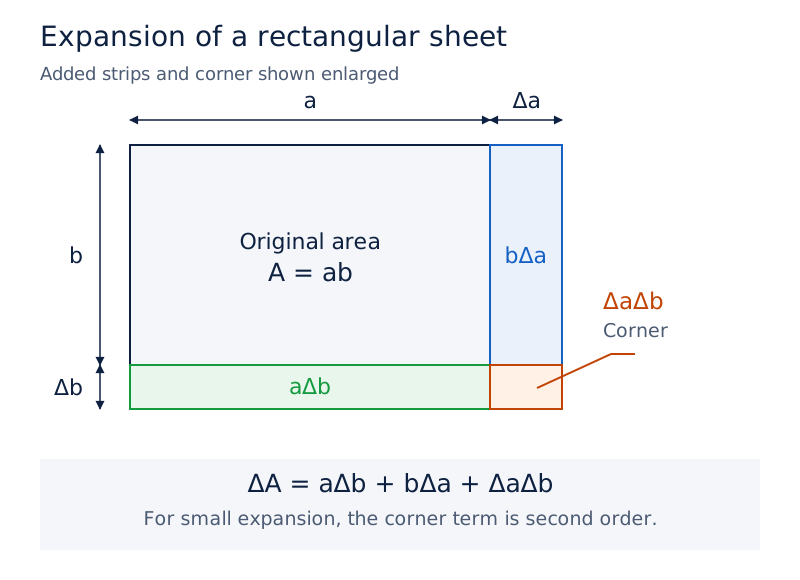
The rectangle has sides labelled and . Added strips have widths and , with a small corner rectangle representing their product. The shaded additions show why the corner term is second order.
Drawn by One Young India. See Fig. 10.8 in your NCERT textbook
Derivation: volume expansion from linear expansion
Take a cube of original side , expanding equally in all directions. Its original volume is , and each side increases by .
- Express its original and changed volumes:
- Expand the cube and retain all terms initially:
- For a small fractional length change, discard second- and third-order terms:
- Compare with the definition of volume expansivity:
Result: The volume coefficient is approximately three times the linear coefficient for small expansion equally in all directions.
Worked example 1. An iron ring has diameter 5.231 m at 27 °C and must fit a wheel rim of diameter 5.243 m. Its linear expansion coefficient is . Find the required ring temperature, treating the rim diameter as fixed.
Let be initial diameter, its increase and the final Celsius temperature. Formula: ; , where is the initial temperature and temperature intervals are expressed consistently.
Substitute:
Answer: The ring must reach approximately 218 °C. Its diameter then increases enough to fit over the rim.
Why are water’s expansion and restrained expansion important?
Why do lakes freeze at the top first?
Water behaves unusually between 0 °C and 4 °C: it contracts on heating through this interval. Equivalently, it expands when cooled below 4 °C. A fixed mass therefore has its minimum volume and maximum density at approximately 4 °C.
As a lake cools towards 4 °C, surface water becomes denser and sinks, while warmer water rises. Once the surface water cools below 4 °C, it becomes less dense and stays near the top. Freezing therefore begins at the surface.
What the figure shows
Thermal expansion of water
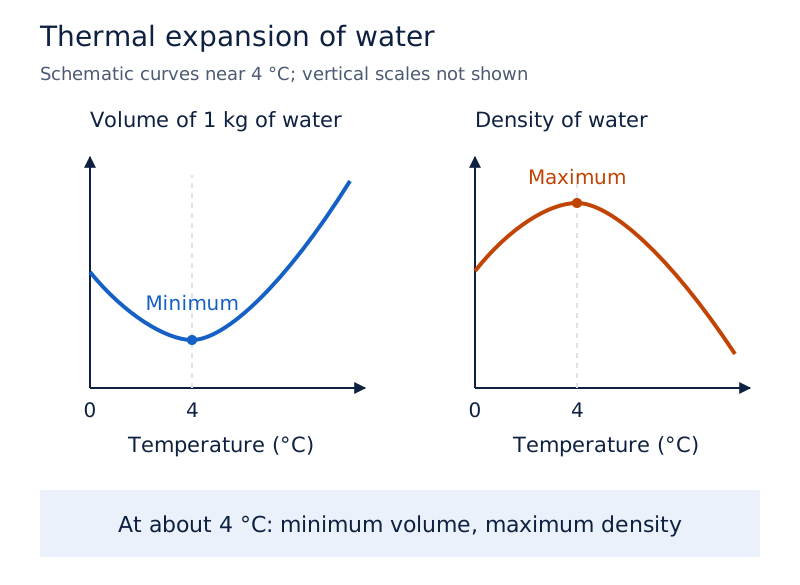
Both horizontal axes show temperature. The left graph plots the volume of one kilogram of water and has a minimum near 4 °C. The right graph plots density and has a maximum near the same temperature.
Drawn by One Young India. See Fig. 10.7 in your NCERT textbook
Gases at ordinary temperatures expand much more than solids and liquids. For an ideal gas at constant pressure, its volume expansivity depends on absolute temperature. This dependence follows by comparing a small volume change with the original gas equation.
- For fixed amount and pressure, write
- For the temperature and volume changes, write
- Divide the second relation by the first:
- Apply the definition of volume expansivity:
What happens if a heated rod cannot expand?
Rigid supports can prevent the expansion that heating would otherwise produce. The supports then exert forces on the rod, creating thermal stress. Let be Young’s modulus, the magnitude of thermal stress and the corresponding force.
Worked example 2. A steel rail of length 5 m and cross-sectional area 40 cm² is prevented from expanding through a temperature rise of 10 °C. Use and . Calculate the stress and restraining force.
Formula: ; .
Substitute:
Answer: The compressive stress is , with a restraining force of 96000 N, approximately .
How do heat capacity and calorimetry describe temperature changes?
Which heat capacity should be used?
The heat needed to warm a sample depends on its mass, temperature change and material. Let be heat supplied, the sample mass, its heat capacity, its specific heat capacity and its molar heat capacity.
The SI unit of heat capacity is joule per kelvin. The SI unit of specific heat capacity is joule per kilogram per kelvin. The SI unit of molar heat capacity is joule per mole per kelvin.
For a temperature interval with no phase change and an appropriate approximately constant specific heat capacity:
Gas heat capacities need a stated condition. The symbols and mean molar heat capacities at constant pressure and constant volume, respectively. Specific heat capacity also depends on temperature, so tabulated values belong to specified conditions.
Water’s high specific heat capacity explains its use in automobile radiators and hot-water bags. For a given mass and temperature change, water can absorb or release considerable heat. It also warms more slowly than land, contributing to coastal temperature effects.
How is a calorimeter included in the heat balance?
Calorimetry measures heat exchange. In a thermally isolated arrangement, heat lost by hotter parts equals heat gained by colder parts. A calorimeter’s vessel and stirrer can also gain heat; their contribution must be included when it is appreciable.
A metallic vessel and stirrer may be surrounded by an insulating jacket containing glass wool. A thermometer measures the mixture’s temperature. Insulation reduces exchange with the surroundings, making the heat-balance assumption a better approximation.
Worked example 3. A 0.047 kg aluminium sphere at 100 °C is placed in 0.25 kg of water and a 0.14 kg copper calorimeter, both initially at 20 °C. The final temperature is 23 °C. Neglect external heat loss. Use water and copper specific heat capacities of and . Find aluminium’s specific heat capacity.
Here denotes heat gained by water and calorimeter, and the unknown aluminium specific heat capacity. Subscripts , and identify water, copper and aluminium. Their temperature-change magnitudes are and .
Formula: ; .
Substitute:
Answer: Aluminium’s specific heat capacity is approximately 911 J per kilogram per kelvin, or .
Why can heating change state without raising temperature?
What happens during a phase change?
Melting changes solid into liquid, while freezing reverses the change. At the melting point, solid and liquid coexist in thermal equilibrium. Supplied heat changes the state while temperature remains constant until melting is complete, at the specified pressure.
Vaporisation changes liquid into vapour. At the boiling point, liquid and vapour coexist. Heat supplied during boiling converts more liquid into vapour without increasing the temperature. Normal melting and boiling points refer to standard atmospheric pressure.
Boiling point increases with pressure and decreases when pressure falls. Water consequently boils at a lower temperature at high altitudes, making cooking difficult. A pressure cooker raises the boiling temperature, allowing faster cooking.
Sublimation is direct conversion of solid into vapour without passing through the liquid state. Dry ice and iodine provide examples. Solid and vapour can coexist in thermal equilibrium during this change.
Pressure can also affect melting. A weighted wire can pass through an ice slab because increased pressure beneath it lowers the melting temperature. Water above the wire refreezes after the pressure is relieved. This refreezing is called regelation.
How is latent heat different from specific heat capacity?
Let denote latent heat per unit mass for a particular change of state. It depends on the substance, process and pressure. The symbols and denote latent heats of fusion and vaporisation.
The SI unit of latent heat is joule per kilogram. Unlike specific heat capacity, latent heat describes energy transfer during a change of state without a temperature change. The two formulas therefore apply to different stages of a heating process.
What the figure shows
Heating water through changes of state
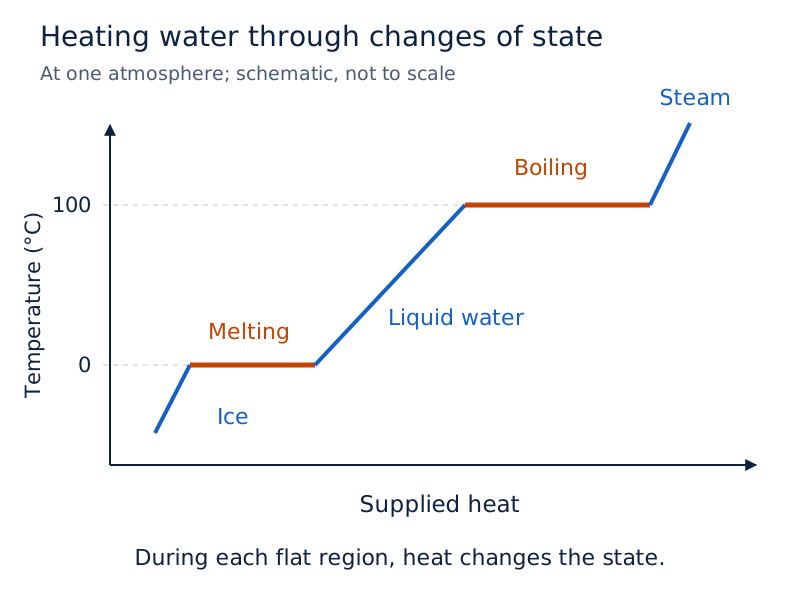
Temperature is plotted vertically and supplied heat horizontally. Sloping regions represent ice, liquid water and steam. Horizontal regions at approximately 0 °C and 100 °C show melting and boiling at one atmosphere. The figure is not to scale.
Drawn by One Young India. See Fig. 10.12 in your NCERT textbook
Worked example 4. Mix 0.15 kg of ice at 0 °C with 0.30 kg of water at 50 °C. All the ice melts and the final temperature is 6.7 °C. Neglect the container’s heat capacity and external heat exchange. Given water’s specific heat capacity , find the latent heat of fusion.
Let be heat lost by hot water and heat used to warm the melted ice. Let and denote hot-water and ice masses, and , their temperature-change magnitudes.
Formula: ; ; .
Substitute:
Answer: The calculated latent heat is approximately 334000 J per kilogram, or .
Worked example 5. Find the heat needed to convert 3 kg of ice at −12 °C into steam at 100 °C at atmospheric pressure. Neglect heating the container. Use ice and water specific heat capacities of and , fusion latent heat , and vaporisation latent heat .
Let , , and denote heat for warming ice, melting it, warming water and vaporising water, respectively. The subscripts on identify ice and water.
Formula: , , , . The temperature rises and are 12 K and 100 K.
Substitute:
- Warm the ice:
- Melt it:
- Warm the water:
- Vaporise it:
- Add the stages:
Answer: The required heat is 9104400 J, approximately . The vaporisation stage requires the greatest contribution.
How does conduction transfer heat through a solid?
What determines steady heat current?
Conduction transfers heat between neighbouring regions at different temperatures without bulk flow of matter. A metal rod heated at one end eventually becomes hot at the other. Gases are poor thermal conductors; many metals conduct heat effectively.
Consider a uniform bar with insulated sides and ends maintained at different temperatures. In steady state, each point keeps a constant temperature even though heat continues to flow. Heat entering any section per unit time equals heat leaving it.
Let be heat current, thermal conductivity, bar length, and and hot- and cold-end temperatures. Here denotes length, not latent heat. With cross-sectional area :
The SI unit of heat current is the watt. The SI unit of thermal conductivity is watt per metre per kelvin. Conductivity values vary somewhat with temperature but can often be treated as constant over a normal range.
| Material | Thermal conductivity in | Comparison |
|---|---|---|
| Copper | 385 | Transfers heat effectively through a cooking-pot base. |
| Glass wool | 0.04 | Useful as thermal insulation. |
| Air | 0.024 | Poor conduction helps trapped-air insulation. |
How do two joined bars behave?
Two bars joined end to end carry the same heat current in steady state if the sides are insulated. Their junction temperature follows by equating their heat currents. Equal currents do not require equal temperature drops, because lengths, areas and conductivities may differ.
For equal lengths and areas, let , denote the conductivities, , the outer-end temperatures, and the junction temperature. Then:
Solving gives the junction temperature. If denotes the equivalent conductivity of the combined bar of twice either individual length, the resulting expressions are:
Insulation reduces unwanted heat transfer. Plastic foams contain air pockets, while glass wool and wood have relatively low conductivities. Copper coating beneath a cooking pot instead encourages heat distribution, helping the base heat more uniformly.
How do convection and radiation transfer heat?
Why does heated fluid circulate?
Convection transfers heat through actual motion of matter and occurs in fluids. In natural convection, heating from below expands the warmer fluid, reducing its density. Buoyancy makes it rise, while cooler fluid replaces it and is heated in turn.
In forced convection, a pump or another external means moves the fluid. Automobile cooling systems and blood circulation are examples. The heart pumps blood through the body, allowing heat to be transported between different regions.
During the day, land heats more quickly than a large body of water. Air next to the land warms, expands and rises. Cooler air moves towards the land, producing a sea breeze. Mixing currents and water’s larger heat capacity help keep the water cooler.
At night, land loses heat more quickly and the water surface becomes warmer relative to it. The convection cycle reverses. The direction of the near-surface breeze therefore depends on which surface is warmer.
Why can radiation cross empty space?
Radiation transfers energy through electromagnetic waves and does not require a material medium. It brings energy from the Sun through space. Solids, liquids and gases all emit thermal radiation by virtue of their temperature.
| Mode | Transfer mechanism | Material medium |
|---|---|---|
| Conduction | Transfer between neighbouring regions without bulk flow | Required |
| Convection | Bulk movement of warmer and cooler fluid | Required; occurs in fluids |
| Radiation | Electromagnetic waves carry energy | Not required; can cross vacuum |
Dark surfaces generally absorb and emit radiant energy better than lighter surfaces. Light-coloured summer clothes reduce absorption of sunlight. Blackened cooking utensils absorb radiation effectively. These effects concern radiation rather than the material’s thermal conductivity alone.
A Dewar flask combines several protections. Silvered walls reflect radiation, an evacuated gap reduces conduction and convection, and insulating supports reduce conductive transfer. Each feature addresses a particular route by which energy could enter or leave the contents.
What do Wien’s law and the Stefan-Boltzmann law predict?
How does the radiation spectrum change with temperature?
Blackbody radiation has a continuous spectrum rather than one wavelength. The distribution of emitted energy depends on temperature. As the temperature rises, the wavelength of maximum emission shifts towards shorter wavelengths. The ideal blackbody curves are independent of the body’s material, shape and size.
Let denote the wavelength of maximum emission and Wien’s constant. Wien’s displacement law is:
What the figure shows
Blackbody spectra
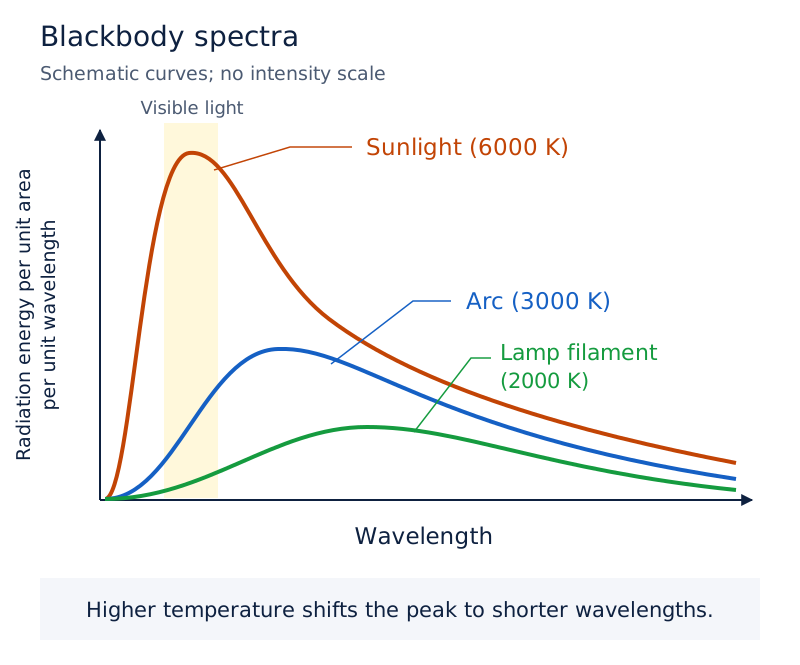
The horizontal axis is wavelength and the vertical axis is radiation energy per unit area per unit wavelength. Curves labelled sunlight, arc and lamp filament peak at progressively longer wavelengths as their labelled temperatures decrease. A narrow visible-light region is marked.
Drawn by One Young India. See Fig. 10.18 in your NCERT textbook
The change of a heated iron piece from dull red towards reddish yellow and white accompanies this shift in its emitted spectrum. Wien’s law can estimate a radiating surface temperature from the position of the spectral maximum.
How are emitted power and net loss different?
Let denote the Stefan-Boltzmann constant and dimensionless emissivity, the fraction of perfect-radiator emission. Here denotes emitted energy per unit time and radiating area. For a perfect radiator, emissivity is unity.
A body also absorbs radiation from its surroundings. If denotes surrounding temperature and the net outward radiative power, then:
Note: Use absolute temperatures in radiation laws. Emitted power is not the same as net heat loss: incoming radiation must also be included when the surroundings have a nonzero temperature.
Worked example 6. A tungsten lamp has emissivity 0.4, surface area 0.3 cm² and temperature 3000 K. Calculate its emitted radiative power, using .
Formula: .
Substitute:
Answer: The unrounded calculation gives 55.1124 W, or about 60 W at one significant figure. This is emitted power, without subtracting incoming radiation.
When does Newton’s law of cooling apply?
What controls the cooling rate?
Newton’s law of cooling states that the rate of heat loss is proportional to the temperature excess above the surroundings, provided that difference is small. The proportionality also depends on the exposed surface’s area and nature.
Let denote body temperature, constant surrounding temperature, elapsed time, and the positive heat-loss coefficient. Writing for heat exchanged by the body, with heat entering taken as positive:
The negative sign expresses energy loss while the body is hotter than its surroundings. Under small temperature differences, the combined effects of conduction, convection and radiation may also be represented by this proportionality.
Derivation: the exponential cooling relation
Assume constant mass , specific heat capacity , surrounding temperature and coefficient , with no phase change. Define as the cooling coefficient per unit time, and as the initial body temperature.
- Relate the changing body temperature to the heat-loss rate:
- Define the rate coefficient and separate variables:
- Integrate from the initial temperature at zero elapsed time to the later temperature:
- Exponentiate and rearrange:
Result: The temperature excess decreases exponentially under these assumptions. Cooling is initially faster and slows as the body approaches the surrounding temperature.
How can the law be checked experimentally?
Place hot water in a copper calorimeter surrounded by a double-walled vessel. Thermometers measure the calorimeter water and surrounding water temperatures. Record the cooling temperature at equal time intervals while keeping the surroundings approximately constant.
What the figure shows
Verification of cooling behaviour
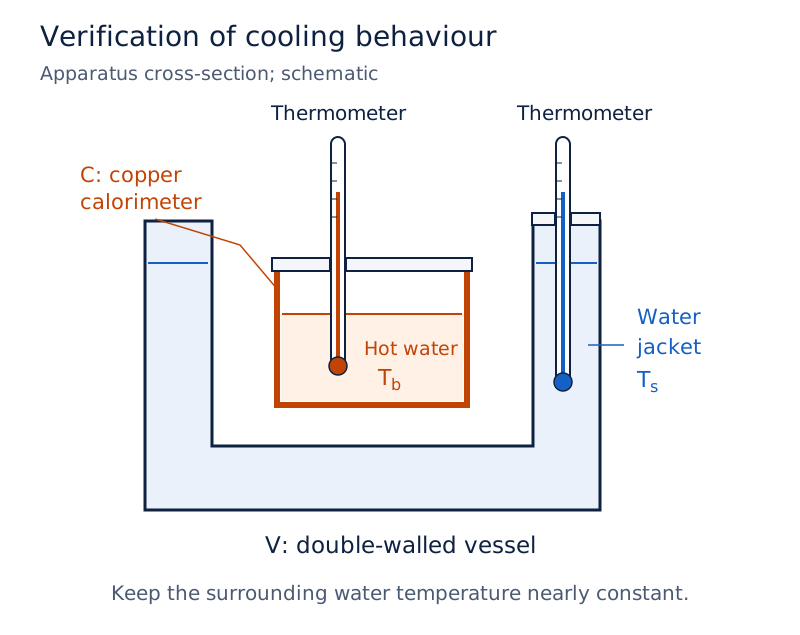
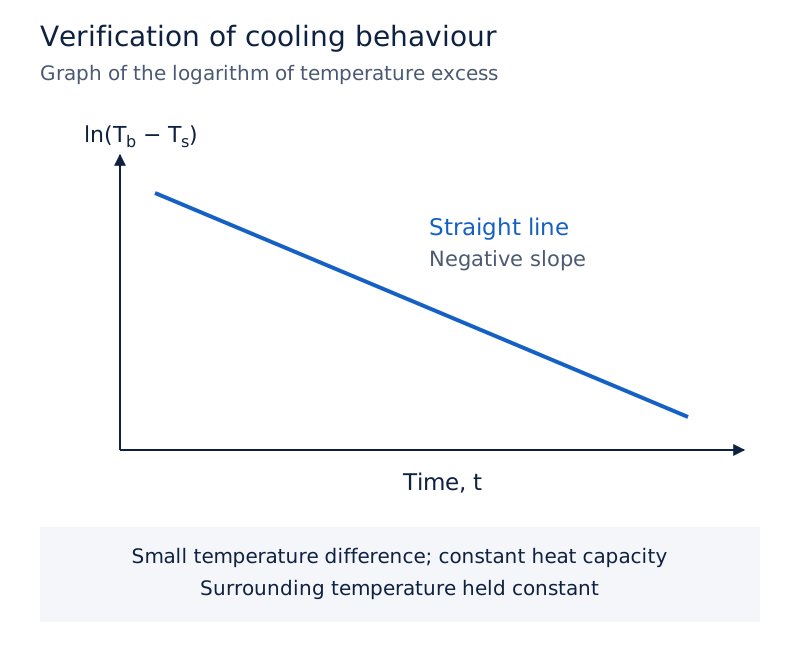
A copper calorimeter labelled C sits within a vessel labelled V. Two thermometers measure the inner and surrounding water temperatures. The accompanying graph shows the logarithm of the temperature excess decreasing along a straight line with time.
Drawn by One Young India. See Fig. 10.20 in your NCERT textbook
The graph tests the logarithmic form of the cooling relation. A steep cooling curve at first does not mean the coefficient changes: the temperature excess itself is larger initially. The small-temperature-difference condition should accompany any use of this law.
Glossary
- Heat — Energy transferred between systems or regions because their temperatures differ.
- Temperature — A quantitative indication of a body’s relative hotness or coldness.
- Absolute zero — The zero of the kelvin scale, corresponding to minus 273.15 degrees Celsius.
- Thermal expansion — Increase in a substance’s dimensions associated with a rise in its temperature.
- Thermal stress — Stress developed when supports prevent the dimensional change caused by temperature change.
- Specific heat capacity — Heat required per unit mass for a unit temperature rise without phase change.
- Calorimetry — Measurement of heat exchanged, commonly using the thermal balance of interacting bodies.
- Latent heat — Heat transferred per unit mass during a specified change of state.
- Regelation — Refreezing of water after the pressure responsible for melting ice is relieved.
- Sublimation — Direct conversion of a solid into vapour without an intervening liquid state.
- Thermal conductivity — Material property determining steady conductive heat current for given dimensions and temperature difference.
- Convection — Heat transfer through actual bulk movement of material within a fluid.
- Emissivity — Dimensionless fraction comparing a surface’s radiative emission with perfect-radiator emission at the same temperature.
- Triple point — Particular temperature and pressure at which solid, liquid and vapour phases coexist.
Common errors and misconceptions
- Misconception: Heat and temperature measure the same thing. Correct: Heat is transferred energy; temperature indicates hotness and determines the direction of heat transfer.
- Misconception: Every substance expands whenever heated. Correct: Most do, but water contracts when heated from 0 °C to 4 °C.
- Misconception: Celsius readings can replace kelvin in every formula. Correct: Equal interval sizes permit temperature differences to be interchanged numerically, but absolute-temperature laws require kelvin.
- Misconception: Supplied heat must increase temperature. Correct: During melting or boiling at constant pressure, heat changes the state while temperature remains constant.
- Misconception: A calorimeter never absorbs heat. Correct: The vessel can warm with its contents, so its heat capacity belongs in the heat balance.
- Misconception: Steady-state conduction means heat flow has stopped. Correct: Temperatures remain steady while equal heat currents enter and leave each section.
- Misconception: A vacuum prevents every mode of heat transfer. Correct: Radiation travels through vacuum even though conduction and convection require matter.
- Misconception: Newton’s cooling law applies without a temperature restriction. Correct: Its proportionality is a valid approximation for small temperature differences under the stated conditions.
Exam-style questions with model answers
Q1. Distinguish heat from temperature and state their SI units. [2 marks]
- Heat is energy transferred because of a temperature difference; its SI unit is the joule.
- Temperature indicates a body’s relative hotness or coldness; its SI unit is the kelvin.
Q2. Explain why a lake freezes at the surface first as it cools through 4 °C. [3 marks]
- Water has its maximum density near 4 °C. As initially warmer surface water cools towards this temperature, it becomes denser and sinks, allowing warmer water to rise.
- When the surface water cools below 4 °C, its volume increases and density decreases, so it stays above the denser water beneath.
- This colder surface layer reaches freezing conditions first. Ice therefore forms at the top, while deeper water need not freeze at the same time.
Q3. Derive the relation between area and linear expansion coefficients for a rectangular sheet. Define your symbols and state the approximation. [4 marks]
- Let , and denote initial length, breadth and area; denotes linear expansivity and temperature rise. Thus , and , with equal expansion properties in both directions.
- The increase in area, , includes two strips and their corner:
- Substitute the length changes and neglect the second-order term when fractional expansion is small:
- Define area expansivity through fractional area change per temperature rise:
Q4. Calculate the heat required to turn 3 kg of ice at −12 °C into steam at 100 °C at atmospheric pressure. Neglect container heating. Use ice and water specific heat capacities of 2100 and 4186 J per kilogram per kelvin, respectively, latent heat of fusion and latent heat of vaporisation . [5 marks]
- First warm the ice to its melting point. Let denote this heat; the temperature rise is 12 K, with no phase change in this stage:
- Next melt all the ice at 0 °C. Let denote the fusion heat; temperature remains constant during this stage:
- Warm the resulting liquid water from 0 °C to 100 °C. Let denote this heat, using the water specific heat capacity:
- Convert the boiling water into steam at the same temperature. Let denote this vaporisation heat:
- The total supplied heat, , is the sum of these four contributions, since both warming stages and both phase changes are necessary:
Q5. Explain how conduction, convection and radiation differ, and identify the relevant insulating features of a Dewar flask. [5 marks]
- Conduction transfers heat between neighbouring parts at different temperatures without bulk movement of the material. It requires matter and can occur through a solid bar.
- Convection transfers heat through actual motion of fluid. Warmer fluid may rise naturally through buoyancy, or a pump may force circulation.
- Radiation transfers energy through electromagnetic waves. It requires no material medium and can therefore carry energy across an evacuated region.
- The evacuated gap between a Dewar flask’s walls reduces conduction and convection across that gap. Insulating supports also reduce conduction through the supporting material.
- The silvered walls reflect radiation, reducing radiative exchange between the contents and surroundings. These measures together help retain either hot or cold contents.
Q6. State Newton’s law of cooling, its main limitation and the temperature dependence it predicts for a cooling body. [3 marks]
- Let denote the rate of heat loss, body temperature, surrounding temperature and a positive coefficient. Newton’s law gives , so heat loss is proportional to temperature excess.
- The relation is valid for small temperature differences. The coefficient depends on the exposed area and nature of the surface; the surrounding temperature is kept approximately constant.
- With constant heat capacity, the temperature excess decreases exponentially with time. Cooling is faster initially and progressively slower as the temperature excess becomes smaller.
Q7. A tungsten lamp has emissivity 0.4, area 0.3 cm² and temperature 3000 K. Given , calculate emitted radiative power. Do not subtract incoming radiation. [3 marks]
- Let denote emitted power, emissivity, area and absolute temperature. The Stefan-Boltzmann relation is . It gives outgoing radiation rather than the net exchange with surroundings.
- Convert area before substitution: . The temperature already uses kelvin, as required by the fourth-power relation.
- Substituting the supplied quantities gives This is approximately 60 W at one significant figure.
Key takeaways
- Heat is transferred because temperatures differ; equal temperatures remove the temperature difference driving that exchange.
- Absolute-temperature laws require kelvin, although a temperature interval has the same numerical size in kelvin and Celsius degrees.
- For small expansion equally in all directions, area and volume coefficients are approximately twice and three times linear expansivity.
- Water’s maximum density near 4 °C explains why lakes begin freezing at the surface.
- Calorimetry includes every appreciable heat gain and loss, including warming of the calorimeter vessel.
- Separate warming stages from phase changes: specific heat capacity and latent heat describe different energy requirements.
- Conduction and convection require matter, whereas radiation crosses vacuum and depends strongly on absolute temperature.
- Newton’s cooling law applies to small temperature differences and predicts a decreasing cooling rate as temperature excess falls.
Test yourself
Why must a gas thermometer’s volume be held constant when pressure indicates temperature?
For a fixed gas amount at constant volume, pressure is proportional to absolute temperature. Changing volume would also change the pressure reading.
What approximation links area expansion with linear expansion?
Expansion must be small and equal in both directions, allowing the product of the two small length changes to be neglected.
Why can preventing a heated rail’s expansion produce a large force?
Rigid supports oppose its thermal expansion, creating compressive strain and stress that act across the rail’s cross-sectional area.
Why does melting ice not immediately become warmer?
At the melting point, supplied heat converts ice into water while the phases coexist at constant temperature.
Why must heat currents through two joined, insulated bars match in steady state?
Unequal currents would cause energy to accumulate or decrease at the junction, changing its temperature and violating steady state.
What shifts when a blackbody’s temperature increases?
The wavelength of maximum emission shifts towards shorter wavelengths, as described by Wien’s displacement law.
Why does a silvered vacuum flask need both reflective walls and an evacuated gap?
Reflective walls reduce radiation, while the evacuated gap reduces conduction and convection. Different features reduce different heat-transfer mechanisms.
Why does a cooling body lose heat more slowly later?
Its temperature excess above the surroundings decreases, reducing heat loss under the conditions of Newton’s cooling law.
Write about it
Turn a question from this chapter into a paper.
The Writing Studio has a structure guide, a rubric and citation tools for 15 formats, from essays to research papers. Drafting is free with an account. Learnacy Essential adds feedback from an AI writing coach and submission to The OYI Review.
Learnacy Essential is ₹1,499 for the year. Publication depends on review and is not guaranteed.