
Thermodynamics | CBSE Class 11 Physics Notes
On this page
Watch & explore
Start with a few high-quality watches, then dive into the notes below.

This note covers thermal equilibrium, the zeroth law, heat and internal energy, the first law, heat capacities, state variables, thermodynamic processes, the second law, reversibility, and the Carnot engine.
What does thermodynamics describe?
Thermodynamics studies heat, temperature and the conversion of heat into other forms of energy. Its concern is the internal condition of a bulk system, such as a gas, rather than the motion of that system as a whole.
A macroscopic description uses measurable quantities such as pressure, volume, temperature, mass and composition. It does not require the position and velocity of every molecule. This makes it possible to describe a gas using relatively few quantities.
Mechanical motion and internal change
A bullet moving rapidly has kinetic energy because of its motion as a whole. That speed alone does not mean its temperature is higher. When the bullet enters wood and stops, its mechanical energy changes into internal energy of the bullet and surrounding wood.
The distinction is between organised motion of the whole object and disordered motion within it. Thermodynamics describes the latter through macroscopic quantities. A system can therefore undergo a thermal change even when its centre of mass remains at rest.
Heat and work in familiar processes
Rubbing the palms together makes them warmer: mechanical work changes their internal condition. In a steam engine, energy supplied through steam can produce useful work by moving pistons. These examples connect mechanical processes with thermal processes.
Thermodynamic laws describe both the accounting of energy and restrictions on possible changes. Conservation of energy tells us how energy transfers balance. It does not, by itself, tell us whether a proposed conversion can occur or whether a process can be exactly reversed.
Definition: A thermodynamic equilibrium state has macroscopic variables that remain unchanged with time under the given external conditions.
This meaning of equilibrium differs from mechanical equilibrium, which concerns zero resultant external force and torque. Molecules can continue moving randomly while the bulk thermodynamic variables remain constant.
How do thermal equilibrium and the zeroth law define temperature?
Two systems in thermal equilibrium have equal temperatures. When bodies at different temperatures are placed in thermal contact, heat passes from the hotter body to the colder body. The net transfer stops when their temperatures become equal.
An adiabatic wall prevents heat transfer across it. A diathermic wall allows such transfer. Whether systems exchange heat therefore depends on the boundary separating them, as well as on their initial conditions.
If two gases are separated by a conducting wall, their macroscopic variables may change until they reach thermal equilibrium. Both pressure and volume need not change: for gases in rigid containers, the volumes stay fixed while the pressures can change.
The zeroth law
The zeroth law of thermodynamics states that two systems separately in thermal equilibrium with a third system are in thermal equilibrium with each other. It identifies temperature as the quantity shared by systems in thermal equilibrium.
Let , and denote the absolute temperatures of systems A, B and C respectively. The symbol denotes absolute temperature generally. The SI unit of temperature is the kelvin, written .
What the figure shows
Testing the zeroth law
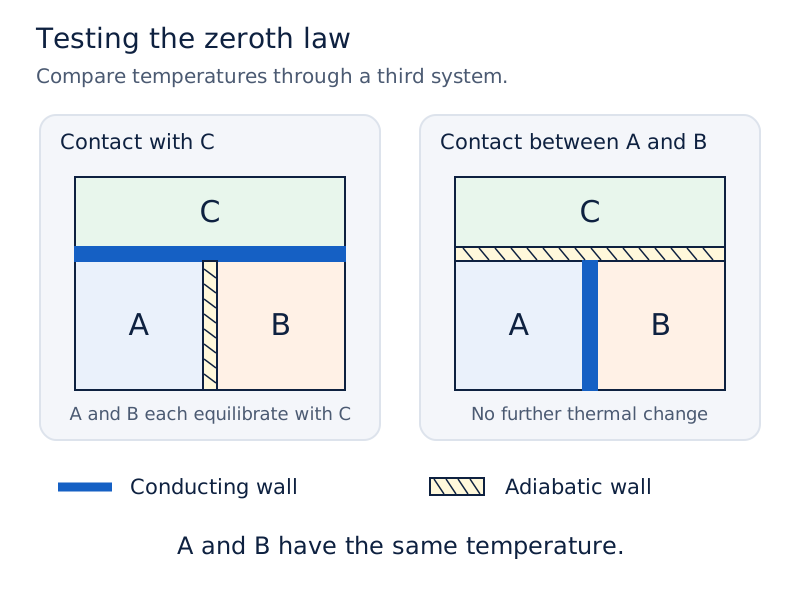
Two arrangements show A and B below C. In the first, A and B are insulated from each other but each contacts C through a conducting wall. In the second, C is insulated while A and B have a conducting wall between them.
Drawn by One Young India. See Fig. 11.2 in your NCERT textbook
The second arrangement produces no further thermal change once the first has reached equilibrium. The third system thus provides a way of comparing temperatures without first putting the original two systems in direct thermal contact.
How do heat, work and internal energy differ?
Internal energy, denoted by , includes the kinetic and potential energies of the molecular constituents in the frame where the system's centre of mass is at rest. It excludes the kinetic energy of the system's overall motion.
Molecular kinetic energy may involve translation, rotation and vibration. If intermolecular forces in a gas are neglected, its internal energy is the sum of the kinetic energies associated with the random motions of its molecules.
Internal energy is a state variable. Its value depends on the current state, not the history of how that state was reached. For an ideal gas of fixed amount, internal energy depends only on temperature.
Two modes of energy transfer
Heat is energy transferred because of a temperature difference. Work transfers energy by other means, such as pushing a piston. Heating a gas and compressing it can both increase its internal energy, although the modes of transfer differ.
| Quantity | Meaning | State or process? |
|---|---|---|
| Internal energy | Energy associated with the system's molecular constituents | Property of the state |
| Heat | Energy crossing the boundary because of a temperature difference | Energy transfer during a process |
| Work | Energy transferred by means such as displacement of a piston | Energy transfer during a process |
The SI unit of internal energy is the joule, written . Heat and work are also measured in joules. Sharing a unit does not make these three quantities interchangeable concepts.
Note: A system possesses internal energy. It does not possess a stored amount of “heat” or “work”. Heat supplied and work done describe transfers during a change of state.
For the same initial and final states, different processes can involve different amounts of heat and work. The change in internal energy remains the same because the endpoints, rather than the intervening path, determine it.
How does the first law account for energy transfers?
Let be heat supplied to a system, be work done by that system on its surroundings, and be its change in internal energy. The symbol indicates the relevant change or transferred amount.
The first law of thermodynamics applies conservation of energy to these transfers:
Heat entering the system is positive; heat leaving is negative. Work done by the system is positive; work done on it is negative. State the convention before substituting numbers, particularly when a question describes compression or work done on a gas.
Expansion against constant pressure
Let be the constant pressure against which a gas expands, and let be its volume change. The SI unit of pressure is the pascal, written . Volume has SI unit .
The pressure-volume work is positive for expansion and negative for compression. The pressure must be constant for this finite-change formula; variable-pressure work requires summing the small contributions along the path.
Worked example 1. A heater supplies energy at , while a system performs work at . Find the rate of increase of internal energy.
Formula: Define , and as the heat input, work output and internal-energy change per second. Then .
Answer: Internal energy increases at .
The SI unit of power is the watt, written , with . Do not confuse the upright unit symbol for watt with the italic symbol for work.
Worked example 2. A gas goes from state A to state B adiabatically with of work done on it. Another path between the same states supplies . Find the work done by the gas on the second path, using .
Formula: , where is work done by the gas on the adiabatic path. On the second path, .
Answer: The gas does approximately of work.
How is supplied heat divided during a change of phase?
A phase change illustrates why supplied heat need not equal the increase in internal energy. When water becomes steam at atmospheric pressure, it expands and does work against the surroundings. Part of the energy input therefore appears as expansion work.
The first law applies even though the process is a change of phase rather than simply a temperature rise. Use the actual change in volume, found by subtracting the initial volume from the final volume.
Liquid water becoming vapour
Worked example 3. A mass of of water becomes vapour at pressure . Its volume changes from to . The latent heat is . Find the expansion work and increase in internal energy.
Formula: Let be mass, be latent heat per unit mass, and and be the liquid and vapour volumes. Then , , and .
Answer: Rounded results are of work and of internal-energy increase.
Most of the supplied energy increases the internal energy; a smaller part does work. Using the heat input alone as the internal-energy change would omit the energy transferred mechanically to the surroundings.
The calculation also shows why temperature and internal energy must not be treated as synonyms. The statement that internal energy depends only on temperature applies to an ideal gas of fixed amount. It does not describe a liquid-to-vapour phase change in general.
What do heat capacity and specific heat capacity measure?
Heat capacity, denoted by , is the heat supplied per temperature rise under stated conditions. Let denote the temperature change. The SI unit of heat capacity is .
Heat capacity depends on the amount of substance. Specific heat capacity, denoted by , removes this dependence by dividing by mass. Molar heat capacity, denoted by , divides by the amount of substance , measured in moles.
The SI unit of specific heat capacity is . The SI unit of molar heat capacity is . These capacities depend on the material, its temperature and the conditions of heat supply.
Water and the calorie
The specific heat of water varies slightly with temperature. A calorie is defined using a specified interval: heating of water from to . The energy conversion is .
What the figure shows
Specific heat of water
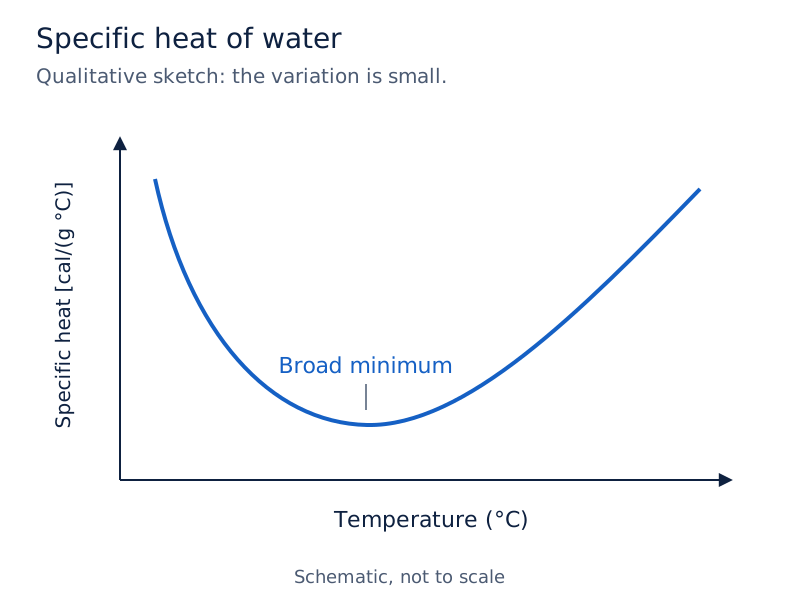
The horizontal axis gives temperature in degrees Celsius; the vertical axis gives specific heat in calories per gram per degree Celsius. The curve falls to a broad minimum and then rises again, showing a small variation.
Drawn by One Young India. See Fig. 11.5 in your NCERT textbook
Worked example 4. Calculate the heat required for the calorie-defining temperature rise of of water, using over that interval.
Formula: .
Answer: This is , equivalent to one calorie.
Molar heat capacity of solids
The equipartition prediction for a solid is , where is the universal gas constant. Measured values generally agree at ordinary temperatures; carbon is an exception. The agreement breaks down at low temperatures, so this prediction is not universal.
Worked example 5. Evaluate the predicted molar heat capacity of a solid using and .
Answer: The prediction is , subject to the ordinary-temperature limitations above.
Why are the constant-pressure and constant-volume heat capacities different?
For a gas, the heat needed for a given temperature increase depends on whether expansion is allowed. At constant volume, no pressure-volume work is done. At constant pressure, heating can also make the gas expand and perform work.
Let be the molar heat capacity at constant volume and the molar heat capacity at constant pressure. For an ideal gas, these satisfy . Both capacities and the gas constant have units .
Derivation: Difference between ideal-gas molar heat capacities
Consider a fixed amount of ideal gas undergoing a small temperature rise. Compare constant-volume and constant-pressure heating through that same rise.
- At constant volume, , so the first law gives . By the definition of molar heat capacity, .
- For the same temperature rise at constant pressure, write . The ideal gas has the same internal-energy change because that change depends only on temperature.
- The ideal-gas equation is . At constant pressure for fixed amount, it gives .
- Substitute both results into the first law: . Divide by to obtain .
Result: The extra heat supplied at constant pressure accounts for expansion work. This relation is for an ideal gas and for molar heat capacities.
Do not substitute mass-specific heat capacities into the molar relation without changing the corresponding gas constant. The distinction between “per kilogram” and “per mole” is part of the physical meaning of the formula, not merely a notation choice.
The dimensionless ratio , called the ratio of heat capacities, appears in the adiabatic relations. It compares two capacities expressed on the same basis.
How do state variables and quasi-static processes describe a gas?
An equation of state connects equilibrium state variables. For an ideal gas, . For a fixed amount, only two of pressure, volume and temperature are independent; the equation determines the third.
A rapidly expanding gas can have different pressures in different regions. Such an intermediate condition cannot be represented as a single equilibrium state with one well-defined pressure and temperature for the whole gas.
Extensive and intensive variables
Imagine dividing a uniform equilibrium system into two equal parts. Extensive variables halve for each part; intensive variables remain unchanged. This test classifies quantities by their dependence on the size of the system.
| Type | Examples | Effect of equal division |
|---|---|---|
| Extensive | Volume, mass and internal energy | Each part has half the original value |
| Intensive | Pressure, temperature and density | Each part retains the original value |
Why use a quasi-static idealisation?
A quasi-static process is an ideal, infinitely slow change through equilibrium states. The pressure and temperature differences driving the change are infinitesimal. The system remains arbitrarily close to mechanical and thermal equilibrium with its surroundings.
Suddenly removing a load from a piston causes acceleration and departures from equilibrium. By contrast, changing the external pressure in very small increments allows the gas to adjust at each stage. A similar sequence of small temperature differences permits gradual thermal change.
Real processes that are sufficiently slow, without large temperature gradients or accelerated piston motion, can approximate this idealisation. It allows pressure-volume paths to represent successive equilibrium states and makes path-dependent work calculable.
Quasi-static behaviour alone does not guarantee reversibility. Dissipative effects must also be absent. A description of a reversible process must therefore address both the sequence of states and losses such as friction.
How are isothermal and adiabatic processes different?
An isothermal process keeps temperature constant. An adiabatic process involves no heat exchange. These are different restrictions: preventing heat transfer does not generally keep temperature unchanged.
Derivation: Work in a quasi-static isothermal ideal-gas process
Let and be the initial and final volumes. Let be total work done by the gas and total heat supplied during the process. The notation means an infinitesimal volume change, and denotes the natural logarithm.
- At fixed temperature and fixed amount, , so . Pressure therefore changes inversely with volume. This is Boyle’s law for a fixed amount at constant temperature.
- Add the infinitesimal pressure-volume work contributions: .
- Substitute the ideal-gas pressure and take the constants outside the integral: .
- For an ideal gas, constant temperature gives . The first law then gives .
Result: During isothermal expansion, the ideal gas absorbs heat and does positive work. During compression, work is done on it and heat is released.
Adiabatic relations and work
For a quasi-static adiabatic ideal-gas process, . With constant heat-capacity ratio, an equivalent relation is . No proof of the pressure-volume relation is needed to use it here.
Here and denote initial and final pressures. Subscripts 1 and 2 identify the corresponding endpoint values, including temperatures and .
Derivation: Work in a quasi-static adiabatic ideal-gas process
Write the fixed value of as , a process constant distinct from the upright kelvin unit symbol. Assume the heat-capacity ratio is constant over the change.
- Use to write .
- Integrate pressure-volume work: .
- Use to obtain .
- Apply the ideal-gas equation at both endpoints: . Since , the first law gives .
Result: Adiabatic expansion does work at the expense of internal energy and lowers ideal-gas temperature. Compression does work on the gas and raises its temperature.
What the figure shows
Isothermal and adiabatic paths
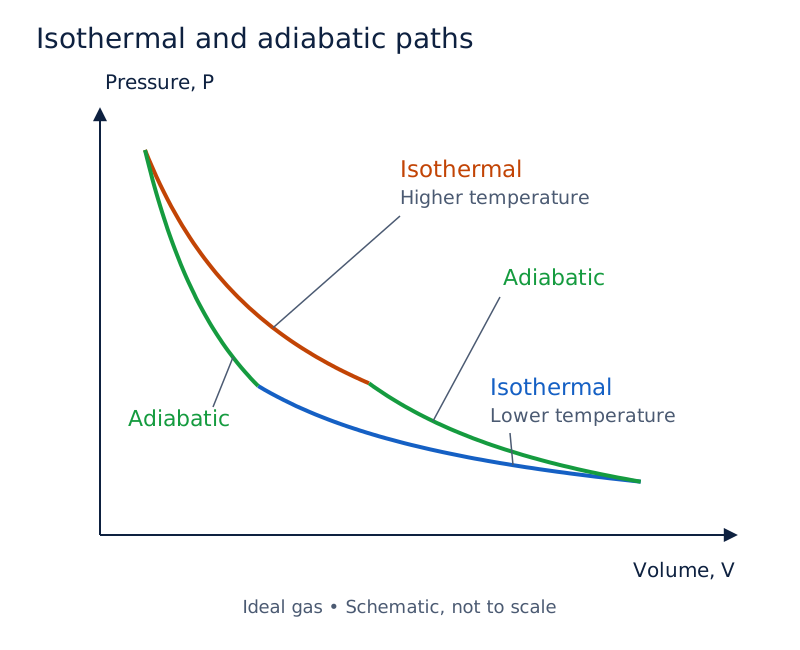
Pressure is on the vertical axis and volume on the horizontal axis. Two curves labelled “Isothermal” are joined by two curves labelled “Adiabatic”. The adiabatic portions connect the two temperature levels.
Drawn by One Young India. See Fig. 11.8 in your NCERT textbook
How do isochoric, isobaric and cyclic processes work?
An isochoric process keeps volume fixed. With no volume change, pressure-volume work is zero. Supplied heat changes internal energy; for an ideal gas, this changes temperature. The heat capacity relevant to this restriction is the constant-volume capacity.
An isobaric process keeps pressure fixed. For a fixed amount of ideal gas, expansion work can be expressed either through the volume change or the temperature change:
A cyclic process returns the system to its initial state. Its net internal-energy change is zero, so net heat supplied equals net work done. Individual stages can still involve non-zero internal-energy changes.
| Process | Restriction | Energy consequence |
|---|---|---|
| Isothermal ideal gas | Temperature constant | |
| Adiabatic | No heat exchange | |
| Isochoric with pressure-volume work only | Volume constant | |
| Isobaric | Pressure constant | |
| Cyclic | Initial state restored | , where “net” denotes the total over the cycle |
Work from a pressure-volume graph
What the figure shows
A linear expansion followed by compression
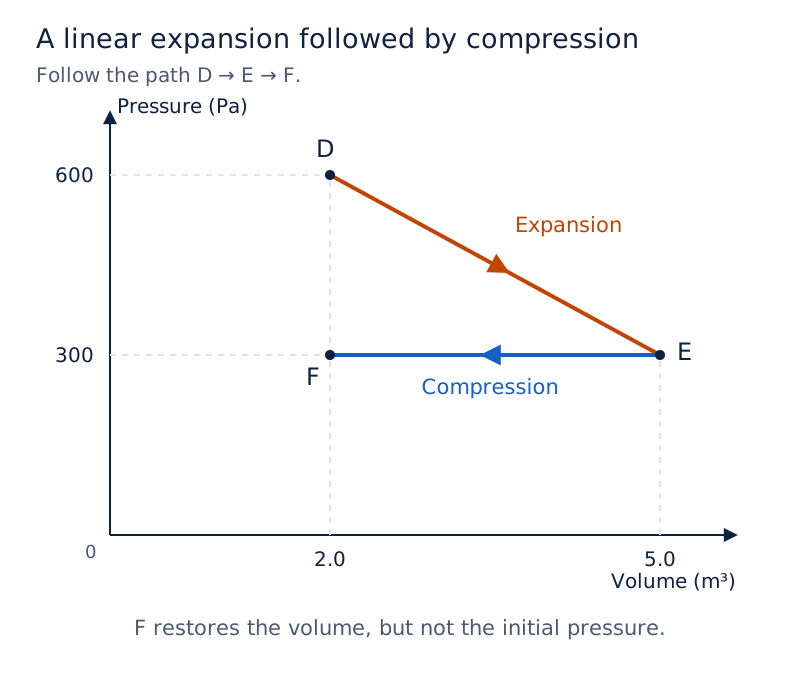
The graph marks D at volume , pressure ; E at , ; and F at , . Arrows run from D to E and then horizontally back to F.
Drawn by One Young India. See Fig. 11.11 in your NCERT textbook
Worked example 6. Calculate total work along the straight path from D to E and the constant-pressure path from E to F, using the coordinates just given.
Formula: For the linear stage, . For compression, . Letter subscripts identify graph points; and denote work on the respective stages.
Answer: The net work done by the gas is .
The endpoint F has the original volume but a different pressure from D. This is therefore not a complete cycle. Returning to one original variable is insufficient; a cycle must restore the complete thermodynamic state.
What do the second law and reversibility tell us?
The second law of thermodynamics restricts processes that conservation of energy alone would allow. Energy accounting could permit a table to cool while a resting book gains mechanical energy and jumps. Such spontaneous conversion is not observed.
Two equivalent statements
The Kelvin-Planck statement rules out a process whose only outcome is taking heat from a reservoir and converting all of it into work. A heat engine cannot have unit efficiency.
The Clausius statement rules out a process whose only outcome is transferring heat from a colder body to a hotter one. A refrigerator needs another effect, such as work supplied from outside, to move heat in that direction.
The qualification “sole result” matters. The second law does not prohibit every transfer from cold to hot. It prohibits achieving that transfer with no accompanying change elsewhere.
What must an exact reversal restore?
A reversible process can be reversed so that both the system and its surroundings return to their original states, with no other change elsewhere. It is an idealisation requiring a quasi-static process without dissipative effects.
Returning the system alone to its starting state is insufficient. Friction and viscosity transfer organised mechanical energy into internal energy. Their effects on the surroundings must also be undone for a process to qualify as reversible.
Irreversibility also arises when a process passes through non-equilibrium states, as in free expansion or an explosive chemical reaction. Gas diffusing through a room does not spontaneously gather back into its cylinder.
In an insulated free expansion against vacuum, there is no heat transfer and no external pressure-volume work. Internal energy is unchanged; for an ideal gas, temperature is unchanged too. Nevertheless, the intermediate states are not equilibrium states, and the expansion is irreversible.
Practical engines involve irreversible effects and operate below the limiting efficiency of a reversible engine between the same two reservoir temperatures. Reducing losses improves performance but does not remove the second-law restriction.
How does a Carnot engine achieve the limiting efficiency?
A Carnot engine is a reversible engine operating between two reservoirs. In this section, is the hot-reservoir absolute temperature and the cold-reservoir absolute temperature. Heat absorption and rejection occur isothermally.
Let be the positive magnitude of heat absorbed from the hot reservoir, the positive magnitude rejected to the cold reservoir, and the engine efficiency. The net work output is .
The four stages
- Isothermal expansion: The gas moves from state 1 to state 2 at , absorbs , and does work.
- Adiabatic expansion: It moves from state 2 to state 3 without heat transfer, cooling from to .
- Isothermal compression: It moves from state 3 to state 4 at , releasing heat of magnitude .
- Adiabatic compression: It returns from state 4 to state 1 without heat transfer, warming from to .
What the figure shows
The Carnot cycle
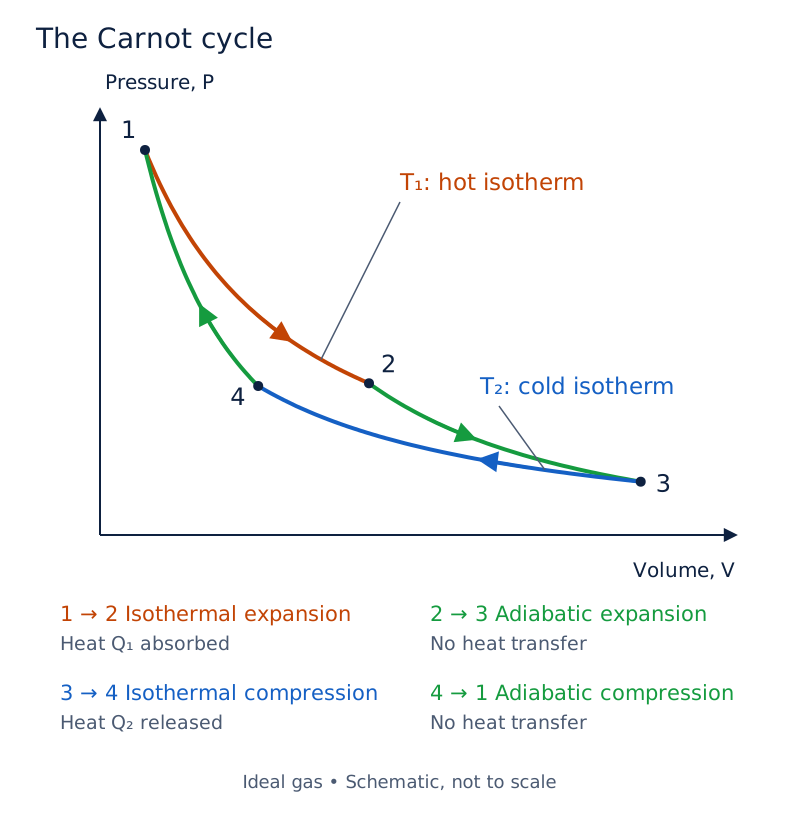
The pressure-volume plot has four labelled states joined in a closed loop. Arrows follow expansion along the upper and right-hand portions, then compression along the lower and left-hand portions. The upper endpoints share the hot temperature and the lower endpoints share the cold temperature.
Drawn by One Young India. See Fig. 11.9 in your NCERT textbook
Derivation: Carnot efficiency
Use an ideal gas as the working substance. Here are the volumes at the four numbered states, while retain their reservoir meanings. Heat rejection is a positive magnitude in the efficiency expression.
- The cycle restores internal energy, so and .
- The two isotherms give and .
- The adiabatic links obey and .
- Eliminating the common temperature ratio between the adiabatic relations gives . The logarithmic factors therefore cancel, leaving .
- Substitute into the efficiency expression: . Both temperatures must be absolute temperatures in kelvins.
Result: Carnot efficiency depends on the two reservoir temperatures and is independent of the working substance. No engine between those same temperatures can have greater efficiency.
Why can no engine exceed this efficiency?
Suppose a more efficient engine drove a reversed Carnot engine, with their heat exchanges at the hot reservoir matched. The combination would extract heat from the cold reservoir and convert it entirely into surplus work, leaving the hot reservoir unchanged.
That outcome violates the Kelvin-Planck statement. The assumption of a more efficient engine must therefore be rejected. Reversing a Carnot cycle instead gives a reversible refrigerator: work input enables it to take heat from the cold reservoir and deliver heat to the hot reservoir.
Glossary
- Thermodynamics — The macroscopic study of heat, temperature and conversions between heat and other forms of energy.
- Thermal equilibrium — A condition in which systems have equal temperatures and no net heat transfer between them.
- Adiabatic wall — An insulating boundary that prevents heat from passing between the systems it separates.
- Diathermic wall — A conducting boundary that permits heat transfer between systems at different temperatures.
- Internal energy — The molecular kinetic and potential energy of a system, excluding the kinetic energy of its overall motion.
- State variable — A quantity determined by the equilibrium state, independently of the path used to reach it.
- Specific heat capacity — Heat supplied per unit mass per temperature rise under specified conditions of heating.
- Equation of state — A relation connecting the variables used to describe an equilibrium state of a system.
- Quasi-static process — An ideal, infinitely slow change through states arbitrarily close to thermal and mechanical equilibrium.
- Isothermal process — A thermodynamic process in which the temperature of the system remains constant throughout.
- Adiabatic process — A thermodynamic process during which no heat is exchanged between the system and surroundings.
- Cyclic process — A sequence of changes that returns the system to its complete initial thermodynamic state.
- Reversible process — An ideal process whose reversal restores both system and surroundings without any other change elsewhere.
- Carnot engine — A reversible heat engine operating between two reservoir temperatures and achieving their limiting engine efficiency.
Common errors and misconceptions
- Misconception: Heat is stored inside a body. Correct: A body has internal energy; heat describes energy transferred because of a temperature difference.
- Misconception: Work done on a gas is positive in the work-by-system convention. Correct: It is negative; compression can therefore increase internal energy even without heat input.
- Misconception: An adiabatic process must have constant temperature. Correct: It has no heat exchange; ideal-gas expansion usually cools the gas and compression warms it.
- Misconception: All constant-temperature processes have zero internal-energy change. Correct: This conclusion follows for a fixed amount of ideal gas, not for every substance or phase change.
- Misconception: Every slow process is reversible. Correct: A reversible process must be quasi-static and free from dissipative effects such as friction and viscosity.
- Misconception: Restoring the initial volume completes a cycle. Correct: The complete state must be restored; the pressure and other state variables must also return.
- Misconception: Celsius temperatures can be used in the Carnot temperature ratio. Correct: The efficiency expression requires absolute temperatures in kelvins.
- Misconception: The second law forbids a refrigerator moving heat from cold to hot. Correct: It forbids that transfer as the sole result; supplied work permits refrigeration.
Exam-style questions with model answers
Q1. State the zeroth law and name the physical quantity it establishes. [2 marks]
- Two systems separately in thermal equilibrium with a third system are in thermal equilibrium with each other.
- The law establishes temperature as the common thermal property of systems in thermal equilibrium.
Q2. Distinguish internal energy from heat, and explain why overall motion does not define temperature. [3 marks]
- Internal energy is the molecular kinetic and potential energy in the frame where the centre of mass is at rest. It is a state variable.
- Heat is energy transferred because of a temperature difference. It describes an energy transfer during a process, rather than a stored property.
- The kinetic energy of the system's overall motion is excluded from internal energy. A rapidly moving bullet is therefore not hotter merely because of its speed.
Q3. A system receives heat at and does work at . Find its internal-energy increase per second, using . [2 marks]
- The first law in rate form is , where the dotted quantities denote internal-energy change, heat input and work output per second.
- . Internal energy increases at this rate.
Q4. For a fixed amount of ideal gas, derive , using , and explain the difference physically. Here are molar heat capacities and is the universal gas constant. [5 marks]
- At constant volume, , so there is no pressure-volume work. The first law gives , where is the temperature increase.
- For the same temperature rise at constant pressure, the heat supplied is . Some energy now performs expansion work.
- Internal energy of a fixed amount of ideal gas depends only on temperature. Consequently, the same temperature increase gives the same for both heating paths.
- At constant pressure, the equation of state gives . Substitution gives .
- Dividing by yields . Constant-pressure heating requires extra heat because the expanding gas does work while undergoing the same internal-energy increase.
Q5. A gas moves linearly from D at , to E at , , then isobarically to F at , . Calculate the work and decide whether this is a cycle. [4 marks]
- Work is the signed area under the pressure-volume path. For the linear expansion, use mean pressure: .
- The return stage is compression at fixed pressure, giving . The negative sign means work is done on the gas.
- Adding the two stage contributions gives net work , done by the gas on its surroundings.
- This is not a cycle. Although the original volume is restored, the final pressure is , whereas the original pressure was .
Q6. State both forms of the second law and explain the conditions needed for reversibility. [4 marks]
- The Kelvin-Planck statement prohibits a process whose sole result is taking heat from a reservoir and converting that heat completely into work.
- The Clausius statement prohibits a process whose sole result is transferring heat from a colder body to a hotter body.
- A reversible process must be quasi-static: successive states remain arbitrarily close to thermal and mechanical equilibrium, with infinitesimal driving differences.
- Dissipative effects such as friction and viscosity must also be absent. Reversal must restore both the system and surroundings, without any other change elsewhere.
Q7. Describe the four stages of a Carnot engine working between hot temperature and cold temperature , and state its efficiency and limitation. [5 marks]
- First, the working gas expands isothermally at the hot-reservoir temperature . It absorbs heat from that reservoir and does work on the surroundings.
- Second, the gas expands adiabatically without exchanging heat. Work done by the gas decreases its internal energy, lowering its temperature from to .
- Third, the gas is compressed isothermally at the cold-reservoir temperature . Work is done on the gas while heat is rejected to the cold reservoir.
- Fourth, adiabatic compression restores the initial state. No heat is exchanged during this stage, and the temperature rises from to .
- The efficiency is , using absolute temperatures in kelvins. It is independent of the working substance, and no engine between the same reservoirs can exceed it.
Key takeaways
- The zeroth law connects thermal equilibrium with a common temperature, allowing thermal states to be compared.
- Internal energy belongs to a state; heat and work describe distinct transfers of energy during processes.
- The first law balances heat supplied against internal-energy increase and work done by the system.
- Constant-pressure heating of an ideal gas requires extra heat for expansion work compared with constant-volume heating.
- Isothermal conditions fix temperature, whereas adiabatic conditions prohibit heat exchange; the restrictions must be distinguished.
- A complete cycle restores every state variable, so net heat input equals net work output.
- Reversibility requires both quasi-static behaviour and the absence of dissipative effects in system and surroundings.
- Carnot efficiency depends only on absolute reservoir temperatures and sets the upper limit for engines between them.
Test yourself
Why can two systems reach thermal equilibrium without their pressures becoming equal?
Thermal equilibrium requires equal temperatures. The boundary conditions can keep volumes fixed, and thermal contact alone does not require equal pressures.
Is the kinetic energy of a moving container included in its internal energy?
No. Internal energy excludes the kinetic energy of the system's overall centre-of-mass motion.
What does dividing a uniform system into equal halves reveal about temperature and volume?
Temperature remains unchanged in each half and is intensive; volume halves and is extensive.
Can an ideal gas absorb heat without increasing its temperature?
Yes. In quasi-static isothermal expansion, supplied heat is balanced by work done while internal energy remains unchanged.
Why does an ideal gas cool during quasi-static adiabatic expansion?
It does work without receiving heat, so its internal energy decreases and its temperature falls. In insulated free expansion against vacuum, no work is done and the ideal-gas temperature remains unchanged.
Does zero net internal-energy change mean no work was done?
No. Over a cycle, internal energy returns to its original value while net heat can supply net work.
Why is free expansion irreversible even when an ideal gas has no temperature change?
Its intermediate states are not equilibrium states, and restoring both gas and surroundings requires other changes.
What happens when the four reversible Carnot stages are run in reverse?
The device acts as a reversible refrigerator, using work to move heat from the cold reservoir to the hot reservoir.
Write about it
Turn a question from this chapter into a paper.
The Writing Studio has a structure guide, a rubric and citation tools for 15 formats, from essays to research papers. Drafting is free with an account. Learnacy Essential adds feedback from an AI writing coach and submission to The OYI Review.
Learnacy Essential is ₹1,499 for the year. Publication depends on review and is not guaranteed.