
Linear Inequalities | CBSE Class 11 Maths Notes
On this page
Watch & explore
Start with a few high-quality watches, then dive into the notes below.
These Class 11 Mathematics notes cover the meaning and types of linear inequalities, rules for solving them, solution sets over different number systems, number-line graphs, double inequalities, simultaneous conditions, and applications involving purchases, marks, consecutive numbers, temperature and acid mixtures.
What is an inequality, and how does it describe a practical limit?
Definition: An inequality relates two real numbers or two algebraic expressions using one of the symbols , , or . These mean less than, greater than, less than or equal to, and greater than or equal to, respectively.
An equation expresses equality. An inequality expresses an order or a limit, which may include equality. The distinction matters when a situation allows several possible values rather than requiring one exact amount. Words such as “at most” and “at least” identify whether the limiting value is permitted.
How does a spending limit become an inequality?
Ravi has ₹200 and buys rice in packets of one kilogram, each costing ₹30. Let denote the number of packets he buys. His expenditure is rupees. Since packets cannot be divided in this purchase, he cannot spend exactly ₹200.
The purchase condition is . The variable represents a count, so negative values and fractions are unsuitable. The allowable values are . This practical restriction must accompany the algebraic inequality; an algebraic answer alone does not describe which purchases are possible.
Reshma has ₹120. Each register costs ₹40 and each pen ₹20. Here, let denote the number of registers and the number of pens. The budget condition is . Spending the full amount is permitted, so equality belongs in the relation.
| Verbal condition | Mathematical symbol | Equality allowed? |
|---|---|---|
| Less than | No | |
| Greater than | No | |
| At most, or not more than | Yes | |
| At least, or not less than | Yes |
A slack inequality such as the budget condition covers two possibilities: expenditure below the limit or expenditure equal to it. These are alternatives. The expenditure does not have to be both below and equal to the limit simultaneously.
How are inequalities classified as numerical, literal, strict or linear?
A numerical inequality compares numbers, as in or . A literal inequality contains a variable, as in , where denotes the number being tested. Its truth depends on the value assigned to that variable.
A strict inequality uses or , excluding equality. A slack inequality uses or , including equality. These descriptions concern the comparison sign, whereas the word “linear” concerns the algebraic expression. A linear inequality can therefore be either strict or slack.
What makes an inequality linear?
Let , and denote real constants, and let and denote variables. The forms , , and , with , are linear inequalities in one variable.
The forms , , and , with and , are linear inequalities in two variables. The variables occur to the first power. The register-and-pen budget is an example involving two quantities.
By contrast, , with , is a quadratic inequality. The squared term prevents it from being linear. Counting the number of letters alone does not distinguish linear from quadratic inequalities; the powers of the variables also matter.
A double inequality combines two comparisons. For example, requires the variable to be greater than three and less than five. Both conditions must hold for the same value. Each comparison sign separately decides whether its endpoint is included.
Which properties allow us to solve an inequality correctly?
Solving an inequality means finding every permitted value that makes it true. A useful transformation preserves its solution set. The operations resemble those used for equations, but multiplication and division require attention to the sign of the number used.
Property: Adding or subtracting the same number
Equal numbers may be added to, or subtracted from, both sides without changing the inequality sign. This allows constant terms to be collected on one side. Subtracting the same variable expression from both sides also preserves the comparison for each value of that variable.
Property: Multiplying or dividing by a positive number
Multiplying or dividing both sides by the same positive number preserves the inequality sign. Once the variable terms have been collected, division by a positive coefficient therefore leaves the direction unchanged. Division must be by a non-zero number.
Property: Multiplying or dividing by a negative number
Multiplying or dividing both sides by the same negative number reverses the inequality sign. Less than becomes greater than, and less than or equal to becomes greater than or equal to. Inclusion of equality is preserved even though the direction reverses.
- Start with the true numerical comparison .
- Multiply both sides by negative one and reverse the comparison: .
- Simplify the products to obtain .
The same rule explains why , after multiplication by negative two, gives . The numerical order changes because the multiplier is negative. The rule concerns the operation applied to both sides, rather than the mere presence of a negative term.
Note: Adding or subtracting a negative number does not itself reverse an inequality. Reversal is required when both sides are multiplied or divided by a negative number. State that operation explicitly when isolating the variable.
A reliable sequence is to simplify brackets or fractions, collect variable terms, collect constants, and then divide by the variable’s coefficient. Before that final division, inspect the coefficient’s sign. After solving, apply any restriction to natural numbers, integers or quantities imposed by the question.
Why does the number system change the solution set?
A solution is a value making the original inequality true. The solution set collects all such values within the stated number system. The same simplified inequality can therefore have different listed solutions when its variable is restricted to natural numbers, integers or real numbers.
How do natural-number and integer answers differ?
Worked example 1. Solve , first for natural numbers and then for integers. Here is the variable whose allowed number system changes.
- Divide both sides by the positive number thirty:
- Simplify the bound:
- For natural numbers, list the positive whole numbers below the bound:
- For integers, include zero and all negative integers as well:
Answer: The largest permitted integer is in either case. The natural-number set is finite, while the integer set continues without a lower bound.
The integer answer above is an abstract algebraic solution. For Ravi’s packet purchase, negative integers have no practical meaning. The original purchase permits only non-negative integer counts. Reading the meaning of a variable is therefore as important as reading its algebraic bound.
How do integer and real-number answers differ?
Worked example 2. Solve , where is first an integer and then a real number.
- Add three to both sides:
- Subtract from both sides:
- Divide by the positive number two:
- Restrict the result to integers when required:
Answer: The integer solutions end at . The real solutions are all real numbers satisfying , written .
The symbol means “belongs to”, and denotes infinity. Parentheses indicate an excluded endpoint in interval notation; a square bracket indicates an included finite endpoint. The interval above extends indefinitely leftwards and excludes two. Unless a question states otherwise, solve over the real numbers.
How do we solve inequalities with negative coefficients and fractions?
A negative coefficient or a fraction does not change the purpose of solving: isolate the variable through operations that preserve the correct solution set. The main decisions are whether a multiplier is positive and whether the final division requires a reversal of direction.
How is a negative coefficient handled?
Worked example 3. Solve , where denotes a real number.
- Subtract from both sides:
- Subtract three from both sides:
- Divide by negative two and reverse the sign:
Answer: All real numbers greater than solve the inequality. The solution interval is , excluding its finite endpoint.
The two subtraction steps leave the comparison sign unchanged. Reversal occurs in the final step because the divisor is negative. Separating these operations makes it clear why the answer points towards values greater than the boundary, even though the original inequality used a less-than sign.
How are numerical denominators removed?
Worked example 4. Solve , where denotes a real number.
- Multiply every term by positive six:
- Expand the bracket:
- Subtract from both sides:
- Subtract ten from both sides:
- Divide by negative five, reversing the inequality:
Answer: The solution is . The finite endpoint is included because equality is allowed.
Multiplication by six clears both numerical denominators without changing the sign. It must also multiply the standalone constant, producing negative thirty. A common denominator is useful only when the operation is applied to every term on both sides, including terms outside fractions.
Keep the fraction bar’s grouping visible. The numerator in the first fraction is the complete expression , whereas the subtraction of five on the right is outside the fraction. Brackets in the next step preserve that distinction and prevent expansion errors.
How are solutions represented on a number line?
A number-line graph shows which real numbers satisfy an inequality. First locate the boundary value. Then decide whether that point belongs to the solution and which direction contains the remaining solutions. These are separate decisions: endpoint inclusion comes from the sign, while direction comes from the comparison.
How is an excluded endpoint drawn?
Worked example 5. Solve and graph , where is a real number.
- Subtract from both sides:
- Subtract three:
- Divide by positive two:
- Mark an open circle at and darken the number line to its left.
Answer: The interval is . The boundary value does not belong to the solution.
What the figure shows
Strict upper bound
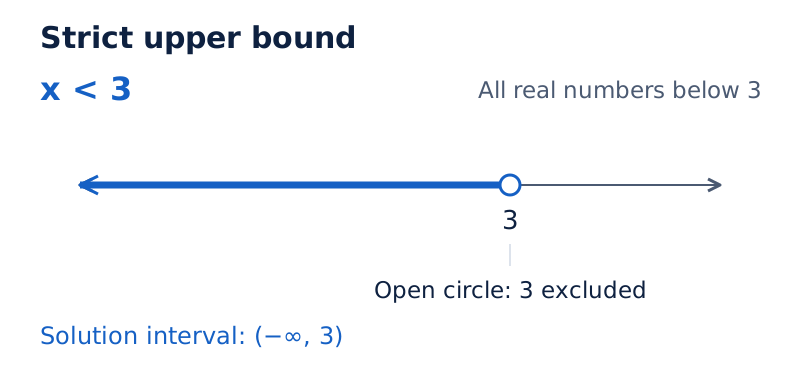
The number line has an open circle at . The highlighted line extends leftwards from that point and ends in a left-pointing arrow, showing values below the excluded boundary.
Drawn by One Young India. See Fig. 5.1 in your NCERT textbook
How is an included endpoint drawn?
Worked example 6. Solve and graph , where is a real number.
- Combine the terms on the right:
- Multiply by positive four:
- Expand the left side:
- Subtract from both sides:
- Add eight to both sides:
- Divide by positive five:
- Mark a filled circle at and darken the line to its right.
Answer: The solution interval is , including the endpoint .
What the figure shows
Included lower bound
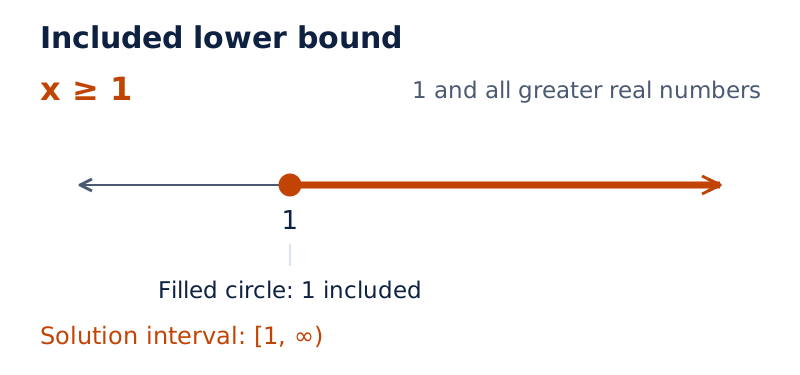
A filled point marks . The highlighted number line extends rightwards from it with an arrow, showing the included boundary and all greater real numbers.
Drawn by One Young India. See Fig. 5.2 in your NCERT textbook
An open circle excludes its number; a filled circle includes it. A leftward line represents smaller values, and a rightward line represents larger values. Draw the graph only after simplifying the inequality, because the final comparison may differ in direction from the original one.
How do marks and consecutive-number problems become inequalities?
A word problem begins with a definition of the unknown. Translate every restriction, including words such as “minimum”, “at least”, “both” and “less than”. Then solve algebraically and interpret the result in the original context rather than stopping at an isolated inequality.
How is a minimum average requirement used?
Worked example 7. A student scores 62 and 48 in the first and second terminal examinations. Find the minimum annual-examination mark needed for an average of at least 60 across the three examinations. Let be the annual-examination mark.
- Express the total divided by the number of examinations:
- Add the known marks:
- Multiply by positive three:
- Subtract the known total:
Answer: The student needs a minimum of marks in the annual examination.
The phrase at least includes equality. Consequently, the boundary value is a valid minimum. The denominator counts all three examinations, including the examination whose mark is unknown. The known marks must be added before comparing the complete average with its target.
How are consecutive odd numbers represented?
Worked example 8. Find all pairs of consecutive odd natural numbers, both larger than 10, whose sum is less than 40. Let be the smaller odd natural number; the next one is .
- Translate the lower restriction and sum condition:
- Collect like terms in the sum:
- Subtract two:
- Divide by positive two:
- Combine this with the original lower bound:
- Select the odd natural numbers in that range:
- Pair each selected number with the odd number two greater than it:
Answer: The four pairs are , , and .
The upper bound restricts the smaller number, not both numbers separately. Thus nineteen can appear as the larger member of a valid pair even though the smaller member must be less than nineteen. Selecting odd natural numbers is an essential final step; the entire real interval is not the requested answer.
How do we solve double inequalities without losing either condition?
A double inequality places the same expression between two bounds. Its solution must satisfy both comparisons. One method is to solve the comparisons separately and take the common values. Another is to perform a permitted operation on all three parts of the chain.
What happens when the variable coefficient is positive?
Worked example 9. Solve , where is a real number.
- Add three to each part:
- Simplify all three expressions:
- Divide each part by positive five:
Answer: The solution is . It includes and excludes .
The different endpoint signs remain different throughout the calculation. Adding a number to the middle expression alone would change the conditions. Applying the same operation to all three parts keeps both comparisons consistent and makes their common solution visible in one chain.
What changes when division is by a negative number?
Worked example 10. Solve , where is a real number.
- Multiply all three parts by positive two:
- Subtract five throughout:
- Divide by negative three and reverse both comparisons:
- Write the lower bound first:
Answer: The solution is , including both finite endpoints.
Rewriting the final chain from smallest to largest does not introduce another operation on the variable. It expresses the same two comparisons in a familiar order. The statement says that the variable is at least the lower bound and at most the upper bound.
Note: In a double inequality, division by a negative number reverses both signs. Keep each endpoint’s equality status while changing direction, and then check that the smaller bound appears on the left in the final increasing-order form.
How is the common solution of two inequalities found?
A system of inequalities requires the same value of the variable to satisfy every stated condition. Solve each inequality first. Then identify their overlap, or intersection. Values that satisfy just one condition do not belong to the solution of the complete system.
How does an overlap appear algebraically and graphically?
Worked example 11. Solve and together, and represent the common solution on a number line. Here is a real number.
- Subtract in the first inequality:
- Add seven to both sides:
- Divide the first inequality by positive two:
- Subtract eleven in the second inequality:
- Divide the second inequality by negative five and reverse the sign:
- Take values meeting both bounds:
- Draw a filled point at , an open point at , and darken the segment between them.
Answer: The solution of the system is , including but excluding .
What the figure shows
Common solution of two inequalities
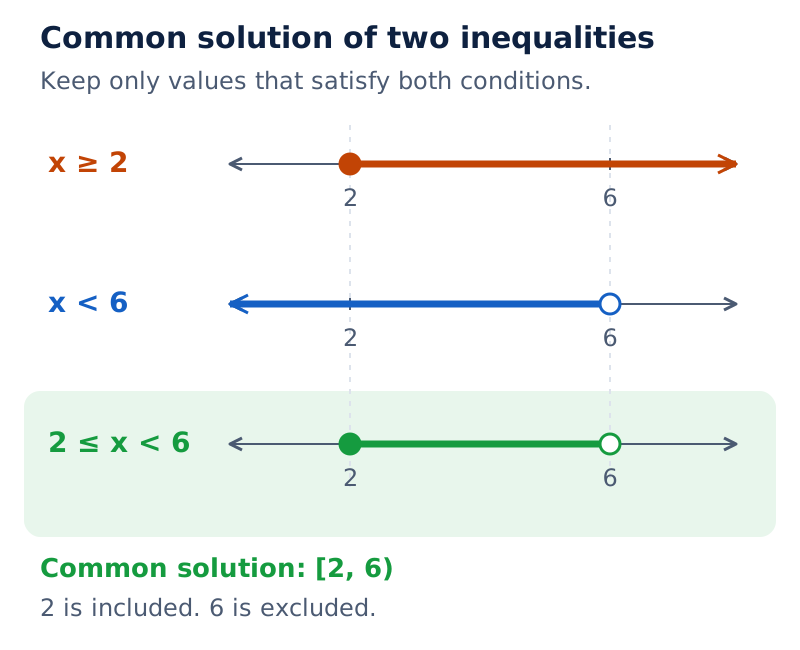
One line shows a filled point at and a ray extending rightwards. Another shows an open point at and a ray extending leftwards. The lower number line highlights their shared segment from to , with the corresponding filled and open endpoints.
Drawn by One Young India. See Fig. 5.3 in your NCERT textbook
The first inequality supplies an upper bound; the second supplies a lower bound. Their overlap is a bounded segment, although each individual graph extends indefinitely in one direction. Keep the endpoint markings when combining the graphs, because a boundary is accepted only if it satisfies both conditions.
The word “and” is decisive. It asks for common solutions rather than every number appearing in either separate solution. Presenting the two separate answers is useful working, but the complete answer must also state their overlap as an interval or a double inequality.
How are temperature ranges and mixture conditions solved?
Applications can impose a lower and an upper limit simultaneously. A conversion formula or a mixture calculation translates those limits into inequalities for the required unknown. Preserve strict or inclusive signs, retain the meaning of each variable and give the final range with the correct units.
How is a temperature interval converted?
Worked example 12. A hydrochloric acid solution must remain strictly between and . Find its Fahrenheit range using , where and are numerical temperatures in degrees Celsius and degrees Fahrenheit, respectively.
- Express the Celsius requirement:
- Substitute the given conversion formula:
- Multiply each part by positive nine-fifths:
- Add thirty-two to every part:
Answer: The temperature must be strictly between and .
Both operations preserve the comparison directions: the multiplier is positive, and addition does not reverse order. Because the original bounds are strict, the converted bounds are also strict. The conversion changes the numerical scale while carrying the same temperature restriction into that scale.
How is the amount of acid compared with the total mixture?
Worked example 13. A manufacturer has 600 litres of a acid solution. How much acid solution must be added so that the resulting acid content is more than but less than ? Let be the number of litres added.
- Write the total mixture volume and acid amount, both in litres:
- Translate the lower concentration limit:
- Multiply by positive one hundred and expand:
- Subtract from both sides:
- Subtract from both sides:
- Divide by positive fifteen:
- Translate the upper concentration limit:
- Multiply by positive one hundred and expand:
- Subtract from both sides:
- Subtract from both sides:
- Divide by positive twelve:
- Combine the two required conditions:
Answer: Add more than litres but less than litres of the acid solution.
The acid amount and total solution volume are different quantities. The target percentages apply to the final volume, including the added solution. Using only the original volume on the right would describe a different condition and would fail to represent the resulting mixture.
The unknown addition must satisfy both concentration requirements. One inequality alone supplies only one boundary. The final open interval records the full restriction and excludes the amounts that would make the concentration exactly equal to either stated percentage limit.
Glossary
- Inequality — A comparison of real numbers or algebraic expressions using a less-than or greater-than relation, possibly including equality.
- Numerical inequality — An inequality comparing numerical quantities, without a variable whose value must be chosen.
- Literal inequality — An inequality containing a variable, whose value determines whether the comparison is true.
- Strict inequality — An inequality that uses a strict comparison and excludes equality between its two sides.
- Slack inequality — An inequality allowing equality as well as the indicated greater-than or less-than comparison.
- Linear inequality — An inequality with variables appearing to the first power in its linear algebraic expressions.
- Solution — A permitted value of the variable that makes the original inequality a true statement.
- Solution set — The collection of all permitted values that satisfy the given inequality or system.
- Double inequality — A chain of two comparisons that must both hold for the expression between them.
- Open circle — A number-line endpoint marking that excludes the marked value from the solution.
- Filled circle — A number-line endpoint marking that includes the marked value in the solution.
- Common solution — A value satisfying every inequality in a system at the same time.
Common errors and misconceptions
- Misconception: Inequalities use exactly the same multiplication rules as equations. Correct: Multiplying or dividing both sides by a negative number reverses the inequality sign.
- Misconception: Subtracting a number requires the sign to reverse. Correct: Subtracting the same number from both sides preserves the comparison; the negative multiplication or division rule is different.
- Misconception: The natural-number, integer and real solutions must be identical. Correct: The algebraic bound must be restricted to the number system specified in the question.
- Misconception: “At least” means strictly greater than. Correct: It includes equality, so the limiting value can satisfy the condition.
- Misconception: Every number-line boundary should be shown with a filled circle. Correct: Strict inequalities use an open circle because their boundary values are excluded.
- Misconception: A double inequality needs an operation only on its middle expression. Correct: Apply the operation to all three parts, reversing both comparisons when dividing by a negative number.
- Misconception: Satisfying one inequality is enough for a system joined by “and”. Correct: Retain only values satisfying every condition, using the overlap of the separate solution sets.
- Misconception: A mixture’s target percentage is calculated from the original volume alone. Correct: Compare the acid amount with the target percentage of the final volume, including the added solution.
Exam-style questions with model answers
Q1. State the rules for adding the same number to both sides of an inequality and for dividing both sides by the same negative number. [2 marks]
- Adding the same number to both sides preserves the direction of the inequality.
- Dividing both sides by the same negative number reverses the inequality sign, while retaining whether equality is allowed.
Q2. Solve when is a natural number. Show the bound and give the complete solution set. [2 marks]
- Divide both sides by positive thirty, preserving the sign:
- Select all natural numbers below this bound. The complete solution set is ; zero and negative integers are not natural numbers here.
Q3. Solve for real , explaining the sign reversal and stating whether the endpoint is included. [4 marks]
- Multiply every term by positive six to clear both denominators. The inequality direction stays unchanged:
- Expand the bracket, then subtract and ten from both sides:
- Divide both sides by negative five. Because the divisor is negative, reverse the comparison:
- The real solution interval is . The endpoint is included because the original and final inequalities both allow equality.
Q4. A student scores 62 and 48 marks in two terminal examinations. What minimum mark is needed in the annual examination for an average of at least 60 over all three examinations? [3 marks]
- Let be the annual-examination mark. Add all three marks and divide by three; “at least” includes equality:
- Add the known marks and multiply both sides by positive three:
- Subtract the known total from both sides: The student therefore needs a minimum of marks in the annual examination to meet the required average.
Q5. Solve the system and for real . State its interval and describe its number-line graph, including both endpoints. [5 marks]
- For the first inequality, subtract and add seven to both sides. This collects variable terms and constants without changing the sign:
- Divide by positive two to obtain . The first condition therefore places a strict upper bound on the possible values.
- For the second inequality, subtract eleven from both sides: . Divide by negative five and reverse the comparison to obtain .
- Require both conditions at once. Their common solution is , or the interval , rather than either separate ray.
- On the number line, draw a filled circle at , an open circle at , and darken only the segment between them. These endpoint markings preserve the two original restrictions.
Q6. A manufacturer has 600 litres of a acid solution. How many litres of a solution must be added to make the final acid content more than but less than ? [6 marks]
- Let be the number of litres added. The final volume is litres, and the acid amount is litres.
- For acid content above the lower limit, compare acid amount with fifteen per cent of the complete final volume:
- Multiply by one hundred and collect terms, then divide by positive fifteen:
- For acid content below the upper limit, use the same final volume and acid amount:
- Multiply by one hundred, collect terms and divide by positive twelve:
- Both limits must hold, giving . Add more than litres and less than litres of the stronger solution; the strict percentage limits exclude both endpoints.
Key takeaways
- An inequality compares two quantities and may express a strict limit or a limit that includes equality.
- Adding or subtracting the same number preserves the inequality sign; multiplication or division requires checking the number’s sign.
- Multiplying or dividing both sides by a negative number reverses the comparison while preserving whether equality is allowed.
- A solution set depends on the specified number system and any practical restrictions on the variable.
- Use an open circle for an excluded endpoint and a filled circle for an included endpoint on a number line.
- A double inequality requires both comparisons to hold, so apply each operation consistently to all three parts.
- The solution of a system is the common part of its separate solution sets, with endpoint restrictions retained.
- Translate every word-problem condition before solving, then interpret the answer using the variable’s meaning and the required units.
Test yourself
What distinguishes a strict inequality from a slack inequality?
A strict inequality excludes equality; a slack inequality allows equality as well as the indicated comparison.
When must the direction of an inequality be reversed?
Reverse the direction when multiplying or dividing both sides by the same negative number.
Why are negative integers excluded from Ravi’s packet-purchase problem?
The variable counts packets purchased, so its practical values must be non-negative integers rather than arbitrary integers.
How is the boundary marked for , where is a real number?
Draw an open circle at three and darken the number line to its left.
How is the boundary marked for , where is a real number?
Draw a filled circle at one and darken the number line to its right.
Which endpoint is included in , where is real?
The lower endpoint, negative one, is included; the upper endpoint, two, is excluded.
Why must the acid-mixture calculation include the added volume?
The target concentration describes the final mixture, so its percentage must use the original and added volumes together.
What does “and” require when two inequalities involve the same variable?
A valid solution must satisfy both inequalities simultaneously and therefore belong to their common solution set.
Write about it
Turn a question from this chapter into a paper.
The Writing Studio has a structure guide, a rubric and citation tools for 15 formats, from essays to research papers. Drafting is free with an account. Learnacy Essential adds feedback from an AI writing coach and submission to The OYI Review.
Publication depends on review and is not guaranteed.