
Nutrition | ICSE Class 9 Biology Notes
On this page
This note covers classes of food, nutrient functions, vitamins and mineral salts, water and cellulose, balanced diet, malnutrition and deficiency diseases, tooth structure, types of teeth, the adult dental formula, digestion, absorption and assimilation.
What is nutrition, and why does the body need different food classes?
Definition: Nutrition involves obtaining food and using it to supply the energy and materials needed for growth, repair and the maintenance of life.
Nutrients are food constituents needed by the body in suitable amounts. Food supplies energy for activity and for maintenance even during rest. It also supplies materials for growth and the repair of body structures.
Carbohydrates are a food class that includes sugars and starch and provides energy. Fats are energy-rich nutrients that also provide stored energy. Proteins are body-building nutrients needed for growth and repair.
Vitamins are organic nutrients required in small amounts for normal body functions. Mineral salts supply inorganic nutrients, including calcium, iodine, iron and sodium. Organic substances are carbon-based compounds; inorganic nutrients here are the mineral components of food.
How do food classes differ from food items?
A food item is something eaten, such as milk or rice. A food class groups nutrients by their nature. Most foods contain more than one nutrient: milk supplies proteins and fats, while peanuts contain both proteins and fats.
| Component | Main role | Some food sources |
|---|---|---|
| Carbohydrates | Supply energy | Rice, wheat, potato |
| Fats | Supply and store energy | Ghee, oils, nuts |
| Proteins | Support growth and repair | Pulses, milk, eggs |
| Vitamins | Support normal functioning and health | Fruits, vegetables, milk |
| Mineral salts | Support structures and body functions | Milk, green leafy vegetables, iodised salt (salt with added iodine) |
Dietary fibre, also called roughage, is the largely undigested plant material in food that helps the passage of stools. Water and roughage are essential parts of the diet alongside the main nutrient classes.
How do carbohydrates, fats and proteins support the body?
Carbohydrates and fats are often grouped as energy-giving foods. Proteins are described as body-building foods because of their importance in growth and repair. These descriptions highlight their roles; a food containing one of these nutrients may contain others too.
What do carbohydrates and fats provide?
Glucose is a simple sugar that provides readily available energy. Starch is a complex carbohydrate that must be broken down during digestion. Digestion means the breakdown of complex food components into simpler substances that the body can use.
Rice, wheat and maize are carbohydrate sources. Potato, sweet potato, banana, pineapple and mango also provide carbohydrates. Common sugar is a carbohydrate, but it is not starch. This distinction matters when interpreting the iodine test, a colour test used to detect starch.
Fats occur in plant and animal foods. Sources include oils, ghee, groundnuts, walnuts, almonds and sunflower seeds. Stored fat provides an energy reserve. Fat supplies more energy per unit mass than carbohydrate or protein.
A gram, written g, is a unit of mass. A kilocalorie, written kcal, is a unit of energy. One gram of carbohydrate provides 4 kcal, one gram of protein provides 4 kcal, and one gram of fat provides 9 kcal.
Why are proteins important during growth?
Proteins provide materials for building and repairing the body. Their smaller building units are amino acids, which are produced when proteins are completely digested. Protein sources include pulses, beans, peas, nuts, milk, paneer, eggs, fish and meat.
A growing child needs a suitable protein supply as part of a balanced diet, one providing all required nutrients in suitable amounts and proportions, with roughage and water. Eating an energy source alone does not meet every nutritional need. Protein-rich foods must be accompanied by other food classes, water and roughage.
What are the functions, sources and deficiency effects of vitamins?
A deficiency is an inadequate supply of a needed nutrient. A deficiency disease or disorder can develop when one or more nutrients are lacking for a long time. Vitamins are needed in small amounts, but small requirements do not make them unimportant.
The letters in vitamin names identify different vitamins. Vitamin B is a group of vitamins; the number in vitamin B₁ identifies one member. Vitamins A, D, E and K are fat-soluble, meaning they dissolve in fats and oils. B-group vitamins and vitamin C are water-soluble, meaning they dissolve in water. The following table links vitamins with functions, sources and deficiency effects.
| Vitamin | Function | Some sources | Deficiency disease or effect |
|---|---|---|---|
| A | Keeps eyes and skin healthy | Papaya, carrot, mango, milk | Poor vision; night blindness, meaning loss of vision in darkness; sometimes complete loss of vision |
| B₁ | Keeps the heart healthy and supports body functions | Legumes (pod-bearing plants), nuts, whole grains, seeds, milk products | Beriberi: swelling, tingling or burning in hands and feet, and trouble in breathing |
| B₂, also called riboflavin | Helps the body release energy from food | Milk, egg white, liver, kidney | Cheilosis, meaning fissuring at the corners of the mouth and lips; digestive disorders and burning sensation of the skin |
| B₆, also called pyridoxine | Helps the body process amino acids | Yeast, milk, egg yolk, cereals and grams (pulse seeds) | Convulsions, meaning episodes of involuntary muscle contractions |
| B₁₂ | Supports normal red blood cell formation | Meat, fish, egg and curd | Pernicious anaemia: red blood cells deficient in haemoglobin, the oxygen-carrying pigment of these cells |
| C | Helps the body fight diseases | Amla, guava, green chilli, orange, lemon | Scurvy: bleeding gums and slow healing of wounds |
| D | Helps the body absorb, or take up, calcium for healthy bones and teeth | Milk, butter, fish, eggs; also made in the body with sunlight exposure | Rickets: soft and bent bones |
| E | Helps protect cells from damage | Vegetable oils such as wheat germ oil and sunflower oil | Increased fragility of red blood cells and muscular weakness |
| K | Supports normal blood clotting, the formation of a clot that limits bleeding | Green leafy vegetables | Increased blood clotting time |
How can food handling affect vitamin supply?
High heat during cooking causes loss of some nutrients, including vitamin C. Washing fruits and vegetables after cutting or peeling may also cause loss of some vitamins. Fruits and vegetables should nevertheless be thoroughly washed before consumption.
Vitamin D differs from a nutrient obtained entirely through food because the body can produce it upon exposure to sunlight. Sunlight is not a food item. Its role is to enable vitamin D production in the body.
Note: Calcium and vitamin D have related roles, but they are different nutrients. Calcium helps maintain bones and teeth, while vitamin D helps the body absorb calcium.
Learning a deficiency name alone is incomplete. Connect it to the missing vitamin, its normal function and suitable food sources. For example, scurvy connects vitamin C deficiency with bleeding gums and slow wound healing, and with sources such as amla and citrus fruits.
Why are calcium, iodine, iron and sodium needed?
Calcium is a mineral needed for healthy bones and teeth. Milk, soya milk, curd, cheese and paneer are sources. A shortage is associated with weak bones and dental problems. Its role must be distinguished from vitamin D's assistance in calcium absorption.
Iodine is needed to make thyroid hormones, chemical messengers from the thyroid gland in the neck that regulate body functions. Iodine deficiency can cause goitre, an enlargement of this gland visible as swelling at the front of the neck.
Iodised salt is common salt containing added iodine salts in the required quantities. It is a source of iodine. Seaweed and water chestnut are other food sources. Iodised salt helps prevent iodine deficiency when included in an adequate diet.
Iron forms part of haemoglobin, the oxygen-carrying pigment in red blood cells. Iron deficiency can cause anaemia, a condition involving insufficient haemoglobin. Weakness and shortness of breath are associated symptoms. Green leafy vegetables are an iron source.
Sodium helps maintain the balance of water and salts in body fluids. It also contributes to nerve signalling and muscle function. Common salt is a dietary source. Sodium and iodine perform different functions, even though iodised salt can supply both.
Why should minerals be learnt separately?
Mineral salts are not interchangeable. Calcium's structural role does not replace iron's role in blood, and iron does not replace iodine. A varied diet matters because different foods supply different combinations of minerals. Identifying a mineral requires linking its function and deficiency effects, rather than treating all minerals as one substance.
What roles do water and cellulose play in the diet?
Water is essential in the diet. It helps the body absorb nutrients from food and remove wastes through sweat and urine. Drinking sufficient water regularly is therefore part of maintaining health, even though water is not an energy-giving food.
Cellulose is a carbohydrate forming part of plant cell walls. Humans cannot digest cellulose. It contributes to dietary fibre, which assists the removal of undigested food and helps stools pass smoothly through the digestive tract, the tube along which food passes.
This is a useful distinction between a nutrient's chemical nature and its nutritional use. Cellulose is a carbohydrate, but humans do not use it in the same way as digestible starch. Its importance in our diet lies in its contribution to roughage.
Which foods supply roughage?
Green leafy vegetables, fresh fruits, wholegrains, pulses and nuts are good roughage sources. Roughage is provided mainly by suitable plant products. It remains important even though it does not supply nutrients to the body in the way digestible food components do.
Constipation means difficulty in passing stools. The role of fibre in promoting smooth stool passage explains why fibre-rich foods are relevant when studying constipation. A balanced diet must include roughage and water as well as energy-giving and body-building components.
When checking a meal, ask separate questions about its energy sources, protein sources, vitamins and minerals, roughage and water. A meal can supply energy yet be poor in fibre. A food's energy content therefore cannot by itself describe its whole nutritional value.
What makes a diet balanced, and how can food labels help?
Definition: A balanced diet provides all essential nutrients in suitable amounts and proportions, together with adequate roughage and water, for growth, development and normal functioning.
Food requirements may vary with age, gender, physical activity, health status and lifestyle. A balanced diet is therefore not one identical menu for everyone. Both the kinds of food and the amounts eaten matter.
How does variety help?
Foods can be grouped as cereals and grains, pulses and legumes, milk and meat products, fruits and vegetables, and fats and sugars. Selecting suitable foods across these groups helps supply different nutrients. A legume is a pod-bearing plant; pulses are its edible dried seeds.
Foods within the same group are similar, but not identical, in nutritional value. Variety within food groups is therefore useful too. Cereal-pulse combinations and the inclusion of milk or curd can improve the protein quality of vegetarian meals.
How should equal quantities be compared?
The following printed label values refer to 100 g of each food. Keeping the mass the same makes the comparison meaningful. Energy is given in kcal; the remaining quantities are masses in g.
| Component per 100 g | Potato wafers | Roasted chana |
|---|---|---|
| Energy | 536 kcal | 355 kcal |
| Fats | 35.0 g | 6.26 g |
| Carbohydrates | 53.0 g | 58.58 g |
| Proteins | 7.0 g | 18.64 g |
| Dietary fibre | 4.8 g | 16.8 g |
For these equal quantities, roasted chana supplies more protein and dietary fibre, and less fat and energy, than potato wafers. These comparisons use the listed values. They do not mean that either food alone supplies a complete balanced diet.
A label comparison also needs care about the question being asked. More energy is a statement about energy content; it is not proof that a food meets more nutritional needs. A balanced diet combines adequacy, variety and suitable proportions.
How do malnutrition, kwashiorkor and marasmus differ?
Malnutrition includes undernutrition and overnutrition. Undernutrition means inadequate nutritional intake or supply to the body; overnutrition involves excessive intake. A deficiency disease concerns a shortage of a particular nutrient or group of nutrients.
Protein-energy malnutrition results from inadequate protein and energy supply. Two important forms studied in children are kwashiorkor and marasmus. Their shared connection with poor nutrition does not mean that their characteristic appearances are the same.
Wasting means loss of body tissue. Oedema means swelling caused by fluid collecting in tissues. These terms distinguish tissue loss from fluid accumulation.
What are the characteristic causes and signs?
| Feature | Kwashiorkor | Marasmus |
|---|---|---|
| Dietary deficiency | Severe protein deficiency, often with a mainly carbohydrate diet | Severe deficiency of energy as well as protein |
| Growth | Growth is impaired | Growth is impaired and body weight is greatly reduced |
| Muscles and fat | Muscle wasting occurs | Marked wasting of muscles and body fat occurs |
| Swelling | Oedema is characteristic | Oedema is absent in the typical form |
| Visible appearance | Swollen abdomen; hair and skin changes may occur | Very thin limbs and loose, wrinkled skin |
Swelling in kwashiorkor must not be mistaken for healthy growth. The severe thinness of marasmus reflects loss of muscle and fat reserves. These signs are typical; appearance alone is not a medical diagnosis.
How can these deficiencies be prevented?
Prevention requires adequate food supplying both energy and protein, together with other nutrients. Giving an energy source without sufficient protein does not correct the underlying dietary imbalance associated with kwashiorkor. Marasmus requires attention to total food and energy adequacy as well as protein.
Breastfeeding, together with suitable complementary feeding, helps meet young children's changing needs. Complementary feeding means introducing other foods alongside breast milk. It should maintain good hygiene and provide adequate nutrition.
How is a tooth structured, and how does decay begin?
A tooth has three main regions. The crown projects above the gum, the neck lies at the gum line, and the root anchors the tooth in its jaw socket. These describe where parts of the tooth lie. Their locations differ from the layers of material making up the tooth.
Enamel is the hard outer covering of the crown. Beneath it lies dentine, the hard tissue forming much of the tooth. The inner pulp cavity contains soft tissue with blood vessels and nerves.
Cementum covers the root, and the periodontal ligament, a supporting band of connective tissue, helps attach the root to its socket. Blood vessels supply living tissues, while nerves provide sensation. Tooth structure connects support, protection and sensitivity.
Diagram
Longitudinal section of a tooth
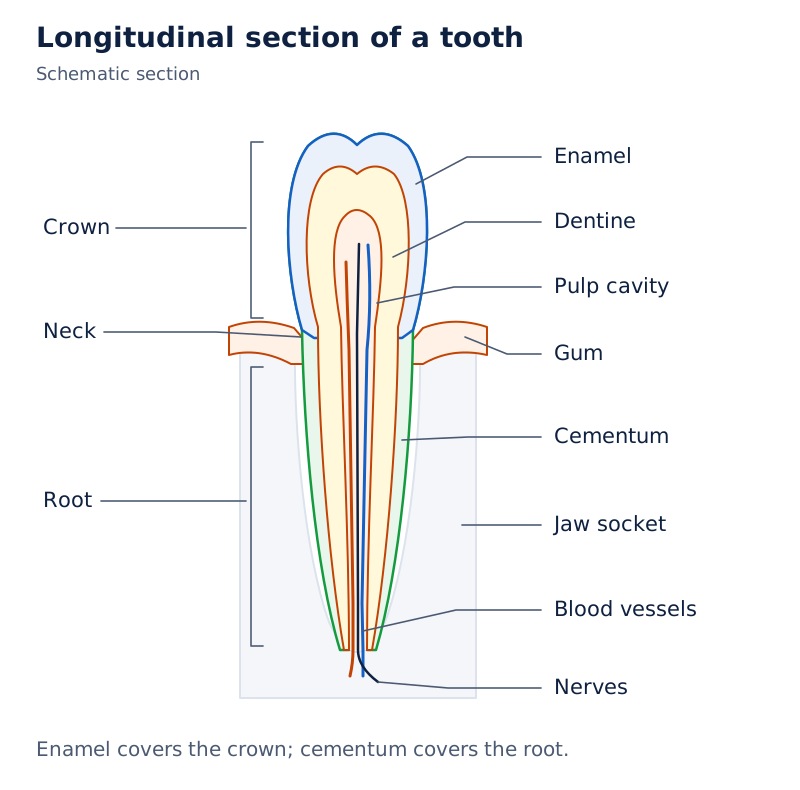
Draw a lengthwise section extending above and below the gum. Label crown, neck, root, enamel over the crown, dentine, pulp cavity, blood vessels, nerves, cementum over the root, gum and jaw socket.
Drawn by One Young India.
What happens during tooth decay?
Dental caries, or tooth decay, involves gradual softening of enamel and dentine. Bacteria acting on sugars produce acids that soften the enamel. Dental plaque is the material formed when bacterial cells and food particles stick to the teeth.
Plaque prevents saliva, the fluid released into the mouth by salivary glands, from reaching the tooth surface to neutralise the acid. If decay remains untreated, microorganisms may invade the pulp, causing inflammation and infection. Brushing after eating removes plaque before bacteria produce acids.
Regular cleaning also removes trapped food. Dental floss is a strong thread moved between teeth to remove food particles. Tooth protection therefore involves both the hard outer covering and practices that prevent damaging material from remaining on the surface.
What are the types of teeth and the adult dental formula?
Different teeth have different shapes suited to different tasks. Incisors are the front cutting and biting teeth. Canines are pointed teeth used for piercing and tearing. Premolars and molars have broader surfaces used in crushing and grinding food.
| Tooth type | Main function | Number in each half of each adult jaw |
|---|---|---|
| Incisors | Cutting and biting | 2 |
| Canines | Piercing and tearing | 1 |
| Premolars | Crushing and grinding | 2 |
| Molars | Grinding | 3 |
What the figure shows
Arrangement of teeth
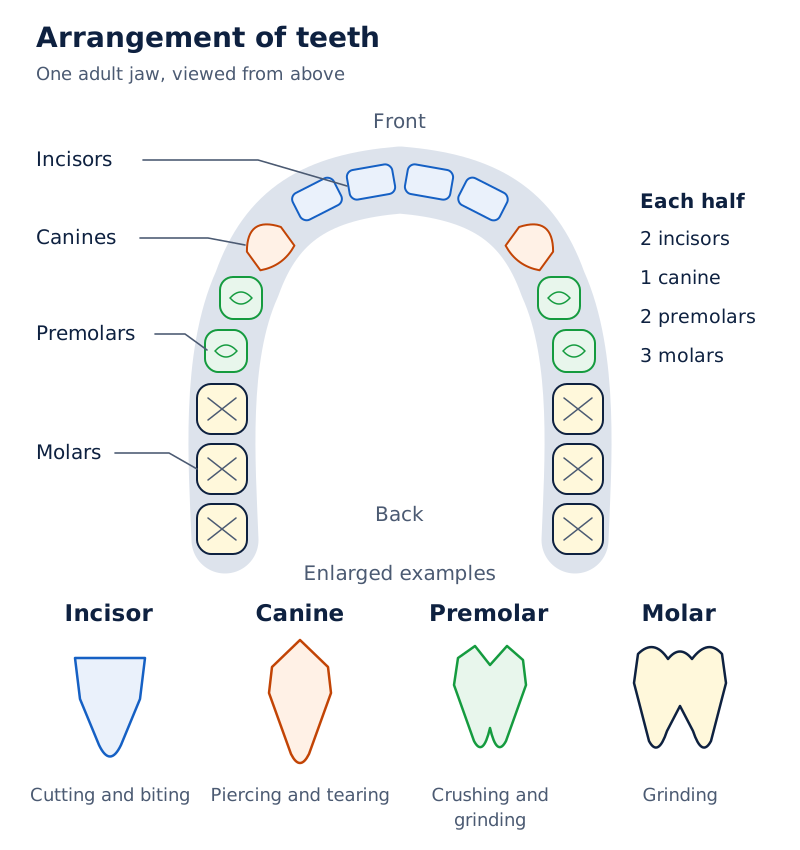
The drawing shows a curved row of teeth with enlarged examples labelled incisor, canine, premolar and molar. Incisors occupy the front; the broad back teeth are molars.
Drawn by One Young India.
How is the dental formula read?
A dental formula records the numbers of each tooth type in one half of the upper and lower jaws. Here I means incisors, C canines, PM premolars and M molars.
The adult formula is I 2/2, C 1/1, PM 2/2, M 3/3. In each pair, the number before the slash refers to one half of the upper jaw; the number after it refers to the corresponding half of the lower jaw.
Each half-jaw has 2 + 1 + 2 + 3 = 8 teeth. Counting both halves of both jaws gives the complete adult set of 32 teeth. The formula describes the full permanent dentition, meaning the permanent set of teeth.
Milk teeth are the first set, replaced by permanent teeth. Permanent teeth may last throughout life or may be lost through dental disease or during old age. The word permanent does not mean that damage or loss is impossible.
How do the mouth, oesophagus and stomach begin digestion?
The alimentary canal is the continuous digestive tube from the mouth to the anus, the opening through which undigested waste leaves. The canal and its associated glands form the digestive system. A gland is a structure that produces and releases a secretion.
The buccal cavity is the mouth cavity. Taking food into the body is ingestion. Teeth break food mechanically into small pieces. Salivary glands release saliva, a fluid that wets food and contains salivary amylase, a starch-digesting enzyme. An enzyme is a biological catalyst, a substance that speeds up a chemical reaction.
Salivary amylase breaks down starch to simple sugar. The tongue mixes food with saliva and helps swallowing.
What sequence takes food towards the stomach?
- Food enters the buccal cavity through ingestion.
- Teeth crush it, and the tongue mixes it with saliva while salivary amylase acts on starch.
- Swallowing passes food into the oesophagus, the foodpipe connecting the mouth region to the stomach.
- Peristalsis, rhythmic contraction of muscles in the canal wall, pushes food along towards the stomach.
The stomach is an expandable muscular organ. Its walls mix food with digestive juices. Gastric glands, glands in its lining, release hydrochloric acid, pepsin (a protein-digesting enzyme) and mucus (a protective secretion). Hydrochloric acid makes the contents acidic, providing conditions in which pepsin acts.
Mucus protects the stomach lining from acid under normal conditions. A sphincter, a ring of muscle controlling an opening, releases food into the small intestine in small amounts.
What the figure shows
Human alimentary canal
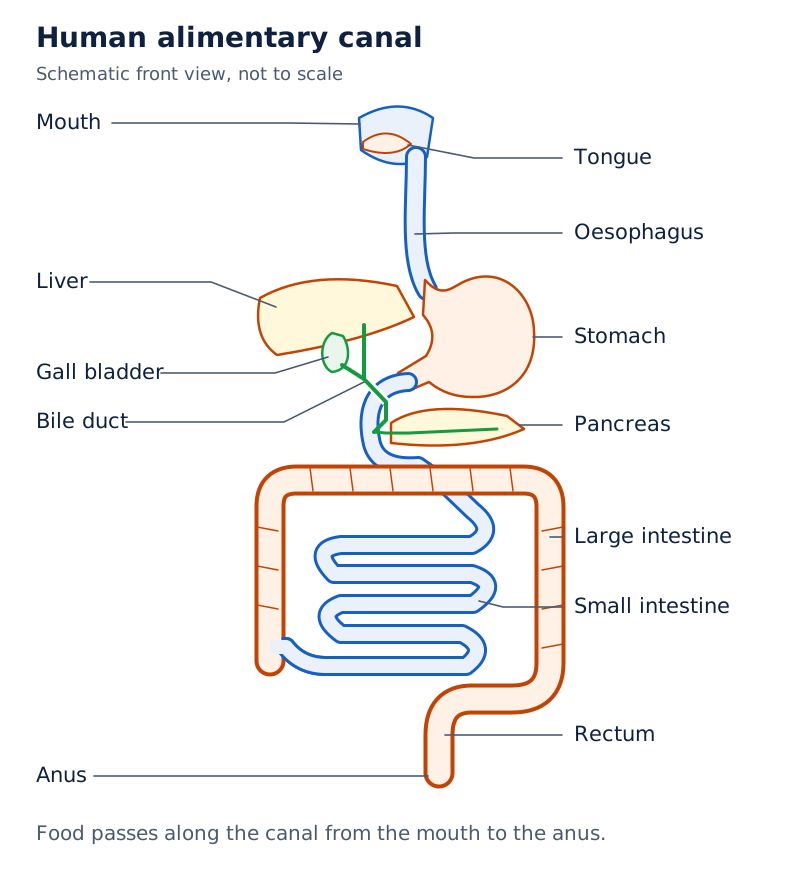
The drawing shows the mouth and tongue leading into the oesophagus and stomach. A coiled small intestine lies inside the outline of the large intestine. The liver, gall bladder, bile duct and pancreas are labelled beside the digestive tube.
Drawn by One Young India.
How do bile and digestive enzymes act in the small intestine?
The small intestine is the long, extensively coiled part of the alimentary canal where digestion of carbohydrates, proteins and fats is completed. It receives secretions from the liver and pancreas, as well as juice from glands in its own wall.
The liver produces bile, a digestive secretion that helps make acidic food from the stomach alkaline and acts on large fat globules. Alkaline means having the chemical character opposite to acidic. The gall bladder stores bile; the bile duct carries it towards the intestine.
Emulsification is the breaking of large fat globules into smaller droplets. Bile salts bring about this change, increasing the surface available for enzyme action. Bile's action on droplet size must be distinguished from the chemical breakdown of fat by enzymes.
What sequence completes digestion?
- Partly digested, acidic food passes from the stomach into the small intestine in controlled amounts.
- Bile helps make the contents alkaline and breaks large fat globules into smaller droplets.
- The pancreas, a gland associated with the intestine, supplies pancreatic juice. It contains trypsin, which digests proteins, and lipase, which breaks down emulsified fats.
- Intestinal juice, secreted by glands in the intestinal wall, completes digestion, producing simple substances suitable for absorption.
| Food component | Products of complete digestion |
|---|---|
| Complex carbohydrates | Glucose |
| Proteins | Amino acids |
| Fats | Fatty acids and glycerol, the smaller components produced from fats |
The process combines suitable chemical conditions, increased access to fat droplets and enzyme action. These are distinct contributions. Breaking a globule into droplets helps lipase work; it does not itself produce fatty acids and glycerol.
How are digested nutrients absorbed and assimilated?
Absorption is the passage of digested nutrients through the intestinal wall into the body's transport system. Assimilation is their use by body cells for purposes such as obtaining energy, growth and repair. These processes follow digestion but are not synonyms for it.
The inner lining of the small intestine has numerous villi, finger-like projections that increase the surface area available for absorption. The singular is villus. Villi have a rich supply of blood vessels associated with carrying absorbed nutrients away.
What happens after food is digested?
- Simple products of digestion reach the absorptive lining of the small intestine.
- Nutrients pass through the wall, aided by the large surface provided by villi.
- Absorbed nutrients are transported to body cells, where they are used for energy, new tissue formation and repair.
- Unabsorbed material passes into the large intestine, where more water is absorbed. The remaining waste leaves through the anus.
The rectum is the terminal storage region of the large intestine before the anus. Removal of undigested waste through the anus is called egestion. The anal sphincter controls the exit of this material.
Excretion is different: it removes waste products formed by the body's chemical activities. Thus, undigested food leaving the digestive tract is egested, while the removal of metabolic wastes is excretion. Metabolic activities are the chemical reactions taking place in the body.
Keep the sequence clear: food is taken in, complex components are digested, simpler nutrients are absorbed, and cells assimilate them. Material that remains unabsorbed is finally removed. This connects food intake with the body's actual use of nutrients.
How can starch, fat and protein be identified in food?
Food tests connect nutrient classes with observable evidence. A reagent is a chemical used in a test. The observation must be linked to the substance tested: the iodine test detects starch, rather than every carbohydrate.
What changes indicate starch and fat?
Place a small food sample on a dish and add 2 to 3 drops of diluted iodine solution. A blue-black colour indicates starch. Common sugar is a carbohydrate but does not give this starch result, showing why the two terms cannot be interchanged.
For fat, place a small food sample on paper, wrap the paper around it and press carefully. If water is present, allow the paper to dry. An oily patch through which light shines faintly indicates fat.
How is the protein test performed?
This test is suitable for a teacher demonstration because the chemicals require careful handling. Its reagents are copper sulphate solution and caustic soda solution. Caustic soda is sodium hydroxide, an alkaline chemical. A violet colour indicates protein.
- Make a paste or powder of the food and place about half a teaspoon in a clean test tube.
- Add 2 to 3 teaspoons of water and shake well.
- Add two drops of copper sulphate solution, then use another dropper to add 10 drops of caustic soda solution.
- Shake and leave undisturbed for a few minutes. A violet colour indicates protein.
Do not taste or smell the chemicals. A food may test positive for more than one component, as peanuts contain both protein and fat. The tests demonstrate presence; these observations alone do not measure the amount of each nutrient.
Glossary
- Nutrition — Obtaining and using food to support energy needs, growth, repair and the maintenance of life.
- Nutrient — A food constituent needed in suitable amounts for normal functioning, growth, repair or energy supply.
- Balanced diet — A diet supplying essential nutrients in suitable amounts and proportions, with adequate roughage and water.
- Roughage — Largely undigested plant material in food that helps the removal of undigested food and passage of stools.
- Deficiency disease — A disease associated with a prolonged inadequate supply of one or more required nutrients.
- Oedema — Swelling caused by the collection of fluid in tissues, characteristic of the typical kwashiorkor pattern.
- Dentine — The hard tissue beneath enamel that forms much of the substance of a tooth.
- Dental formula — A record of tooth numbers by type in one half of each of the two jaws.
- Digestion — Breakdown of complex food components into simpler substances that can be absorbed and used.
- Peristalsis — Rhythmic contraction of muscles in the alimentary canal wall that moves food along the digestive tube.
- Emulsification — Breaking large fat globules into smaller droplets to increase the surface available for enzyme action.
- Absorption — Passage of digested nutrients across the intestinal wall into the body's internal transport system.
- Assimilation — Use of absorbed nutrients by body cells for energy, growth, repair and other body functions.
- Egestion — Removal of undigested food waste from the digestive tract through the anus.
Common errors and misconceptions
- Misconception: Each food supplies only one nutrient. Correct: Most foods contain several nutrients; peanuts contain both protein and fat.
- Misconception: An energy-rich diet must be balanced. Correct: Balance also requires suitable proteins, vitamins, minerals, roughage and water.
- Misconception: Iodine solution detects every carbohydrate. Correct: The blue-black result indicates starch; common sugar does not give this starch result.
- Misconception: Swelling in kwashiorkor indicates good growth. Correct: Oedema is fluid accumulation in tissues and can accompany impaired growth and muscle wasting.
- Misconception: The adult dental formula lists an entire jaw. Correct: Each upper or lower entry refers to one half of that jaw.
- Misconception: Bile breaks fats directly into fatty acids and glycerol. Correct: Bile emulsifies fat; digestive enzymes carry out chemical breakdown.
- Misconception: Digestion, absorption and assimilation are identical. Correct: They mean food breakdown, uptake through the intestinal wall and use by cells respectively.
- Misconception: Egestion is the removal of metabolic wastes. Correct: Egestion removes undigested food waste; excretion removes wastes of the body's chemical activities.
Exam-style questions with model answers
Q1. Peanuts give a violet colour in the copper sulphate and caustic soda test and leave an oily patch on dry paper. Violet indicates protein; an oily patch indicates fat. Identify the two food components demonstrated. [2 marks]
- Protein is present because the food sample gives a violet colour in the specified protein test.
- Fat is present because the sample leaves an oily patch on the dry paper.
Q2. Per 100 g, potato wafers contain 536 kcal energy, 35.0 g fat, 7.0 g protein and 4.8 g dietary fibre. Roasted chana contains 355 kcal energy, 6.26 g fat, 18.64 g protein and 16.8 g fibre. State four comparisons favouring chana when seeking lower energy and fat but higher protein and fibre. [4 marks]
- Roasted chana has lower energy: 355 kcal compared with 536 kcal in potato wafers, for the same 100 g mass.
- Chana has less fat: 6.26 g compared with 35.0 g in the equal quantity of wafers.
- Chana has more protein: 18.64 g compared with 7.0 g in the wafers.
- Chana has more dietary fibre: 16.8 g compared with 4.8 g in the wafers.
Q3. Use these facts: vitamin C deficiency causes scurvy, whose signs include bleeding gums and slow wound healing; amla and guava supply vitamin C. Identify the deficiency disease, give its two stated signs, and name the two stated food sources. [4 marks]
- The disease is scurvy, linked here to an inadequate supply of vitamin C in the diet.
- Bleeding gums are one of the stated signs associated with this vitamin deficiency disease.
- Slow healing of wounds is the second stated sign associated with the same deficiency.
- Amla and guava are the two stated food sources that supply the missing vitamin C.
Q4. Each half of each adult jaw has 2 incisors, 1 canine, 2 premolars and 3 molars. Incisors cut, canines tear, and premolars and molars grind. Using I, C, PM and M for these types, give the dental formula, explain its notation, calculate the full-set total and relate the three functional groups to their tasks. [6 marks]
- The formula is I 2/2, C 1/1, PM 2/2, M 3/3, recording the four tooth types in the order supplied.
- In each pair, the first number records one half of the upper jaw and the second one half of the lower jaw.
- Each half-jaw contains 2 + 1 + 2 + 3 = 8 teeth; four half-jaws therefore contain 32 teeth in the full adult set.
- The incisors are the cutting teeth, enabling food to be bitten into smaller pieces.
- The canines are the tearing teeth, contributing the tearing function to the handling of food in the mouth.
- The premolars and molars form the grinding group, helping reduce food mechanically before it passes onwards.
Q5. Bile makes acidic stomach contents alkaline and divides large fat globules into smaller droplets. These droplets expose more surface to enzymes. Pancreatic lipase acts on emulsified fats, whose complete digestion produces fatty acids and glycerol. Explain this sequence in five points. [5 marks]
- Bile helps change the acidic contents arriving from the stomach to alkaline conditions in the small intestine.
- It divides large fat globules into smaller droplets. This physical division into droplets is the process called emulsification.
- The smaller droplets provide more surface for contact with digestive enzymes, making the fat more accessible to their action.
- Pancreatic lipase acts on the emulsified fat. The enzyme's chemical action is distinct from bile's action on droplet size.
- Complete fat digestion produces fatty acids and glycerol. Producing these smaller substances therefore follows emulsification and enzyme action, rather than emulsification alone.
Q6. Digestion breaks complex food into simpler substances; absorption moves digested nutrients through the intestinal wall; assimilation uses them in cells. Classify and explain these observations: starch is broken down, digested nutrients cross the gut wall, and absorbed nutrients are used to repair tissue. [3 marks]
- Starch breakdown is digestion because it changes a complex food component into simpler substances, matching the stated definition.
- Nutrients crossing the intestinal wall show absorption because the observation concerns their uptake across the gut lining, rather than further food breakdown.
- Use of absorbed nutrients for tissue repair is assimilation because the nutrients have reached cells and are being used by the body.
Q7. Typically, kwashiorkor involves severe protein deficiency and oedema, whereas marasmus involves severe energy and protein deficiency with marked wasting and no oedema. Oedema means tissue swelling from fluid accumulation. Compare their dietary causes, their swelling patterns and the meaning of oedema. [3 marks]
- Kwashiorkor is linked to severe protein deficiency, while marasmus involves an inadequate supply of energy as well as protein.
- Oedema is characteristic of typical kwashiorkor, whereas typical marasmus shows marked wasting without oedema, distinguishing the stated visible patterns.
- Oedema is swelling from fluid collecting in tissues. It should therefore not be interpreted as healthy tissue growth or evidence of adequate nutrition.
Key takeaways
- Carbohydrates and fats provide energy, while proteins are particularly important for growth and repair of body structures.
- A balanced diet supplies suitable nutrient amounts and proportions, with roughage and water, and requirements vary between individuals.
- Vitamin and mineral deficiencies have different effects, so connect each missing nutrient with its functions, sources and characteristic signs.
- Cellulose contributes roughage in the human diet, helping the passage of undigested material despite being indigestible to humans.
- Kwashiorkor characteristically includes oedema, while typical marasmus involves severe wasting associated with inadequate energy and protein supply.
- The adult dental formula describes one half of each jaw and gives a full permanent set of 32 teeth.
- Bile helps provide alkaline conditions and emulsifies fats, while digestive enzymes break food into simpler chemical substances.
- Digestion, absorption and assimilation respectively break food down, take nutrients into the body and use them in cells.
Test yourself
Why is a food item not the same as a food class?
A food item can contain several nutrient classes. Milk, for example, supplies proteins and fats.
Why does common sugar not give the starch test?
Common sugar is a carbohydrate, but it is not starch. The blue-black iodine result detects starch.
How does vitamin D support healthy bones and teeth?
Vitamin D helps the body absorb calcium, a mineral needed for healthy bones and teeth.
What does cellulose contribute to our diet?
It contributes dietary fibre or roughage, helping the passage of undigested material and stools.
What does 2/2 mean for incisors in the dental formula?
There are two incisors in one half of the upper jaw and two in the corresponding lower half.
Why does emulsification help fat digestion?
It divides large fat globules into smaller droplets, increasing the surface available for digestive enzyme action.
How do villi assist absorption?
These finger-like projections increase the intestinal surface area, while their blood vessels help carry absorbed nutrients away.
How does egestion differ from excretion?
Egestion removes undigested food waste from the digestive tract; excretion removes wastes produced by the body's chemical activities.
Write about it
Turn a question from this chapter into a paper.
The Writing Studio has a structure guide, a rubric and citation tools for 15 formats, from essays to research papers. Drafting is free with an account. Learnacy Essential adds feedback from an AI writing coach and submission to The OYI Review.
Learnacy Essential is ₹1,499 for the year. Publication depends on review and is not guaranteed.